
 ,
Lalla Aicha Ba,
Dan Eugene Bernardi,
Mbaye Diaw Dioum,
Insa Seck,
Seydou Ka,
Ismaila Ciss,
Abda Ba,
Seynabou Sokhna,
Moussa Ndao,
Illa Tea,
Matar Seck*
,
Lalla Aicha Ba,
Dan Eugene Bernardi,
Mbaye Diaw Dioum,
Insa Seck,
Seydou Ka,
Ismaila Ciss,
Abda Ba,
Seynabou Sokhna,
Moussa Ndao,
Illa Tea,
Matar Seck*
The mango (Mangifera indica), belonging to the genus Mangifera of the family Anacardiaceae, is cultivated worldwide as an economically important fruit crop. It is also widely used in traditional medicine, which has stimulated growing interest in investigating and evaluating the therapeutic potential of its bioactive compounds. This study was carried out to assess physicochemical parameters and fatty acid composition of Mangifera indica seed oil collected from four Senegalese varieties. The oil contents obtained for the four varieties were 7.08%, 7.5%, 7.3 and 7.11% respectively for Sewe, Bouka, Palmer and Dieg bou gate. The oils, which were characterized by Gas Chromatography (GC) with Flame Ionization Detector (FID), were mainly composed of stearic acid, ranging from 41.849 ± 0.048 to 47.793 ± 0.071%, and oleic acid from 31.085 ± 0.153 to 39.053 ± 0.050%. Among the four Senegalese mango cultivars, Palmer has the highest oleic acid content (39.053 ± 0.050%). Significant amounts of palmitic, linoleic, and arachidonic acids were also detected, while the remaining fatty acids in the mango kernel were present only in trace amounts. The saponification values were identified to be in the range of 212.9 - 234.2 mg KOH/g of oil, and the iodine values ranging from 50.4 to 59.7 g I2 /100 g of oil. The study showed that oils from different Senegalese cultivars of Mangifera indica have potential for various industrial applications.
| Published in | American Journal of Applied Chemistry (Volume 14, Issue 1) |
| DOI | 10.11648/j.ajac.20261401.12 |
| Page(s) | 11-17 |
| Creative Commons |
This is an Open Access article, distributed under the terms of the Creative Commons Attribution 4.0 International License (http://creativecommons.org/licenses/by/4.0/), which permits unrestricted use, distribution and reproduction in any medium or format, provided the original work is properly cited. |
| Copyright |
Copyright © The Author(s), 2026. Published by Science Publishing Group |
Oil, Fatty Acids Profile, Saponification Value, Iodine Value, GC/FID
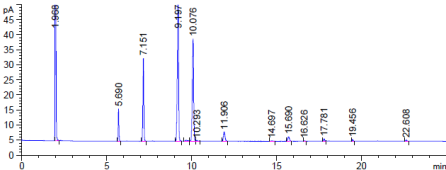
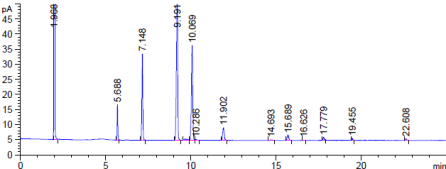
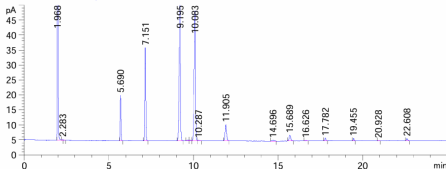
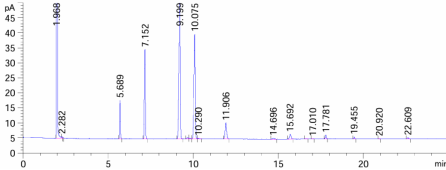
Fatty acids | Retention time (min) | Sewe | Bouka | Palmer | Dieg bou gate |
|---|---|---|---|---|---|
Palmitic acid | 5.73 | 9.977 ± 0.009 | 10.309 ± 0.011 | 11.369 ± 0.008 | 10.592 ± 0.005 |
Stearic acid | 9.22 | 46.298 ± 0.082 | 46.046 ± 0.223 | 41.849 ± 0.048 | 47.793 ± 0.071 |
Oleic acid | 10.23 | 33.815 ± 1.021 | 31.085 ± 0.153 | 39.053 ± 0.050 | 32.458 ± 0.049 |
linoleic acid | 11.99 | 3.970 ± 0.005 | 5.338 ± 0.035 | 6.112 ± 0.007 | 6.403 ± 0.003 |
Palmitoleic acid | 6.32 | 0.074 ± 0.002 | 0.0768 ± 0.001 | 0.0633 ±0.001 | 0.073 ± 0.001 |
Vaccenic acid | 10.36 | 0.251 ±0.001 | 0.168 ± 0.003 | 0.116 ± 0.003 | 0.213 ± 0.006 |
Linolenic acid | 14.74 | 0.244 ± 0.001 | 0.275 ± 0.001 | 0.151 ± 0.002 | 0.339 ± 0.001 |
Arachidonic acid | 15.73 | 1.709 ± 0.005 | 1.667 ± 0.009 | 1.084 ± 0.013 | 1.348 ± 0.007 |
Gadoleic acid | 16.65 | 0.146 ± 0.001 | 0.152 ± 0.006 | 0.084 ± 0.002 | 0.137 ± 0.008 |
Eicosadienoic acid | 17.94 | 0.144 ± 0.001 | 0.085 ± 0.004 | 0.111 ± 0.001 | 0.094 ± 0.001 |
Behenic acid | 19.47 | 0.358 ± 0.002 | 0.360 ± 0.001 | 0.248 ± 0.002 | 0.314 ± 0.001 |
Lignoceric acid | 22.62 | 0.361 ± 0.003 | 0.429 ± 0.003 | 0.300 ± 0.002 | 0.305 ± 0.002 |
Parameter | Sewe | Bouka | Palmer | Dieg bou gate |
|---|---|---|---|---|
Color | pale yellow | pale yellow | pale yellow | pale yellow |
State at room temperature | Solid | Solid | Solid | Solid |
Yield (%) | 7.08 | 7.5 | 7.3 | 7.1 |
Saponification Value (mg KOH/g of oil) | 212.9 | 228.7 | 234.2 | 225.8 |
Iodine value (g I2 /100 g of oil) | 52 | 50.4 | 59.7 | 54.7 |
GC | Gas Chromatography |
FID | Flame Ionization Detector |
AFNOR | French Association for Standardization |
SV | Saponification Value |
IV | Iodine Value |
| [1] | S. Chowdhury, S. K. Poddar, S. Zaheen, F. A. Noor, N. Ahmed, S. Haque, A. Sukul, S. B. Sunjida, Md. M. U. Mazumder and N. Akbar, “Phytochemical screening and evaluation of cytotoxic and hypoglycemic properties of Mangifera indica peels,” Asian Pacific Journal of Tropical Biomedicine., vol. 7, no. 1, pp. 49-52, 2017. |
| [2] | G. Minniti, L. F. Laurindo, N. M. Machado, L. G. Duarte, E. L. Guiguer, A. C. Araujo, J. A. Dias, C. B. Lamas, Y. C. Nunes, M. D. Bechara, E. B. Júnior, F. B. Gimenes and S. M. Barbalho, “Mangifera indica L., By-Products, and Mangiferin on Cardio-Metabolic and Other Health Conditions: A Systematic Review,” Life., 13, 2270, 2023. |
| [3] | K. M. Yap, M. Sekar, L. J. Seow, S. H. Gan, S. R. Bonam, N. N. I. M. Rani, P. T. Lum, V. Subramaniyan, Y. S. Wu, N. K. Fuloria and S. Fuloria, “Mangifera indica (Mango): A Promising Medicinal Plant for Breast Cancer Therapy and Understanding Its Potential Mechanisms of Action,” Breast Cancer: Targets and Therapy, vol. 1314, pp. 471-503, 2021. |
| [4] | B. Mirza, C. R. Croley, M. Ahmad, J. Pumarol, N. Das, G. Sethi and A. Bishayee, “Mango (Mangifera indica L.): a magnificent plant with cancer preventive and anticancer therapeutic potential,” Critical Reviews in Food Science and Nutrition., vol. 61, pp. 2125-2151, 2020. |
| [5] | A. Swaroop, M. Bagchi, H. Moriyama, and D. Bagchi, “Health Benefits of Mango (Mangifera Indica L) and Mangiferin,” Japan Journal of Medicine, vol. 1, no. 2, pp. 149–154, 2018. |
| [6] | M. Lauricella, S. Emanuele, G. Calvaruso, M. Giuliano, and A. D. Anneo, “Multifaceted Health Benefits of Mangifera indica L. (Mango): The Inestimable Value of Orchards Recently Planted in Sicilian Rural Areas,” Nutrients, vol. 9, 2017. |
| [7] | D. H. Ngo, D. N. Ngo, T. T. N. Vo, and T. S. Vo, “Mechanism of action of Mangifera indica leaves for anti-diabetic activity,” Scientia Pharmaceutica, vol. 87, no. 2, 2019. |
| [8] | S. M. R. Ribeiro, L. C. A. Barbosa, J. H. Queiroz, M. Kno, and A. Schieber “Phenolic compounds and antioxidant capacity of Brazilian mango (Mangifera indica L.) varieties,” Food Chemistry, vol. 110, pp. 620–626, 2008. |
| [9] | M. K. Ediriweera, K. H. Tennekoon, and S. R. Samarakoon, “A Review on Ethnopharmacological Applications, Pharmacological Activities, and Bioactive Compounds of Mangifera indica (Mango),” Evidence-Based Complementary and Alternative Medicine, vol. 2017, 2017. |
| [10] | V. M. Lieb, L. K. Schuster, A. Kronmüller, H. Schmarr, R. Carle, C. B. Steingass “Fatty acids, triacylglycerols, and thermal behaviour of various mango (Mangifera indica L.) kernel fats,” Food Research International, vol. 116, pp. 527–537, 2019. |
| [11] | AFNOR, “Norme Iso 5509: Animal and vegetable fats and oils-preparation of methyl esters of fatty acids. International organization for standardization,” Geneva, Switzerland 2000. |
| [12] | AFNOR (Association Française pour la Normalisation), “Recueil des normes françaises, Corps gras, graines oléagineuses, produits dérivés”, 2ème édition, [French Association for Standardization), “Collection of French standards, Fats, oilseeds, derived products”, 2nd edition] Paris, 438 p, 1981. |
| [13] | J. A. Solís-fuentes and M. C. Durán-de-bazúa, “Mango Seed : Mango (Mangifera indica L.) Seed and Its Fats”, Nuts and Seeds in Health and Disease Prevention, Second Edition, pp. 79-90, 2020. |
| [14] | P. Choudhary, T. Bidyalakshmi, D. Surya, T. Ramesh, C. Kasana, D. S. Popatrao and K. Narsaiah “Mango Seed Kernel : A Bountiful Source of Nutritional and Bioactive Compounds,” Food and Bioprocess Technology, Vol. 16, pp. 289–312, 2022. |
| [15] | M. H. A. Jahurul, I. S. M. Zaidul, K. Ghafoor, F. Y. Al-Juhaimi, K.-L. Nyam, N. A. N. Norulaini, F. Sahena, A. K. M. Omar, “Mango (Mangifera indica L.) by-products and their valuable components : A review,” Food Chemistry, vol. 183, pp. 173–180, 2015. |
| [16] | P. W. Mwaurah, S. Kumar, N. Kumar, A. Panghal, A. K. Attkan, V. K. Singh, M. K. Garg “Physicochemical characteristics, bioactive compounds and industrial applications of mango kernel and its products : A review,” comprehensive reviews in food science and food safety, vol. 19, pp. 1–26, 2020. |
| [17] | C. Torres-leon, R. Rojas, J. C. Contreras-esquivel, L. Serna-cock, R. E. Belmares-cerda, and P. C. N. Aguilar, “Mango seed: Functional and nutritional properties,” Trends in Food Science & Technology, vol. 55, pp. 109-117, 2016. |
| [18] | I. Bhatta, P. Shrestha, P. Acharya, S. Pantha, R. Devkota and A. Adhikari “Comparative Study of Fatty Acids Profiles in Mangifera indica L. Seed Butter Extracts from Different Regions in Nepal Using GC-MS,” vol. 23, no. 1, pp. 1–6, 2025. |
| [19] | J. Jin, P. Warda, H. Mu, Y. Zhang, L. Jie, J. Mao, D. Xie, J. Huang, Q. Jin and X. Wang “Characteristics of Mango Kernel Fats Extracted from 11 China - Specific Varieties and Their Typically Fractionated Fractions,” Journal of the American Oil Chemists Society, vol. 93, 2016. |
| [20] | D. S. Torsen, J. B. Hussein, S. D. Allison and T. S. Workneh, “Characterization of oil solvent extracted from four Mango (Mangifera indica L.) kernels,” European Food Research and Technology, vol. 251, pp. 3633–3648, 2025. |
| [21] | S. Sonwai and P. Ponprachanuvut, “Studies of Fatty Acid Composition, Physicochemical and Thermal Properties, and Crystallization Behavior of Mango Kernel Fats from Various Thai Varieties,” Journal of Oleo Science, vol. 63, pp. 661–669, 2014. |
| [22] | S. Zahoor, F. Anwar, R. Qadir, W. Soufan and M. Sakran, “Physicochemical attributes and antioxidant potential of kernel oils from selected Mango varieties,” ACS Omega, vol. 8, pp. 22613–22622, 2023. |
| [23] | M. H. A. Jahurul, I. S. M. Zaidul, N. N. A. Norulaini, F. Sahena, J. M. Jaffri and A. K. M. Omar, “Supercritical carbon dioxide extraction and studies of mango seed kernel for cocoa butter analogy fats,” CyTA– Journal of Food, vol. 12, no. 1, pp. 97–103, 2013. |
APA Style
Ndoye, S. F., Ba, L. A., Bernardi, D. E., Dioum, M. D., Seck, I., et al. (2026). Fatty Acid Profiles and Physicochemical Properties of Kernels from Four Senegalese Varieties of Mangifera indica L. American Journal of Applied Chemistry, 14(1), 11-17. https://doi.org/10.11648/j.ajac.20261401.12
ACS Style
Ndoye, S. F.; Ba, L. A.; Bernardi, D. E.; Dioum, M. D.; Seck, I., et al. Fatty Acid Profiles and Physicochemical Properties of Kernels from Four Senegalese Varieties of Mangifera indica L. Am. J. Appl. Chem. 2026, 14(1), 11-17. doi: 10.11648/j.ajac.20261401.12
@article{10.11648/j.ajac.20261401.12,
  author = {Samba Fama Ndoye and Lalla Aicha Ba and Dan Eugene Bernardi and Mbaye Diaw Dioum and Insa Seck and Seydou Ka and Ismaila Ciss and Abda Ba and Seynabou Sokhna and Moussa Ndao and Illa Tea and Matar Seck},
  title = {Fatty Acid Profiles and Physicochemical Properties of Kernels from Four Senegalese Varieties of
Mangifera indica L},
  journal = {American Journal of Applied Chemistry},
  volume = {14},
  number = {1},
  pages = {11-17},
  doi = {10.11648/j.ajac.20261401.12},
  url = {https://doi.org/10.11648/j.ajac.20261401.12},
  eprint = {https://article.sciencepublishinggroup.com/pdf/10.11648.j.ajac.20261401.12},
  abstract = {The mango (Mangifera indica), belonging to the genus Mangifera of the family Anacardiaceae, is cultivated worldwide as an economically important fruit crop. It is also widely used in traditional medicine, which has stimulated growing interest in investigating and evaluating the therapeutic potential of its bioactive compounds. This study was carried out to assess physicochemical parameters and fatty acid composition of Mangifera indica seed oil collected from four Senegalese varieties. The oil contents obtained for the four varieties were 7.08%, 7.5%, 7.3 and 7.11% respectively for Sewe, Bouka, Palmer and Dieg bou gate. The oils, which were characterized by Gas Chromatography (GC) with Flame Ionization Detector (FID), were mainly composed of stearic acid, ranging from 41.849 ± 0.048 to 47.793 ± 0.071%, and oleic acid from 31.085 ± 0.153 to 39.053 ± 0.050%. Among the four Senegalese mango cultivars, Palmer has the highest oleic acid content (39.053 ± 0.050%). Significant amounts of palmitic, linoleic, and arachidonic acids were also detected, while the remaining fatty acids in the mango kernel were present only in trace amounts. The saponification values were identified to be in the range of 212.9 - 234.2 mg KOH/g of oil, and the iodine values ranging from 50.4 to 59.7 g I2 /100 g of oil. The study showed that oils from different Senegalese cultivars of Mangifera indica have potential for various industrial applications.},
 year = {2026}
}
TY  - JOUR
T1  - Fatty Acid Profiles and Physicochemical Properties of Kernels from Four Senegalese Varieties of
Mangifera indica L
AU  - Samba Fama Ndoye
AU  - Lalla Aicha Ba
AU  - Dan Eugene Bernardi
AU  - Mbaye Diaw Dioum
AU  - Insa Seck
AU  - Seydou Ka
AU  - Ismaila Ciss
AU  - Abda Ba
AU  - Seynabou Sokhna
AU  - Moussa Ndao
AU  - Illa Tea
AU  - Matar Seck
Y1  - 2026/03/26
PY  - 2026
N1  - https://doi.org/10.11648/j.ajac.20261401.12
DO  - 10.11648/j.ajac.20261401.12
T2  - American Journal of Applied Chemistry
JF  - American Journal of Applied Chemistry
JO  - American Journal of Applied Chemistry
SP  - 11
EP  - 17
PB  - Science Publishing Group
SN  - 2330-8745
UR  - https://doi.org/10.11648/j.ajac.20261401.12
AB  - The mango (Mangifera indica), belonging to the genus Mangifera of the family Anacardiaceae, is cultivated worldwide as an economically important fruit crop. It is also widely used in traditional medicine, which has stimulated growing interest in investigating and evaluating the therapeutic potential of its bioactive compounds. This study was carried out to assess physicochemical parameters and fatty acid composition of Mangifera indica seed oil collected from four Senegalese varieties. The oil contents obtained for the four varieties were 7.08%, 7.5%, 7.3 and 7.11% respectively for Sewe, Bouka, Palmer and Dieg bou gate. The oils, which were characterized by Gas Chromatography (GC) with Flame Ionization Detector (FID), were mainly composed of stearic acid, ranging from 41.849 ± 0.048 to 47.793 ± 0.071%, and oleic acid from 31.085 ± 0.153 to 39.053 ± 0.050%. Among the four Senegalese mango cultivars, Palmer has the highest oleic acid content (39.053 ± 0.050%). Significant amounts of palmitic, linoleic, and arachidonic acids were also detected, while the remaining fatty acids in the mango kernel were present only in trace amounts. The saponification values were identified to be in the range of 212.9 - 234.2 mg KOH/g of oil, and the iodine values ranging from 50.4 to 59.7 g I2 /100 g of oil. The study showed that oils from different Senegalese cultivars of Mangifera indica have potential for various industrial applications.
VL  - 14
IS  - 1
ER  -
Department of Chemistry, University Cheikh Anta Diop, Dakar, Senegal
Department of Engineering Sciences and Techniques, University Amadou Mahtar Mbow, Dakar, Senegal
Department of Chemistry, University Alioune Diop, Bambey, Senegal
Department of Pharmacy, University Cheikh Anta Diop, Dakar, Senegal;Departement of Chemistry, University of Nantes, Nantes, France
Department of Chemistry, University Cheikh Anta Diop, Dakar, Senegal
Department of Chemistry, University Cheikh Anta Diop, Dakar, Senegal
Department of Chemistry, University Cheikh Anta Diop, Dakar, Senegal
Department of Chemistry, University Cheikh Anta Diop, Dakar, Senegal
Department of Chemistry, University Alioune Diop, Bambey, Senegal
Department of Chemistry, University Cheikh Anta Diop, Dakar, Senegal
Departement of Chemistry, University of Nantes, Nantes, France
Department of Pharmacy, University Cheikh Anta Diop, Dakar, Senegal

Information


 Share This Article
 Twitter
 Linked In
 Facebook
 Copy
Copy Download