Abstract
Slope instability is a common problem in mountainous road corridors, particularly in regions characterized by steep terrain, weak soil formations, and intense seasonal rainfall. The Bonga-Felegeselam road in southwestern Ethiopia has experienced several slope failures during construction due to these unfavorable geological and hydrological conditions. This study investigates the causes of instability and evaluates appropriate stabilization measures for two critical cut slopes located between Stations 16+900 to 16+980 (left-hand side, LHS) and Stations 35+200 to 35+300 (both LHS and RHS) of LOT I: Bonga Asphalt Road Project. Detailed site characterization was conducted through field observations, geometric configuration, soil classification, and laboratory testing to determine the relevant geotechnical properties. Slope stability was assessed using both deterministic and probabilistic approaches based on the Limit Equilibrium Method (LEM) and the Finite Element Method (FEM). The analyses considered different groundwater conditions to evaluate the influence of rainfall-induced saturation on slope stability. The results indicate that the slopes become highly unstable under fully saturated conditions, with factors of safety ranging from 0.657 to 0.916 and failure probabilities between 41.8% and 95.3%. Sensitivity analysis further showed that slope stability is more sensitive to variations in the friction angle than cohesion. To mitigate the instability, a combination of masonry retaining walls, surface drainage, and subsurface drainage systems was proposed. Post-remediation analyses demonstrated a significant improvement in slope stability, increasing the factor of safety to values between 1.57 and 1.90. The findings highlight the importance of integrating deterministic and probabilistic approaches to develop reliable stabilization strategies for rainfall-prone mountainous regions.
|
Published in
|
American Journal of Civil Engineering (Volume 14, Issue 2)
|
|
DOI
|
10.11648/j.ajce.20261402.13
|
|
Page(s)
|
67-81 |
|
Creative Commons
|

This is an Open Access article, distributed under the terms of the Creative Commons Attribution 4.0 International License (http://creativecommons.org/licenses/by/4.0/), which permits unrestricted use, distribution and reproduction in any medium or format, provided the original work is properly cited.
|
|
Copyright
|
Copyright © The Author(s), 2026. Published by Science Publishing Group
|
Keywords
Slope Stability Analysis, Limit Equilibrium Method, Finite Element Method, Cut Slope Stability Analysis,
Deterministic Approach, Probabilistic Approach
1. Introduction
Experience is the best teacher but often not the kindest. Failures provide invaluable lessons and insights for preventing future issues, especially in geotechnical engineering where slope instability poses serious risks
| [1] | Duncan, J. M., Wright, S. G., & Brandon, T. L. (2014). Soil strength and slope stability. John Wiley & Sons. |
[1]
. Slope instability is one of the most common problems in road construction projects in hilly areas where large earthworks involving excavations of 3-4 million cubic meters are done to fulfill road standards
| [2] | Cheng, Y. M., & Lau, C. K. (2014). Slope stability analysis and stabilization: New methods and insight. CRC Press.
https://doi.org/10.4324/9780203927953 |
| [3] | Brinkgreve, R. B. J., & Vermeer, P. A. (2003). PLAXIS Version 8 material model manual. Delft University of Technology. |
[2, 3]
. These problems often arise due to insufficient site investigation and inadequate slope design, leading to failures during or after excavation, resulting in significant project cost overruns and delays
| [4] | Woldearegay, K. (2013). Review of the occurrences and influencing factors of landslides in the highlands of Ethiopia. Momona Ethiopian Journal of Science, 5(1), 3-31. |
| [5] | Abebe, B., Dramis, F., Fubelli, G., Umer, M., & Asrat, A. (2010). Landslides in the Ethiopian highlands and Rift margins. Journal of African Earth Sciences, 56(4-5), 131-138.
https://doi.org/10.1016/j.jafrearsci.2009.07.007 |
[4, 5]
. Southwest Ethiopia is home to the Bonga-Felegeselam Road Project, exemplifies these challenges. Ethiopian Roads Authority (ERA) identified the area as landslide-prone due to its steep topography, high-intensity rainfall, and weak geological formations
. Several studies have highlighted that such conditions; including geomorphological variability, old landslide scars, and shallow groundwater tables, contribute significantly to slope instability in Ethiopian highlands
| [8] | Ayenew, T., & Barbieri, G. (2005). Inventory of landslides and susceptibility mapping in the Dessie area, northern Ethiopia. Engineering Geology, 77(1-2), 1-15.
https://doi.org/10.1016/j.enggeo.2004.07.002 |
| [9] | Griffiths, D. V., & Lane, P. A. (1999). Slope stability analysis by finite elements. Geotechnique, 49(3), 387-403.
https://doi.org/10.1680/geot.1999.49.3.387 |
| [10] | Fredlund, D. G., & Krahn, J. (1977). Comparison of slope stability methods of analysis. Canadian Geotechnical Journal, 14(3), 429-439. https://doi.org/10.1139/t77-045 |
[8-10]
. Furthermore, seasonal rainfall from March to October with high intensity accelerates the saturation of soil masses, leading to progressive failure
.
Slope failures in Ethiopia have been extensively studied in various regions including the Blue Nile Basin, Dessie area, and Rift margins, all of which exhibit similar failure mechanisms dominated by rainfall infiltration and weak clayey soils
| [7] | Ayalew, L., & Yamagishi, H. (2004). Slope failures in the Blue Nile basin. Geomorphology, 57(1-2), 95-116.
https://doi.org/10.1016/S0169-555X(03)00100-0 |
| [8] | Ayenew, T., & Barbieri, G. (2005). Inventory of landslides and susceptibility mapping in the Dessie area, northern Ethiopia. Engineering Geology, 77(1-2), 1-15.
https://doi.org/10.1016/j.enggeo.2004.07.002 |
| [11] | Cornforth, D. H. (2005). Landslides in practice. John Wiley & Sons. |
| [12] | Christian, J. T., & Baecher, G. B. (2001). Factors of safety and reliability in geotechnical engineering. Journal of Geotechnical and Geoenvironmental Engineering, 127(8), 700-703.
https://doi.org/10.1061/(ASCE)1090-0241(2001)127:8(700) |
[7, 8, 11, 12]
. Researchers have used limit equilibrium and finite element methods to assess slope stability, showing that failure often occurs under fully saturated, drained conditions
| [1] | Duncan, J. M., Wright, S. G., & Brandon, T. L. (2014). Soil strength and slope stability. John Wiley & Sons. |
| [9] | Griffiths, D. V., & Lane, P. A. (1999). Slope stability analysis by finite elements. Geotechnique, 49(3), 387-403.
https://doi.org/10.1680/geot.1999.49.3.387 |
| [10] | Fredlund, D. G., & Krahn, J. (1977). Comparison of slope stability methods of analysis. Canadian Geotechnical Journal, 14(3), 429-439. https://doi.org/10.1139/t77-045 |
| [13] | Malkawi, A. I. H., Hassan, W. F., & Abdulla, F. A. (2000). Uncertainty and reliability analysis applied to slope stability. Structural Safety, 22(2), 161-187.
https://doi.org/10.1016/S0167-4730(99)00041-X |
[1, 9, 10, 13]
. As road construction expands across mountainous and escarpment terrains, such failures become increasingly common, posing severe risks to public safety and infrastructure reliability
| [4] | Woldearegay, K. (2013). Review of the occurrences and influencing factors of landslides in the highlands of Ethiopia. Momona Ethiopian Journal of Science, 5(1), 3-31. |
| [5] | Abebe, B., Dramis, F., Fubelli, G., Umer, M., & Asrat, A. (2010). Landslides in the Ethiopian highlands and Rift margins. Journal of African Earth Sciences, 56(4-5), 131-138.
https://doi.org/10.1016/j.jafrearsci.2009.07.007 |
| [11] | Cornforth, D. H. (2005). Landslides in practice. John Wiley & Sons. |
[4, 5, 11]
. Therefore, this study focuses on analyzing the causes and mechanisms of slope failures at two critical cut-slope sections along the Bonga-Felegeselam Road Project. By integrating deterministic and probabilistic slope stability analyses using both LEM and FEM approaches
| [1] | Duncan, J. M., Wright, S. G., & Brandon, T. L. (2014). Soil strength and slope stability. John Wiley & Sons. |
| [2] | Cheng, Y. M., & Lau, C. K. (2014). Slope stability analysis and stabilization: New methods and insight. CRC Press.
https://doi.org/10.4324/9780203927953 |
| [3] | Brinkgreve, R. B. J., & Vermeer, P. A. (2003). PLAXIS Version 8 material model manual. Delft University of Technology. |
| [9] | Griffiths, D. V., & Lane, P. A. (1999). Slope stability analysis by finite elements. Geotechnique, 49(3), 387-403.
https://doi.org/10.1680/geot.1999.49.3.387 |
[1-3, 9]
, the study aims to identify primary failure causes and propose appropriate remedial measures. The numerical results from these analyses are verified with field-observed failures to ensure practical applicability
| [10] | Fredlund, D. G., & Krahn, J. (1977). Comparison of slope stability methods of analysis. Canadian Geotechnical Journal, 14(3), 429-439. https://doi.org/10.1139/t77-045 |
| [14] | Chowdhury, R. N., & Xu, D. W. (1992). Reliability index for slope stability assessment—two methods compared. Reliability Engineering & System Safety, 37(2), 99-108.
https://doi.org/10.1016/0951-8320(92)90002-3 |
[10, 14]
.
2. Materials and Methods
2.1. Location of the Study Area
The project area is situated is in southwest Ethiopia and may be reached by the main asphalt route that runs from Addis Ababa to Bonga via Wolkite and Jimma. The road splits off in the direction of Felegeselam town after Bonga. Two failed cut slopes located near Bonga town were selected for this investigation. The terrain is characterized by steep topography, high rainfall, and deeply weathered residual soils, which contribute to slope instability
| [4] | Woldearegay, K. (2013). Review of the occurrences and influencing factors of landslides in the highlands of Ethiopia. Momona Ethiopian Journal of Science, 5(1), 3-31. |
| [5] | Abebe, B., Dramis, F., Fubelli, G., Umer, M., & Asrat, A. (2010). Landslides in the Ethiopian highlands and Rift margins. Journal of African Earth Sciences, 56(4-5), 131-138.
https://doi.org/10.1016/j.jafrearsci.2009.07.007 |
| [6] | Ayalew, L. (1999). The effect of seasonal rainfall on landslides in the highlands of Ethiopia. Bulletin of Engineering Geology and the Environment, 58(1), 9-19.
https://doi.org/10.1007/s100640050072 |
[4-6]
. The geological and geomorphological conditions of this area are similar to other landslide-prone highlands of Ethiopia
| [7] | Ayalew, L., & Yamagishi, H. (2004). Slope failures in the Blue Nile basin. Geomorphology, 57(1-2), 95-116.
https://doi.org/10.1016/S0169-555X(03)00100-0 |
| [8] | Ayenew, T., & Barbieri, G. (2005). Inventory of landslides and susceptibility mapping in the Dessie area, northern Ethiopia. Engineering Geology, 77(1-2), 1-15.
https://doi.org/10.1016/j.enggeo.2004.07.002 |
[7, 8]
.
2.2. Materials
The slope stability analysis used parameters derived from field and laboratory investigations. Subsurface profiling was carried out based on geophysical survey results and borehole drilling. Laboratory and in-situ tests were conducted to determine geotechnical parameters such as unit weight, cohesion, angle of internal friction, and shear strength
| [1] | Duncan, J. M., Wright, S. G., & Brandon, T. L. (2014). Soil strength and slope stability. John Wiley & Sons. |
| [9] | Griffiths, D. V., & Lane, P. A. (1999). Slope stability analysis by finite elements. Geotechnique, 49(3), 387-403.
https://doi.org/10.1680/geot.1999.49.3.387 |
| [10] | Fredlund, D. G., & Krahn, J. (1977). Comparison of slope stability methods of analysis. Canadian Geotechnical Journal, 14(3), 429-439. https://doi.org/10.1139/t77-045 |
[1, 9, 10]
. These parameters were used for both deterministic and probabilistic analyses. The factor of safety (FOS) was computed under effective stress conditions by considering pore pressure and varying groundwater levels. For full saturation, a pore fluid unit weight of 9.81 kN/m³ was applied to model excess pore pressure, consistent with previous works
| [11] | Cornforth, D. H. (2005). Landslides in practice. John Wiley & Sons. |
[11]
. This method aligns with established practices for analyzing slope behavior under high rainfall and saturation conditions
| [12] | Christian, J. T., & Baecher, G. B. (2001). Factors of safety and reliability in geotechnical engineering. Journal of Geotechnical and Geoenvironmental Engineering, 127(8), 700-703.
https://doi.org/10.1061/(ASCE)1090-0241(2001)127:8(700) |
| [13] | Malkawi, A. I. H., Hassan, W. F., & Abdulla, F. A. (2000). Uncertainty and reliability analysis applied to slope stability. Structural Safety, 22(2), 161-187.
https://doi.org/10.1016/S0167-4730(99)00041-X |
[12, 13]
. Field observation indicated circular failure surfaces typical of cohesive soil slopes, modeled using the Mohr-Coulomb failure criterion
| [1] | Duncan, J. M., Wright, S. G., & Brandon, T. L. (2014). Soil strength and slope stability. John Wiley & Sons. |
| [9] | Griffiths, D. V., & Lane, P. A. (1999). Slope stability analysis by finite elements. Geotechnique, 49(3), 387-403.
https://doi.org/10.1680/geot.1999.49.3.387 |
| [14] | Chowdhury, R. N., & Xu, D. W. (1992). Reliability index for slope stability assessment—two methods compared. Reliability Engineering & System Safety, 37(2), 99-108.
https://doi.org/10.1016/0951-8320(92)90002-3 |
[1, 9, 14]
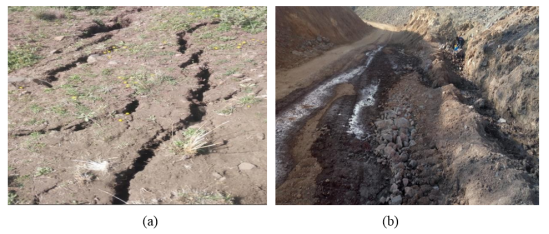
. Representative failure geometry and soil conditions were recorded for further analysis (see
Figures 1a, 1b for site conditions such as tension cracks and seepage zones).
Figure 1. Field observation at failed slope (a) Tension crack observed, (b) Seepage water emerging from the slope during the site investigation.
2.3. Methods
Data for the analysis were obtained from two main sources: primary field data and secondary data from road construction agencies. Primary data included direct field observations of scarps, cracks, seepage, and toe erosion, while interviews with local residents helped reconstruct the slope failure history
| [5] | Abebe, B., Dramis, F., Fubelli, G., Umer, M., & Asrat, A. (2010). Landslides in the Ethiopian highlands and Rift margins. Journal of African Earth Sciences, 56(4-5), 131-138.
https://doi.org/10.1016/j.jafrearsci.2009.07.007 |
| [6] | Ayalew, L. (1999). The effect of seasonal rainfall on landslides in the highlands of Ethiopia. Bulletin of Engineering Geology and the Environment, 58(1), 9-19.
https://doi.org/10.1007/s100640050072 |
[5, 6]
. The field observations confirmed that failures occurred after heavy rainfall events and not due to seismic activity, consistent with findings from similar Ethiopian studies
| [7] | Ayalew, L., & Yamagishi, H. (2004). Slope failures in the Blue Nile basin. Geomorphology, 57(1-2), 95-116.
https://doi.org/10.1016/S0169-555X(03)00100-0 |
| [8] | Ayenew, T., & Barbieri, G. (2005). Inventory of landslides and susceptibility mapping in the Dessie area, northern Ethiopia. Engineering Geology, 77(1-2), 1-15.
https://doi.org/10.1016/j.enggeo.2004.07.002 |
[7, 8]
.
Data processing included several steps:
1) Selection of representative failure locations.
2) Development of slope geometry using survey data and AutoCAD templates.
3) Interpretation of borehole and triaxial test data.
4) Generation of finite element meshes using PLAXIS software
| [3] | Brinkgreve, R. B. J., & Vermeer, P. A. (2003). PLAXIS Version 8 material model manual. Delft University of Technology. |
| [9] | Griffiths, D. V., & Lane, P. A. (1999). Slope stability analysis by finite elements. Geotechnique, 49(3), 387-403.
https://doi.org/10.1680/geot.1999.49.3.387 |
[3, 9]
.
These analyses followed well-established geotechnical methods that integrate LEM and FEM modeling
| [1] | Duncan, J. M., Wright, S. G., & Brandon, T. L. (2014). Soil strength and slope stability. John Wiley & Sons. |
| [2] | Cheng, Y. M., & Lau, C. K. (2014). Slope stability analysis and stabilization: New methods and insight. CRC Press.
https://doi.org/10.4324/9780203927953 |
| [10] | Fredlund, D. G., & Krahn, J. (1977). Comparison of slope stability methods of analysis. Canadian Geotechnical Journal, 14(3), 429-439. https://doi.org/10.1139/t77-045 |
[1, 2, 10]
. The LEM employed the Morgenstern-Price method, while FEM simulations used the Mohr-Coulomb constitutive model to represent soil behavior
| [3] | Brinkgreve, R. B. J., & Vermeer, P. A. (2003). PLAXIS Version 8 material model manual. Delft University of Technology. |
| [9] | Griffiths, D. V., & Lane, P. A. (1999). Slope stability analysis by finite elements. Geotechnique, 49(3), 387-403.
https://doi.org/10.1680/geot.1999.49.3.387 |
[3, 9]
. Uncertainty in soil parameters was addressed using the probabilistic approach described by
| [1] | Duncan, J. M., Wright, S. G., & Brandon, T. L. (2014). Soil strength and slope stability. John Wiley & Sons. |
[1]
and
| [15] | Harr, M. E. (1987). Reliability-based design in civil engineering. McGraw-Hill. |
[15]
. The input parameters for Station 16+980 used in the LEM and FEM analyses are presented in
Tables 1 and 2, respectively. Similarly, the input parameters for Station 35+270 used in the LEM and FEM analyses are provided in
Tables 3 and 4, respectively.
2.4. Selection of Potential Failed Slope Location
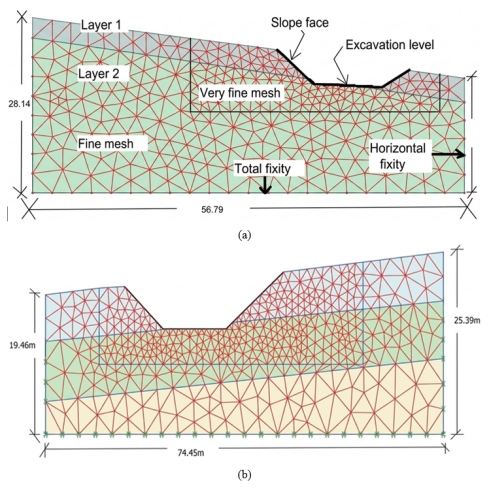
Several failure-prone areas were identified along the project corridor, but two critical sites were chosen based on the availability of geological, geotechnical, and topographical data. Both locations Stations 16+980 and 35+270 exhibited prominent tension cracks, seepage zones, and toe erosion features (see
Figure 2a and 2b for geometric representations). The geometry-based modeling provided realistic input for numerical analysis and improved interpretation of slope stability results
| [9] | Griffiths, D. V., & Lane, P. A. (1999). Slope stability analysis by finite elements. Geotechnique, 49(3), 387-403.
https://doi.org/10.1680/geot.1999.49.3.387 |
| [10] | Fredlund, D. G., & Krahn, J. (1977). Comparison of slope stability methods of analysis. Canadian Geotechnical Journal, 14(3), 429-439. https://doi.org/10.1139/t77-045 |
| [13] | Malkawi, A. I. H., Hassan, W. F., & Abdulla, F. A. (2000). Uncertainty and reliability analysis applied to slope stability. Structural Safety, 22(2), 161-187.
https://doi.org/10.1016/S0167-4730(99)00041-X |
[9, 10, 13]
.
Figure 2. Slope geometry adopted for the stability analysis: (a) model of the cut slope at Station 16+980 and (b) model of the cut slope at Station 35+270.
2.5. Soil Properties
At Station 16+980, borehole data and laboratory testing revealed two main layers:
Layer 1 (0-6 m): Light brown, moist, high-plasticity CL with sand that is firm to extremely stiff.
Layer 2 (6-16 m): Light grey to pale yellow, low-plasticity CL with sand, firm to hard.
At Station 35+270, three layers were identified:
Layer 1 (0-7.5 m): Extremely stiff to hard, CL with pebbles, dark grey with orange specks.
Layer 2 (7.5-13.5 m): Firm to stiff, reddish-brown CL.
Layer 3 (13.5-22 m): Hard, light brown, dry, gravelly CL.
Laboratory results (
Tables 1-4) summarize the geotechnical parameters used for the analyses. The soils exhibit low permeability and moderate to high plasticity, with reduced shear strength under saturation, consistent with prior findings by
| [20] | Skempton, A. W. (1964). Long-term stability of clay slopes. Geotechnique, 14(2), 77-102. |
[20]
and
| [10] | Fredlund, D. G., & Krahn, J. (1977). Comparison of slope stability methods of analysis. Canadian Geotechnical Journal, 14(3), 429-439. https://doi.org/10.1139/t77-045 |
[10]
. These soil properties make slopes vulnerable to failure during prolonged rainfall events
| [5] | Abebe, B., Dramis, F., Fubelli, G., Umer, M., & Asrat, A. (2010). Landslides in the Ethiopian highlands and Rift margins. Journal of African Earth Sciences, 56(4-5), 131-138.
https://doi.org/10.1016/j.jafrearsci.2009.07.007 |
| [6] | Ayalew, L. (1999). The effect of seasonal rainfall on landslides in the highlands of Ethiopia. Bulletin of Engineering Geology and the Environment, 58(1), 9-19.
https://doi.org/10.1007/s100640050072 |
| [12] | Christian, J. T., & Baecher, G. B. (2001). Factors of safety and reliability in geotechnical engineering. Journal of Geotechnical and Geoenvironmental Engineering, 127(8), 700-703.
https://doi.org/10.1061/(ASCE)1090-0241(2001)127:8(700) |
[5, 6, 12]
.
Table 1. Input parameters of station 16+980 for limit equilibrium analysis obtained from laboratory test.
Geotechnical properties | subsurface profile of the cut slope at Km 16+980 |
unsaturated unit weight (γun) | layer 1 | layer 2 |
17.3 | 19.02 |
saturated unit weight (γsat) | 18.12 | 19.02 |
cohesion (KN/m2) | 20.45 | 31.66 |
groundwater table | 2.5m | below |
Table 2. Input parameters of station 16+980 for finite element analysis obtained from laboratory test.
Geotechnical properties | subsurface profile of the cut slope at Km 16+980 |
unsaturated unit weight (γun) | layer 1 | layer 2 |
17.3 | 19.02 |
saturated unit weight (γsat) | 18.12 | 19.02 |
cohesion c' (KN/m2) | 17.01 | 28.77 |
angle of friction ∅’ [°] | 4.2 | 6 |
young's modulus E'[KPa] | 4526.33 | 14190.11 |
poisonous ratio ν’ [-] | 0.35 | 0.35 |
dilatancy angle ψ [°] | 0 | 0 |
ground water table (GWT) | 2.5m | below |
Table 3. Input parameters of station 35+270 for limit equilibrium analysis obtained from laboratory test.
Geotechnical properties | cut slope subsurface profile at Km 16+980 |
bulk unit weight (ɣbulk) [KN/m3] | layer 1 (0-7.5m) | layer 2 (7.5-13.5m) | layer 3 (13.5-22m) |
17.54 | 18.33 | 18.75 |
cohesion c' (KN/m2) | 14.1 | 34.2 | 49.3 |
angle of friction ∅’ [°] | 3.8 | 5.1 | 7.3 |
ground water table (GWT) | nill |
Table 4. Input parameters of station 35+270 for finite element analysis.
Geotechnical properties | cut slope subsurface profile at Km 16+980 |
bulk unit weight (ɣbulk) [KN/m3] | layer 1 (0-7.5m) | layer 2 (7.5-13.5m) | layer 3 (13.5-22m) |
17.54 | 18.33 | 18.75 |
cohesion c' (KN/m2) | 14.1 | 34.2 | 49.3 |
angle of friction ∅’ [°] | 3.8 | 5.1 | 7.3 |
young's modulus E'[KPa] | 5543.48 | 20702.27 | 38489.38 |
poisonous ratio ν’ [-] | 0.35 | 0.35 | 0.35 |
dilatancy angle ψ [°] | 0 | 0 | 0 |
ground water table (GWT) | nill |
3. Analysis of the Failed Cut Slopes
3.1. Failure of the Cut Portion at Km 16+980 (LHS)
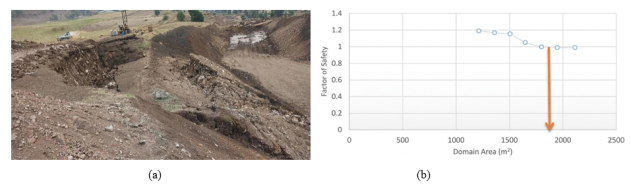
Field inspection confirmed that the slope failure occurred in a circular mode, extending approximately 12 m downslope from the crown, with a detachment depth between 1-2.5 m
| [1] | Duncan, J. M., Wright, S. G., & Brandon, T. L. (2014). Soil strength and slope stability. John Wiley & Sons. |
| [2] | Cheng, Y. M., & Lau, C. K. (2014). Slope stability analysis and stabilization: New methods and insight. CRC Press.
https://doi.org/10.4324/9780203927953 |
[1, 2]
. The affected slope section is shown in
Figure 3a. Sensitivity analysis was performed to define appropriate model boundaries, and as presented in
Figure 3b, the factor of safety (FOS) stabilized as the domain width increased, consistent with the findings of
| [1] | Duncan, J. M., Wright, S. G., & Brandon, T. L. (2014). Soil strength and slope stability. John Wiley & Sons. |
[1]
. The Limit Equilibrium Method (LEM) (
Table 6) employed the Morgenstern-Price method, while the Finite Element Method (FEM) (
Table 7) used the Mohr-Coulomb constitutive model
| [3] | Brinkgreve, R. B. J., & Vermeer, P. A. (2003). PLAXIS Version 8 material model manual. Delft University of Technology. |
| [9] | Griffiths, D. V., & Lane, P. A. (1999). Slope stability analysis by finite elements. Geotechnique, 49(3), 387-403.
https://doi.org/10.1680/geot.1999.49.3.387 |
[3, 9]
. Variability in soil parameters was incorporated using the N-sigma (Nσ) rule, following the approach recommended by
| [1] | Duncan, J. M., Wright, S. G., & Brandon, T. L. (2014). Soil strength and slope stability. John Wiley & Sons. |
[1]
and
| [15] | Harr, M. E. (1987). Reliability-based design in civil engineering. McGraw-Hill. |
[15]
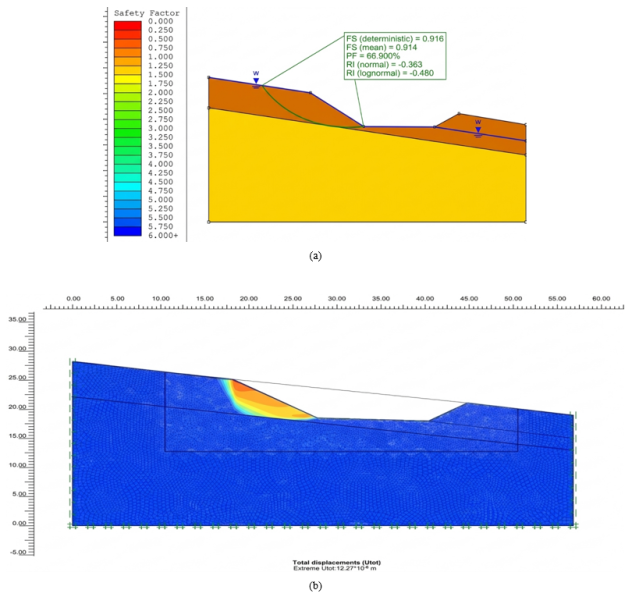
. As shown in
Figure 4a and 4b, the FOS decreased notably under fully saturated, drained conditions. For LEM, FOS values ranged from 0.916 to 1.054, while FEM results ranged from 0.762 to 1.021. These results confirm that saturation and elevated pore-water pressure are the principal destabilizing factors for the slope
| [9] | Griffiths, D. V., & Lane, P. A. (1999). Slope stability analysis by finite elements. Geotechnique, 49(3), 387-403.
https://doi.org/10.1680/geot.1999.49.3.387 |
| [10] | Fredlund, D. G., & Krahn, J. (1977). Comparison of slope stability methods of analysis. Canadian Geotechnical Journal, 14(3), 429-439. https://doi.org/10.1139/t77-045 |
| [13] | Malkawi, A. I. H., Hassan, W. F., & Abdulla, F. A. (2000). Uncertainty and reliability analysis applied to slope stability. Structural Safety, 22(2), 161-187.
https://doi.org/10.1016/S0167-4730(99)00041-X |
[9, 10, 13]
.
Figure 3. (a) View of the landslide affecting the roadside cut at Station 16+980 (LHS), and (b) sensitivity analysis conducted to determine the appropriate model geometry for the stability analysis.
Uncertainties in soil properties were evaluated using the Nσ rule, which considers the highest and lowest conceivable parameter values based on engineering judgment. The standard deviation and coefficient of variation (COV) were computed using Equations (
1) and (
2) and compared with the recommended ranges given by
| [1] | Duncan, J. M., Wright, S. G., & Brandon, T. L. (2014). Soil strength and slope stability. John Wiley & Sons. |
[1]
in
Table 5.
Considering that the slope material consists predominantly of clayey soil, and allowing for uncertainties arising from sampling, transportation, and laboratory testing, COV values of 30% for cohesion and 10% for friction angle were finally adopted for the probabilistic analysis
| [19] | Mitchell, J. K., & Soga, K. (2005). Fundamentals of soil behavior (3rd ed.). Wiley. |
[19]
.
Table 5. Coefficients of Variation for Geotechnical Properties and in Situ Tests (Duncan, J. M., 2014).
Property or in Situ Test | COV (%) | References |
Unit weight (𝛾) | 3-7 | Harr (1987), Kulhawy (1992) |
Buoyant unit weight (𝛾b) | 0-10 | Lacasse and Nadim (1997), Duncan (2000) |
Effective stress friction angle (𝜙′) | 2-13 | Harr (1987), Kulhawy (1992), Duncan (2000) |
Undrained shear strength (su) and c′ | 13-40 | Kulhawy (1992), Harr (1987), Lacasse and Nadim (1997) |
Undrained strength ratio (su∕𝜎v′) | 5-15 | Lacasse and Nadim (1997), Duncan (2000) |
Standard penetration test blow count (N) | 15-45 | Harr (1987), Kulhawy (1992) |
Electric cone penetration test (qc) | 5-15 | Kulhawy (1992) |
Mechanical cone penetration test (qc) | 15-37 | Harr (1987), Kulhawy (1992) |
Dilatometer test tip resistance (qD) | 5-15 | Kulhawy (1992) |
Vane shear test undrained strength (sv) | 10-20 | Kulhawy (1992) |
Table 6. The outcome of station 16+980's LEM analysis.
Method of analysis | Conditions considered | Factor of safety | Probability of failure |
At normal GWT | Full saturation | At normal GWT | Full saturation |
LEM | undrained | 1.054 | 0.964 | 41.80% | 60.40% |
drained | 1.043 | 0.916 | 47.60% | 66.90% |
Figure 4. Results of slope stability analyses for Station 16+980: (a) LEM (b) FEM.
Table 7. The outcome of station 16+980's FEM.
Method of analysis | Conditions considered | Factor of safety |
At normal GWT | Full saturation |
Finite element analysis | undrained | 1.026 | 0.785 |
drained | 1.021 | 0.762 |
3.2. Failure of the Cut Section at Km 35+270
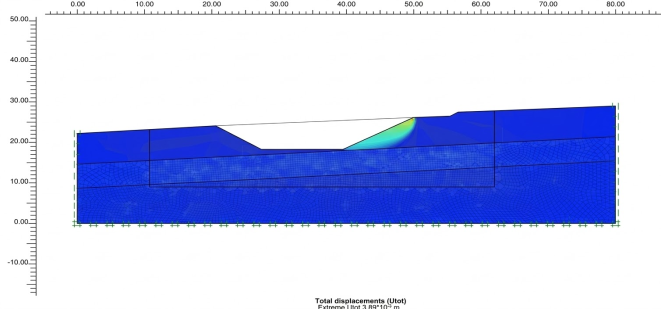
Both sides of the road were impacted by the failure at this station. Failure geometry extended about 15 m from the crest, and sensitivity analysis was conducted to determine the appropriate mesh and boundary (
Figure 5). The LEM results (
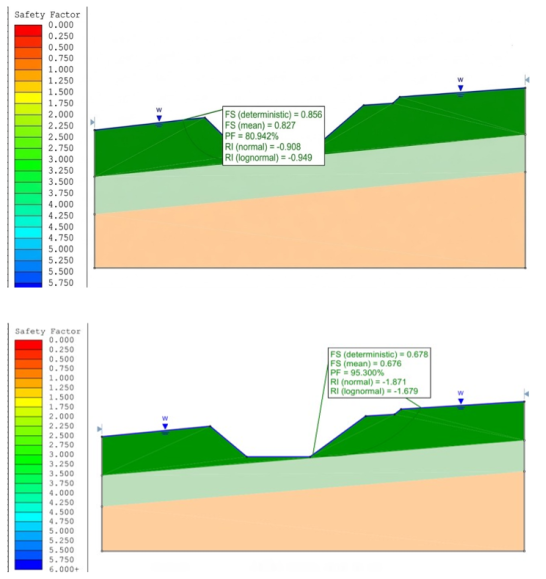
Table 8) showed FOS values between 0.678 and 0.965, with failure probabilities ranging from 60% to 95%. The FEM results (
Table 9) confirmed a critical FOS of 0.657 under full saturation, as shown in
Figure 6. These results correspond closely with
and
| [10] | Fredlund, D. G., & Krahn, J. (1977). Comparison of slope stability methods of analysis. Canadian Geotechnical Journal, 14(3), 429-439. https://doi.org/10.1139/t77-045 |
[10]
, who showed that fully saturated conditions produce minimum safety factors. Similar rainfall-induced failures have been reported in Ethiopian road projects
| [5] | Abebe, B., Dramis, F., Fubelli, G., Umer, M., & Asrat, A. (2010). Landslides in the Ethiopian highlands and Rift margins. Journal of African Earth Sciences, 56(4-5), 131-138.
https://doi.org/10.1016/j.jafrearsci.2009.07.007 |
| [6] | Ayalew, L. (1999). The effect of seasonal rainfall on landslides in the highlands of Ethiopia. Bulletin of Engineering Geology and the Environment, 58(1), 9-19.
https://doi.org/10.1007/s100640050072 |
| [7] | Ayalew, L., & Yamagishi, H. (2004). Slope failures in the Blue Nile basin. Geomorphology, 57(1-2), 95-116.
https://doi.org/10.1016/S0169-555X(03)00100-0 |
| [8] | Ayenew, T., & Barbieri, G. (2005). Inventory of landslides and susceptibility mapping in the Dessie area, northern Ethiopia. Engineering Geology, 77(1-2), 1-15.
https://doi.org/10.1016/j.enggeo.2004.07.002 |
| [11] | Cornforth, D. H. (2005). Landslides in practice. John Wiley & Sons. |
[5-8, 11]
.
Table 8. The limit equilibrium analysis result of station 35+270.
Method of analysis | Conditions considered | Factor of safety | Probability of failure |
At normal GWT | Full saturation | At normal GWT | Full saturation |
RHS | LHS | RHS | LHS | RHS | LHS | RHS | LHS |
LEM | drained | 0.79 | 0.965 | 0.678 | 0.856 | 87.80% | 60.50% | 95.30% | 80.94% |
Figure 5. Analysis of station 35+270 using finite elements.
Figure 6. RHS and LHS analysis of station 35+270 using LEM while taking full saturation conditions into account.
Table 9. The outcome of station 35+270's finite element analysis.
Method of analysis | Conditions considered | Factor of safety |
At normal GWT | Full saturation |
Finite element analysis | drained | 0.813 | 0.657 |
4. Result and Discussion
The slope stability analyses for both investigated stations confirmed that failures occurred primarily under fully saturated conditions. The calculated factors of safety (FOS) from the finite element analysis ranged between 0.657 (for Station 35+270 under full saturation) and 1.021 (for Station 16+980 under normal groundwater conditions), indicating overall instability of the existing slopes. This pattern is consistent with findings by
| [1] | Duncan, J. M., Wright, S. G., & Brandon, T. L. (2014). Soil strength and slope stability. John Wiley & Sons. |
[1]
and
, who emphasized the high sensitivity of cohesive slopes to increases in pore-water pressure and moisture content. Intense rainfall and human activities, such as irrigation, trigger slope instability
| [22] | Temesgen, B., Mohammed, M. U., & Korme, T. (2001). Natural hazard assessment using GIS and remote sensing in Wondogenet, Ethiopia. Physics and Chemistry of the Earth, 26(9), 665-675.
https://doi.org/10.1016/S1464-1917(01)00065-2 |
| [23] | Ayalew, L., & Vernier, A. (2021). Causes and mechanisms of slope instability in Dessie town, Ethiopia. In Slope stability engineering (pp. 1181-1186). Routledge. |
[22, 23]
. By consequence, To evaluate how soil strength parameters influence stability, a sensitivity analysis was performed by varying cohesion (c) and friction angle (φ) independently using the General Limit Equilibrium (GLE) method
| [26] | Getinet, T. (2016). Analysis and remedial measures for slope instability related problems of selected sections of LOT II: Belta-Otolo Asphalt Road Project. (thesis, Addis Ababa University). |
| [27] | Samuel, A. (2017). Slope stability analysis of rainfall-induced landslides: Gohatsion-Dejen Road, Abay Gorge (thesis, Addis Ababa Science and Technology University). |
[26, 27]
. Each parameter was increased by 25%, 50%, 75%, and 100%, while keeping other conditions constant. The results are summarized in
Table 10.
Table 10. Sensitivity analysis of strength factors to determine how they affect FOS.
No. | Cut section (Km) | FS Design stability | Factor of safety |
Cohesion Increment by | The angle of friction increment |
25% | 50% | 75% | 100% | 25% | 50% | 75% | 100% |
1 | 16+980 | 0.762 | 1.136 | 1.1351 | 1.566 | 1.781 | 0.997 | 1.234 | 1.554 | 1.722 |
2 | 35+270 (LHS) | 0.856 | 1.054 | 1.261 | 1.462 | 1.704 | 0.865 | 1.112 | 1.384 | 1.584 |
As shown in
Table 10, the factor of safety exceeded 1.5 (stable condition) only when cohesion or friction angle increased by 75 - 100%. The slope at Km 16+980 achieved stability at both 75% and 100% increments, while at Km 35+270, stability was reached only at 100% increases. The right-hand side (RHS) of Station 35+270 remained marginally stable even under the most favorable conditions. Overall, variations in the friction angle improved stability more effectively than cohesion. This observation agrees with the classification of
| [4] | Woldearegay, K. (2013). Review of the occurrences and influencing factors of landslides in the highlands of Ethiopia. Momona Ethiopian Journal of Science, 5(1), 3-31. |
| [21] | Van Den Eeckhaut, M., et al. (2009). Spatial patterns of old, deep-seated landslides in northern Ethiopia. Geomorphology, 105(3-4), 239-252.
https://doi.org/10.1016/j.geomorph.2008.10.005 |
[4, 21]
and
| [5] | Abebe, B., Dramis, F., Fubelli, G., Umer, M., & Asrat, A. (2010). Landslides in the Ethiopian highlands and Rift margins. Journal of African Earth Sciences, 56(4-5), 131-138.
https://doi.org/10.1016/j.jafrearsci.2009.07.007 |
[5]
, where FOS < 1.0 indicates failure, 1.0-1.5 represents questionable stability, and FOS > 1.5 represents a safe condition
| [25] | Ethiopian Road Authority. (2002). Pavement design manual. Addis Ababa. |
[25]
.
FEM provided more realistic stress-strain and pore-pressure distributions than the limit equilibrium approach, as also reported by
and
| [28] | Assefa, E., et al. (2017). Slope stability evaluation for new railway embankment using stochastic FEM. Electronic Journal of Geotechnical Engineering, 22, 51-79. |
[28]
. Recent studies have further demonstrated FEM's capability to capture complex geological effects on seismic behavior in challenging terrains
| [31] | Shitu, A., Shitu, E. & Rais, I. Deformation Behavior of Cross-Passage Tunnel in Weak Soils: A Parametric Study Based on Advanced Soil Models. Transp. Infrastruct. Geotech. 12, 219 (2025). https://doi.org/10.1007/s40515-025-00679-5 |
[31]
. The probabilistic failure probability (Pf) ranged between 41.8% and 95.3%, reflecting significant variability in soil strength due to natural heterogeneity and sampling uncertainty
| [13] | Malkawi, A. I. H., Hassan, W. F., & Abdulla, F. A. (2000). Uncertainty and reliability analysis applied to slope stability. Structural Safety, 22(2), 161-187.
https://doi.org/10.1016/S0167-4730(99)00041-X |
| [17] | Foye, K. C., Salgado, R., & Scott, B. (2006). Assessment of variable uncertainties for reliability-based design of foundations. Journal of Geotechnical and Geoenvironmental Engineering, 132(9), 1197-1207.
https://doi.org/10.1061/(ASCE)1090-0241(2006)132:9(1197) |
[13, 17]
. These probabilities are consistent with reliability studies by
and
. Both deterministic and probabilistic analyses demonstrated that slope failures in the study area are primarily controlled by high rainfall infiltration, low shear strength, and fluctuating groundwater levels. These findings underscore the necessity of proper drainage control and the installation of retaining structures to ensure long-term slope stability along Ethiopian road corridors.
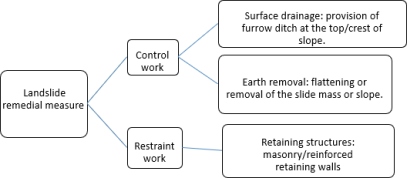
There are two choices to improve the stability of any slopes: increasing resistance or decreasing driving forces. In the remediation of the landslide, the countermeasures may be either Control or Restraint work as shown in
Figure 7.
Figure 7. Slope failure countermeasures.
Remedial measure at 16+980
The main causes of failure were the steep cut angle, presence of springs and shallow groundwater, and weak fine-grained soils
| [5] | Abebe, B., Dramis, F., Fubelli, G., Umer, M., & Asrat, A. (2010). Landslides in the Ethiopian highlands and Rift margins. Journal of African Earth Sciences, 56(4-5), 131-138.
https://doi.org/10.1016/j.jafrearsci.2009.07.007 |
| [6] | Ayalew, L. (1999). The effect of seasonal rainfall on landslides in the highlands of Ethiopia. Bulletin of Engineering Geology and the Environment, 58(1), 9-19.
https://doi.org/10.1007/s100640050072 |
| [11] | Cornforth, D. H. (2005). Landslides in practice. John Wiley & Sons. |
[5, 6, 11]
. To mitigate these issues, a masonry retaining wall combined with surface and subsurface drainage was constructed. In mountainous road corridors, reducing the self‑weight of retaining and slope‑supporting structures through lightweight concrete made with volcanic scoria
can help lower driving forces on potential failure surfaces and thus contribute to improved slope stability. The area lies in a low-seismic-hazard zone (PGA = 0.03 g)
| [24] | Gouin, P. (1979). Earthquake history of Ethiopia and the Horn of Africa. IDRC, Ottawa, ON, CA. |
| [29] | Authority, E. R. (1995). EBCS-8: Design of structures for earthquake resistance. Addis Ababa: Ministry of Works and Urban Development. |
[24, 29]
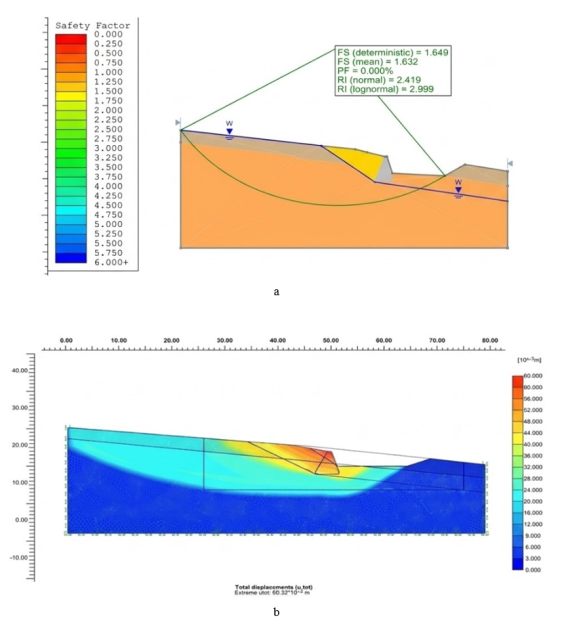
. After remediation, both LEM and FEM analyses (
Tables 11 and 12) indicated FOS values between 1.625 and 1.896, with negligible failure probability. As shown in
Figure 8, FEM results revealed a substantial reduction in displacement, with a maximum of 60.32 × 10⁻³ m. These findings are consistent with
| [10] | Fredlund, D. G., & Krahn, J. (1977). Comparison of slope stability methods of analysis. Canadian Geotechnical Journal, 14(3), 429-439. https://doi.org/10.1139/t77-045 |
[10]
and
| [28] | Assefa, E., et al. (2017). Slope stability evaluation for new railway embankment using stochastic FEM. Electronic Journal of Geotechnical Engineering, 22, 51-79. |
[28]
, who confirmed the effectiveness of retaining walls in stabilizing saturated slopes.
Table 11. The station 16+980 LEM result following corrective action.
Method of analysis | Conditions considered | Factor of safety | Probability of failure |
At normal GWT | Full saturation | At normal GWT | Full saturation |
LEM | undrained | 1.896 | 1.687 | 0.000% | 0.000% |
drained | 1.789 | 1.649 | 0.000% | 0.000% |
Table 12. The outcome of station 16+980's FEM following corrective action.
Method of analysis | Conditions considered | Factor of safety |
At normal GWT | Full saturation |
Finite element analysis | undrained | 1.769 | 1.697 |
drained | 1.703 | 1.625 |
Figure 8. Comparison of slope stability analyses at Station 16+980 after remedial measures using (a) the Limit Equilibrium Method and (b) the Finite Element Method.
Remedial measure at 35+270
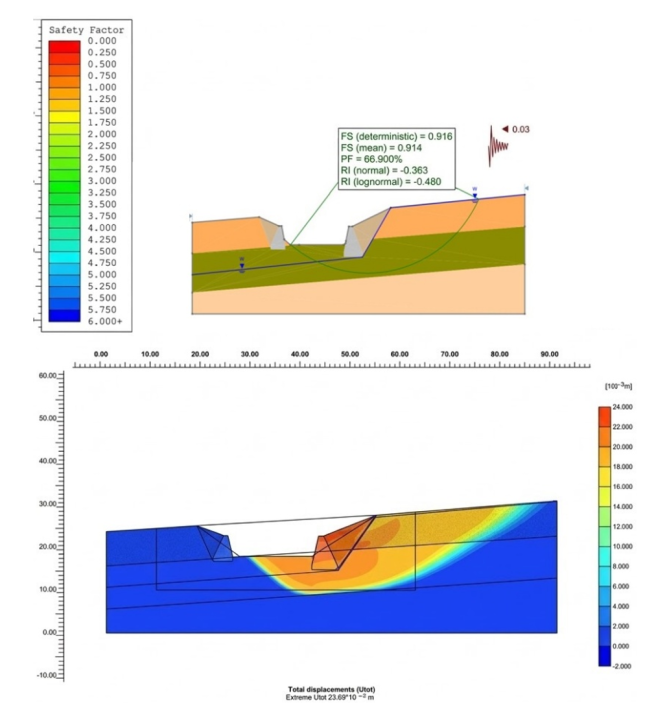
The slope at this location failed due to steep cutting, intense rainfall infiltration, and low-strength clayey soils. Stabilization involved constructing a masonry retaining wall, improving surface drainage, and adding toe protection. Post-remediation LEM results (
Table 13) showed improved FOS values between 1.585 and 1.928, while FEM results (
Table 14) ranged from 1.576 to 1.639. The FEM deformation map (
Figure 9) displayed a maximum displacement of 23.69 × 10⁻³ m, confirming slope stability recovery. These combined countermeasures align with the stabilization approaches recommended by
| [11] | Cornforth, D. H. (2005). Landslides in practice. John Wiley & Sons. |
[11]
and
| [18] | Wolle, C. M., & Hachich, W. (1989). Rain-induced landslides in southeastern Brazil. 12th International Conference on Soil Mechanics and Foundation Engineering, 1639-1642. |
[18]
.
Table 13. The station 35+270 LEM result following corrective action.
Method of analysis | Conditions considered | Factor of safety | Probability of failure |
At normal GWT | Full saturation | At normal GWT | Full saturation |
RHS | LHS | RHS | LHS | RHS | LHS | RHS | LHS |
Limit equilibrium m analysis | drained | 1.928 | 1.677 | 1.83 | 1.585 | 0.00% | 0.00% | 0.00% | 0.50% |
Table 14. The outcome of station 35+270's FEM study following corrective action.
Method of analysis | Conditions considered | Factor of safety |
At normal GWT | Full saturation |
Finite element analysis | drained | 1.639 | 1.576 |
Figure 9. Stability analysis results for Station 35+270 after implementation of remedial measures: (a) LEM and (b) FEM.
5. Conclusion
This study explored the causes of slope failures and developed practical solutions for two critical cut slopes located at Km 16+980 and Km 35+270 along the Bonga-Felegeselam road. Using both deterministic and probabilistic analyses through the Limit Equilibrium and Finite Element Methods, the investigation clearly showed that steep slope geometry, shallow groundwater levels, and rainfall-induced saturation were the main factors behind the observed failures. These conditions reduced the soil’s shear strength and triggered instability during periods of intense rainfall. To restore stability, a combination of control and restraint measures such as masonry retaining walls, surface and subsurface drainage systems, and toe protection were designed and implemented. After these remedial works, the factor of safety (FOS) increased significantly, from below 1.0 to above 1.6, confirming the effectiveness of the interventions
| [30] | Shitu, A., & Shitu, E. (2026). Utilizing the Taguchi Method to Optimize Slope Stability and Analyse Parameter Sensitivity in Road Cuts: Insights from Southern Ethiopia. Science, 1(1), 33-54. https://doi.org10.11648/j.sdenv.20260101.14 |
[30]
. The finite element results also revealed a marked reduction in displacement, indicating the success of the stabilization measures.
Overall, the findings emphasize that effective drainage management combined with well-designed retaining structures can greatly enhance slope stability in Ethiopia’s mountainous and rainfall-prone regions. Moreover, integrating deterministic and probabilistic methods provides a more comprehensive understanding of slope behavior, improving both design confidence and long-term safety for future infrastructure projects.
6. Recommendation for Future Research
While this study provided valuable insights into the causes and control of slope instability, further research is needed to deepen our understanding and improve design reliability. The following recommendations are suggested:
1) Back-Analysis for Better Accuracy: Future studies should perform detailed back-analyses of actual slope failures to fine-tune laboratory-derived soil parameters and improve the accuracy of numerical models.
2) Stronger Probabilistic Assessment: Collecting more field and laboratory data will help refine the variability of soil parameters such as cohesion and friction angle, allowing for more dependable reliability-based designs.
3) Use of 3D Modelling: Employing three-dimensional finite element analysis will provide a more realistic picture of slope behavior, especially in complex terrains where 2D models have limitations.
4) Long-Term Field Monitoring: Installing piezometers and inclinometers on remediated slopes will make it possible to monitor changes in groundwater levels and slope movement over time, offering valuable feedback on the long-term effectiveness of the implemented measures.
5) Incorporating Remote Sensing and GIS Tools: Integrating satellite imagery and GIS-based analysis can help identify vulnerable zones early, enabling proactive mitigation planning for road networks across similar terrains.
These steps will not only strengthen the scientific understanding of slope behavior but also contribute to safer, more resilient, and cost-effective road infrastructure across Ethiopia’s highlands.
Abbreviations
CL | Lean Clay (Unified Soil Classification System) |
COV | Coefficient of Variation |
ERA | Ethiopian Roads Authority |
FEM | Finite Element Method |
FOS | Factor of Safety |
GLE | General Limit Equilibrium |
GWT | Ground Water Table |
LEM | Limit Equilibrium Method |
LHS | Left-Hand Side |
| N-sigma (Statistical variability rule) |
| Probability of Failure |
PGA | Peak Ground Acceleration |
RHS | Right-Hand Side |
RI | Reliability Index |
RSBF | Reduced Set of Base Functions |
SBFEM | Scaled Boundary Finite Element Method |
UIRM | Unit Impulse Response Matrix |
Author Contributions
Ermias Shitu: Investigation, Data curation, Methodology, Software, Formal analysis, Writing - original draft
Aklilu Shitu Gebremariam: Investigation, Data curation, Methodology, Software, Formal Analysis, Writing - original draft
Sufiyan Ahmad: Investigation, Data curation, Methodology, Software, Formal Analysis
Mohd Sheob: Software, Formal Analysis, Writing - review & editing
Data Availability Statement
The datasets used and/or analysed during the current study are available from the corresponding author on reasonable request.
Conflicts of Interest
The authors declare no conflicts of interest.
Appendix: Notations and Symbols
1. Greek Letters
Table 15. Symbols used in the paper.
Symbol | Description | Unit |
| Unit weight | kN/m³ |
| Unsaturated unit weight | kN/m³ |
| Saturated unit weight | kN/m³ |
| Bulk unit weight | kN/m³ |
| Effective angle of internal friction | degrees (°) |
| Effective cohesion | kN/m² |
| Dilatancy angle | degrees (°) |
| Poisson's ratio | dimensionless [-] |
| Standard deviation | varies |
| Effective stress | kN/m² |
| Effective vertical stress | kN/m² |
| Shear stress | kN/m² |
μ | Mean value | varies |
2. Subscripts and Superscripts
Table 16. Expression of some parameters used in the paper.
Notation | Meaning |
' (prime) | Effective Stress Parameter |
un | Unsaturated Condition |
sat | Saturated Condition |
bulk | Bulk Property |
v | Vertical (as in ) |
w | Water (as in Unit Weight of Water) |
3. Dimensionless Numbers & Field Tests
Table 17. Abbreviations used.
Symbol | Description |
| Coefficient of Variation |
| Standard penetration test (SPT) blow count |
| Cone penetration test (CPT) resistance |
| Dilatometer test tip resistance |
| Undrained shear strength |
References
| [1] |
Duncan, J. M., Wright, S. G., & Brandon, T. L. (2014). Soil strength and slope stability. John Wiley & Sons.
|
| [2] |
Cheng, Y. M., & Lau, C. K. (2014). Slope stability analysis and stabilization: New methods and insight. CRC Press.
https://doi.org/10.4324/9780203927953
|
| [3] |
Brinkgreve, R. B. J., & Vermeer, P. A. (2003). PLAXIS Version 8 material model manual. Delft University of Technology.
|
| [4] |
Woldearegay, K. (2013). Review of the occurrences and influencing factors of landslides in the highlands of Ethiopia. Momona Ethiopian Journal of Science, 5(1), 3-31.
|
| [5] |
Abebe, B., Dramis, F., Fubelli, G., Umer, M., & Asrat, A. (2010). Landslides in the Ethiopian highlands and Rift margins. Journal of African Earth Sciences, 56(4-5), 131-138.
https://doi.org/10.1016/j.jafrearsci.2009.07.007
|
| [6] |
Ayalew, L. (1999). The effect of seasonal rainfall on landslides in the highlands of Ethiopia. Bulletin of Engineering Geology and the Environment, 58(1), 9-19.
https://doi.org/10.1007/s100640050072
|
| [7] |
Ayalew, L., & Yamagishi, H. (2004). Slope failures in the Blue Nile basin. Geomorphology, 57(1-2), 95-116.
https://doi.org/10.1016/S0169-555X(03)00100-0
|
| [8] |
Ayenew, T., & Barbieri, G. (2005). Inventory of landslides and susceptibility mapping in the Dessie area, northern Ethiopia. Engineering Geology, 77(1-2), 1-15.
https://doi.org/10.1016/j.enggeo.2004.07.002
|
| [9] |
Griffiths, D. V., & Lane, P. A. (1999). Slope stability analysis by finite elements. Geotechnique, 49(3), 387-403.
https://doi.org/10.1680/geot.1999.49.3.387
|
| [10] |
Fredlund, D. G., & Krahn, J. (1977). Comparison of slope stability methods of analysis. Canadian Geotechnical Journal, 14(3), 429-439.
https://doi.org/10.1139/t77-045
|
| [11] |
Cornforth, D. H. (2005). Landslides in practice. John Wiley & Sons.
|
| [12] |
Christian, J. T., & Baecher, G. B. (2001). Factors of safety and reliability in geotechnical engineering. Journal of Geotechnical and Geoenvironmental Engineering, 127(8), 700-703.
https://doi.org/10.1061/(ASCE)1090-0241(2001)127:8(700)
|
| [13] |
Malkawi, A. I. H., Hassan, W. F., & Abdulla, F. A. (2000). Uncertainty and reliability analysis applied to slope stability. Structural Safety, 22(2), 161-187.
https://doi.org/10.1016/S0167-4730(99)00041-X
|
| [14] |
Chowdhury, R. N., & Xu, D. W. (1992). Reliability index for slope stability assessment—two methods compared. Reliability Engineering & System Safety, 37(2), 99-108.
https://doi.org/10.1016/0951-8320(92)90002-3
|
| [15] |
Harr, M. E. (1987). Reliability-based design in civil engineering. McGraw-Hill.
|
| [16] |
Shitu, A., Shitu, E. Volcanic scoria as a sustainable alternative to sand in structural lightweight concrete. Sci Rep 15, 34431 (2025).
https://doi.org/10.1038/s41598-025-17494-0
|
| [17] |
Foye, K. C., Salgado, R., & Scott, B. (2006). Assessment of variable uncertainties for reliability-based design of foundations. Journal of Geotechnical and Geoenvironmental Engineering, 132(9), 1197-1207.
https://doi.org/10.1061/(ASCE)1090-0241(2006)132:9(1197)
|
| [18] |
Wolle, C. M., & Hachich, W. (1989). Rain-induced landslides in southeastern Brazil. 12th International Conference on Soil Mechanics and Foundation Engineering, 1639-1642.
|
| [19] |
Mitchell, J. K., & Soga, K. (2005). Fundamentals of soil behavior (3rd ed.). Wiley.
|
| [20] |
Skempton, A. W. (1964). Long-term stability of clay slopes. Geotechnique, 14(2), 77-102.
|
| [21] |
Van Den Eeckhaut, M., et al. (2009). Spatial patterns of old, deep-seated landslides in northern Ethiopia. Geomorphology, 105(3-4), 239-252.
https://doi.org/10.1016/j.geomorph.2008.10.005
|
| [22] |
Temesgen, B., Mohammed, M. U., & Korme, T. (2001). Natural hazard assessment using GIS and remote sensing in Wondogenet, Ethiopia. Physics and Chemistry of the Earth, 26(9), 665-675.
https://doi.org/10.1016/S1464-1917(01)00065-2
|
| [23] |
Ayalew, L., & Vernier, A. (2021). Causes and mechanisms of slope instability in Dessie town, Ethiopia. In Slope stability engineering (pp. 1181-1186). Routledge.
|
| [24] |
Gouin, P. (1979). Earthquake history of Ethiopia and the Horn of Africa. IDRC, Ottawa, ON, CA.
|
| [25] |
Ethiopian Road Authority. (2002). Pavement design manual. Addis Ababa.
|
| [26] |
Getinet, T. (2016). Analysis and remedial measures for slope instability related problems of selected sections of LOT II: Belta-Otolo Asphalt Road Project. (thesis, Addis Ababa University).
|
| [27] |
Samuel, A. (2017). Slope stability analysis of rainfall-induced landslides: Gohatsion-Dejen Road, Abay Gorge (thesis, Addis Ababa Science and Technology University).
|
| [28] |
Assefa, E., et al. (2017). Slope stability evaluation for new railway embankment using stochastic FEM. Electronic Journal of Geotechnical Engineering, 22, 51-79.
|
| [29] |
Authority, E. R. (1995). EBCS-8: Design of structures for earthquake resistance. Addis Ababa: Ministry of Works and Urban Development.
|
| [30] |
Shitu, A., & Shitu, E. (2026). Utilizing the Taguchi Method to Optimize Slope Stability and Analyse Parameter Sensitivity in Road Cuts: Insights from Southern Ethiopia. Science, 1(1), 33-54.
https://doi.org10.11648/j.sdenv.20260101.14
|
| [31] |
Shitu, A., Shitu, E. & Rais, I. Deformation Behavior of Cross-Passage Tunnel in Weak Soils: A Parametric Study Based on Advanced Soil Models. Transp. Infrastruct. Geotech. 12, 219 (2025).
https://doi.org/10.1007/s40515-025-00679-5
|
Cite This Article
-
APA Style
Shitu, E., Gebremariam, A. S., Ahmad, S., Sheob, M. (2026). Reliability-Based Slope Stability Analysis Along the
Bonga-Felegeselam Road, Ethiopia. American Journal of Civil Engineering, 14(2), 67-81. https://doi.org/10.11648/j.ajce.20261402.13
 Copy
|
Copy
|
 Download
ACS Style
Shitu, E.; Gebremariam, A. S.; Ahmad, S.; Sheob, M. Reliability-Based Slope Stability Analysis Along the
Bonga-Felegeselam Road, Ethiopia. Am. J. Civ. Eng. 2026, 14(2), 67-81. doi: 10.11648/j.ajce.20261402.13
Copy
|
Download
AMA Style
Shitu E, Gebremariam AS, Ahmad S, Sheob M. Reliability-Based Slope Stability Analysis Along the
Bonga-Felegeselam Road, Ethiopia. Am J Civ Eng. 2026;14(2):67-81. doi: 10.11648/j.ajce.20261402.13
Copy
|
Download
-
@article{10.11648/j.ajce.20261402.13,
  author = {Ermias Shitu and Aklilu Shitu Gebremariam and Sufiyan Ahmad and Mohd Sheob},
  title = {Reliability-Based Slope Stability Analysis Along the
Bonga-Felegeselam Road, Ethiopia},
  journal = {American Journal of Civil Engineering},
  volume = {14},
  number = {2},
  pages = {67-81},
  doi = {10.11648/j.ajce.20261402.13},
  url = {https://doi.org/10.11648/j.ajce.20261402.13},
  eprint = {https://article.sciencepublishinggroup.com/pdf/10.11648.j.ajce.20261402.13},
  abstract = {Slope instability is a common problem in mountainous road corridors, particularly in regions characterized by steep terrain, weak soil formations, and intense seasonal rainfall. The Bonga-Felegeselam road in southwestern Ethiopia has experienced several slope failures during construction due to these unfavorable geological and hydrological conditions. This study investigates the causes of instability and evaluates appropriate stabilization measures for two critical cut slopes located between Stations 16+900 to 16+980 (left-hand side, LHS) and Stations 35+200 to 35+300 (both LHS and RHS) of LOT I: Bonga Asphalt Road Project. Detailed site characterization was conducted through field observations, geometric configuration, soil classification, and laboratory testing to determine the relevant geotechnical properties. Slope stability was assessed using both deterministic and probabilistic approaches based on the Limit Equilibrium Method (LEM) and the Finite Element Method (FEM). The analyses considered different groundwater conditions to evaluate the influence of rainfall-induced saturation on slope stability. The results indicate that the slopes become highly unstable under fully saturated conditions, with factors of safety ranging from 0.657 to 0.916 and failure probabilities between 41.8% and 95.3%. Sensitivity analysis further showed that slope stability is more sensitive to variations in the friction angle than cohesion. To mitigate the instability, a combination of masonry retaining walls, surface drainage, and subsurface drainage systems was proposed. Post-remediation analyses demonstrated a significant improvement in slope stability, increasing the factor of safety to values between 1.57 and 1.90. The findings highlight the importance of integrating deterministic and probabilistic approaches to develop reliable stabilization strategies for rainfall-prone mountainous regions.},
 year = {2026}
}
Copy
|
Download
-
TY  - JOUR
T1  - Reliability-Based Slope Stability Analysis Along the
Bonga-Felegeselam Road, Ethiopia
AU  - Ermias Shitu
AU  - Aklilu Shitu Gebremariam
AU  - Sufiyan Ahmad
AU  - Mohd Sheob
Y1  - 2026/03/27
PY  - 2026
N1  - https://doi.org/10.11648/j.ajce.20261402.13
DO  - 10.11648/j.ajce.20261402.13
T2  - American Journal of Civil Engineering
JF  - American Journal of Civil Engineering
JO  - American Journal of Civil Engineering
SP  - 67
EP  - 81
PB  - Science Publishing Group
SN  - 2330-8737
UR  - https://doi.org/10.11648/j.ajce.20261402.13
AB  - Slope instability is a common problem in mountainous road corridors, particularly in regions characterized by steep terrain, weak soil formations, and intense seasonal rainfall. The Bonga-Felegeselam road in southwestern Ethiopia has experienced several slope failures during construction due to these unfavorable geological and hydrological conditions. This study investigates the causes of instability and evaluates appropriate stabilization measures for two critical cut slopes located between Stations 16+900 to 16+980 (left-hand side, LHS) and Stations 35+200 to 35+300 (both LHS and RHS) of LOT I: Bonga Asphalt Road Project. Detailed site characterization was conducted through field observations, geometric configuration, soil classification, and laboratory testing to determine the relevant geotechnical properties. Slope stability was assessed using both deterministic and probabilistic approaches based on the Limit Equilibrium Method (LEM) and the Finite Element Method (FEM). The analyses considered different groundwater conditions to evaluate the influence of rainfall-induced saturation on slope stability. The results indicate that the slopes become highly unstable under fully saturated conditions, with factors of safety ranging from 0.657 to 0.916 and failure probabilities between 41.8% and 95.3%. Sensitivity analysis further showed that slope stability is more sensitive to variations in the friction angle than cohesion. To mitigate the instability, a combination of masonry retaining walls, surface drainage, and subsurface drainage systems was proposed. Post-remediation analyses demonstrated a significant improvement in slope stability, increasing the factor of safety to values between 1.57 and 1.90. The findings highlight the importance of integrating deterministic and probabilistic approaches to develop reliable stabilization strategies for rainfall-prone mountainous regions.
VL  - 14
IS  - 2
ER  -
Copy
|
Download





 Share This Article
 Twitter
 Linked In
 Facebook