Research Article | | Peer-Reviewed

Design of Reinforced Concrete Retaining Wall by Hybrid Teaching Learning Based Optimization

Received: 9 April 2026     Accepted: 25 April 2026     Published: 13 May 2026
Views:       Downloads:
Abstract

Reinforced concrete (RC) retaining walls are widely used in civil engineering applications, where economical and efficient designs are essential, given their extensive use and material demands. This study aims to optimize the weight and cost of RC cantilever retaining walls by developing a hybrid Teaching–Learning-Based Optimization (TLBO) algorithm with enhanced performance characteristics. The proposed method introduces a multi-population selection strategy that improves exploration of the design space in early iterations and promotes convergence in later stages. In addition, a pre-generated list of feasible reinforcement configurations is incorporated to eliminate repetitive constraint checks, thereby reducing computational effort. The optimization framework considers both geotechnical and structural constraints, including stability against sliding and overturning, bearing capacity, and compliance with ACI 318-19 design requirements. Two benchmark problems—retaining walls with and without a shear key—are analyzed to evaluate the effectiveness of the proposed hybrid TLBO. The results are compared with several established optimization techniques, including genetic algorithms, particle swarm optimization, grey wolf optimization, and other heuristic methods. The findings demonstrate that the hybrid TLBO algorithm provides more consistent, near-optimal solutions, as indicated by lower standard deviation values and improved convergence. The optimized designs achieve reduced cost and weight while satisfying all design constraints, with several critical constraints approaching their capacity limits, indicating optimal resource utilization. Furthermore, the proposed modifications reduce computational time by eliminating up to 20% of constraint evaluations. Overall, the study confirms that the hybrid TLBO approach is a robust and efficient tool for the optimal design of RC retaining walls, offering superior performance compared to conventional optimization methods.

Published in American Journal of Civil Engineering (Volume 14, Issue 3)
DOI 10.11648/j.ajce.20261403.11
Page(s) 134-148
Creative Commons

This is an Open Access article, distributed under the terms of the Creative Commons Attribution 4.0 International License (http://creativecommons.org/licenses/by/4.0/), which permits unrestricted use, distribution and reproduction in any medium or format, provided the original work is properly cited.

Copyright

Copyright © The Author(s), 2026. Published by Science Publishing Group

Keywords

Reinforced Concrete Retaining Walls, Structural Optimization, Teaching-Learning-Based Optimization (TLBO), Hybrid Optimization Algorithm, Cost Minimization, Weight Minimization, Multi-Population Strategy, Mutation-Based Optimization

1. Introduction
Reinforced concrete (RC) retaining walls are widely used in many civil engineering projects, including structural and geotechnical works. These structures are critical in highway construction, where bridges are used, and soils are retained. Due to their locations, residential buildings, recreational centers, water supply projects, and other civil engineering projects would require the construction of RC retaining walls. This universal application of RC cantilevered retaining walls encourages engineers to pursue low-cost, low-weight designs through optimization.
RC retaining walls have been the subject of numerous structural optimization studies over the past few decades. Camp & Akin used big bang-big crunch optimization to minimize the cost and weight of retaining walls, and they compared their results with other evolutionary optimization designs. Kaveh & Farhoudi investigated the optimum design of RC cantilevered walls using dolphin echolocation optimization. Temür & Bekdaş applied teaching learning-based optimization (TLBO) to design RC cantilever retaining walls. They conducted a comparative study of the retaining wall's average and minimum weights compared to other heuristic optimization methods. Kaveh & Shakouri Mahmud Abadi studied the optimum cost of retaining walls using a harmony search-based algorithm. Kayabekir et al. studied the optimum design of RC retaining walls using a harmony search algorithm with three objective functions: cost minimization, CO2 emission minimization, and multi-objective cost and CO2 emission minimization. Kalemci et al. used grey wolf optimization, a technique that mimics grey wolves' hierarchy and hunting methods, to minimize the weight of RC cantilevered retaining walls. They compared the results of the weight minimization with those from over 10 previous studies. Nandha Kumar and Suribabu studied the weight reduction of the RC cantilevered retaining walls using a differential evolution algorithm. The optimum solution saved about 15% of the material weight. Gandomi et al. investigated the efficiency of the accelerated particle swarm, firefly, and cuckoo search algorithms in minimizing the weight of RC cantilever retaining walls. They also conducted a parametric study investigating the effect of the base shear key, surcharge load, base soil friction angle, and backfill slope. Bekdaş et al. used TLBO to determine a restricted-optimum design for RC retaining walls.
One aspect of the optimization process among all these researchers is consensus. When any algorithm selects a better population, it will likely converge on a better solution. None of these studies examines the effects of selecting a search population based on fitness at the early stages of the algorithm, which should improve the convergence of any optimization method.
Issa used a distributed genetic algorithm to minimize the weight of steel portal frames. A mutation strategy was applied to encourage exploration of the design space, increasing mutation probabilities at the early stages of the algorithm and systematically decreasing mutation values as the generation increased. It was shown that this adaptation diversified the search population and consistently produced optimal solutions .
Many researchers have shown that TLBO is robust and effective . Others, such as Camp & Farshchin and Rao & Patel , have modified the TLBO algorithm to improve overall performance.
This study aims to develop and evaluate an enhanced hybrid TLBO framework for the optimal design of RC cantilever retaining walls, with the dual objective of minimizing structural weight and construction cost while satisfying all geotechnical and structural design constraints. The proposed approach introduces a mutation-based multi-population strategy to improve exploration of the design space and the reliability of convergence. In addition, a computationally efficient methodology is implemented by predefining feasible reinforcement configurations, thereby eliminating repetitive constraint checks associated with steel reinforcement limits and significantly reducing computational effort. The performance of the proposed hybrid TLBO algorithm is systematically assessed through benchmark problems and compared with established optimization techniques to demonstrate its accuracy, efficiency, and robustness in achieving near-optimal engineering designs.
2. Design Optimization Process
The design of RC retaining walls must satisfy both geotechnical and structural requirements. Feasible RC retaining wall designs must withstand overturning and sliding forces and provide minimum bearing displacement. Also, different elements of the RC retaining walls must provide adequate flexural and shear stresses.
2.1. Basis of Geotechnical Design
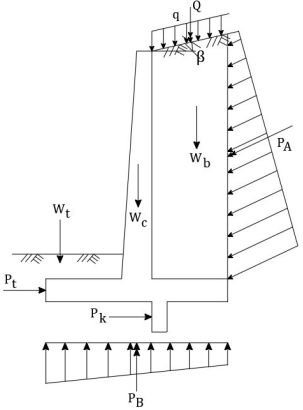
Figure 1 shows the geotechnical forces considered in the design of RC cantilevered retaining walls per unit meter length, where Wc is the weight of the retaining wall, Wb is the weight of backfill on the heel, Wt is the weight of soil on the toe surcharge load, q is the distributed surcharge load, Q is the resultant surcharge load, β is the backfill angle, PA is the active earth force, Pt is the passive earth force on the front part of the toe, Pk is the passive earth force on the key, and PB is the bearing stress force .
Figure 1. The forces acting on RC cantilevered retaining walls.
The active and passive earth pressure coefficients, Ka and Kp, respectively, are calculated using Rankine theory as
Ka=cosβ cosβ- cos2β- cos2cosβ+ cos2β- cos2(1)
The coefficient of the passive earth pressure is:
Kp=cosβ cosβ+ cos2β- cos2cosβ- cos2β- cos2(2)
where ϕ is the angle of the internal friction in the soil.
The forces shown in Figure 1 produce an overturning moment; if the retaining wall cannot resist them, it will fail by overturning. The factor of safety for overturning SFO:
SFO=MRMA(3)
where ΣMR is the sum of the moments of resisting forces, and ΣMA is the sum of moments of applied forces around the front face of the toe. To avoid an overturning hazard, the safety factor SFO must be greater than the predetermined value, typically between 1.5 and 2.5.
The factor of safety for the sliding forces, SFS, is
SFS=FRFA(4)
where ΣFR is the sum of the horizontal resisting forces, and ΣFA is the sum of the horizontal applied forces.
The applied force is the summation of the horizontal components of the active earth pressure:
FA=PAcosβ(5)
The resisting forces are calculated as
FR=N*tan23*φbase+23*B*cbase+PP(6)
where ϕbase is the internal friction angle of the base soil, cbase is the cohesion of the base soil, ΣN is the sum of the weight of the retaining wall, surcharge load, and the vertical components of the active forces
N=WC+Wb+Q+PAsinβ(7)
The ΣPp is the passive force expressed as
P= Pt+Pk(8)
with
Pt=12γfillD2Kp+2cD2Kp(9)
Pk=12γbasehk2Kp+2cbasehk2Kp(10)
where D is the total depth of the retained soil causing passive earth pressure, γfill is the unit weight of the retained soil, c is the cohesion of the retained soil, hk is the depth of the soil in front of the base shear key, and γbase is the unit weight of the base soil.
Since the foundation of the wall is considered a shallow foundation, the factor of safety for bearing capacity, SFB, is expressed as:
SFB=quqmax(11)
where qu and qmax are the ultimate bearing capacity and the maximum applied bearing stress, respectively. Terzaghi's bearing capacity theory is used to compute the ultimate bearing capacity as
qu=cbaseNcγfillDNq+12γbaseNg(B-2e)(12)
where Nc, Nq, and Ng are Terzaghi's coefficients, B is the width of the slab, γfill is the unit weight of the retained soil, and e is the eccentricity given as
e=MR-MOV(13)
where ΣMO is the sum of the moments of the applied force around the middle of the slab, ΣMR is the sum of the moments of resisting forces, and ΣV is the sum of the vertical forces acting on the foundation.
The minimum and maximum values of the soil bearing capacity of the shallow foundation could be calculated from:
qmin.max=VB16eB(14)
2.2. Basis of Structural Design
The critical sections, including the stem, toe, and heel, are checked for compliance with applied forces and moments during the structural analysis and design of RC retaining walls. These sections must meet the strength capacity defined by ACI 318-19 .
The nominal flexural strength Mn of the cross-section shall be greater than the ultimate flexural strength Mu.
MnMu(15)
The nominal flexural strength of the RC retaining wall is calculated as
Mn=0.9Asfyd-a2(16)
where As is the area of the reinforcing steel, fy is the yield strength of the steel reinforcement, d is the effective depth of the cross-section, and a is the depth of equivalent rectangular stress block given as
a=Asfy0.85fcb(17)
where fc is the concrete compressive strength and b is the width of the cross-section.
The nominal shear strength Vn should be greater than the ultimate applied shear force Vu
VnVu(18)
where Vu is
Vn=0.750.17fcbd(19)
2.3. Loads
When investigating the external stability of RC retaining walls, i.e., bearing capacity of the foundation, sliding, and overturning, in the geotechnical basis of design, service loads are used to compute the earth pressure with a load factor value of 1.0. On the other hand, the loads used in the structural design of the RC retaining walls should be consistent with ACI 318-19 , which requires increasing service loads by specified factors.
If resistance against the soil pressure, S (weight of soil), is included in combination with the dead load, D (weight of concrete), and live load, L (surcharge load), the factor is computed from the following combination:
FL=1.2D+1.6L+1.6S(20)
For the design of the toe where D or L reduces the effect of soil pressure, the factor load used in the design is computed from the following combination:
FL=0.9D+1.6S(21)
For any combination of dead load, live load, and soil pressure, the required strength shall not be less than:
FL=1.2D+1.6L(22)
For the design of the arm and heel, Eq. (20) usually governs, whereas for the toe, Eq. (21) governs.
Dead loads, such as concrete weight, should be multiplied by 0.9 for the toe slab and by 1.2 for the heel slab and stem.
Each critical flexural section should satisfy the minimum and maximum reinforcement ratios and minimum and maximum reinforcement spacing as specified by ACI 318-19 .
The minimum area of flexural reinforcement, Asmin, shall not be less than the following.
ASmin=fc4fybd1.4fcbd(23)
The minimum reinforcement ratio ρmin can be computed as
ρmin=ASminbd(24)
The limit for the maximum steel ratio ρmax is the balanced steel ratio, which produces balanced strain conditions under flexure:
ρb=0.85β1fcfy600600+fy(25)
The development length, ld, should comply with ACI 318-19 requirements to ensure adequate bond between concrete and steel reinforcement. For a deformed steel bar diameter db of 19mm or less, ld should be:
ld=fyψtψe2.1λfcdb(26)
where ψt is the modification factor for casting location, ψe is the modification factor for development length, and λ It is a factor based on the reinforcement coating, usually set to 1.0.
For steel reinforcing bar diameters greater than 19mm, ld should be
ld=fyψtψe1.7λfcdb(27)
Provided that ld is not less than 300mm.
The development length for hooks ldh is calculated as
ldh=0.24fyfcdb(28)
and shall not be smaller than #8 steel reinforcing bar diameters or 150mm.
2.4. Optimum Design
In many RC retaining walls, the objective function may be formulated to minimize the weight of concrete and steel reinforcement, or to minimize the total cost, including concrete, steel reinforcement, and formwork.
The objective function for weight FW is
FW= WC+ Wst(29)
where WC is the weight of concrete, and Wst is the weight of steel reinforcement
The objective function for cost FC is
FC= CstWst+ CCVC+ CFAF(30)
where Cst is the cost of steel reinforcement per weight, CC is the cost of concrete per volume, VC is the volume of concrete, CF is the cost of formwork per area, and AF is the area of formwork.
2.5. Design Variables
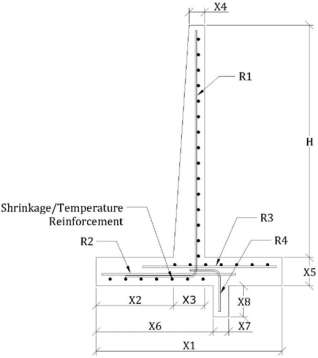
Two groups of design variables are used in RC retaining walls: those representing the wall geometry, including cross-sections, and those for reinforcement. As shown in Figure 2, twelve variables are commonly used for the optimum design of RC retaining walls.
Figure 2. Design variables of RC cantilevered retaining wall.
Variables that express the sections of the wall include X1: width of the base slab, X2: width of the slab, X3: stem thickness at the bottom of the wall, X4: stem thickness at the top of the wall, X5: base slab thickness, X6: distance from the front of the toe slab to the front of the shear key, X7: width of the base shear key, X8: height of the base shear key.
The reinforcement design variables for the retaining wall are R1: the vertical steel area in the stem per unit length of the wall, R2: the horizontal steel area of the toe slab, R3: the horizontal steel area of the heel slab, and R4: the vertical steel area of the shear key per unit length of the wall.
In this study, both geometric design and reinforcement variables are discrete variables.
3. Hybrid TLBO
In many learning environments, teachers are essential to transferring knowledge to students, helping them learn at a higher level. There is a correlation between a teacher's knowledge and competence and students' learning outcomes. The more qualified the teacher, the higher the mean of learning outcome. In addition, learners gain knowledge from their peers through interaction, communication, information sharing, research, extracurricular activities, and tutorial work, all of which significantly support the learning process.
In this model, students learn from teachers and peers in a classroom with varying levels of learning. Rao et al. first conceptualize the teaching-learning process of teachers and students in classrooms into an optimization algorithm. The teaching-learning analogy guides the optimization process to identify the best learner as a teacher, who can transfer information to the student body and bring the classroom knowledge mean closer to the teacher's level. Then, students are randomly paired and interact to improve the less knowledgeable student's level. Rao et al. organized this process into a cycle of teacher learning followed by student learning. In the TLBO algorithm, after a predetermined number of learning cycles, the best teacher represents the best solution to an optimization problem.
There have been efforts to modify the original TLBO algorithm to improve its performance and generate better solutions. This study makes two significant modifications to the TLBO algorithm to improve convergence and reduce computational time.
3.1. Modifying TLBO
Like many other heuristic search techniques, a TLBO algorithm begins with a randomly selected initial population. The diversity and overall fitness of the initial population are essential for the algorithm to converge rapidly to a good solution.
Issa modified a distributed genetic algorithm by applying higher mutation probabilities in the first few generations to encourage exploration of the design space, then lowering mutation rates later to promote convergence. In this study, this generational mutation probability strategy is integrated into a TLBO algorithm to generate multiple populations over cycles rather than selecting a single population at the beginning. The probability of selecting a new population PSGC is given as
PSGC=PSmax-e-120-e-GC20e-120-e-NG20PSmax-PSmin(31)
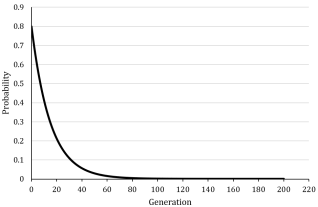
where PSmax is the predetermined maximum probability value, PSmin is the predetermined minimum probability value, GC is the current generation, and NG is the number of predetermined generations. Figure 3 shows the variation of PSGC for 200 generations with a maximum probability value of 80% and a minimum of 0.05%.
Figure 3. Selection probability of generating a new population.
As indicated in Figure 3, the probability value of selecting a new population PSGC varies with the number of generations. The probability is high during the initial generations, allowing frequent selection of new populations, exploration of a larger portion of the design space, and diversification of solutions. As the number of generations increases, PSGC decreases, allowing TLBO to converge to the optimum solution. For each generation, PSGC is computed using Eq. (31) and compared to a random number [0, 1]. Suppose the random number is less than or equal to the probability value of the current generation. In that case, a new population is selected for that generation, and the algorithm proceeds to the teacher phase. Also, an elitist strategy is used to preserve the best solutions from the current population in the next generation.
3.2. Modifying Fitness Computation
A design's feasibility is generally assessed during optimization by checking a series of geotechnical and structural constraints. Violations of these constraints are usually reflected in a penalty applied to the objective function. Some constraints are associated with minimum and maximum amounts of reinforcing steel and rebar spacing, and checking these constraints for each increases the computational time. This study developed a list of feasible steel reinforcement configurations for various thicknesses and lengths of structural elements to ensure compliance with these constraints. In addition to Eqs. (23) & (24), the following constraints were considered to generate a list of feasible reinforcement configurations following ACI 318-19 :
ρmax0.85fcfy37β1(32)
where <i></i>1 is the ratio of the depth of the rectangular stress block to the depth of the neutral axis, determined as
β1=0.85 for fc28 MPa(33)
β1=0.85-0.5fc-287 0.65 for fc>28 MPa(34)
The reinforcement ratio ρ is defined as
ρ=Asbd(35)
The minimum and maximum reinforcement spacing, Smin and Smax are
Smin=max(db, 43dA, 25mm)(36)
Smax=min(t, 300mm)(37)
where db is the diameter of a steel bar, dA is the maximum diameter of coarse aggregate, and t is the thickness of the structural element.
Table 1 shows a sample list of feasible reinforcement configurations for various thicknesses. Each number in the list represents the area of steel reinforcement, considering the number of steel bars used. For instance, 497 mm2 indicated as the first number under 200 mm thickness is equivalent to 7-ϕ10mm, and 568 mm2 under 220 mm is equivalent to 2-ϕ20mm.
Table 1. List of feasible reinforcement configurations.

Thickness, t (mm)

Feasible Reinforcement Configurations, mm2

200

497, 568, 639, 645, 710, 770, 774, 781, 852, 903, 923, 924, 994, 1000, 1032, 1065, 1078, 1136, 1161, 1200, 1207, 1232, 1278, 1290, 1349, 1386, 1400, 1419, 1420, 1491, 1540, 1548, 1562, 1600, 1633, 1677, 1694, 1704, 1800, 1806, 1848, 1935

210

497, 568, 639, 645, 710, 770, 774, 781, 852, 903, 923, 924, 994, 1000, 1032, 1065, 1078, 1136, 1161, 1200, 1207, 1232, 1278, 1290, 1349, 1386, 1400, 1419, 1420, 1491, 1540, 1548, 1562, 1600, 1633, 1677, 1694, 1704, 1800, 1806, 1848, 1935, 1988, 2000, 2002, 2064, 2156

220

568, 639, 645, 710, 770, 774, 781, 852, 903, 923, 924, 994, 1000, 1032, 1065, 1078, 1136, 1161, 1200, 1207, 1232, 1278, 1290, 1349, 1386, 1400, 1419, 1420, 1491, 1540, 1548, 1562, 1600, 1633, 1677, 1694, 1704, 1800, 1806, 1848, 1935, 1988, 2000, 2002, 2064, 2156, 2193, 2200, 2272, 2310, 2322

----

-----

600

903, 923, 924, 994, 1000, 1032, 1065, 1078, 1136, 1161, 1200, 1207, 1232, 1278, 1290, 1349, 1386, 1400, 1419, 1420, 1491, 1540, 1548, 1562, 1600, 1633, 1677, 1694, 1704, 1800, 1806, 1848, 1935, 1988, 2000, 2002, 2036, 2064, 2156, 2193, 2200, 2272, 2310, 2322, 2400, 2451, 2464, 2545, 2556, 2580, 2600, 2618, 2709, 2772, 2800, 2838, 2840, 2926, 3000, 3018, 3054, 3080, 3096, 3124, 3200, 3225, 3234, 3276, 3400, 3408, 3483, 3563, 3600, 3692, 3800, 3870, 3976, 4000

The reinforcement areas are assigned to the structural elements from the feasible reinforcement configuration list before computing the fitness function, ensuring compliance with the minimum and maximum reinforcement area and spacing requirements. The remaining geotechnical and structural constraints are presented in the following section.
4. Constraints
Constraints define the search space for the optimization problems. RC retaining walls have two sets of constraints: geotechnical and structural constraints.
Geotechnical Constraints
The stability factor of safety against overturning (FSO), sliding (FSS), and bearing capacity failure (FSB) must be adequate.
g1=MO(FSo)MRO-10(38)
g2=FS(FSS)FRS-10(39)
g3=qB(FSB)qRB-10(40)
where, MO is the overturning moment, MRO is the resisting moment against overturning, FS is the applied sliding force, FRS is the resisting force against sliding, qB is the applied soil pressure on the footing, and qRB is the allowable soil pressure.
Structural Constraints
In addition to the reinforcement configurations, the moment and shear capacity, and the development length requirement must be satisfied.
The constraints for moment capacity are
g4-7=MdMn-10(41)
where Md is the applied moment to the arm, toe, heel, and key.
For shear strength, the constraints are
g8-11=VdVn-10(42)
where Vd is the applied shear to the arm, toe, heel, and key,
The development length constraints are
g12=ldbarmX5-cc-10(43)
g13=ldharmX5-cc-10(44)
g14=ldbtoeX1-X2-cc-10(45)
g15=12ldhtoeX5-cc-10(46)
g16=ldbheelX2+X3-cc-10(47)
g17=12ldhheelX5-cc-10(48)
g18=ldbkeyX5-cc-10(49)
g19=ldhkeyX5-cc-10(50)
where ldb and ldh are the development lengths of the main reinforcement bars and hooks of the arm, toe, heel, and key.
To avoid negative stress values,
g20=qB0(51)
where qB is the soil pressure under the base.
A penalty is applied for any violation of a constraint that would increase the value of the fitness function through a penalty coefficient C, as
FC= (CstWst+ CCVC)(1+C)(52)
The penalty coefficient C is computed using two categories:
C=in10gi if <g(i)1C=in50gi  if g(i)>1(53)
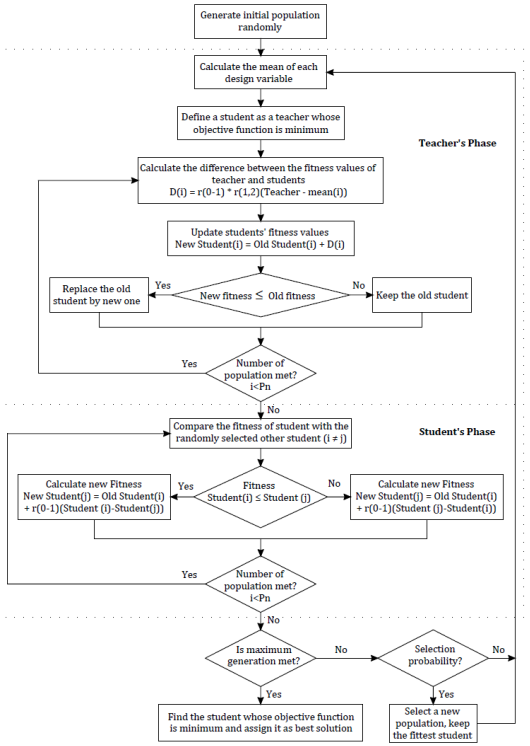
Figure 4 shows a flowchart of the hybrid TLBO algorithm, where r(0, 1) denotes a probability between 0 and 1, r(1, 2) denotes a probability of selecting either 1 or 2, and mean(i) denotes the average fitness across the population.
Figure 4. The flowchart of hybrid TLBO.
5. Effectiveness of Hybrid TLBO
In this study, the hybrid TLBO is compared with other optimization methods to assess the effectiveness of the proposed modifications. Two common benchmark examples, with and without a shear key, are used by many researchers and employed in this study to evaluate the effectiveness of Hybrid-TLBO.
Example 1
Example 1 is the design of an RC cantilevered retaining wall without a shear key. The objective function considers only the weight of the wall's concrete and steel per unit length. Table 2 lists the geotechnical and cost parameters. Table 3 lists the upper and lower limits on geometric design variables; the design considers a 10mm increment for all dimensions.
Table 2. RC Cantilevered Retaining Walls Parameters for Example 1.

Parameters

Symbol

Value

Unit

Arm height

H

3

m

Depth of soil in front of the wall

D

0.5

m

Surcharge load

Q

20

kPa

Cohesion of the base soil

cbase

125

kPa

Internal friction angle of base soil

φbase

0

°

Internal friction angle of retaining soil

φ

36

°

Compressive strength of concrete

fc

21

MPa

Yield strength of reinforcing steel

fy

400

MPa

Concrete cover

cc

70

mm

Percentage of shrinkage and temperature reinforcement

ρst

0.002

-

Backfill slope

B

10

°

Unit weight of retained soil

γfill

17.5

kN/m3

Unit weight of base soil

γbase

18.5

kN/m3

Unit weight of concrete

γC

23.5

kN/m3

Unit weight of steel

Gs

78.5

kN/m3

Factor of safety for overturning stability

FSO

1.5

-

Factor of safety for sliding

FSS

1.5

-

Factor of safety for soil bearing capacity

FSB

1.5

-

Cost of steel

CS

0.4

USD/kg

Cost of concrete

CC

40

USD/m3

Table 3. Limits of geometric design variables.

Design Variable

Unit

Lower Limit

Upper Limit

X1

mm

1,309

2,333.3

X2

mm

436.3

777.7

X3

mm

200

333.3

X4

mm

200

333.3

X5

mm

272.2

333.3

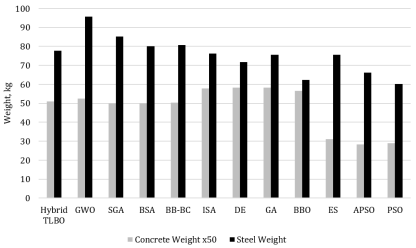
In this example, the maximum and minimum selection probabilities are 80% and 0.05%, respectively, with NG = 30. The population size is 120, and the algorithm runs for 200 generations. Table 4 compares the design developed by the hybrid TLBO algorithm with those of other optimization methods. The comparisons are made with grey wolf optimization (GWO) by Kalemci , search group algorithm (SGA) and backtracking search algorithm (BSA) by Lopez , big bang-big crunch (BB-BC) optimization by Camp and Akin , interior search algorithm (ISA) by Gandomi et al. , differential evolution (DE), genetic algorithm (GA), biogeography based optimization algorithm (BBO) and evolutionary strategy (ES) by Gandomi et al. , and accelerated particle swarm optimization (APSO) and particle swarm optimization (PSO) algorithm by Gandomi et al. . Figure 5 compares the results using the hybrid TLBO algorithm and other methods for low-cost designs.
Table 4. Low-weight design for RC wall without shear key.

Search Technique

X1 mm

X2 mm

X3 mm

X4 mm

X5 mm

R1

R2

R3

Cost

Hybrid TLBO Min Cost

1,740

660

270

200

270

15-ϕ10mm

10-ϕ10mm

10-ϕ10mm

$70.92

Hybrid TLBO Min Weight

1,740

700

210

200

270

14-ϕ12mm

10-ϕ10mm

10-ϕ10mm

$74.47

GWO

1,800

670

210

200

280

28-ϕ10mm

3-ϕ18mm

3-ϕ18mm

$83.00

SGA

1,710

650

200

200

270

27-ϕ10mm

12-ϕ10mm

10-ϕ10mm

$76.84

BSA

1,710

640

200

200

270

27-ϕ10mm

9-ϕ10mm

10-ϕ10mm

$74.50

BB-BC

1,740

650

200

200

270

27-ϕ10mm

10-ϕ10mm

10-ϕ10mm

$70.96

ISA

1,840

750

290

200

270

6-ϕ16mm

3-ϕ18mm

3-ϕ18mm

$73.06

DE

1,870

620

290

200

270

6-ϕ16mm

4-ϕ16mm

5-ϕ14mm

$75.49

GA

1,910

580

270

200

280

17-ϕ10mm

8-ϕ12mm

3-ϕ18mm

$77.63

BBO

1,840

740

270

200

270

16-ϕ10mm

9-ϕ10mm

9-ϕ10mm

$73.08

ES

1,840

690

320

220

280

9-ϕ12mm

6-ϕ14mm

7-ϕ14mm

$78.07

APSO

1,840

570

270

200

270

17-ϕ10mm

13-ϕ10mm

10-ϕ10mm

$73.06

PSO

1,840

740

290

200

270

15-ϕ10mm

9-ϕ10mm

9-ϕ10mm

$73.06

Figure 5. Comparisons of design weight between the Hybrid TLBO and other search techniques for retaining walls without a shear key.
Using weight as the objective function in minimization leads to a higher cost. Since the objective function treats the weight of concrete and steel similarly, the higher the steel weight, the more costly the design. On the other hand, if cost minimization is the objective, a higher concrete weight is preferred, as it reduces the design cost. Hybrid TLBO generates a design with material costs of 74.47 USD ($40/concrete volume and $0.4/steel weight) for weight minimization. In contrast, the material cost for cost minimization is 70.92 USD, slightly lower than the best cost-minimizing BB-BC result ($70.96).
In this example, the significant difference between hybrid TLBO and other optimization methods was that three strength constraints approached 100% of their capacity, indicating an optimal or near-optimal solution. Table 5 lists those constraints above 90% of the maximum limit for various optimization techniques. As shown in Table 5, several optimization methods violated constraints below the 5% acceptable range in practice. The best designs, including those generated by the hybrid TLBO algorithm, maximized the sliding, bearing, and arm moment capacities. A few designs reached near capacity for the heel moment.
Table 5. Controlling constraints and the ratio applied to the capacity value.

Search Technique

Sliding

Bearing

Arm Moment

Heel Moment

SD of Minimum Cost

SD of Minimum Weight

Hybrid TLBO

99.70%

98.82%

99.13%

89.06%

0.1269

0.3068

GWO

94.92%

-

-

SGA

99.12%

Violation

97.39%

95.62%

-

-

BSA

98.68%

Violation

97.39%

97.85%

-

-

BB-BC

97.50%

Violation

97.39%

Violation

0.57

5.89

ISA

98.71%

0.2761

10.4974

DE

98.71%

1.67

33.83

GA

92.01%

1.6

33.99

BBO

97.77%

95.70%

98.54%

0.827

30.45

ES

95.85%

1.308

34.23

APSO

90.92%

96.70%

2.279

12.918

PSO

98.27%

93.85%

0.136

0.345

This study also examined the effectiveness of selection probability on the algorithm's performance. Table 6 lists the weight and cost optimization results with and without population selection probability. The multi-population strategy generated lower mean and standard deviation (SD) values for weight and cost optimization. Comparing the hybrid TLBO SD values with those of other optimization methods in Table 5 shows improvements of 6.7% over the best PSO cost-minimization result and 11.1% over the PSO weight-minimization result. Furthermore, selecting the reinforcement area from the list of reinforcement configurations has eliminated 4 of 18 constraint checks in Example 1, saving 22% in constraint value computation in each generation of hybrid TLBO.
Table 6 shows the results of changes in the traditional TLBO.
Table 6. Results of variables' effect on Hybrid TLBO.

Objective

Variables

Mean

Median

Fitness Value

Standard Deviation

Weight Minimization

Multi-Population Selections

2,627.5

2,627

2,627

0.3068

Single Population Selection

2,627.8

2,627

2,627

0.6052

Cost Minimization

Multi-Population Selections

$71.00

$70.92

$70.92

0.1269

Single Population Selection

$71.05

$70.92

$70.92

0.8355

Example 2 is the design of an RC cantilevered retaining wall with a shear key. The objective function considers only the weight of the wall's concrete and steel per unit length. Table 7 lists the geotechnical and cost parameters. Table 8 lists the upper and lower limits on geometric design variables; the design considers a 10mm increment in all dimensions. In this example, the maximum and minimum selection probabilities are 80% and 0.05%, respectively, with NG = 30. The population size is 200, and the algorithm is run for 200 generations.
Table 7. RC Cantilevered Retaining Walls Parameters for Example 2.

Parameters

Symbol

Value

Unit

Arm height

H

4.5

m

Depth of soil in front of the wall

D

0.3

m

Surcharge load

Q

30

kPa

Cohesion of the base soil

cbase

0

kPa

Internal friction angle of base soil

φbase

34

°

Internal friction angle of retaining soil

φ

28

°

Compressive strength of concrete

fc

21

MPa

Yield strength of reinforcing steel

fy

400

MPa

Concrete cover

cc

70

mm

Percentage of shrinkage and temperature reinforcement

ρst

0.002

-

Backfill slope

β

0

°

Unit weight of retained soil

γfill

18.5

kN/m3

Unit weight of base soil

γbase

17

kN/m3

Unit weight of concrete

γC

23.5

kN/m3

Unit weight of steel

Gs

78.5

kN/m3

Factor of safety for overturning stability

FSO

1.5

-

Factor of safety for sliding

FSS

1.5

-

Factor of safety for soil bearing capacity

FSB

1.5

-

Cost of steel

CS

0.4

USD/kg

Cost of concrete

CC

40

USD/m3

Table 8. Limits of geometric design variables.

Design Variable

Unit

Lower Limit

Upper Limit

X1

mm

1,960

5,500

X2

mm

650

1,160

X3

mm

250

500

X4

mm

250

500

X5

mm

400

500

X6

mm

1,960

5,500

X7

mm

200

500

X8

mm

200

500

Table 9 compares the results of Hybrid TLBO with those of other optimization methods. The comparisons are made with grey wolf optimization (GWO) by Kalemci et al. , the search group algorithm (SGA) and the backtracking search algorithm (BSA) by Lopez , and big bang-big crunch (BB-BC) optimization by Camp and Akin .
Table 9. Low-weight design for RC wall with a shear key.

Search Technique

X1 mm

X2 mm

X3 mm

X4 mm

X5 mm

X6 mm

X7 mm

X8 mm

R1

R2

R3

R4

Cost

Hybrid TLBO Min Cost

3,290

1,150

490

250

490

1,960

200

490

17-ϕ14mm

21-ϕ10mm

16-ϕ12mm

7-ϕ10mm

$206.75

Hybrid TLBO Min Weight

3,280

1,150

480

250

490

1,960

200

490

5-ϕ25mm

21-ϕ10mm

16-ϕ12mm

7-ϕ10mm

$212.96

GWO

3,210

660

390

250

470

2,490

200

490

19-ϕ16mm

20-ϕ10mm

21-ϕ12mm

4-ϕ12mm

$234.33

SGA

3,450

650

410

250

420

2,320

200

500

22-ϕ14mm

20-ϕ10mm

24-ϕ12mm

27-ϕ10mm

$233.81

BSA

3,460

650

410

250

420

2,720

200

500

30-ϕ12mm

16-ϕ10mm

25-ϕ12mm

6-ϕ10mm

$244.21

BB-BC

3,760

680

410

250

400

3,220

200

490

22-ϕ14mm

18-ϕ10mm

20-ϕ14mm

6-ϕ10mm

$233.81

Table 10 shows the results of changes in the traditional TLBO.
Table 10. Results of variables' effect on Hybrid-TLBO for retaining wall with a shear key.

Objective

Variables

Mean

Median

Fitness Value

SD

Weight Minimization

Multi-Population Selections

7,875.5

7,844.2

7,844.2

0.9318

Single Population Selection

7,987.4

7,844.2

7,844.2

1.8356

Cost Minimization

Multi-Population Selections

$213.83

$206.75

$206.75

3.4261

Single Population Selection

$216.20

$206.75

$206.75

4.5800

As shown in Table 11, the controlling constraints, those exceeding 90% of capacity, for the design of the RC retaining wall with a shear key are bearing, arm moment, shear, and heel moment. A few optimization methods violated constraints; however, their values are below the 5% acceptable range in practice. The hybrid TLBO developed better designs when minimizing the cost. Three strength constraints reached nearly 100% capacity, indicating that the design is optimal or near-optimal.
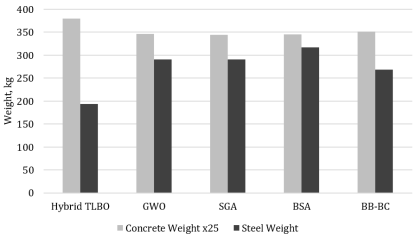
The design obtained for cost minimization uses less steel and more concrete than weight minimization, and a higher amount of concrete since the steel price per unit weight is higher than that of concrete. In addition, the variation of solutions obtained from hybrid TLBO is lower than that of other optimization methods, as indicated by the lower SD values. There is an 84.2% improvement in the SD values, indicating that the design results are very close across runs. Furthermore, using a feasible list of reinforcement configurations eliminated 4 of 20 constraint checks in Example 2, saving 20% in constraint-value computation in each generation of the hybrid TLBO.
Figure 6 compares the results of hybrid TLBO and other optimization methods for low-weight designs.
Table 11. Controlling constraints and the ratio applied to the capacity value with a shear key.

Search Technique

Bearing

Arm Moment

Arm Shear

Heel Moment

Heel Shear

SD

Hybrid TLBO Min Weight

90.92%

99.8%

91.4%

99.65%

3.4261

Hybrid TLBO Min Cost

99.97%

98.69%

99.46%

92.39%

0.9318

GWO

98.34%

91.55%

94.15%

Violation

Violation

-

SGA

94.8%

99.98%

Violation

-

BSA

90.2%

99.43%

93.03%

-

BB-BC

93.76%

99.51%

93.08%

5.89

Figure 6. Comparisons of design weight between the Hybrid TLBO and other search techniques for retaining wall with a shear key.

6. Conclusion
This study presented a modified TLBO approach for the optimal design of RC retaining walls, demonstrating both improved computational efficiency and solution quality. The proposed hybrid method integrates a multi-selection population strategy and a predefined feasible reinforcement configuration list, addressing two key limitations in conventional optimization approaches: premature convergence and excessive computational cost associated with constraint checking.
The results confirm that the hybrid TLBO significantly enhances the exploration of the design space while maintaining robust convergence toward near-optimal solutions. Compared to established optimization techniques, the method consistently achieved lower standard deviation values, indicating improved stability and reliability of the solutions. Moreover, several governing constraints approached their capacity limits, which is a strong indicator of optimal or near-optimal structural performance. The introduction of the feasible reinforcement configuration list reduced the number of constraint evaluations by approximately 20%, thereby improving computational efficiency without compromising design accuracy.
From a practical design perspective, the findings reinforce that cost-based optimization yields more economical solutions than weight minimization, primarily because of the relative cost differences between steel and concrete. The hybrid TLBO method, therefore, provides a balanced and efficient framework for achieving cost-effective, structurally sound retaining wall designs.
Overall, the proposed approach offers a reliable and efficient tool for structural optimization of RC retaining walls and has strong potential for broader application in other civil engineering optimization problems. Future research can extend this work by incorporating multi-objective optimization (e.g., cost, sustainability, and CO₂ emissions) and by applying the methodology to more complex geotechnical conditions, dynamic loading scenarios, and real-world design case studies.
Abbreviations

RC

Reinforced Concrete

TLBO

Teaching-Learning-Based Optimization

Hybrid TLBO

Modified Teaching-Learning-Based Optimization

GWO

Grey Wolf Optimization

SGA

Search Group Algorithm

BSA

Backtracking Search Algorithm

BB-BC

Big Bang–Big Crunch Optimization

ISA

Interior Search Algorithm

DE

Differential Evolution

GA

Genetic Algorithm

BBO

Biogeography-Based Optimization

ES

Evolutionary Strategy

APSO

Accelerated Particle Swarm Optimization

PSO

Particle Swarm Optimization

CO₂

Carbon Dioxide

ACI

American Concrete Institute

SFS

Safety Factor for Sliding

SFB

Safety Factor for Bearing

FSO

Factor of Safety for Overturning

FSS

Factor of Safety for Sliding

Author Contributions
Honar Issa: Formal Analysis, Methodology, Software, Validation, Visualization, Writing – original draft
Charles Camp: Conceptualization, Methodology, Supervision, Validation, Writing – review & editing
Conflicts of Interest
The authors declare that there are no conflicts of interest regarding the publication of this paper. The research presented in this study was conducted independently, and no financial, personal, or institutional relationships influenced the design, analysis, or reporting of the results.
References
[1] C. V. Camp and A. Akin, "Design of retaining wall using big bang-big crunch optimization," Journal of Structural Engineering, vol. 138, no. 3, pp. 438 - 448, 2012.
[2] A. Kaveh and N. Farhoudi, "Dolphin echolocation optimization for design of cantilever retaining walls," Asian Journal of Civil Engineering, vol. 17, no. 2, pp. 193 - 211, 2016.
[3] R. Temür and G. Bekdaş, "Teaching learning-based optimization for design of cantilever retaining walls," Structural Engineering and Mechanics, vol. 57, no. 4, pp. 763 - 783, 2016.
[4] A. Kaveh and A. Shakouri Mahmud Abadi, "Harmony search based algorithms for the optimum cost design of reinforced concrete cantilever retaining walls," International Journal of Civil Engineering, vol. 9, no. 1, pp. 1 - 8, 2010.
[5] A. E. Kayabekir, Z. A. Arama, G. Bekdas, S. M. Nigdeli, and Z. W. Geem, "Eco-friendly design of reinforced concrete retaining walls: multi-objective optimization with harmony search applications," Sustainability, vol. 12, no. 6087, pp. 1 - 30, 2020.
[6] E. N. Kalemci, S. B. İkizler, T. Dede, and Z. Angın, "Design of reinforced concrete cantilever retaining wall using Grey Wolf Optimization algorithm," Structures, no. 23, pp. 245 - 253, 2020.
[7] V. Nandha Kumar and C. R. Suribabu, "Optimal design of cantilever retaining wall using differential evolution algorithm," International Journal of Optimization in Civil Engineering, vol. 7, no. 3, pp. 433-449, 2017.
[8] A. H. Gandomi, A. R. Kashani, and F. Zeighami, "Retaining wall optimization using interior search algorithm with different bound constraint handling," International Journal for Numerical and Analytical Methods in Geomechanics, vol. 44, no. 11, pp. 1304-1331, 2017.
[9] G. Bekdaş, S. M. Nigdeli, R. Temür, and A. E. Kayabekir, "Restricted optimum design of reinforced concrete retaining walls," International Journal of Theoretical and Applied Mechanics, vol. 1, pp. 326-332, 2016.
[10] H. K. Issa, "Simplified structural analysis of steel portal developed from structural optimization," Computer Aided Optimum Design in Engineering, vol. 125, pp. 47-58, 2012.
[11] A. H. Gandomi, A. R. Kashani, D. A. Roke, and M. Mousavi, "Optimization of retaining wall design using recent swarm intelligence techniques," Engineering Structures, vol. 103, pp. 72-84, 2015.
[12] A. H. Gandomi, A. R. Kashani, D. A. Roke, and M. Mousavi, "Optimization of retaining wall design using evolutionary algorithms," Structural and Multidisciplinary Optimization, vol. 55, no. 3, pp. 809-825, 2017.
[13] C. V. Camp and M. Farshchin, "Design of space trusses using modified teaching-learning based optimization," Engineering Structures, Vols. 62 - 63, pp. 87 - 97, 2014.
[14] R. V. Rao and V. Patel, "Multi-objective optimization of two stage thermoelastic cooler using a modified teaching-learning based optimization algorithm," Engineering Application of Artificial Intelligence, vol. 26, no. 1, pp. 430 - 445, 2013.
[15] A. C. Institute, Building Code Requirements for Structural Concrete, Detroit, 2019.
[16] R. V. Rao, V. J. Savsani and D. P. Vakharia, "Teaching–learning-based optimization: A novel method for constrained mechanical design optimization problems," Computer-Aided Design, vol. 43, pp. 303 - 315, 2011.
[17] H. K. Issa and F. Mohammad, "Effect of mutation schemes on convergence to optimum design of steel frames," Journal of Constructional Steel Research, vol. 66, pp. 954-961, 2010.
[18] H. R. Lopez, "Optimum project of cantilever retaining wall using search group algorithm and backtracking search algorithm," International Journal of Numerical Methods for Calculation and Design in Engineering, 2017.
Cite This Article
  • APA Style

    Issa, H., Camp, C. (2026). Design of Reinforced Concrete Retaining Wall by Hybrid Teaching Learning Based Optimization. American Journal of Civil Engineering, 14(3), 134-148. https://doi.org/10.11648/j.ajce.20261403.11

    Copy | Download

    ACS Style

    Issa, H.; Camp, C. Design of Reinforced Concrete Retaining Wall by Hybrid Teaching Learning Based Optimization. Am. J. Civ. Eng. 2026, 14(3), 134-148. doi: 10.11648/j.ajce.20261403.11

    Copy | Download

    AMA Style

    Issa H, Camp C. Design of Reinforced Concrete Retaining Wall by Hybrid Teaching Learning Based Optimization. Am J Civ Eng. 2026;14(3):134-148. doi: 10.11648/j.ajce.20261403.11

    Copy | Download

  • @article{10.11648/j.ajce.20261403.11,
      author = {Honar Issa and Charles Camp},
      title = {Design of Reinforced Concrete Retaining Wall by Hybrid Teaching Learning Based Optimization},
      journal = {American Journal of Civil Engineering},
      volume = {14},
      number = {3},
      pages = {134-148},
      doi = {10.11648/j.ajce.20261403.11},
      url = {https://doi.org/10.11648/j.ajce.20261403.11},
      eprint = {https://article.sciencepublishinggroup.com/pdf/10.11648.j.ajce.20261403.11},
      abstract = {Reinforced concrete (RC) retaining walls are widely used in civil engineering applications, where economical and efficient designs are essential, given their extensive use and material demands. This study aims to optimize the weight and cost of RC cantilever retaining walls by developing a hybrid Teaching–Learning-Based Optimization (TLBO) algorithm with enhanced performance characteristics. The proposed method introduces a multi-population selection strategy that improves exploration of the design space in early iterations and promotes convergence in later stages. In addition, a pre-generated list of feasible reinforcement configurations is incorporated to eliminate repetitive constraint checks, thereby reducing computational effort. The optimization framework considers both geotechnical and structural constraints, including stability against sliding and overturning, bearing capacity, and compliance with ACI 318-19 design requirements. Two benchmark problems—retaining walls with and without a shear key—are analyzed to evaluate the effectiveness of the proposed hybrid TLBO. The results are compared with several established optimization techniques, including genetic algorithms, particle swarm optimization, grey wolf optimization, and other heuristic methods. The findings demonstrate that the hybrid TLBO algorithm provides more consistent, near-optimal solutions, as indicated by lower standard deviation values and improved convergence. The optimized designs achieve reduced cost and weight while satisfying all design constraints, with several critical constraints approaching their capacity limits, indicating optimal resource utilization. Furthermore, the proposed modifications reduce computational time by eliminating up to 20% of constraint evaluations. Overall, the study confirms that the hybrid TLBO approach is a robust and efficient tool for the optimal design of RC retaining walls, offering superior performance compared to conventional optimization methods.},
     year = {2026}
    }
    

    Copy | Download

  • TY  - JOUR
    T1  - Design of Reinforced Concrete Retaining Wall by Hybrid Teaching Learning Based Optimization
    AU  - Honar Issa
    AU  - Charles Camp
    Y1  - 2026/05/13
    PY  - 2026
    N1  - https://doi.org/10.11648/j.ajce.20261403.11
    DO  - 10.11648/j.ajce.20261403.11
    T2  - American Journal of Civil Engineering
    JF  - American Journal of Civil Engineering
    JO  - American Journal of Civil Engineering
    SP  - 134
    EP  - 148
    PB  - Science Publishing Group
    SN  - 2330-8737
    UR  - https://doi.org/10.11648/j.ajce.20261403.11
    AB  - Reinforced concrete (RC) retaining walls are widely used in civil engineering applications, where economical and efficient designs are essential, given their extensive use and material demands. This study aims to optimize the weight and cost of RC cantilever retaining walls by developing a hybrid Teaching–Learning-Based Optimization (TLBO) algorithm with enhanced performance characteristics. The proposed method introduces a multi-population selection strategy that improves exploration of the design space in early iterations and promotes convergence in later stages. In addition, a pre-generated list of feasible reinforcement configurations is incorporated to eliminate repetitive constraint checks, thereby reducing computational effort. The optimization framework considers both geotechnical and structural constraints, including stability against sliding and overturning, bearing capacity, and compliance with ACI 318-19 design requirements. Two benchmark problems—retaining walls with and without a shear key—are analyzed to evaluate the effectiveness of the proposed hybrid TLBO. The results are compared with several established optimization techniques, including genetic algorithms, particle swarm optimization, grey wolf optimization, and other heuristic methods. The findings demonstrate that the hybrid TLBO algorithm provides more consistent, near-optimal solutions, as indicated by lower standard deviation values and improved convergence. The optimized designs achieve reduced cost and weight while satisfying all design constraints, with several critical constraints approaching their capacity limits, indicating optimal resource utilization. Furthermore, the proposed modifications reduce computational time by eliminating up to 20% of constraint evaluations. Overall, the study confirms that the hybrid TLBO approach is a robust and efficient tool for the optimal design of RC retaining walls, offering superior performance compared to conventional optimization methods.
    VL  - 14
    IS  - 3
    ER  - 

    Copy | Download

Author Information