Research Article | | Peer-Reviewed

Whitefly–Natural Enemy Dynamics and Cassava Mosaic Disease Evaluated Under Field Condition in Sierra Leone

Received: 11 December 2025     Accepted: 25 December 2025     Published: 19 January 2026
Views:       Downloads:
Abstract

Bemisia tabaci is a major pest of cassava in sub-Saharan Africa, causing yield losses through direct feeding and its role in transmitting cassava mosaic disease (CMD). Natural enemies such as lacewings, ladybird beetles, and spiders provide valuable biological control services, yet their interactions with different whitefly developmental stages and plant structural traits remain insufficiently characterized. This study examined the dynamics among natural enemies, whitefly eggs, nymphs, adults, and plant height across 3, 6, 9, and 12 months after planting (MAP) under field conditions. The trial was conducted under natural cassava production conditions during 2020/2021 cropping season at the upland experimental site of the School of Agriculture and Food Sciences, Njala University. A total of 270 cassava genotypes comprising 268 local varieties and 2 improved checks (SLICASS 4 and SLICASS 6) were laid out in an augmented randomized design with four blocks. Results showed that lacewings and spiders strongly tracked nymph and adult whitefly populations, while ladybird beetles showed weaker associations. Principal Component Analysis (PCA) revealed alignment of predators with pest pressure during mid- and late season, whereas plant height exhibited minimal influence. Findings underscore the central role of lacewings and spiders in early and sustained suppression of whitefly populations, highlighting the importance of conservation-based integrated pest management (IPM) strategies. Findings serve as useful guide for conservation biological control as a primary IPM strategy for the enhancement of habitats for effective predators (lacewings and spiders) of the whitefly through reduced pesticide use, ground vegetation retention, intercropping, and maintenance of natural refuge habitats.

Published in American Journal of Entomology (Volume 10, Issue 1)
DOI 10.11648/j.aje.20261001.11
Page(s) 1-15
Creative Commons

This is an Open Access article, distributed under the terms of the Creative Commons Attribution 4.0 International License (http://creativecommons.org/licenses/by/4.0/), which permits unrestricted use, distribution and reproduction in any medium or format, provided the original work is properly cited.

Copyright

Copyright © The Author(s), 2026. Published by Science Publishing Group

Keywords

Natural Enemies, Whitefly Developmental Stages, Cassava Mosaic Disease, Prevalence, Correlation, Cassava

1. Introduction
Bemisia tabaci (Gennadius) (Hemiptera: Aleyrodidae) is an insect pest species complex that causes widespread damage to cassava cultivated around the globe including Africa . Bemisia tabaci directly damages the cassava during fecundation, and the excretion of a sugar-rich honey dew acts as a substrate for development of sooty mould that reduces both respiration and photosynthesis . In addition, the B. tabaci serves as a vector of many plant viruses that cause the cassava mosaic disease (CMD) and cassava brown streak disease (CBSD), that in combination lead to significant storage root yield loss in cassava . Despite substantial efforts deployed in developing virus-resistant cassava genotypes, more research efforts aimed at understanding the whitefly vector, which can reduce yields by 40% are still needed . This disproportionation technique to managing insect vectored plant diseases is usual, leading to management strategies that are unsustainable.
Arthropod parasitoids and predators are ubiquitous and operate continuously on all life stages of the B. tabaci, and function as control factors in the process. Biological control strategy often targets better exploitation of this behavior in order to more effectively manage pests and reduce insecticide use. Biological control of whiteflies and other pests has been pursued through observation and utilization of natural enemies , through analysis of existing agroecosystems or through search for and introduction of natural enemies , indicating which key factors control the pest. Natural enemies such as lacewings (Chrysopidae), ladybird beetles (Coccinellidae), and spiders (Araneae) can significantly reduce whitefly populations through predation on eggs, nymphs, and occasionally adults. Lacewings have been known for their voracious larval feeding on soft-bodied insects , whereas spiders function as generalist predators capable of suppressing early pest colonization . On the other hand, Ladybird beetles exhibit broader prey preferences, which may reduce their functional overlap with whitefly control . Implementation of the biological control has resulted from habitat manipulation to favor or conserve existing species, introduction of new species, and mass rearing and release of both .
The choice of which natural enemy or combination to use, and whether to only conserve the existing complex or augment numbers or species is often complex. Decisions should be made only after analysis of the efficacy of present pest-enemy interactions, including specific observations and life-table analytical studies. For instance, Naranjo et al. have shown, using life table analysis, a marked influence of factors such as plant species upon effectiveness of the natural enemy complex in managing B. tabaci.
The driving force behind conducting biological studies on B. tabaci enemies is, in addition to overall scientific interest, the desire to improve pest control. This is reflected in both the organisms studied and the kinds of studies conducted. Predators that have proven to be readily exploitable for mass culture– and manipulation in greenhouse agriculture– have been used most often in mass rearing and behavior investigations following host plant and compatibility studies. Studies on parasitoids, of which only three species have been commercially employed so far, incorporate several additional well-known and “hopeful” species. These studies include additional basic behavioral observations disclosing why these species do not always provide adequate control. Indigenous predators and parasitoids are present and active in all agroecosystems, even if in low numbers.
A number of factors, working either in isolation or combination, influence the abundance of B. tabaci in cassava . These factors include the biotic (cassava cultivar, cassava age, cassava virus infection status, non-cassava host plants, natural enemies, competition with other herbivores and endosymbionts), abiotic (altitude, climate and weather) and other factors such as pesticides and hybridization . Over the years, whitefly outbreaks have intensified due to climate variability, changing cropping systems, and expansion of susceptible cassava cultivars . Plant structural traits, including height and canopy architecture, have also been noted to influence predator access, microhabitat suitability, and whitefly colonization . However, dearth of information exists on the prevalence of natural enemies of whitefly developmental stages and the degree to which plant height shapes seasonal predator-prey interactions in cassava. In the present study, it was hypothesized that functional relationship exists among whitefly developmental stages, natural enemies and cassava mosaic disease (CMD) across key cassava growth phases. Moreover, Predator Abundance influences whitefly population dynamics under field conditions. The unraveling of such knowledge would contribute to conservation biological control that is imperative in the IPM strategy for the suppression of pest populations. Thus, the objective of this study was to assess the prevalence of natural enemies of whitefly developmental stages and cassava mosaic disease in cassava grown under field conditions.
2. Materials and Methods
2.1. Experimental Site
The field trial was established at the upland experimental site of the School of Agriculture and Food Sciences Experimental site, Njala University, Njala Campus, Njala, Southern Sierra Leone during the 2020/2021 cropping season. The site is located at an elevation of approximately 50 meters above sea level, at latitude 8°6′ N and longitude 12°6′ W. The experimental site is predominantly covered by secondary bush vegetation. The area experiences a rainy season from April to November and a dry season extending from October to May. The soil type, temperature range, and prevailing humidity during the experimental season were typical of cassava-producing regions in sub-Saharan Africa and comparable to environmental conditions noted in previous whitefly-CMD epidemiological studies . The region experiences a wet season from May to October, with rainfall often exceeding 2,000 mm annually, while temperature ranges between 25-29°C and a dry season from November to April, marked by reduced precipitation and occasional dry winds .
2.2. Experimental Material, Design, Layout and Management
The experimental materials included stem cuttings of 268 cassava genotypes, collected from all districts of Sierra Leone and 2 improved released varieties (SLICASS 4 and SLICASS 6) utilized as checks. The experiment was laid out in an augmented randomized design with four blocks, each measuring 28 m × 10 m with 1 m distance between the blocks. This enabled robust assessment of block effects (microenvironment) and treatment effects (genotype), consistent with modern entomological field methods . The total experimental area utilized was 43 m × 28 m. About 10 stem cuttings per genotype, each measuring 30 cm in length, were planted on a standard plot size of 10 m long ridges while uniform plant-to-plant and row spacing was used 1 m × 1 m spatial arrangement. No irrigation was done and manual weeding schedule was employed monthly with no fertilizer and pesticide application to avoid interference with the natural whitefly vectors and the resultant disease dynamics. Sampling took place at 3, 6, 9, and 12 months after planting (MAP), representing early, mid, peak, and late cassava growth stages.
2.3. Data Collection
2.3.1. Assessment of Whitefly Developmental Stages and Natural Enemies
Whitefly eggs, nymphs, and adults were counted directly from the abaxial surfaces of leaves following standard procedures recommended for cassava entomological surveillance . Using a hand lens with 20x magnification, large and visible whitefly nymphs between the central and left-side main veins on the underside of the fifth main stem were tallied across experimental sites . Ten leaves per plant (top, middle, bottom strata) were assessed to capture vertical distribution.
Natural enemies such as lacewings (Chrysopidae), ladybird beetles (Coccinellidae), and spiders (Araneae) were visually counted on sampled plants. Predators were identified to family level using field keys developed by Kumar et al. . Sampling was conducted during morning hours to minimize disturbance.
2.3.2. Assessment of Cassava Mosaic Virus Infection and Plant Height Parameters
CMD severity was scored on a 1-5 scale using the IITA standard scoring system . Incidence was calculated as the percentage of plants showing symptoms within each plot.
Plant height was measured from soil surface to the apical meristem using a meter rule. Plant height was included as a plant architectural variable influencing pest and predator dynamics .
2.4. Statistical Analysis
The principal component analysis (PCA) of the key traits studied was done using the stats and factoextra packages and the correlation coefficient for the association between different traits in R version 1.0.5.999 . The PCA was carried out to explore multivariate structure and identify dominant interactions. The statistical significance of the correlations was determined based on the standard guideline by Ratner where sets of traits with r-values ranging from 0 – 0.3 = weak positive or low color intensity, 0.3 – 0.7 medium positive or medium color intensity, and from 0.7 – 1 = strong positive or high color intensity; whereas those ranging from 0 – -0.3 = weak negative or low color intensity, -0.3 – -0.7 medium negative or medium color intensity, and from -0.7 – -1 = strong negative linear relationship or high color intensity. ANOVA was used to determine block and treatment effects on natural enemy abundance .
3. Results
3.1. Correlation Among Whitefly Developmental Stages and Natural Enemies
Whitefly developmental stage infestation and natural enemies’ parameters show dynamic correlations across the four growth phases of cassava (3, 6, 9 and 12-MAP) (Table 1). As the crop ages, these correlations were observed to change, providing insight on pest pressure and the role of natural enemies throughout sampling time. At 3 MAP (the early growth stage of the crop), whitefly nymphs and whitefly eggs had a medium positive association (r = 0.63***), suggesting early reproductive buildup or coordinated development between both life stages, whereas adults exhibited weak positive correlations with lacewing, lady bird beetle, and spider. Additionally, there is a weak positive correlation between adult whiteflies and nymphs (r = 0.22***) and eggs (r = 0.13*), indicating that early infestation is well established throughout all stages.
Table 1. Correlation coefficient among whitefly developmental stages and natural enemies sampled at 3, 6, 9 and 12 MAP.Correlation coefficient among whitefly developmental stages and natural enemies sampled at 3, 6, 9 and 12 MAP.Correlation coefficient among whitefly developmental stages and natural enemies sampled at 3, 6, 9 and 12 MAP.

Trait

LW

LBB

SP

NWE

NWN

NWA

Correlation coefficient at 3 MAP

LW

1.00

LBB

0.06

1.00

SP

0.22***

0.16*

1.00

NEW

0.09

0.09

0.15*

1.00

NWN

0.21***

0.19**

0.23***

0.63***

1.00

NWA

0.13*

0.15*

0.23***

0.13*

0.22***

1.00

Correlation coefficient at 6 MAP

LW

1.00

LBB

0.17***

1.00

SP

0.12*

0.17***

1.00

NEW

0.10

0.07

0.14*

1.00

NWN

0.21***

0.11

0.10

0.40***

1.00

NWA

0.22***

0.05

0.17***

0.22***

0.49***

1.00

Correlation coefficient at 9 MAP

LW

1.00

LBB

0.23

1.00

SP

0.22***

0.33***

1.00

NEW

-0.07

-0.15*

0.08

1.00

NWN

0.12

0.09

0.13*

0.24***

1.00

NWA

0.28***

0.08

0.07

0.13*

0.59***

1.00

Correlation coefficient at 12 MAP

LW

1.00

LBB

0.34***

1.00

SP

0.43***

0.47***

1.00

NEW

0.16**

0.42***

0.30***

1.00

NWN

0.35***

0.24***

0.26***

0.03

1.00

NWA

0.42***

0.24***

0.30***

-0.001

0.42***

1.00

*, **, and *** = significant at p < 0.05, 0.01, 0.001, respectively; LW=lacewing, LBB=lady bird beetle, SP=spider, NWE=number of whitefly eggs, NWN=number of whitefly nymph, NWA=number of whitefly adults
Interestingly, adult whiteflies had a weak and positive correlation with number of whitefly adults (r = 0.13*), ladybird beetles (r = 0.15*) and spider (r = 0.23***), respectively, suggesting that pest pressure is influenced by the occurrence, prevalence and activities of natural enemies. At 6-MAP, correlation patterns changed considerably. Adult whiteflies and nymphs (r = 0.49***), and between the eggs and nymphs (r = 0.40***) had a positively intermediate correlations, whereas their associations with their natural enemies were relatively weak positive (r < 0.30), highlighting the extent of influence of the natural enemies on the pest pressure. At 9-MAP, Correlations between natural enemy parameters and whitefly stages started to declining the mid-reproductive stage. The total strength of the correlations between adult whiteflies and nymphs (r = 0.59***) and illness severity (r = 0.17**) decreases. Additionally, a modest decrease in the correlation between severity and incidence (r = 0.17**) was observed suggesting a possible change in host resistance or disease progression.
Pest pressure was increasingly indicative of outcomes of the natural enemies at the transitional phase. The correlation between number of adult whitefly and ladybird beetle occurrence increased from r = 0.13* (3 MAP), r = 0.22*** (6 MAP), r = 0.28*** (9 MAP) to (r = 0.42***) at 12-MAP, the late growth stage, highlighting the incremental effect of ladybird beetle natural enemy on whitefly insect attacks. The correlations between adult whiteflies and ladybird beetle (r = 0.42***), spiders (r = 0.30***), number of whitefly nymphs (r = 0.42***); and between spiders and ladybird beetles (r = 0.47***), between spiders and lacewing (r = 0.43***); between ladybird beetle and lacewing (r = 0.34***); and between spiders and number of whitefly eggs (r = 0.30***) were intermediately positive. Findings imply that, especially during the early and late phases of cassava development, tracking the numbers of whitefly and their natural enemies may be a useful early warning system for their infestation and resultant disease outbreaks caused by the vector insects.
3.2. Variability in Whitefly Developmental Stages and Natural Enemies
The principal component analysis (PCA) illustrates how natural enemies, different developmental stages of whitefly, and plant height at 3 months after planting (MAP) are classified into primary components that account for the variability in the dataset (Table 2). The PC1, PC2, and PC3 had the highest eigenvalues (2.092, 1.659, and 1.312), and together represent approximately 56% of the total variance, with PC1 accounting for 23.2%, PC2 for 18.4%, and PC3 for 14.6%. Smaller eigenvalues, such as those for PC8 and PC9, contributed little and mainly captured minor variations. PC1 is heavily linked to whitefly stages, particularly nymphs and eggs, along with spiders and lacewings, signifying that these variables are the most significant contributors to the primary variation axis. PC2 is primarily influenced by disease severity mean and incidence, indicating that this component reflects the effect of CMD. PC3 is predominantly associated with plant height, demonstrating that growth performance is measured separately from pest pressures. Other components such as PC4 and PC5 reveal particular associations; for instance, ladybird beetles and spiders exhibit negative values, while plant height and lacewings show moderate associations. In summary, the analysis indicates that whitefly developmental stages and natural enemies are the principal factors driving variation in the system, whereas indicators of plant health like severity and incidence form a separate dimension, and plant height represents another distinct axis of variability.
Table 2. Variabilities in natural enemies and whitefly development stages sampled at 3 months after planting.Variabilities in natural enemies and whitefly development stages sampled at 3 months after planting.Variabilities in natural enemies and whitefly development stages sampled at 3 months after planting.

Variable

PC1

PC2

PC3

PC4

PC5

PC6

PC7

PC8

PC9

PHT

0.227

0.055

0.719

0.107

0.483

0.024

0.418

0.007

0.093

LW

0.503

0.244

0.352

0.48

0.054

0.373

0.415

0.113

0.07

LBB

0.428

0.084

0.231

0.786

0.06

0.325

0.151

0.017

0.078

SP

0.537

0.066

0.17

0.019

0.73

0.041

0.378

0.032

0.013

NEW

0.654

0.145

0.528

0.094

0.289

0.005

0.223

0.189

0.308

NWN

0.763

0.193

0.418

0.065

0.137

0.053

0.067

0.191

0.373

NWA

0.473

0.293

0.337

0.057

0.02

0.705

0.269

0.056

0.039

CMDS

0.269

0.841

0.04

0.011

0.005

0.163

0.023

0.404

0.167

CMDI

0.106

0.857

0.139

0.198

0.011

0.142

0.014

0.374

0.19

EV

2.092

1.659

1.312

0.916

0.875

0.794

0.64

0.393

0.319

PV

23.25

18.44

14.58

10.18

9.72

8.82

7.11

4.36

3.54

CV

23.25

41.68

56.26

66.44

76.16

84.98

92.09

96.46

100

*PHT=plant height, LW=lacewing, LBB=lady bird beetle, SP=spider, NWE=number of whitefly eggs, NWN=number of whitefly nymph, NWA=number of whitefly adults, CMDS= cassava mosaic virus severity, CMDI=cassava mosaic virus incidence, EV=eigen values, PV=proportion of variance, CV=cumulative variance.
At 6 MAP, PC1 had an eigenvalue of 2.567, accounting for the highest share of variance (28.5%), primarily influenced by stages of whiteflies, their severity, and incidence (Table 3). PC2 and PC3, which have eigenvalues of 1.273 and 1.030, contributed 14.1% and 11.4%, respectively, reflecting the impact of natural enemies like ladybird beetles and spiders. Collectively, the first three components encompassed over 54% of the overall variability, signifying that whitefly development and pest pressure were the primary factors, whereas plant height and specific predators exhibit stronger associations on subsequent components with lower eigenvalues, thereby contributing less to the total variation.
Table 3. Variabilities in natural enemies and whitefly development stages sampled at 6 months after planting.Variabilities in natural enemies and whitefly development stages sampled at 6 months after planting.Variabilities in natural enemies and whitefly development stages sampled at 6 months after planting.

Variable

PC1

PC2

PC3

PC4

PC5

PC6

PC7

PC8

PC9

PHT

-0.150

0.411

-0.151

0.772

0.328

0.277

-0.052

0.013

0.045

LW

0.375

0.382

0.280

0.135

-0.659

0.288

0.316

-0.003

0.024

LBB

0.170

0.604

0.435

0.061

0.043

-0.607

-0.198

0.065

0.015

SP

0.253

0.483

0.226

-0.501

0.476

0.389

0.107

-0.100

-0.051

NEW

0.463

0.271

-0.623

-0.096

0.094

-0.265

0.430

0.223

0.025

NWN

0.710

0.141

-0.386

0.018

-0.132

-0.071

-0.255

-0.487

-0.046

NWA

0.707

0.012

-0.118

-0.093

-0.104

0.256

-0.497

0.392

-0.007

CMDS

0.760

-0.369

0.256

0.103

0.211

-0.026

0.110

-0.053

0.387

CMDI

0.718

-0.361

0.268

0.281

0.184

-0.068

0.182

0.031

-0.362

EV

2.567

1.273

1.030

0.977

0.886

0.825

0.695

0.459

0.289

PV

28.53

14.14

11.44

10.85

9.84

9.16

7.72

5.10

3.22

CV

28.53

42.67

54.11

64.97

74.806

83.97

91.69

96.79

100

*PHT=plant height, LW=lacewing, LBB=lady bird beetle, SP=spider, NWE=number of whitefly eggs, NWN=number of whitefly nymph, NWA=number of whitefly adults, CMDS= cassava mosaic virus severity, CMDI=cassava mosaic virus incidence, EV=eigen values, PV=proportion of variance, CV=cumulative variance.
The PCA of natural enemies and the developmental stages of whiteflies at 9 MAP indicates that the initial five components collectively accounted for approximately 78% of the total variation, while the subsequent components contributed less (Table 4). The PC1, with an eigenvalue of 2.269, represents 25.2% of the variance and is characterized by high positive values from factors such as severity mean, the number of whitefly adults, the number of whitefly nymphs, and incidence. This shows that PC1 embodies the aspect of whitefly infestation intensity and disease severity mean, effectively capturing the overall pressure imposed by the pest population.
Table 4. Variabilities in natural enemies and whitefly development stages sampled at 9 months after planting.Variabilities in natural enemies and whitefly development stages sampled at 9 months after planting.Variabilities in natural enemies and whitefly development stages sampled at 9 months after planting.

Variable

PC1

PC2

PC3

PC4

PC5

PC6

PC7

PC8

PC9

PHT

-0.081

0.332

0.399

0.599

0.464

0.378

0.076

0.022

-0.029

LW

0.317

0.653

0.131

0.33

-0.06

-0.565

0.016

-0.131

0.08

LBB

0.307

0.572

-0.475

-0.213

-0.073

0.207

0.507

0.057

0.001

SP

0.289

0.571

-0.112

-0.461

0.391

0.082

-0.45

0.035

-0.052

NEW

0.262

-0.289

0.489

-0.405

0.523

-0.252

0.322

0.058

-0.013

NWN

0.691

-0.038

0.432

-0.178

-0.254

0.289

-0.02

-0.345

0.187

NWA

0.715

0.04

0.38

0.071

-0.383

0.031

-0.07

0.408

-0.14

CMDS

0.722

-0.317

-0.351

0.226

0.151

-0.033

-0

-0.215

-0.365

CMDI

0.637

-0.343

-0.434

0.248

0.267

-0.014

-0.07

0.161

0.354

EV

2.269

1.494

1.295

1.039

0.956

0.661

0.579

0.383

0.323

PV

25.21

16.60

14.39

11.55

10.63

7.34

6.44

4.25

3.59

CV

25.21

41.81

56.20

67.75

78.37

85.72

92.15

96.41

100

*PHT=plant height, LW=lacewing, LBB=lady bird beetle, SP=spider, NWE=number of whitefly eggs, NWN=number of whitefly nymph, NWA=number of whitefly adults, CMDS= cassava mosaic virus severity, CMDI=cassava mosaic virus incidence, EV=eigen values, PV=proportion of variance, CV=cumulative variance.
The PC2, with an eigenvalue of 1.494 and 16.6% of the variance, is closely linked to the populations of lacewings, ladybird beetles, and spiders, clearly reflecting the abundance of natural enemies. The third component, possessing an eigenvalue of 1.295 and explaining 14.4% of the variance, indicates positive relationships with plant height, whitefly eggs, and nymphs, while showing negative associations with ladybird beetles and incidence, suggesting a trade-off between plant growth and the initial pest stages on one side and the presence of predators and disease incidence on the other. The fourth component, which has an eigenvalue of 1.039 accounting for 11.5% of the variance, highlights plant vigor, as evidenced by its strong positive relationship with plant height, while contrasting with spider activity and egg density.
The PCA on natural enemies and the various developmental stages of whiteflies at 12 MAP revealed that the first four components collectively accounted for approximately 71.8% of the overall variability, while the remaining components had smaller percentage contributions (Table 5). The primary principal component, which has an eigenvalue of 2.528 accounting for 28.1% of the variance, is significantly influenced by strong positive associations from lacewing (0.719), ladybird beetle (0.698), spider (0.744), as well as whitefly adults (0.623) and nymphs (0.592). This suggests that PC1 reflects the relationship between predator abundance and the pressure exerted by the whitefly population. The second principal component, with an eigenvalue of 1.738 being responsible for 19.3% of the variance, is marked by very high associations from severity mean (0.888) and incidence (0.869), indicating that PC2 represents the aspects of disease severity and incidence. The third component, possessing an eigenvalue of 1.212 and accounting for 13.5% of the variance, is notably linked to whitefly eggs (0.723) and ladybird beetles (0.344), while showing negative associations with nymphs (-0.457) and adults (-0.456), demonstrating a contrast between early pest stages versus later pest stages or the presence of predators. The fourth component, with an eigenvalue of 0.984 and explaining 10.9% of the variance, is predominantly characterized by plant height (0.959), signifying that PC4 illustrates plant growth independently from dynamics of pests or predators. The remaining components each account for less than 8% of the variance and delineate finer distinctions.
Table 5. Variabilities in natural enemies and whitefly development stages sampled at 12 months after planting. Variabilities in natural enemies and whitefly development stages sampled at 12 months after planting. Variabilities in natural enemies and whitefly development stages sampled at 12 months after planting.

Variable

PC1

PC2

PC3

PC4

PC5

PC6

PC7

PC8

PC9

PHT

-0.0810

0.3320

0.3990

0.5990

0.4640

0.3780

0.0760

0.0220

-0.0290

LW

0.3170

0.6530

0.1310

0.3300

-0.0600

-0.5650

0.0160

-0.1310

0.0800

LBB

0.3070

0.5720

-0.4750

-0.2130

-0.0730

0.2070

0.5070

0.0570

0.0010

SP

0.2890

0.5710

-0.1120

-0.4610

0.3910

0.0820

-0.4500

0.0350

-0.0520

NEW

0.2620

-0.2890

0.4890

-0.4050

0.5230

-0.2520

0.3220

0.0580

-0.0130

NWN

0.6910

-0.0380

0.4320

-0.1780

-0.2540

0.2890

-0.0190

-0.3450

0.1870

NWA

0.7150

0.0400

0.3800

0.0710

-0.3830

0.0310

-0.0660

0.4080

-0.1400

CMDS

0.7220

-0.3170

-0.3510

0.2260

0.1510

-0.0330

-0.0040

-0.2150

-0.3650

CMDI

0.6370

-0.3430

-0.4340

0.2480

0.2670

-0.0140

-0.0730

0.1610

0.3540

EV

2.27

1.49

1.30

1.04

0.96

0.66

0.58

0.38

0.32

PV

25.21

16.60

14.39

11.55

10.63

7.34

6.44

4.25

3.59

CV

25.21

41.81

56.20

67.75

78.37

85.72

92.15

96.41

100.00

*PHT=plant height, LW=lacewing, LBB=lady bird beetle, SP=spider, NEW=number of whitefly eggs, NWN=number of whitefly nymph, NWA=number of whitefly adults, CMDS= cassava mosaic virus severity, CMDI=cassava mosaic virus incidence, EV=eigen values, PV=proportion of variance, CV=cumulative variance.
3.3. Analysis of Predator-Prey-Interactions
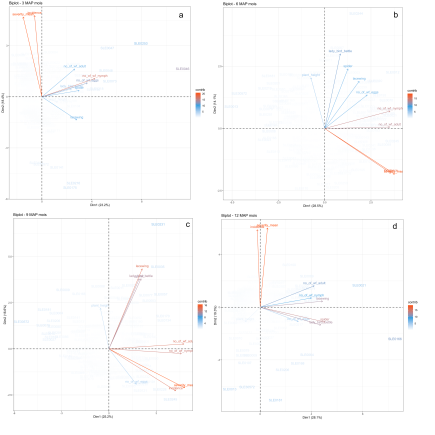
The multivariate analysis for predator-prey interactions displays distinct seasonal variations in the dynamics between pests and their natural enemies (Figure 1). The PCA reveals a very broad clustering of data points at 3 MAP, indicating that predator-prey interactions are still in their infancy.
Figure 1. Plots showing contributions of predator-prey interactions of traits to variability in cassava genotypes sampled at 3 MAP (PC1), 6 MAP (PC2), 9 MAP (PC3) and 12 MAP (PC4).Plots showing contributions of predator-prey interactions of traits to variability in cassava genotypes sampled at 3 MAP (PC1), 6 MAP (PC2), 9 MAP (PC3) and 12 MAP (PC4).
The moderate alignment of the vectors representing variables such as "whitefly adults" and "nymphs" suggests that these life stages co-occur and may be responsible for early pest pressure. Due to their delayed population growth or reduced ability to inhibit pests, natural enemies like lacewings and spiders could show weaker vector contributions at this point. The distance between clusters is more noticeable by 6 MAP. This can indicate a change in the ratio of predators to prey. For example, a rise in the vector strength of spiders and lacewings could be a sign of their increasing power to control whitefly populations. A divergence in ecological processes and active suppression can be seen if the vectors of whitefly eggs and nymphs point in the opposite directions from those of predators. The start of the effectiveness of biological control may occur at this period. The PCA shows higher vector alignment and closer grouping at 9 MAP, which may be a sign of stabilized predator-prey dynamics. While predator populations increase in response to earlier prey abundance, whitefly populations may have decreased as a result of persistent predation. The principal component, which is probably motivated by predator-prey feedback loops, appears to capture more of the system's structure as the explained variance increases along dimension1. With lengthy, but precisely oriented vectors for both the prey and predator variables, the biplot exhibits the clearest separation between clusters by 12 MAP. This indicates that the system has reached a mature ecological state in which whiteflies are subject to significant regulatory pressure from predator populations. Reduced pest pressure and successful suppression are indicated if whitefly adult and egg vectors are minimized or orthogonal to predator vectors. Strong predator vectors, on the other hand, can indicate their dominance in determining the dynamics of the agroecosystem.
3.4. Effects of Predator Abundance
Significant block effects were detected for lacewings at all sampling regimes, while ladybird beetles exhibited significant block effects at 6, 9 and 12 MAP (Table 6), and spiders at 3, 9 and 12 MAP (Table 7). Treatment effects were mostly non-significant, underscoring the dominance of spatial and environmental factors over genotype effects.
Table 6. Analysis of variance of lacewing and ladybird beetles sampled across four sampling regimes.Analysis of variance of lacewing and ladybird beetles sampled across four sampling regimes.Analysis of variance of lacewing and ladybird beetles sampled across four sampling regimes.

Items

Degree of freedom (MAP)

Sum Sq (MAP)

Mean Sq (MAP)

F value (MAP)

Pr(>F) (MAP)

MAPs

3

6

9

12

3

6

9

12

3

6

9

12

3

6

9

12

3

6

9

12

Lacewing

Block (ignoring Treatments)

3

3

3

3

18.026

2.478

28.757

48.884

6.009

0.826

9.586

16.295

9.931

8.403

42.224

10.863

0.046

0.034

0.002

0.022

Treatment (eliminating Blocks)

261

260

260

260

87.061

132.944

596.933

187.339

0.334

0.511

2.296

0.721

0.551

5.201

10.113

0.48

0.855

0.058

0.017

0.916

Treatment: Check

1

1

1

1

0.005

1.176

0.68

5.12

0.005

1.176

0.68

5.12

0.008

11.96

2.997

3.413

0.933

0.026

0.158

0.138

Treatment: Test and Test vs. Check

260

259

259

259

87.056

131.768

596.252

182.219

0.335

0.509

2.302

0.704

0.553

5.175

10.141

0.469

0.854

0.058

0.017

0.923

Residuals

3

4

4

4

1.815

0.393

0.908

6

0.605

0.098

0.227

1.5

Ladybird beetles

Block (ignoring Treatments)

3

3

3

3

0.123

0.33

1.288

1.047

0.041

0.11

0.429

0.349

2.244

9.086

28.624

7.156

0.262

0.029

0.004

0.044

Treatment (eliminating Blocks)

261

260

260

260

5.512

16.715

8.572

14.25

0.021

0.064

0.033

0.055

1.152

5.315

2.198

1.124

0.542

0.056

0.231

0.529

Treatment: Check

1

1

1

1

0.405

0.027

0.08

0.125

0.405

0.027

0.08

0.125

22.091

2.254

5.333

2.564

0.018

0.208

0.082

0.185

Treatment: Test and Test vs. Check

260

259

259

259

5.107

16.688

8.492

14.125

0.02

0.064

0.033

0.055

1.071

5.327

2.186

1.119

0.575

0.055

0.233

0.532

Residuals

3

4

4

4

0.055

0.048

0.06

0.195

0.018

0.012

0.015

0.049

Table 7. Analysis of variance of spiders sampled across four sampling regimes.Analysis of variance of spiders sampled across four sampling regimes.Analysis of variance of spiders sampled across four sampling regimes.

Items

Degree of freedom (MAP)

Sum Sq (MAP)

Mean Sq (MAP)

F value (MAP)

Pr(>F) (MAP)

MAPs

3

6

9

12

3

6

9

12

3

6

9

12

3

6

9

12

3

6

9

12

Block (ignoring Treatments

3

3

3

3

1.114

0.23

4.67

6.51

0.371

0.077

1.557

2.17

18.575

1.387

11.974

64.295

0.019

0.368

0.018

0.001

Treatment (eliminating Blocks)

261

260

260

260

35.566

30.509

48.812

42.302

0.136

0.117

0.188

0.163

6.813

2.118

1.444

4.821

0.068

0.244

0.402

0.066

Treatment: Check

1

1

1

1

0.02

0.201

0.02

0.405

0.02

0.201

0.02

0.405

1

3.622

0.154

12

0.391

0.13

0.715

0.026

Treatment: Test and Test vs. Check

260

259

259

259

35.546

30.308

48.792

41.897

0.137

0.117

0.188

0.162

6.836

2.112

1.449

4.793

0.068

0.245

0.401

0.066

Residuals

3

4

4

4

0.06

0.222

0.52

0.135

0.02

0.055

0.13

0.034

4. Discussion
4.1. Correlations and Variability in Whitefly Developmental Stages and Natural Enemies
This study provides a comprehensive evaluation of interactions among whitefly developmental stages, their natural enemies, plant height, and CMD expression. The results align with recent findings demonstrating that whitefly population peaks and disease spread are closely tied to temporal changes in cassava canopy structure and predator activity . Results demonstrate strong predator–prey synchrony between natural enemies and whitefly developmental stages. Lacewings showed the strongest numerical response to increasing nymph and adult populations, supporting prior findings on their efficiency as biological control agents . Spiders functioned as consistent generalist predators, maintaining stable correlations across all MAPs . Their early presence is particularly valuable in suppressing initial whitefly colonization. Ladybird beetles exhibited weaker associations with whitefly abundance, consistent with their polyphagous feeding habits .
Plant height showed limited influence on predator–prey interactions. While early height influenced whitefly adult colonization, its effect diminished later, aligning with observations that cassava canopy structure influences microclimate more than predator accessibility .
Plant height exhibited minimal influence on whitefly life stages or natural enemy populations, especially beyond 6 MAP. Early-season colonization tendencies toward taller plants were evident but did not persist into later growth stages. This suggests that while plant height may influence initial microhabitat preference, other plant traits such as canopy density, leaf hairiness, and architectural complexity have stronger ecological effects on whitefly ecology . These findings support broader evidence that cassava plant architecture affects predator accessibility and microclimate stability more than height alone . Hence, plant height is not a reliable ecological predictor of pest pressure or predator efficacy.
4.2. Analysis of Predator-Prey-Interactions
Lacewings and spiders demonstrated consistent positive correlations with whitefly nymphs and adults across all sampling periods, indicating they respond numerically and functionally to increases in pest density. Their strong association with key vector life stages confirms their importance as natural regulators of whitefly populations. Similar predator tracking behavior has been documented in cassava ecosystems, where lacewings show high predatory efficiency on nymphal whiteflies , while spiders maintain stable predatory pressure as generalist hunters . Ladybird beetles, however, showed much weaker correlations across MAPs. This agrees with Santos et al. , who opined that coccinellids are highly polyphagous, often feeding on diverse prey types such as aphids, mites, and small caterpillars, thereby reducing their specialization toward whiteflies. Thus, their ecological role may be supplementary rather than central in cassava IPM programs.
The PCA results reveal shifting interactions between whitefly abundance and CMD severity/incidence over time. At 3 MAP, CMD variables are weakly linked with pest abundance, consistent with early, low-level inoculation. At 6 MAP, strong correlations emerge between adults and CMD parameters, aligning with known epidemiological dynamics where adult whiteflies act as principal vectors . At 9 MAP, CMD severity and incidence peak sharply, reflecting cumulative viral infections rather than real-time vector activity. Recent modeling studies confirm that CMD expression intensifies progressively throughout the season, even when vector populations plateau . This explains why CMD variables remain strongly correlated at 12 MAP, even though whitefly reproduction slows. These patterns underline the importance of early and mid-season vector management to reduce long-term disease burden.
The combined findings strongly support the use of conservation biological control as a core component of cassava IPM. Strategies that enhance lacewing and spider populations such as reduced pesticide use, maintenance of ground vegetation, intercropping, and inclusion of floral strips can greatly strengthen natural pest suppression. These recommendations align with updated IPM guidelines that emphasize ecological intensification and reduced chemical reliance in African agriculture .
4.3. Effects of Predator Abundance
The findings of the analysis of variance indicate that block effects were consistently significant for lacewings, ladybird beetles, and spiders across the four sampling regimes, suggesting strong spatial heterogeneity influencing predator abundance. Treatment effects (cassava variety) were largely nonsignificant, indicating varietal differences did not meaningfully shape predator populations. This supports the conclusion that environmental variation—such as microclimate, soil conditions, or vegetation structure—is a stronger determinant of predator activity than genotype .
5. Conclusions
This study provides a comprehensive, season-long assessment of interactions among whitefly developmental stages, natural enemies, plant height, and cassava mosaic disease (CMD) expression across key cassava growth phases. The findings clearly demonstrate that lacewings and spiders are the most ecologically influential natural enemies associated with whitefly suppression. Their consistent positive correlations with nymphs and adults from 3 to 12 MAP indicate that these predators respond numerically and functionally to whitefly abundance, making them critical allies in natural pest regulation.
Ladybird beetles, though present, exhibited weaker and inconsistent associations with whitefly stages, suggesting a limited role in suppressing vector populations. Their polyphagous behavior likely reduces their effectiveness as specialized whitefly predators. Plant height, while having minor early-season influence on adult whitefly colonization, did not significantly affect predator or pest abundance during mid- to late-season stages. This indicates that more complex architectural traits—such as canopy density, leaf arrangement, and microclimate—likely exert stronger ecological influence than height alone.
The PCA results reveal that CMD severity and incidence become highly associated with adult whitefly abundance particularly from 6 to 9 MAP, reflecting peak disease transmission during the period of highest vector pressure. By 12 MAP, CMD remained strongly expressed even though whitefly reproduction slowed, consistent with cumulative viral load and established infection. Strong block effects across MAPs highlight the major role of environmental heterogeneity and microhabitat conditions—such as shade, soil fertility, adjacent vegetation, and field structure—in shaping natural enemy communities. These environmental factors often outweigh cassava genotype effects. Overall, the study emphasizes the importance of ecological processes driving predator–prey dynamics, CMD spread, and plant–insect interactions. The results support integrating conservation biological control as a central pillar of cassava IPM programs, alongside targeted vector monitoring and landscape management.
The exploitation of conservation biological control as a primary IPM strategy could enhance habitats for lacewings and spiders—the most effective predators—through reduced pesticide use, ground vegetation retention, intercropping, and maintenance of natural refuge habitats. Strengthening of early-season monitoring programs (3–6 MAP) for whitefly adults and nymphs at early growth stages strongly predict CMD spread. Regular monitoring can guide timely interventions and prevent epidemic-scale disease transmission. Increase habitat complexity within and around cassava fields necessitates the incorporation of flowering strips, hedgerows, or cover crops that provide shelter and alternative food sources for predators, supporting their persistence even during low prey availability. Incorporation of landscape-level management strategies including spatial heterogeneity strongly influences predator abundance. Field layout optimization, maintenance of semi-natural habitats, and reduction of bare-field zones can improve natural enemy colonization. Promotion of farmer capacity building through training on predator identification, CMD symptom recognition, whitefly scouting techniques, and responsible pesticide use are imperative to avoid disrupting beneficial arthropods. Integration of resistant or tolerant cassava varieties in IPM packages can contribute to reduce CMD burden and complement biological control. Regional coordination of CMD and whitefly management through coordinated surveillance and synchronized community-based planting can minimize vector sources and disease reservoirs.
Abbreviations

CMD

Cassava Mosaic Disease

IPM

Integrated Pest Management

MAP

Month After Planting

PCA

Principal Component Analysis

SLICASS

Sierra Leone Improved Cassava

Acknowledgments
The authors acknowledge the Njala University field staff for their technical support during sampling and natural enemies surveillance. Special appreciation is extended to the entomology and pathology research teams for their insight into whitefly and natural enemies monitoring methods. Gratitude is also expressed to local farmers for their collaboration and logistical assistance.
Author Contributions
Raymonda Adeline Bernardette Johnson: Conceptualization, Formal Analysis, Methodology, Project administration, Resources, Writing – original draft, Writing – review & editing
Alusaine Edward Samura: Conceptualization, Methodology, Project administration, Resources, Writing – review & editing
Mohamed Allieu Bah: Conceptualization, Methodology, Project administration, Writing – review & editing
Ivan Cruz: Conceptualization, Methodology, Project administration, Writing – review & editing
Daniel Obeng-Ofori: Conceptualization, Methodology, Project administration, Writing – review & editing
Paul Musa Lahai: Validation, Formal Analysis, Writing – review & editing
Prince Emmanuel Norman: Validation, Formal Analysis, Writing – review & editing
Data Availability Statement
The data is available from the corresponding author upon reasonable request.
Conflicts of Interest
The authors declare no conflicts of interest.
References
[1] Legg, J., Owor, B., Sseruwagi, P., and Ndunguru, J. Cassava mosaic virus disease in East and Central Africa: epidemiology and management of a regional pandemic. Advances in Virus Research, 2006, 67, pp. 355–418.
[2] Patil, B., Legg, J., Kanju, E. and Fauquet, C. Cassava brown streak disease: a threat to food security in Africa. Journal of General Virology, 2015, 96, 956–968.
[3] Nelson, S. Sooty Mold. Plant Disease PD-52. Mänoa, Honolulu, Hawai‘i, Cooperative extension Service, College of Tropical Agriculture and Human Resources, University of Hawaii, 2008.
[4] Maruthi, M. N., Colvin, J., Seal, S. and Thresh, J. M. First report of a distinct begomovirus infecting cassava from Zanzibar. Plant Disease, 2002a, 86, 187.
[5] Maruthi, M. N., Colvin, J., Seal, S., Gibson, G. and Cooper, J. Co-adaptation between cassava mosaic gemini viruses and their local vector populations. Virus Research, 86, 2002b, 71–85.
[6] Thresh, J. M., Otim-Nape, G. W., Legg, J. P. and Fargette, D. African cassava mosaic virus disease: the magnitude of the problem. African Journal of Root and Tuber Crops, 1997, 2, 13.
[7] Albajes, R., Sarasúa, M. J., Avilla, J., Arnó, J. and Gabarra, R. Integrated pest management in a Mediterranean region: the case of Catalonia, Spain. In Integrated Pest Management in the Global Arena, ed. KM Maredia, D Dakouo, D Mota-Sánchez, Oxon, UK: CABI Publishing, 2003, pp. 341–355.
[8] Naranjo, S. E. and Ellsworth, P. C. Mortality dynamics and population regulation in Bemisia tabaci. Entomologia Experimentalis et Applicata, 2005, 116 (2), 93–108.
[9] Gould, J., Hoelmer, K. A., and Goolsby, J. A. (eds). Classical Biological Control of Bemisia tabaci in the United States– A Review of Interagency Research and Implementation, Vol. 4, 344pp. Amsterdam, The Netherlands: Springer, 2008.
[10] Obeng-Ofori, D., Owusu, E. O., and Afreh-Nuamah, K. Functional responses of lacewing predators to whitefly nymph densities. Journal of Biological Control, 1998, 12, 85–92.
[11] Onzo, A., Hanna, R., and Zannou, I. Role of generalist predators in suppressing whitefly populations in cassava agroecosystems. Biological Control, 2009, 51(2), 123–131.
[12] Hodek, I., and Honěk, A. Scale of polyphagy in ladybird beetles: Implications for biological control. Biological Control, 2009, 51(3), 439–447.
[13] Nomikou, M., Janssen, A., Schraag, R., Sabelis, M. W. Phytoseiid predators as potential biological control agents for Bemisia tabaci. Experimental and Applied Acarology, 2001, 25, 271–291.
[14] Naranjo, S. E., Ellsworth, P. C., Hagler, J. R. Conservation of natural enemies in cot ton: role of insect growth regulators for management of Bemisia tabaci. Biological Control, 2004b, 30, 52–72.
[15] Naranjo, S. E., Cañas, L., and Ellsworth, P. C. Mortality and population dynamics of Bemisia tabaci within a multi-crop system. In Proceedings of the Third International Symposium on Biological Control of Arthropods, Christchurch, New Zealand, ed. PG Mason, DR Gillespie, CD Vincent, 2009, pp. 202–207. Publ. FHTET-2008-06: USDA Forest Service.
[16] Macfadyen, S., Paull, C., Boykin, L. M., De Barro, P., Maruthi, M. N., Otim, M., Kalyebi, A., Vassão, D. G., Sseruwagi, P., Tay, W. T., Delatte, H., Seguni, Z., Colvin, J. and Omongo, C. A. Cassava whitefly, Bemisia tabaci (Gennadius) (Hemiptera: Aleyrodidae) in East African farming landscapes: a review of the factors determining abundance. Bulletin of Entomological Research, 2018, pp. 1–18.
[17] Legg, J. P., Sseruwagi, P., Boniface, S., Okao-Okuja, G., Shirima, R., Bigirimana, S., Gashaka, G., Herrmann, H. W., Jeremiah, S., Obiero, H. Spatio-temporal patterns of genetic change amongst populations of cassava Bemisia tabaci whiteflies driving virus pandemics in East and Central Africa. Virus Research, 2014, 186, 61–75.
[18] Akinlosotu, T. A., Jackai, L. E. N., and Adebayo, A. A. Whitefly infestations and cassava morphology: Implications for vector colonization dynamics. Journal of Tropical Agriculture, 1993, 70, 45–52.
[19] Legg, J. P., and Zerihun, A. Seasonal Dynamics of Cassava Mosaic Disease Spread in East African Agroecosystems. Plant Disease, 2023, 107, 1451–1460.
[20] Mbewe, N., Chipabika, G. and Mwila, M. Microenvironmental Drivers of Whitefly and Natural Enemy Dynamics in Cassava-Based Landscapes. Agriculture, Ecosystem and Environment, 2021a, 319, 107559.
[21] Yila, K. M., Gboku, M. L. S., Lebbie, M. S. and Kamara, L. I. Changes in Rainfall and Temperature and Its Impact on Crop Production in Moyamba District, Southern Sierra Leone. Atmospheric and Climate Sciences, 2023, 13, 19-43.
[22] Singh, K. and Varma, A. Modern Statistical Modeling Approaches in Vector Ecology and Entomology. Journal of Insect Science, 2023, 23, 1–15.
[23] Abdullahi, A., Sani, I., Ibrahim, N. D. and Yusuf, I. Field Sampling Methods for Whitefly Population Assessment in Tropical Cropping Systems. Journal of Applied Entomology, 2021, 145, 795–804.
[24] Diehl, J. W., Ellsworth, P. C. and Naranjo, S. E. Evaluation of a leaf turnmet hod for sampling white flies in cotton. In: Cotton, a College of Agriculture Report. The University of Arizona Cooperative Extension, Series P-99. 1995, pp. 241-246.
[25] Kumar, P., Singh, R. and Arya, M. Field identification keys for predatory arthropods in tropical agricultural systems. Entomologia Experimentalis et Applicata, 2022, 170(3), 215–229.
[26] Sseruwagi, P., Sserubombwe, W. S., Legg, J. P., Ndunguru, J. and Thresh, J. M. Methods of Surveying the Incidence and Severity of Cassava Mosaic Disease and Whitefly Vector Populations on Cassava in Africa: A Review. Virus Research, 2004, 100(1), 129–142.
[27] Mwangi, P., Cheruiyot, D., and Kiplagat, O. Plant height and architectural influences on whitefly colonization in cassava. Tropical Plant Pathology, 2020, 45(6), 654–662.
[28] Resende, M. D. V. Biometric Genetics and Statistics in the Breeding of Perennial Plants; Embrapa: Brasília, DF, Brazil, 2002.
[29] Kassambara, A.; Mundt, F. Factoextra: Extract and Visualize the Results of Multivariate Data Analyses: R Package Version 1.0.5.999. 2017. Available online:
[30] Ratner, B. The correlation coefficient: Its values range between +1/−1, or do they?” Journal of Targeting, Measurement and Analysis for Marketing, 2009, 17(2), 139–142.
[31] Singh, K., and Varma, A. Modern statistical approaches for entomological research: A practical guide. Journal of Insect Science, 2023, 23(2), 1–15.
[32] Otim-Nape, G. W., Arah, R. O., and Kamau, J. Cassava whitefly population trends and virus transmission dynamics in Eastern Africa. African Crop Science Journal, 2021, 29(1), 57–74.
[33] Mohammed, R., Olalekan, O., and Katungi, E. Ecological interactions shaping cassava pest dynamics under climate variability in sub-Saharan Africa. Journal of Applied Entomology, 2022, 146(4), 456–468.
[34] Horowitz, A. R., and Gerling, D. Whitefly–natural enemy interactions: Biological and behavioral perspectives. Phytoparasitica, 1992, 20(1), 47–55.
[35] Aregbesola, O. A., Sife, A. S., and Sæthre, M. G. Cassava canopy structure influences population dynamics of whiteflies and natural enemies. International Journal of Pest Management, 2020, 66(4), 345–357.
[36] Mengistu, A., Wegary, D., and Woldehawariat, Y. Cassava canopy and microclimate characteristics influencing Bemisia tabaci distribution. Crop Protection, 2022, 156, 105954.
[37] Santos, D., Ribeiro, M., and Silva, J. Diet breadth and predation efficiency of coccinellid beetles in tropical agroecosystems. Insects, 2021, 12(9), 789.
[38] Kansiime, M., Nakato, V., and Alicai, T. Longitudinal dynamics of cassava mosaic disease symptom progression under varying whitefly pressure. Virus Research, 2023, 323, 199059.
[39] FAO. Integrated Pest Management Guidelines for Sustainable Agriculture. Food and Agriculture Organization of the United Nations, 2022.
[40] Kuntzman, J. and Brom, J. (2025). From Fields to Microclimate: Assessing the Influence of Agricultural Landscape Structure on Vegetation Cover and Local Climate in Central Europe. Remote Sensing, 2025, 17(1), 6.
Cite This Article
  • APA Style

    Johnson, R. A. B., Samura, A. E., Bah, M. A., Cruz, I., Obeng-Ofori, D., et al. (2026). Whitefly–Natural Enemy Dynamics and Cassava Mosaic Disease Evaluated Under Field Condition in Sierra Leone. American Journal of Entomology, 10(1), 1-15. https://doi.org/10.11648/j.aje.20261001.11

    Copy | Download

    ACS Style

    Johnson, R. A. B.; Samura, A. E.; Bah, M. A.; Cruz, I.; Obeng-Ofori, D., et al. Whitefly–Natural Enemy Dynamics and Cassava Mosaic Disease Evaluated Under Field Condition in Sierra Leone. Am. J. Entomol. 2026, 10(1), 1-15. doi: 10.11648/j.aje.20261001.11

    Copy | Download

    AMA Style

    Johnson RAB, Samura AE, Bah MA, Cruz I, Obeng-Ofori D, et al. Whitefly–Natural Enemy Dynamics and Cassava Mosaic Disease Evaluated Under Field Condition in Sierra Leone. Am J Entomol. 2026;10(1):1-15. doi: 10.11648/j.aje.20261001.11

    Copy | Download

  • @article{10.11648/j.aje.20261001.11,
      author = {Raymonda Adeline Bernardette Johnson and Alusaine Edward Samura and Mohamed Allieu Bah and Ivan Cruz and Daniel Obeng-Ofori and Paul Musa Lahai and Prince Emmanuel Norman},
      title = {Whitefly–Natural Enemy Dynamics and Cassava Mosaic Disease Evaluated Under Field Condition in Sierra Leone},
      journal = {American Journal of Entomology},
      volume = {10},
      number = {1},
      pages = {1-15},
      doi = {10.11648/j.aje.20261001.11},
      url = {https://doi.org/10.11648/j.aje.20261001.11},
      eprint = {https://article.sciencepublishinggroup.com/pdf/10.11648.j.aje.20261001.11},
      abstract = {Bemisia tabaci is a major pest of cassava in sub-Saharan Africa, causing yield losses through direct feeding and its role in transmitting cassava mosaic disease (CMD). Natural enemies such as lacewings, ladybird beetles, and spiders provide valuable biological control services, yet their interactions with different whitefly developmental stages and plant structural traits remain insufficiently characterized. This study examined the dynamics among natural enemies, whitefly eggs, nymphs, adults, and plant height across 3, 6, 9, and 12 months after planting (MAP) under field conditions. The trial was conducted under natural cassava production conditions during 2020/2021 cropping season at the upland experimental site of the School of Agriculture and Food Sciences, Njala University. A total of 270 cassava genotypes comprising 268 local varieties and 2 improved checks (SLICASS 4 and SLICASS 6) were laid out in an augmented randomized design with four blocks. Results showed that lacewings and spiders strongly tracked nymph and adult whitefly populations, while ladybird beetles showed weaker associations. Principal Component Analysis (PCA) revealed alignment of predators with pest pressure during mid- and late season, whereas plant height exhibited minimal influence. Findings underscore the central role of lacewings and spiders in early and sustained suppression of whitefly populations, highlighting the importance of conservation-based integrated pest management (IPM) strategies. Findings serve as useful guide for conservation biological control as a primary IPM strategy for the enhancement of habitats for effective predators (lacewings and spiders) of the whitefly through reduced pesticide use, ground vegetation retention, intercropping, and maintenance of natural refuge habitats.},
     year = {2026}
    }
    

    Copy | Download

  • TY  - JOUR
    T1  - Whitefly–Natural Enemy Dynamics and Cassava Mosaic Disease Evaluated Under Field Condition in Sierra Leone
    AU  - Raymonda Adeline Bernardette Johnson
    AU  - Alusaine Edward Samura
    AU  - Mohamed Allieu Bah
    AU  - Ivan Cruz
    AU  - Daniel Obeng-Ofori
    AU  - Paul Musa Lahai
    AU  - Prince Emmanuel Norman
    Y1  - 2026/01/19
    PY  - 2026
    N1  - https://doi.org/10.11648/j.aje.20261001.11
    DO  - 10.11648/j.aje.20261001.11
    T2  - American Journal of Entomology
    JF  - American Journal of Entomology
    JO  - American Journal of Entomology
    SP  - 1
    EP  - 15
    PB  - Science Publishing Group
    SN  - 2640-0537
    UR  - https://doi.org/10.11648/j.aje.20261001.11
    AB  - Bemisia tabaci is a major pest of cassava in sub-Saharan Africa, causing yield losses through direct feeding and its role in transmitting cassava mosaic disease (CMD). Natural enemies such as lacewings, ladybird beetles, and spiders provide valuable biological control services, yet their interactions with different whitefly developmental stages and plant structural traits remain insufficiently characterized. This study examined the dynamics among natural enemies, whitefly eggs, nymphs, adults, and plant height across 3, 6, 9, and 12 months after planting (MAP) under field conditions. The trial was conducted under natural cassava production conditions during 2020/2021 cropping season at the upland experimental site of the School of Agriculture and Food Sciences, Njala University. A total of 270 cassava genotypes comprising 268 local varieties and 2 improved checks (SLICASS 4 and SLICASS 6) were laid out in an augmented randomized design with four blocks. Results showed that lacewings and spiders strongly tracked nymph and adult whitefly populations, while ladybird beetles showed weaker associations. Principal Component Analysis (PCA) revealed alignment of predators with pest pressure during mid- and late season, whereas plant height exhibited minimal influence. Findings underscore the central role of lacewings and spiders in early and sustained suppression of whitefly populations, highlighting the importance of conservation-based integrated pest management (IPM) strategies. Findings serve as useful guide for conservation biological control as a primary IPM strategy for the enhancement of habitats for effective predators (lacewings and spiders) of the whitefly through reduced pesticide use, ground vegetation retention, intercropping, and maintenance of natural refuge habitats.
    VL  - 10
    IS  - 1
    ER  - 

    Copy | Download

Author Information
  • Department of Crop Protection, School of Agriculture and Food Sciences, Njala University, Njala Campus, Moyamba, Sierra Leone

    Biography: Raymonda Adeline Bernardette Johnson PhD, Ministry of Agriculture and Food Security, Sierra Leone. Associate Lecturer, Crop Protection Department, Njala University. Expertise in biology, entomology, phytosanitary, pesticide management, IPM, integrated crop management, epidemiology, standards, food safety-CODEX, SPS, AMR, One health, trade and phytosanitary policy. She is a plant health technical experts, FAO and national consultant of WHO-CODEX program. An Africa representative in IPPC- Standard Committee. Currently the president of the West African Pesticide Registration Committee and deputy secretary of Toxicology and Ecotoxicology sub- committee. She was part of the committee that spear headed the formation of the African Phytosanitary Programme in collaboration with USDA, IPPC and AUIAPSC. Vice chair of National Food Safety Taskforce and Chair of the National Pesticide Management, National IPM and Fall Armyworm and National SPS Committees. Member of the Regional and National AMR Committee, national CODEX committee and a vice chair at the regional CODEX pesticide committee.

  • Department of Crop Protection, School of Agriculture and Food Sciences, Njala University, Njala Campus, Moyamba, Sierra Leone

    Biography: Alusaine Edward Samura PhD is the acting head of the Crop Protection Department at the School of Agriculture and Food Science, Njala University and the Country Director of the Central and West African Virus Epidemiology WAVE Sierra Leone. culminating after 20 years’ research. He is currently serving as a as secretary of the Bio efficacy sub- committee in the West African Pesticide Registration Committee serving. He is a master trainer of the African Phytosanitary Programme on advanced plant health science and state-of-the-art digital tools to better equip field staff and administrators. He was instrumental in incorporating plant health into the One Health Governance Manual of the Republic of Sierra Leone. He is a member of the variety release and registration committee, National Pesticide Management Committee, national taskforces on Fall Armyworm and cassava viruses, National Food Safety taskforce as well as the Research and Publication Committee, School of Agriculture, Njala University.

  • Department of Crop Science, School of Agriculture and Food Sciences, Njala University, Njala Campus, Moyamba, Sierra Leone

    Biography: Mohamed Allieu Bah, Ph.D. in Crop Science, Deputy Vice Chancellor, Njala Campus. Research portfolio demonstrates a strong commitment to sustainable agriculture and crop improvement in Sierra Leone and West Africa. His work on heavy metal stress tolerance in plants has contributed to understanding plant adaptation mechanisms, while his extensive work on rice breeding and evaluation directly supports food security in the region. His development of numerous training manuals reflects his dedication to knowledge transfer and capacity building in agricultural communities.

  • Department of Entomology, Brazilian Agricultural Research Corporation, Sete Lagoas, Brazil

    Biography: Ivan Cruz, Agronomist, Master and PhD in Entomology; MBA in Project Management; Scientific Researcher; Biological Management of Insect Pests - Embrapa (Brazilian Agricultural Research Corporation). Graduated in agronomic engineering (1973) and started to work (1974) in insect research by the Brazilian Agricultural Research Corporation (EMBRAPA). Master's degree (1980) from Purdue University, USA, and a PhD from Brazilian University USP (1986) and Specialist degree in Project Management (MBA, 2021). He was president of the Brazilian Maize and Sorghum Association (ABMS) and is currently Editor of the International Journal of Maize and Sorghum. In terms of management, he was a General Manager at Embrapa Maize and Sorghum. At the national level of Embrapa, he was president of the Bio Inputs Research Portfolio Program. He participated in international research programs representing Embrapa. Recently (2022) he published the book “biological control of corn pests: an opportunity for farmers (Portuguese and English).

  • Department of Conservation Biology, Catholic University of Ghana, Sunyani, Ghana

    Biography: Daniel Obeng-Ofori is a Professor of Applied Biology and Entomology and a distinguished University Administrator. He holds Bachelors in Agriculture, MPhil in Applied Biology and PhD in Entomology. Daniel won the prestigious Alexander von Humboldt Research Fellowship in Germany. He joined University of Ghana and became Professor in 2004. He has held several academic positions at Legon, UENR and CUG including Pro Vice-Chancellor and Vice-Chancellor. Daniel has conducted research and published widely and mentored several Bachelors, Masters and PhD scholars. He reviews scientific manuscripts for publication in 53 scholarly journals. He had been a Team Leader in many funded international research projects. Daniel was among the top World Scientists’ 2021 and 2022 rankings. He is a recipient of ICIPE’s 50th Anniversary Achievement Award in Nairobi, Kenya, 2020 and Ghana’s Most Respected CEO 2023 (Private University). And was Humboldt Ambassador Scientist for Ghana from 2016-2019.

  • Department of Forestry and Tree Crops Improvement Program, Kenema Forestry and Tree Crops Research Centre, Sierra Leone Agricultural Research Institute, Kenema, Sierra Leone

    Biography: Paul Musa Lahai is a PhD holder with specialty in Plant Breeding and Genetics at the Njala University, Crop Science Department. He completed his PhD in Crop Science (Plant Breeding and Genetics) from Njala University in October, 2025, and has Master of Philosophy in Entomology from the University of Ghana, Legon in 2012. Furthermore, he obtained another Master of Advanced Studies in Integrated Crop Management at the University of Neuchatel, Switzerland. He has participated in multiple international research collaboration projects in recent years. He currently serves as the head of Tree Crops of the Sierra Leone Agricultural Research Institute since November, 2019.

  • Department of Germplasm Enhancement and Seeds Systems, Sierra Leone Agricultural Research Institute, Freetown, Sierra Leone

    Biography: Prince Emmanuel Norman (PhD) is a Chief Research Officer and Deputy Director General, Research, Technology and Innovation Development at Sierra Leone Agricultural Research Institute (SLARI). He completed his PhD in Plant Breeding from University of Ghana in 2019, and his Master of Science in Plant Breeding from the University of KwaZulu-Natal, South Africa in 2011. Recognized for his exceptional contributions, Rev. Dr. Prince Emmanuel Norman has been honored with the INV Awards 2025 International Research and Invention Award, and Academic Awards ACH Awards 2025, etc. Dr. Norman's research has primarily centered around the genetic improvement of staple crops, particularly the white Guinea yam, cassava, sweet potato, cocoyam, cereals, etc. as well as agronomy, tissue culture, physiology, pathology, crop protection, etc. He has participated in multiple international research collaboration projects in recent years. He currently serves as Reviewer of numerous publications, examiner and mentor to many young upcoming researchers.


  • Abstract
  • Keywords
  • Document Sections

    1. 1. Introduction
    2. 2. Materials and Methods
    3. 3. Results
    4. 4. Discussion
    5. 5. Conclusions
    Show Full Outline
  • Abbreviations
  • Acknowledgments
  • Author Contributions
  • Data Availability Statement
  • Conflicts of Interest
  • References
  • Cite This Article
  • Author Information
  • Figure 1

    Figure 1. Plots showing contributions of predator-prey interactions of traits to variability in cassava genotypes sampled at 3 MAP (PC1), 6 MAP (PC2), 9 MAP (PC3) and 12 MAP (PC4).