
We analyzed cases of hearing impairment in Japanese patients with ankylosing spondylitis (AS), as only two similar studies from Asia are found in the literature. Patients were diagnosed using the revised diagnostic criteria for AS as well as positive MRI findings of the sacro-iliac joints. Patients older than sixty years were excluded because of potential age-related hearing impairment. Four patients met the study criteria and were included in the analysis. Three patients were found to have high-frequency hearing impairment, presumably with cochlear dysfunction. In addition, the patients with AS are reported to have HLA B27 antigen positivity with high frequency in the European countries. Therefore, HLA B27 positivity is also studied. HLA B27 was only one patient positive. Hearing impairment in Japanese patients with AS is also frequently observed but not associated with HLA B27 positivity.
| Published in | American Journal of Internal Medicine (Volume 14, Issue 2) |
| DOI | 10.11648/j.ajim.20261402.11 |
| Page(s) | 18-22 |
| Creative Commons |
This is an Open Access article, distributed under the terms of the Creative Commons Attribution 4.0 International License (http://creativecommons.org/licenses/by/4.0/), which permits unrestricted use, distribution and reproduction in any medium or format, provided the original work is properly cited. |
| Copyright |
Copyright © The Author(s), 2026. Published by Science Publishing Group |
Ankylosing Spondylitis, Impaired Hearing, Cochlear Dysfunction, HLA B27
Case | Onset | Initial sympoms | HLA 27 | XP of sacro-iliac joints | MRI | Treatment |
|---|---|---|---|---|---|---|
18 y/o male | 16 y/o | lumbago | (+) | 2nd degree(erosions) | A2 C0 | AZF, PSL |
49 y/o female | 20 y/o | lumbago | (-) | 3rd degree(erosions, joint space widening) | A2 C2 | AZF or MTX, PSL |
53 y/o female | 46 y/o | lumbago, PIP arthralgia | (-) | 2nd degree(erosions) | A1C0 | AZF |
57y/o female | 34y/o | lumbago, PIP arthralgia | (-) | 2nd degree(erosions) | A2 C2 | AZF or MTX |
Case | Hearing at 4000Hz | air conduction | bone conduction | |||||
|---|---|---|---|---|---|---|---|---|
No.1 | 18 y/o | male | rt 40dB | lt 5db | rt 35dB | lt 5dB | ||
No.2 | 49 y/o | female | rt 55dB | lt 40dB | (-) | (-) | ||
No.3 | 53 y/o | female | rt 10db | lt 10dB | rt 0dB | lt 0dB | ||
No.4 | 57 y/o | female | rt 20dB | lt 30dB | rt 5dB | lt 15dB | ||
AS | Ankylosing Spondylitis |
DPOAE | Distortion Product of Otoacoustic Emission |
Hz | Hertz |
dB | Decibel |
| [1] | Raza K, Karokis D, Wilson F, et al. Sensorineural hearing loss, iritis and ankylosing spondylitis. Brit J Rheumatol 1998; 37: 1363. |
| [2] | Savasatno M, Morioni G, Bernini G, et al. Tinnitus and bilateral sensorineural hearing loss: Ankylosing spondylitis or a side-effect of sulphasalazine treatment ? Acta Oto-Laryngologica 2005; 125: 671-673. |
| [3] | Adam M, Nabi Erkan A, Arslan D, et al. High-frequency sensorineural hearing loss in patients with ankylosing spondylitis: is it an extraarticular feature of the disease? Rheumatol Int 2008; 28: 413-417. |
| [4] | Amor-Dorado JC, Barreria-Fernandez MP, Vazquez-Rodriguez TR, et al. Audiovestibular manifestations in patients with ankylosing spondylitis. Medicine 2011; 90: 99-108. |
| [5] | Karatas D, Dogan J, Ekinci A, et al. Evaluation of auditory and cochlear function in ankylosing spondylitis patients according to the site of involvement. Eur Arch Otorhinolaryngol 2017; 274: 3875-3881. |
| [6] | Yan F, Reddy PD, Nguyen SA, et al. Hearing loss in patients with ankylosing spondylitis: A systematic review and metaanalysis. J Rheumatol 2021; 48: 40-47. |
| [7] | Sugawara K Hashimoto M, Hirose Y, et al. Autoimmune inner ear disease associated with ankylosing spondylitis. Egyptian J Otolaryng 2014; 30: 176-179. |
| [8] | Ajmani S, Keshri A, Srivastava R, et al. Hearing loss in ankylosing spondylitis. Int J Rheum Dis 2019; 22: 1202-1208. |
| [9] | Van der Linden S, Valkenberg HA, Cats A. Evaluation of diagnostic criteria of ankylosing spondylitis. A proposal for modification of New York criteria. Arthritis Rheum 1984; 27: 361-366. |
| [10] | Mandl P, Navarro-Compan V, Terslev L, et al. EURAR recommendation for the use of imaging in the diagnosis and management of spondyloarthritis in clinical practice. Ann Rheum Dis 2015; 74: 1327-1339. |
| [11] | Itoh Y, Mizuki N, Shimada T, et al. High-throughput DNA typing of HLA-A,-B,-C, and -DRB1 loci by a PCR-SSOP-Luminex method in the Japanese population. Immunogenetics 2005; 57: 717-729. |
| [12] | Magaro M, Ceresia G, Frustaci A. Arthritis of the middle ear in ankylosing spondylitis. Ann Rheum Dis 1984; 43: 658-659. |
| [13] | DE Miguel E, Tomas M, Benito S, et al. Ankylosing spondylitis and middle ear impairment. Ann Rheum Dis 1987; 46: 174. |
| [14] | Wasano K, Kaga K, Ogawa K. Patterns of hearing changes in women and men from denarians to nonagenarians. The Lancet Reginal Health-Western Pacific 2021; 9: 100131. |
| [15] | Rudwaleit M, van der Hejide D, Khan MA, et al. How to diagnose axial spondylitis early. Ann Rheum Dis 2004, 63: 535-543. |
APA Style
Nakabayashi, K., Hamanoue, Y., Miyaji, M., Saito, K. (2026). Impaired Hearing at High Frequency in Patients with Ankylosing Spondylitis: A Report from Japan. American Journal of Internal Medicine, 14(2), 18-22. https://doi.org/10.11648/j.ajim.20261402.11
ACS Style
Nakabayashi, K.; Hamanoue, Y.; Miyaji, M.; Saito, K. Impaired Hearing at High Frequency in Patients with Ankylosing Spondylitis: A Report from Japan. Am. J. Intern. Med. 2026, 14(2), 18-22. doi: 10.11648/j.ajim.20261402.11
@article{10.11648/j.ajim.20261402.11,
  author = {Kimimasa Nakabayashi and Yasuhiro Hamanoue and Mamiko Miyaji and Koichiro Saito},
  title = {Impaired Hearing at High Frequency in Patients with Ankylosing Spondylitis: A Report from Japan},
  journal = {American Journal of Internal Medicine},
  volume = {14},
  number = {2},
  pages = {18-22},
  doi = {10.11648/j.ajim.20261402.11},
  url = {https://doi.org/10.11648/j.ajim.20261402.11},
  eprint = {https://article.sciencepublishinggroup.com/pdf/10.11648.j.ajim.20261402.11},
  abstract = {We analyzed cases of hearing impairment in Japanese patients with ankylosing spondylitis (AS), as only two similar studies from Asia are found in the literature. Patients were diagnosed using the revised diagnostic criteria for AS as well as positive MRI findings of the sacro-iliac joints. Patients older than sixty years were excluded because of potential age-related hearing impairment. Four patients met the study criteria and were included in the analysis. Three patients were found to have high-frequency hearing impairment, presumably with cochlear dysfunction. In addition, the patients with AS are reported to have HLA B27 antigen positivity with high frequency in the European countries. Therefore, HLA B27 positivity is also studied. HLA B27 was only one patient positive. Hearing impairment in Japanese patients with AS is also frequently observed but not associated with HLA B27 positivity.},
 year = {2026}
}
TY  - JOUR
T1  - Impaired Hearing at High Frequency in Patients with Ankylosing Spondylitis: A Report from Japan
AU  - Kimimasa Nakabayashi
AU  - Yasuhiro Hamanoue
AU  - Mamiko Miyaji
AU  - Koichiro Saito
Y1  - 2026/05/08
PY  - 2026
N1  - https://doi.org/10.11648/j.ajim.20261402.11
DO  - 10.11648/j.ajim.20261402.11
T2  - American Journal of Internal Medicine
JF  - American Journal of Internal Medicine
JO  - American Journal of Internal Medicine
SP  - 18
EP  - 22
PB  - Science Publishing Group
SN  - 2330-4324
UR  - https://doi.org/10.11648/j.ajim.20261402.11
AB  - We analyzed cases of hearing impairment in Japanese patients with ankylosing spondylitis (AS), as only two similar studies from Asia are found in the literature. Patients were diagnosed using the revised diagnostic criteria for AS as well as positive MRI findings of the sacro-iliac joints. Patients older than sixty years were excluded because of potential age-related hearing impairment. Four patients met the study criteria and were included in the analysis. Three patients were found to have high-frequency hearing impairment, presumably with cochlear dysfunction. In addition, the patients with AS are reported to have HLA B27 antigen positivity with high frequency in the European countries. Therefore, HLA B27 positivity is also studied. HLA B27 was only one patient positive. Hearing impairment in Japanese patients with AS is also frequently observed but not associated with HLA B27 positivity.
VL  - 14
IS  - 2
ER  -
Department of Internal Medicine, Kugayama Hospital, Tokyo, Japan; Department of Internal Medicine, Kyorin University School of Medicine, Tokyo, Japan
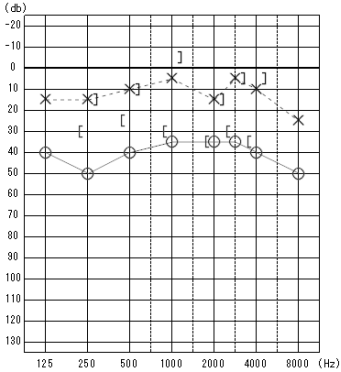
Figure 1. Pure tone audiometry results for patient No.1 who was18 years old.
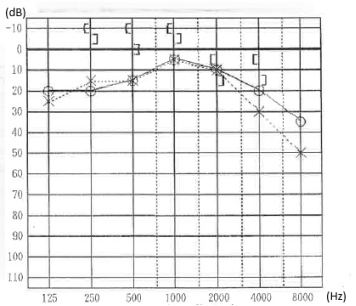
Figure 2. Pure tone audiometry results for patient No.4 who was 46 years old.
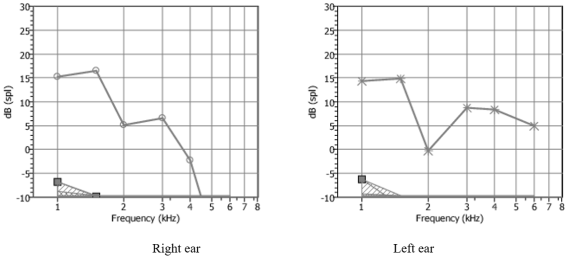
Figure 3. Distortion product of otoacoustic emission(DPOAE)test. Patient No.1 who was 18 years old.
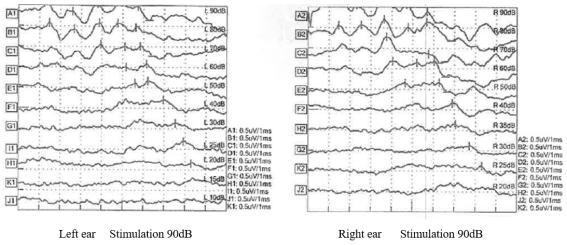
Figure 4. Auditory brain stem response for patient of No.1 who was18 years old.

Information


 Share This Article
 Twitter
 Linked In
 Facebook
 Copy
Copy Download