Case Report | | Peer-Reviewed

Perioperative Observation and Nursing of a Child with Facial Venous Malformation Treated with Interventional Embolization

Received: 11 September 2024     Accepted: 4 October 2024     Published: 29 October 2024
Views:       Downloads:
Abstract

Background: Venous malformations (VMs) are a rare disease with an incidence of only about 1/10,000 in children, but VMs can expand as the child grows, appearing more in shallow skin areas such as the neck of the head, can cause discomfort or degradation, and therefore, can seriously affect the physical and mental health of the child. There are numerous treatment options for VMs, and interventional embolosclerotherapy has become the clinically preferred treatment for VMs due to its many advantages. Case Presentation: We summarize the perioperative care experience of a 10-year-old child with severe right facial malformation diagnosed as facial venous malformation (VMs) who underwent interventional embolization during hospitalization. After 14 days of careful treatment and nursing by medical staff, the child was discharged successfully. Discussion: The key points of our perioperative care for this patient include paying attention to the mental health of the child and providing psychological support; strengthening health education and paying attention to the prevention of falls; preoperative preparation; intraoperative care; observation of the condition; pain assessment and care; strengthening discharge guidance; and doing a good job in continuous nursing. Conclusion: For the nursing of the child with facial venous malformations, it is necessary to pay attention not only to their physiological care but also to their psychological care to help them recover as soon as possible.

Published in American Journal of Nursing Science (Volume 13, Issue 5)
DOI 10.11648/j.ajns.20241305.12
Page(s) 106 -110
Creative Commons

This is an Open Access article, distributed under the terms of the Creative Commons Attribution 4.0 International License (http://creativecommons.org/licenses/by/4.0/), which permits unrestricted use, distribution and reproduction in any medium or format, provided the original work is properly cited.

Copyright

Copyright © The Author(s), 2024. Published by Science Publishing Group

Keywords

Facial Venous Malformation, Hardening Treatment Technique, Perioperative Period, Observation, Nursing

1. Introduction
Venous malformations (VMs) are made up of embryonic vascular structural abnormalities that occurred during the development process caused by congenital defects and are one of the most common clinical vascular malformations . VMs is a rare disease with an incidence rate of only about 1/10,000 in children , but VMs can expand as the child grows and more often appear in shallow areas of the skin, such as the neck of the head, which can cause discomfort or degradation in the child and therefore seriously affect the quality of life of the child.
Currently, the clinical treatment for VMs is mainly traditional surgery, laser therapy, involving sclerosis treatment, and other methods . The likelihood of recurrence of VMs after traditional surgical treatment is small, but the incidence of complications is very high. And the interventional embolization treatment, with its hardening agglomeration of micro-injury, simple operation, and low complication rate, has become the preferred clinical approach for the treatment of VMs .
In March 2023, a patient with a severe facial malformation on the right side was diagnosed with facial VMs. The patient was successfully discharged from the hospital with anesthesia and digital subtraction angiography (DSA). After careful treatment and care of the caregiver 14 days, the patient was successfully discharged from the hospital, and the child's care experience is now as follows.
2. Clinical Information
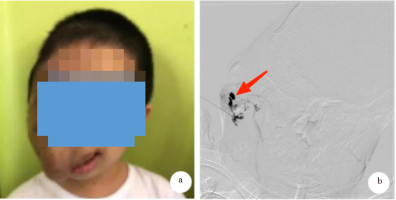
The guardian of the child complained that the child had facial deformity for more than 10 years and occasional secretions in her right eye. In recent years, she did not see significant improvement after conservative treatment. Therefore, she came to our department. The right side of her face is deformed, and her right eye is droopy (Figure 1a). The MR examination indicated that the abnormal signal focus of the right collar-face was considered to be vascular malformation, involving the cavernous sinus of the right orbital inner wall, the longus capitis, the mastoid wall, the parotid gland, the masseter muscle, the alveolar process, and the soft tissue of the maxillofacial and temporoparietal scalp. Improve the preoperative preparation, and confirm the diagnosis of VMs.
Under general anesthesia and guided by DSA, the patient underwent "subcutaneous tissue sclerosis treatment of the face". During the operation, a 0.45 G scalp needle was used to puncture the vascular lumen with thickened blood, which was clearly located in the lesion area (Figure 1b). The scalp needle was used alternately with "' Pingyangmycin ':' 50% glucose '= 1:1" and "' 1% polydocaol ': air = 1:4 "for the treatment of thickening intravascular sclerosis. The patient had no postoperative complications, such as wound bleeding, allergic reaction, skin or limb ischemic necrosis, thromboembolic complications, transient chest depression and dry cough, and hemolysis, except for local wound pain. The patient was discharged successfully after 2 days of postoperative hospitalization.
Figure 1. Preoperative facial appearance and intraoperative imaging examination of the child.
a: Before operation, the patient's facial appearance showed a right facial mass and right eyelid droop. b: The intraoperative DSA showed the right facial venous malformations with tortuous and thickened return veins (arrow).
3. Discussion
3.1. Pay Attention to the Child's Mental Health and Provide Psychological Support
This case is a 10-year-old girl who is in the transition stage from childhood to adolescence. Children at this stage have greater self-esteem and are more psychologically sensitive and vulnerable. A large area of facial deformity caused by long-term facial VMs may lead to inferiority complex . In addition, the unfamiliar ward environment and cold medical equipment, together with the quiet character of the child, led to her silence and poor compliance with treatment and nursing . On admission, the child's psychological status was evaluated by the Generalized Anxiety Disorder scale (GAD-2 and GAD-7) and the Patient Health Questionnaire-2 (PHQ-2). The GAD-2 score of the child was 3, and the GAD-7 score was 8, indicating that the child had mild anxiety problems. The PHQ-2 score of the child was 1, indicating no depression.
Therefore, nursing staff should not only care for this child with physical care also need to pay attention to focus on her mental health, strengthen psychological nursing, and provide guidance and help to her and her guardians. While this child was in the hospital, we gave him a personalized psychological intervention. On the day of the child's discharge, the score of the Generalized Anxiety Disorder scale was 1, and the child's anxiety problem was relieved. The child changed from resistance to medical staff at admission to active interaction and communication with medical staff and active cooperation with treatment.
3.2. Strengthen Health Education and Pay Attention to Fall Prevention
In this case, the child is 10 years old, which is an active age. However, due to long-term facial VMs involving the right side of the face, the right eyelid droops, and the vision of the right eye is seriously affected, and the risk of falling is higher. There is also an increased risk of bleeding from ruptured blood vessels that enlarge the face after a fall . The nursing staff used the Humpty Dumpty Fall Scale (HDFS) to assess the fall risk of the child at admission with a score of 12, indicating a high risk of fall.
Therefore, it is very important to strengthen the health education of the child and her guardians, improve the awareness of risk prevention, and prevent the rupture of facial blood vessels caused by the child's falls. The nursing staff advised the child and her guardians to prioritize bed rest, exercise caution when getting out of bed, and refrain from engaging in vigorous activities such as running. During the hospitalization, our health education was proper, and no complications such as falls and blood vessel rupture occurred.
3.3. Preoperative Preparation
Instruct and assist the child to complete the preoperative examination, ask the child about the history of drug allergies, find out whether the child is allergic to allergies, ask the child to urinate before the operation, and assist the doctor to complete the examination of coagulation function, blood routine, urinary routine, biochemical indexes, MR examination, stool routine, etc.
3.4. Intraoperative Nursing
In this case, the 10-year-old child had poor treatment compliance and even resisted surgery due to the unfamiliar operating room environment and separation from the guardian . Nursing staff assisted the anesthesiologist to calm the child during the anesthesia process with gentle tone and movements, chatting with the child to distract her attention, and gently tapping her shoulder to relax her.
In addition, during the use of lauryl alcohol injection, we should pay close attention to whether the child have allergic reactions, such as rash, itching, etc., and anaphylactic shock may occur in severe cases . Closely observe the ECG monitoring indicators of the child, including respiration, heart rate, heart rhythm, blood oxygen saturation, blood pressure, etc., and make timely predictions of abnormal conditions, and always prepare rescue items to ensure the safety of children. There was no allergic reaction to the laurosinol injection after the injection during the operation.
3.5. Observation of Postoperative Condition
The child was treated under general anesthesia and guided by DSA for the serosing of subcutaneous tissue of the face with the laurosinol injection. Although interventional embolic serosing was safer than traditional surgery for this child, a series of adverse reactions could still occur after the treatment with laurosinol injection. It includes allergic reactions, swelling, skin or limb ischemic necrosis, thromboembolic complications, pigmentation, superficial phlebitis, transient chest depression and dry cough, hemolytic reactions, etc .
The child returned to the ward after surgery. During the nursing process, the vital signs and mental condition of the child were observed and recorded in time after each shift, and the blood and fluid seepage of the surgical wound were observed. We continued to closely observe the postoperative allergic reaction of the child to the laurosinol injection. Her vital signs were stable, and no other adverse reactions occurred during hospitalization except for mild swelling of the lesion site.
3.6. Postoperative Pain Assessment and Care
Effective pain management can prevent the child from experiencing symptoms such as a rapid heart rate and a sharp rise in blood pressure due to pain and help her recover as soon as possible . The postoperative pain of the child mainly appeared near the puncture point of the laurosinol injection. The right side of the child's face was slightly swollen on the second day after surgery compared with that before surgery. The Faces Pain Scale (FPS) score was 2 points, indicating mild pain. After surgery, the child preferred to be in the lateral position due to pain, and pressing the pain site during the lateral position could relieve the pain, but it was not conducive to the treatment effect. The nursing staff advised the child to take more supine position or healthy lateral position (left decubitus position) and asked the guardian to supervise the child and correct his decubitus position so as to facilitate the recovery of the disease. At the same time, the child was instructed to divert their attention by watching cartoons or playing small games when in pain . After careful care by the nursing staff, the pain score was 1 again on the second day after surgery, and the pain of the child was relieved.
3.7. Strengthen Discharge Guidance and Do a Good Job of Continuous Nursing
The treatment cycle of VMs is determined according to the size of the lesion. If the lesion is large, the treatment frequency is higher and the treatment cycle is longer . In this case, the disease cycle of the child is long, and the lesion is relatively large, so it is very important to do discharge guidance and follow-up. Our department has set up a continuous nursing team, including follow-up nurses, doctors in charge, and guardians, to discuss and formulate follow-up plans according to the condition of the child, establish an electronic information database, and assign special personnel to input the rehabilitation indicators and condition changes of the child after surgery. Before discharge, we continued to emphasize the importance of preventing falls and avoiding ruptured blood vessels in the face.
The child was followed up at the first month after discharge. After discharge, the child was evaluated again for anxiety and pain. The anxiety and pain problems of the child were solved, the size of the right facial mass did not change much compared with before, and the facial skin color at the injection site of hardener did not change, and regular treatment was required according to the size of the lesion.
4. Conclusion
Interventional embolization and sclerotherapy for the treatment of venous malformations (VMs) has the advantages of being minimally invasive, simple to operate, low complication rate, low cost, less pain, leaving fewer scars after treatment, and meeting the psychological needs of patients and their guardians for "beauty" . The main adverse reactions include allergic reactions, swelling, skin or limb ischemic necrosis, thromboembolic complications, pigmentation, etc . The adverse reactions are relatively mild, and serious adverse reactions are rare. It is safer than traditional surgical treatment, but this method also has certain disadvantages, namely that some patients need to be treated with multiple injections and the treatment cycle is long. In addition, the requirements for the hardener are relatively high. The foam hardener used in this case is lauromacrogol injection. According to relevant domestic and foreign research , lauromacrogol injection is a relatively safe and effective foam hardener.
Abbreviations

DSA

Digital Subtraction Angiography

FPS

Faces Pain Scale

GAD

The Generalized Anxiety Disorder scale

HDFS

Humpty Dumpty Fall Scale

MR

Magnetic Resonance

PHQ

The Patient Health Questionnaire

VMs

Venous Malformations

Author Contributions
Shuixiang Wu: Conceptualization, Writing – original draft, Writing – review & editing
Yan Zhou: Validation, Writing – review & editing
Yujuan Yang: Conceptualization, Writing – original draft, Writing – review & editing
Jian Han: Validation, Writing – review & editing
Xiaowen Zhu: Validation, Writing – review & editing
Funding
This study was funded by Nurturing funds for nursing talents of Jinan University (JHA20230604) and the Nurse Association of Guangdong Province (gdshsxh2023ms15).
Conflicts of Interest
The authors declare no conflicts of interest.
References
[1] Nevesny F, Chevallier O, Falvo N, et al. Bleomycin for Percutaneous Sclerotherapy of Venous and Lymphatic Malformations: A Retrospective Study of Safety, Efficacy and Mid - Term Outcomes in 26 Patients. J Clin Med. 2021 Mar 22; 10(6): 1302.
[2] Lei Guo, Dan Song, liang Wang. Consensus of Chinese experts on the treatment of venous malformation with foam sclerosant. Journal of Vascular and Endovascular Surgery, 2022, 8(11): 1281-1285, 1310.
[3] Sun N, Liu R, Cheng G, et al. The rare complication of vascular malformations of the limb after sclerotherapy: a report of 3 cases and brief literature review. BMC Pediatr. 2023 Apr 28; 23(1): 202.
[4] Du Z, Liu JL, You YH, et al. Genetic landscape of common venous malformations in the head and neck. J Vasc Surg Venous Lymphat Disord. 2021 Jul; 9(4): 1007-1016. e7.
[5] De Maria L, De Sanctis P, Tollefson M, et al. Sclerotherapy for low-flow vascular malformations of the orbital and periocular regions: Systematic review and meta-analysis. Surv Ophthalmol. 2020 Jan-Feb; 65(1): 41-47.
[6] Jieping Liang, Yanfang Chen, Jiapeng Li, et al. DSA-guided sclerotherapy for cephalo-cervical venous malformations: nursing issues and countermeasures [J]. Journal of Interventional Radiology, 2013, 22(3): 3.
[7] Lu Lu, Yan Fang, Caiping Yao, et al. Clinical analysis of a child with vascular anastomotic thrombosis after living donor small bowel transplantation. Chinese Journal of Nursing, 2023, 58(5): 605-608.
[8] Yu Sun; Ying Gu; Huimei Wang. Perioperative nursing care of a pediatric patient with kawasaki disease complicated with giant coronary aneurysm. Chinese Journal of Nursing, 2023, 58(5): 595-599.
[9] Xue Li, Huiqiong Xie. Design and application of children fall/falling bed assessment form. Chinese Nursing Research, 2018, 32(4): 572-575.
[10] Haibo Li, Jing Zhang, Shaoyi Zhou, et al. DSA-guided foam sclerotherapy for the treatment of venous malformations in children: clinical observation. Journal of Interventional Radiology, 2013, 22(9): 738-741.
[11] Qinghua Li, Chunmei Hong, Lixuan Zeng. Observation and nursing of the treatment of venous malformation with foam hardener. Chinese General Practice Nursing, 2015, (7): 622-622.
[12] Zhenzhen Shao, Lin Zhu, Wenjuan Tang, et al. A review on postoperative pain assessment tools in children. Journal of Nursing Science, 2021, 36(5): 102-108.
[13] Shufang Ji, Yongkang Qu, Yaodong XUu, et al. The influence of congenital malformation of external and middle ear on the psychologic status of children patients. Journal of Clinical Otorhinolaryngology Head and Neck Surgery, 2014, 28(7): 450-452.
[14] De Maria L, De Sanctis P, Balakrishnan K, et al. Sclerotherapy for Venous Malformations of Head and Neck: Systematic Review and Meta-Analysis. Neurointervention. 2020 Mar; 15(1): 4-17.
[15] Yaowu Yang, Ka-wai Cheng, Sun Moyi, et al. Expert consensus on the treatment of oral and maxillofacial hemangiomas and vascular malformations by lauromacrogol sclerotherapy. China Journal of Oral and Maxillofacial Surgery, 2018, 16(3): 275-278.
[16] Anh TT, Nguyen QL, Thi QM, et al. Digital Subtraction Angiography-Guided Foam Sclerotherapy with Polidocanol for Treating Superficial Venous Malformation. Ann Vasc Dis. 2021 Sep 25; 14(3): 231-235.
Cite This Article
  • APA Style

    Wu, S., Zhou, Y., Yang, Y., Han, J., Zhu, X. (2024). Perioperative Observation and Nursing of a Child with Facial Venous Malformation Treated with Interventional Embolization. American Journal of Nursing Science, 13(5), 106 -110. https://doi.org/10.11648/j.ajns.20241305.12

    Copy | Download

    ACS Style

    Wu, S.; Zhou, Y.; Yang, Y.; Han, J.; Zhu, X. Perioperative Observation and Nursing of a Child with Facial Venous Malformation Treated with Interventional Embolization. Am. J. Nurs. Sci. 2024, 13(5), 106 -110. doi: 10.11648/j.ajns.20241305.12

    Copy | Download

    AMA Style

    Wu S, Zhou Y, Yang Y, Han J, Zhu X. Perioperative Observation and Nursing of a Child with Facial Venous Malformation Treated with Interventional Embolization. Am J Nurs Sci. 2024;13(5):106 -110. doi: 10.11648/j.ajns.20241305.12

    Copy | Download

  • @article{10.11648/j.ajns.20241305.12,
      author = {Shuixiang Wu and Yan Zhou and Yujuan Yang and Jian Han and Xiaowen Zhu},
      title = {Perioperative Observation and Nursing of a Child with Facial Venous Malformation Treated with Interventional Embolization
    },
      journal = {American Journal of Nursing Science},
      volume = {13},
      number = {5},
      pages = {106 -110},
      doi = {10.11648/j.ajns.20241305.12},
      url = {https://doi.org/10.11648/j.ajns.20241305.12},
      eprint = {https://article.sciencepublishinggroup.com/pdf/10.11648.j.ajns.20241305.12},
      abstract = {Background: Venous malformations (VMs) are a rare disease with an incidence of only about 1/10,000 in children, but VMs can expand as the child grows, appearing more in shallow skin areas such as the neck of the head, can cause discomfort or degradation, and therefore, can seriously affect the physical and mental health of the child. There are numerous treatment options for VMs, and interventional embolosclerotherapy has become the clinically preferred treatment for VMs due to its many advantages. Case Presentation: We summarize the perioperative care experience of a 10-year-old child with severe right facial malformation diagnosed as facial venous malformation (VMs) who underwent interventional embolization during hospitalization. After 14 days of careful treatment and nursing by medical staff, the child was discharged successfully. Discussion: The key points of our perioperative care for this patient include paying attention to the mental health of the child and providing psychological support; strengthening health education and paying attention to the prevention of falls; preoperative preparation; intraoperative care; observation of the condition; pain assessment and care; strengthening discharge guidance; and doing a good job in continuous nursing. Conclusion: For the nursing of the child with facial venous malformations, it is necessary to pay attention not only to their physiological care but also to their psychological care to help them recover as soon as possible.
    },
     year = {2024}
    }
    

    Copy | Download

  • TY  - JOUR
    T1  - Perioperative Observation and Nursing of a Child with Facial Venous Malformation Treated with Interventional Embolization
    
    AU  - Shuixiang Wu
    AU  - Yan Zhou
    AU  - Yujuan Yang
    AU  - Jian Han
    AU  - Xiaowen Zhu
    Y1  - 2024/10/29
    PY  - 2024
    N1  - https://doi.org/10.11648/j.ajns.20241305.12
    DO  - 10.11648/j.ajns.20241305.12
    T2  - American Journal of Nursing Science
    JF  - American Journal of Nursing Science
    JO  - American Journal of Nursing Science
    SP  - 106 
    EP  - 110
    PB  - Science Publishing Group
    SN  - 2328-5753
    UR  - https://doi.org/10.11648/j.ajns.20241305.12
    AB  - Background: Venous malformations (VMs) are a rare disease with an incidence of only about 1/10,000 in children, but VMs can expand as the child grows, appearing more in shallow skin areas such as the neck of the head, can cause discomfort or degradation, and therefore, can seriously affect the physical and mental health of the child. There are numerous treatment options for VMs, and interventional embolosclerotherapy has become the clinically preferred treatment for VMs due to its many advantages. Case Presentation: We summarize the perioperative care experience of a 10-year-old child with severe right facial malformation diagnosed as facial venous malformation (VMs) who underwent interventional embolization during hospitalization. After 14 days of careful treatment and nursing by medical staff, the child was discharged successfully. Discussion: The key points of our perioperative care for this patient include paying attention to the mental health of the child and providing psychological support; strengthening health education and paying attention to the prevention of falls; preoperative preparation; intraoperative care; observation of the condition; pain assessment and care; strengthening discharge guidance; and doing a good job in continuous nursing. Conclusion: For the nursing of the child with facial venous malformations, it is necessary to pay attention not only to their physiological care but also to their psychological care to help them recover as soon as possible.
    
    VL  - 13
    IS  - 5
    ER  - 

    Copy | Download

Author Information
  • Abstract
  • Keywords
  • Document Sections

    1. 1. Introduction
    2. 2. Clinical Information
    3. 3. Discussion
    4. 4. Conclusion
    Show Full Outline
  • Abbreviations
  • Author Contributions
  • Funding
  • Conflicts of Interest
  • References
  • Cite This Article
  • Author Information