
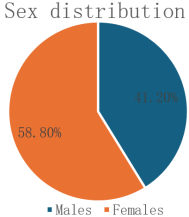
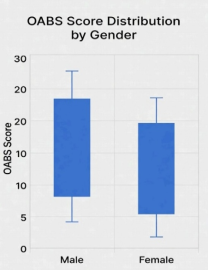
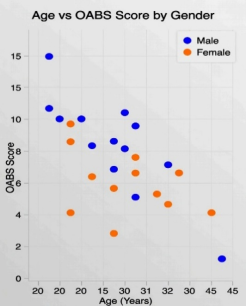
Introduction: Overactive bladder syndrome is a clinical condition that affects both males and females and has a significant negative impact on the quality of life. Overactive bladder syndrome refers to a chronic condition of the urinary bladder characterized by a constellation of predominantly storage lower urinary tract symptoms. Overactive bladder syndrome is a clinical diagnosis that suggests significant bladder dysfunction, failure of urine storage and often associated with detrusor over activity during the bladder filling phase. The etiology and pathophysiology remains largely unknown with studies suggesting possible multifactorial causes. Despite the appreciable burden on young adults, several studies underestimated prevalence of overactive bladder syndrome amongst young adults. Overactive Bladder Symptom Score is a reliable and valid tool in symptom assessment and re-evaluation following treatment. This study is focus in finding the prevalence of overactive bladder syndrome in young adults as well as the impact on QoL. Methodology: This is a prospective randomized cross-sectional study. By simple random sampling, consenting participants who met the inclusion criteria were recruited for the study. A structured questionnaire (overactive bladder syndrome score- OABSS) was utilized in assessment of symptom severity and impact. The Completed questionnaire/proforma of all the recruited subjects were collated and analyzed using Statistical Package for the Social Sciences (SPSS) version 23.0 and P values less than 0.05 were considered to be statistically significant. Results: A total of 306 individuals participated in the study. One hundred and eighty (58.8%) participants were females while 126 (41.2%) were males. The age range of the participants was 20 – 40 years with a mean age of 29.8 +/- 5.6. The overall OABSS ranges from 0 – 15 with a mean score of 2.09+/-2.05. Two hundred and sixty four participants (93.14%) had OABSS of 0 – 5 which represents mild or no symptoms, 5.88% had moderate symptoms while 0.98% had severe symptoms. Females report significantly higher OABSS than males. The mean score of OABS in females was 2.52 while the mean score of OABS in males was 1.48. Conclusion: Overactive Bladder Syndrome refers to a chronic embarrassing condition of the urinary bladder. Despite the appreciable burden on young adults, it is more prevalent in females. It remains an evolving pathology which becomes more manifest with aging and often underreported amongst younger individual for obvious reasons. Though management could be challenging, exiting prospects via awareness and innovations can never be overemphasized.
| Published in | Central African Journal of Public Health (Volume 12, Issue 3) |
| DOI | 10.11648/j.cajph.20261203.12 |
| Page(s) | 141-147 |
| Creative Commons |
This is an Open Access article, distributed under the terms of the Creative Commons Attribution 4.0 International License (http://creativecommons.org/licenses/by/4.0/), which permits unrestricted use, distribution and reproduction in any medium or format, provided the original work is properly cited. |
| Copyright |
Copyright © The Author(s), 2026. Published by Science Publishing Group |
Overactive Bladder, Overactive Bladder Symptom Score, Lower Urinary Tract Symptoms, Quality of Life
OABSS | Frequency/number of participant |
|---|---|
0 | 42 |
1 | 93 |
2 | 84 |
3 | 51 |
4 | 15 |
6 | 9 |
7 | 6 |
8 | 3 |
15 | 3 |
Gender | Mean score |
|---|---|
Female | 2.52 +/- 1.75 |
Male | 1.48 +/- 1.06 |
OABS | Overactive Bladder Syndrome |
OABSS | Overactive Bladder Symptom Score |
QoL | Quality of Life |
LUTS | Lower Urinary Tract Symptoms |
ICS | International Continence Society |
BPE | Benign Prostatic Enlargement |
SPSS | Statistical Package for Social Sciences |
| [1] | Leron E, Weintraub AY, Mastrolia SA, Schwarzman P. Overactive bladder syndrome: Evaluation and management. Curr Urol. 2018; 11: 117–125. |
| [2] | Haylen BT, de Ridder D, Freeman RM, Swift SE, Berghmans B, Lee J, Monga A, Petri E, Rizk DE, Sand PK, Schaer GN. An International Urogynecological Association (IUGA)/International Continence Society (ICS) joint report on the terminology for female pelvic floor dysfunction. Int Urogynecol J. 2010 Jan; 21(1): 5-26. |
| [3] | Abrams P, Cardozo L, Fall M, Griffiths D, Rosier P, Ulmsten U, van Kerrebroeck P, Victor A, Wein A. The standardisation of terminology of lower urinary tract function: report from the Standardisation Sub-committee of the International Continence Society. Neurourol Urodyn. 2002; 21(2): 167-78. |
| [4] | Irwin DE, Milsom I, Hunskaar S, Reilly K, Kopp Z, Herschorn S, Coyne K, Kelleher C, Hampel C, Artibani W, Abrams P. Population-based survey of urinary incontinence, overactive bladder, and other lower urinary tract symptoms in five countries: results of the EPIC study. Eur Urol. 2006 Dec; 50(6): 1306-14; discussion 1314-5. |
| [5] | Milsom I, Abrams P, Cardozo L, Roberts RG, Thüroff J, Wein AJ. How widespread are the symptoms of an overactive bladder and how are they managed? A population-based prevalence study. BJU Int. 2001 Jun; 87(9): 760-6. |
| [6] | Stewart WF, Van Rooyen JB, Cundiff GW, Abrams P, Herzog AR, Corey R, Hunt TL, Wein AJ. Prevalence and burden of overactive bladder in the United States. World J Urol. 2003 May; 20(6): 327-36. |
| [7] | Temml C, Heidler S, Ponholzer A, Madersbacher S. Prevalence of the overactive bladder syndrome by applying the International Continence Society definition. Eur Urol. 2005 Oct; 48(4): 622-7. |
| [8] | Shaw C, Tansey R, Jackson C, Hyde C, Allan R. Barriers to help seeking in people with urinary symptoms. Fam Pract. 2001 Feb; 18(1): 48-52. |
| [9] | Teunissen D, Lagro-Janssen T. Urinary incontinence in community dwelling elderly: are there sex differences in help-seeking behaviour? Scand J Prim Health Care. 2004 Dec; 22(4): 209-16. |
| [10] | Coyne KS, Payne C, Bhattacharyya SK, Revicki DA, Thompson C, Corey R, Hunt TL. The impact of urinary urgency and frequency on health-related quality of life in overactive bladder: results from a national community survey. Value Health. 2004 Jul-Aug; 7(4): 455-63. |
| [11] | Irwin DE, Milsom I, Kopp Z, Abrams P, Cardozo L. Impact of overactive bladder symptoms on employment, social interactions and emotional well-being in six European countries. BJU Int. 2006 Jan; 97(1): 96-100. |
| [12] | Wennberg AL, Molander U, Fall M, Edlund C, Peeker R, Milsom I. A longitudinal population-based survey of urinary incontinence, overactive bladder and other lower urinary tract symptoms in women. Eur Urol. 2009 Apr; 55(4): 783-91. |
| [13] | Nicolson P, Kopp Z, Chapple CR, Kelleher C. It's just the worry about not being able to control it! A qualitative study of living with overactive bladder. Br J Health Psychol. 2008 May; 13(Pt 2): 343-59. |
| [14] | Fitzgerald MP, Thom DH, Wassel-Fyr C, Subak L, Brubaker L, Van Den Eeden SK, Brown JS; Reproductive Risks for Incontinence Study at Kaiser Research Group. Childhood urinary symptoms predict adult overactive bladder symptoms. J Urol. 2006 Mar; 175(3 Pt 1): 989-93. |
| [15] | Nuotio M, Jylhä M, Koivisto AM, Tammela TL. Association of risk factors and lower urinary tract symptoms in men and women. BJU Int. 2002 May; 89(7): 661–6. |
| [16] | Abrams P, Kelleher CJ, Kerr LA, Rogers RG. Overactive bladder significantly affects quality of life. Am J Manag Care. 2000 Jul; 6(11 Suppl): S580-90. |
| [17] | Coyne KS, Sexton CC, Kopp ZS, Ebel-Bitoun C, Milsom I, Chapple C. The impact of overactive bladder on mental health, work productivity and health-related quality of life in the UK and Sweden: Results from EpiLUTS. BJU Int. 2011; 108: 1459–1471. |
| [18] | Tikkinen KA, Tammela TL, Rissanen AM, Valpas A, Huhtala H, Auvinen A. Is the prevalence of overactive bladder overestimated? A population-based study in Finland. PLoS One. 2007 Feb 7; 2(2): e195. |
| [19] | Obiatuegwu K, Atim T, Abu S, Aisuodionoe-Shadrach O, Dakum N. Correlation between the severity of erectile dysfunction and prostate size in patients with benign prostatic enlargement. Afr J Urol 27, 31 (2021). |
| [20] | Homma Y, Yoshida M, Seki N, Yokoyama O, Kakizaki H, Gotoh M, Yamanishi T, Yamaguchi O, Takeda M, Nishizawa O. Symptom assessment tool for overactive bladder syndrome--overactive bladder symptom score. Urology. 2006 Aug; 68(2): 318-23. |
| [21] | Obiatuegwu K, Magnus F, Aniede E, Magnus V. Relationship between Erectile Dysfunction and International Prostate Symptom Score. Clinical Medicine Research, 2025, 14(5), 181-186. |
APA Style
Onyeka, O. K. (2026). Overactive Bladder Syndrome in Young Adults: Prevalence and Impacts on Quality of Life. Central African Journal of Public Health, 12(3), 141-147. https://doi.org/10.11648/j.cajph.20261203.12
ACS Style
Onyeka, O. K. Overactive Bladder Syndrome in Young Adults: Prevalence and Impacts on Quality of Life. Cent. Afr. J. Public Health 2026, 12(3), 141-147. doi: 10.11648/j.cajph.20261203.12
@article{10.11648/j.cajph.20261203.12,
  author = {Obiatuegwu Kenenna Onyeka},
  title = {Overactive Bladder Syndrome in Young Adults: Prevalence and Impacts on Quality of Life},
  journal = {Central African Journal of Public Health},
  volume = {12},
  number = {3},
  pages = {141-147},
  doi = {10.11648/j.cajph.20261203.12},
  url = {https://doi.org/10.11648/j.cajph.20261203.12},
  eprint = {https://article.sciencepublishinggroup.com/pdf/10.11648.j.cajph.20261203.12},
  abstract = {Introduction: Overactive bladder syndrome is a clinical condition that affects both males and females and has a significant negative impact on the quality of life. Overactive bladder syndrome refers to a chronic condition of the urinary bladder characterized by a constellation of predominantly storage lower urinary tract symptoms. Overactive bladder syndrome is a clinical diagnosis that suggests significant bladder dysfunction, failure of urine storage and often associated with detrusor over activity during the bladder filling phase. The etiology and pathophysiology remains largely unknown with studies suggesting possible multifactorial causes. Despite the appreciable burden on young adults, several studies underestimated prevalence of overactive bladder syndrome amongst young adults. Overactive Bladder Symptom Score is a reliable and valid tool in symptom assessment and re-evaluation following treatment. This study is focus in finding the prevalence of overactive bladder syndrome in young adults as well as the impact on QoL. Methodology: This is a prospective randomized cross-sectional study. By simple random sampling, consenting participants who met the inclusion criteria were recruited for the study. A structured questionnaire (overactive bladder syndrome score- OABSS) was utilized in assessment of symptom severity and impact. The Completed questionnaire/proforma of all the recruited subjects were collated and analyzed using Statistical Package for the Social Sciences (SPSS) version 23.0 and P values less than 0.05 were considered to be statistically significant. Results: A total of 306 individuals participated in the study. One hundred and eighty (58.8%) participants were females while 126 (41.2%) were males. The age range of the participants was 20 – 40 years with a mean age of 29.8 +/- 5.6. The overall OABSS ranges from 0 – 15 with a mean score of 2.09+/-2.05. Two hundred and sixty four participants (93.14%) had OABSS of 0 – 5 which represents mild or no symptoms, 5.88% had moderate symptoms while 0.98% had severe symptoms. Females report significantly higher OABSS than males. The mean score of OABS in females was 2.52 while the mean score of OABS in males was 1.48. Conclusion: Overactive Bladder Syndrome refers to a chronic embarrassing condition of the urinary bladder. Despite the appreciable burden on young adults, it is more prevalent in females. It remains an evolving pathology which becomes more manifest with aging and often underreported amongst younger individual for obvious reasons. Though management could be challenging, exiting prospects via awareness and innovations can never be overemphasized.},
 year = {2026}
}
TY  - JOUR
T1  - Overactive Bladder Syndrome in Young Adults: Prevalence and Impacts on Quality of Life
AU  - Obiatuegwu Kenenna Onyeka
Y1  - 2026/05/13
PY  - 2026
N1  - https://doi.org/10.11648/j.cajph.20261203.12
DO  - 10.11648/j.cajph.20261203.12
T2  - Central African Journal of Public Health
JF  - Central African Journal of Public Health
JO  - Central African Journal of Public Health
SP  - 141
EP  - 147
PB  - Science Publishing Group
SN  - 2575-5781
UR  - https://doi.org/10.11648/j.cajph.20261203.12
AB  - Introduction: Overactive bladder syndrome is a clinical condition that affects both males and females and has a significant negative impact on the quality of life. Overactive bladder syndrome refers to a chronic condition of the urinary bladder characterized by a constellation of predominantly storage lower urinary tract symptoms. Overactive bladder syndrome is a clinical diagnosis that suggests significant bladder dysfunction, failure of urine storage and often associated with detrusor over activity during the bladder filling phase. The etiology and pathophysiology remains largely unknown with studies suggesting possible multifactorial causes. Despite the appreciable burden on young adults, several studies underestimated prevalence of overactive bladder syndrome amongst young adults. Overactive Bladder Symptom Score is a reliable and valid tool in symptom assessment and re-evaluation following treatment. This study is focus in finding the prevalence of overactive bladder syndrome in young adults as well as the impact on QoL. Methodology: This is a prospective randomized cross-sectional study. By simple random sampling, consenting participants who met the inclusion criteria were recruited for the study. A structured questionnaire (overactive bladder syndrome score- OABSS) was utilized in assessment of symptom severity and impact. The Completed questionnaire/proforma of all the recruited subjects were collated and analyzed using Statistical Package for the Social Sciences (SPSS) version 23.0 and P values less than 0.05 were considered to be statistically significant. Results: A total of 306 individuals participated in the study. One hundred and eighty (58.8%) participants were females while 126 (41.2%) were males. The age range of the participants was 20 – 40 years with a mean age of 29.8 +/- 5.6. The overall OABSS ranges from 0 – 15 with a mean score of 2.09+/-2.05. Two hundred and sixty four participants (93.14%) had OABSS of 0 – 5 which represents mild or no symptoms, 5.88% had moderate symptoms while 0.98% had severe symptoms. Females report significantly higher OABSS than males. The mean score of OABS in females was 2.52 while the mean score of OABS in males was 1.48. Conclusion: Overactive Bladder Syndrome refers to a chronic embarrassing condition of the urinary bladder. Despite the appreciable burden on young adults, it is more prevalent in females. It remains an evolving pathology which becomes more manifest with aging and often underreported amongst younger individual for obvious reasons. Though management could be challenging, exiting prospects via awareness and innovations can never be overemphasized.
VL  - 12
IS  - 3
ER  -
Department of Surgery, Federal Medical Center, Abuja, Nigeria; Department of Surgery, Baze University, Abuja, Nigeria

Information


 Share This Article
 Twitter
 Linked In
 Facebook
 Copy
Copy Download