
In this work, Co3O4@C composite electrode materials were successfully fabricated by coating amorphous carbon on Co3O4 nanorods. Electrochemical tests demonstrated that the Co3O4@C composite exhibited superior electrochemical performance compared with pure Co3O4, including larger capacitive response, higher specific capacitance, and more excellent rate capability and cycle stability. Specifically, the Co3O4@C composite delivered specific capacitances of 924, 830, 752, and 680 F g-1 at current densities of 2, 5, 8, and 10 A g-1, respectively, retaining 73.6% of its initial capacitance when the current density was increased from 2 to 10 A g-1. After 2000 consecutive charge–discharge cycles, the capacitance retention of Co3O4@C reached 89.4%, which was higher than that of pure Co3O4 (85.3%). Moreover, the Co3O4@C composite possessed accelerated ion and electron transport kinetics compared with pure Co3O4. The enhanced electrochemical performance of Co3O4@C can be ascribed to the synergistic effect between Co3O4 and amorphous carbon, the improved electrical conductivity provided by the carbon component, and the protective role of the carbon layer in mitigating the agglomeration and structural degradation of Co3O4 during cycling. These findings suggest that the Co3O4@C composite is a promising electrode material for high-performance supercapacitors.
| Published in | American Journal of Electrical Power and Energy Systems (Volume 15, Issue 2) |
| DOI | 10.11648/j.epes.20261502.12 |
| Page(s) | 27-33 |
| Creative Commons |
This is an Open Access article, distributed under the terms of the Creative Commons Attribution 4.0 International License (http://creativecommons.org/licenses/by/4.0/), which permits unrestricted use, distribution and reproduction in any medium or format, provided the original work is properly cited. |
| Copyright |
Copyright © The Author(s), 2026. Published by Science Publishing Group |
Co3O4@C Composite, Amorphous Carbon, Supercapacitor, Electrode Material, Electrochemical Performance, Pseudocapacitance
Co3O4 | Cobalt Tetroxide |
XRD | X-ray Diffractometer |
SEM | Scanning Electron Microscopy |
CV | Cyclic Voltammetry |
GCD | Galvanostatic Charge/Discharge |
EIS | Electrochemical Impedance Spectroscopy |
| [1] | Zhang L L, Zhao X S. Carbon-based materials as supercapacitor electrodes [J]. Chemical Society Reviews, 2009, 38(9): 2520-2531. |
| [2] | Chmiola J, Yushin G, Gogotsi Y, et al. Anomalous increase in carbon capacitance at pore sizes less than 1 nanometer [J]. Science, 2006, 313(5794): 1760-1763. |
| [3] | Wang G, Zhang L, Zhang J. A review of electrode materials for electrochemical supercapacitors [J]. Chemical Society Reviews, 2012, 41(2): 797-828. |
| [4] | Wang X, Hu A, Meng C, et al. Recent Advance in Co3O4 and Co3O4 -Containing Electrode Materials for High-Performance Supercapacitors [J]. Materials, 2020, 25(2): 269. |
| [5] | Jiang Y, Chen L, Zhang H, et al. Two-dimensional Co3O4 thin sheets assembled by 3D interconnected nanoflake array framework structures with enhanced supercapacitor performance derived from coordination complexes [J]. Chemical Engineering Journal, 2016, 292: 1-12. |
| [6] | Qi F Y, Lu X Y, Wang Y Q, et al. Fabrication of hierarchical MoO3@NixCo2x(OH)6x core–shell arrays on carbon cloth as enhanced-performance electrodes for asymmetric supercapacitors [J]. Journal of Colloid and Interface Science, 2022, 607, 1253-1261. |
| [7] | Li H, Qi F Y, Yang F, et al. Novel synthesis of hierarchical NiGa2O4@MnO2 core-shell hetero-nanostructured nanowall arrays on carbon cloth for high-performance all-solid-state asymmetrical supercapacitors [J]. Journal of Colloid and Interface Science, 2021, 587, 302-310. |
| [8] | Li J, Cheng X, Shashurin A, et al. Review of Electrochemical Capacitors Based on Carbon Nanotubes and Graphene [J]. Graphene, 2012, 1(1): 1-13. |
| [9] | Pan H, Li J, Feng Y P. Carbon Nanotubes for Supercapacitor [J]. Nanoscale Research Letters, 2010, 5(3): 654-668. |
| [10] | Forse A C, Merlet C, Griffin J M, et al. New Perspectives on the Charging Mechanisms of Supercapacitors [J]. Journal of the American Chemical Society, 2016, 138(18): 5731-5744. |
| [11] | Qi F Y, Shao L Y, Shi X Y, et al.“Carbon quantum dots-glue” enabled high-capacitance and highly stable nickel sulphide nanosheet electrode for supercapacitors [J]. Journal of Colloid and Interface Science, 2021, 601, 669-677. |
| [12] | Qi F Y, Li H, Yang F, et al. Core-shell coaxially structured NiCo2S4@TiO2 nanorod arrays as advanced electrode for solid-state asymmetric supercapacitorss [J]. Nanotechnology, 2021, 32(29), 295705. |
| [13] | Li R, Li J, Liu Q, et al. Recent progress on covalent organic frameworks and their composites as electrode materials for supercapacitors [J]. Advanced Composites and Hybrid Materials, 2025, 8(1): 86. |
| [14] | Yin B S, Zhang S W, Ren Q Q, et al. Elastic soft hydrogel supercapacitor for energy storage [J]. Journal of Materials Chemistry A, 2017, 5(47): 24942-24950. |
| [15] | Song X S, Li X F, Bai Z M, et al. Rationally-designed configuration of directly-coated Ni3S2/Ni electrode by RGO providing superior sodium storage [J]. Carbon, 2018, 133: 14-22. |
| [16] | Lang J, Zhang X, Liu L, et al. Highly enhanced energy density of supercapacitors at extremely low temperatures [J]. Journal of Power Sources, 2019, 423: 271-279. |
| [17] | Vijayakumar S, Ponnalagi A K, Nagamuthu S, et al. Microwave assisted synthesis of Co3O4 nanoparticles for high-performance supercapacitors [J]. Electrochimica Acta, 2013, 106: 500-505. |
| [18] | Duan Y, Hu T, Yang L, et al. Facile fabrication of electroactive microporous Co3O4 through microwave plasma etching for supercapacitors [J]. Journal of Alloys and Compounds, 2019, 771: 156-161. |
| [19] | Chen J, Xu Z, Zhu H, et al. An ultrafast supercapacitor built by Co3O4 with tertiary hierarchical architecture [J]. Vacuum, 2020, 174(1): 109219. |
APA Style
Sun, X., Cao, C., Zhao, L., Song, C., Sun, D. (2026). Fabrication of Amorphous Carbon-Coated Co3O4 (Co3O4@C) Composite and Its Enhanced Electrochemical Performance for Supercapacitor Electrodes. American Journal of Electrical Power and Energy Systems, 15(2), 27-33. https://doi.org/10.11648/j.epes.20261502.12
ACS Style
Sun, X.; Cao, C.; Zhao, L.; Song, C.; Sun, D. Fabrication of Amorphous Carbon-Coated Co3O4 (Co3O4@C) Composite and Its Enhanced Electrochemical Performance for Supercapacitor Electrodes. Am. J. Electr. Power Energy Syst. 2026, 15(2), 27-33. doi: 10.11648/j.epes.20261502.12
@article{10.11648/j.epes.20261502.12,
  author = {Xiaochen Sun and Chaocao Cao and Limin Zhao and Caixia Song and Dan Sun},
  title = {Fabrication of Amorphous Carbon-Coated Co3O4 (Co3O4@C) Composite and Its Enhanced Electrochemical Performance for Supercapacitor Electrodes},
  journal = {American Journal of Electrical Power and Energy Systems},
  volume = {15},
  number = {2},
  pages = {27-33},
  doi = {10.11648/j.epes.20261502.12},
  url = {https://doi.org/10.11648/j.epes.20261502.12},
  eprint = {https://article.sciencepublishinggroup.com/pdf/10.11648.j.epes.20261502.12},
  abstract = {In this work, Co3O4@C composite electrode materials were successfully fabricated by coating amorphous carbon on Co3O4 nanorods. Electrochemical tests demonstrated that the Co3O4@C composite exhibited superior electrochemical performance compared with pure Co3O4, including larger capacitive response, higher specific capacitance, and more excellent rate capability and cycle stability. Specifically, the Co3O4@C composite delivered specific capacitances of 924, 830, 752, and 680 F g-1 at current densities of 2, 5, 8, and 10 A g-1, respectively, retaining 73.6% of its initial capacitance when the current density was increased from 2 to 10 A g-1. After 2000 consecutive charge–discharge cycles, the capacitance retention of Co3O4@C reached 89.4%, which was higher than that of pure Co3O4 (85.3%). Moreover, the Co3O4@C composite possessed accelerated ion and electron transport kinetics compared with pure Co3O4. The enhanced electrochemical performance of Co3O4@C can be ascribed to the synergistic effect between Co3O4 and amorphous carbon, the improved electrical conductivity provided by the carbon component, and the protective role of the carbon layer in mitigating the agglomeration and structural degradation of Co3O4 during cycling. These findings suggest that the Co3O4@C composite is a promising electrode material for high-performance supercapacitors.},
 year = {2026}
}
TY  - JOUR
T1  - Fabrication of Amorphous Carbon-Coated Co3O4 (Co3O4@C) Composite and Its Enhanced Electrochemical Performance for Supercapacitor Electrodes
AU  - Xiaochen Sun
AU  - Chaocao Cao
AU  - Limin Zhao
AU  - Caixia Song
AU  - Dan Sun
Y1  - 2026/04/23
PY  - 2026
N1  - https://doi.org/10.11648/j.epes.20261502.12
DO  - 10.11648/j.epes.20261502.12
T2  - American Journal of Electrical Power and Energy Systems
JF  - American Journal of Electrical Power and Energy Systems
JO  - American Journal of Electrical Power and Energy Systems
SP  - 27
EP  - 33
PB  - Science Publishing Group
SN  - 2326-9200
UR  - https://doi.org/10.11648/j.epes.20261502.12
AB  - In this work, Co3O4@C composite electrode materials were successfully fabricated by coating amorphous carbon on Co3O4 nanorods. Electrochemical tests demonstrated that the Co3O4@C composite exhibited superior electrochemical performance compared with pure Co3O4, including larger capacitive response, higher specific capacitance, and more excellent rate capability and cycle stability. Specifically, the Co3O4@C composite delivered specific capacitances of 924, 830, 752, and 680 F g-1 at current densities of 2, 5, 8, and 10 A g-1, respectively, retaining 73.6% of its initial capacitance when the current density was increased from 2 to 10 A g-1. After 2000 consecutive charge–discharge cycles, the capacitance retention of Co3O4@C reached 89.4%, which was higher than that of pure Co3O4 (85.3%). Moreover, the Co3O4@C composite possessed accelerated ion and electron transport kinetics compared with pure Co3O4. The enhanced electrochemical performance of Co3O4@C can be ascribed to the synergistic effect between Co3O4 and amorphous carbon, the improved electrical conductivity provided by the carbon component, and the protective role of the carbon layer in mitigating the agglomeration and structural degradation of Co3O4 during cycling. These findings suggest that the Co3O4@C composite is a promising electrode material for high-performance supercapacitors.
VL  - 15
IS  - 2
ER  -
School of Energy and Electric Power Engineering, Xinjiang Vocational University of Technology, Urumqi, China
School of Energy and Electric Power Engineering, Xinjiang Vocational University of Technology, Urumqi, China
School of Energy and Electric Power Engineering, Xinjiang Vocational University of Technology, Urumqi, China; School of Emergency Management, Lanzhou Resource and Environment Vocational and Technical University, Lanzhou, China
School of Energy and Electric Power Engineering, Xinjiang Vocational University of Technology, Urumqi, China
School of Energy and Electric Power Engineering, Xinjiang Vocational University of Technology, Urumqi, China
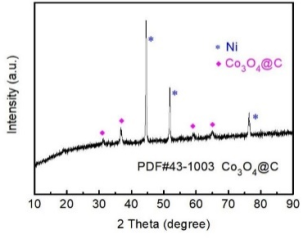
Figure 1. XRD patterns of as-prepared Co3O4@C nanobundles.
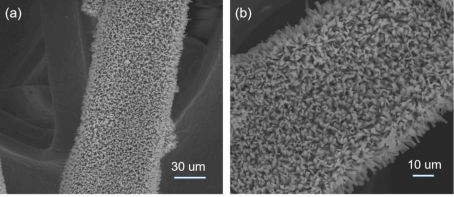
Figure 2. SEM images of Co3O4@C: (a) and (b) different magnified SEM images of Co3O4@C nanobundles.
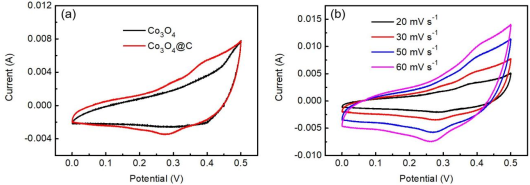
Figure 3. CV curves of diamond-shaped rod structure Co3O4 and Co3O4@C: (a) CV curves of Co3O4 nanorods and Co3O4@C nanorods at at a certain scan rate of 30 mV s-1; (b) CV curves of Co3O4@C nanorods at different scan rates (20-60 mV s-1).
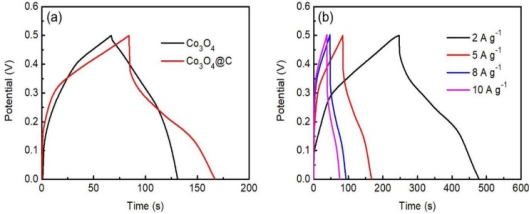
Figure 4. GCD curves of Co3O4 and Co3O4@C: (a) at a certain current density of 5 A g-1; (b) GCD curves of Co3O4@C at different current densities.
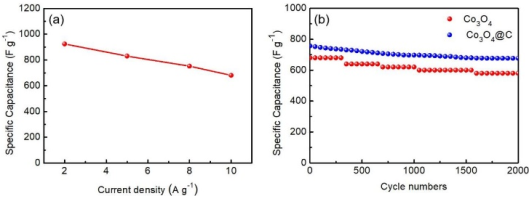
Figure 5. Electrochemical performance of Co3O4 and Co3O4@C: (a) Specific capacitances at different current densities of Co3O4@C; (b) cycling stability of Co3O4 and Co3O4@C for 2000 cycles at 8 A g-1.
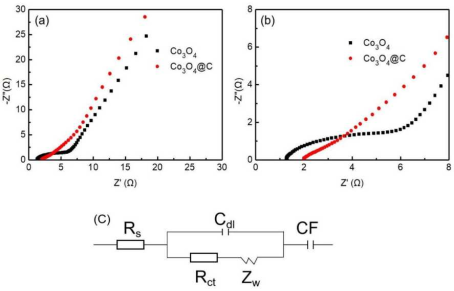
Figure 6. Electrochemical impedance of Co3O4 and Co3O4@C: (a) Nyquist plots of Co3O4 and Co3O4@C; (b) high frequency region Nyquist plots of Co3O4 and Co3O4@C; (c) the simulated circuit diagram of Co3O4@C.

Information



 Share This Article
 Twitter
 Linked In
 Facebook
 Copy
Copy Download