Research Article | | Peer-Reviewed

Perceptions and Representations of Drought in the Oued El Abid Watershed

Received: 17 October 2025     Accepted: 24 December 2025     Published: 9 January 2026
Views:       Downloads:
Abstract

This study analyzes perceptions and representations of drought among residents of the Oued El Abid watershed in Morocco, based on a structured field survey conducted with 150 households. The results reveal a high level of awareness of drought, with 95% of respondents acknowledging its occurrence and 80% considering their area to be directly affected. Nearly 75% of the surveyed population report having personally experienced its impacts, particularly reduced precipitation, water scarcity, and the drying up of springs and streams. Local populations perceive a significant deterioration in climatic conditions, as 58.4% currently consider precipitation to be low compared to 45.6% who previously described it as abundant. In addition, 72.2% of respondents report an increase in temperatures, and 70.4% identify recent decades as the driest. Drought is described as a multidimensional phenomenon encompassing climatic, hydrological, agricultural, and socio-economic aspects, with direct repercussions on water resources, agriculture, and livestock. The study highlights critical impacts on water supply, marked by reduced flows in springs, rivers, and wells, as well as significant economic consequences, including crop losses, declining agricultural yields, and livestock mortality, thereby increasing the socio-economic vulnerability of local populations. Furthermore, adaptation strategies such as the semi-nomadic mobility of herds illustrate the capacity of communities to adjust their practices in response to environmental constraints. Overall, these findings emphasize that drought represents a major environmental and socio-economic challenge in the Oued El Abid watershed, and that integrating local perceptions is essential for developing sustainable water resource management strategies and strengthening community resilience to climate change.

Published in Humanities and Social Sciences (Volume 14, Issue 1)
DOI 10.11648/j.hss.20261401.12
Page(s) 10-19
Creative Commons

This is an Open Access article, distributed under the terms of the Creative Commons Attribution 4.0 International License (http://creativecommons.org/licenses/by/4.0/), which permits unrestricted use, distribution and reproduction in any medium or format, provided the original work is properly cited.

Copyright

Copyright © The Author(s), 2026. Published by Science Publishing Group

Keywords

Drought, Watershed, Oued El-Abid, Survey, Perception

1. Introduction
Drought is a recurrent and structural climatic phenomenon in Morocco, deeply rooted in the collective imagination of its population for centuries . This natural phenomenon is both a characteristic of the Moroccan climate and a determining factor in the evolution of the country’s ecological and socio-economic dynamics. Historically, drought has led to major crises, affecting agricultural production, water availability, and living conditions. Significant episodes, such as "the famine year of 1779" and "the Bon year of 1945," remain ingrained in collective memory due to the famines and epidemics they triggered .
Historical and dendrochronological studies confirm that Morocco has experienced droughts of varying frequency and intensity throughout its history. Between 1896 and 1996, several periods of moderate to severe drought were recorded, impacting water resources and agricultural production Since the beginning of the 21st century, an increase in the frequency and severity of droughts has been observed, illustrating a growing trend toward increased aridity . These changes are attributed to climate variability and the effects of global climate change.
Drought has both direct and indirect consequences on Morocco’s water resources, agricultural systems, and economic activities. It also affects lifestyles, social relationships, and community dynamics . Roger Bastide (1971) highlights the importance of community solidarity in mitigating the effects of drought, particularly through forms of mutual aid and resource redistribution .
At the international level, several studies have highlighted the increasing impact of droughts in developing countries. For example, Setiawan Amsari Mudzakir analyzed the spatiotemporal characteristics of droughts in Indonesia and their relationship with El Niño events . Their findings indicate that these climatic episodes exacerbate the frequency and intensity of droughts. Other research, such as that of Kuswanto Heri, has confirmed that the duration of droughts in certain Indonesian regions tends to increase .
In this context, resilience to drought has become a major challenge for vulnerable societies. Managing this phenomenon requires a better understanding of local perceptions and the adaptation strategies adopted by affected populations. Singh and Chudasama (2016) demonstrated that inhabitants' perceptions play a central role in the implementation of adaptation strategies . A study conducted by Jarawura in Ghana revealed that combining traditional knowledge with scientific expertise enhances sustainable water management during drought periods .
In the Moroccan context, studying the perception of drought in the Oued El Abid watershed is crucial for understanding its impacts on local populations. This approach aims primarily to analyze the social representations of drought, assess the adaptation strategies implemented, and examine the evolution of climatic conditions between the past and present. It also helps identify the socio-economic impacts of this phenomenon on the basin’s inhabitants.
2. Methodology
The methodology adopted in this article is structured around three main axes: the description of the study area, data collection, and data analysis. The study is based on a survey conducted among local populations to examine their perception of drought and assess its effects on their livelihoods.
2.1. Study Area
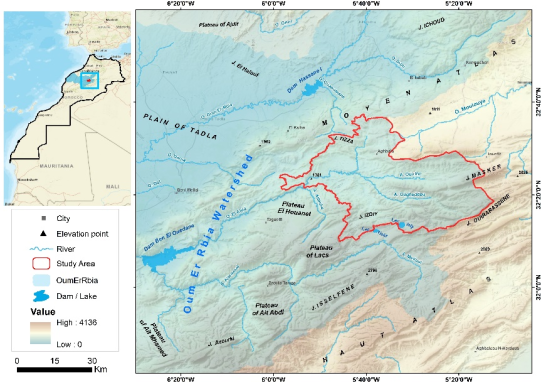
The upstream watershed of Oued El Abid covers an area of 1,725.5 km² in the Central High Atlas, between longitudes 5°14’ and 5°59’ West and latitudes 32°11’ and 32°37’ North. It is bordered by the Oued Moulouya watershed to the northeast and the Oued Ziz watershed to the east and southeast. Its main watercourse, the Oued El Abid, is permanent, originating at an altitude of 1,660 meters and flowing from east to west over a distance of 77.62 km before reaching the artificial lake of Bin El Ouidane.
The study mainly focuses on the upper part of the watershed, which plays a crucial role in the genesis of water resources . This area corresponds to the Oued El Abid watershed upstream of the Bin El Ouidane dam, which is part of the larger Oum Er Rbia watershed, one of the most important in Morocco in terms of water availability and agricultural irrigation . Fully located in the Central High Atlas, this region is characterized by rugged topography, including mountains, ridges, high plateaus, depressions, and valleys, which strongly influence the flow dynamics .
The dominant vegetation mainly consists of holm oaks and junipers, with other forest formations varying according to altitude and local climatic conditions . The climate is Mediterranean, with a rainy season from November to April and a dry season from May to October . The average number of rainy days ranges from 42 to 70 days per year, with irregular precipitation and a hydrological regime marked by high seasonal variability, which directly impacts water resource availability .
Oued El Abid is retained at the Bin El Ouidane dam before being directed to the irrigated area of Beni Moussa. The upstream zone plays a fundamental role in water supply, as it serves as the main collection and recharge area for the watershed .
Figure 1. Location of the Oued El Abid Watershed. Location of the Oued El Abid Watershed.
2.2. Data Collection
Fieldwork, particularly surveys, is an essential step in any geographical study. As Firdion (2012) points out, "it represents the indispensable foundation of any research, not only in geography" .
In analyzing the phenomenon of drought, various methodologies and indicators are commonly used, including the NDWI (Normalized Difference Water Index) and the SPI (Standardized Precipitation Index). However, for this study, we adopted a qualitative and participatory approach, focusing on a questionnaire administered to households in the Oued El Abid watershed to explore their perceptions and representations of drought. This questionnaire is structured into four categories of questions:
1) Opinion questions: Aiming to understand how surveyed households perceive drought.
2) Comparison questions: Allowing for parallels to be drawn between past and present climatic conditions.
3) Ordinal questions: Designed to rank the decades perceived as the driest and hottest.
4) Open-ended questions: Providing respondents with a space for free expression to share their feelings and observations.
2.3. Determination of the Sample Size
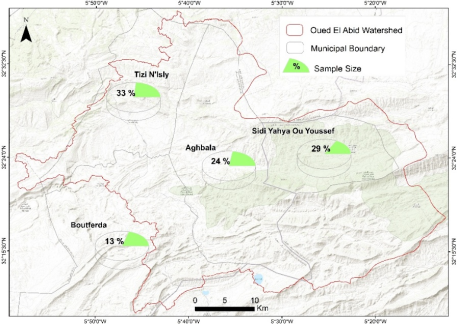
Our study area includes three municipalities, which led us to adopt a municipal approach (Figure 2) to structure our survey. The sample size was determined using Cochran’s formula , which estimates the required number of respondents based on several parameters:
N=Z2P(1-P)E2(1)
Where:
1) N: Required sample size
2) Z = 1.96: Z-value for a 95% confidence level
3) P = 0.5: Estimated proportion (often set to 0.5 to maximize variability)
4) E = 0.08: Margin of error of 8% (i.e., 0.08)
By applying this formula, the required sample size is 150 individuals for a 95% confidence level and an 8% margin of error.
Based on our field observations, the local population demonstrates a deep understanding of its environment, which it has shaped and continues to adapt, while being aware of the risks, particularly drought. To refine our analysis, a 41-question survey was developed and administered to 150 households in the watershed, distributed across the following municipalities (Figure 2): Tizi N-Isly (33.30%), Aghbala (28.99%), Boutferda (24.40%), and Sidi Yahya Ou Youssef (13.30%). The sample was randomly selected to ensure a balanced distribution of respondents. The map illustrates the distribution of survey participants in the upstream watershed of Oued El Abid, highlighting municipal boundaries and sample sizes.
Figure 2. Sample Size Distribution.
2.4. Analyzed Data
The analysis begins with the presentation of the households' sociodemographic characteristics. Next, we examined the types of property, particularly agricultural land (rainfed or irrigated) and livestock ownership. We then analyzed the population's knowledge and perceptions of drought. Finally, we assessed the impacts of this phenomenon on the local population, focusing on its economic, social, and environmental consequences.
Table 1. Key Information Analyzed in This Study.

Variable

Question

Demographic Data

Municipality

Gender

Age

Occupation

Type of housing

Marital status

Education

Source of water used

Property

Do you have agricultural land

If yes, is it rainfed or irrigated

How many head of livestock do you have

How many head of cattle do you own?

Knowledge and Perception of Drought

Do you know what drought is

Does the watershed experience the phenomenon of drought

Has the watershed been impacted by drought

Have you been affected by the effects of drought

How have climatic conditions changed

Impact of Drought

Impact on water resources

Economic impacts

Social impacts

3. Results and Discussion
3.1. Demographic Data and Perception of Drought
3.1.1. Demographic Data
Based on our field observations, the local population has a deep understanding of its environment, which it has shaped and continues to adapt, while being aware of the risks it faces, particularly drought. To refine our analysis, a 41-question survey was developed and administered to 150 households in the watershed, distributed as follows: Tizi N-Isly (33.30%), Aghbala (28.99%), Boutferda (24.40%), and Sidi Yahya Ou Youssef (13.30%).
The analysis of the collected data highlights the socio-demographic and economic characteristics of the population in the studied watershed. The high presence of men among the household heads (87%) reflects a social organization where this role is predominantly occupied by men. The average age of respondents is relatively high, with 48% aged between 50 and 60 years and 23% over 60 years old, indicating an aging population. Additionally, 13% of the respondents are women, and the average age of the household heads is 51 years. Regarding education, most have received traditional education, while 11% have never attended school.
Table 2. Socio-demographic and Economic Characteristics of the Surveyed Population.

Variable

Category

Percentage

Gender

Man

87,00%

Woman

13,00%

Total

100,00%

Age

>40

12,00%

40-50

17,00%

50-60

48,00%

<60

23,00%

Total

100,00%

Activity

Agriculture

42,00%

Pasture

37,00%

None

21,00%

Total

100,00%

Housing Type

Traditional

53,00%

Modern

28,00%

Mixed

19,00%

Total

100,00%

Level of education

None

11,20%

Traditional

54,50%

Primary School

19,70%

High School

12,10%

University

2,50%

Total

100,00%

Economically, the main activities are agriculture (42%) and livestock farming (37%), illustrating a strong reliance on natural resources, which are particularly vulnerable to climate-related events like drought. However, 21% of respondents are not engaged in any activity, suggesting economic precarity and limited access to employment opportunities. Housing conditions reveal a lifestyle still marked by traditions, with 53% of homes being of traditional type, compared to only 28% of modern constructions. This trend could be attributed to economic constraints or cultural preferences. Regarding education, 54.5% of respondents received traditional education, while 11.2% have never attended school. The low rate of access to secondary education (12.1%) and higher education (2.5%) highlights educational limitations that may affect the ability to adapt to environmental and economic challenges. These results indicate that, although the local population is aware of climate risks, it faces structural vulnerabilities related to its aging population, heavy dependence on agricultural activities, and limited access to education all of which directly influence its resilience to the effects of climate change.
3.1.2. Perception of Drought
The results of our survey highlight a strong awareness among the watershed population regarding the issue of drought. The residents associate this phenomenon with various factors, including decreased rainfall, lack of potable water, reduced water resources for irrigation, and the drying up of springs and rivers. Thus, 95% of the respondents acknowledge the presence of drought in their region, while only 5% express a contrary view. Moreover, 80% of the participants believe that the studied area directly suffers from the consequences of drought, and 75% report personally experiencing its effects.
Table 3. Perception of Drought and Evolution of Climatic Conditions.

Does the watershed experience the phenomenon of drought?

Yes

95,00%

No

5,00%

Total

100%

Has the watershed been impacted by drought?

Yes

80,00%

No

20,00%

Total

100%

Have you been affected by the effects of drought?

Yes

75,00%

No

25,00%

Total

100%

Precipitation

In the past

In the present

Low

15,60%

58,40%

Average

38,90%

41,60%

Strongholds

45,60%

0%

Total

100%

100%

Precipitation period

In the past

In the present

A few days

37,30%

83,30%

One week

46,20%

16,70%

One month

16,50%

0%

Total

100%

100%

Evolution of temperature

Decrease

4,40%

The same

23,30%

Increases

72,30%

Total

100%

The hottest period

The dry period

80

17,60%

9,30%

90

23,30%

20,30%

2000

58,80%

70,40%

Total

100%

100%

Evolution of Cold Waves and Snow

In the past

In the present

A few days

16,20%

53,70%

One month

40,30%

24,30%

Over a month

43,50%

22,00%

Total

100%

100%

The analysis of the locals' perception of the climate reveals a significant change in weather conditions over time. In the past, 45.6% of respondents considered rainfall to be abundant, 38.9% deemed it moderate, and 15.6% regarded it as weak. Today, this trend has reversed: 58.4% of the residents believe that rainfall has become weak, and 41.6% perceive it as average.
Regarding the duration of rainy episodes, the collected data indicate a notable decrease. In the past, 42.6% of respondents thought the rains lasted more than a week, 37.3% mentioned a few days, and 16.7% spoke of a duration of one month. Currently, 83.3% of participants report that the rains no longer last more than a few days, while only 16.7% say they can extend up to a week.
The rise in temperatures is another major transformation noted in the survey. According to the Intergovernmental Panel on Climate Change (IPCC) , the average temperature has increased by 0.16°C per decade. The General Directorate of National Meteorology (GDNM) reports that the temperature rose by 1.63°C in 2022, making the 2021-2022 hydrological season one of the driest since 1981. These observations are confirmed by local perceptions: 72.2% of respondents report an increase in temperatures, and 58.8% believe that the last decades have been the hottest. Additionally, 70.4% of respondents think these periods were also marked by the most significant drought.
The frequency and intensity of cold waves and snowfall episodes have also undergone significant changes. In the past, 45.6% of residents considered precipitation to be abundant, compared to only 58.4% who now perceive it as weak. Regarding the duration of rainy episodes, those lasting more than a month have decreased from 43.4% to 22%, while episodes lasting a few days have increased from 16.2% to 53.7%. This overall trend reveals a gradual reduction in the duration of extreme weather events, confirming the impacts of climate change.
The increase in temperatures and the reduction in rainfall have direct consequences on water resources, agriculture, and pastoral activities, thus threatening food security and livelihoods. This situation highlights the need for adaptation strategies and sustainable management of natural resources to cope with the growing effects of climate change in the region.
3.2. Impact of Drought
The different types of droughts (climatic, hydrological, agricultural, socio-economic) can be seen as extensions of the initial effects of climatic drought . In other words, it is a propagation of this phenomenon at various levels . For example, hydrological drought is characterized by a reduction in water resources , while socio-economic drought refers to the economic and social impacts caused by this shortage. Similarly, agricultural drought results from the effects of drought on crops, leading to a decrease in yields. This clearly illustrates that drought has multiple repercussions that affect various sectors, as confirmed by our survey.
3.2.1. The Impact on Water Resources
The scarcity of water resources in Morocco is a well-established reality . This shortage is particularly noticeable in the Oum Er Rabia watershed, especially in the upper part of the Oued El Abid, where the decrease in the volumes of water stored in the Beni El Ouidane dam, as well as the reduction in the flow of Oued El Abid and the water sources in the watershed, highlight the growing impact of drought . This observation, supported by field data and surveys conducted with local populations, underscores the critical state of water resources. Regarding the Oueds, a significant majority of respondents (67.8%) reported that the nearest valley regularly experienced periods of drying up, while 32.2% stated that the Oued had never reached such a level of drought (Figure 3).
As for the water sources, they have experienced a similar fate to that of the Oueds. According to (Figure 2), 65.2% of survey participants reported a decline in the flow of water from the sources, while 34.7% stated that they continued to provide water consistently. Water resources (sources, wells, and Oueds) are affected to varying degrees by drought. In some cases, drought impacts surface water more than groundwater; however, both types can also be affected simultaneously.
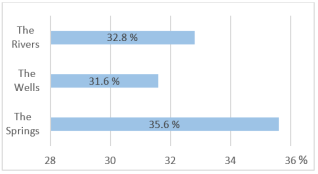
According to (Figure 4), it is clear that sources are the most severely impacted by drought, with a rate of 35.6%, followed by Oueds with 32.7%, and finally wells with 31.6%. During our survey, we observed that water resources in the watershed were heavily affected by these unfavorable climatic conditions. However, when asked "which water source is most affected by drought," most responses referred primarily to the source that was most used by the respondents and considered to be the one suffering the most from the impact of this drought.
Figure 3. Water source most impacted by drought.
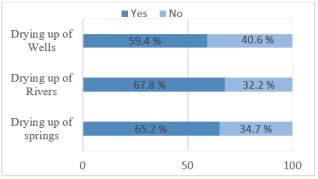
Figure 4. Impact of Drought on Springs, Wadis, and Wells.
3.2.2. Economic Impacts
Drought causes significant economic costs for the country, impacting both the agricultural and pastoral sectors. In the long term, its consequences can be irreversible, particularly concerning soil degradation and reduced fertility, leading to food deficits and potentially, in extreme cases, famines . Moreover, the reduction in forage resources directly affects livestock, leading to decreased productivity and increased mortality rates .
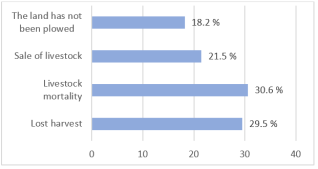
In the studied region, economic losses are significant and manifest at several levels. The survey reveals that 30.6% of respondents have observed livestock mortality, while 21.5% had to sell their livestock, likely due to a lack of food resources and the difficulty of maintaining them. Furthermore, 29.5% of residents report crop losses, directly impacting food security and farmers' income. Finally, 13.2% of respondents indicated that they delayed plowing in anticipation of rainfall, illustrating the growing uncertainty linked to climatic hazards .
These results confirm national trends, where recurring drought periods have a lasting impact on agricultural activities and increase the vulnerability of rural populations .
Figure 5. Economic impacts of drought.
3.2.3. Social Impacts of Drought
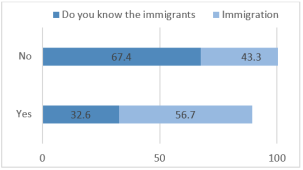
The consequences of drought are multiple and interdependent, affecting environmental, economic, and social dimensions. Among these, the social impact is particularly pronounced, leading to increased poverty, heightened tensions over water resources, and forced migration dynamics. Several studies highlight that drought episodes in Morocco have historically contributed to migration movements, particularly rural exodus and the mobility of herders seeking resources for their livestock .
Although traditional nomadism is declining, drought fosters the emergence of a semi-nomadic lifestyle, where movement is dictated by the availability of natural resources, particularly water and pasture . This phenomenon, although little studied, generates local tensions, especially around water points, and influences the socio-economic dynamics of the affected territories.
The results of our survey confirm this reality: 63.2% of respondents acknowledge the existence of the nomadic phenomenon in the region, while 37% refute it. Additionally, 62% of respondents report that nomads move their herds based on available water resources, thus highlighting the vulnerability of herders to climate hazards. While this mobility is essential for their survival, it exacerbates land disputes and conflicts over access to resources, further challenging sustainable management in arid areas .
Figure 6. Immigration in the Watershed.
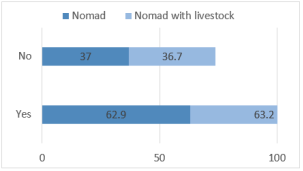
Figure 7. Nomadism in the Study Area.

4. Conclusion
Drought is a structural climatic reality in Morocco, and its recent intensification exacerbates the socio-economic and environmental challenges faced by local populations. The study conducted in the Oued El Abid watershed highlights an increased awareness of this phenomenon among residents, who primarily associate it with a marked reduction in rainfall, dwindling water resources, and rising temperatures.
The survey of 150 participants reveals several socio-demographic factors influencing the vulnerability of populations to drought. The majority of respondents (87%) are men, with an average age of 51 years. Agriculture (42%) and grazing (37%) remain the main economic activities, making these populations highly dependent on climatic conditions. Moreover, the education level remains limited, with 54.5% of participants having received traditional education and 11.2% never having attended school.
The study’s results highlight a widespread awareness of drought: 95% of residents recognize its presence in their region, and 80% believe it has a direct impact on their environment. The perception of climate changes emphasizes a marked transformation: while 45.6% of respondents once considered rainfall abundant, 58.4% now view it as low. Furthermore, the duration of rainfall has significantly decreased, with 83.3% of those surveyed stating that it now lasts only a few days. Meanwhile, 72.2% of respondents notice an increase in temperatures, and 70.4% believe that the frequency and intensity of drought episodes have significantly increased in recent decades.
The consequences of drought are manifold. Regarding water resources, 68% of residents report a decrease in the flow of springs and rivers, while 53% report the complete drying up of certain springs. The impact on agriculture is also significant: 75% of farmers report a drop in yields, and 41% of herders observe a reduction in their livestock.
Abbreviations

NDWI

Normalized Difference Water Index

SPI

Standardized Precipitation Index

IPCC

Intergovernmental Panel on Climate Change

GDNM

General Directorate of National Meteorology

Conflicts of Interest
The authors declare no conflicts of interest.
References
[1] Wilhite, D. A., & Glantz, M. H. (1985). Understanding: the drought phenomenon: the role of definitions. Water international, 10(3), 111-120.
[2] Bzioui, M. (2004). Rapport national 2004 sur les ressources en eau au Maroc. UN Water-Africa, 94, 2004.
[3] Ouakhir, H., El El Ghachi, M., Goumih, M., & Ennaji, N. (2020). Fluvial dynamic in Oued El Abid Basin: monitoring and quantification at an upstream river section in bin El Ouidane dam-2016/2017-(central high atlas/Morocco).
[4] Cervigni, R., & Morris, M. (2016). Confronting Drought in Africa’s Drylands [Affronter la secheresse dans les zones arides de l’Afrique]. World Bank Publications-Books.
[5] Salem, H. B., & Smith, T. (2008). Feeding strategies to increase small ruminant production in dry environments. Small ruminant research,77(2-3), 174-194.
[6] FAO, L., Mota, S. I., & Rego, A. C. (2019). Shaping the Nrf2-ARE-related pathways in Alzheimer’s and Parkinson’s diseases. Ageing Research Reviews, 54, 100942.
[7] Requier-Desjardins, D., Sautier, D., & Touzard, J. M. (2007). Dossiers Systemes agroalimentaires localises. Economies et societes, 29, 1465-1484.
[8] QADEM, A. (2021). Low water flows and interannual variability of precipitation in the upper Sebou (Middle Atlas, Morocco): A major challenge facing water resource management. Environmental and Water Sciences, public Health and Territorial Intelligence Journal, 5(1), 546-553.
[9] Hamza, M. A. (2012). Nomadisme et semi-nomadisme au Maroc. Encyclopedie berbere, (34), 5602-5609.
[10] Hayat, L. (2018). Modelisation agroeconomique dynamique pour la gestion durable des ressources en eau dans les zones arides et semi-arides: cas du sous bassin de Tadla, Maroc.
[11] Jenkins, M. A., & Pallardy, S. G. (1995). The influence of drought on red oak group species growth and mortality in the Missouri Ozarks. Canadian Journal of Forest Research, 25(7), 1119-1127.
[12] Stour, L., & Agoumi, A. (2008). Secheresse climatique au Maroc durant les dernieres decennies. Hydroecologie appliquee, 16, 215-232.
[13] Naciri, M. (1985) Calamites naturelles et fatalite historique. Conf. Secheresse, Gestion des Eaux et Production Alimentaire (Agadir, Maroc, novembre 1985).
[14] Bastide, R. (1971). Anthropologie appliquee. Paris: Stock, p. 236.
[15] Bijaber N, El Hadani D, Saidi M, Svoboda MD, Wardlow BD, Hain CR, Poulsen CC, Yessef M, Rochdi A. Developing a Rem IPCC otely Sensed Drought Monitoring Indicator for Morocco. Geosciences. 2018; 8(2): 55.
[16] Gil, M., Anas, E., Telesphore, B., & Armand, T. (2012). Analyse statistique de l’evolution de la couverture vegetale a partir d’image MODIS et NOAA sur le bassin versant du Bouregreg (MAROC). Geo Obs, (20), 33-44.
[17] Fall, A. S. (2007). Bricoler pour survivre: perceptions de la pauvrete dans l'agglomeration urbaine de Dakar. Karthala Edition.
[18] Setiawan, A. M., Lee, W. S., & Rhee, J. (2017). Spatio‐temporal characteristics of Indonesian drought related to El Niño events and its predictability using the multi‐model ensemble. International Journal of Climatology, 37(13), 4700-4719.
[19] Kuswanto, H., Hibatullah, F., & Soedjono, E. S. (2019). Perception of weather and seasonal drought forecasts and its impact on livelihood in East Nusa Tenggara, Indonesia. Heliyon, 5(8).
[20] Singh, P. K., Chudasama, H., 2016. Pathways for drought resilient livelihoods based on people’s perception. Clim. Change 140(2), 179–193.
[21] Jarawura, F. X. (2014). Perceptions of drought among rural farmers in the Savelugu district in the northern Savannah of Ghana. Ghana Journal of Geography, 6, 102-120.
[22] Bissour, R. (2019). Ressources en eau de l’oued El Abid amont barrage Bin El Ouidane et agriculture irriguee: Caracterisation, quantification et valorisation. Cas du perimetre irrigue de Beni Moussa (Region Beni Mellal Khenifra) (Doctoral dissertation, Universite Sultan Moulay Slimane, Beni Mellal (Maroc). tel-03254247
[23] Romaric, E. M. V. (2018). Synthese hydrogeologique et proposition de scenarii de recharge artificielle du sahel doukkala (bassin de l’oum errbia, maroc).
[24] Houssa, Abdelhadi AIT, DRISSI, Saad, ASEHRAOU, Abdeslam, et al. Changements climatiques au Maroc: quels systemes de culture et quelles biotechnologies pour s'y adapter ? Revue Marocaine des Sciences Agronomiques et Veterinaires, 2017, vol. 5, no 3.
[25] Ennasr-Seif, M., Zaaboul, R., Hirich, A., Caroletti, G. N., Bouchaou, L., El Morjani, Z. E. A., ... & Choukr-Allah, R. (2016). Climate change and adaptive water management measures in Chtouka Ait Baha region (Morocco). Science of the Total Environment, 573, 862-875.
[26] Traboulsi, M. (2012). La saison pluvieuse au Proche-Orient: une tendance au raccourcissement. Climatologie, 9, 9-29.
[27] Ardoin-Bardin, S. (2004). Variabilite hydroclimatique et impacts sur les ressources en eau de grands bassins hydrographiques en zone soudano-sahelienne (Doctoral dissertation, Universite Montpellier II-Sciences et Techniques du Languedoc).
[28] Boukdir, Ahmed, El Maslouhi, Rachid, Mabrouki, Mustapha, et al. Modelling reservoir sedimentation at Bin El Ouidane Dam, Morocco. Agrofor, 2017, vol. 2, no 1.
[29] Firdion, J. M. (2012). Construire un echantillon. Paugam S (ed.), L’enquête sociologique, Paris, Presses Universitaires de France, 69-92.
[30] Cochran, W. G. (1977). Sampling Techniques (3rd ed.). John Wiley & Sons.
[31] GIEC, 2007: Bilan 2007 des changements climatiques. Contribution des Groupes de travail I, II et III au quatrieme Rapport d’evaluation du Groupe d’experts intergouvernemental sur l’evolution du climat [Equipe de redaction principale, Pachauri, R. K. et Reisinger, A. (publie sous la direction de~)]. GIEC, Geneve, Suisse… 103 pages.)
[32] Direction de la Meteorologie Nationale (DMN) (2007). Les changements climatiques au Maroc: Observations et projections. DMN, Secretariat d'Etat aupres du Ministere de l'Energie, des Mines, de l'Eau et de l'Environnement, Charge de l'Eau et de l'Environnement, Royaume du Maroc, Casablanca, 20 p.
[33] Roche, M. F. (1986). Dictionnaire français d'hydrologie de surface: avec equivalents en anglais, espagnol, allemand (No. BOOK). Masson.
[34] Nejjari, A. (2002). La sécheresse, l'eau et l'homme dans le bassin versant du Haut Sebou (Moyen Atlas septentrional-Maroc) (Doctoral dissertation, Metz).
[35] World Bank Group. (2021). Global Economic Prospects, January 2021. World Bank Publications.
Cite This Article
  • APA Style

    Eljaouhary, Y., Qadem, A., Lebaut, S., Itobi, N., Es-seqally, A., et al. (2026). Perceptions and Representations of Drought in the Oued El Abid Watershed. Humanities and Social Sciences, 14(1), 10-19. https://doi.org/10.11648/j.hss.20261401.12

    Copy | Download

    ACS Style

    Eljaouhary, Y.; Qadem, A.; Lebaut, S.; Itobi, N.; Es-seqally, A., et al. Perceptions and Representations of Drought in the Oued El Abid Watershed. Humanit. Soc. Sci. 2026, 14(1), 10-19. doi: 10.11648/j.hss.20261401.12

    Copy | Download

    AMA Style

    Eljaouhary Y, Qadem A, Lebaut S, Itobi N, Es-seqally A, et al. Perceptions and Representations of Drought in the Oued El Abid Watershed. Humanit Soc Sci. 2026;14(1):10-19. doi: 10.11648/j.hss.20261401.12

    Copy | Download

  • @article{10.11648/j.hss.20261401.12,
      author = {Yassine Eljaouhary and Abdelghani Qadem and Sebastien Lebaut and Najat Itobi and Abdelfettah Es-seqally and Hanane Bouyazri},
      title = {Perceptions and Representations of Drought in the Oued El Abid Watershed},
      journal = {Humanities and Social Sciences},
      volume = {14},
      number = {1},
      pages = {10-19},
      doi = {10.11648/j.hss.20261401.12},
      url = {https://doi.org/10.11648/j.hss.20261401.12},
      eprint = {https://article.sciencepublishinggroup.com/pdf/10.11648.j.hss.20261401.12},
      abstract = {This study analyzes perceptions and representations of drought among residents of the Oued El Abid watershed in Morocco, based on a structured field survey conducted with 150 households. The results reveal a high level of awareness of drought, with 95% of respondents acknowledging its occurrence and 80% considering their area to be directly affected. Nearly 75% of the surveyed population report having personally experienced its impacts, particularly reduced precipitation, water scarcity, and the drying up of springs and streams. Local populations perceive a significant deterioration in climatic conditions, as 58.4% currently consider precipitation to be low compared to 45.6% who previously described it as abundant. In addition, 72.2% of respondents report an increase in temperatures, and 70.4% identify recent decades as the driest. Drought is described as a multidimensional phenomenon encompassing climatic, hydrological, agricultural, and socio-economic aspects, with direct repercussions on water resources, agriculture, and livestock. The study highlights critical impacts on water supply, marked by reduced flows in springs, rivers, and wells, as well as significant economic consequences, including crop losses, declining agricultural yields, and livestock mortality, thereby increasing the socio-economic vulnerability of local populations. Furthermore, adaptation strategies such as the semi-nomadic mobility of herds illustrate the capacity of communities to adjust their practices in response to environmental constraints. Overall, these findings emphasize that drought represents a major environmental and socio-economic challenge in the Oued El Abid watershed, and that integrating local perceptions is essential for developing sustainable water resource management strategies and strengthening community resilience to climate change.},
     year = {2026}
    }
    

    Copy | Download

  • TY  - JOUR
    T1  - Perceptions and Representations of Drought in the Oued El Abid Watershed
    AU  - Yassine Eljaouhary
    AU  - Abdelghani Qadem
    AU  - Sebastien Lebaut
    AU  - Najat Itobi
    AU  - Abdelfettah Es-seqally
    AU  - Hanane Bouyazri
    Y1  - 2026/01/09
    PY  - 2026
    N1  - https://doi.org/10.11648/j.hss.20261401.12
    DO  - 10.11648/j.hss.20261401.12
    T2  - Humanities and Social Sciences
    JF  - Humanities and Social Sciences
    JO  - Humanities and Social Sciences
    SP  - 10
    EP  - 19
    PB  - Science Publishing Group
    SN  - 2330-8184
    UR  - https://doi.org/10.11648/j.hss.20261401.12
    AB  - This study analyzes perceptions and representations of drought among residents of the Oued El Abid watershed in Morocco, based on a structured field survey conducted with 150 households. The results reveal a high level of awareness of drought, with 95% of respondents acknowledging its occurrence and 80% considering their area to be directly affected. Nearly 75% of the surveyed population report having personally experienced its impacts, particularly reduced precipitation, water scarcity, and the drying up of springs and streams. Local populations perceive a significant deterioration in climatic conditions, as 58.4% currently consider precipitation to be low compared to 45.6% who previously described it as abundant. In addition, 72.2% of respondents report an increase in temperatures, and 70.4% identify recent decades as the driest. Drought is described as a multidimensional phenomenon encompassing climatic, hydrological, agricultural, and socio-economic aspects, with direct repercussions on water resources, agriculture, and livestock. The study highlights critical impacts on water supply, marked by reduced flows in springs, rivers, and wells, as well as significant economic consequences, including crop losses, declining agricultural yields, and livestock mortality, thereby increasing the socio-economic vulnerability of local populations. Furthermore, adaptation strategies such as the semi-nomadic mobility of herds illustrate the capacity of communities to adjust their practices in response to environmental constraints. Overall, these findings emphasize that drought represents a major environmental and socio-economic challenge in the Oued El Abid watershed, and that integrating local perceptions is essential for developing sustainable water resource management strategies and strengthening community resilience to climate change.
    VL  - 14
    IS  - 1
    ER  - 

    Copy | Download

Author Information