This article discusses the similarities and differences between traditional vocal works and virtual singer works. It introduces the vocal characteristics of virtual singers, explores the differences between their performances and those of real singers, and analyzes the considerations that composers have for harmony and texture design when composing for virtual singers and real vocals, such as the way in which traditional functional harmonies and modern twelve-tone sequences are harmonic, and what the differences are, It also discusses the differences in the expression of various harmonic techniques in song composition when applied to the two types of vocal music,and composers' ideas for using different harmonies for different groups when composing. This article focuses on virtual singers Kafu and Hatsune Miku, as well as some representative musical works sounded by the two virtual singers. Several artist songs written for real vocal singers will also be analyzed comparatively, such as the Mass, Rossini's opera, and the vocal parts of Boulez's Ownerless Mallet. The impact of different vocal characteristics on the uniqueness of musical works, along with the technical differences and similarities between compositions for virtual and real singers, will be discussed. At the same time, this article provides theoretical references and compositional inspirations for the composition of virtual voices and the study of contemporary vocal music art.
This is an Open Access article, distributed under the terms of the Creative Commons Attribution 4.0 International License (http://creativecommons.org/licenses/by/4.0/), which permits unrestricted use, distribution and reproduction in any medium or format, provided the original work is properly cited.
ACG (Anime, Comic, Game) culture, a prominent Internet subculture, originated in Japan and has had a deeply influenced the lives of teenagers today
[1]
Ye, Runze, Xu Ganli. (2024) The Two-Way Interaction Between Mainstream Culture and ACG (Anime, Comics, and Games) Subculture: A Case Study of the Virtual Singer Luo Tianyi. Youth Journal (1), 103-111.
[2]
Liu,Yu. (2023) An Exploration of the Paths for the Cultural Output of the Film and Television Industry in the Digital Media Era. Capital University of Economics and Business. Journalism communication, (2023.2) ,1672-0261,23-1147/G2.
[1, 2]
. Virtual singers, a component of this “two-dimensional culture” (Er Ci Yuan), have gained widespread attention. Virtual singers created by Japanese studios, characterized by their distinct vocal styles and appealing character designs, have introduced a new dimension to musical sound. Upon examining this phenomenon, the author observed that composers encounter both similarities and differences when composing for virtual singers compared to real vocalists. Likewise, the singing techniques of virtual singers often exhibit both resemblances and contrasts with those of real singers.
For this discussion, Kafu, developed by the Kami Mura Studio, and Hatsune Miku will be used as case studies. The similarities and differences in the singing techniques and composition styles of virtual singers will be examined. The distinct vocal styles of virtual singers, the structure of their vocal ranges, the rhythmic aspects of their vocals, as well as the harmonics of accompaniment in virtual-singer pieces and traditional art songs, will all be considered.
2. Vocal Characteristics of Virtual Singers
Kafu, a virtual singer focusing on sophisticated vocals, was created on the Cevio AI platform, with her voice characteristics taken from the KAF. Her voice is high-tension. As a virtual singer, Kafu’s breathy sound makes her voice more realistic. Also, her TA (Tension Adjustment) voice tuning has a youthful sound. Like KAF says: “My character, Kafu Morisaki can use this great power to take away all the rage and sadness in the world and strip it away with her song.
[3]
Alicia Haddick. (2025) Virtual singer Kaf's music becomes magic in 'Kamitsubaki City Under Construction. The Japan times.
[3]
The uniqueness of her voice stems from her hoarse quality, which makes her singing sound more emotional when she sings love or laziness lyrics. The uniqueness of her singing style is most exceptional.
Hatsune Miku, a blue-haired, anime-style character,
[4]
Norrasate Udakarn, Remi Namtep. (2024) An Exploratory Analysis of how Vocaloid’s Synthesized Vocals can be used as an Innovative Music Education Method in Teaching Sight–Singing. College of Music, Payap University, Chiang Mai, Thailand. Pakistan Journal of Life and Social Sciences. Pak. j. life soc. Sci. (2024), 22(2): 8850-8862.
[4]
created by Crypton Future Media on August 31, 2007, employs Yamaha’s ‘VOCALOID’ speech synthesis software. Hatsune Miku was soon recognised as one of the most famous virtual singers. Since 2009, Hatsune Miku has held over eighty large-scale concerts worldwide, such as Magic Future and MIKU EXPO
[5]
Ji, Yingying, Huang Xiang, Xiang Yao, Liu Jialin, Cai Mingyu. (2025) Study on the Emotional Interaction between Two-dimensional Virtual Idols and Fan Groups -- a Case Study of Hatsune Miku: Asia-Pacific Science Literature Bulletin Issue04 April 20251.
[5]
. The years after her initial release yielded hundreds of thousands of subsequent fan contributions, extending her voice and character. From original music to live concerts, collaborative projects, and video games.
[6]
Esther Chen. (2024) The Vocaloid Phenomenon: Deconstruction of Music Culture Through Hatsune Miku.
[6]
Hatsune Miku has been famous not only as a singer but also as an element of various forms of creative products in Japanese culture. Hatsune Miku can also be regarded as a fully realised character, enhancing her users' experience. ‘VOCALOID 2.0’ enables users to create their own songs as well as lyrics with Hatsune Miku’s voice, which promotes creativity among virtual singers
[7]
Yang, Yuxuan. (2023) From Lynn Minmay and Hatsune Miku to A-SOUL: The Generational Evolution and Localization of Virtual Idols [J]. Audiovisual, (2): 124-128.
[7]
.
3. Differences Between Virtual Singers and Real Singers
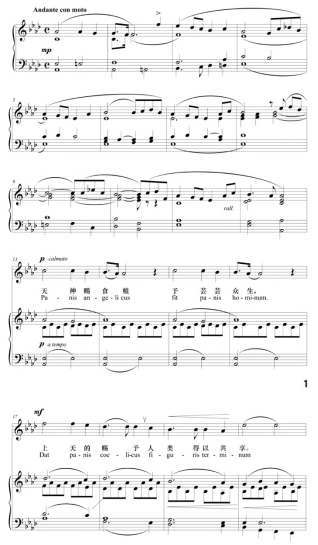
The writer has identified some of the main differences between virtual singers’ performances and real singing. For example, in real singing, vibrato is an important concept. However, in the case of virtual singers’ performances, it is hard to produce this effect due to the mechanical sound-production process used by virtual singers. For this reason, it can be concluded that virtual singers cannot produce vibrato naturally. The main reason is that the production of sound in virtual singers’ performances is dependent on mathematical formulas. For this reason, according to the song “Panis angelicus” (as illustrated in Figure 1), singers must produce vibrato slowly. The song is melodic, sweet, and slow. For this particular song, which acts as a church hymn, the singer must produce vibrato delicately
[8]
Zhang, Xiangming. (2012) On the Role of "Vibrato" in Vocal Performance. [D]. Fujian Normal University.
Figure 1. “Panis angelicus” is from the church hymn in the Soleri Mass.
In contrast, virtual singers do not produce such vibrato when holding long notes to express emotion. The hoarse sound quality of some virtual voices can even feel uncomfortable when paired with vibrato. For example, in "Asahi" (Figure 2), composed by Iori Kanzaki, when expressing love during the climax of the piece, vibrato is intentionally avoided. Instead, a smooth, sustained note is used. In the second measure, the note E reaches a high point of emotional expression, yet no vibrato is applied.
While comparing real vocals and virtual singers, the writer discovered that composers interact differently with both, particularly regarding vocal range. For virtual singers, composers tend to opt for extremely high or low pitches, which would be difficult or impossible for human singers. However, with machine production, it becomes easy to create tension during the climax of a song without harming the human singer’s vocal cords.
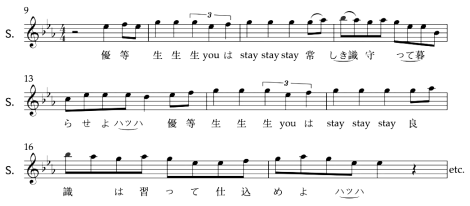
For instance, in the song “Elite” by Chinozo (Figure 3), the composer extends the passage of the soprano’s voice transition note by continually repeating it. The transition of a normal soprano voice happens at F2, while it is unusual to find a song revolving around this note. The song also utilises the B2 note extensively. The B2 note is difficult in reality, while it can be accomplished easily by a virtual singer.
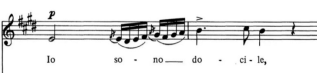
However, in real-world vocals, the composer does not use an oscillating pattern of the vocal passaggio. The pattern below or slightly above the transition region is more common. The key is avoiding vocal fatigue. “Una Voce poco fa” (Refer to Figure 4) utilises modular scales, ornamentations, or triplets. The scales vary. This section has a relatively tight rhythm, formed by a continuous series of notes, making the overall music more tonally consistent.
[9]
Song,jiaorui. (2023) Analysis of the singing style of the aria "una voce poco fa" [A]. Guangxi University of Arts and Music School.
[9]
Here, florid techniques are also employed. Florid singing not only showcases the singer's extraordinary vocal skills but is also an important medium for emotional expression and artistic creation. Through various techniques such as rapid scale runs, this section adds infinite possibilities to the music.
[10]
Ma,yiyi. (2025) Analysis and Singing Study of the Opera Excerpt "Una Voce Poco Fa" Guizhou university.
[10]
The stability of the vocal range ensures the smoothness of the voice and enables free breathing
[11]
Zhao, Na. (2011) A Study on the Vocal Characteristics of Coloratura Mezzo-Soprano. [D]. Shaanxi Normal University.
[11]
.
The author also found that virtual singers are often used to perform at speeds that are difficult for human singers to achieve. This contributes to a futuristic, mechanical sound that captivates audiences. Virtual singers can execute extremely fast musical passages that would otherwise be exhausting for real singers, reducing rehearsal time and the potential for performance errors. For example, Hatsune Miku’s "The Disappearance of Hatsune Miku" has become a classic virtual singer work. The tempo of this piece reaches 245 beats per minute (BPM), far exceeding the human limit of 208 BPM. This super-high-speed song cannot be performed by human singers. The rapid tempo evokes a sense of parting and sadness, with the song disappearing just as quickly as it is sung. This feeling of futurism and emotional detachment is achieved without the discomfort or vocal strain that would affect a real singer. The song reaches an instantaneous speed of 720 BPM, with 12 notes per second—far beyond the limits of human vocalization. Until 2018, it was considered the fastest "farewell song." This genre of ultra-fast electronic music has since become a hallmark of virtual singer performances
[12]
Xu, Yihong. (2012) Japan's New Idol—Hatsune Miku [J]. Japanese Knowledge, 2012(12): 36-37.
Dan Wei, (2018) A Study on the Cultural Phenomenon and Communication Characteristics of Virtual Music Characters in the Context of New Media. [D]. Shenzhen University.
[14]
Wu, Jixue. (2017) The Transformation of Sequences—An Initial Exploration of the Pitch Organization in Pierre Boulez's Chamber Work "Without Owner's Hammer." New Voices in Music: Journal of Shenyang Conservatory of Music, 35(1), 10.
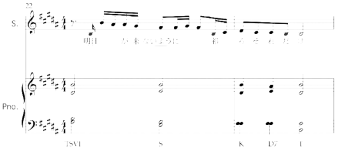
While comparing the musical compositions of virtual singers with art songs, the writer has identified various similarities and divergences in the use of harmonies. Most musical pieces composed for virtual singers are aimed at appealing to society’s prevailing musical interests, which often entail tonal pieces with defined harmonies. This always leaves the listener with a feeling of anticipation, making the musical pieces catchy. For example, in the musical piece “Do not Say Goodbye” (Figure 5), the key musical piece gradually shifts into the chorus section by using conventional harmonic techniques. The application of the conventional cadential formula at the end of the verse always leaves the listeners feeling there is an element of expectation.
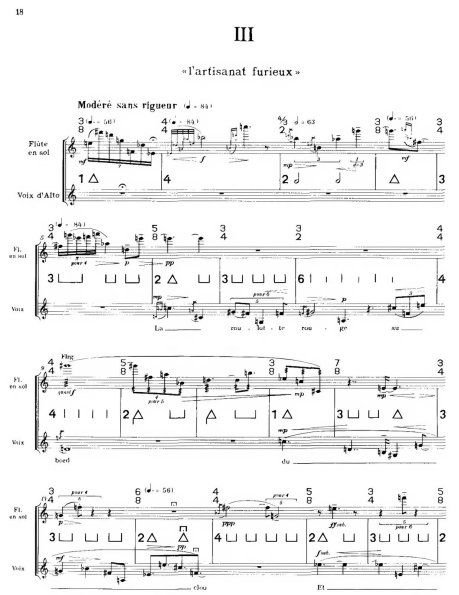
On the other hand, compositions for real vocals often lean towards avant-garde and experimental approaches. Some 20th-century composers, for instance, have favored a more logical, structured form of composition. Since Schoenberg introduced the twelve-tone technique, many vocal composers have adopted this method, including Pierre Boulez. In his work "The Hammer Without a Master", the contralto section completely abandons traditional harmonic systems. Boulez uses sequences to create music that emphasizes logical construction, contributing to the development of avant-garde music. The following is an excerpt from the contralto section of "The Hammer Without a Master" (Figure 6).
Unlike traditional harmonic resolutions, "The Hammer Without a Master" employs a monolithic twelve-tone sequence (Figure 7), which rejects traditional tonal concepts. There is no final cadence, and the work resists the usual directional pull of classical harmony. This contrasts sharply with virtual singer works like "Don’t Say Goodbye", which adhere to tonal harmony and melodic conventions.
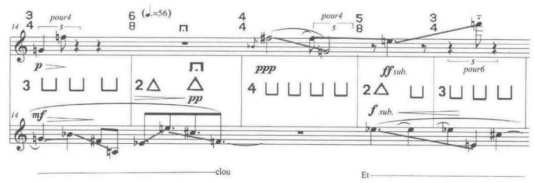
Figure 8. “The Hammer Without a Master” mm. 14 - 18.
In the third movement of "The Hammer Without a Master", Boulez designs a twelve-tone sequence for the mezzo-soprano section. In measures 6-8, we see a descending chromatic progression (G-sharp to F) in the mezzo-soprano voice. In measure 14, B-flat and A form a descending major seventh, followed by an ascending minor ninth between B-flat and E-flat in measure 15 (in Figure 8). Boulez manipulates pitch relationships systematically, utilizing sequences to create intricate pitch structures and connections
[15]
Wang, Shuangfeng. (2019). Why Are Virtual Idols So Popular? [J]. Shanghai Informatization (10), 3.
[15]
.
From this analysis, the writer highlights how Boulez uses the twelve-tone sequence as a source of pitches while maintaining its integrity. However, “Do not Say Goodbye” uses conventional harmony, aiming to produce a catchy tune that appeals to many. The second piece is fit for consumption by the masses, preferably at events where listeners can gain insight into popular harmony. However, Boulez uses twelve tones in composing melodic pieces. The composer’s approach highlights the ever-evolving nature of developments in classical musical composition. The focus on pitches shows how musical efforts have helped create progress in the world of classical musical composition.
5. Conclusions
With the rapid development of technology and society, virtual idols have introduced new possibilities for vocal performances. In the past, composers composing for real singers were constrained by the limitations of human physiology, particularly regarding vocal range and rhythmic complexity. As a result, some musical works could not meet the expectations of fans. However, the emergence of virtual idols has transformed the relationship between fans and performers, shifting from “I support what idols do” to “I decide what idols do”. This change has expanded the scope of musical production, allowing virtual idols to exist as unique entities separate from their human counterparts.
By comparing the compositions of virtual singers with the traditional art song “The Hammer Without a Master” in terms of harmony, melody, and composition, the writer notes that the various approaches to vocalisation practices and listener expectations place different demands on musical composition. The composers of pieces performed by virtual singers, as well as those performed by real vocals, work with different perspectives. This has resulted in an observable distinction between compositions by virtual singers and traditional art songs.
The writer thinks that as the number of virtual singers continues to rise, more traditional composers will be interested in writing arrangements for them. Composers will develop strategies for making the most of both the benefits of virtual and human singers. A talented composer can do both well, thereby benefiting the world of modern music and traditional composition methods. The writer hopes that, as time passes, the world will enjoy not only virtual singer music but also art songs.
Abbreviations
ACG
Anime, Comic, Game
BPM
Beats per minute
TA
Tension Adjustment
Conflicts of Interest
The author declares no conflicts of interest.
References
[1]
Ye, Runze, Xu Ganli. (2024) The Two-Way Interaction Between Mainstream Culture and ACG (Anime, Comics, and Games) Subculture: A Case Study of the Virtual Singer Luo Tianyi. Youth Journal (1), 103-111.
[2]
Liu,Yu. (2023) An Exploration of the Paths for the Cultural Output of the Film and Television Industry in the Digital Media Era. Capital University of Economics and Business. Journalism communication, (2023.2) ,1672-0261,23-1147/G2.
[3]
Alicia Haddick. (2025) Virtual singer Kaf's music becomes magic in 'Kamitsubaki City Under Construction. The Japan times.
[4]
Norrasate Udakarn, Remi Namtep. (2024) An Exploratory Analysis of how Vocaloid’s Synthesized Vocals can be used as an Innovative Music Education Method in Teaching Sight–Singing. College of Music, Payap University, Chiang Mai, Thailand. Pakistan Journal of Life and Social Sciences. Pak. j. life soc. Sci. (2024), 22(2): 8850-8862.
[5]
Ji, Yingying, Huang Xiang, Xiang Yao, Liu Jialin, Cai Mingyu. (2025) Study on the Emotional Interaction between Two-dimensional Virtual Idols and Fan Groups -- a Case Study of Hatsune Miku: Asia-Pacific Science Literature Bulletin Issue04 April 20251.
[6]
Esther Chen. (2024) The Vocaloid Phenomenon: Deconstruction of Music Culture Through Hatsune Miku.
[7]
Yang, Yuxuan. (2023) From Lynn Minmay and Hatsune Miku to A-SOUL: The Generational Evolution and Localization of Virtual Idols [J]. Audiovisual, (2): 124-128.
[8]
Zhang, Xiangming. (2012) On the Role of "Vibrato" in Vocal Performance. [D]. Fujian Normal University.
[9]
Song,jiaorui. (2023) Analysis of the singing style of the aria "una voce poco fa" [A]. Guangxi University of Arts and Music School.
[10]
Ma,yiyi. (2025) Analysis and Singing Study of the Opera Excerpt "Una Voce Poco Fa" Guizhou university.
[11]
Zhao, Na. (2011) A Study on the Vocal Characteristics of Coloratura Mezzo-Soprano. [D]. Shaanxi Normal University.
[12]
Xu, Yihong. (2012) Japan's New Idol—Hatsune Miku [J]. Japanese Knowledge, 2012(12): 36-37.
Dan Wei, (2018) A Study on the Cultural Phenomenon and Communication Characteristics of Virtual Music Characters in the Context of New Media. [D]. Shenzhen University.
[14]
Wu, Jixue. (2017) The Transformation of Sequences—An Initial Exploration of the Pitch Organization in Pierre Boulez's Chamber Work "Without Owner's Hammer." New Voices in Music: Journal of Shenyang Conservatory of Music, 35(1), 10.
[15]
Wang, Shuangfeng. (2019). Why Are Virtual Idols So Popular? [J]. Shanghai Informatization (10), 3.
Chen, Z. (2026). Comparative Analysis of Compositions for Virtual Singers and Human Singers. Humanities and Social Sciences, 14(2), 125-130. https://doi.org/10.11648/j.hss.20261402.17
Chen, Z. Comparative Analysis of Compositions for Virtual Singers and Human Singers. Humanit. Soc. Sci.2026, 14(2), 125-130. doi: 10.11648/j.hss.20261402.17
Chen Z. Comparative Analysis of Compositions for Virtual Singers and Human Singers. Humanit Soc Sci. 2026;14(2):125-130. doi: 10.11648/j.hss.20261402.17
@article{10.11648/j.hss.20261402.17,
  author = {Zeyun Chen},
  title = {Comparative Analysis of Compositions for Virtual Singers and Human Singers},
  journal = {Humanities and Social Sciences},
  volume = {14},
  number = {2},
  pages = {125-130},
  doi = {10.11648/j.hss.20261402.17},
  url = {https://doi.org/10.11648/j.hss.20261402.17},
  eprint = {https://article.sciencepublishinggroup.com/pdf/10.11648.j.hss.20261402.17},
  abstract = {This article discusses the similarities and differences between traditional vocal works and virtual singer works. It introduces the vocal characteristics of virtual singers, explores the differences between their performances and those of real singers, and analyzes the considerations that composers have for harmony and texture design when composing for virtual singers and real vocals, such as the way in which traditional functional harmonies and modern twelve-tone sequences are harmonic, and what the differences are, It also discusses the differences in the expression of various harmonic techniques in song composition when applied to the two types of vocal music,and composers' ideas for using different harmonies for different groups when composing. This article focuses on virtual singers Kafu and Hatsune Miku, as well as some representative musical works sounded by the two virtual singers. Several artist songs written for real vocal singers will also be analyzed comparatively, such as the Mass, Rossini's opera, and the vocal parts of Boulez's Ownerless Mallet. The impact of different vocal characteristics on the uniqueness of musical works, along with the technical differences and similarities between compositions for virtual and real singers, will be discussed. At the same time, this article provides theoretical references and compositional inspirations for the composition of virtual voices and the study of contemporary vocal music art.},
 year = {2026}
}
TY  - JOUR
T1  - Comparative Analysis of Compositions for Virtual Singers and Human Singers
AU  - Zeyun Chen
Y1  - 2026/03/31
PY  - 2026
N1  - https://doi.org/10.11648/j.hss.20261402.17
DO  - 10.11648/j.hss.20261402.17
T2  - Humanities and Social Sciences
JF  - Humanities and Social Sciences
JO  - Humanities and Social Sciences
SP  - 125
EP  - 130
PB  - Science Publishing Group
SN  - 2330-8184
UR  - https://doi.org/10.11648/j.hss.20261402.17
AB  - This article discusses the similarities and differences between traditional vocal works and virtual singer works. It introduces the vocal characteristics of virtual singers, explores the differences between their performances and those of real singers, and analyzes the considerations that composers have for harmony and texture design when composing for virtual singers and real vocals, such as the way in which traditional functional harmonies and modern twelve-tone sequences are harmonic, and what the differences are, It also discusses the differences in the expression of various harmonic techniques in song composition when applied to the two types of vocal music,and composers' ideas for using different harmonies for different groups when composing. This article focuses on virtual singers Kafu and Hatsune Miku, as well as some representative musical works sounded by the two virtual singers. Several artist songs written for real vocal singers will also be analyzed comparatively, such as the Mass, Rossini's opera, and the vocal parts of Boulez's Ownerless Mallet. The impact of different vocal characteristics on the uniqueness of musical works, along with the technical differences and similarities between compositions for virtual and real singers, will be discussed. At the same time, this article provides theoretical references and compositional inspirations for the composition of virtual voices and the study of contemporary vocal music art.
VL  - 14
IS  - 2
ER  -
Chen, Z. (2026). Comparative Analysis of Compositions for Virtual Singers and Human Singers. Humanities and Social Sciences, 14(2), 125-130. https://doi.org/10.11648/j.hss.20261402.17
Chen, Z. Comparative Analysis of Compositions for Virtual Singers and Human Singers. Humanit. Soc. Sci.2026, 14(2), 125-130. doi: 10.11648/j.hss.20261402.17
Chen Z. Comparative Analysis of Compositions for Virtual Singers and Human Singers. Humanit Soc Sci. 2026;14(2):125-130. doi: 10.11648/j.hss.20261402.17
@article{10.11648/j.hss.20261402.17,
  author = {Zeyun Chen},
  title = {Comparative Analysis of Compositions for Virtual Singers and Human Singers},
  journal = {Humanities and Social Sciences},
  volume = {14},
  number = {2},
  pages = {125-130},
  doi = {10.11648/j.hss.20261402.17},
  url = {https://doi.org/10.11648/j.hss.20261402.17},
  eprint = {https://article.sciencepublishinggroup.com/pdf/10.11648.j.hss.20261402.17},
  abstract = {This article discusses the similarities and differences between traditional vocal works and virtual singer works. It introduces the vocal characteristics of virtual singers, explores the differences between their performances and those of real singers, and analyzes the considerations that composers have for harmony and texture design when composing for virtual singers and real vocals, such as the way in which traditional functional harmonies and modern twelve-tone sequences are harmonic, and what the differences are, It also discusses the differences in the expression of various harmonic techniques in song composition when applied to the two types of vocal music,and composers' ideas for using different harmonies for different groups when composing. This article focuses on virtual singers Kafu and Hatsune Miku, as well as some representative musical works sounded by the two virtual singers. Several artist songs written for real vocal singers will also be analyzed comparatively, such as the Mass, Rossini's opera, and the vocal parts of Boulez's Ownerless Mallet. The impact of different vocal characteristics on the uniqueness of musical works, along with the technical differences and similarities between compositions for virtual and real singers, will be discussed. At the same time, this article provides theoretical references and compositional inspirations for the composition of virtual voices and the study of contemporary vocal music art.},
 year = {2026}
}
TY  - JOUR
T1  - Comparative Analysis of Compositions for Virtual Singers and Human Singers
AU  - Zeyun Chen
Y1  - 2026/03/31
PY  - 2026
N1  - https://doi.org/10.11648/j.hss.20261402.17
DO  - 10.11648/j.hss.20261402.17
T2  - Humanities and Social Sciences
JF  - Humanities and Social Sciences
JO  - Humanities and Social Sciences
SP  - 125
EP  - 130
PB  - Science Publishing Group
SN  - 2330-8184
UR  - https://doi.org/10.11648/j.hss.20261402.17
AB  - This article discusses the similarities and differences between traditional vocal works and virtual singer works. It introduces the vocal characteristics of virtual singers, explores the differences between their performances and those of real singers, and analyzes the considerations that composers have for harmony and texture design when composing for virtual singers and real vocals, such as the way in which traditional functional harmonies and modern twelve-tone sequences are harmonic, and what the differences are, It also discusses the differences in the expression of various harmonic techniques in song composition when applied to the two types of vocal music,and composers' ideas for using different harmonies for different groups when composing. This article focuses on virtual singers Kafu and Hatsune Miku, as well as some representative musical works sounded by the two virtual singers. Several artist songs written for real vocal singers will also be analyzed comparatively, such as the Mass, Rossini's opera, and the vocal parts of Boulez's Ownerless Mallet. The impact of different vocal characteristics on the uniqueness of musical works, along with the technical differences and similarities between compositions for virtual and real singers, will be discussed. At the same time, this article provides theoretical references and compositional inspirations for the composition of virtual voices and the study of contemporary vocal music art.
VL  - 14
IS  - 2
ER  -







 Share This Article
 Twitter
 Linked In
 Facebook
 Copy
Copy Download