
It is well known that every derivation on a von Neumann algebra is inner, which reflects the strong rigidity of these algebras. In contrast, for general C*-algebras there may exist non-inner derivations, indicating a more complicated and diverse algebraic structure. This fundamental difference has stimulated extensive research on derivations on various classes of operator algebras. In recent years, increasing attention has been paid to derivations defined on algebras of unbounded operators, in particular on algebras of measurable, locally measurable, and τ-measurable operators associated with von Neumann algebras. Such algebras arise naturally within the framework of noncommutative integration theory and provide a rich setting for extending classical results from the theory of bounded operators. In particular, a complete description of derivations on these algebras has been established in a number of works when they are associated with type I von Neumann algebras, demonstrating that under appropriate assumptions the derivations possess strong regularity properties and admit explicit representations. The present article is devoted to the development of a real analogue of the results described above. More precisely, derivations on algebras of measurable, locally measurable, and τ-measurable operators associated with real type I von Neumann algebras are investigated. By carefully adapting the methods from the complex case and taking into account the specific algebraic and topological features of real operator algebras, a complete characterization of all derivations on the algebras under consideration is obtained. These results generalize known theorems for complex von Neumann algebras to the real setting and contribute to a deeper understanding of derivations on algebras of unbounded operators associated with real operator algebras.
| Published in | International Journal of Applied Mathematics and Theoretical Physics (Volume 12, Issue 1) |
| DOI | 10.11648/j.ijamtp.20261201.12 |
| Page(s) | 28-33 |
| Creative Commons |
This is an Open Access article, distributed under the terms of the Creative Commons Attribution 4.0 International License (http://creativecommons.org/licenses/by/4.0/), which permits unrestricted use, distribution and reproduction in any medium or format, provided the original work is properly cited. |
| Copyright |
Copyright © The Author(s), 2026. Published by Science Publishing Group |
Derivations, Algebra of Measurable Operators, Locally Measurable Operator, -measurable Operator, Von Neumann Algebras
 -measurable operators affiliated with von Neumann algebra of type I is given. Papers
  -measurable operators affiliated with real von Neumann algebra of type I are obtained.
  be a *-subalgebra of
  of all bounded linear operators on complex Hilbert space
  . The set
  is called the commutant of the *-algebra
  . The set
 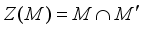 is called the center of the algebra
  . A *-subalgebra
  with the property
  is called W*-algebra, where
  is the double commutant of
  . It is equivalent to that, *-subalgebra
  is weakly closed and consists identity (i.e. 1
  ). W*-algebras are also known as von Neumann Algebras. A W*-algebra
  is called a factor if its center is trivial, i.e.
  coincides with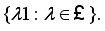
 is called discrete, or of type I, if for every nonzero central projection
  there exists a nonzero abelian projection
  such that
  .
.  is called of type
  if
if  is a nonfinite (infinite) algebra of type I.
 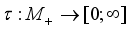 is called a trace on
  if
if  for all
  ;
; 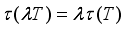 for every
  and
and  (with the convention
  );
); 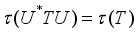 for every
  and every unitary operator
  .
.  is called finite if
  for every
  ; semifinite if
  for every
  ; faithful if from
  with
with  it follows that
  ; normal if from
  with
with 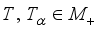 it follows that
 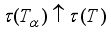 .
.  is said to be affiliated with algebra
  (notation:
  ) if
) if  for every unitary operator
  .
.  is a closed linear subspace of
  and
and  denotes the orthogonal projection onto
  , then
  if and only if
 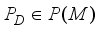 , where
  is complete lattice of all projections from
  .
.  is called strongly dense in
  with respect to
  if
if  and there exists a sequence of projections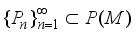
 such that
  is a finite projection for each
  .
.  is determined by the sequence of projections
  .
.  it follows directly that every strongly dense linear subspace is dense in
  .
.  with domain
  , acting in the Hilbert space
  , is called affiliated with
  (notation:
  ) if
) if  for every unitary
  , that is,
  and
and 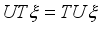 for all
  .
.  is affiliated with
  if and only if
  . A closed linear operator
  acting in a Hilbert space
  is called measurable with respect to algebra
  if
if  and its domain
  is strongly dense in
  .
.  the set of all operators that are measurable with respect to algebra
  . Clearly,
 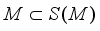 .
.  acting in a Hilbert space
  is called locally measurable with respect to algebra
  if
if  and there exists a sequence of central projections
 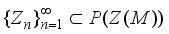 such that
  for all
  .
.  the set of all linear operators that are locally measurable with respect to algebra
  . It is clear that
 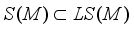 , and
, and 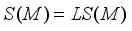 if
if  is a factor.
  2.2. Derivations on the Algebra
  be an algebra over the complex numbers. A linear operator
  is called a derivation if it satisfies the Leibniz rule
  for all
  . Every element
  defines a derivation
  on
on  by
by  . Such derivations
  are called inner derivations.
  that defines the derivation
  belongs to a larger algebra
  that contains
  , then
  is called a spatial derivation.
  is commutative, all inner derivations are zero, so they are trivial. One of the main problems in the theory of derivations is to determine when derivations are automatically inner or spatial, and whether non-inner derivations exist, especially nontrivial derivations on commutative algebras.
  is called real W*-algebra, if it is weakly closed, 1
  , and
, and 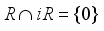 . Real W*-algebras are also known as real von Neumann Algebras. Let
  be a real von Neumann algebra and
 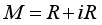 . We consider the algebra
  of all measurable operators affiliated with a real von Neumann algebra
  It is proved that (see
  , analogically it is proven that
  . Below, we give a full description of derivations on the algebra
  of all locally measurable operators affiliated with a type I real von Neumann algebra
  .
.  on
on  is inner, then it is
  -linear, that is,
 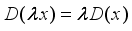 for all
 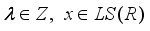 , where
  is the center of
  . The following result shows that the opposite statement is also true.
  be a type I real von Neumann algebra with the center
  . Then every
  -linear derivation
  on the algebra
  is inner.
  , the derivation
  can be extended by
  -linearity to derivation
  on
on  as
as 
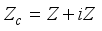 is a center of
  . Since every derivation on
  is inner (see
  is inner, i.e. there is an element
  such that
  . Then we have
 and
and 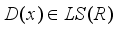 , then
  . Hence
 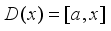 , i.e.
  is inner. The theorem is proven.
  is a type
  real von Neumann algebra, then any derivation on the algebra
  is inner.
  isa commutative algebra and suppose that
  is the algebra of
  matrices over
  . If
. If 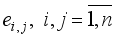 , are the matrix units in
  , then every element
  has the form
 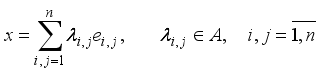 .
.  be a derivation. Setting
 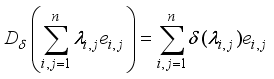 (1)
(1)  on the algebra
  . Moreover
  is a derivation on the algebra
  and its restriction onto the center of the algebra
  coincides with the given
  .
.  be a homogeneous real von Neumann algebra of type
  , with the center
  . Since
 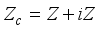 is the center of
  , it follows that
  and
and  . Let
. Let 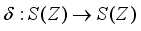 be a derivation and
  be a derivation on the algebra
  defined by (1). Extend
  to
to  by setting
 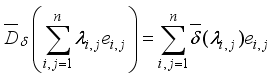 (2)
(2) 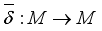 is the extension of
  to
to  , defined by
  . It is clear that
  is a derivation on
  , and
, and  is a derivation on
 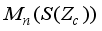 .
.  , real von Neumann algebras.
  be a homogeneous real von Neumann algebra of type
  . Each derivation
  on the algebra
  has a unique representation as a sum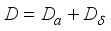
 is an inner derivation given by an element
  , and
, and  is a derivation of type (1) coming from a derivation
  on the center
  .
.  be an arbitrary derivation on the algebra
  . Now consider the restriction of this derivation
  onto the center
  of this algebra, and let
  be the derivation on the algebra
  constructed as in (1). Put
 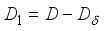 . Then for any
  we have
  , i.e.
  is identically zero on
  . Therefore
  is
is  -linear and by Theorem 3.1 we obtain that
  is an inner derivation, and thus
  for an appropriate
 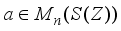 . Therefore
 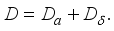 If
If  , then
  . Since
  is identically zero on the center of the algebra
  , this implies that
  is also identically zero on the center of
  . This means that
  , and therefore
  , i.e. the decomposition of
  is unique. The proof is complete.
  to
to  by
by  . By Lemma 3.3 (see
  has the form
 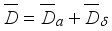 , where
  with
with  , and
, and  is the derivation defined in (2). From the proof of the Lemma 3.3, it is easy to see that
 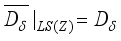 , and for
  with
with  we obtain
 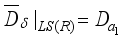 , i.e. we have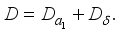
 be any finite real von Neumann algebra of type I with the center
  . There exists a family of central projections from
  which we denote
 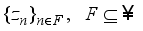 , with
 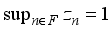 such that the algebra
  is *-isomorphic to the C*-product of real von Neumann algebras
  of type
  respectively,
  , i.e.
 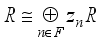 .
. 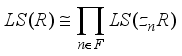 .
.  be a derivation on
  , and
, and  be its restriction onto the center
  . Since
  maps each
  into itself,
  generates a derivation
  on
on  for each
  .
.  (3)
(3)  is a derivation on
  .
.  be a finite real von Neumann algebra of type I. Each derivation
  on the algebra
  has a unique representation as a sum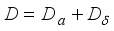
 of locally measurable operators with respect to an arbitrary type I real von Neumann algebra
  .
.  is a type I real von Neumann algebra. There exists a central projection
  such that
  is a finite real von Neumann algebra;
  is a real von Neumann algebra of type
  .
.  on
on  and suppose that
  is its restriction onto its center
  By Theorem 3.2
  is inner and thus we have
  , i.e.
  .
.  be the derivation on
  defined as in (3) and consider its extension
  on
on 
 (4)
(4)  .
.  be a type I real von Neumann algebra. Each derivation
  on
on  has a unique representation as a sum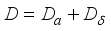
 is an inner derivation implemented by an element
  , and
, and  is a derivation of the form (4), generated by a derivation
  on the center of
  .
.  of measurable operators associated with a type I real von Neumann algebra
  .
.  be an arbitrary subalgebra of
  which contains
  .
. 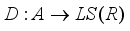 and let us show that
  can be extended to a derivation
  on the whole
  .
.  is of type I, for an arbitrary element
  there exists a sequence
  of mutually orthogonal central projections with
  and
and  for all
  . Set
. Set 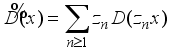 (5)
(5) 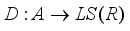 is identically zero on central projections of
  the equality (5) yields a well-defined derivation
 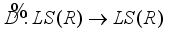 which coincides with
  on
on  .
.  -linearity of
  on
on  , implies
  -linearity of
  , and by Theorem 3.1 the derivation
  is inner on
  . Therefore
  is a spatial derivation on
  , i.e. there exists an element
  such that
  .
.  be a type I real von Neumann algebra with the center
  , and let
  be an arbitrary subalgebra in
  containing
  . Then any
  -linear derivation
 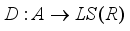 is spatial and implemented by an element of
  .
.  be a type I real von Neumann algebra with the center
  and let
  be a
be a  -linear derivation on
  or
or  . Then
  is spatial and implemented by an element of
  .
.  is a type
  real von Neumann algebra, then every derivation
 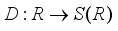 has the form
  , for an appropriate
  .
.  extends to derivation
  on
on  as
as  . By Lemma 3.4 (see
  on
on  is inner, i.e. there is an element
  , such that
  . Then we have
  . Since
  and
and  , then
  . Hence
 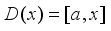 , i.e.
  is inner. The Lemma is proven.
  be a type I real von Neumann algebra with the center
  . Then every
  -linear deriva tion
  on the algebra
  is inner. In particular, if
  is of type
  then every derivation on
  is inner.
  be a type I real von Neumann algebra. Then every derivation
  on the algebra
  has a unique representation as a sum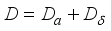
 is inner and implemented by an element
  , and
, and  is the derivation of the form (3) generated by a derivation
  on the center of
  .
.  be a faithful normal semifinite trace on a von Neumann algebra
  . A linear subspace
  is called
  -dense if
  and for every
  there exists a projection
  such that
  and
and  .
.  -dense subspace
  is strongly dense.
  acting in
  is called
  -measurable with respect to algebra
  if
if  and
and  is
is  -dense in
  .
.  the set of all
  -measurable operators. Clearly,
  . And
. And 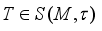 if and only if
  and
and  P(T) is
  -dense in
  .
.  of
of  -measurable operators affiliated with a type I real von Neumann algebra
  and a faithful normal semifinite trace
  . Similarly to the proof of Theorem 2.1 (see
  be a type I real von Neumann algebra with the center
  and a faithful normal semi-finite trace. Then every
  -linear derivation
  on the algebra
  is inner. As a special case, if
  is of type
  , then every derivation on
  is inner.
  on
on  . Now, similarly to Lemma 3.5 one can prove the following.
  be a finite real von Neumann algebra of type I with a faithful normal semi-finite trace
  . Each derivation
  on the algebra
  can be uniquely represented in the form
 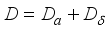 where
where  is an inner derivation implemented by an element
  , and
, and  is a derivation given as (5).
  be a type I real von Neumann algebra with a faithful normal semi-finite trace
  . Then every derivation
  on the algebra
  can be uniquely represented in the form
 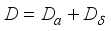 where
where  is an inner derivation implemented by an element
  , and
, and  is the derivation from lemma 4.7.
  on the algebra
  (see Section 1), then it is clear that every non-zero derivation of the form
  is discontinuous in
  . Therefore, the above Theorem 4.8 implies the following.
  be a type I real von Neumann algebra with a faithful normal semi-finite trace
  . A derivation
  on the algebra
  is inner if and only if it is continuous in the measure topology.
  -measurable operators, affiliated with real von Neumann algebra of type I, are obtained.
  -measurable operators affiliated with von Neumann algebra of type I is obtained. Here, a real analogue of these results is considered. That is, descriptions of derivations on some algebras of measurable, locally measurable, and
  -measurable operators affiliated with real von Neumann algebra of type I are obtained.
  -measurable operators, affiliated with real von Neumann algebra of type I, are obtained.
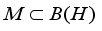
 B(H) | Algebra of all Bounded Linear Operators Acting on a Complex Hilbert Space H |
P(M) | Complete Lattice of all Projections from M |
| [1] | Albeverio S., Ayupov Sh. A., Kudaybergenov K. K., Derivations on the algebra of measurable operators affiliated with a type I von Neumann algebra, Siberian Adv. Math. 2008. No 18. 8694. |
| [2] | Albeverio S., Ayupov Sh. A., Kudaybergenov K. K., Structure of derivations on various algebras of measurable oper?ators, J. Funct. Anal. 2009, 252. 2917-2943. |
| [3] | S. Albeverio, Sh. A. Ayupov, K. K. Kudaybergenov. Local Derivations on Algebras of Measurable Operators. Comm. Contemp. Math., 2011. Vol. 13, No. 4 (2011) 1-15. |
| [4] | Ayupov Sh. A., Kudaybergenov K. K., Innerness of continuous derivations on algebras of measurable operators affili?ated with finite von Neumann algebras. Journal of Mathematical Analysis and Applications. 408/1, (2013), 256-267. |
| [5] | Ayupov Sh. A, Rakhimov A.A, Usmanov Sh. M. Jordan, Real and Lie Structures in Operator Algebras, Kluw.Acad.Pub., MAIA, 1997, 418, 235p. |
| [6] | A. F. Ber, V. I. Chilin, F. A. Sukochev. Continuity of derivations in algebras of locally measurable operators. Integr. Equ. Oper. Theory / Proc. Lond. Math. Soc. 2013. |
| [7] | A. F. Ber, V. I. Chilin, F. A. Sukochev. Innerness of continuous derivations on algebras of locally measurable operators. Proc. London Math. Soc., 2014. |
| [8] | A. F. Ber, B. de Pagter, F. A. Sukochev. Some remarks on derivations in algebras of measurable operators. Math. Notes, 2010. |
| [9] | Muratov M. A., Chilin V. I., Topological algebras of measurable and locally measurable operators, CMFD, 2016, 61. 115-163. |
| [10] | Karimov U.Sh., Algebra of measurable operators affiliated with finite real W*-algebras and its derivations. Bull.Math.Inst. 2025. Vol 8. Issue 6. 161-165. |
APA Style
Rakhimov, A., Karimov, U. (2026). Derivations on Some Algebras of Measurable Operators Affiliated with Real W*-algebras of Type I. International Journal of Applied Mathematics and Theoretical Physics, 12(1), 28-33. https://doi.org/10.11648/j.ijamtp.20261201.12
ACS Style
Rakhimov, A.; Karimov, U. Derivations on Some Algebras of Measurable Operators Affiliated with Real W*-algebras of Type I. Int. J. Appl. Math. Theor. Phys. 2026, 12(1), 28-33. doi: 10.11648/j.ijamtp.20261201.12
@article{10.11648/j.ijamtp.20261201.12,
  author = {Abdugafur Rakhimov and Ulugbek Karimov},
  title = {Derivations on Some Algebras of Measurable Operators Affiliated with Real W*-algebras of Type I},
  journal = {International Journal of Applied Mathematics and Theoretical Physics},
  volume = {12},
  number = {1},
  pages = {28-33},
  doi = {10.11648/j.ijamtp.20261201.12},
  url = {https://doi.org/10.11648/j.ijamtp.20261201.12},
  eprint = {https://article.sciencepublishinggroup.com/pdf/10.11648.j.ijamtp.20261201.12},
  abstract = {It is well known that every derivation on a von Neumann algebra is inner, which reflects the strong rigidity of these algebras. In contrast, for general C*-algebras there may exist non-inner derivations, indicating a more complicated and diverse algebraic structure. This fundamental difference has stimulated extensive research on derivations on various classes of operator algebras. In recent years, increasing attention has been paid to derivations defined on algebras of unbounded operators, in particular on algebras of measurable, locally measurable, and τ-measurable operators associated with von Neumann algebras. Such algebras arise naturally within the framework of noncommutative integration theory and provide a rich setting for extending classical results from the theory of bounded operators. In particular, a complete description of derivations on these algebras has been established in a number of works when they are associated with type I von Neumann algebras, demonstrating that under appropriate assumptions the derivations possess strong regularity properties and admit explicit representations. The present article is devoted to the development of a real analogue of the results described above. More precisely, derivations on algebras of measurable, locally measurable, and τ-measurable operators associated with real type I von Neumann algebras are investigated. By carefully adapting the methods from the complex case and taking into account the specific algebraic and topological features of real operator algebras, a complete characterization of all derivations on the algebras under consideration is obtained. These results generalize known theorems for complex von Neumann algebras to the real setting and contribute to a deeper understanding of derivations on algebras of unbounded operators associated with real operator algebras.},
 year = {2026}
}
TY  - JOUR
T1  - Derivations on Some Algebras of Measurable Operators Affiliated with Real W*-algebras of Type I
AU  - Abdugafur Rakhimov
AU  - Ulugbek Karimov
Y1  - 2026/01/27
PY  - 2026
N1  - https://doi.org/10.11648/j.ijamtp.20261201.12
DO  - 10.11648/j.ijamtp.20261201.12
T2  - International Journal of Applied Mathematics and Theoretical Physics
JF  - International Journal of Applied Mathematics and Theoretical Physics
JO  - International Journal of Applied Mathematics and Theoretical Physics
SP  - 28
EP  - 33
PB  - Science Publishing Group
SN  - 2575-5927
UR  - https://doi.org/10.11648/j.ijamtp.20261201.12
AB  - It is well known that every derivation on a von Neumann algebra is inner, which reflects the strong rigidity of these algebras. In contrast, for general C*-algebras there may exist non-inner derivations, indicating a more complicated and diverse algebraic structure. This fundamental difference has stimulated extensive research on derivations on various classes of operator algebras. In recent years, increasing attention has been paid to derivations defined on algebras of unbounded operators, in particular on algebras of measurable, locally measurable, and τ-measurable operators associated with von Neumann algebras. Such algebras arise naturally within the framework of noncommutative integration theory and provide a rich setting for extending classical results from the theory of bounded operators. In particular, a complete description of derivations on these algebras has been established in a number of works when they are associated with type I von Neumann algebras, demonstrating that under appropriate assumptions the derivations possess strong regularity properties and admit explicit representations. The present article is devoted to the development of a real analogue of the results described above. More precisely, derivations on algebras of measurable, locally measurable, and τ-measurable operators associated with real type I von Neumann algebras are investigated. By carefully adapting the methods from the complex case and taking into account the specific algebraic and topological features of real operator algebras, a complete characterization of all derivations on the algebras under consideration is obtained. These results generalize known theorems for complex von Neumann algebras to the real setting and contribute to a deeper understanding of derivations on algebras of unbounded operators associated with real operator algebras.
VL  - 12
IS  - 1
ER  -
Department of Algebra and Functional Analysis, National University of Uzbekistan, Tashkent, Uzbekistan
Research Fields: Functional analysis, Theory of operator algebras, Theory of unbounded operators, Topology, Fuzzy topology
Department of Algebra and Functional Analysis, National University of Uzbekistan, Tashkent, Uzbekistan
Research Fields: Functional analysis, Theory of operator algebras, Theory of unbounded operators, Topology.

Information



 Share This Article
 Twitter
 Linked In
 Facebook
 be the derivation on the matrix algebra
  defined as in (
 is an inner derivation implemented by an element
  , and
, and  is a derivation given as (
 Copy
Copy Download