Research Article | | Peer-Reviewed

Technical Assessment of Existing Irrigation Schemes for Micro-Hydro Power Generation Potential in the Case of West Shewa and East Wollaga, Ethiopia

Received: 15 December 2025     Accepted: 29 December 2025     Published: 20 January 2026
Views:       Downloads:
Abstract

The energy generated by the force of water can provide a more sustainable, non-polluting alternative to fossil fuels and other renewable energy sources, including wind, solar, tidal, geothermal, and bioenergy. Micro hydropower is hydro energy on a small scale and provides hydromechanical and hydroelectric power to small communities. This study aimed to conduct technical assessments of the micro-hydropower potential of generating hydroelectric and hydro mechanical power from existing irrigation schemes in West Shewa and East Wollaga, Oromia. From the two zones, 16 schemes from the East Wollaga Zone, and 5 schemes from the West Shewa Zone were selected; all of these schemes had the potential for irrigation and were functional. Out of 8 districts, 21 irrigation schemes were technically assessed. Among the analyzed schemes, the maximum Hydraulic power potential for micro-hydropower generation at 80% efficiency was 14.27 kW at the Chaka Arba scheme in the Wayu Tuka district and 5.95 kW, 5.35 kW, 6.54 kW, 5.4 kW, 5.35 kW, and 6.5 kW at Jalale, Gindo, Indiris, Laga Dabesa, Molo, and Sako schemes of East Wollaga Zone, respectively. The maximum discharge recorded was 1.429 m3/s at the Chole 3rd scheme in the Toke Kutaye district in the West Shewa zone. Generally, some of the assessed schemes are insufficient for micro-hydro power generation in the West Shewa zone. However, some of them are possible with technical advances for Pico-hydropower and micro-hydropower.

Published in International Journal of Electrical Components and Energy Conversion (Volume 11, Issue 1)
DOI 10.11648/j.ijecec.20261101.11
Page(s) 1-6
Creative Commons

This is an Open Access article, distributed under the terms of the Creative Commons Attribution 4.0 International License (http://creativecommons.org/licenses/by/4.0/), which permits unrestricted use, distribution and reproduction in any medium or format, provided the original work is properly cited.

Copyright

Copyright © The Author(s), 2026. Published by Science Publishing Group

Keywords

Discharge, Head, Irrigation Schemes, Micro-Hydropower, Technical Assessment

1. Introduction
The hydroelectric systems are classified as “hydroelectric” because they use the available head and flow of water to convert that energy into electricity . The turbine is used to rotate a generator that produces either DC or AC electricity. A package of electrical equipment and controls is used to safely transfer that electricity to a local electric load, or in this case, to power electric motors. Hydropower systems require little maintenance and have low operating costs.
Generally, turbines are highly reliable and durable. The systems are becoming more popular in the agricultural community because of their ability to not only save on electricity production expenses but also reduce carbon emissions and other greenhouse gases by not burning oil or natural gas to power the irrigation systems These self-sustaining hydropower systems are not only beneficial to the user but also to the general community as a whole.
According to this method, transforming natural water energy into electrical energy is one of the most advanced when compared to other renewable energy sources . One of the most promising forms of renewable energy is hydropower . Hydropower produced 19.8% of the world's electricity in 2021, while other renewable energy sources produced 28.3%. Large (>10MW), medium (<10MW), small (<1MW), micro (<100KW), and Pico (< 5KW) hydropower resources are the different categories .
The small hydropower in Ethiopia is 12.9 MW; the potential is estimated to be 1,500 MW, indicating that less than 1 percent has been developed . The world has been producing energy for many years to fulfill its energy demand despite the availability of various energy sources, but at the moment, there is an energy crisis .
The increasing need for energy necessitates the use of alternative energy sources like renewable energy . One energy source that might be developed is micro- and Pico-hydropower, which, even in low-density regions, can offer rural areas inexpensive power . Micro hydropower plants use the movement of water to create energy through variations in discharge and elevation .
If irrigation networks have consistent flow, a reliable indicator of water supply, they can support the development of micro hydropower plants. According to , micro hydropower plants can be created if irrigation networks have a minimum head of two meters, are located in primary or secondary channels, and generate 5 kW to 100 kW of energy.
Recently, the Oromia region, Ethiopia, has built a significant amount of irrigation canals and dams to meet its demands, which may be utilized to produce energy or power for agricultural uses. The micro-hydropower plant's irrigation canals may be utilized with irrigation water to create a self-sufficient community.
Hydropower projects for agriculture make use of the infrastructure that is being built or is already in place for gravity irrigation systems . Because the systems don't require burning oil or natural gas to power the irrigation systems, they not only cut producers' electric power costs but also lower greenhouse gas emissions and carbon emissions overall .
For these reasons, the agriculture community is starting to use the systems more frequently. Therefore, the purpose of this research was to provide a technical evaluation of the current irrigation schemes for the potential to generate micro hydro power in the West Shewa and East Wollaga Zones. As a result, this paper aimed to evaluate the technical and economic feasibility assessment of generating hydroelectric and hydro mechanical power from existing irrigation schemes.
2. Materials and Methods
2.1. Materials
The instruments and materials that were used for assessment were the following: Tape, Bubble level, Meter stick, Rope, Stopwatch, and Styrofoam
2.2. Methods
The investigation was carried out in the areas that may be used for irrigation schemes in west Shewa and east Wollaga. From those zones, 20 schemes from the west Shewa Zone, and 20 schemes from the East Wollega Zone were chosen; every plan had the capacity to be irrigated and was operational. As a result, 21 irrigation systems out of 7 districts were evaluated. Seasonal variations affect the flow rate via the irrigation networks. Nevertheless, from January 30 to March 30 of the irrigation session, the lowest flow rate was utilized to evaluate the potential for micro hydropower in the West Shewa and East Wollaga zones.
2.2.1. Methods for Measuring Flow Rates
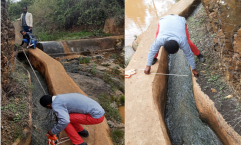
The following steps were taken to determine the flow rate using the float technique, also referred to as the cross-sectional method: First, we located the high spots where the irrigation water runs through the canals. Select a straight canal segment that is at least ten meters long, and ensure that the canal's shape is as uniform as feasible across the length. To indicate a section of the canal, place one board at its upstream end; this corresponds to point A in the figure. Track a distance of at least 10 meters along the canal.
At the downstream end of the chosen section of the canal, position a single board. These correspond to point B in the figure. At least two meters upstream from point A, place the floating object on the canal's middle line. Set the stopwatch to begin when the object leaves point A. When the floating item reaches point B, stop the timer and note the time in seconds. To get the average time required for an item to go from point A to point B, repeat step five times.
Figure 1. The photo taken during the measurement of the flow rate. The photo taken during the measurement of the flow rate.
2.2.2. Performance Evaluation Calculations
1) Flow rate
The flow rate was calculated using the following formula:
= A* V* 0.8(1)
Where Q is the flow rate in m3/s, and V is the average flow velocity in m/s.
A = cross-sectional area in m2 and the 0.83 coefficient of friction .
2) The Measurement of Water Speed
Water speed is the ratio of the distance a floating Styrofoam object travels to the time it takes to travel that distance. The principle used is that the speed on the surface of the flow in the canal is straight and one-way. The following equation was used to compute the speed of water flow.
V=St(2)
Where S is the distance traveled in meters, and t is the time taken in seconds
3) Canal wet cross-sectional area
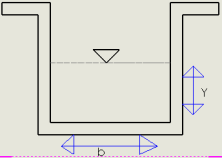
In all three zones of the irrigation network, square canals are used. The wet canal's cross-sectional area was measured by taking measurements in the horizontal (width of flow) and vertical (depth of flow) directions in line with the flow cross-section form. A wet cross-section of the canal was calculated by using the following equation:
A=b*y(3)
Where, A cross-sectional area of wet (m2) b is the width of the wet section cross–section (m), y is the depth of water (m).
4) Hydraulic Power Estimation
Hydraulic power generation was computed following equation (4).
Phyd=p*g*H*Q*η(4)
Where: is water density (kg/m3), g is gravitational (m/s2), Q is the flow rate (m3/s), and η is the overall efficiency (0.8).
Measured and calculated Variables
a) Head
b) Discharge
c) Speed of water
d) Number of households living around irrigation schemes
e) The distance of irrigation schemes from the residential area
f) Hydraulic power generation at 80% efficiency
Figure 2. The transverse cross-section of the square canal. The transverse cross-section of the square canal.
2.2.3. Data Collection Methods
The data were collected through technical assessments of existing irrigation schemes in the West Shewa and East Wollaga zones. The flow rate was measured by timing a float as it moved over a specific length of canal (completely straight and free of obstacles). The floating method was used to determine flow velocity. The heads of irrigation schemes were measured using meter sticks, rope, a spirit level, and tape.
2.2.4. Data Analysis Method
According to its applicability, the whole acquired data was analyzed using simple descriptive statistics.
3. Results and Discussion
Table 1. Hydraulic Head, Flow Rate, and Corresponding Power Potential of Selected Schemes. Hydraulic Head, Flow Rate, and Corresponding Power Potential of Selected Schemes. Hydraulic Head, Flow Rate, and Corresponding Power Potential of Selected Schemes.

Districts

Site

Distance from residential area (m)

Number of households

Head (m)

Flow rate (m3/s)

HPG (kW)

HPP (kW) at 80% efficiency

Dandi

Fakare

500

150

0.1

0.2

0.198

0.158

Kure

420

181

0.12

0.17

0.198

0.158

Jirma

1000

53

0.1

0.75

0.743

0.594

Toke kutaye

Chanco

200

40

0.15

0.18

0.278

0.222

Chole 3rd

151

60

0.3

1.42

4.246

3.397

Ejersa Lafo

Jamjam

250

150

0.42

0.5

2.080

1.664

Oda Guba

200

124

0.23

0.6

1.367

1.093

Sibu Sire

Lalisa

98

39

0.85

0.25

2.105

1.684

Jalale

100

100

0.6

1.25

7.431

5.944

Gindo

200

112

0.9

0.75

6.687

5.350

Ambelta

100

100

0.83

0.625

5.139

4.111

Indiris

500

40

1.1

0.75

8.174

6.539

Digga

Gebo

150

143

0.7

0.6

4.161

3.329

Laga dabesa

250

150

0.5

1.36

6.755

5.404

Dimtu

180

190

0.3

0.48

1.426

1.141

Wayu

Tuka

Tato

200

60

0.9

0.6

5.350

4.280

Molo

710

40

1.2

0.56

6.687

5.350

Sako

300

47

1.1

0.75

8.174

6.539

Chaka Arba

200

62

1.5

1.2

17.835

14.268

Jimma Arjo

Nageso

201

30

0.98

0.2

1.941

1.553

Leka Dulacha

kombolcha

337

21

0.27

0.23

0.617

0.493

The assessments of existing irrigation schemes for micro hydro power generation potential in West Shewa and East Wollaga zones were conducted. On 5 schemes from the west Shewa Zone, and 16 schemes from the east Wollaga; each of those schemes was functional and had irrigation potential. 21 irrigation schemes were evaluated among the 8 districts.
It demonstrates the irrigation schemes assessed for micro hydropower, as well as the characteristics of the distance from residential areas, the number of households around irrigation schemes, the head, flow rate, and efficiency. The hydraulic power potential was estimated at 80% efficiency of micro-hydro power.
The measured, calculated, and statistically analysed data from the assessment of the potential of irrigation schemes for micro-hydropower generation are shown in Table 1. It demonstrates the irrigation schemes assessed for micro hydropower generation in south-western Oromia in East Wollaga and West Shewa zones, as well as the characteristics of the distance from residential areas, the number of households around irrigation schemes, the head, flow rate, and efficiency.
The hydraulic power potential was estimated at 80% efficiency of micro-hydro power. The hydraulic power was estimated using an equation (4), and according to this determination, the requirement is fulfilled . Table 1: The irrigation schemes assessed for micro hydropower distance from residential areas, the number of households around irrigation schemes, the head, flow rate, and efficiency.
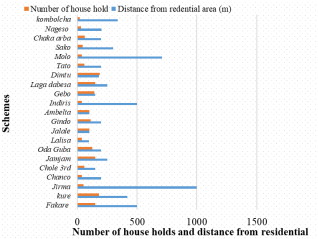
Figure 3. Schemes versus distance from the residential area and number of households. Schemes versus distance from the residential area and number of households.
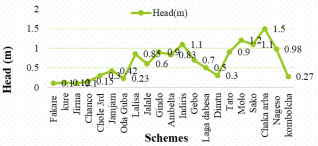
Figure 3 shows the relationship between irrigation schemes versus distances from residential areas and the number of households living around the schemes. The scheme's minimum and maximum distances from residential areas were 98 m and 1000 m from the Lalisa Scheme in Sibu Sire district and Jirma in Dandi district, respectively. In each of the zones, the average scheme distance from the residential area was 297 m. The minimum and maximum numbers of households living around irrigation schemes were 21 and 198 at Kombolcha in Leka Dulacha district and Dimtu scheme in Wayu tuka districts, respectively.
In each of the zones, the average number of households living near the scheme was 90. In general, the distance of the schemes from the residential area affects hydroelectricity generation from micro-hydropower because it requires a long wire to supply electricity to the people living in the area. The long lengths of wire have more resistance than short lengths; thus, the lengths of the wire will cause a larger voltage drop.
According to an investigation of the potential of irrigation schemes for micro-hydropower (Figure 4), the Chaka Arba scheme in the Wayu Tuka district has the highest head of 1.5 m. When the head drops below 1.5 m, it is technically possible to develop it for the Archimedean screw and waterwheel turbines.
Figure 4. Depicts the relationship between irrigation schemes and heads. Depicts the relationship between irrigation schemes and heads.
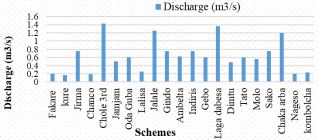
Figure 5. The relationship between irrigation schemes and discharge. The relationship between irrigation schemes and discharge.
From the analysis of the assessed irrigation scheme potentials for micro hydropower generation (Figure 5), the minimum and maximum discharge were 0.167 m3⁄s and 1.429 m3⁄s at the Kure scheme in the Dandi district and the Chole 3rd scheme in the Toke Kutaye district in the West Shewa, respectively. The average discharge from the two zones was 0.64m3⁄s.
Therefore, micro-hydro development in irrigation networks needs to pay attention to the availability of water in the channel.
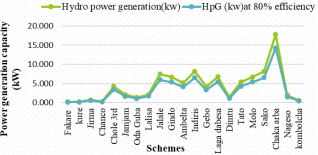
The maximum hydraulic power potential obtained was 14.27 kW at the Chaka arba scheme in the Wayu Tuka district of the east Wollaga zone and 5.95 kW, 5.35 kW, 6.54 kW, 5.4 kW, 5.35 kW, and 6.5 kW at Jalale, Gindo, Indiris, Laga dabesa, Molo, and Sako schemes of East Wollaga, respectively. The Chole 3rd (3.4 kW), Ambelta (4.1 kW), Gebo (3.23 kW), and Tato (4.28 kW) schemes can generate Pico hydropower. Micro hydropower plants are defined as having a generation capacity ranging from 5 kW to 100 kW, and Pico hydropower (<5 kW) .
Figure 6. The relationship between irrigation schemes and hydraulic power at 80% efficiency. The relationship between irrigation schemes and hydraulic power at 80% efficiency.

4. Conclusions and Recommendation
The study examined and assessed several irrigation schemes. Based on the head measurement, flow rate, number of households, residential area distance from the schemes, and hydraulic power at 80 % efficiency of hydropower was calculated. The following conclusion was drawn from the assessments:
The maximum hydraulic power potential and head obtained from the assessment of irrigation schemes for micro-hydro power generation among the schemes studied were 5.14 kW and 1.5 m, respectively, at the Chaka Arba scheme in the Wayu Tuka district of East Wollaga zone. The maximum discharge recorded was 1.429 m3⁄s at the Chole 3rd scheme in the Toke Kutaye district in the west Shewa zone.
Based on the results and discussion obtained, the following recommendations were made:
1) For the assessment of irrigation schemes that generate micro and Pico hydropower, it’s possible to use a cross-flow turbine, Archimedes screw turbine, and water wheel turbines.
2) The Chaka Arba, Jalale, Gindo, Indiris, Laga Dabesa, Molo, and Sako Scheme can generate micro hydropower, and Chole 3rd (3.4 kW), Gebo (3.23 kW), and Tato (4.28 kW) can generate Pico hydropower in areas with low population density.
3) The constructed irrigation schemes were not considered for the generation of hydraulic power, but in the future, the design of irrigation schemes will be considered for the generation of micro hydro power simultaneously.
Abbreviations

AC

Alternating Current

DC

Direct Current

HPG

Hydropower Generation

HPP

Hydropower Potential

KW

Kilowatt

Acknowledgments
The authors would like to thank the Renewable Energy Engineering Team of Bako Agricultural Engineering Research Center for the data collection that supported the manuscript, contribution to the preparation of the paper, and valuable comments and suggestions on research work, and technicians of the metal and wood workshop, particularly Mr. Habtamu, and Mr. Shibiru Kebede for their emanate contribution for the Micro-hydropower technical assessments. Finally, my thank goes to all staff of the Oromia Agricultural Research Institute for their financial support and comments in reviewing the manuscript throughout our chain.
Funding
This research received no external funding.
Conflicts of Interest
The authors declare no conflicts of interest regarding the publication of this paper.
References
[1] H. Bakhoda, M. Almassi, N. Moharamnejad, R. Moghaddasi, and M. Azkia, “Energy production trend in Iran and its effect on sustainable development,” Renewable and Sustainable Energy Reviews, vol. 16, no. 2, pp. 1335–1339, Feb. 2012,
[2] O. John, “Measurement methods for hydropower resources: a review,” Jan. 2018.
[3] E. Yi̇Ği̇T, “Journal of International Management, Educational and Economics Perspectives,” Journal of International Management, 2016.
[4] O. A. C. Hoes, L. J. J. Meijer, R. J. Van Der Ent, and N. C. Van De Giesen, “Systematic high-resolution assessment of global hydropower potential,” PLoS ONE, vol. 12, no. 2, p. e0171844, Feb. 2017,
[5] Y. Damtew and G. Getenet, “Assessment of Hydropower Potential of Selected Rivers in North Shoa Zone, Amhara Regional State, Ethiopia,” American Journal of Energy Research, vol. 7, no. 1, pp. 15–18, Mar. 2019,
[6] A. Tibesso, A. Aliyi, and Y. Docha, “Technical Assessment of Existing Irrigation Schemes for Micro-hydro Power Generation Potential in Jimma, Buno Bedelle, and Ilubabor Zones, South-Western Oromia,” Int. J. Energy Power Eng., vol. 14, no. 3, pp. 86–95, Aug. 2025,
[7] R. Guchhait and B. Sarkar, “Increasing Growth of Renewable Energy: A State of Art,” Energies, vol. 16, no. 6, p. 2665, Jan. 2023,
[8] R. Das, A. Date, H. Chowdhury, and H. Hassan, “Feasibility of Micro-Hydro Power for Rural Electrification in Bangladesh: A Case Study from the Chittagong Hill Tracts,” ENERGY, vol. 122, no. 12, pp. 4815–4835, 2025,
[9] A. Williams and S. Porter, “Comparison of hydropower options for developing countries with regard to the environmental, social and economic aspects,” Jan. 2006.
[10] A. Zukhrufiyati, J. Triyono, S. Ginting, and E. Irianto, “DETERMINATION OF DEPENDABLE FLOW FOR MICROHYDRO POWER PLANT IN IRRIGATION NETWORK,” Sept. 2019.
[11] E. Mwangi, D. A. García, and P. Johnson, “Adoption of Renewable Energy Technologies in Modern Farming: Benefits and Barriers,” vol. 1, 2025.
[12] J. Qin, W. Duan, S. Zou, Y. Chen, W. Huang, and L. Rosa, “Global energy use and carbon emissions from irrigated agriculture,” Nat Commun, vol. 15, no. 1, p. 3084, Apr. 2024,
[13] A. Tamrakar, “Hydro Power Opportunity in the Sewage Waste Water,” Jan. 2015, Accessed: Jan. 06, 2026. [Online]. Available:
Cite This Article
  • APA Style

    Mideksa, G., Tesfaye, D., Kedir, U., Ahmed, K. (2026). Technical Assessment of Existing Irrigation Schemes for Micro-Hydro Power Generation Potential in the Case of West Shewa and East Wollaga, Ethiopia. International Journal of Electrical Components and Energy Conversion, 11(1), 1-6. https://doi.org/10.11648/j.ijecec.20261101.11

    Copy | Download

    ACS Style

    Mideksa, G.; Tesfaye, D.; Kedir, U.; Ahmed, K. Technical Assessment of Existing Irrigation Schemes for Micro-Hydro Power Generation Potential in the Case of West Shewa and East Wollaga, Ethiopia. Int. J. Electr. Compon. Energy Convers. 2026, 11(1), 1-6. doi: 10.11648/j.ijecec.20261101.11

    Copy | Download

    AMA Style

    Mideksa G, Tesfaye D, Kedir U, Ahmed K. Technical Assessment of Existing Irrigation Schemes for Micro-Hydro Power Generation Potential in the Case of West Shewa and East Wollaga, Ethiopia. Int J Electr Compon Energy Convers. 2026;11(1):1-6. doi: 10.11648/j.ijecec.20261101.11

    Copy | Download

  • @article{10.11648/j.ijecec.20261101.11,
      author = {Gemechis Mideksa and Duresa Tesfaye and Usman Kedir and Kamil Ahmed},
      title = {Technical Assessment of Existing Irrigation Schemes for Micro-Hydro Power Generation Potential in the Case of West Shewa and East Wollaga, Ethiopia},
      journal = {International Journal of Electrical Components and Energy Conversion},
      volume = {11},
      number = {1},
      pages = {1-6},
      doi = {10.11648/j.ijecec.20261101.11},
      url = {https://doi.org/10.11648/j.ijecec.20261101.11},
      eprint = {https://article.sciencepublishinggroup.com/pdf/10.11648.j.ijecec.20261101.11},
      abstract = {The energy generated by the force of water can provide a more sustainable, non-polluting alternative to fossil fuels and other renewable energy sources, including wind, solar, tidal, geothermal, and bioenergy. Micro hydropower is hydro energy on a small scale and provides hydromechanical and hydroelectric power to small communities. This study aimed to conduct technical assessments of the micro-hydropower potential of generating hydroelectric and hydro mechanical power from existing irrigation schemes in West Shewa and East Wollaga, Oromia. From the two zones, 16 schemes from the East Wollaga Zone, and 5 schemes from the West Shewa Zone were selected; all of these schemes had the potential for irrigation and were functional. Out of 8 districts, 21 irrigation schemes were technically assessed. Among the analyzed schemes, the maximum Hydraulic power potential for micro-hydropower generation at 80% efficiency was 14.27 kW at the Chaka Arba scheme in the Wayu Tuka district and 5.95 kW, 5.35 kW, 6.54 kW, 5.4 kW, 5.35 kW, and 6.5 kW at Jalale, Gindo, Indiris, Laga Dabesa, Molo, and Sako schemes of East Wollaga Zone, respectively. The maximum discharge recorded was 1.429 m3/s at the Chole 3rd scheme in the Toke Kutaye district in the West Shewa zone. Generally, some of the assessed schemes are insufficient for micro-hydro power generation in the West Shewa zone. However, some of them are possible with technical advances for Pico-hydropower and micro-hydropower.},
     year = {2026}
    }
    

    Copy | Download

  • TY  - JOUR
    T1  - Technical Assessment of Existing Irrigation Schemes for Micro-Hydro Power Generation Potential in the Case of West Shewa and East Wollaga, Ethiopia
    AU  - Gemechis Mideksa
    AU  - Duresa Tesfaye
    AU  - Usman Kedir
    AU  - Kamil Ahmed
    Y1  - 2026/01/20
    PY  - 2026
    N1  - https://doi.org/10.11648/j.ijecec.20261101.11
    DO  - 10.11648/j.ijecec.20261101.11
    T2  - International Journal of Electrical Components and Energy Conversion
    JF  - International Journal of Electrical Components and Energy Conversion
    JO  - International Journal of Electrical Components and Energy Conversion
    SP  - 1
    EP  - 6
    PB  - Science Publishing Group
    SN  - 2469-8059
    UR  - https://doi.org/10.11648/j.ijecec.20261101.11
    AB  - The energy generated by the force of water can provide a more sustainable, non-polluting alternative to fossil fuels and other renewable energy sources, including wind, solar, tidal, geothermal, and bioenergy. Micro hydropower is hydro energy on a small scale and provides hydromechanical and hydroelectric power to small communities. This study aimed to conduct technical assessments of the micro-hydropower potential of generating hydroelectric and hydro mechanical power from existing irrigation schemes in West Shewa and East Wollaga, Oromia. From the two zones, 16 schemes from the East Wollaga Zone, and 5 schemes from the West Shewa Zone were selected; all of these schemes had the potential for irrigation and were functional. Out of 8 districts, 21 irrigation schemes were technically assessed. Among the analyzed schemes, the maximum Hydraulic power potential for micro-hydropower generation at 80% efficiency was 14.27 kW at the Chaka Arba scheme in the Wayu Tuka district and 5.95 kW, 5.35 kW, 6.54 kW, 5.4 kW, 5.35 kW, and 6.5 kW at Jalale, Gindo, Indiris, Laga Dabesa, Molo, and Sako schemes of East Wollaga Zone, respectively. The maximum discharge recorded was 1.429 m3/s at the Chole 3rd scheme in the Toke Kutaye district in the West Shewa zone. Generally, some of the assessed schemes are insufficient for micro-hydro power generation in the West Shewa zone. However, some of them are possible with technical advances for Pico-hydropower and micro-hydropower.
    VL  - 11
    IS  - 1
    ER  - 

    Copy | Download

Author Information
  • Table 1

    Table 1. Hydraulic Head, Flow Rate, and Corresponding Power Potential of Selected Schemes. Hydraulic Head, Flow Rate, and Corresponding Power Potential of Selected Schemes.