Abstract
Soils represent the largest terrestrial carbon reservoir, storing more carbon than the atmosphere and vegetation combined, and therefore play a critical role in climate change mitigation. This review synthesizes current evidence on the role of soils in mitigating climate change, with a focus on soil carbon sequestration, greenhouse gas regulation, and the effectiveness of soil-based management strategies. A comprehensive evaluation of recent meta-analyses, global datasets, and modeling studies was conducted to assess key mitigation pathways and identify existing policy and knowledge gaps. The findings indicate that practices such as conservation agriculture, cover cropping, biochar application, manure amendments, agroforestry, liming, and enhanced rock weathering can significantly increase soil organic carbon stocks and reduce greenhouse gas emissions, although their effectiveness varies depending on soil type, climate, and management conditions. Quantitative evidence shows that cover crops can increase soil organic carbon by approximately 15.5%, while manure and biochar applications can enhance carbon stocks by over 30% and 60%, respectively, under favorable conditions. Despite this potential, the integration of soils into climate mitigation policies remains limited due to measurement uncertainties, insufficient long-term data, and weak inclusion in carbon market frameworks. Overall, soils represent a substantial yet underutilized opportunity for climate mitigation, and improving monitoring systems, strengthening policy integration, and promoting site-specific management strategies are essential to fully harness their potential while supporting sustainable agricultural systems.
Keywords
Soil Carbon Sequestration, Climate Change Mitigation, Greenhouse Gases, Agroecosystems, Soil Management Practices
1. Introduction
Soils are the largest terrestrial carbon reservoir
, storing an estimated 1,500–2,400 Pg of organic carbon (SOC) in the top 1 m, surpassing atmospheric carbon (~800 Pg C) and aboveground biomass (~600 Pg C)
| [6] | FAO. (2023). Global Soil Organic Carbon Sequestration Potential Map (GSOCseq). Food and Agriculture Organization of the United Nations. https://fao-sid.github.io/GSOCseq/ |
| [10] | IPCC. (2019). Climate Change and Land: An IPCC Special Report on climate change, desertification, land degradation, sustainable land management, food security, and greenhouse gas fluxes in terrestrial ecosystems. |
| [12] | Köchy, M., Hiederer, R., & Freibauer, A. (2015). Global distribution of soil organic carbon - Part 1: Masses and frequency distributions of SOC stocks. SOIL, 1, 351-365.
https://doi.org/10.5194/soil-1-351-2015 |
[6, 10, 12]
. This immense capacity makes soils critical for climate change mitigation; however, they remain underrecognized in policy and global mitigation frameworks, which prioritize forests, energy, and technological interventions often emphasizing technical mitigation pathways without fully integrating socio-economic and policy realities
| [2] | Amundson, R., Buck, H., & Lajtha, K. (2022). Soil science in the time of climate mitigation. Biogeochemistry, 161(1), 47-58. |
[2]
. Soil processes, including carbon stabilization through mineral associations, microbial turnover, and aggregate formation, modulate greenhouse gas (GHG) fluxes (CO
2, CH
4, N
2O)
| [22] | Tian, H., Xu, R., Canadell, J. G., Thompson, R. L., Winiwarter, W., Janssens-Maenhout, G. & Ciais, P. (2020). A comprehensive quantification of global nitrous oxide sources and sinks. Nature, 586, 248-256.
https://doi.org/10.1038/s41586-020-2780-0 |
[22]
and influence ecosystem resilience, nutrient cycling, and water retention
| [14] | Lal, R., Monger, C., Nave, L., & Smith, P. (2021). The role of soil in regulation of climate. Philosophical Transactions of the Royal Society B, 376(1834), 20210084.
https://doi.org/10.1098/rstb.2021.0084 |
[14]
.
Despite this, significant knowledge and methodological gaps persist. Soil carbon dynamics vary widely with soil type, climate, and management, complicating measurement and modeling. Subsoil SOC (20–100 cm), which accounts for approximately 800 Pg C globally, is poorly characterized, limiting understanding of long-term sequestration potential
| [23] | Wang, J., Jansson, R., Li, Y., & Zhang, X. (2025). Global patterns of soil organic carbon distribution in subsoils (20-100 cm). Earth System Science Data, 17, 3375-3392.
https://doi.org/10.5194/essd-17-3375-2025 |
[23]
. Long-term datasets remain sparse, slowing policy integration, and soils are often excluded from Nationally Determined Contributions (NDCs) due to slow response times, high uncertainty, and technical complexity
| [14] | Lal, R., Monger, C., Nave, L., & Smith, P. (2021). The role of soil in regulation of climate. Philosophical Transactions of the Royal Society B, 376(1834), 20210084.
https://doi.org/10.1098/rstb.2021.0084 |
[14]
.
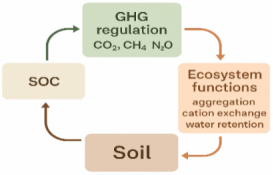
This review synthesizes recent quantitative evidence, including meta-analyses and modeling studies, to highlight the underappreciated role of soils in climate mitigation. It identifies key barriers in monitoring, modeling, and policy, and explores opportunities such as improved soil carbon measurement, inclusion in carbon markets, and the deployment of soil-based mitigation strategies to harness soils for global climate change mitigation effectively. The key pathways linking soil processes to climate mitigation, including carbon sequestration, greenhouse gas regulation, and ecosystem functions, are illustrated in
Figure 1.
Figure 1. Soil and Climate Interactions (Conceptual Diagram).
2. Soil Processes in Climate Mitigation
Soils play a critical role in climate mitigation because of their capacity to sequester carbon, regulate greenhouse gases, and provide ecosystem functions that support long-term stability. Understanding these processes is essential for assessing how soil-based strategies can meaningfully contribute to global climate targets
| [14] | Lal, R., Monger, C., Nave, L., & Smith, P. (2021). The role of soil in regulation of climate. Philosophical Transactions of the Royal Society B, 376(1834), 20210084.
https://doi.org/10.1098/rstb.2021.0084 |
[14]
.
2.1. Soil Carbon Stocks and the Global Carbon Cycle
According to a global assessment, the mass of soil organic carbon (SOC) in the top 1 meter of soil is estimated to be 1,062–2,476 Pg C, depending on how bulk density is defined. This large pool underlines soils’ central importance in the global carbon budget
| [12] | Köchy, M., Hiederer, R., & Freibauer, A. (2015). Global distribution of soil organic carbon - Part 1: Masses and frequency distributions of SOC stocks. SOIL, 1, 351-365.
https://doi.org/10.5194/soil-1-351-2015 |
[12]
. Because even small percentage changes in SOC can significantly affect atmospheric CO
2, maintaining and increasing SOC represents a promising mitigation strategy
| [12] | Köchy, M., Hiederer, R., & Freibauer, A. (2015). Global distribution of soil organic carbon - Part 1: Masses and frequency distributions of SOC stocks. SOIL, 1, 351-365.
https://doi.org/10.5194/soil-1-351-2015 |
[12]
.
2.2. Soil as a Source and Sink of Greenhouse Gases
Soils both emit and absorb greenhouse gases. They release CO
2 via microbial decomposition and N
2O through nitrogen cycling, depending on moisture, management, and nutrient status
| [14] | Lal, R., Monger, C., Nave, L., & Smith, P. (2021). The role of soil in regulation of climate. Philosophical Transactions of the Royal Society B, 376(1834), 20210084.
https://doi.org/10.1098/rstb.2021.0084 |
[14]
. Through judicious land use and science-based management, degraded soils can become net sinks of atmospheric carbon, helping to offset net emissions
| [14] | Lal, R., Monger, C., Nave, L., & Smith, P. (2021). The role of soil in regulation of climate. Philosophical Transactions of the Royal Society B, 376(1834), 20210084.
https://doi.org/10.1098/rstb.2021.0084 |
[14]
. Soils in humid climates tend to store more organic carbon (SOC), whereas soils in arid and semi-arid climates can store both SOC and soil inorganic carbon (SIC). However, potential trade-offs exist, as some practices that enhance SOC, such as heavy organic amendment application, may inadvertently increase non-CO
2 emissions like N
2O, depending on site-specific moisture and management regimes
| [14] | Lal, R., Monger, C., Nave, L., & Smith, P. (2021). The role of soil in regulation of climate. Philosophical Transactions of the Royal Society B, 376(1834), 20210084.
https://doi.org/10.1098/rstb.2021.0084 |
| [22] | Tian, H., Xu, R., Canadell, J. G., Thompson, R. L., Winiwarter, W., Janssens-Maenhout, G. & Ciais, P. (2020). A comprehensive quantification of global nitrous oxide sources and sinks. Nature, 586, 248-256.
https://doi.org/10.1038/s41586-020-2780-0 |
[14, 22]
.
2.3. Ecosystem Functions That Support Mitigation
Beyond carbon storage, soils provide critical functions that support climate resilience and mitigation. Soil aggregation helps physically protect organic matter, slowing decomposition
| [14] | Lal, R., Monger, C., Nave, L., & Smith, P. (2021). The role of soil in regulation of climate. Philosophical Transactions of the Royal Society B, 376(1834), 20210084.
https://doi.org/10.1098/rstb.2021.0084 |
[14]
. The capacity of soil to hold and exchange cations (CEC) supports nutrient cycling, reducing the need for synthetic fertilizers, which are often a source of N
2O emissions
| [14] | Lal, R., Monger, C., Nave, L., & Smith, P. (2021). The role of soil in regulation of climate. Philosophical Transactions of the Royal Society B, 376(1834), 20210084.
https://doi.org/10.1098/rstb.2021.0084 |
[14]
. Moreover, soils with good water retention can buffer microbial activity under stress (drought or saturation), potentially reducing GHG pulses under extreme conditions
| [14] | Lal, R., Monger, C., Nave, L., & Smith, P. (2021). The role of soil in regulation of climate. Philosophical Transactions of the Royal Society B, 376(1834), 20210084.
https://doi.org/10.1098/rstb.2021.0084 |
[14]
.
3. Evidence of Effective Soil-Based Mitigation Strategies
3.1. Conservation Agriculture
Conservation agriculture (CA), encompassing no-till (NT) and residue retention (RR), has been widely promoted to enhance soil carbon (C) sequestration. A global meta-analysis of 132 peer-reviewed studies revealed that long-term (>15 years) NT significantly increased absolute mineralizable carbon (AMC) in both surface (0–5 cm) and subsoils (>20 cm), particularly in alkaline soils (pH >7.8) without crop rotation. RR generally increased AMC, although its negative effect on specific mineralizable carbon (SMC) was pronounced in high N-input (>300 kg N/ha) and sandy soils. The combination of NT+RR significantly decreased SMC, suggesting improved SOC sequestration efficiency. Both NT and RR positively affected multiple soil quality indicators, including aggregate stability and SOC concentration, while ammonium nitrogen and bulk density were less responsive
| [9] | He, C., Chen, Z., Qiu, K. Y., Chen, J. S., Bohoussou, Y. N. D., Dang, Y. P., & Zhang, H. L. (2023). Effects of conservation agriculture on carbon mineralization: A global meta-analysis. Soil and Tillage Research, 229, 105685.
https://doi.org/10.1016/j.still.2022.105685 |
[9]
. These findings underscore CA’s potential to increase SOC while mitigating CO
2 emissions.
3.2. Cover Crops
Inclusion of cover crops in agricultural rotations enhances SOC and multiple soil quality parameters. A meta-analysis of global cropland studies found that cover crops increased SOC by 15.5% on average, with the largest gains in fine-textured soils and temperate climates. Cover crop mixtures outperformed mono-species, and legumes contributed more SOC than grasses. Shallow soils (≤30 cm) experienced significant increases, while deeper layers showed limited change. Regression analysis indicated that SOC gains were associated with improved mineralizable carbon, nitrogen, and reduced runoff and erosion. The mean carbon sequestration rate from cover cropping was estimated at 0.56 Mg ha
-1 yr
-1, translating to 0.16 ± 0.06 Pg C yr
-1 if adopted on 15% of global cropland (~1–2% of current fossil fuel emissions)
| [11] | Jian, J., Du, X., Reiter, M. S., & Stewart, R. D. (2020). A meta-analysis of global cropland soil carbon changes due to cover cropping. Soil Biology and Biochemistry, 143, 107735.
https://doi.org/10.1016/j.soilbio.2020.107735 |
[11]
.
3.3. Biochar
Biochar, a carbon-rich byproduct of biomass pyrolysis, enhances soil carbon pools and mitigates climate change. A meta-analysis of 169 studies with 586 paired comparisons showed that biochar application increased total carbon (TC) by 64.3%, organic carbon by 84.3%, microbial biomass C by 20.1%, labile C by 22.9%, and fulvic acid by 42.1%, while dissolved organic C, humic acid, and humin were unaffected. Carbon sequestration was most effective with higher application rates, fine-textured soils, low initial C, and temperate climates under short-term controlled conditions. The response of individual carbon fractions varied with biochar type, soil properties, and experimental conditions
| [4] | Chagas, J. K. M., de Figueiredo, C. C., & Ramos, M. L. G. (2022). Biochar increases soil carbon pools: Evidence from a global meta-analysis. Journal of Environmental Management, 305, 114403. https://doi.org/10.1016/j.jenvman.2021.114403 |
[4]
.
3.4. Manure and Organic Amendments
Manure application consistently enhances SOC in agricultural soils. A meta-analysis of 101 studies (592 treatments) reported an average SOC increase of 35.4%, corresponding to 10.7 Mg ha
-1. Increases were higher in conventional tillage systems (+2.2 Mg ha
-1) than reduced tillage, in intermediate and shallow soils (0–20 cm), and in soils with low initial SOC (<1%). Clay soils and acidic soils showed greater SOC gains compared to sandy and neutral/alkaline soils. Farmyard, cattle, and pig manure had the strongest effects, while straw and green manure had minor impacts. Combined manure and mineral fertilizer applications further increased SOC stocks (+1.7 Mg ha
-1). Long-term field studies, especially in tropical climates, are needed to assess carbon saturation and sustainability
.
3.5. Agroforestry
Agroforestry systems can enhance SOC when converting from less complex land-uses. A meta-analysis of 53 studies revealed that transitions from agriculture to agroforestry significantly increased SOC by 26–40% at depths of 0–100 cm, while conversion from forest to agroforestry sometimes decreased SOC in shallow soils (0–30 cm). SOC gains varied by system type: agrisilviculture, silvopasture, and agrosilvopastoral systems generally improved SOC, whereas conversions from forest or uncultivated land to some agroforestry types occasionally led to decreases. The heterogeneity of outcomes reflects differences in study design, sampling depth, and management practices
.
3.6. Soil Liming
Soil liming improves SOC stability, reduces N
2O emissions, and mitigates acidity-related constraints. Liming raises soil pH, promoting microbial activity and nutrient availability, which indirectly enhances C sequestration by increasing organic matter stabilization. Limed soils have shown reductions of N
2O emissions by up to 30% in acidic croplands and increased labile and stable SOC fractions, particularly in temperate regions
| [14] | Lal, R., Monger, C., Nave, L., & Smith, P. (2021). The role of soil in regulation of climate. Philosophical Transactions of the Royal Society B, 376(1834), 20210084.
https://doi.org/10.1098/rstb.2021.0084 |
[14]
. While liming is highly site-specific, it offers co-benefits for crop productivity and mitigation potential.
3.7. Enhanced Rock Weathering (ERW)
ERW, the application of finely ground silicate rocks such as basalt, captures atmospheric CO
2 and improves soil health. Field-scale studies across multiple crops and climates indicate that ERW increases soil porewater alkalinity and can enhance SOC when combined with organic amendments. However, impacts on CO
2, CH
4, and N
2O emissions are inconsistent due to variability in soil type, climate, crop, and management. ERW remains a promising negative emissions technology, but site-specific research, monitoring frameworks, and best-practice guidelines are essential for effective implementation
| [7] | Geoghegan, E. K. (2024). Evaluating Enhanced Rock Weathering as a Tool for Soil GHG Reduction and Carbon Sequestration in Croplands (Doctoral dissertation, Cornell University). |
| [15] | Levy, C. R., Almaraz, M., Beerling, D. J., Raymond, P., Reinhard, C. T., Suhrhoff, T. J., & Taylor, L. (2024). Enhanced rock weathering for carbon removal-monitoring and mitigating potential environmental impacts on agricultural land. Environmental Science & Technology, 58(39), 17215-17226.
https://doi.org/10.1021/acs.est.4c04123 |
[7, 15]
. To synthesize the comparative evidence across soil-based climate mitigation strategies,
Table 1,
Figure 2, and
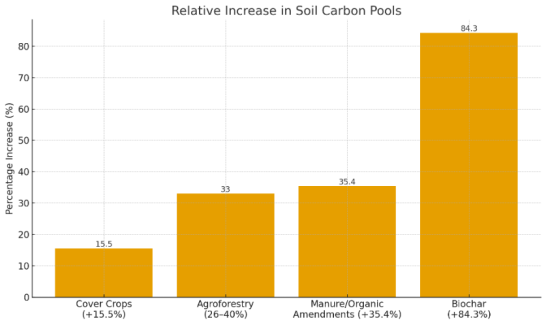
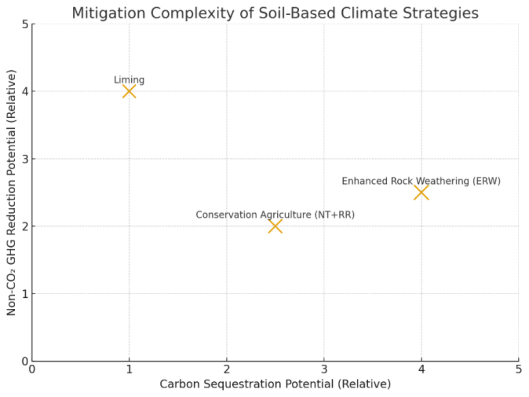
Figure 3 jointly summarize their effects, mechanisms, and outcomes.
Table 1 presents the mean changes in soil organic carbon (SOC) and the key factors influencing these responses across management practices.
Figure 2 compares the relative impacts of these practices on different soil carbon pools, while
Figure 3 integrates dominant mechanisms, co-benefits, and limitations, providing an overarching framework for evaluating soil-based mitigation options.
Table 1. Summary of the mean SOC changes and key influencing factors for each soil-based mitigation strategy.
Strategy | SOC Change / Effect | Key Factors Influencing SOC | References |
Conservation Agriculture (No-Till + Residue Retention) | ↑ Absolute Mineralizable C (AMC); SMC ↑ with RR; ↓ SMC with NT in acidic soils | Soil pH, N fertilization, long-term practice, soil depth | | [9] | He, C., Chen, Z., Qiu, K. Y., Chen, J. S., Bohoussou, Y. N. D., Dang, Y. P., & Zhang, H. L. (2023). Effects of conservation agriculture on carbon mineralization: A global meta-analysis. Soil and Tillage Research, 229, 105685.
https://doi.org/10.1016/j.still.2022.105685 |
[9] |
Cover Crops | ↑ SOC by 15.5% overall; sequestration rate 0.56 Mg ha-1 yr-1 | Soil texture, climate, crop type, cover crop species, rotation years | | [11] | Jian, J., Du, X., Reiter, M. S., & Stewart, R. D. (2020). A meta-analysis of global cropland soil carbon changes due to cover cropping. Soil Biology and Biochemistry, 143, 107735.
https://doi.org/10.1016/j.soilbio.2020.107735 |
[11] |
Biochar | ↑ Total C +64.3%, Organic C +84.3%, Microbial biomass C +20.1% | Biochar type, soil texture, C content, climate, experiment duration | | [4] | Chagas, J. K. M., de Figueiredo, C. C., & Ramos, M. L. G. (2022). Biochar increases soil carbon pools: Evidence from a global meta-analysis. Journal of Environmental Management, 305, 114403. https://doi.org/10.1016/j.jenvman.2021.114403 |
[4] |
Manure / Organic Amendments | ↑ SOC 35.4% (10.7 Mg ha-1); higher in conventional tillage | Soil type, initial SOC, climate, manure type, application rate | |
Agroforestry | ↑ SOC 26–40% depending on land-use change and soil depth | Previous land use, agroforestry type, soil horizon | . |
Liming | Improves SOC stability; reduces N2O emissions | Soil acidity, lime type, application rate | | [14] | Lal, R., Monger, C., Nave, L., & Smith, P. (2021). The role of soil in regulation of climate. Philosophical Transactions of the Royal Society B, 376(1834), 20210084.
https://doi.org/10.1098/rstb.2021.0084 |
[14] |
Enhanced Rock Weathering (ERW) | Mixed results; may alter CO2, CH4, N2O; increases soil alkalinity | Soil type, crop type, organic amendments, climate, basalt particle size | | [7] | Geoghegan, E. K. (2024). Evaluating Enhanced Rock Weathering as a Tool for Soil GHG Reduction and Carbon Sequestration in Croplands (Doctoral dissertation, Cornell University). | | [15] | Levy, C. R., Almaraz, M., Beerling, D. J., Raymond, P., Reinhard, C. T., Suhrhoff, T. J., & Taylor, L. (2024). Enhanced rock weathering for carbon removal-monitoring and mitigating potential environmental impacts on agricultural land. Environmental Science & Technology, 58(39), 17215-17226.
https://doi.org/10.1021/acs.est.4c04123 |
[7, 15] |
Figure 2. Comparative Impact on Soil Carbon Pools from Key Management Strategies.
Figure 3. Mitigation Strategy Matrix: Comparative Mechanisms and Outcomes.
4. Soil in Climate Mitigation Policies: Evidence and Opportunities
Soils are critical for climate mitigation, serving as major carbon reservoirs and regulators of greenhouse gases (GHGs). Croplands and pastures are significant sources of CH
4 and N
2O emissions, particularly through rice cultivation, peatland drainage, and fertilizer application
| [20] | Streck, C., & Gay, A. (2017). The role of soils in international climate change policy. In International Yearbook of Soil Law and Policy 2016 (pp. 105-128). Springer. |
[20]
. Recognizing this potential, international frameworks such as the Paris Agreement, nationally determined contributions (NDCs)
| [10] | IPCC. (2019). Climate Change and Land: An IPCC Special Report on climate change, desertification, land degradation, sustainable land management, food security, and greenhouse gas fluxes in terrestrial ecosystems. |
[10]
, and the “4 per 1000” (4p1000) initiative which aims to increase global soil organic carbon (SOC) stocks by 0.4% per year in managed agricultural lands are increasingly emphasizing soil carbon sequestration
| [16] | Lorenz, K., & Lal, R. (2018). Importance of soils of agroecosystems for climate change policy. In K. Lorenz & R. Lal (Eds.), Carbon Sequestration in Agricultural Ecosystems (pp. 357-386). Springer.
https://doi.org/10.1007/978-3-319-92318-5 |
[16]
.
Policy mechanisms such as climate-smart agriculture (CSA) and payments for ecosystem services (PES) provide high-level frameworks to integrate soil protection with food security goals
| [16] | Lorenz, K., & Lal, R. (2018). Importance of soils of agroecosystems for climate change policy. In K. Lorenz & R. Lal (Eds.), Carbon Sequestration in Agricultural Ecosystems (pp. 357-386). Springer.
https://doi.org/10.1007/978-3-319-92318-5 |
[16]
. These frameworks signal the importance of incorporating soil-based interventions into national and global climate strategies, highlighting opportunities for targeted actions without detailing specific technological tools.
In summary, policy recognition for soils in climate mitigation has strengthened in recent years. Strategic alignment of scientific evidence, economic incentives, and policy mechanisms is essential to unlock soils’ potential in reducing net GHG emissions and supporting sustainable agricultural landscapes.
5. Barriers and Knowledge Gaps in Soil-Based Climate Mitigation
Despite recognition in international frameworks, soils remain underutilized in climate mitigation due to multiple barriers and gaps in knowledge. Measurement challenges are a major constraint: soil carbon dynamics are slow and spatially variable, and long-term datasets are limited, making it difficult to reliably quantify carbon sequestration and greenhouse gas fluxes at scale
| [20] | Streck, C., & Gay, A. (2017). The role of soils in international climate change policy. In International Yearbook of Soil Law and Policy 2016 (pp. 105-128). Springer. |
[20]
. Modeling uncertainties further complicate predictions of soil carbon changes under different management scenarios, particularly across diverse climates, soil types, and land uses
| [16] | Lorenz, K., & Lal, R. (2018). Importance of soils of agroecosystems for climate change policy. In K. Lorenz & R. Lal (Eds.), Carbon Sequestration in Agricultural Ecosystems (pp. 357-386). Springer.
https://doi.org/10.1007/978-3-319-92318-5 |
[16]
.
Financial and socio-economic barriers also limit adoption of soil-focused mitigation strategies. Weak integration of soils into carbon markets, lack of standardized protocols for carbon credits, and limited funding for soil monitoring reduce the incentives for farmers to implement practices like agroforestry, cover cropping, or biochar application. Trade concerns and the complexity of linking soil carbon to ecosystem services payments create additional obstacles
| [16] | Lorenz, K., & Lal, R. (2018). Importance of soils of agroecosystems for climate change policy. In K. Lorenz & R. Lal (Eds.), Carbon Sequestration in Agricultural Ecosystems (pp. 357-386). Springer.
https://doi.org/10.1007/978-3-319-92318-5 |
[16]
.
Knowledge gaps remain regarding the interactions between soil management, nutrient limitations, and long-term carbon sequestration potential. Few studies address tropical soils, deep soil layers, or the combined effects of multiple practices over decades. Additionally, site-specific constraints, including soil texture, pH, and local climate, influence the effectiveness of mitigation strategies but are poorly quantified in global assessments
| [16] | Lorenz, K., & Lal, R. (2018). Importance of soils of agroecosystems for climate change policy. In K. Lorenz & R. Lal (Eds.), Carbon Sequestration in Agricultural Ecosystems (pp. 357-386). Springer.
https://doi.org/10.1007/978-3-319-92318-5 |
| [20] | Streck, C., & Gay, A. (2017). The role of soils in international climate change policy. In International Yearbook of Soil Law and Policy 2016 (pp. 105-128). Springer. |
[16, 20]
.
Addressing these barriers requires investment in long-term field trials, improved MRV systems, standardized soil carbon monitoring protocols
| [3] | Batjes, N. H., Ceschia, E., Heuvelink, G. B. M., Demenois, J., Le Maire, G., Cardinael, R., & van Egmond, F. M. (2024). Towards a modular, multi?ecosystem monitoring, reporting and verification (MRV) framework for soil organic carbon stock change assessment. Carbon Management, 15(1), 2410812. https://doi.org/10.1080/17583004.2024.2410812 |
[3]
, and stronger integration of soils into climate policies and carbon markets. Increasing awareness among policymakers and stakeholders, coupled with rigorous scientific evidence, is essential to unlock the full mitigation potential of soils. Key policy barriers, knowledge gaps, and enabling measures for soil-based climate mitigation are summarized in
Table 2.
Table 2. Key barriers and opportunities for soil-based climate mitigation policies.
Aspect | Key Points | References |
Policy Recognition | - Paris Agreement acknowledges soils in NDCs- 4 per 1000 Initiative targets +0.4% SOC/year in managed croplands- Climate-smart agriculture (CSA) and payments for ecosystem services (PES) frameworks include soil management | | [16] | Lorenz, K., & Lal, R. (2018). Importance of soils of agroecosystems for climate change policy. In K. Lorenz & R. Lal (Eds.), Carbon Sequestration in Agricultural Ecosystems (pp. 357-386). Springer.
https://doi.org/10.1007/978-3-319-92318-5 | | [20] | Streck, C., & Gay, A. (2017). The role of soils in international climate change policy. In International Yearbook of Soil Law and Policy 2016 (pp. 105-128). Springer. |
[16, 20] |
Major Barriers | - Difficulties in measuring soil carbon changes- Slow response of soils compared to forests- Limited long-term datasets- Weak integration into carbon markets- Financial constraints and socio-economic complexity | | [16] | Lorenz, K., & Lal, R. (2018). Importance of soils of agroecosystems for climate change policy. In K. Lorenz & R. Lal (Eds.), Carbon Sequestration in Agricultural Ecosystems (pp. 357-386). Springer.
https://doi.org/10.1007/978-3-319-92318-5 | | [20] | Streck, C., & Gay, A. (2017). The role of soils in international climate change policy. In International Yearbook of Soil Law and Policy 2016 (pp. 105-128). Springer. |
[16, 20] |
Knowledge Gaps | - Uncertainty in soil carbon models across climates and soil types- Limited tropical soil studies and deep soil layer data- Effects of combined management practices over decades not well quantified- Influence of site-specific constraints (texture, pH, nutrients) | | [16] | Lorenz, K., & Lal, R. (2018). Importance of soils of agroecosystems for climate change policy. In K. Lorenz & R. Lal (Eds.), Carbon Sequestration in Agricultural Ecosystems (pp. 357-386). Springer.
https://doi.org/10.1007/978-3-319-92318-5 | | [20] | Streck, C., & Gay, A. (2017). The role of soils in international climate change policy. In International Yearbook of Soil Law and Policy 2016 (pp. 105-128). Springer. |
[16, 20] |
Measures to Overcome Barriers | - Standardized soil carbon monitoring and MRV systems- Integration of soils in NDCs and carbon markets- Long-term field trials across multiple soil types and climates- Policy incentives for agroforestry, cover cropping, biochar, and other CSA practices | | [16] | Lorenz, K., & Lal, R. (2018). Importance of soils of agroecosystems for climate change policy. In K. Lorenz & R. Lal (Eds.), Carbon Sequestration in Agricultural Ecosystems (pp. 357-386). Springer.
https://doi.org/10.1007/978-3-319-92318-5 | | [20] | Streck, C., & Gay, A. (2017). The role of soils in international climate change policy. In International Yearbook of Soil Law and Policy 2016 (pp. 105-128). Springer. |
[16, 20] |
6. Opportunities: Bringing Soil into Climate Mitigation
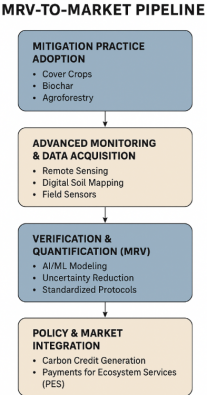
Building on the policy recognition described in Section 4, this section highlights practical, technological, and economic pathways to enhance soil-based climate mitigation. The progression from soil management practices to monitoring, verification, and carbon market integration is conceptualized in
Figure 4.
6.1. Spatial Targeting and Soil Carbon Assessment
High-resolution soil mapping and digital soil approaches enable the identification of high-potential areas for carbon sequestration
| [1] | Amelung, W., Bossio, D., de Vries, W., Kögel Knabner, I., Lehmann, J., Amundson, R., Chabbi, A. (2020). Towards a global-scale soil climate mitigation strategy. Nature Communications, 11(1), 5427. |
| [17] | Padarian, J., Minasny, B., McBratney, A., & Smith, P. (2022). Soil carbon sequestration potential in global croplands. PeerJ, 10, e13740. https://doi.org/10.7717/peerj.13740 |
[1, 17]
. Spatially explicit strategies can prioritize degraded lands or regions with low SOC stocks, maximizing climate benefits.
6.2. Economic Incentives and Market Mechanisms
Payments for ecosystem services (PES) and carbon farming schemes incentivize the adoption of SOC-enhancing practices. Linking carbon gains to credit markets encourages long-term investment in soil management while co-benefiting soil fertility and crop productivity
| [16] | Lorenz, K., & Lal, R. (2018). Importance of soils of agroecosystems for climate change policy. In K. Lorenz & R. Lal (Eds.), Carbon Sequestration in Agricultural Ecosystems (pp. 357-386). Springer.
https://doi.org/10.1007/978-3-319-92318-5 |
| [18] | Rubin, R., Oldfield, E., Lavallee, J. M., Griffin, T., Mayers, B., & Sanderman, J. (2023). Climate mitigation through soil amendments: quantification, evidence, and uncertainty. Carbon Management, 14(1), 2217785.
https://doi.org/10.1080/17583004.2023.2217785 |
[16, 18]
.
6.3. Monitoring, Reporting, and Verification (MRV) Systems
Reliable, cost-effective MRV systems are crucial for scaling soil-based mitigation. Standardized soil sampling, carbon stock assessments, and modeling frameworks help track SOC changes, reduce uncertainties, and provide evidence for carbon markets
| [1] | Amelung, W., Bossio, D., de Vries, W., Kögel Knabner, I., Lehmann, J., Amundson, R., Chabbi, A. (2020). Towards a global-scale soil climate mitigation strategy. Nature Communications, 11(1), 5427. |
| [3] | Batjes, N. H., Ceschia, E., Heuvelink, G. B. M., Demenois, J., Le Maire, G., Cardinael, R., & van Egmond, F. M. (2024). Towards a modular, multi?ecosystem monitoring, reporting and verification (MRV) framework for soil organic carbon stock change assessment. Carbon Management, 15(1), 2410812. https://doi.org/10.1080/17583004.2024.2410812 |
| [19] | Shaaban, M., & Núñez-Delgado, A. (2024). Soil adsorption potential: Harnessing Earth’s living skin for mitigating climate change and greenhouse gas dynamics. Environmental Research, 251, 118738.
https://doi.org/10.1016/j.envres.2024.118738 |
[1, 3, 19]
.
6.4. National Soil Carbon Strategies
Countries can institutionalize soil-based mitigation through strategies that set SOC targets, align with climate commitments, and provide technical support to farmers
| [16] | Lorenz, K., & Lal, R. (2018). Importance of soils of agroecosystems for climate change policy. In K. Lorenz & R. Lal (Eds.), Carbon Sequestration in Agricultural Ecosystems (pp. 357-386). Springer.
https://doi.org/10.1007/978-3-319-92318-5 |
| [21] | Telo da Gama, J. (2023). The role of soils in sustainability, climate change, and ecosystem services: Challenges and opportunities. Ecologies, 4(3), 552-567. |
[16, 21]
. Integrating research, extension services, and policy instruments ensures effective implementation at scale.
6.5. Global Initiatives and Knowledge Exchange
International programs such as the 4 per 1000 initiative and FAO soil programs promote soil carbon sequestration by providing technical guidance, standardizing protocols, and facilitating global knowledge exchange
| [17] | Padarian, J., Minasny, B., McBratney, A., & Smith, P. (2022). Soil carbon sequestration potential in global croplands. PeerJ, 10, e13740. https://doi.org/10.7717/peerj.13740 |
| [21] | Telo da Gama, J. (2023). The role of soils in sustainability, climate change, and ecosystem services: Challenges and opportunities. Ecologies, 4(3), 552-567. |
[17, 21]
. These initiatives help harmonize best practices and foster coordinated action to maximize the mitigation potential of soils.
In general, leveraging emerging technologies, economic incentives, national strategies, and global initiatives creates multiple avenues to enhance soils’ role in climate mitigation. By integrating scientific evidence, policy frameworks, and practical interventions, soils can contribute meaningfully to GHG reduction, climate resilience, and sustainable agriculture.
Figure 4. The Path from Soil Management to Carbon Market Integration.
7. Future Perspectives: Leveraging Soils for Climate Mitigation
Soils are critical for climate mitigation, acting as major carbon reservoirs and regulators of greenhouse gases. Despite their potential, soils remain underutilized in climate action. Moving forward, strategic integration of scientific evidence, policy mechanisms, economic incentives, and technological innovations is essential to unlock the full mitigation potential of soils.
7.1. Actionable Recommendations
1) Policy Integration: Embed soil carbon management and SOC targets in NDCs and carbon market frameworks.
2) Monitoring and Verification (MRV): Develop cost-effective, standardized MRV systems for soil carbon and GHG fluxes.
3) Economic Incentives: Promote payments for ecosystem services (PES) and carbon farming to incentivize adoption of SOC-enhancing practices.
4) Technology Adoption: Apply digital soil mapping, remote sensing, and AI for site-specific soil carbon interventions.
5) Long-term Field Research: Establish multi-site, long-duration trials to quantify cumulative impacts of integrated soil management practices across climates, soil types, and cropping systems.
7.2. Research Questions for Future Studies
1) How do integrated soil management practices affect deep soil carbon pools and long-term SOC stability?
2) Which socio-economic and policy mechanisms most effectively drive adoption of SOC-enhancing practices?
3) How can site-specific constraints (soil texture, pH, nutrient limitations) be optimized for maximum carbon sequestration?
4) What are the interactions between soil carbon, GHG emissions, and crop productivity under combined climate-smart practices?
5) How can emerging technologies (AI, remote sensing) improve accuracy, accessibility, and adoption in MRV systems?
6) What are the net climate mitigation benefits (accounting for all GHG fluxes and carbon permanence risks) and the economic viability of integrated soil management practices over a multi-decadal timeline?
7.3. Integrative Outlook
By addressing knowledge gaps, scaling interventions, and monitoring outcomes rigorously, soils can transition from an underappreciated resource to a cornerstone of global climate mitigation. Prioritizing high-potential regions, leveraging policy frameworks, and linking scientific evidence to economic incentives will maximize both climate and food security co-benefits. Future perspectives should focus on harmonizing research, policy, and practice to enable scalable, effective, and sustainable soil-based mitigation strategies.
8. Conclusion
Soils are central to global climate mitigation, functioning as major carbon reservoirs and regulators of GHGs. Evidence from studies on carbon sequestration, biochar, manure, agroforestry, and enhanced rock weathering demonstrates that deliberate soil management can increase soil organic and inorganic carbon, reduce emissions, and enhance ecosystem resilience. While policy recognition has improved through frameworks such as the Paris Agreement, NDCs, and the 4 per 1000 initiative, barriers including measurement uncertainty, socio-economic constraints, and limited long-term data remain. Emerging opportunities spatial targeting, MRV systems, economic incentives, and global initiatives provide pathways to scale soil-based mitigation effectively. Strategic integration of scientific evidence, practical interventions, and policy mechanisms is critical to realize soils’ full potential in climate change mitigation, safeguard food security, and promote sustainable agricultural landscapes.
Abbreviations
GHGs | Greenhouse Gases |
CO2 | Carbon Dioxide |
CH4 | Methane |
N2O | Nitrous Oxide |
SOC | Soil Organic Carbon |
SIC | Soil Inorganic Carbon |
NT | No-Till |
RR | Residue Retention |
CA | Conservation Agriculture |
AMC | Absolute Mineralizable Carbon |
SMC | Specific Mineralizable Carbon |
ERW | Enhanced Rock Weathering |
NDCs | Nationally Determined Contributions |
CSA | Climate-Smart Agriculture |
PES | Payments for Ecosystem Services |
MRV | Monitoring, Reporting, and Verification |
4p1000 | 4 per 1000 Initiative |
Author Contributions
Henok Heluf Gebrekidan: Conceptualization, Data Curation, Methodology, Visualization, Writing – original draft, Writing – review & editing
Funding
This research received no external funding.
Data Availability Statement
Data sharing is not applicable to this article as no datasets were generated or analyzed during the study.
Conflicts of Interest
The author declares that there are no competing interests.
References
| [1] |
Amelung, W., Bossio, D., de Vries, W., Kögel Knabner, I., Lehmann, J., Amundson, R., Chabbi, A. (2020). Towards a global-scale soil climate mitigation strategy. Nature Communications, 11(1), 5427.
|
| [2] |
Amundson, R., Buck, H., & Lajtha, K. (2022). Soil science in the time of climate mitigation. Biogeochemistry, 161(1), 47-58.
|
| [3] |
Batjes, N. H., Ceschia, E., Heuvelink, G. B. M., Demenois, J., Le Maire, G., Cardinael, R., & van Egmond, F. M. (2024). Towards a modular, multi?ecosystem monitoring, reporting and verification (MRV) framework for soil organic carbon stock change assessment. Carbon Management, 15(1), 2410812.
https://doi.org/10.1080/17583004.2024.2410812
|
| [4] |
Chagas, J. K. M., de Figueiredo, C. C., & Ramos, M. L. G. (2022). Biochar increases soil carbon pools: Evidence from a global meta-analysis. Journal of Environmental Management, 305, 114403.
https://doi.org/10.1016/j.jenvman.2021.114403
|
| [5] |
De Stefano, A., & Jacobson, M. G. (2018). Soil carbon sequestration in agroforestry systems: a meta-analysis. Agroforestry Systems, 92(2), 285-299.
https://doi.org/10.1007/s10457-017-0082-2
|
| [6] |
FAO. (2023). Global Soil Organic Carbon Sequestration Potential Map (GSOCseq). Food and Agriculture Organization of the United Nations.
https://fao-sid.github.io/GSOCseq/
|
| [7] |
Geoghegan, E. K. (2024). Evaluating Enhanced Rock Weathering as a Tool for Soil GHG Reduction and Carbon Sequestration in Croplands (Doctoral dissertation, Cornell University).
|
| [8] |
Gross, A., & Glaser, B. (2021). Meta-analysis on how manure application changes soil organic carbon storage. Scientific Reports, 11(1), 5516.
https://doi.org/10.1038/s41598-021-85058-1
|
| [9] |
He, C., Chen, Z., Qiu, K. Y., Chen, J. S., Bohoussou, Y. N. D., Dang, Y. P., & Zhang, H. L. (2023). Effects of conservation agriculture on carbon mineralization: A global meta-analysis. Soil and Tillage Research, 229, 105685.
https://doi.org/10.1016/j.still.2022.105685
|
| [10] |
IPCC. (2019). Climate Change and Land: An IPCC Special Report on climate change, desertification, land degradation, sustainable land management, food security, and greenhouse gas fluxes in terrestrial ecosystems.
|
| [11] |
Jian, J., Du, X., Reiter, M. S., & Stewart, R. D. (2020). A meta-analysis of global cropland soil carbon changes due to cover cropping. Soil Biology and Biochemistry, 143, 107735.
https://doi.org/10.1016/j.soilbio.2020.107735
|
| [12] |
Köchy, M., Hiederer, R., & Freibauer, A. (2015). Global distribution of soil organic carbon - Part 1: Masses and frequency distributions of SOC stocks. SOIL, 1, 351-365.
https://doi.org/10.5194/soil-1-351-2015
|
| [13] |
Lal, R. (2013). Soil carbon management and climate change. Carbon Management, 4(4), 439-462.
https://doi.org/10.4155/cmt.13.31
|
| [14] |
Lal, R., Monger, C., Nave, L., & Smith, P. (2021). The role of soil in regulation of climate. Philosophical Transactions of the Royal Society B, 376(1834), 20210084.
https://doi.org/10.1098/rstb.2021.0084
|
| [15] |
Levy, C. R., Almaraz, M., Beerling, D. J., Raymond, P., Reinhard, C. T., Suhrhoff, T. J., & Taylor, L. (2024). Enhanced rock weathering for carbon removal-monitoring and mitigating potential environmental impacts on agricultural land. Environmental Science & Technology, 58(39), 17215-17226.
https://doi.org/10.1021/acs.est.4c04123
|
| [16] |
Lorenz, K., & Lal, R. (2018). Importance of soils of agroecosystems for climate change policy. In K. Lorenz & R. Lal (Eds.), Carbon Sequestration in Agricultural Ecosystems (pp. 357-386). Springer.
https://doi.org/10.1007/978-3-319-92318-5
|
| [17] |
Padarian, J., Minasny, B., McBratney, A., & Smith, P. (2022). Soil carbon sequestration potential in global croplands. PeerJ, 10, e13740.
https://doi.org/10.7717/peerj.13740
|
| [18] |
Rubin, R., Oldfield, E., Lavallee, J. M., Griffin, T., Mayers, B., & Sanderman, J. (2023). Climate mitigation through soil amendments: quantification, evidence, and uncertainty. Carbon Management, 14(1), 2217785.
https://doi.org/10.1080/17583004.2023.2217785
|
| [19] |
Shaaban, M., & Núñez-Delgado, A. (2024). Soil adsorption potential: Harnessing Earth’s living skin for mitigating climate change and greenhouse gas dynamics. Environmental Research, 251, 118738.
https://doi.org/10.1016/j.envres.2024.118738
|
| [20] |
Streck, C., & Gay, A. (2017). The role of soils in international climate change policy. In International Yearbook of Soil Law and Policy 2016 (pp. 105-128). Springer.
|
| [21] |
Telo da Gama, J. (2023). The role of soils in sustainability, climate change, and ecosystem services: Challenges and opportunities. Ecologies, 4(3), 552-567.
|
| [22] |
Tian, H., Xu, R., Canadell, J. G., Thompson, R. L., Winiwarter, W., Janssens-Maenhout, G. & Ciais, P. (2020). A comprehensive quantification of global nitrous oxide sources and sinks. Nature, 586, 248-256.
https://doi.org/10.1038/s41586-020-2780-0
|
| [23] |
Wang, J., Jansson, R., Li, Y., & Zhang, X. (2025). Global patterns of soil organic carbon distribution in subsoils (20-100 cm). Earth System Science Data, 17, 3375-3392.
https://doi.org/10.5194/essd-17-3375-2025
|
Cite This Article
-
APA Style
Gebrekidan, H. H. (2026). The Underrecognized Role of Soil Processes in Global Climate Change Mitigation: A Critical Review. International Journal of Ecotoxicology and Ecobiology, 11(1), 1-8. https://doi.org/10.11648/j.ijee.20261101.11
 Copy
|
Copy
|
 Download
ACS Style
Gebrekidan, H. H. The Underrecognized Role of Soil Processes in Global Climate Change Mitigation: A Critical Review. Int. J. Ecotoxicol. Ecobiol. 2026, 11(1), 1-8. doi: 10.11648/j.ijee.20261101.11
Copy
|
Download
AMA Style
Gebrekidan HH. The Underrecognized Role of Soil Processes in Global Climate Change Mitigation: A Critical Review. Int J Ecotoxicol Ecobiol. 2026;11(1):1-8. doi: 10.11648/j.ijee.20261101.11
Copy
|
Download
-
@article{10.11648/j.ijee.20261101.11,
  author = {Henok Heluf Gebrekidan},
  title = {The Underrecognized Role of Soil Processes in Global Climate Change Mitigation: A Critical Review},
  journal = {International Journal of Ecotoxicology and Ecobiology},
  volume = {11},
  number = {1},
  pages = {1-8},
  doi = {10.11648/j.ijee.20261101.11},
  url = {https://doi.org/10.11648/j.ijee.20261101.11},
  eprint = {https://article.sciencepublishinggroup.com/pdf/10.11648.j.ijee.20261101.11},
  abstract = {Soils represent the largest terrestrial carbon reservoir, storing more carbon than the atmosphere and vegetation combined, and therefore play a critical role in climate change mitigation. This review synthesizes current evidence on the role of soils in mitigating climate change, with a focus on soil carbon sequestration, greenhouse gas regulation, and the effectiveness of soil-based management strategies. A comprehensive evaluation of recent meta-analyses, global datasets, and modeling studies was conducted to assess key mitigation pathways and identify existing policy and knowledge gaps. The findings indicate that practices such as conservation agriculture, cover cropping, biochar application, manure amendments, agroforestry, liming, and enhanced rock weathering can significantly increase soil organic carbon stocks and reduce greenhouse gas emissions, although their effectiveness varies depending on soil type, climate, and management conditions. Quantitative evidence shows that cover crops can increase soil organic carbon by approximately 15.5%, while manure and biochar applications can enhance carbon stocks by over 30% and 60%, respectively, under favorable conditions. Despite this potential, the integration of soils into climate mitigation policies remains limited due to measurement uncertainties, insufficient long-term data, and weak inclusion in carbon market frameworks. Overall, soils represent a substantial yet underutilized opportunity for climate mitigation, and improving monitoring systems, strengthening policy integration, and promoting site-specific management strategies are essential to fully harness their potential while supporting sustainable agricultural systems.},
 year = {2026}
}
Copy
|
Download
-
TY  - JOUR
T1  - The Underrecognized Role of Soil Processes in Global Climate Change Mitigation: A Critical Review
AU  - Henok Heluf Gebrekidan
Y1  - 2026/04/02
PY  - 2026
N1  - https://doi.org/10.11648/j.ijee.20261101.11
DO  - 10.11648/j.ijee.20261101.11
T2  - International Journal of Ecotoxicology and Ecobiology
JF  - International Journal of Ecotoxicology and Ecobiology
JO  - International Journal of Ecotoxicology and Ecobiology
SP  - 1
EP  - 8
PB  - Science Publishing Group
SN  - 2575-1735
UR  - https://doi.org/10.11648/j.ijee.20261101.11
AB  - Soils represent the largest terrestrial carbon reservoir, storing more carbon than the atmosphere and vegetation combined, and therefore play a critical role in climate change mitigation. This review synthesizes current evidence on the role of soils in mitigating climate change, with a focus on soil carbon sequestration, greenhouse gas regulation, and the effectiveness of soil-based management strategies. A comprehensive evaluation of recent meta-analyses, global datasets, and modeling studies was conducted to assess key mitigation pathways and identify existing policy and knowledge gaps. The findings indicate that practices such as conservation agriculture, cover cropping, biochar application, manure amendments, agroforestry, liming, and enhanced rock weathering can significantly increase soil organic carbon stocks and reduce greenhouse gas emissions, although their effectiveness varies depending on soil type, climate, and management conditions. Quantitative evidence shows that cover crops can increase soil organic carbon by approximately 15.5%, while manure and biochar applications can enhance carbon stocks by over 30% and 60%, respectively, under favorable conditions. Despite this potential, the integration of soils into climate mitigation policies remains limited due to measurement uncertainties, insufficient long-term data, and weak inclusion in carbon market frameworks. Overall, soils represent a substantial yet underutilized opportunity for climate mitigation, and improving monitoring systems, strengthening policy integration, and promoting site-specific management strategies are essential to fully harness their potential while supporting sustainable agricultural systems.
VL  - 11
IS  - 1
ER  -
Copy
|
Download





 Share This Article
 Twitter
 Linked In
 Facebook