Laboratory of Energy, National Higher Polytechnic School of Douala, University of Douala, Douala, Cameroon
Laboratory of Energetics and Applied Thermal, ENSAI-University of Ngaoundere, Ngaoundere, Cameroon
Department of Marine Energy Engineering, National Advanced School of Maritime and Ocean Science and Technology (NASMOST), University of Ebolowa, Kribi, Cameroon
Experimentation and Production Center, National Advanced School of Maritime and Ocean Science and Technology (NASMOST), University of Ebolowa, Kribi, Cameroon
Laboratory of Energetics and Applied Thermal, ENSAI-University of Ngaoundere, Ngaoundere, Cameroon
Department of Marine Energy Engineering, National Advanced School of Maritime and Ocean Science and Technology (NASMOST), University of Ebolowa, Kribi, Cameroon
Experimentation and Production Center, National Advanced School of Maritime and Ocean Science and Technology (NASMOST), University of Ebolowa, Kribi, Cameroon
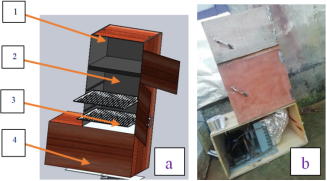
The aim of this project is to design and build a refrigerated dryer for preserving fruit and vegetables. The prototype comprises a refrigeration chamber, a drying chamber and a condensing unit housing. SOLIDWORKS and EES software were used for the design and power calculation of the refrigeration system units, respectively. The dryer is supplied with hot air by the condensing unit. The experimental part will involve characterizing the air in the drying and refrigeration chambers, and the product in the drying chamber. Sizing the refrigeration chamber based on a heat balance gave us a condenser power of 489.24 W and a drying temperature of 48°C. The coefficient of performance being at a temperature of 5°C.
This is an Open Access article, distributed under the terms of the Creative Commons Attribution 4.0 International License (http://creativecommons.org/licenses/by/4.0/), which permits unrestricted use, distribution and reproduction in any medium or format, provided the original work is properly cited.
Today, the desire to preserve the sustenance of food is one of the driving forces behind the development and improvement of preservation techniques. These include drying and refrigeration. Drying is an energy-intensive and costly operation, accounting for 10-15% of total industrial energy consumption worldwide
[8]
Khaldi (2018) Numerical study of the thermal behavior of a solar dryer using a thermal bed for energy storage, thesis defended for the purpose of obtaining the Doctorate of the Université Bourgogne Franche-Comte. Etude numérique du comportement thermique d’un séchoir solaire utilisant un lit thermique pour le stockage d’énergie, thèse soutenue en vue de l’obtention du Doctorat de l’Université Bourgogne Franche-Comte.
[8]
. This large share means that we need to find ways of optimizing processes, both economically and ecologically. With the aim of reducing energy losses during a drying operation, some work has been carried out on product characterization
[2]
Ekani Roger Yannick Tetang Fokone Abraham, Edoun Marcel, and Kuitche Alexis (2019) Experimental Study of the Drying Kinetics of Mango (mangifera indica L.) during Airflow Drying Licking Countercurrent, American Journal of Food Science and Technology, vol. 7, no. 4 127-132.
Ekani Roger Yannick, Tétang Fokoné Abraham, Edoun Marcel and Kuitche Alexis (2022) Airflow drying licking countercurrent of Mango (mangifera indica L.): Experimental determination of drying parameters, International Journal for Research in Applied Science & Engineering Technology, Vol. 10, pp. 441-445, August 2022.
[10]
M Fterich, H Chouikhi, H Bentaher, A Maalej (2018) Experimental parametric study of a mixed-mode forced convection solar dryer equipped with a PV/T air collector, Sol. Energy 171 751–760,
; other researchers have worked on characterizing drying equipment
[1]
Edoun M (2010) Development of a tool to assist in the design of small-scale drying processes in humid tropical areas, thesis defended for the award of a Doctorate/PhD in process engineering at the National Higher School of Agro-Industrial Sciences. Développement d’un outil d’aide à la conception de procédés de séchage à petite échelle en zone tropicale humide, thèse soutenue en vue de l’obtention du Doctorat/PhD en génie des procédés à l’Ecole Nationale Supérieure des Sciences AgroIndustrielles (ENSAI).
[6]
JianchunYana, HaiWeia, ZhaoyanYoua, HuichangWua, JiayuZhangb, KunjieChenb, HuanxiongXiea, (2022) Design and experiment of a box-type heat-pump dryer with side ventilating and rack moving, Thermal Engineering. Journal homepage
L Abhay, V P Chandramohan, et V R K Raju (2017) Design, Development and Performance of Indirect Type Solar Dryer for Banana Drying, Energy Procedia, p. 409‑416.
[11]
Mohamed Fterich, Mamdouh Ibrahim Elamy, Ezzeddine Touti, Hatem Bentaher (2023) Experimental and numerical study of tomatoes drying kinetics using solar ryer equipped with PVT air collector, Engineering Science and Technology, an International Journal 47-101524,
. This is the background to our work. The main objective of our study is to contribute to drying optimization. The aim is to design and characterize a prototype refrigerated dryer.
2. Refrigeration Dryer Design
In this section we will describe, dimension and calculate the parameters of our machine.
2.1. Description of the System
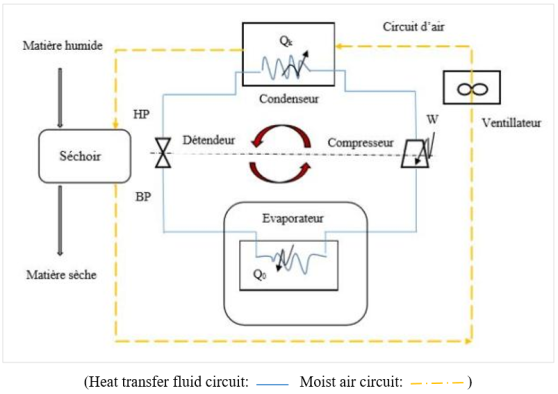
The system works by using waste heat from the refrigeration machine's condenser to heat the air circulating around the mushrooms to be dried. This hot air then evaporates the water from the mushrooms, causing them to dehydrate. This method recycles the heat from the condenser and uses it for a useful process, thus reducing energy costs. This phenomenon is illustrated in Figure 1.
Figure 1. Block diagram of the system coupling the dryer to a refrigeration machine.
2.2. Sizing the Refrigeration Chamber
We evaluated the heat output of the heat exchangers and the compressor and then deduced the power of the fan to be installed.
2.2.1. The Characteristics of Outside Air
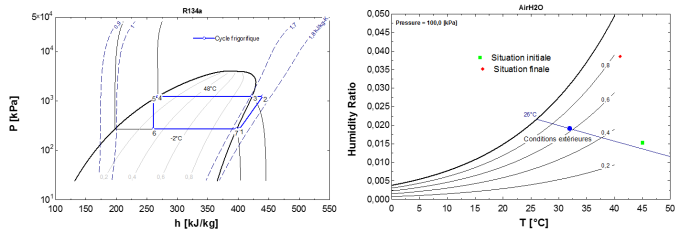
The machine we want to build will be installed in the city of Douala, and we have recorded the average air characteristics in Table 1 below.
Table 1. Outside air characteristics
[7]
Kemajou Alexis (2007) Introduction to the mastery of air conditioning and air handling. Initiation à la maitrise de la climatisation et du conditionnement de l’air, Edition MASSEU. 367 p.
[7]
.
Dry temperature (°c)
Moist température (°c)
Relative humidity Hr (%)
Moisture content (g/ kgas)
Enthalpy (kJ/kgas)
32
26
83
25,2
96,72
2.2.2. Sizing Hypotheses
To achieve the objective of this work, it is important for us to set dimensioning assumptions in order to overcome certain difficulties. Our assumptions are as follows:
Overheating temperature 5°C; Undercooling temperature 5°C; The enthalpy of the drying air remains constant during drying to keep the temperature invariant; The walls of the drying unit have uniform and constant temperatures; Heat exchanges by conduction and radiation are negligible.
2.2.3. Refrigeration Machine Power Balance
The aim is to determine the energy consumption of the machine's main components. The EES (Engineering Equation Solver) software is used to calculate the compressor, condenser, expansion valve and evaporator capacities using the following equations:
The compressor
(1)
The condenser
We report that the amount of heat per unit mass of fluid circulating in the plant is deduced from examination of the enthalpy diagram:
(2)
The expansion valve
The expansion of the fluid is isenthalpic. The enthalpy diagram shows that this is the case:
(3)
Evaporator
(4)
Since the condenser capacity is a known value, the mass flow m ̇ of the refrigerant is calculated as follows:
(5)
Coefficient of performance
The COP is defined as the ratio between the need and the resource. In our case, this machine will have two aspects of this coefficient:
(6)
Index i=f for cold production and i=cd for heat production. In this study, it is the heat production vocation that is valued.
Ventilator sizing
The useful power of the fan capable of conveying the quantity of air proportional to the drying chamber.
(7)
2.3. Calculation of Drying Chamber Parameters
For our project, we'll be drying 1 kg of mushroom (oyster mushroom) with an initial moisture content of 85% and a final moisture content of between 10 and 12%. The drying method used will be convection drying at 45°C through a thermal dryer. The mathematical equations used for sizing our plant are as follows:
Quantity of water to extract
[4]
ITEIPMAI (1995) Drying, from principles to the definition of your installation. Le séchage, des principes à la définition de votre installation. Editeur: 49120 Chemille France.
[4]
:
(8)
Moisture content
[1]
Edoun M (2010) Development of a tool to assist in the design of small-scale drying processes in humid tropical areas, thesis defended for the award of a Doctorate/PhD in process engineering at the National Higher School of Agro-Industrial Sciences. Développement d’un outil d’aide à la conception de procédés de séchage à petite échelle en zone tropicale humide, thèse soutenue en vue de l’obtention du Doctorat/PhD en génie des procédés à l’Ecole Nationale Supérieure des Sciences AgroIndustrielles (ENSAI).
[1]
(9)
Required evaporation capacity in kg/h
[4]
ITEIPMAI (1995) Drying, from principles to the definition of your installation. Le séchage, des principes à la définition de votre installation. Editeur: 49120 Chemille France.
[4]
:
(10)
Required Dry air flow in m3/h air
[5]
Jean-François Rozi (1995) Drying food products, Techniques, processes, equipment. Sécher des produits alimentaires, Techniques, procédés, équipements, GRET, France.
[5]
:
(11)
2.4. Drying Chamber Energy Balance
This assessment will consist of evaluating the various losses from the drying chamber.
Energy dissipated by walls
(12)
As our wall is made of wood panel and aluminum sheet, the thickness of the sheet will be neglected. The interior convection coefficient is given by the following equations
[13]
Benaouda, Benhamou. A, Biddaria, Abdellzoui. M, Belhamel. M (2006) Design, construction, and experimentation of a partially solar-heated dryer operating with forced convection, Thermal Laboratory, Center for Renewable Energy Development, Route de l’Observation BP 62 Bouzareah, Algiers. Conception, réalisation et expérimentation d’un séchoir à chauffage partielle solaire fonctionnant en convection forcée, Laboratoire de Thermique centre de développement des énergies Renouvelables, Route de l’observation BP 62 Bouzareah, Alger.
[13]
:
(13)
(14)
(15)
The overall heat exchange surface is given by the following relationship:
(16)
Energy required to dry products
(17)
The latent heat of vaporization of the water contained in the product
(18)
Provisional power balance
(19)
Total balance (QT)
The total balance sheet is the sum of the provisional balance sheet and non-quantifiable losses. It is expressed by the relationship below.
(20)
Dryer efficiency calculation
(21)
Refrigerant selection
The refrigerant used here is R134a with a mass flow rate of.
3. Results and Discussion
This section presents the results of the sizing, characterization and realization of the machine.
3.1. Presentation of Sizing Results
Le tableau 2 ci-dessous nous présente le récapitulatif des résultats issus du dimensionnement. Ces données ont permis de choisir les équipements nécessaires pour la réalisation du prototype.
Table 2. Sizing results.
Designations
Results
Designations
Results
Compressor capacity
Pcp = 113,11W
Air flow required
Qa = 103,6875 m3/h
Condenser capacity
Pcd = 489,24 W
Power required for drying
Ps = 453W
Cooling capacity
Pf = 376,13 W
Energy dissipated by the walls
Qp = 26,64 W
Coefficient of performance
COP heat = 4,325 COP cold =3,32
Latent heat of vaporization of the water contained in the product
Ql = 0,0429 W
Quantity of water to be extracted
Qe = 0,8295 kg
Provisional power balance
Qpr = 479,64 W
Evaporation capacity required
CE/h = 0,207375 kg/h
Dryer efficiency
ղ=92,59%
3.2. Refrigeration Machine Performance
To satisfy the cooling and/or heating requirement, the mass flow rate circulating in the system must be equal to 2.68 g/s.
We have considered an isentropic efficiency of 85%, for an evaporation temperature of -2°C and a condensation temperature of 48°C.
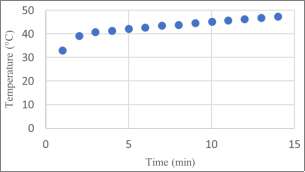
Figure 4. Profile of air temperature as a function of time.
The curve increases. This shows that the air in the dryer heats up with increasing time. It can also be seen that, in the absence of racks, the air temperature in the dryer is homogeneous. This observation has also been made by
[1]
Edoun M (2010) Development of a tool to assist in the design of small-scale drying processes in humid tropical areas, thesis defended for the award of a Doctorate/PhD in process engineering at the National Higher School of Agro-Industrial Sciences. Développement d’un outil d’aide à la conception de procédés de séchage à petite échelle en zone tropicale humide, thèse soutenue en vue de l’obtention du Doctorat/PhD en génie des procédés à l’Ecole Nationale Supérieure des Sciences AgroIndustrielles (ENSAI).
[12]
Tetang F A (2018) Modeling of heat and mass transfer during intermittent drying of high-moisture fruits: Application to 'Amélie' mango, Doctoral thesis, University of Ngaoundéré. Modélisation des transferts de chaleur et de matière lors du séchage intermittent des fruits à forte teneur en eau: Application à la mangue’Amélie’, thèse de Doctorat, Université de Ngaoundéré.
[13]
Benaouda, Benhamou. A, Biddaria, Abdellzoui. M, Belhamel. M (2006) Design, construction, and experimentation of a partially solar-heated dryer operating with forced convection, Thermal Laboratory, Center for Renewable Energy Development, Route de l’Observation BP 62 Bouzareah, Algiers. Conception, réalisation et expérimentation d’un séchoir à chauffage partielle solaire fonctionnant en convection forcée, Laboratoire de Thermique centre de développement des énergies Renouvelables, Route de l’observation BP 62 Bouzareah, Alger.
[14]
Kouhila M, Belghit A, Boutaleb B C (2000) Etude Expérimentale du Séchage Convectif de la SAUGE dans un Séchoir Solaire muni d’un Appoint Electrique, Rev. Energ, Ren, Chemss pp 33-38.
[1, 12-14]
.
3.4.2. Product Characterization in the Dryer
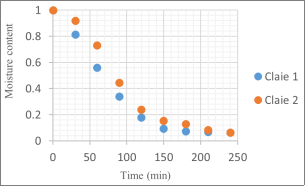
Figure 5 shows the evolution of the reduced water content of the mushroom as a function of time for through-flow drying for two racks in the dryer.
The curves show the same pattern, with rack 1 below rack 2 from the start to the end of drying. To reach a water content reduced by 0.1, the curves for racks 1 and 2 take 150 minutes and 180 minutes respectively. It can be said that the products on the racks reach their equilibrium water content one after the other, as the thermal energy expended by water evaporation is accompanied by air cooling. Similar results have been obtained by
[2]
Ekani Roger Yannick Tetang Fokone Abraham, Edoun Marcel, and Kuitche Alexis (2019) Experimental Study of the Drying Kinetics of Mango (mangifera indica L.) during Airflow Drying Licking Countercurrent, American Journal of Food Science and Technology, vol. 7, no. 4 127-132.
Benaouda, Benhamou. A, Biddaria, Abdellzoui. M, Belhamel. M (2006) Design, construction, and experimentation of a partially solar-heated dryer operating with forced convection, Thermal Laboratory, Center for Renewable Energy Development, Route de l’Observation BP 62 Bouzareah, Algiers. Conception, réalisation et expérimentation d’un séchoir à chauffage partielle solaire fonctionnant en convection forcée, Laboratoire de Thermique centre de développement des énergies Renouvelables, Route de l’observation BP 62 Bouzareah, Alger.
[14]
Kouhila M, Belghit A, Boutaleb B C (2000) Etude Expérimentale du Séchage Convectif de la SAUGE dans un Séchoir Solaire muni d’un Appoint Electrique, Rev. Energ, Ren, Chemss pp 33-38.
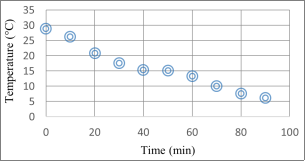
Figure 6. Evolution of the refrigeration temperature as a function of time.
The curve decreases with increasing time. We can see that the curve reaches a temperature of 5°C after 90 minutes. We can see that cold is being produced in our appliance.
4. Conclusions
At the end of this work, the aim was to design and build a system enabling fruit and vegetables to be preserved simultaneously by drying and refrigeration. A prototype thermal dryer coupled with a refrigeration machine was designed to meet this need. The drying cabin has a drying area of around 0.74 m² for a capacity of 1 kg of fresh produce, and the refrigeration chamber is around 0.42 m². The resulting condenser power of 489.24W produces a drying temperature of 48°C. Our refrigeration machine produces cold at a temperature of 5°C.
Edoun M (2010) Development of a tool to assist in the design of small-scale drying processes in humid tropical areas, thesis defended for the award of a Doctorate/PhD in process engineering at the National Higher School of Agro-Industrial Sciences. Développement d’un outil d’aide à la conception de procédés de séchage à petite échelle en zone tropicale humide, thèse soutenue en vue de l’obtention du Doctorat/PhD en génie des procédés à l’Ecole Nationale Supérieure des Sciences AgroIndustrielles (ENSAI).
[2]
Ekani Roger Yannick Tetang Fokone Abraham, Edoun Marcel, and Kuitche Alexis (2019) Experimental Study of the Drying Kinetics of Mango (mangifera indica L.) during Airflow Drying Licking Countercurrent, American Journal of Food Science and Technology, vol. 7, no. 4 127-132.
Ekani Roger Yannick, Tétang Fokoné Abraham, Edoun Marcel and Kuitche Alexis (2022) Airflow drying licking countercurrent of Mango (mangifera indica L.): Experimental determination of drying parameters, International Journal for Research in Applied Science & Engineering Technology, Vol. 10, pp. 441-445, August 2022.
[4]
ITEIPMAI (1995) Drying, from principles to the definition of your installation. Le séchage, des principes à la définition de votre installation. Editeur: 49120 Chemille France.
[5]
Jean-François Rozi (1995) Drying food products, Techniques, processes, equipment. Sécher des produits alimentaires, Techniques, procédés, équipements, GRET, France.
[6]
JianchunYana, HaiWeia, ZhaoyanYoua, HuichangWua, JiayuZhangb, KunjieChenb, HuanxiongXiea, (2022) Design and experiment of a box-type heat-pump dryer with side ventilating and rack moving, Thermal Engineering. Journal homepage
Kemajou Alexis (2007) Introduction to the mastery of air conditioning and air handling. Initiation à la maitrise de la climatisation et du conditionnement de l’air, Edition MASSEU. 367 p.
[8]
Khaldi (2018) Numerical study of the thermal behavior of a solar dryer using a thermal bed for energy storage, thesis defended for the purpose of obtaining the Doctorate of the Université Bourgogne Franche-Comte. Etude numérique du comportement thermique d’un séchoir solaire utilisant un lit thermique pour le stockage d’énergie, thèse soutenue en vue de l’obtention du Doctorat de l’Université Bourgogne Franche-Comte.
[9]
L Abhay, V P Chandramohan, et V R K Raju (2017) Design, Development and Performance of Indirect Type Solar Dryer for Banana Drying, Energy Procedia, p. 409‑416.
[10]
M Fterich, H Chouikhi, H Bentaher, A Maalej (2018) Experimental parametric study of a mixed-mode forced convection solar dryer equipped with a PV/T air collector, Sol. Energy 171 751–760,
Mohamed Fterich, Mamdouh Ibrahim Elamy, Ezzeddine Touti, Hatem Bentaher (2023) Experimental and numerical study of tomatoes drying kinetics using solar ryer equipped with PVT air collector, Engineering Science and Technology, an International Journal 47-101524,
Tetang F A (2018) Modeling of heat and mass transfer during intermittent drying of high-moisture fruits: Application to 'Amélie' mango, Doctoral thesis, University of Ngaoundéré. Modélisation des transferts de chaleur et de matière lors du séchage intermittent des fruits à forte teneur en eau: Application à la mangue’Amélie’, thèse de Doctorat, Université de Ngaoundéré.
[13]
Benaouda, Benhamou. A, Biddaria, Abdellzoui. M, Belhamel. M (2006) Design, construction, and experimentation of a partially solar-heated dryer operating with forced convection, Thermal Laboratory, Center for Renewable Energy Development, Route de l’Observation BP 62 Bouzareah, Algiers. Conception, réalisation et expérimentation d’un séchoir à chauffage partielle solaire fonctionnant en convection forcée, Laboratoire de Thermique centre de développement des énergies Renouvelables, Route de l’observation BP 62 Bouzareah, Alger.
[14]
Kouhila M, Belghit A, Boutaleb B C (2000) Etude Expérimentale du Séchage Convectif de la SAUGE dans un Séchoir Solaire muni d’un Appoint Electrique, Rev. Energ, Ren, Chemss pp 33-38.
Ekani, R. Y., Lemdjo, R. B. K., Kewou, S., Deli, G., Kikmo, C. W., et al. (2026). Design, Production and Testing of a Dryer Coupled with a Refrigeration Machine for Fruit and Vegetable Preservation. International Journal of Food Engineering and Technology, 10(1), 10-16. https://doi.org/10.11648/j.ijfet.20261001.12
Ekani, R. Y.; Lemdjo, R. B. K.; Kewou, S.; Deli, G.; Kikmo, C. W., et al. Design, Production and Testing of a Dryer Coupled with a Refrigeration Machine for Fruit and Vegetable Preservation. Int. J. Food Eng. Technol.2026, 10(1), 10-16. doi: 10.11648/j.ijfet.20261001.12
Ekani RY, Lemdjo RBK, Kewou S, Deli G, Kikmo CW, et al. Design, Production and Testing of a Dryer Coupled with a Refrigeration Machine for Fruit and Vegetable Preservation. Int J Food Eng Technol. 2026;10(1):10-16. doi: 10.11648/j.ijfet.20261001.12
@article{10.11648/j.ijfet.20261001.12,
  author = {Roger Yannick Ekani and Rutheel Brunda Kenvo Lemdjo and Serge Kewou and Goron Deli and Christophe Wilba Kikmo and Prosper Edouma and Jean Calvin Seutche and Frederic Lontsi and Marcel Edoun},
  title = {Design, Production and Testing of a Dryer Coupled with a Refrigeration Machine for Fruit and Vegetable Preservation},
  journal = {International Journal of Food Engineering and Technology},
  volume = {10},
  number = {1},
  pages = {10-16},
  doi = {10.11648/j.ijfet.20261001.12},
  url = {https://doi.org/10.11648/j.ijfet.20261001.12},
  eprint = {https://article.sciencepublishinggroup.com/pdf/10.11648.j.ijfet.20261001.12},
  abstract = {The aim of this project is to design and build a refrigerated dryer for preserving fruit and vegetables. The prototype comprises a refrigeration chamber, a drying chamber and a condensing unit housing. SOLIDWORKS and EES software were used for the design and power calculation of the refrigeration system units, respectively. The dryer is supplied with hot air by the condensing unit. The experimental part will involve characterizing the air in the drying and refrigeration chambers, and the product in the drying chamber. Sizing the refrigeration chamber based on a heat balance gave us a condenser power of 489.24 W and a drying temperature of 48°C. The coefficient of performance being at a temperature of 5°C.},
 year = {2026}
}
TY  - JOUR
T1  - Design, Production and Testing of a Dryer Coupled with a Refrigeration Machine for Fruit and Vegetable Preservation
AU  - Roger Yannick Ekani
AU  - Rutheel Brunda Kenvo Lemdjo
AU  - Serge Kewou
AU  - Goron Deli
AU  - Christophe Wilba Kikmo
AU  - Prosper Edouma
AU  - Jean Calvin Seutche
AU  - Frederic Lontsi
AU  - Marcel Edoun
Y1  - 2026/04/02
PY  - 2026
N1  - https://doi.org/10.11648/j.ijfet.20261001.12
DO  - 10.11648/j.ijfet.20261001.12
T2  - International Journal of Food Engineering and Technology
JF  - International Journal of Food Engineering and Technology
JO  - International Journal of Food Engineering and Technology
SP  - 10
EP  - 16
PB  - Science Publishing Group
SN  - 2640-1584
UR  - https://doi.org/10.11648/j.ijfet.20261001.12
AB  - The aim of this project is to design and build a refrigerated dryer for preserving fruit and vegetables. The prototype comprises a refrigeration chamber, a drying chamber and a condensing unit housing. SOLIDWORKS and EES software were used for the design and power calculation of the refrigeration system units, respectively. The dryer is supplied with hot air by the condensing unit. The experimental part will involve characterizing the air in the drying and refrigeration chambers, and the product in the drying chamber. Sizing the refrigeration chamber based on a heat balance gave us a condenser power of 489.24 W and a drying temperature of 48°C. The coefficient of performance being at a temperature of 5°C.
VL  - 10
IS  - 1
ER  -
Laboratory of Energy, National Higher Polytechnic School of Douala, University of Douala, Douala, Cameroon;Laboratory of Energetics and Applied Thermal, ENSAI-University of Ngaoundere, Ngaoundere, Cameroon;Department of Marine Energy Engineering, National Advanced School of Maritime and Ocean Science and Technology (NASMOST), University of Ebolowa, Kribi, Cameroon;Experimentation and Production Center, National Advanced School of Maritime and Ocean Science and Technology (NASMOST), University of Ebolowa, Kribi, Cameroon
Laboratory of Energy, National Higher Polytechnic School of Douala, University of Douala, Douala, Cameroon
Serge Kewou
Laboratory of Energetics and Applied Thermal, ENSAI-University of Ngaoundere, Ngaoundere, Cameroon;Department of Marine Energy Engineering, National Advanced School of Maritime and Ocean Science and Technology (NASMOST), University of Ebolowa, Kribi, Cameroon;Experimentation and Production Center, National Advanced School of Maritime and Ocean Science and Technology (NASMOST), University of Ebolowa, Kribi, Cameroon
Goron Deli
Departement of Renewable Energy, National Advanced School of Engineering, University of Maroua, Maroua, Cameroun
Ekani, R. Y., Lemdjo, R. B. K., Kewou, S., Deli, G., Kikmo, C. W., et al. (2026). Design, Production and Testing of a Dryer Coupled with a Refrigeration Machine for Fruit and Vegetable Preservation. International Journal of Food Engineering and Technology, 10(1), 10-16. https://doi.org/10.11648/j.ijfet.20261001.12
Ekani, R. Y.; Lemdjo, R. B. K.; Kewou, S.; Deli, G.; Kikmo, C. W., et al. Design, Production and Testing of a Dryer Coupled with a Refrigeration Machine for Fruit and Vegetable Preservation. Int. J. Food Eng. Technol.2026, 10(1), 10-16. doi: 10.11648/j.ijfet.20261001.12
Ekani RY, Lemdjo RBK, Kewou S, Deli G, Kikmo CW, et al. Design, Production and Testing of a Dryer Coupled with a Refrigeration Machine for Fruit and Vegetable Preservation. Int J Food Eng Technol. 2026;10(1):10-16. doi: 10.11648/j.ijfet.20261001.12
@article{10.11648/j.ijfet.20261001.12,
  author = {Roger Yannick Ekani and Rutheel Brunda Kenvo Lemdjo and Serge Kewou and Goron Deli and Christophe Wilba Kikmo and Prosper Edouma and Jean Calvin Seutche and Frederic Lontsi and Marcel Edoun},
  title = {Design, Production and Testing of a Dryer Coupled with a Refrigeration Machine for Fruit and Vegetable Preservation},
  journal = {International Journal of Food Engineering and Technology},
  volume = {10},
  number = {1},
  pages = {10-16},
  doi = {10.11648/j.ijfet.20261001.12},
  url = {https://doi.org/10.11648/j.ijfet.20261001.12},
  eprint = {https://article.sciencepublishinggroup.com/pdf/10.11648.j.ijfet.20261001.12},
  abstract = {The aim of this project is to design and build a refrigerated dryer for preserving fruit and vegetables. The prototype comprises a refrigeration chamber, a drying chamber and a condensing unit housing. SOLIDWORKS and EES software were used for the design and power calculation of the refrigeration system units, respectively. The dryer is supplied with hot air by the condensing unit. The experimental part will involve characterizing the air in the drying and refrigeration chambers, and the product in the drying chamber. Sizing the refrigeration chamber based on a heat balance gave us a condenser power of 489.24 W and a drying temperature of 48°C. The coefficient of performance being at a temperature of 5°C.},
 year = {2026}
}
TY  - JOUR
T1  - Design, Production and Testing of a Dryer Coupled with a Refrigeration Machine for Fruit and Vegetable Preservation
AU  - Roger Yannick Ekani
AU  - Rutheel Brunda Kenvo Lemdjo
AU  - Serge Kewou
AU  - Goron Deli
AU  - Christophe Wilba Kikmo
AU  - Prosper Edouma
AU  - Jean Calvin Seutche
AU  - Frederic Lontsi
AU  - Marcel Edoun
Y1  - 2026/04/02
PY  - 2026
N1  - https://doi.org/10.11648/j.ijfet.20261001.12
DO  - 10.11648/j.ijfet.20261001.12
T2  - International Journal of Food Engineering and Technology
JF  - International Journal of Food Engineering and Technology
JO  - International Journal of Food Engineering and Technology
SP  - 10
EP  - 16
PB  - Science Publishing Group
SN  - 2640-1584
UR  - https://doi.org/10.11648/j.ijfet.20261001.12
AB  - The aim of this project is to design and build a refrigerated dryer for preserving fruit and vegetables. The prototype comprises a refrigeration chamber, a drying chamber and a condensing unit housing. SOLIDWORKS and EES software were used for the design and power calculation of the refrigeration system units, respectively. The dryer is supplied with hot air by the condensing unit. The experimental part will involve characterizing the air in the drying and refrigeration chambers, and the product in the drying chamber. Sizing the refrigeration chamber based on a heat balance gave us a condenser power of 489.24 W and a drying temperature of 48°C. The coefficient of performance being at a temperature of 5°C.
VL  - 10
IS  - 1
ER  -





 Share This Article
 Twitter
 Linked In
 Facebook
 Copy
Copy Download