Research Article | | Peer-Reviewed

Frequency and Characterization of TP53 Tumor Suppressor Gene Mutations in the Development and Progression of Prostate Tumors in Senegal

Received: 15 April 2026     Accepted: 28 April 2026     Published: 12 May 2026
Views:       Downloads:
Abstract

Prostate tumors are more common worldwide, with 60% of men over the age of 50 affected by benign prostatic hyperplasia (BPH) and 1.5 million new cases and 397,000 deaths from prostate cancer (PCa), which ranks as the second most common cancer globally. Although age is the most significant factor, other factors are associated with their development, and genetic factors appear to play a major role. This study aimed to evaluate the involvement of TP53 gene mutations in cases of prostate tumors among Senegalese men while contributing to the understanding of the mutational link between the two tumors. sixteen BPH tissue samples and seventeen PCa tissue samples were collected via biopsy from Senegalese patients following informed consent. DNA extraction followed by PCR amplification and sequencing were performed. Mutation Surveyor was used to identify mutations. Mutation Taster, Polyphen-2, SIFT, and SNP & GO were used to assess pathogenicity predictions. I-Mutant2, MuPro, and Dynamut2 were used to predict the stability, flexibility, and dynamics of the mutated p53 protein. MutPred2 and Mutation3D were used to predict physicochemical properties and map risk mutations. Variability, diversity, and genetic structure were determined using MEGA, BioEdit, DnaSP, and Arlequin. A total of 32 TP53 mutations were identified in the two tumors. These mutations were predominant in prostate cancer. No mutations shared between the two tumor types were found; however, shared mutations within each tumor type were observed, particularly one mutation (c.652G>A p.218Val>Met) present in all prostate cancer patients. Most non-synonymous mutations are predicted to be pathogenic and destabilizing for the mutated p53 protein in both tumors. Low polymorphism and a short genetic distance were observed between the two prostate tumors. This study provided insight into the potential impact of TP53 gene mutations on prostate tumors. Despite their low frequency in the Senegalese population, which may be explained by the small sample size, they play a role in the development and aggressiveness of prostate tumors. Therefore, special attention is required in patients carrying these mutations, particularly for the c.652G>A p.218Val>Met mutation, as the latter could influence management.

Published in International Journal of Genetics and Genomics (Volume 14, Issue 2)
DOI 10.11648/j.ijgg.20261402.13
Page(s) 60-75
Creative Commons

This is an Open Access article, distributed under the terms of the Creative Commons Attribution 4.0 International License (http://creativecommons.org/licenses/by/4.0/), which permits unrestricted use, distribution and reproduction in any medium or format, provided the original work is properly cited.

Copyright

Copyright © The Author(s), 2026. Published by Science Publishing Group

Keywords

Benign Prostatic Hyperplasia, Prostate Cancer, Mutations, TP53, Gene, Senegal

1. Introduction
The prostate, as a male reproductive gland, is highly susceptible to malignant transformation and therefore has a higher incidence of malignancy than other structures of the urogenital system. In fact, two types of tumors can affect the prostate: benign prostatic hyperplasia (BPH) and prostate cancer (PCa). BPH is defined as a non-malignant enlargement of the prostate characterized by rapid proliferation of stromal and epithelial cells, and its incidence increases with age and life expectancy . It manifests as lower urinary tract symptoms (LUTS). It affects more than 60% of men over the age of 50, and its prevalence continues to rise due to the aging of the global population resulting from medical advances. According to estimates, the incidence of this condition in Senegal will increase in the coming years, as demographic data indicate a rise in life expectancy to between 74 and 76 years by 2035 .
As for prostate cancer, there are an estimated 1.5 million new cases and 397,000 deaths, making it the second most common cancer worldwide . In Senegal, in 2022, 913 cases were recorded, accounting for 24.1% of all cases, and it is the most common cancer among men . Due to this high prevalence for both types of tumors, they are more than just a public health problem. A detailed understanding of the pathological process of these tumors remains incomplete. Although age is the most important factor, particularly for BPH, their development is associated with genetic, environmental, and hormonal factors .
One of the key characteristics of tumor development is the acquisition by cancer cells of somatic mutations in their genome, mutations absent in healthy tissues. Certain DNA repair genes are frequently mutated in cancer. However, data on their overall genomic landscape and the functional implications of these alterations remain limited. TP53, a gene located on chromosome 17p13, encodes a protein with domains associated with transcriptional activation, DNA binding, and oligomerization . Mutations in this gene, present in more than 50% of cancer cases, have the ability to transform TP53 from a tumor suppressor gene into an oncogene . Although mutations in this gene are present in cancers, the effects of these mutations and their functional implications are not well understood in the case of prostate tumors, particularly BPH. Similarly, the mutational relationships that may be one of the factors driving progression from a benign tumor (BT) to a malignant tumor (MT) or an aggressive course of these conditions remain controversial. This study aimed to evaluate the role of TP53 gene mutations in cases of prostate tumors among Senegalese men while contributing to the understanding of the mutational link between the two tumors.
2. Materials and Methods
2.1. Study Population and Data Collection
Sixteen patients with benign prostatic hyperplasia and seventeen men with prostate cancer were selected for the study. Participants were recruited after obtaining informed consent at the urology department of the El Hadji Ahmadou Sakhir NDIEGUENE Regional Hospital in Thiès, Senegal. Prostate tissue was obtained via biopsy from patients diagnosed with a benign or malignant tumor following histological confirmation (examinations: digital rectal exam combined with a PSA level > 4 ng/ml). A total of thirty-three (33) samples were collected. Inclusion criteria included any patient with either benign prostatic hyperplasia or prostate cancer, following histopathological confirmation.
2.2. DNA Extraction, Polymerase Chain Reaction, and Sequencing
For each prostate tissue sample, DNA was extracted using the Zymo Research kit according to the manufacturer’s instructions. The TP53 gene region was amplified using the following primers: sense primer: (F) 5'-GTTTCTTTGCTGCCGTCTTC-3' and reverse primer: (R) 5'-CTTAACCCCTCCTCCCAGAG-3'. The reaction volume used was 25 µl containing 16.4 µl of PCR water (Nuclease-Free Water), 2.5 µl of 10X buffer, 0.5 µl of dNTPs, 1.25 µl of forward primer (F), 1.25 µl of reverse primer (R), 1 µl of MgCl2, 0.1 µl of Taq, and 2 µl of DNA. The PCR was performed on a thermal cycler under the following conditions: an initial denaturation at 94°C for 7 min, 35 cycles of denaturation at 94°C for 1 min, annealing at 64°C for 1 min, extension at 72°C for 1 min, and a final extension at 72°C for 10 min. The PCR products from each sample were subjected to electrophoresis on a 2% agarose gel using 5 μl of amplicons and the addition of a 100-dalton molecular weight marker (PurpleLadder). After visualization, they were purified and sequenced using an ABIPRISM BigDye TM Terminator sequencing reaction kit in an MJ Research PTC-225 Peltier-type thermal cycler.
2.3. Genetic Analyses
2.3.1. Comparison of Detected Mutations Between Prostate Tumors
The frequency of mutations between benign and malignant tumors was assessed to compare the mutation rate of the TP53 gene in prostate tumors. Thus, the percentages of mutations found in each tumor type are highlighted to illustrate the difference in TP53 gene mutation rates in these tumors.
2.3.2. Mutation Analysis
To identify TP53 gene mutations, the obtained sequences were analyzed using Mutation Surveyor version 5.0.1 (Softgenetics, State College, Pennsylvania, United States) (www.softgenetics.com) and compared to the reference sequence with accession number NG_017013.2 available on GenBank (https://www.ncbi.nlm.nih.gov/genbank/). The identified variants were submitted to a set of databases to verify whether they had already been recorded. These databases include dbSNP (Single Nucleotide Polymorphism), COSMIC (Catalog of Somatic Mutations in Cancer), and ClinVar, managed by the NCBI (National Center for Biotechnology Information). A mutation is considered novel if it has never been reported in any of these three databases.
2.3.3. Predicting the Potential Impact of Mutations on the Structure and Function of Mutated Proteins
To investigate the effects of detected non-synonymous mutations on the pathogenicity of prostate tumors, computational prediction bioinformatics tools were used. These include Mutation Taster, Polyphen-2, SIFT, and SNP & GO. The Mutation Taster tool predicts the functional effects of point mutations. It generates a score using a Grantham matrix that takes into account the physicochemical properties of amino acids (0 ≤ scores ≤ 215). The Polyphen-2 server was used to predict the potential impact of an amino acid substitution on the function and structure of the protein under study. Based on sequence, structure, and phylogenetic relationships, it uses a prediction approach based on a calculation of the PSIC (position-specific independent counts) score difference between the wild-type and mutant amino acids. Mutations with a score ≥ 0.95 are considered likely to be deleterious, those with a score between 0.5 and 0.95 are considered potentially deleterious, and those with a score ≤ 0.5 are considered benign. As for SIFT (Sorting Intolerant From Tolerant), it has made it possible to distinguish deleterious missense mutations from tolerated ones. The analysis is based on homology, calculating normalized probabilities based on the alignment for all possible substitutions. SNPs (Single Nucleotide Polymorphisms) with a score > 0.05 are considered tolerated, and those with a score ≤ 0.05 are considered deleterious. As for SNP & GO, it is used to accurately predict variants associated with the disease. It calculates a score while evaluating the association of each mutation with the disease. If the non-synonymous mutation has a score ≥ 0.5, it is considered to be implicated in the disease; however, if it has a score ≤ 0.5, it is considered to have a neutral effect.
2.3.4. Frequencies of Non-synonymous Mutations Shared by Both Prostate Tumors
To assess the possibility of any association between the occurrence and development of benign and malignant prostate tumors, the frequency of particularly pathogenic mutations was determined and presented according to tumor type.
2.3.5. Prediction of the Stability, Flexibility, and Dynamics of Mutated Proteins
Several bioinformatics tests were performed to evaluate the stability, flexibility, and dynamics of the mutated proteins. I-Mutant (https://folding.biofold.org/cgi-bin/i-mutant2.0.cgi): was useful for estimating the potential effects of non-synonymous mutations on the structural stability of the protein and the change in free energy (ΔΔG). When ΔΔG is > 0 kcal/mol, stability increases, and when ΔΔG is < 0 kcal/mol, stability decreases. Mupro (http://mupro.proteomics.ics.uci.edu/) is used to predict energy changes and how variants affect protein stability. Protein stability is predicted based on a confidence score (score < 0: decreased stability; score > 0: increased stability). Dynamut2 (https://biosig.lab.uq.edu.au/dynamut2/) is a bioinformatics server that was used to evaluate the effects of mutations on protein stability and dynamics. It is based on the normal mode analysis (NMA) method, and mutations are predicted as follows: Gibbs free energy (ΔΔG) values < 0 predicted for mutations are classified as destabilizing, and those > 0 are classified as stabilizing.
2.3.6. Prediction of the Effects of Non-synonymous Mutations on Physicochemical Properties and 3D Visualization of Selected Mutations
Two servers were used (MutPred2: (http://mutpred2.mutdb.org/) and Mutation3D: http://mutation3d.org/). MutPred2 enabled the prediction of the molecular causes of the pathology by evaluating the impact of amino acid substitutions. It uses a probability score based on the gain or loss of 14 different structural and functional properties. The five most affected properties are listed along with their p-value, thereby measuring the significance of their disruption. As for the Mutation3D tool, it was used to identify groups of amino acid substitutions via the 3D clustering method. It is a tool that enables prediction and functional visualization to study the spatial configuration of amino acid substitutions in protein models and structures in order to map high-risk mutations.
2.3.7. Phylogenetic Analyses
Following alignment of the sequences obtained using BioEdit software version 7.0.5.3, genetic variability and diversity were analyzed. Specifically, the total number of sequences (N), the sample size (n), polymorphic (parsimony and non-informative) and monomorphic sites, the total number of mutations (Eta), the average number of nucleotide differences (k), the percentage of transitions and transversions, the mutation rate (R), the number of haplotypes, and the genetic diversity indices (Hd and Pi) were evaluated. These parameters were calculated using DnaSP version 5.10.01 and MEGA version 11 . Amino acid frequency distributions were also calculated using MEGA version 11 to convert nucleotide sequences into amino acid sequences . Genetic structure was also assessed by evaluating genetic differentiation (Fst) and genetic distances within and between populations. Similarly, the distribution of genetic variability at the intra- and inter-population levels was estimated using the AMOVA test. Genetic distances were estimated using the MEGA 11 software by applying the Kimura two-parameter (K2P) model . The Fst and AMOVA tests, meanwhile, were performed using the Arlequin software, version 3.1.0.2 .
3. Results
3.1. Comparison of TP53 Gene Mutations Between Prostate Tumors
Table 1. Comparison of TP53 gene mutation frequencies between HBP and PCa.

Tumour type

TP53 gene mutations

Number of patients with mutations

Total number (n)

Frequency of mutations (%)

Exon 5_Intron5

Exon 6_Intron6

Benign tumours

1

10

4

16

25

Malignant tumours

11

10

14

17

82.35

TP53 gene mutations were detected in both benign (BPH) and malignant (PCa) tissues. However, the prevalence of mutations is higher in PCa than in BPH, with respective percentages of 82.35% (14/17) and 25% (4/16). Similarly, within individual patients, the trend is the same: patients with more mutations are found in PCa. In fact, of the 4 HBP patients with mutations, only one had 5 mutations, and the others each had 2 mutations. In contrast, among PCa patients, some had more than 5 mutations (Table 1). Table 1 also summarizes the mutational distribution of exon-intron regions 5 and 6 across 33 tissues (11 in the Exon 5_Intron 5 region = 33.33% and 20 in the Exon 6_Intron 6 region = 60.60%).
3.2. Nature and Location of Mutations
Table 2. Nature and location of TP53 gene mutations in prostate tumors.

Mutations

Position

dbSNP

COSMIC

ClinVar

Effects of coding

Amino acid affected

Histology

c.408A>G

Exon 5

rs758781593

COSM44154

185409

Synonym

p.136Gln>Gln

Benign tumour

c.424C>G

Exon 5

New

COSM44969

3809688

Non-synonymous

p.142Pro>Ala

Malignant tumour

c.426T>A

Exon 5

New

COSM44919

New

Non-Synonym

p.142Pro>Ala

Malignant tumour

c.431A>G

Exon 5

New

COSM44028

2080519

Non-synonymous

p.144Gln>Arg

Malignant tumour

c.438G>A

Exon 5

rs1131691026

COSM10727

428890

Nonsense

p.146Trp>*

Benign tumour

c.469G>A

Exon 5

rs121912654

COSM43625

185404

Non-synonymous

p.157Val>Ile

Malignant tumour

c.506T>C

Exon 5

New

COSM43851

New

Non-synonymous

p.169Met>Thr

Malignant tumour

c.559+13G>C

Intron 5

New

New

New

No

Malignant tumour

c.559+27C>G

Intron 5

rs778145407

New

New

No

Malignant tumour

c.559+30G>A

Intron 5

New

New

New

No

Malignant tumour

c.559+31G>C

Intron 5

New

New

New

No

Malignant tumour

c.560-3T>G

Intron 5

rs763746485

COSM46059

634683

No

Malignant tumour

c.626G>A

Exon 6

New

COSM45995

962629

Non-synonymous

p.209Arg>Lys

Benign tumour

c.629A>G

Exon 6

New

COSM45441

3232058

Non-synonymous

p.210Asn>Ser

Benign tumour

c.631A>G

Exon 6

rs1060501198

COSM44238

406581

Non-synonymous

p.211Thr>Ala

Malignant tumour

c.652G>A

Exon 6

rs878854072

COSM44683

237952

Non-synonymous

p.218Val>Met

Malignant tumour

c.654G>T

Exon 6

New

New

1754155

Synonym

p.218Val>Val

Malignant tumour

c.657C>G

Exon 6

New

COSM44799

New

Synonym

p.219Pro>Pro

Benign tumour

c.659A>G

Exon 6

rs121912666

COSM10758

127819

Non-synonymous

p.220Tyr>Cys

Benign tumour

c.660T>G

Exon 6

New

COSM44505

New

Nonsense

p.220Y>*

Malignant tumour

c.661G>T

Exon 6

rs786201592

COSM44817

634754

Nonsense

p.221Glu>*

Malignant tumour

c.663G>T

Exon 6

New

COSM46369

New

Non-synonymous

p.221Glu>Asp

Benign tumour

c.665C>G

Exon 6

New

New

New

Non-synonymous

p.222Pro>Arg

Malignant tumour

c.666G>C

Exon 6

New

COSM43924

New

Synonym

p.222Pro>Pro

Benign tumour

c.672+3C>A

Intron 6

New

COSM6474332

New

No

Malignant tumour

c.672+5G>C

Intron 6

New

New

2102775

No

Malignant tumour

c.672+8T>A

Intron 6

New

New

New

No

Malignant tumour

c.672+13A>G

Intron 6

New

New

1354615

No

Malignant tumour

c.672+29G>A

Intron 6

New

New

New

No

Benign tumour

c.672+30G>A

Intron 6

rs200372146

New

New

No

Benign tumour

c.672+31A>G

Intron 6

rs34949160

COSM45453

133420

No

Benign tumour

c.672+32G>A

Intron 6

New

New

New

No

Benign tumour

A total of 32 mutations were identified in the two tumors. 11 of these mutations had already been recorded in the dbSNP database, and 21 (65.63%) were found to be novel. In the ClinVar database, 16 (50%) of these mutations had already been identified, and 16 (50%) were new. In the COSMIC database, 19 (59.38%) of these mutations had been listed, and 40.63% were new. Based on the distribution by exonic and intronic region, we found 7 (21.88%) mutations in exon 5, 5 (15.63%) in intron 5, 12 (37.5%) in exon 6, and 8 (25%) in intron 6. Among these, there are non-synonymous mutations (12, or 37.5%), synonymous mutations (3, or 9.38%), and nonsense mutations (3, or 9.38%). By tissue type, 12 (37.5%) were from benign tumors and 20 were from malignant tumors (62.5%). Most of these mutations were in exon 6 (12, or 37.5%), of which 7 (58.33%) were non-synonymous (Table 2).
3.3. Prediction of the Impact of Non-synonymous Mutations
Of the 32 mutations detected, 11 are non-synonymous, and the pathogenicity of these mutations is summarized in Table 3. Four mutations are pathogenic, six are likely pathogenic, and one mutation is non-pathogenic. The pathogenic mutations are as follows: c.424C>G p.142Pro>Ala, c.631A>G p.211Thr>Ala, c.652G>A p.218Val>Met, and c.659A>G p.220Tyr>Cys. Of the 4 pathogenic mutations, 3 are from malignant tumors and one from a benign tumor.
Table 3. Pathogenicity of non-synonymous mutations in prostate tumors.

Amino acids affected

Mutation Taster (score)

Polyphen-2 (score)

SIFT (score)

SNPs & GO

Histology

c.424C>G p.142Pro>Ala

Deleterious (27)

Probably damaging (1)

Deleterious (0.02)

Diseased (0.820)

Malignant tumour

c.431A>G p.144Gln>Arg

Deleterious (43)

Probably damaging (0.996)

Tolerated (0.08)

Neutral (0.307)

Malignant tumour

c.469G>A p.157Val>Ile

Deleterious (29)

Potentially damaging (0.690)

Tolerated (0.54)

Neutral (0.043)

Malignant tumour

c.506T>C p.169Met>Thr

Deleterious (81)

Benign (0.029)

Deleterious (0.02)

Diseased (0.623)

Malignant tumour

c.626G>A p.209Arg>Lys

Deleterious (26)

Benign (0.00)

Tolerated (0.94)

Neutral (0.377)

Benign tumour

c.629A>G p.210Asn>Ser

Benign (46)

Benign (0.276)

Tolerated (0.41)

Neutral (0.427)

Benign tumour

c.631A>G p.211Thr>Ala

Deleterious (58)

Probably damaging (0.979)

Deleterious (0.01)

Diseased (0.782)

Malignant tumour

c.652G>A p.218Val>Met

Deleterious (21)

Probably damaging (0.999)

Deleterious (0.00)

Diseased (0.822)

Malignant tumour

c.659A>G p.220Tyr>Cys

Deleterious (194)

Potentially damaging (0.701)

Deleterious (0.00)

Diseased (0.886)

Benign tumour

c.663G>T p.221Glu>Asp

Deleterious (45)

Benign (0.138)

Deleterious (0.00)

Diseased (0.833)

Benign tumour

c.665C>G p.222Pro>Arg

Deleterious (103)

Potentially damaging (0.701)

Tolerated (0.09)

Neutral (0.489)

Malignant tumour

3.4. Frequency of Non-synonymous Mutations Shared Between Prostate Tumors
The frequency of non-synonymous mutations was determined and showed that there are no common deleterious mutations between the two prostate tumors. However, frequencies are slightly higher in malignant tumors than in benign tumors, and one of the malignant mutations was present in 100% of all patients (c.652G>A p.218Val>Met) (Table 4).
Table 4. Frequency of deleterious mutations detected across prostate tumors.

Mutations

% BT

% MT

c.424C>G p.142Pro>Ala

0

9

c.431A>G p.144Gln>Arg

0

9

c.469G>A p.157Val>Ile

0

9

c.506T>C p.169Met>Thr

0

45.45

c.626G>A p.209Arg>Lys

9.09

0

c.629A>G p.210Asn>Ser

9.09

0

c.631A>G p.211Thr>Ala

0

27.27

c.652G>A p.218Val>Met

0

100

c.659A>G p.220Tyr>Cys

9.09

0

c.663G>T p.221Glu>Asp

9.09

0

c.665C>G p.222Pro>Arg

0

63.63

BT = benign tumor; MT = malignant tumor
3.5. Prediction of the Effect of Non-synonymous Substitutions on the Stability, Flexibility, and Dynamics of Mutated Proteins
Table 5. Characterization of the effect of non-synonymous mutations on the stability.

Variants

I-Mutant2.0 (PDB, 1TUP, Chain A)

MUpro

Stability

ΔΔG (kcal/mol)

Stability

ΔΔG (kcal/mol)

Stability

Confidence score

P142A

Decreased

-1.94

Decreased

-0.371

Decreased

-1

Q144R

Decreased

-1.22

Decreased

-0.813

Decreased

-0.199

V157I

Decreased

-1.50

Decreased

-0.377

Decreased

-0.283

M169T

Decreased

-0.72

Decreased

-1.215

Increased

0.282

R209K

Decreased

-0.73

Decreased

-1.524

Decreased

-1

N210S

Decreased

-1.37

Decreased

-1.243

Decreased

-0.696

T211A

Decreased

-0.71

Decreased

-1.299

Decreased

-1

V218M

Decreased

-2.78

Decreased

-0.707

Decreased

-0.397

Y220C

Decreased

-1.60

Decreased

-0.244

Decreased

-0.771

E221N

Decreased

-0.15

Decreased

-0.823

Decreased

-1

P222R

Decreased

-1.19

Decreased

-0.878

Decreased

-0.427

Table 6. Prediction of mutant protein stability using DynaMut2.

Variants

ΔΔG (kcal/mol)

Protein stability

Wild Type

Mutant

P142A

-2,06

Destabilising

Q144R

-0,32

Destabilising

V157I

-0,95

Destabilising

M169T

-0,43

Destabilising

R209K

-0,08

Destabilising

N210S

0,14

Stabilising

T211A

-1,08

Destabilising

V218M

-0,92

Destabilising

Y220C

-2,37

Destabilising

E221N

-0,65

Destabilising

P222R

-0,04

Destabilising

Note: ΔΔG = change in Gibbs free energy; PDB = Protein Data Bank; 1TUP = PDB structure ID; the residue highlighted in green is the wild-type, and the one highlighted in orange is the mutant.
The predictive analysis of the stability of the mutated proteins is presented in Table 5. All mutations are predicted to be destabilizing, with high ΔΔG values indicating a decrease in stability and confidence scores. Only one mutation (c.506T>C p.169Met>Thr) showed a slightly stabilizing effect on the protein with a score of 0.282 on the MUpro tool. Similarly, Table 6 reports the prediction of stability, dynamics, and conformational disruption induced by non-synonymous mutations on the protein. All are predicted to be unstable with the exception of one mutation (N210S with a Gibbs free energy of 0.14 kcal/mol).
3.6. Prediction of Physicochemical Effects and 3D Visualization of Non-synonymous Mutations
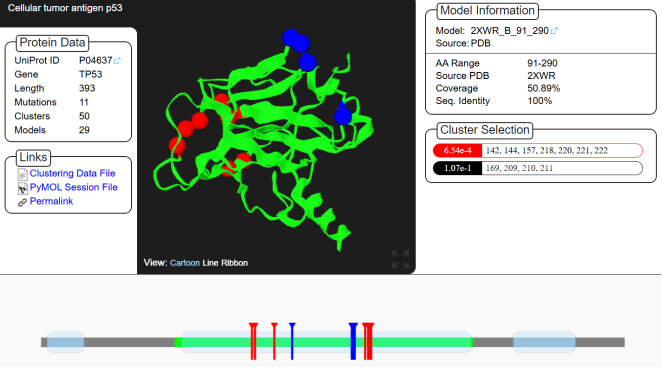
Not all mutations resulted in significant changes in the structural and functional properties of the mutated p53 protein, with the exception of two variants (P142A and Y220C). These variants, which are potential SNPs, significantly (p-value < 0.05) contributed to the pathogenesis of prostate tumors by altering various aspects of the protein (altered transmembrane proteins (P142A and Y220C)), the gain of a disulfide bond at C141 specifically for the P142A mutation, and the loss of a strand and sulfation at Y220 specifically for variant C (Table 7). Visualization of non-synonymous mutations was also evaluated using Mutation3D, revealing the presence of deleterious substitutions in the p53 protein. Of the 11 detected mutations, seven (P142A; Q144R; V157I; V218M; Y220C; E221N; and P222R) were considered high-risk mutations for the p53 protein. All of these mutations are located in malignant prostate tumors, with the exception of two (Y220C and E221N) (Figure 1).
Figure 1. 3D structure of the p53 protein, generated by the mutation 3D server, and representation of the selected mutations on the protein domains (http://mutation3d.org/).
Table 7. Prediction of the pathogenicity of non-synonymous mutations in the p53 protein as predicted by MutPred2.

Variants

MutPre2 score

Molecular mechanisms

P-value

P142A

0.607

Altered transmembrane protein

0.03

Gain of disulphide bond at C141

0.05

Q144R

0.413

-

-

V157I

0.162

-

-

M169T

0.288

-

-

R209K

0.067

-

-

N210S

0.065

-

-

T211A

0.446

-

-

V218M

0.462

-

-

Y220C

0.638

Strand loss

0.01

Altered transmembrane protein

0.02

Loss of sulphation at Y220

0.05

E221N

0.353

-

-

P222R

0.207

-

-

3.7. Evolutionary Molecular Analyses
3.7.1. Genetic Diversity
The sequences obtained from the two prostate tumors have the same number of sites (350 bp). Among these sequences, 5 polymorphic sites (1.42%) 4 of which are non-informative and 1 is a parsimony polymorphism and 345 monomorphic sites were found in the HBP, with a mutation rate (R) of 0.519. As for PCa, 12 sites are polymorphic, representing 3.43% (8 non-informative polymorphisms and 4 parsimony polymorphisms), and 338 monomorphic sites (96.57%) with a mutation rate (R) of 1.29. The total number of mutations (Eta) and the average number of nucleotide differences (k) in TBs are lower (Eta = 5 and k = 0.733) than those found in TMs (Eta = 12 and k = 2.382). Similarly, the transition rate is lower, whereas the transversion rate is higher in TBs than in MTs. The same trend is observed regarding the low number of haplotypes in TBs (4 haplotypes) compared to MTs (11 haplotypes). Genetic diversity is also assessed by examining genetic diversity indices. High haplotype diversity and low nucleotide diversity were observed in malignant tumors (Hd = 0.882 and Pi = 0.00681) compared to benign tumors, which had low values for both genetic diversity indices (Hd = 0.350 and Pi = 0.00210) (Table 8).
Table 8. Genetic variability of the TP53 gene between prostate tumors.

Benign prostate tumours

Malignant prostate tumours

Genetic variability parameters

Variables

Number

Percentage

Number

Percentage

Number of individuals

17

51.51%

16

48.48%

Number of sites

350

350

Monomorphic sites

345

98.57

338

96.57

Polymorphic sites

5

1.42%

12

3.43

Non-informative variable sites

4

1.14%

8

2.29

Variable sites in parsimony

1

0.29

4

1.14

Total number of mutations (Eta)

5

12

Average number of nucleotide differences (k)

0.733

2.382

Percentage of transition

35.7

58.14

Percentage of Transversion

64.32

41.86

Mutation rate (R)

0.519

1.298

Number of haplotypes

4

11

Genetic diversity indices

Hd (Variance)

0.350 ± 0.2183

0.882 ± 0.00516

Pi (variance)

0.00210 ± 0.0000011

0.00681 ± 0.0000012

3.7.2. Frequency Distribution of Amino Acids in Prostate Tumors
Converting nucleotide sequences into amino acid sequences using the second reading frame revealed a difference in amino acid frequencies between the two tumors. Certain amino acids, such as proline, threonine, methionine, asparagine, and lysine, decreased, whereas the levels of other amino acids increased in the cancerous tissues. A comparison of the means between the two tumors showed statistical significance for all amino acids except asparagine (Table 9).
Table 9. Amino acid levels in benign and malignant tumors.

Amino acids

BT

MT

P-Value

Ala

11.494

11.596

8.092e-05***

Cys

4.454

4.570

6.284e-05***

Asp

1.149

1.160

1.066e-05***

Glu

3.448

3.479

1.066e-05***

Phe

1.149

1.228

3.452e-06***

Gly

2.443

2.456

0.001813

His

2.299

2.387

1.278e-05***

Ile

6.897

7.026

1.278e-05***

Lys

1.221

1.160

1.278e-05***

Leu

9.195

9.277

1.066e-05***

Met

4.598

4.570

0.000225***

Asn

1.078

0.477

0.09862

Pro

12.716

12.688

0.0009343***

Gln

1.1494

1.160

1.066e-05***

Arg

5.603

5.798

1.119e-05***

Ser

12.643

13.302

0.0003191***

Thr

5.819

5.799

0.0002292***

Val

3.448

3.479

1.066e-05***

Trp

9.195

8.390

1.066e-05***

Tyr

0

0

-

Significance codes: p<0.001 ‘***’ p≈0.001 ‘**’ p≈0.01 ‘*’, BT = benign tumor; MT = malignant tumor
3.7.3. Genetic Structure Among Prostate Tumors
The estimated genetic distance among prostate tumors is low, with a small standard deviation (D = 0.00391 ± 0.00265). This trend is observed in malignant tumors, where a low genetic distance was also noted (D = 0.01 ± 0.000). However, within benign tumors, there is no genetic distance (D = 0.00 ± 0.000). The genetic differentiation coefficient (Fst) was also estimated and was statistically significant. The AMOVA test showed high genetic differentiation within each tumor type compared to between tumor types (Table 10).
Table 10. Intra- and inter-population genetic structure.

Type of tissue

Intra-population distance ± standard deviation

Inter-population distance ± standard deviation

Fst (P-Value)

AMOVA test

TB

TM

TB

TM

intra-population

inter-population

TB

0.00 ± 0.00

0.00391 ± 0.00265

0.37792 (0.00±0.000)

62.21

37.79

TM

0.01 ± 0.00

BT = benign tumor; MT = malignant tumor
4. Discussion
The objective of this study was to evaluate the impact of genetic polymorphism in the TP53 gene in prostate tumors in Senegal by providing insights into the mutational link between the two tumor types. Thus, out of 33 prostate tissue samples 16 from BPH and 17 from PCa no mutations were detected in 12 of the 16 BPH samples. Only 4 samples had mutations, representing 25%. These findings do not align with those of Zole et al. (2024), who reported no mutations in exons 5 and 6 of the TP53 gene in their study on TP53 alterations in BPH patients . In fact, they emphasized that there are no mutations in this gene likely to be associated with this tumor. In contrast, regarding PCa, 14 patients had mutations, representing 82.35%. These data corroborate those of Schlechte et al. (1998), who demonstrated that there are more mutations in PCa than in BPH . These results indicate that TP53 mutations are more common in malignant tumors, but certain alterations could also be detected in advanced cases of BPH, suggesting a possible role in the progression of the disease from an early stage to more severe forms.
The distribution of mutations in this region of TP53 was also assessed by histological type, with a frequency of 6.25% in benign tumors and 64.70% in malignant tumors for exon 5_intron 5. For exon 6_intron 6, the rate is 62.5% in benign tumors and 58.82% in malignant tumors. This indicates that mutations in the exon 5_intron 5 region are more frequent in malignant tumors than in benign tumors, whereas mutations in the exon 6_intron 6 region are more common in benign tumors than in malignant tumors. This trend has also been reported in German studies, which found a mutation distribution rate of 16.1% in exon 5 and 35.5% in exon 6 of the HBP, and a mutation distribution of 46.4% in exon 5 and 32.1% in exon 6 in PCa . In addition, Zhou’s findings corroborate those of Schlechte and colleagues regarding mutation distribution rates; however, Zhou and his team limited their study to exon 6 in localized PCa . It can therefore be assumed that in benign tumors, mutations in exon 6 are predominant, whereas those in exon 5 are predominant in malignant tumors.
The nature of the mutations in this region of TP53 was also evaluated. A total of 32 mutations were detected, of which 7 (21.88%) and 25 (84.38%) were listed in one of the three databases: dbSNP, COSMIC, and ClinVar. These results are lower than those reported by Aboulalaa et al. (2024) in a study of 48 Moroccan patients with prostate cancer who had a mutation in exon 5 . They reported a total of 137 mutations, 115 of which were novel, although the study was limited to malignant tumors . Among the mutations identified in this study, the majority are non-synonymous, representing the predominant type of p53 mutation. Indeed, 37.5% of the detected mutations are non-synonymous, with 15.63% located in exon 5 and 21.88% in exon 6 in prostate tumors. These results support the findings of Wang et al. (2024), who reported that the most frequent mutations in the TP53 gene are missense mutations (62%) . The same trend was noted in the study by Petitjean and colleagues, which showed that the majority (75%) of TP53 mutations are non-synonymous substitutions exhibiting great variability in their type and position .
Next are nonsense mutations, which account for 12.5% of the total, with 25% occurring in exon 5 and 75% in exon 6; non-stop mutations account for 9.38%, with 33.33% occurring in exon 5 and 66.67% in exon 6. According to recent studies, these mutations produce non-functional proteins and are associated with less favorable clinical outcomes. Indeed, one study showed that these types of mutations lead to the loss of C-terminal regulation and metamerization domains in patients with squamous cell carcinoma of the tongue .
In prostate tumors, overall, studies have reported that TP53 nonsense mutations are independent negative prognostic markers in metastatic cancer and are associated with a poorer prognosis than other TP53 mutations . Similarly, these mutations are associated with higher rates of AR (androgen receptor) amplification than other TP53 gene mutations .
The actual effects of predicting these non-synonymous variants on the pathogenicity of prostate tumors have yet to be explored. Studies have shown that these mutations are, in most cases, highly deleterious, unlike silent mutations, which are generally less deleterious. This is the same observation noted in our results: most of them are pathogenic and give rise to malignant tumors. These mutations originating in the DNA-binding domain of TP53 which enables contact with target DNA sequences to transactivate downstream genes could affect the protein’s conformational changes, subsequently altering TP53’s contact with its target sequences and thereby impairing transcriptional function . This is consistent with studies demonstrating that most non-synonymous mutations in the central DNA-binding domain of this gene lead to a loss of protein transactivation activity . Some of the pathogenic variants identified in this study, such as T211A, could impact the post-translational role of TP53, potentially affecting the stability and function of p53, which in turn influences its tumor-suppressor role . Others, such as V218M, which is present in all non-synonymous mutations in prostate cancer, have been reported as amino acid residues harboring hotspot mutations in studies highlighting the relative mutational complexity involved in understanding cancer development .
To better understand the mutational link between these two prostate conditions, an assessment of shared mutations was also conducted. No mutations were found to be shared between the two tumors. The absence of shared mutations could be explained by several factors, including the fact that the two conditions do not originate in the same areas of the prostate (Prostate Cancer primarily in the peripheral zone and BPH in the transition zone) . Our results are consistent with the generally accepted view that, unlike prostate cancer which is characterized by somatic mutations and genomic instability BPH rarely exhibits these abnormalities. Despite the absence of these shared mutations between the two tumor types, shared mutations within each tumor type were identified. Indeed, in 37% of the detected benign tumors, a single synonymous mutation (c.408A>G p.136 Q>Q) is shared by two patients. As for malignant tumors, which account for 62.5% of the detected mutations, 55% are shared among patients. This demonstrates a difference in mutational linkage within tumors, where there are more shared mutations among patients with prostate cancer than among patients with benign prostatic hyperplasia. These findings may support the notion that TP53 mutations contribute to disease progression and aggressiveness, and may even be associated with a poor prognosis in patients with these mutations .
Protein stability is a key determinant of biological functions and activities. In this study, we found that all non-synonymous mutations resulted in reduced stability of the p53 protein, though to varying degrees. The lowest energy was observed for the valine-to-methionine mutation at codon 218, indicating a greater impact on protein structure compared to other mutations. Interestingly, this variant was present in all non-synonymous mutations detected in PCa; this could suggest its involvement in the aggressiveness of prostate carcinogenesis. Furthermore, the P142A and Y220C variants proved to be highly destabilizing and were associated with alterations in the molecular mechanisms of p53. This destabilization predicted structural and functional effects of the mutated p53 protein based on its physicochemical properties. These mutations are thought to have significantly promoted prostate pathogenesis by altering various aspects of the p53 protein. The P142A variant is thought to have altered the transmembrane protein and to have resulted in the formation of a disulfide bond at the cysteine amino acid at codon 141. As for the Y220C variant, the molecular changes involved include a loss of a strand, an alteration of the transmembrane protein, and a loss of sulfation at the tyrosine amino acid at codon 220. The functional impact is significant, as it has been reported that these gain-of-function (GOF) and loss-of-function (LOF) mutations are critical for the survival and growth of cancer cells .
To further investigate this mutation prediction, the impact of these mutations on molecular interactions and on the structural and conformational disruption of the protein was visualized and analyzed. Seven of the 11 mutations are considered high-risk mutations for the p53 protein (P142A, Q144R, V157I, V218M, Y220C, and P222R). The DNA-binding domain is a functionally active site within the p53 protein structure. Mutations at this site can therefore have an incalculable impact on its activity . Consequently, the proteins resulting from these 7 mutations could be harmful at a supra-optimal level in the human genome.
Genetic variability was also assessed and revealed a very high proportion of conserved sites, indicating low polymorphism characterized by a low rate of polymorphic sites in both benign tumors (1.42%) and malignant tumors (3.43%). Although there is no high level of polymorphism, we found that, in malignant tumors, polymorphism is slightly higher than in benign tumors. These results indicate a process of genetic mutation accumulation occurring from tumorigenesis to carcinogenesis. During this process, further genetic diversification and evolution occur, caused in part by rates of incorrect DNA replication . A high rate of transversions is observed in benign tumors. It is nearly twice as frequent as transitions in Senegalese patients with BPH. Conversely, in PCa, the percentage of transitions is higher, with a rate of 58.14% compared to 41.86% for transversions. These results confirm the findings of Alexandrov et al. (2020), demonstrating that each tumor type exhibits a unique combination of these mutational signatures, hence the polymorphism observed in this gene in both tumor types .
Genetic diversity is assessed by evaluating the Hd and Pi indices. These indices were found to be low in benign tumors. They are characterized by a low mutation rate accompanied by a similarly low number of haplotypes. This may be due to the fact that the tumor cells were in a permissive environment where natural selection was weak. In contrast, in malignant tumors, high haplotype diversity and high nucleotide diversity were found. These results indicate that there has been a rapid accumulation of TP53 mutations, suggesting rapid cell proliferation in Senegalese patients with prostate cancer. This represents an expanding population, resulting in prostate adenocarcinomas that can progress to an advanced stage if not treated in a timely manner. These alterations act as a catalyst for neoplastic progression, which subsequently leads to the development of metastases .
Amino acid distribution was also evaluated to determine whether it was associated with this detected low-frequency polymorphism. The results showed a significant difference in distribution for all amino acids except asparagine. Certain amino acids, such as proline (Pro), threonine (Thr), methionine (Met), tryptophan (Trp), and lysine (Lys), were significantly elevated in benign tumors, whereas in PCa, they were significantly reduced. Conversely, the remaining amino acids were significantly elevated in cancerous tissues and significantly reduced in PCa. Interestingly, among the amino acids that decreased in PCa, all are essential amino acids with the exception of proline. This supports the idea that malignant tumors appear to be metabolic consumers that absorb the body’s essential resources and strain its internal production capabilities to such an extent that there is a drop in the levels of certain non-essential amino acids, as is the case with proline. Indeed, Hussain et al. (2023) have, for example, shown that the most significant enrichment pathways in the analysis of metabolic pathways were the metabolism of tryptophan, arginine, and proline . According to them, the study demonstrates that frequent changes in the metabolites mentioned above suggest their role in the pathogenesis of cancer patients. Other authors have reported that levels of certain amino acids, such as tryptophan, increased during treatment, indicating that the amino acid profile could serve as a prognostic biomarker .
The genetic structure has also been identified, and a low genetic distance has been observed within malignant tumors. However, there is no genetic distance within benign tumors, indicating a similar population. This appears to be consistent with the fact that benign tumors are more stable than malignant tumors, characterized by less frequent mutations. These tumors are more homogeneous at the cellular level, with low or even zero genetic distance within tumor cells . At the population level, a low genetic distance was noted between the two tumors. This low distance could be due to other factors, such as epigenetic mechanisms (DNA methylation), among others. The high Fst value (Fst = 0.37792) further supports the distinction between these two tumors. Although these tumors share the same organ (the prostate) and androgen dependence, the absence of common mutations observed between them also confirms this distinction. These observations are supported by a high AMOVA test (37.79), which is consistent with findings in the literature that have thus far sought to distinguish these two diseases at different levels (tissue, molecular, and epigenetic) despite their anatomical coexistence .
5. Conclusion
Overall, the study allowed us to understand the mutational profile and genetic characterization of the TP53 gene in prostate tumors among Senegalese men with prostate cancer. In fact, no mutational link was found between these two prostate tumors. TP53 mutations represent a key biomarker for the progression of prostate tumors. Despite their low mutational expression which may be due to the sample size mutations in this gene may be a risk factor for prostate tumor progression. PCa mutations were found to be more involved in the pathology than those of BPH. Furthermore, the fact that a specific mutation (c.506T>C p.169Met>Thr) is present in 100% of patients with PCa corroborates this involvement in the aggressiveness of malignant prostate tumors. Therefore, further monitoring and large-scale studies should be conducted to assess the potential role of these TP53 genetic alterations, specifically in the progression to prostate cancer. Since this topic has rarely been explored in Africa particularly in Senegal at the molecular level, even as prostate disease affects Senegalese men, expanding this study would be an asset for future research, particularly regarding the fundamental activities of the p53 mutant as therapeutic targets tailored to the Senegalese population.
Abbreviations

DNA

Deoxyribonucleic Acid

dbSNP

Single Nucleotide Polymorphism Database

dNTP

Deoxyribonucleotide Triphosphate

COSMIC

Catalogue of Somatic Mutations in Cancer

Fst

Fixation Index

BPH

Benign Prostatic Hyperplasia

NCBI

National Center for Biotechnology Information

p53

Protein 53

PCa

Prostate Cancer

PCR

Polymerase Chain Reaction

PDB

Protein Data Bank

PSA

Prostate-Specific Antigen

PSIC

Position-Specific Independent Counts

SIFT

Sorting Intolerant from Tolerant

SNP

Single Nucleotide Polymorphism

TP53

Tumor Protein p53

Author Contributions
Fahimat Ahamada: Data curation, Formal Analysis, Funding acquisition, Visualization, Conceptualization, Investigation, Methodology, Software, Writing – original draft
Anna Ndong: Investigation, Writing – review & editing
Mame Diarra Samb: Software, Writing – review & editing
Fatimata Mbaye: Conceptualization, Methodology, Writing – review & editing, Validation
Mbacke Sembene: Project administration, Resources, Supervision, Validation, Conceptualization, Methodology, Funding acquisition, Writing – review & editing
Conflicts of Interest
The authors declare that they have no conflicts of interest.
References
[1] Egan, K. B. (2016). The Epidemiology of Benign Prostatic Hyperplasia Associated with Lower Urinary Tract Symptoms : Prevalence and Incident Rates. Urologic Clinics of North America, 43(3), 289-297.
[2] Gupta, S., Gupta, G., & L. Sharma, V. (2017). Evolving Novel Chemical Entities for Management of Benign Prostatic Hyperplasia#. Mini-Reviews in Medicinal Chemistry, 17(7), 593-602.
[3] National Agency for Statistics and Demography (ANSD). Report on Population Projections for Senegal, 2023–2073. Accessed April 13, 2026, at
[4] Bray, F., Laversanne, M., Sung, H., Ferlay, J., Siegel, R. L., Soerjomataram, I., & Jemal, A. (2024). Global cancer statistics 2022 : GLOBOCAN estimates of incidence and mortality worldwide for 36 cancers in 185 countries. CA: A Cancer Journal for Clinicians, 74(3), 229-263.
[5] Milliron, B.-J., Bruneau, M., Obeid, E., Gross, L., Bealin, L., Smaltz, C., & Giri, V. N. (2019). Diet assessment among men undergoing genetic counseling and genetic testing for inherited prostate cancer : Exploring a teachable moment to support diet intervention. The Prostate, 79(7), 778-783.
[6] Baker, S. J., & Vogelstein, B. (2019). p53 : A tumor suppressor hiding in plain sight. Journal of Molecular Cell Biology, 11(7), 536-538.
[7] Olivier, M., Hollstein, M., & Hainaut, P. (2010). TP53 Mutations in Human Cancers : Origins, Consequences, and Clinical Use. Cold Spring Harbor Perspectives in Biology, 2(1), a001008.
[8] Rozas, J., Ferrer-Mata, A., Sánchez-DelBarrio, J. C., Guirao-Rico, S., Librado, P., Ramos-Onsins, S. E., & Sánchez-Gracia, A. (2017). DnaSP 6 : DNA Sequence Polymorphism Analysis of Large Data Sets. Molecular Biology and Evolution, 34(12), 3299-3302.
[9] Tamura, K., Stecher, G., & Kumar, S. (2021). MEGA11 : Molecular Evolutionary Genetics Analysis Version 11. Molecular Biology and Evolution, 38(7), 3022-3027.
[10] Excoffier, L., Laval, G., & Schneider, S. (2007). Arlequin (version 3.0) : An integrated software package for population genetics data analysis. Evolutionary Bioinformatics Online, 1, 47-50.
[11] Zole, E., Baumanis, E., Freimane, L., Dāle, R., Leiše, A., Lietuvietis, V., & Ranka, R. (2024). Changes in TP53 Gene, Telomere Length, and Mitochondrial DNA in Benign Prostatic Hyperplasia Patients. Biomedicines, 12(10), Article 10.
[12] Schlechte, H., Lenk, S. V., Löning, T., Schnorr, D., Rudolph, B. D., Ditscherlein, G., & Loening, S. A. (1998). P53 tumour suppressor gene mutations in benign prostatic hyperplasia and prostate cancer. European Urology, 34(5), 433-440.
[13] Zhou, J., Lai, Y., Peng, S., Tang, C., Chen, Y., Li, L., Huang, H., & Guo, Z. (2022). Comprehensive analysis of TP53 and SPOP mutations and their impact on survival in metastatic prostate cancer. Frontiers in Oncology, 12, 957404.
[14] Aboulalaa, K., Laraqui, A., Tagajdid, R., Ennibi, K., & Ennaji, M. M. (2024). Germline mutations of TP53 gene can be a key factor in prostate cancer genesis. Exploration of Medicine, 641-655.
[15] Wang, Z., Burigotto, M., Ghetti, S., Vaillant, F., Tan, T., Capaldo, B. D., Palmieri, M., Hirokawa, Y., Tai, L., Simpson, D. S., Chang, C., Huang, A. S., Lieschke, E., Diepstraten, S. T., Kaloni, D., Riffkin, C., Huang, D. C. S., Li Wai Suen, C. S. N., Garnham, A. L., … Strasser, A. (2024). Loss-of-Function but Not Gain-of-Function Properties of Mutant TP53 Are Critical for the Proliferation, Survival, and Metastasis of a Broad Range of Cancer Cells. Cancer Discovery, 14(2), 362-379.
[16] Petitjean, A., Mathe, E., Kato, S., Ishioka, C., Tavtigian, S. V., Hainaut, P., & Olivier, M. (2007). Impact of mutant p53 functional properties on TP53 mutation patterns and tumor phenotype : Lessons from recent developments in the IARC TP53 database. Human Mutation, 28(6), 622-629.
[17] Du, X., Zheng, J., Lu, X., & Zhang, Y. (2025). A Truncated Mutation of TP53 Promotes Chemoresistance in Tongue Squamous Cell Carcinoma. International Journal of Molecular Sciences, 26(5), 2353.
[18] Cho, Y., Gorina, S., Jeffrey, P. D., & Pavletich, N. P. (1994). Crystal structure of a p53 tumor suppressor-DNA complex : Understanding tumorigenic mutations. Science (New York, N. Y.), 265(5170), 346-355.
[19] Kato, S., Han, S.-Y., Liu, W., Otsuka, K., Shibata, H., Kanamaru, R., & Ishioka, C. (2003). Understanding the function–structure and function–mutation relationships of p53 tumor suppressor protein by high-resolution missense mutation analysis. Proceedings of the National Academy of Sciences of the United States of America, 100(14), 8424-8429.
[20] Gully, C. P., Velazquez-Torres, G., Shin, J.-H., Fuentes-Mattei, E., Wang, E., Carlock, C., Chen, J., Rothenberg, D., Adams, H. P., Choi, H. H., Guma, S., Phan, L., Chou, P.-C., Su, C.-H., Zhang, F., Chen, J.-S., Yang, T.-Y., Yeung, S.-C. J., & Lee, M.-H. (2012). Aurora B kinase phosphorylates and instigates degradation of p53. Proceedings of the National Academy of Sciences, 109(24).
[21] Shan, L., Yu, J., He, Z., Chen, S., Liu, M., Ding, H., Xu, L., Zhao, J., Yang, A., & Jiang, H. (2020). Defining relative mutational difficulty to understand cancer formation. Cell Discovery, 6(1), 48.
[22] McNeal, J. E., Redwine, E. A., Freiha, F. S., & Stamey, T. A. (1988). Zonal Distribution of Prostatic Adenocarcinoma: Correlation with Histologic Pattern and Direction of Spread. The American Journal of Surgical Pathology, 12(12), 897.
[23] Berner, A., Geitvik, G., Karlsen, F., Fosså, S. D., Nesland, J. M., & BØRresen, A.-L. (1995). TP53 mutations in prostatic cancer. Analysis of pre- and post-treatment archival formalin-fixed tumour tissue. The Journal of Pathology, 176(3), 299-308.
[24] Yang, F., Petsalaki, E., Rolland, T., Hill, D. E., Vidal, M., & Roth, F. P. (2015). Protein domain-level landscape of cancer-type-specific somatic mutations. PLoS Computational Biology, 11(3), e1004147.
[25] Nachman, M. W., & Crowell, S. L. (2000). Estimate of the mutation rate per nucleotide in humans. Genetics, 156(1), 297-304.
[26] Alexandrov, L. B., Kim, J., Haradhvala, N. J., Huang, M. N., Tian Ng, A. W., Wu, Y., Boot, A., Covington, K. R., Gordenin, D. A., Bergstrom, E. N., Islam, S. M. A., Lopez-Bigas, N., Klimczak, L. J., McPherson, J. R., Morganella, S., Sabarinathan, R., Wheeler, D. A., Mustonen, V., Getz, G., … Stratton, M. R. (2020). The repertoire of mutational signatures in human cancer. Nature, 578(7793), 94-101.
[27] McGranahan, N., Favero, F., de Bruin, E. C., Birkbak, N. J., Szallasi, Z., & Swanton, C. (2015). Clonal status of actionable driver events and the timing of mutational processes in cancer evolution. Science translational medicine, 7(283), 283ra54.
[28] Turajlic, S., & Swanton, C. (2016). Metastasis as an evolutionary process. Science, 352(6282), 169-175.
[29] Ben-David, U., & Amon, A. (2020). Context is everything : Aneuploidy in cancer. Nature Reviews. Genetics, 21(1), 44-62.
[30] Hussain, A., Xie, L., Deng, G., & Kang, X. (2023). Common alterations in plasma free amino acid profiles and gut microbiota-derived tryptophan metabolites of five types of cancer patients. Amino Acids, 55(9), 1189-1200.
[31] ynakiewicz, A., Stanislawska-Sachadyn, A., Sawicka-Zukowska, M., Galezowska, G., Ratajczyk, J., Owczarzak, A., Skuza, M., Wolska, L., & Stachowicz-Stencel, T. (2021). Plasma free amino acid profiling as metabolomic diagnostic and prognostic biomarker in paediatric cancer patients : A follow-up study. Amino Acids, 53(1), 133-138.
[32] Marusyk, A., Almendro, V., & Polyak, K. (2012). Intra-tumour heterogeneity : A looking glass for cancer ? Nature Reviews Cancer, 12(5), 323-334.
[33] Ørsted, D. D., & Bojesen, S. E. (2013). The link between benign prostatic hyperplasia and prostate cancer. Nature Reviews Urology, 10(1), 49-54.
[34] Kim, S. S., Lee, S. C., Lim, B., Shin, S.-H., Kim, M. Y., Kim, S.-Y., Lim, H., Charton, C., Shin, D., Moon, H. W., Kim, J., Park, D., Park, W.-Y., & Lee, J. Y. (2023). DNA methylation biomarkers distinguishing early-stage prostate cancer from benign prostatic hyperplasia. Prostate International, 11(2), 113-121.
Cite This Article
  • APA Style

    Ahamada, F., Ndong, A., Samb, M. D., Mbaye, F., Sembene, M. (2026). Frequency and Characterization of TP53 Tumor Suppressor Gene Mutations in the Development and Progression of Prostate Tumors in Senegal. International Journal of Genetics and Genomics, 14(2), 60-75. https://doi.org/10.11648/j.ijgg.20261402.13

    Copy | Download

    ACS Style

    Ahamada, F.; Ndong, A.; Samb, M. D.; Mbaye, F.; Sembene, M. Frequency and Characterization of TP53 Tumor Suppressor Gene Mutations in the Development and Progression of Prostate Tumors in Senegal. Int. J. Genet. Genomics 2026, 14(2), 60-75. doi: 10.11648/j.ijgg.20261402.13

    Copy | Download

    AMA Style

    Ahamada F, Ndong A, Samb MD, Mbaye F, Sembene M. Frequency and Characterization of TP53 Tumor Suppressor Gene Mutations in the Development and Progression of Prostate Tumors in Senegal. Int J Genet Genomics. 2026;14(2):60-75. doi: 10.11648/j.ijgg.20261402.13

    Copy | Download

  • @article{10.11648/j.ijgg.20261402.13,
      author = {Fahimat Ahamada and Anna Ndong and Mame Diarra Samb and Fatimata Mbaye and Mbacke Sembene},
      title = {Frequency and Characterization of TP53 Tumor Suppressor Gene Mutations in the Development and Progression of Prostate Tumors in Senegal},
      journal = {International Journal of Genetics and Genomics},
      volume = {14},
      number = {2},
      pages = {60-75},
      doi = {10.11648/j.ijgg.20261402.13},
      url = {https://doi.org/10.11648/j.ijgg.20261402.13},
      eprint = {https://article.sciencepublishinggroup.com/pdf/10.11648.j.ijgg.20261402.13},
      abstract = {Prostate tumors are more common worldwide, with 60% of men over the age of 50 affected by benign prostatic hyperplasia (BPH) and 1.5 million new cases and 397,000 deaths from prostate cancer (PCa), which ranks as the second most common cancer globally. Although age is the most significant factor, other factors are associated with their development, and genetic factors appear to play a major role. This study aimed to evaluate the involvement of TP53 gene mutations in cases of prostate tumors among Senegalese men while contributing to the understanding of the mutational link between the two tumors. sixteen BPH tissue samples and seventeen PCa tissue samples were collected via biopsy from Senegalese patients following informed consent. DNA extraction followed by PCR amplification and sequencing were performed. Mutation Surveyor was used to identify mutations. Mutation Taster, Polyphen-2, SIFT, and SNP & GO were used to assess pathogenicity predictions. I-Mutant2, MuPro, and Dynamut2 were used to predict the stability, flexibility, and dynamics of the mutated p53 protein. MutPred2 and Mutation3D were used to predict physicochemical properties and map risk mutations. Variability, diversity, and genetic structure were determined using MEGA, BioEdit, DnaSP, and Arlequin. A total of 32 TP53 mutations were identified in the two tumors. These mutations were predominant in prostate cancer. No mutations shared between the two tumor types were found; however, shared mutations within each tumor type were observed, particularly one mutation (c.652G>A p.218Val>Met) present in all prostate cancer patients. Most non-synonymous mutations are predicted to be pathogenic and destabilizing for the mutated p53 protein in both tumors. Low polymorphism and a short genetic distance were observed between the two prostate tumors. This study provided insight into the potential impact of TP53 gene mutations on prostate tumors. Despite their low frequency in the Senegalese population, which may be explained by the small sample size, they play a role in the development and aggressiveness of prostate tumors. Therefore, special attention is required in patients carrying these mutations, particularly for the c.652G>A p.218Val>Met mutation, as the latter could influence management.},
     year = {2026}
    }
    

    Copy | Download

  • TY  - JOUR
    T1  - Frequency and Characterization of TP53 Tumor Suppressor Gene Mutations in the Development and Progression of Prostate Tumors in Senegal
    AU  - Fahimat Ahamada
    AU  - Anna Ndong
    AU  - Mame Diarra Samb
    AU  - Fatimata Mbaye
    AU  - Mbacke Sembene
    Y1  - 2026/05/12
    PY  - 2026
    N1  - https://doi.org/10.11648/j.ijgg.20261402.13
    DO  - 10.11648/j.ijgg.20261402.13
    T2  - International Journal of Genetics and Genomics
    JF  - International Journal of Genetics and Genomics
    JO  - International Journal of Genetics and Genomics
    SP  - 60
    EP  - 75
    PB  - Science Publishing Group
    SN  - 2376-7359
    UR  - https://doi.org/10.11648/j.ijgg.20261402.13
    AB  - Prostate tumors are more common worldwide, with 60% of men over the age of 50 affected by benign prostatic hyperplasia (BPH) and 1.5 million new cases and 397,000 deaths from prostate cancer (PCa), which ranks as the second most common cancer globally. Although age is the most significant factor, other factors are associated with their development, and genetic factors appear to play a major role. This study aimed to evaluate the involvement of TP53 gene mutations in cases of prostate tumors among Senegalese men while contributing to the understanding of the mutational link between the two tumors. sixteen BPH tissue samples and seventeen PCa tissue samples were collected via biopsy from Senegalese patients following informed consent. DNA extraction followed by PCR amplification and sequencing were performed. Mutation Surveyor was used to identify mutations. Mutation Taster, Polyphen-2, SIFT, and SNP & GO were used to assess pathogenicity predictions. I-Mutant2, MuPro, and Dynamut2 were used to predict the stability, flexibility, and dynamics of the mutated p53 protein. MutPred2 and Mutation3D were used to predict physicochemical properties and map risk mutations. Variability, diversity, and genetic structure were determined using MEGA, BioEdit, DnaSP, and Arlequin. A total of 32 TP53 mutations were identified in the two tumors. These mutations were predominant in prostate cancer. No mutations shared between the two tumor types were found; however, shared mutations within each tumor type were observed, particularly one mutation (c.652G>A p.218Val>Met) present in all prostate cancer patients. Most non-synonymous mutations are predicted to be pathogenic and destabilizing for the mutated p53 protein in both tumors. Low polymorphism and a short genetic distance were observed between the two prostate tumors. This study provided insight into the potential impact of TP53 gene mutations on prostate tumors. Despite their low frequency in the Senegalese population, which may be explained by the small sample size, they play a role in the development and aggressiveness of prostate tumors. Therefore, special attention is required in patients carrying these mutations, particularly for the c.652G>A p.218Val>Met mutation, as the latter could influence management.
    VL  - 14
    IS  - 2
    ER  - 

    Copy | Download

Author Information
  • Abstract
  • Keywords
  • Document Sections

    1. 1. Introduction
    2. 2. Materials and Methods
    3. 3. Results
    4. 4. Discussion
    5. 5. Conclusion
    Show Full Outline
  • Abbreviations
  • Author Contributions
  • Conflicts of Interest
  • References
  • Cite This Article
  • Author Information