Abstract
This review provides a systematic and critical synthesis of the state of knowledge on uranium metallogeny in Ethiopia. Employing a structured methodology, we compiled and analyzed data from peer-reviewed journals, geological surveys, and technical reports to construct a coherent geological framework for uranium mineralization in the country. The review establishes that uranium mineralization in Ethiopia is primarily hosted within three principal geotectonic domains: Neoproterozoic basement rocks of the Arabian-Nubian Shield, Paleozoic-Mesozoic sedimentary sequences, and Cenozoic volcanic and sedimentary formations associated with the East African Rift System. From these domains, we identify and characterize key deposit types, including intrusive-related occurrences within granitic bodies, volcanic and sub-volcanic deposits, sandstone-hosted stratiform accumulations, and surficial calcrete-style deposits. Each type exhibits distinct lithological, structural, and geochemical controls that govern ore formation and distribution. The metallogenic evolution of these deposits is shown to be intricately linked to major tectonic cycles: the Pan-African orogeny, which generated primary enrichments; subsequent Phanerozoic basin development, which facilitated sedimentary-hosted mineralization; and Cenozoic rift-related magmatism and hydrothermal activity, which remobilized and reconcentrated uranium in younger settings. A critical analysis of the existing literature reveals significant knowledge gaps that currently hinder comprehensive resource assessment. These deficiencies include a lack of precise geochronological constraints on mineralization events, a poor understanding of the thermodynamic and geochemical controls on uranium mobility in different host rocks, and insufficient data on the mineralogical factors that will ultimately affect process amenability and extraction. This synthesis underscores the considerable, yet underexplored, uranium potential of Ethiopia. By consolidating disparate information, it provides a robust geological framework designed to guide future exploration strategies and mineral processing research. The review concludes by emphasizing the critical need for an integrated geology-metallurgy approach in future resource assessment to ensure that exploration is both scientifically guided and economically viable.
Keywords
Mineralization, Metallogenesis, Neoproterozoic Basement, Tectonic Control, Lithostratigraphy
1. Introduction
Uranium, as a cornerstone of nuclear energy and a strategic commodity, has seen renewed global interest in exploration and resource definition, driven by the pursuit of low-carbon energy sources
. Africa hosts several world-class uranium provinces, yet the potential within the Horn of Africa, particularly Ethiopia, remains systematically underexplored and poorly synthesized in international literature
| [2] | Beyth, M., Stern, R. J., Altherr, R., & Kröner, A. (1994). The Late Precambrian Timna Igneous Complex, Southern Israel: Evidence for Comagmatic-Type Sanukitoid Monzodiorite and Alkali Granite Magma. Lithos, 31(3-4), 103–124.
https://doi.org/10.1016/0024-4937(94)90004-3 |
[2]
. The geologic tapestry of Ethiopia, encompassing Archean to Recent formations, offers a unique natural laboratory to investigate uranium metallogeny across diverse tectonic regimes.
The country's geology is fundamentally bisected by the East African Rift System (EARS), a tectonically active continental rift that has profoundly influenced magmatic, hydrothermal, and sedimentary processes since the Oligocene
| [3] | Bonavia, F. F., Chorowicz, J. (1992). Northward expulsion of the Pan-African of Northeast Africa guided by a reentrant zone of the Tanzania Craton. Geology, 20(11), 1023–1026.
https://doi.org/10.1130/0091-7613 |
[3]
. Flanking the rift are extensive Precambrian basement terrains of the Arabian-Nubian Shield and the Mozambique Belt, which have undergone complex polyphase deformation and metamorphism
| [4] | Stern, R. J. (1994). Arc assembly and continental collision in the Neoproterozoic East African Orogen: implications for the consolidation of Gondwanaland. Annual Review of Earth and Planetary Sciences, 22, 319–351.
https://doi.org/10.1146/annurev.ea.22.050194.001535 |
[4]
. This juxtaposition of ancient crystalline rocks with youthful rift-related volcanics and sediments creates a multifaceted geological setting with high uranium fertility.
Previous investigations, primarily by the Ethiopian Geological Survey and various international collaborations, have identified numerous uranium occurrences, ranging from anomalous geochemical concentrations to nascent deposits
| [5] | Bosellini, A., Russo, A., Fantozzi, P. L., Assefa, G., & Solomon, T. (1997). The Mesozoic succession of the Mekele Outlier (Tigre Province, Ethiopia). Memorie di Scienze Geologiche, 49, 95–116. |
| [6] | Corti, G. (2009). Continental rift evolution: from rift initiation to incipient break-up in the Main Ethiopian Rift, East Africa. Earth-Science Reviews, 96(1-2), 1–53.
https://doi.org/10.1016/j.earscirev.2009.06.005 |
[5, 6]
. However, these studies have often been localized, episodic, and reported in dispersed sources, including government reports, conference proceedings, and regional journals, lacking a unified metallogenic synthesis. This fragmentation impedes the development of a coherent national exploration strategy and a robust understanding of resource potential.
Therefore, this review aims to systematically consolidate and critically evaluate all available geological and metallogenic data on uranium mineralization in Ethiopia. Its objectives are to: (1) define and characterize the principal uranium-bearing geologic provinces; (2) classify deposit types within a global context; (3) decipher the critical lithological, structural, and geochemical controls on mineralization; (4) reconstruct the metallogenic evolution within Ethiopia’s tectonic history; and (5) discuss implications for exploration targeting and future research. By integrating geological genesis with preliminary mineral processing considerations, this work seeks to provide an indispensable reference for academic researchers, exploration geologists, and resource policymakers.
2. Ethiopia’s Regional Geology and Setting
The geological architecture of Ethiopia is a product of three major tectonic regimes, each imprinting distinct characteristics on the country's uranium potential. The oldest and most fundamental component is the Neoproterozoic basement of the Arabian-Nubian Shield (ANS), which forms the Precambrian nucleus of the region
| [4] | Stern, R. J. (1994). Arc assembly and continental collision in the Neoproterozoic East African Orogen: implications for the consolidation of Gondwanaland. Annual Review of Earth and Planetary Sciences, 22, 319–351.
https://doi.org/10.1146/annurev.ea.22.050194.001535 |
[4]
. This basement comprises a complex assemblage of accreted island arcs, ophiolitic sutures, and granitoid intrusions, metamorphosed under greenschist to amphibolite facies conditions during the Pan-African orogeny (~870-550 Ma). This crystalline basement is unconformably overlain by a veneer of Paleozoic to Mesozoic sedimentary rocks, deposited in intracratonic basins during periods of relative tectonic quiescence
| [5] | Bosellini, A., Russo, A., Fantozzi, P. L., Assefa, G., & Solomon, T. (1997). The Mesozoic succession of the Mekele Outlier (Tigre Province, Ethiopia). Memorie di Scienze Geologiche, 49, 95–116. |
[5]
. These sequences, including the Enticho Sandstone and the Adigrat Sandstone, represent significant aquifers and host rocks for uranium mineralization.
The most profound and ongoing geological process is the Cenozoic rifling associated with the East African Rift System (EARS). Initiated in the Oligocene, rifting has been accompanied by massive flood basalt volcanism (the Ethiopian Traps, ~30 Ma), subsequent central volcano development, and the formation of the Main Ethiopian Rift (MER) and Afar Depression
. This tectono-magmatic event has created a wealth of potential uranium sources (U-rich silicic differentiates), transport mechanisms (hydrothermal and groundwater systems), and traps (faults, porous sediments, reductants). The intersection of these three geological domains Precambrian basement, Phanerozoic cover, and Cenozoic rift creates a uniquely favorable metallogenic environment where multiple uranium concentration mechanisms have operated over geological time.
3. Methodology of the Review
This review was conducted following a systematic methodology to ensure comprehensiveness, reproducibility, and academic rigor. The primary data sources were peer-reviewed international geoscience journals, national geological survey publications (primarily from the Geological Survey of Ethiopia), archived technical reports from exploration companies, and relevant academic theses and dissertations. Digital databases, including Scopus, Web of Science, and Google Scholar, were interrogated using a combination of keywords: uranium Ethiopia, East African Rift mineralization, Arabian-Nubian Shield uranium, sandstone-hosted uranium Ethiopia, and related terms.
Literature selection followed predefined criteria. Priority was given to: (1) publications containing original field, geochemical, geochronological, or mineralogical data on Ethiopian uranium occurrences; (2) regional geological studies providing context for mineralization; and (3) theoretical or comparative studies on deposit types relevant to the Ethiopian context. Grey literature was included but critically appraised for data quality and consistency with published science.
The analytical approach was both descriptive and critical. Data on deposit location, host rock, mineralogy, geochemistry, structural controls, and genetic models were extracted into a structured database. This information was then synthesized thematically to characterize deposit types and spatio-temporal distribution. The critical interpretation involved evaluating the strength of evidence for different genetic models, identifying contradictions between studies, and assessing the implications of geological characteristics for potential mineral processing pathways (e.g., uranium mineral species, grain size, gangue mineralogy, presence of penalty elements). The final synthesis constructs a metallogenic evolution model by integrating these themes within the established plate tectonic history of Northeast Africa.
4. Results and Discussion
4.1. Lithostratigraphic and Tectonic Framework of Uranium-Hosting Terrains in Ethiopia
Ethiopia’s Neoproterozoic basement provides primary magmatic uranium within peralkaline granites and tectonic shear zones of the Arabian-Nubian Shield. The overlying Mesozoic sandstones (Enticho and Adigrat) act as secondary reservoirs, concentrating uranium in sedimentary traps at redox boundaries. The Cenozoic volcanic-rift system drives modern mineralization through hydrothermal activity and the formation of surficial calcrete deposits in arid rift basins. Based on Ethiopia’s geological history, the table categorizes Lithostratigraphic and Tectonic Framework of Uranium-Hosting Terrains in Ethiopia
| [7] | Küster, D. (2009). Granitoid-hosted Ta mineralization in the Arabian-Nubian Shield: Ore deposit types, tectono-metallogenetic setting and petrogenetic framework. Ore Geology Reviews, 35(1), 68–86.
https://doi.org/10.1016/j.oregeorev.2008.09.006 |
| [9] | Getaneh, W. (1991). Lithostratigraphy and environment of deposition of the Late Paleozoic to Early Mesozoic sedimentary sequence of the Ogaden Basin, Ethiopia. Journal of African Earth Sciences, 13(3), 437–453. |
| [12] | Rango, G. G., Beccaluva, L., Bianchini, G., Tassinari, R., & Siena, F. (2013). Uranium enrichment in the Afar volcanic province, Ethiopia. Journal of African Earth Sciences, 77, 1–13. https://doi.org/10.1016/j.jafrearsci.2012.09.006 |
[7, 9, 12]
.
Table 1. Simplified Lithostratigraphic and Tectonic Framework of Uranium-Hosting Terrains in Ethiopia.
Tectono-Stratigraphic Province | Age | Dominant Lithology | Tectonic Setting | Primary Uranium Host/Association | References |
Arabian-Nubian Shield Basement | Neoproterozoic (870-550 Ma) | Metavolcanics, metasediments, syn- to post-tectonic granitoids (including peralkaline varieties) | Island arc accretion & continental collision; Post-orogenic extension | Intrusive-associated (alaskitic, peralkaline granites); Vein-type | | [4] | Stern, R. J. (1994). Arc assembly and continental collision in the Neoproterozoic East African Orogen: implications for the consolidation of Gondwanaland. Annual Review of Earth and Planetary Sciences, 22, 319–351.
https://doi.org/10.1146/annurev.ea.22.050194.001535 | | [7] | Küster, D. (2009). Granitoid-hosted Ta mineralization in the Arabian-Nubian Shield: Ore deposit types, tectono-metallogenetic setting and petrogenetic framework. Ore Geology Reviews, 35(1), 68–86.
https://doi.org/10.1016/j.oregeorev.2008.09.006 | | [8] | Emam, A., Zoheir, B., El-Wahed, M. A., & Ahmed, A. (2019). Granitoid-associated uranium mineralization in the Arabian-Nubian Shield: a review. Journal of African Earth Sciences, 151, 136–152. https://doi.org/10.1016/j.jafrearsci.2018.12.001 |
[4, 7, 8] |
Paleozoic-Mesozoic Sedimentary Basin | Ordovician - Cretaceous | Sandstones, conglomerates, minor shales & carbonates | Intracratonic sag basin & passive margin | Sandstone-hosted (tabular, roll-front) | | [5] | Bosellini, A., Russo, A., Fantozzi, P. L., Assefa, G., & Solomon, T. (1997). The Mesozoic succession of the Mekele Outlier (Tigre Province, Ethiopia). Memorie di Scienze Geologiche, 49, 95–116. | | [9] | Getaneh, W. (1991). Lithostratigraphy and environment of deposition of the Late Paleozoic to Early Mesozoic sedimentary sequence of the Ogaden Basin, Ethiopia. Journal of African Earth Sciences, 13(3), 437–453. | | [10] | Wolela, A. (2010). Sedimentology, Diagenesis and Reservoir Characteristics of the Paleozoic and Mesozoic Sandstones of the Ogaden Basin, Ethiopia. Journal of Petroleum Geology, 33(3), 201–220.
https://doi.org/10.1111/j.1747-5457.2010.00475.x |
[5, 9, 10] |
Cenozoic Ethiopian Plateau & Rift | Oligocene - Recent | Flood basalts, ignimbrites, rhyolites, rift sediments (sand, silt, diatomite) | Continental flood basalt province & active continental rift | Volcanic-associated (intra-caldera, fracture-controlled); Surficial (calcrete, playa); Hydrothermal | | [6] | Corti, G. (2009). Continental rift evolution: from rift initiation to incipient break-up in the Main Ethiopian Rift, East Africa. Earth-Science Reviews, 96(1-2), 1–53.
https://doi.org/10.1016/j.earscirev.2009.06.005 | | [11] | Gianelli, G., & Teklemariam, M. (1993). Water-rock interaction processes in the Aluto-Langano geothermal field (Ethiopia). Journal of Volcanology and Geothermal Research, 56(4), 429–445.
https://doi.org/10.1016/0377-0273(93)90011-U | | [12] | Rango, G. G., Beccaluva, L., Bianchini, G., Tassinari, R., & Siena, F. (2013). Uranium enrichment in the Afar volcanic province, Ethiopia. Journal of African Earth Sciences, 77, 1–13. https://doi.org/10.1016/j.jafrearsci.2012.09.006 |
[6, 11, 12] |
4.2. Uranium Deposit Types and Their Characteristics
The synthesis of available data reveals four principal uranium deposit types in Ethiopia, each with a distinct geological signature. These are summarized in
Table 2, which provides a comparative overview of their key attributes.
Table 2. Characteristics of Major Uranium Deposit Types in Ethiopia (with selected references).
Deposit Type | Typical Host Rocks | Principal Uranium Minerals | Key Geometrical & Grade Characteristics | Proposed Genetic Model | Examples in Ethiopia | References |
Intrusive-Associated | Peralkaline to alkaline granites (alaskite), syenites, pegmatites. | Primary: Uraninite, coffinite. Secondary: Autunite, torbernite. | Disseminations, veins, stockworks within and around intrusive bodies. Variable grade (0.03-0.1% U3O8). | Magnatic crystallization of U-rich differentiates followed by hydrothermal remobilization. | Bokan Mt. analogs (in ANS), Kenticha area prospects. | | [7] | Küster, D. (2009). Granitoid-hosted Ta mineralization in the Arabian-Nubian Shield: Ore deposit types, tectono-metallogenetic setting and petrogenetic framework. Ore Geology Reviews, 35(1), 68–86.
https://doi.org/10.1016/j.oregeorev.2008.09.006 | | [8] | Emam, A., Zoheir, B., El-Wahed, M. A., & Ahmed, A. (2019). Granitoid-associated uranium mineralization in the Arabian-Nubian Shield: a review. Journal of African Earth Sciences, 151, 136–152. https://doi.org/10.1016/j.jafrearsci.2018.12.001 | | [13] | Mohamed, H. A., El-Sayed, M. M., & Moghazi, A. K. M. (2015). Geochemistry and petrogenesis of Neoproterozoic peralkaline granites from the Gebel El Asr area, South Eastern Desert, Egypt. Journal of African Earth Sciences, 112, 413–429. https://doi.org/10.1016/j.jafrearsci.2015.10.004 |
[7, 8, 13] |
Sandstone-Hosted | Paleozoic-Mesozoic fluvial to marginal marine sandstones (e.g., Enticho, Adigrat Sandstones). | Coffinite, uraninite, with abundant secondary hexavalent U-minerals (carnotite, tyuyamunite). | Tabular and roll-front geometries. Grades typically 0.05-0.2% U3O8. | Low-temperature hydrothermal to groundwater roll-front processes, with redox control (pyrite, organic matter). | Calub, Daro, Elkere occurrences (Ogaden Basin). | | [5] | Bosellini, A., Russo, A., Fantozzi, P. L., Assefa, G., & Solomon, T. (1997). The Mesozoic succession of the Mekele Outlier (Tigre Province, Ethiopia). Memorie di Scienze Geologiche, 49, 95–116. | | [9] | Getaneh, W. (1991). Lithostratigraphy and environment of deposition of the Late Paleozoic to Early Mesozoic sedimentary sequence of the Ogaden Basin, Ethiopia. Journal of African Earth Sciences, 13(3), 437–453. | | [14] | Ayalew, T., & Yemane, T. (2016). Sandstone-hosted uranium mineralization in the Paleozoic Enticho Sandstone, northern Ethiopia. Journal of African Earth Sciences, 117, 303–315. https://doi.org/10.1016/j.jafrearsci.2016.02.005 |
[5, 9, 14] |
Volcanic & Hydrothermal | Cenozoic silicic volcanic rocks (rhyolite, ignimbrite), associated faults & fractures. | Uraninite, pitchblende, secondary autunite. | Veins, breccia fillings, disseminations in fractured zones & caldera settings. Can be high-grade (locally >0.5% U3O8). | Direct precipitation from late-stage magmatic-hydrothermal fluids or leaching of U-rich volcanics by meteoric fluids. | Afdera volcanic province, Aluto Volcanic Complex. | | [11] | Gianelli, G., & Teklemariam, M. (1993). Water-rock interaction processes in the Aluto-Langano geothermal field (Ethiopia). Journal of Volcanology and Geothermal Research, 56(4), 429–445.
https://doi.org/10.1016/0377-0273(93)90011-U | | [12] | Rango, G. G., Beccaluva, L., Bianchini, G., Tassinari, R., & Siena, F. (2013). Uranium enrichment in the Afar volcanic province, Ethiopia. Journal of African Earth Sciences, 77, 1–13. https://doi.org/10.1016/j.jafrearsci.2012.09.006 | | [15] | Teklemariam, M., Battaglia, S., Gianelli, G., & Ruggieri, G. (1996). Hydrothermal alteration in the Aluto-Langano geothermal field, Ethiopia. Geothermics, 25(6), 679–702.
https://doi.org/10.1016/S0375-6505(96)00023-X |
[11, 12, 15] |
Surficial (Calcrete) | Quaternary to Recent valley-fill sediments, calcrete/gyperete in playa settings. | Carnotite, autunite, other uranyl vanadates & phosphates. | Shallow, stratiform layers within evaporitic sequences. Low to moderate grade (0.01-0.08% U3O8), but potentially large tonnage. | Precipitation from oxidizing groundwater in arid environments, often controlled by water table fluctuations. | Melka Sede (Afar), Dulecha area. | | [16] | Arakel, A. V. (1988). Carnotite mineralization in inland drainage areas of Australia. Ore Geology Reviews, 3(1-3), 289–311. https://doi.org/10.1016/0169-1368(88)90022-1 | | [17] | Mumin, A. H., Corriveau, L., Somarin, A. K., & Ouellette, D. (2007). Calcrete uranium deposits in the Southern High Plains, USA. Ore Geology Reviews, 32(1-2), 136–168.
https://doi.org/10.1016/j.oregeorev.2006.11.002 |
[16, 17] |
4.3. Structural and Lithological Controls
Uranium mineralization in Ethiopia is governed by a hierarchy of controls operating from the regional scale to the deposit scale. At the regional scale, the first-order control is the spatial coincidence of uranium sources and transport pathways with suitable traps. The ANS granitoids and Cenozoic silicic volcanics provide the primary uranium sources. Major tectonic structures, particularly the rift-border faults, transfer zones within the MER, and reactivated basement shear zones, act as crustal-scale conduits for fluid migration over long distances and geological time
. These structures also create the subsiding basins that host permeable sedimentary aquifers (sandstone hosts) and closed hydrological systems for surficial concentration.
At the deposit scale, lithological control is paramount. For sandstone-hosted deposits, the presence of porous and permeable sandstone units interbedded with impermeable siltstone or shale (forming aquitards) is essential. Mineralization is invariably associated with reductants, most commonly disseminated pyrite, carbonaceous plant debris (in Mesozoic units), or hydrocarbons
| [9] | Getaneh, W. (1991). Lithostratigraphy and environment of deposition of the Late Paleozoic to Early Mesozoic sedimentary sequence of the Ogaden Basin, Ethiopia. Journal of African Earth Sciences, 13(3), 437–453. |
| [14] | Ayalew, T., & Yemane, T. (2016). Sandstone-hosted uranium mineralization in the Paleozoic Enticho Sandstone, northern Ethiopia. Journal of African Earth Sciences, 117, 303–315. https://doi.org/10.1016/j.jafrearsci.2016.02.005 |
[9, 14]
. In volcanic settings, mineralization is focused in highly fractured and brecciated zones, within porous ignimbrite units, or along contacts between different volcanic flows. Structural traps at this scale include fault intersections, fracture networks, and the margins of hydrothermal breccia bodies
| [11] | Gianelli, G., & Teklemariam, M. (1993). Water-rock interaction processes in the Aluto-Langano geothermal field (Ethiopia). Journal of Volcanology and Geothermal Research, 56(4), 429–445.
https://doi.org/10.1016/0377-0273(93)90011-U |
| [15] | Teklemariam, M., Battaglia, S., Gianelli, G., & Ruggieri, G. (1996). Hydrothermal alteration in the Aluto-Langano geothermal field, Ethiopia. Geothermics, 25(6), 679–702.
https://doi.org/10.1016/S0375-6505(96)00023-X |
[11, 15]
. For surficial deposits, the control shifts to the geomorphology of internal drainage basins and the geochemical interface between oxidizing vadose zone waters and reducing or evaporative conditions at the capillary fringe
.
4.4. Metallogenic Evolution: A Temporal Synthesis
The Conceptual Metallogenic Evolution Model detailing the multi-stage formation and enrichment of Uranium (U) deposits over geological time, spanning from the Early Proterozoic to the Phanerozoic. The process begins with the development of U-rich source rocks in a rift-passive margin environment approximately 2.0-1.8 billion years ago, followed by subsequent phases of continental arc formation and basin inversion that facilitate the creation of hydrothermal U veins. As the model progresses through post-collisional extension and sedimentation, it highlights the transition from primary mineralization to supergene enrichment. This final stage, occurring in the present Phanerozoic era, is characterized by weathering processes and the formation of calcrete and laterite-type deposits near the groundwater table, effectively concentrating minerals like Uraninite, Pitchblende, and Coffinite within the stratigraphic layers
| [8] | Emam, A., Zoheir, B., El-Wahed, M. A., & Ahmed, A. (2019). Granitoid-associated uranium mineralization in the Arabian-Nubian Shield: a review. Journal of African Earth Sciences, 151, 136–152. https://doi.org/10.1016/j.jafrearsci.2018.12.001 |
| [10] | Wolela, A. (2010). Sedimentology, Diagenesis and Reservoir Characteristics of the Paleozoic and Mesozoic Sandstones of the Ogaden Basin, Ethiopia. Journal of Petroleum Geology, 33(3), 201–220.
https://doi.org/10.1111/j.1747-5457.2010.00475.x |
| [17] | Mumin, A. H., Corriveau, L., Somarin, A. K., & Ouellette, D. (2007). Calcrete uranium deposits in the Southern High Plains, USA. Ore Geology Reviews, 32(1-2), 136–168.
https://doi.org/10.1016/j.oregeorev.2006.11.002 |
[8, 10, 17]
.
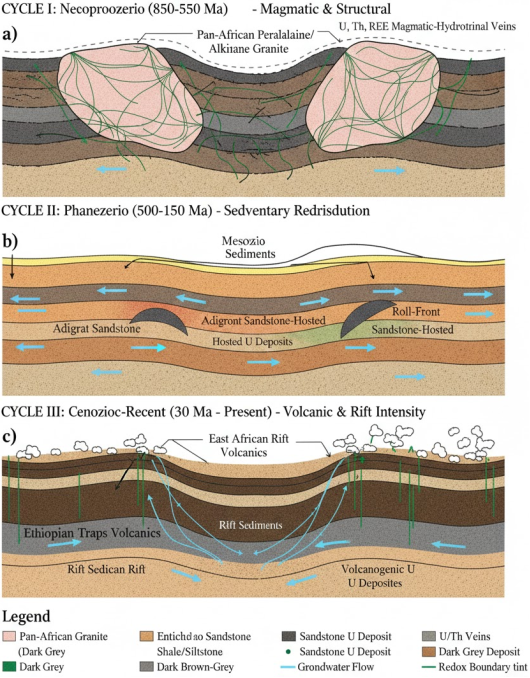
The uranium endowment of Ethiopia is not the product of a single event but the result of a sequential metallogenic evolution tied to its tectonic history (
Figure 1 Conceptual Metallogenic Evolution Model). Cycle I (Neoproterozoic): During the terminal stages of the Pan-African orogeny, post-collisional extension facilitated the emplacement of U, Th, REE-enriched peralkaline and alkaline granites. These intrusions (e.g., in the southern ANS) formed primary magmatic concentrations of uranium, some of which were subsequently remobilized into shear zones and contact aureoles by late magmatic-hydrothermal fluids
| [7] | Küster, D. (2009). Granitoid-hosted Ta mineralization in the Arabian-Nubian Shield: Ore deposit types, tectono-metallogenetic setting and petrogenetic framework. Ore Geology Reviews, 35(1), 68–86.
https://doi.org/10.1016/j.oregeorev.2008.09.006 |
| [8] | Emam, A., Zoheir, B., El-Wahed, M. A., & Ahmed, A. (2019). Granitoid-associated uranium mineralization in the Arabian-Nubian Shield: a review. Journal of African Earth Sciences, 151, 136–152. https://doi.org/10.1016/j.jafrearsci.2018.12.001 |
[7, 8]
. Cycle II (Phanerozoic): The erosion of these uraniferous basement rocks during the Paleozoic and Mesozoic provided the detrital uranium source for the overlying sedimentary basins. Groundwater circulation, potentially driven by tectonic uplift or climate change, mobilized hexavalent uranium, precipitating it as sandstone-hosted deposits at redox boundaries within the Enticho and Adigrat Sandstones
| [5] | Bosellini, A., Russo, A., Fantozzi, P. L., Assefa, G., & Solomon, T. (1997). The Mesozoic succession of the Mekele Outlier (Tigre Province, Ethiopia). Memorie di Scienze Geologiche, 49, 95–116. |
| [10] | Wolela, A. (2010). Sedimentology, Diagenesis and Reservoir Characteristics of the Paleozoic and Mesozoic Sandstones of the Ogaden Basin, Ethiopia. Journal of Petroleum Geology, 33(3), 201–220.
https://doi.org/10.1111/j.1747-5457.2010.00475.x |
[5, 10]
.
Cycle III (Cenozoic-Recent): This is the most intense and diverse mineralization cycle. The eruption of the Ethiopian Traps (~30 Ma) involved significant crustal melting, generating juvenile uranium sources in differentiated silicic magmas. Subsequent rift development created: (a) Hydrothermal systems where these magmas drove convection, leaching uranium from volcanic piles and precipitating it in veins and fractures
| [11] | Gianelli, G., & Teklemariam, M. (1993). Water-rock interaction processes in the Aluto-Langano geothermal field (Ethiopia). Journal of Volcanology and Geothermal Research, 56(4), 429–445.
https://doi.org/10.1016/0377-0273(93)90011-U |
| [12] | Rango, G. G., Beccaluva, L., Bianchini, G., Tassinari, R., & Siena, F. (2013). Uranium enrichment in the Afar volcanic province, Ethiopia. Journal of African Earth Sciences, 77, 1–13. https://doi.org/10.1016/j.jafrearsci.2012.09.006 |
[11, 12]
; (b) New sedimentary traps in rift basins, where uranium from weathered volcanics was concentrated into sandstone and surficial deposits
| [16] | Arakel, A. V. (1988). Carnotite mineralization in inland drainage areas of Australia. Ore Geology Reviews, 3(1-3), 289–311. https://doi.org/10.1016/0169-1368(88)90022-1 |
| [17] | Mumin, A. H., Corriveau, L., Somarin, A. K., & Ouellette, D. (2007). Calcrete uranium deposits in the Southern High Plains, USA. Ore Geology Reviews, 32(1-2), 136–168.
https://doi.org/10.1016/j.oregeorev.2006.11.002 |
[16, 17]
; and (c) Continued groundwater circulation in older basins, potentially rejuvenating older sandstone-hosted mineralization. This cycle remains active today, with ongoing hydrothermal activity in the rift and continued formation of surficial calcrete deposits.
Figure 1. Conceptual Metallogenic Evolution Model.
4.5. Integrated Interpretation: Linking Geology to Mineral Processing Implications
The genetic model and deposit typology have direct and critical implications for mineral processing and resource assessment. The mineralogy dictates processing flow sheets. Deposits dominated by refractory uranium minerals like uraninite or brannerite may require aggressive acid or alkaline leaching at fine grind sizes. In contrast, deposits with abundant secondary minerals (carnotite, autunite) are often amenable to cheaper, less aggressive heap or in-situ recovery (ISR) techniques
| [19] | AEA. (1993). Manual on Laboratory Testing for Uranium Ore Processing. International Atomic Energy Agency. IAEA-TECDOC-313. |
[19]
. The sandstone-hosted deposits of the Ogaden Basin, with their porous hosts and reported secondary mineralogy, are prime candidates for ISR feasibility studies, provided hydrogelogical conditions are suitable and uranium is not tightly adsorbed onto clays.
The gangue mineralogy is equally crucial. High carbonate content in host rocks (common in calcrete deposits or calcite-cemented sandstones) consumes acid, making alkaline (carbonate) leaching more economical
. The presence of penalty elements like arsenic, molybdenum, or selenium in volcanic-hydrothermal deposits can complicate processing and increase environmental management costs. Furthermore, the geometrical and geotechnical characteristics derived from the geological setting influence mining method. Shallow, stratiform surficial deposits suggest low-cost open-pit mining, while deep, fault-controlled hydrothermal veins would require underground methods. An integrated geological-metallurgical model from the exploration phase is therefore essential for accurate economic valuation.
4.6. Mineral Processing Implications and Knowledge Gaps
The geological characteristics of these deposit types have direct implications for mineral processing and resource development. For instance, uranium recovery from intrusive-related deposits like Kenticha would likely involve conventional milling (crushing, grinding, acid or alkaline leach) similar to granite-hosted deposits elsewhere, but may be complicated by the presence of refractory uranium in resistant minerals like zircon or thorite, and the co-occurrence of valuable by-products like tantalum. Sandstone-hosted deposits could potentially be amenable to in-situ recovery (ISR) techniques, given their permeability and the chemical nature of the mineralization, but this depends critically on detailed hydrogeological characterization to ensure aquifer confinement and prevent environmental contamination
| [21] | Alexandre, P., Kyser, K. (2005). Effects of cationic substitutions and alteration in uraninite, and implications for the dating of uranium deposits. Canadian Mineralogist, 43(3), 1005–1017. https://doi.org/10.2113/gscanmin.43.3.1005 |
[21]
.
Significant knowledge gaps hinder both a full genetic understanding and optimal resource assessment. First, there is a striking lack of precise geochronology (e.g., U-Pb on uraninite, Re-Os on sulfides) to directly date mineralization events and tie them to tectonic phases. Second, fluid inclusion and stable isotope (O, H, C, S) studies are virtually absent, leaving the source and chemistry of ore-forming fluids largely inferred
| [21] | Alexandre, P., Kyser, K. (2005). Effects of cationic substitutions and alteration in uraninite, and implications for the dating of uranium deposits. Canadian Mineralogist, 43(3), 1005–1017. https://doi.org/10.2113/gscanmin.43.3.1005 |
[21]
. Third, the genetic link between specific magmatic suites (e.g., composition of the Ethiopian Traps rhyolites) and uranium fertility is poorly quantified. Fourth, the hydrogeological models for the sedimentary basins are rudimentary, lacking 3D understanding of paleo-flow regimes. Finally, the environmental geochemistry and speciation of uranium in the active rift setting, which impacts both exploration (geochemical sampling) and environmental management, require detailed study
.
5. Conclusions
This comprehensive review consolidates the current state of knowledge on uranium mineralization in Ethiopia, establishing a nation-wide metallogenic framework. The key conclusion is that Ethiopia's uranium endowment is the product of three major, sequential geodynamic episodes: (1) Neoproterozoic crust formation and granite genesis, (2) Mesozoic basin development and hydrodynamic activity, and (3) Cenozoic rifting, volcanism, and aridification. These episodes have generated a diverse portfolio of deposit types, including intrusive-related, sandstone-hosted, volcanic-hydrothermal, and surficial calcrete deposits, each with distinct exploration criteria.
The geological controls on mineralization are multifaceted. For primary deposits, lithological control (fertile source rocks) is paramount, whether it is uraniferous alaskite, volcanic glass, or silicic differentiates of flood basalts. Structural control is critical for focused fluid flow, from shear zones in the basement to rift faults and sedimentary aquifer boundaries. Geochemical control is exerted by redox boundaries, which are the ultimate trap for mobile uranium, manifested as reduction spots in sandstone, episyenite fronts in granite, or evaporative interfaces in calcrete. Climate has played a decisive role in the formation of both sandstone-hosted (via weathering and groundwater flow) and surficial deposits.
From an exploration perspective, this review identifies high-priority targets. The ANS province requires detailed follow-up on alaskite bodies and associated pegmatite fields, utilizing radiometrics and structural mapping. The sedimentary basins, particularly the Ogaden, need integrated seismic, drill-hole, and hydrogeological studies to define redox fronts and paleo-channels at depth. The MER and Afar rifts are prospective for both vein-type hydrothermal deposits along major fault zones and for near-surface calcrete deposits in internal drainage basins, requiring geochemical sampling and shallow drilling.
To advance the scientific understanding and resource potential of uranium in Ethiopia, the following research recommendations are made: 1) Execute a coordinated geochronology program to directly date mineralization events across all provinces. 2) Conduct systematic fluid inclusion and stable isotope studies to constrain ore fluid sources and evolution. 3) Perform detailed lithogeochemical surveys to map uranium fertility of different magmatic suites, particularly within the Cenozoic volcanic succession. 4) Develop 3D hydrogeological models for key sedimentary basins to assess ISR potential and understand ore genesis. 5) Integrate modern remote sensing, geophysics, and AI-assisted data analysis to identify new anomalies and structural targets. 6) The lack of prior research on Ethiopian uranium deposits highlights a significant limitation. Addressing these gaps will not only refine genetic models but also significantly de-risk exploration and contribute to the sustainable development of Ethiopia's mineral resources.
Abbreviations
ANS | Arabian-Nubian Shield |
EARS | East African Rift System |
ISR | In-Situ Recovery |
MER | Main Ethiopian Rift |
Acknowledgments
I would like to express my sincere gratitude to the Mineral Industry Development Institute for providing the professional environment and institutional support necessary to conduct this review. I am also deeply grateful to my colleagues at the Institute for their insightful discussions and encouragement. Their shared expertise in Ethiopia’s regional geology was invaluable in refining the scope of this work.
Author Contributions
Wakjira Tesfaye: Conceptualization, Data curation, Formal Analysis, Funding acquisition, Investigation, Methodology, Project administration, Resources, Software, Supervision, Validation, Visualization, Writing – original draft, Writing – review & editing
Conflicts of Interest
The authors declare no conflicts of interest.
References
| [1] |
Dahlkamp, F. J. (2016). Uranium Deposits of the World. Springer.
https://doi.org/10.1007/978-3-540-78558-3
|
| [2] |
Beyth, M., Stern, R. J., Altherr, R., & Kröner, A. (1994). The Late Precambrian Timna Igneous Complex, Southern Israel: Evidence for Comagmatic-Type Sanukitoid Monzodiorite and Alkali Granite Magma. Lithos, 31(3-4), 103–124.
https://doi.org/10.1016/0024-4937(94)90004-3
|
| [3] |
Bonavia, F. F., Chorowicz, J. (1992). Northward expulsion of the Pan-African of Northeast Africa guided by a reentrant zone of the Tanzania Craton. Geology, 20(11), 1023–1026.
https://doi.org/10.1130/0091-7613
|
| [4] |
Stern, R. J. (1994). Arc assembly and continental collision in the Neoproterozoic East African Orogen: implications for the consolidation of Gondwanaland. Annual Review of Earth and Planetary Sciences, 22, 319–351.
https://doi.org/10.1146/annurev.ea.22.050194.001535
|
| [5] |
Bosellini, A., Russo, A., Fantozzi, P. L., Assefa, G., & Solomon, T. (1997). The Mesozoic succession of the Mekele Outlier (Tigre Province, Ethiopia). Memorie di Scienze Geologiche, 49, 95–116.
|
| [6] |
Corti, G. (2009). Continental rift evolution: from rift initiation to incipient break-up in the Main Ethiopian Rift, East Africa. Earth-Science Reviews, 96(1-2), 1–53.
https://doi.org/10.1016/j.earscirev.2009.06.005
|
| [7] |
Küster, D. (2009). Granitoid-hosted Ta mineralization in the Arabian-Nubian Shield: Ore deposit types, tectono-metallogenetic setting and petrogenetic framework. Ore Geology Reviews, 35(1), 68–86.
https://doi.org/10.1016/j.oregeorev.2008.09.006
|
| [8] |
Emam, A., Zoheir, B., El-Wahed, M. A., & Ahmed, A. (2019). Granitoid-associated uranium mineralization in the Arabian-Nubian Shield: a review. Journal of African Earth Sciences, 151, 136–152.
https://doi.org/10.1016/j.jafrearsci.2018.12.001
|
| [9] |
Getaneh, W. (1991). Lithostratigraphy and environment of deposition of the Late Paleozoic to Early Mesozoic sedimentary sequence of the Ogaden Basin, Ethiopia. Journal of African Earth Sciences, 13(3), 437–453.
|
| [10] |
Wolela, A. (2010). Sedimentology, Diagenesis and Reservoir Characteristics of the Paleozoic and Mesozoic Sandstones of the Ogaden Basin, Ethiopia. Journal of Petroleum Geology, 33(3), 201–220.
https://doi.org/10.1111/j.1747-5457.2010.00475.x
|
| [11] |
Gianelli, G., & Teklemariam, M. (1993). Water-rock interaction processes in the Aluto-Langano geothermal field (Ethiopia). Journal of Volcanology and Geothermal Research, 56(4), 429–445.
https://doi.org/10.1016/0377-0273(93)90011-U
|
| [12] |
Rango, G. G., Beccaluva, L., Bianchini, G., Tassinari, R., & Siena, F. (2013). Uranium enrichment in the Afar volcanic province, Ethiopia. Journal of African Earth Sciences, 77, 1–13.
https://doi.org/10.1016/j.jafrearsci.2012.09.006
|
| [13] |
Mohamed, H. A., El-Sayed, M. M., & Moghazi, A. K. M. (2015). Geochemistry and petrogenesis of Neoproterozoic peralkaline granites from the Gebel El Asr area, South Eastern Desert, Egypt. Journal of African Earth Sciences, 112, 413–429.
https://doi.org/10.1016/j.jafrearsci.2015.10.004
|
| [14] |
Ayalew, T., & Yemane, T. (2016). Sandstone-hosted uranium mineralization in the Paleozoic Enticho Sandstone, northern Ethiopia. Journal of African Earth Sciences, 117, 303–315.
https://doi.org/10.1016/j.jafrearsci.2016.02.005
|
| [15] |
Teklemariam, M., Battaglia, S., Gianelli, G., & Ruggieri, G. (1996). Hydrothermal alteration in the Aluto-Langano geothermal field, Ethiopia. Geothermics, 25(6), 679–702.
https://doi.org/10.1016/S0375-6505(96)00023-X
|
| [16] |
Arakel, A. V. (1988). Carnotite mineralization in inland drainage areas of Australia. Ore Geology Reviews, 3(1-3), 289–311.
https://doi.org/10.1016/0169-1368(88)90022-1
|
| [17] |
Mumin, A. H., Corriveau, L., Somarin, A. K., & Ouellette, D. (2007). Calcrete uranium deposits in the Southern High Plains, USA. Ore Geology Reviews, 32(1-2), 136–168.
https://doi.org/10.1016/j.oregeorev.2006.11.002
|
| [18] |
Chorowicz, J. (2005). The East African rift system. Journal of African Earth Sciences, 43(1-3), 379–410.
https://doi.org/10.1016/j.jafrearsci.2005.07.019
|
| [19] |
AEA. (1993). Manual on Laboratory Testing for Uranium Ore Processing. International Atomic Energy Agency. IAEA-TECDOC-313.
|
| [20] |
Lottermoser, B. G. (2010). Mine Wastes: Characterization, Treatment and Environmental Impacts. Springer.
https://doi.org/10.1007/978-3-642-12419-8
|
| [21] |
Alexandre, P., Kyser, K. (2005). Effects of cationic substitutions and alteration in uraninite, and implications for the dating of uranium deposits. Canadian Mineralogist, 43(3), 1005–1017.
https://doi.org/10.2113/gscanmin.43.3.1005
|
| [22] |
Hofmann, B. A. (1990). Reduction spheroids from northern Switzerland: Mineralogy, geochemistry and genetic models. Chemical Geology, 81(1-2), 55–81.
https://doi.org/10.1016/0009-2541(90)90041-T
|
Cite This Article
-
APA Style
Tesfaye, W. (2026). Metallogenic Evolution and Geologic Controls of Uranium Mineralization in Ethiopia: A Comprehensive Review. International Journal of Mineral Processing and Extractive Metallurgy, 11(1), 12-19. https://doi.org/10.11648/j.ijmpem.20261101.12
 Copy
|
Copy
|
 Download
ACS Style
Tesfaye, W. Metallogenic Evolution and Geologic Controls of Uranium Mineralization in Ethiopia: A Comprehensive Review. Int. J. Miner. Process. Extr. Metall. 2026, 11(1), 12-19. doi: 10.11648/j.ijmpem.20261101.12
Copy
|
Download
AMA Style
Tesfaye W. Metallogenic Evolution and Geologic Controls of Uranium Mineralization in Ethiopia: A Comprehensive Review. Int J Miner Process Extr Metall. 2026;11(1):12-19. doi: 10.11648/j.ijmpem.20261101.12
Copy
|
Download
-
@article{10.11648/j.ijmpem.20261101.12,
  author = {Wakjira Tesfaye},
  title = {Metallogenic Evolution and Geologic Controls of Uranium Mineralization in Ethiopia: A Comprehensive Review},
  journal = {International Journal of Mineral Processing and Extractive Metallurgy},
  volume = {11},
  number = {1},
  pages = {12-19},
  doi = {10.11648/j.ijmpem.20261101.12},
  url = {https://doi.org/10.11648/j.ijmpem.20261101.12},
  eprint = {https://article.sciencepublishinggroup.com/pdf/10.11648.j.ijmpem.20261101.12},
  abstract = {This review provides a systematic and critical synthesis of the state of knowledge on uranium metallogeny in Ethiopia. Employing a structured methodology, we compiled and analyzed data from peer-reviewed journals, geological surveys, and technical reports to construct a coherent geological framework for uranium mineralization in the country. The review establishes that uranium mineralization in Ethiopia is primarily hosted within three principal geotectonic domains: Neoproterozoic basement rocks of the Arabian-Nubian Shield, Paleozoic-Mesozoic sedimentary sequences, and Cenozoic volcanic and sedimentary formations associated with the East African Rift System. From these domains, we identify and characterize key deposit types, including intrusive-related occurrences within granitic bodies, volcanic and sub-volcanic deposits, sandstone-hosted stratiform accumulations, and surficial calcrete-style deposits. Each type exhibits distinct lithological, structural, and geochemical controls that govern ore formation and distribution. The metallogenic evolution of these deposits is shown to be intricately linked to major tectonic cycles: the Pan-African orogeny, which generated primary enrichments; subsequent Phanerozoic basin development, which facilitated sedimentary-hosted mineralization; and Cenozoic rift-related magmatism and hydrothermal activity, which remobilized and reconcentrated uranium in younger settings. A critical analysis of the existing literature reveals significant knowledge gaps that currently hinder comprehensive resource assessment. These deficiencies include a lack of precise geochronological constraints on mineralization events, a poor understanding of the thermodynamic and geochemical controls on uranium mobility in different host rocks, and insufficient data on the mineralogical factors that will ultimately affect process amenability and extraction. This synthesis underscores the considerable, yet underexplored, uranium potential of Ethiopia. By consolidating disparate information, it provides a robust geological framework designed to guide future exploration strategies and mineral processing research. The review concludes by emphasizing the critical need for an integrated geology-metallurgy approach in future resource assessment to ensure that exploration is both scientifically guided and economically viable.},
 year = {2026}
}
Copy
|
Download
-
TY  - JOUR
T1  - Metallogenic Evolution and Geologic Controls of Uranium Mineralization in Ethiopia: A Comprehensive Review
AU  - Wakjira Tesfaye
Y1  - 2026/03/14
PY  - 2026
N1  - https://doi.org/10.11648/j.ijmpem.20261101.12
DO  - 10.11648/j.ijmpem.20261101.12
T2  - International Journal of Mineral Processing and Extractive Metallurgy
JF  - International Journal of Mineral Processing and Extractive Metallurgy
JO  - International Journal of Mineral Processing and Extractive Metallurgy
SP  - 12
EP  - 19
PB  - Science Publishing Group
SN  - 2575-1859
UR  - https://doi.org/10.11648/j.ijmpem.20261101.12
AB  - This review provides a systematic and critical synthesis of the state of knowledge on uranium metallogeny in Ethiopia. Employing a structured methodology, we compiled and analyzed data from peer-reviewed journals, geological surveys, and technical reports to construct a coherent geological framework for uranium mineralization in the country. The review establishes that uranium mineralization in Ethiopia is primarily hosted within three principal geotectonic domains: Neoproterozoic basement rocks of the Arabian-Nubian Shield, Paleozoic-Mesozoic sedimentary sequences, and Cenozoic volcanic and sedimentary formations associated with the East African Rift System. From these domains, we identify and characterize key deposit types, including intrusive-related occurrences within granitic bodies, volcanic and sub-volcanic deposits, sandstone-hosted stratiform accumulations, and surficial calcrete-style deposits. Each type exhibits distinct lithological, structural, and geochemical controls that govern ore formation and distribution. The metallogenic evolution of these deposits is shown to be intricately linked to major tectonic cycles: the Pan-African orogeny, which generated primary enrichments; subsequent Phanerozoic basin development, which facilitated sedimentary-hosted mineralization; and Cenozoic rift-related magmatism and hydrothermal activity, which remobilized and reconcentrated uranium in younger settings. A critical analysis of the existing literature reveals significant knowledge gaps that currently hinder comprehensive resource assessment. These deficiencies include a lack of precise geochronological constraints on mineralization events, a poor understanding of the thermodynamic and geochemical controls on uranium mobility in different host rocks, and insufficient data on the mineralogical factors that will ultimately affect process amenability and extraction. This synthesis underscores the considerable, yet underexplored, uranium potential of Ethiopia. By consolidating disparate information, it provides a robust geological framework designed to guide future exploration strategies and mineral processing research. The review concludes by emphasizing the critical need for an integrated geology-metallurgy approach in future resource assessment to ensure that exploration is both scientifically guided and economically viable.
VL  - 11
IS  - 1
ER  -
Copy
|
Download





 Share This Article
 Twitter
 Linked In
 Facebook