
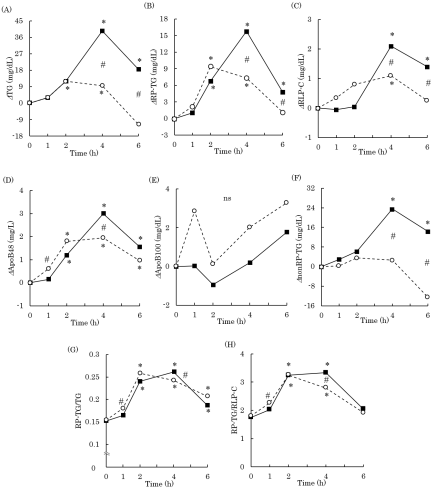
Aim: To investigate the effect of coingestion of fructose with fat cream on postprandial lipid metabolism in Japanese female university students, using remnant and non-remnant indices. Methods: Healthy young Japanese women (n=54) with apolipoprotein E phenotype 3/3 were enrolled. They participated on two occasions, ingesting either fat cream (OFTT creamTM, Jomo, Japan; 1 g/kg as cream, 0.35 g/kg as fat) alone or fat cream with fructose (0.5 g/kg). Venous blood samples were collected before (0 h) and at 0.5, 1, 2, 4, and 6 h after ingestion. Results: After ingestion of fat cream alone, serum concentration of triglyceride increased at 2 and 4 h, but non-remnant triglyceride concentration did not rise during the experiment. In contrast, after ingesting fructose in combination with fat cream, both serum triglyceride and non-remnant triglyceride levels increased at 4 h and did not return to baseline by the end of the experiment. The ratio of remnant triglyceride to total triglyceride, and an index of particle size were higher in the fructose with fat cream than fat cream alone at 4 h after ingestion. Conclusion: Coingestion of fructose with fat cream, but not fat cream alone, exacerbated postprandial lipidemia primarily by stimulating endogenous non-remnant triglyceride secretion.
| Published in | International Journal of Nutrition and Food Sciences (Volume 15, Issue 1) |
| DOI | 10.11648/j.ijnfs.20261501.13 |
| Page(s) | 16-24 |
| Creative Commons |
This is an Open Access article, distributed under the terms of the Creative Commons Attribution 4.0 International License (http://creativecommons.org/licenses/by/4.0/), which permits unrestricted use, distribution and reproduction in any medium or format, provided the original work is properly cited. |
| Copyright |
Copyright © The Author(s), 2026. Published by Science Publishing Group |
Fat-Ingestion Test, Fructose, Postprandial Lipidemia, Remnant, Triglyceride
Age (years) | 21.0 (21.0, 22.0) |
Height (cm) | 158.3 (154.6, 160.4) |
Mass (kg) | 51.0 (46.0, 54.6) |
BMI (kg/m2) | 20.0 (18.5, 21.5) |
W/H | 0.78 (0.74, 0.82) |
VFA (cm2) | 25.5 (17.4, 35.5) |
HOMA-IR | 1.21 (0.78, 1.72) |
HbA1c (%) | 5.20 (5.10, 5.40) |
TC (mg/dL) | 169.0 (156.0, 183.0) |
LDL-C (mg/dL) | 93.7 (80.6, 109.8) |
HDL-C (mg/dL) | 64.0 (57.0, 69.0) |
ApoA-I (mg/dL) | 147.5 (139.0, 158.0) |
ApoA-II (mg/dL) | 25.3 (23.5, 27.8) |
ApoC-II (mg/dL) | 2.10 (1.70, 2.80) |
ApoC-III (mg/dL) | 6.60 (6.10, 7.70) |
ApoE (mg/dL) | 3.95 (3.30, 4.40) |
Trial | 0 h | 0.5 h | 1 h | |
|---|---|---|---|---|
Glucose | F | 88.9 (79.6, 96.2) | 88.2 (80.8, 92.4) | 88.4 (81.8, 95.8) |
(mg/dL) | FFr | 90.2 (81.0, 95.8) | 96.6 (85.5, 101.5)* # | 93.6 (84.4, 98.5) |
Fructose | F | 0.43 (0.18, 0.68) | 0.52 (0.09, 0.74) | 0.50 (0.10, 0.68) |
(mg/dL) | FFr | 0.45 (0.16, 0.63) | 5.49 (3.87, 7.38)* # | 5.84 (4.35, 7.29)* # |
Insulin | F | 5.1 (4.0, 7.2) | 7.2 (6.0, 11.0)* | 7.2 (3.8, 7.3)* |
(mU/L) | FFr | 5.7 (3.7, 7.6) | 12.6 (9.5, 16.8)* # | 11.2 (8.7, 13.7)* # |
TG | F | 56.5 (42.0, 74.0) | 59.5 (44.0, 76.0) | |
(mg/dL) | FFr | 52.0 (46.0, 65.0) | 55.0 (46.0, 70.0) | |
RP-TG | F | 7.9 (6.6, 10.8) | 10.1 (7.3, 15.1) | |
(mg/dL) | FFr | 8.3 (7.0, 9.9) | 9.3 (7.3, 11.3) | |
RLP-C | F | 4.50 (3.40, 58.0) | 4.90 (3.50, 6.50) | |
(mg/dL) | FFr | 4.80 (3.60, 5.70) | 4.70 (3.60, 5.80) | |
ApoB48 | F | 2.00 (1.20, 2.70) | 2.60 (1.90, 3.70) | |
(mg/L) | FFr | 1.90 (1.35, 2.50) | 2.05 (1.20, 2.50) # | |
ApoB100 | F | 67.8 (58.5, 80.7) | 70.7 (57.3, 78.9) | |
(mg/dL) | FFr | 69.3 (57.9, 77.8) | 69.3 (58.8, 76.9) | |
nonRP-TG | F | 48.6 (31.1, 59.6) | 49.0 (33.7, 63.1) | |
(mg/dL) | FFr | 43.5 (39.3, 56.6) | 46.4 (37.5, 58.2) | |
RP-TG/TG | F | 0.15 (0.13, 0.19) | 0.18 (0.15, 0.22) | |
FFr | 0.15 (0.13, 0.18) | 0.17 (0.14, 0.19) # | ||
RP-TG/RLP-C | F | 1.80 (1.54, 2.24) | 2.27 (1.85, 2.76) | |
FFr | 1.75 (1.50, 2.48) | 2.03 (1.63, 2.52) # |
Trial | 2 h | 4 h | 6 h | |
|---|---|---|---|---|
Glucose | F | 90.5 (84.0, 96.2) | 86.4 (78.7, 91.4) | 82.3 (75.7, 87.3)* |
(mg/dL) | FFr | 90.6 (82.3, 96.0) | 88.4 (81.2, 94.3) | 86.7 (81.9, 92.3) # |
Fructose | F | 0.47 (0.07, 0.81) | 0.36 (0.05, 0.77) | 0.40 (0.12, 0.54) |
(mg/dL) | FFr | 2.17 (1.55, 3.02)* # | 0.63 (0.27, 0.90) # | 0.47 (0.15, 0.60) |
Insulin | F | 5.1 (3.8, 7.3)* | 3.5 (2.3, 4.6) | 3.0 (2.2, 3.8)* |
(mU/L) | FFr | 7.4 (5.7, 11.2)* # | 3.7 (2.9, 6.4) | 3.1 (2.5, 4.2)* |
TG | F | 68.5 (53.0, 91.0)* | 66.0 (51.0, 90.0)* | 45.0 (36.0, 63.0) |
(mg/dL) | FFr | 64.0 (51.0, 83.0) | 91.5 (67.0, 125.0)* # | 70.5 (51.0, 88.0)* # |
RP-TG | F | 17.3 (12.2, 24.5)* | 15.3 (10.4, 23.6)* | 9.1 (7.0, 12.1) |
(mg/dL) | FFr | 15.0 (9.9, 21.4)* | 24.0 (14.9, 34.0)* # | 13.1 (10.1, 16.8)* # |
RLP-C | F | 5.30 (3.90, 6.90) | 5.60 (4.40, 7.90)* | 4.75 (3.60, 6.20) |
(mg/dL) | FFr | 4.80 (3.80, 6.30) | 6.85 (5.40, 8.80)* # | 6.15 (4.80, 8.30)* # |
ApoB48 | F | 3.80 (2.70, 4.70)* | 3.95 (2.90, 5.20)* | 2.95 (2.20, 3.60)* |
(mg/L) | FFr | 3.10 (2.40, 4.70))* | 4.90 (4.10, 6.00)* # | 3.45 (2.80, 4.70)* |
ApoB100 | F | 67.9 (56.6, 78.6) | 69.8 (57.6, 81.6) | 71.1 (58.8, 82.8) |
(mg/dL) | FFr | 68.4 (57.8, 76.7) | 69.5 (58.6, 78.3) | 71.1 (60.7, 79.5) |
nonRP-TG | F | 52.2 (39.5, 67.2) | 51.3 (36.9, 67.2) | 36.2 (28.3, 52.9) |
(mg/dL) | FFr | 49.7 (38.6, 61.6) | 67.0 (51.3, 84.0)* # | 57.8 (40.6, 72.1)* # |
RP-TG/TG | F | 0.26 (0.22. 0.29)* | 0.24 (0.20, 0.28)* | 0.21 (0.18, 0.24)* |
FFr | 0.24 (0.19, 0.29)* | 0.26 (0.22, 0.32)* # | 0.19 (0.16, 0.22)* | |
RP-TG/RLP-C | F | 3.25 (2.40, 4.45)* | 2.79 (2.00, 3.50)* | 1.92 (1.64, 2.29) |
FFr | 3.24 (2.23, 3.79)* | 3.34 (2.64, 4.60)* # | 2.05 (1.57, 2.81) |
Trial | TG (mg∙h/dL) | RP-TG (mg∙h/dL) | RLP-C (mg∙h/dL) | ApoB48 (mg∙h/L) | nonRP-TG (mg∙h/dL) |
|---|---|---|---|---|---|
F | 37.3 (17.0, 70.5) | 31.2 (21.0, 50.3) | 3.5 (1.7, 5.8) | 8.2 (5.1, 11.2) | 13.2 (12.5, 28.6) |
FFr | 83.8 (62.0, 155.0)# | 46.2 (26.8, 78.4)# | 6.3 (4.2, 11.4)# | 9.9 (7.0, 12.8) | 46.1 (28.8, 76.9)# |
BMI | Body Mass Index |
CAD | Coronary Artery Disease |
CM | Chylomicron |
HbA1c | Hemoglobin A1c |
HDL-C | High-density Lipoprotein-cholesterol |
HOMA-IR | Homeostasis Model Assessment for Insulin Resistance |
LDL | Low-density Lipoprotein |
NGSP | National Glycohemoglobin Standardization Program |
RLP-C | Remnant Lipoprotein-cholesterol |
RP-TG | Remnant-like particle-triglyceride |
TC | Total Cholesterol |
TG | Triglyceride |
TRL | Triglyceride-rich Lipoprotein |
VFA | Visceral Fat Area |
VLDL | Very Low-density Lipoprotein |
W/H | Waist-to-Hip |
<i></i>AUC | Incremental Area Under the Curve |
| [1] | Ferrari, R., Aguiar, C., Alegria, E., Bonadonna, R. C., Cosentino, F., Elisaf, M., Farnier, M., Ferrières, J., Filardi, P. P., Hancu, N., Kayikcioglu, M., Silva, A. M. E., Millan, J., Reiner, Ž., Tokgozoglu, L., Valensi, P., Viigimaa, M., Vrablik, M., Zambon, A., Zamorano, J. L., Catapano, A. Current practice in identifying and treating cardiovascular risk, with a focus on residual risk associated with atherogenic dyslipidaemia. Eur Heart J Suppl. 2016, 18 (suppl_C), C2-C12. |
| [2] | Nakajima, K., Nakano, T., Tokita, Y., Nagamine, T., Inazu, A., Kobayashi, J., Mabuchi, H., Stanhope, K. L., Havel, P. J., Okazaki, M., Ai, M., Tanaka, A. Postprandial lipoprotein metabolism: VLDL vs chylomicrons. Clin Chim Acta. 2011, 412(14-15), 1306-1318. |
| [3] | Mach, F., Baigent, C., Catapano, A. L., Koskinas, K. C., Casula, M., Badimon, L., Chapman, M. J., De Backer G. G., Delgado, V., Ference, B. A., Graham, I. M., Halliday, A., Landmesser, U., Mihaylova, B., Pedersen, T. R., Riccardi, G., Richter, D. J., Sabatine, M. S., Taskinen, M. R., Tokgozoglu, L., Wiklund, O; ESC Scientific Document Group. 2019 ESC/EAS Guidelines for the management of dyslipidaemias: lipid modification to reduce cardiovascular risk. Eur Heart J. 2020. 41(1), 111-188. |
| [4] | Kaltoft, M., Langsted, A., Nordestgaard, B. G. Triglycerides and remnant cholesterol associated with risk of aortic valve stenosis: Mendelian randomization in the Copenhagen General Population Study. Eur Heart J. 2020. 41(24), 2288-2299. |
| [5] | Iso, H., Naito, Y., Sato, S., Kitamura, A., Okamura, T., Sankai, T., Shimamoto, T., Iida, M., Komachi, Y. Serum triglycerides and risk of coronary heart disease among Japanese men and women. Am J Epidemiol. 2001. 153(5), 490-499. |
| [6] | Austin, M. A., King, M. C., Vranizan, K. M., Krauss, R. M. Atherogenic lipoprotein phenotype. A proposed genetic marker for coronary heart disease risk. Circulation. 1990. 82(2), 495-506. |
| [7] | Miller, M., Seidler, A., Moalemi, A., Pearson, T. A. Normal triglyceride levels and coronary artery disease events: the Baltimore Coronary Observational Long-Term Study. J Am Coll Cardiol. 1998. 31(6), 1252-1257. |
| [8] | Lawler, P. R., Kotrri, G., Koh, M., Goodman, S. G., Farkouh, M. E,. Lee, D. S., Austin, P. C., Udell, J. A., Ko, D. T. Real-world risk of cardiovascular outcomes associated with hypertriglyceridaemia among with individuals atherosclerotic cardiovascular disease and potential eligibility for emerging therapies. Eur Heart J. 2020. 41(1), 86-94. |
| [9] | Takeuchi, K., Kazumura, K., Kuzawa, K., Hatano, Y., Nagai, M., Naito, M. Effect of fat ingestion on postprandial oxidative status in healthy young women: a pilot study. J Clin Biochem Nutr. 2024. 74(1) 30-36. |
| [10] | Bantel, J. P., Raatz, S. K., Thomas, W., Georgopoulos, A. Effect of dietary fructose on plasma lipids in healthy subjects. Am J Clin Nutr. 2000. 72(5), 1128-1134. |
| [11] | Reiser, S., Powell, A. S., Scholfield, D. J., Panda, P., Ellwood, K. C., Canary, J. J. Blood lipids, lipoproteins, apoproteins, and uric acid in men fed diets containing fructose or high-amylose cornstarch. Am J Clin Nutr. 1989. 49(5), 832-839. |
| [12] | Saito, H., Kato, M., Yoshida, A., Naito, M. The ingestion of a fructose-containing beverage combined with fat cream exacerbates postprandial lipidemia in young healthy women. J Atheroscler Thromb. 2015. 22(1), 85-94. |
| [13] | Eshak, E. S., Iso, H., Kokubo, Y., Saito, I., Yamagishi, K., Inoue, M., Tsugane, S. Soft drink intake in relation to incident ischemic heart disease, stroke, and stroke subtypes in Japanese men and women: the Japan Public Health Center-based study cohort I. Am J Clin Nutr. 2012. 96(6), 1390-1397. |
| [14] |
World Health Organization: The “3 by 35” Initiative targets tobacco, alcohol, and sugary drinks to cut deaths and boost health and development funding. Available from:
https://www.who.int/news/item/02-07-2025-who-launches-bold-push-to-raise-health-taxes-and-save-millions-of-lives (accessed 1 September 2025). |
| [15] | Mizutani-Watanabe, E., Naito, M. Remnant indices for estimating postprandial lipidemia in young women. Int J Nutr Food Sci. 2023. 12(1), 21-28. |
| [16] | Park, Y. K., Yetley, E. A. Intakes and food sources of fructose in the United States. Am J Clin Nutr. 1993. 58(5), 737S-747S. |
| [17] | Asano, M., Fukakura, N., Odachi, J., Kawaraya, C., Nanba, A., Yasuda, N., Yamamoto, E. Use of fast foods among young people. Jpn J Nutr Diet. 2003. 61(1), 47-54. |
| [18] | Kamimura, Y., Sumioka, Y., Kitabayasi, K., Morita, K. Relationships between eating fast food and daily living habits, health conditions and eating habits of university students. Bul Hijiyama Univ. 2014. 21, 197-207. |
| [19] | Mizutani-Watanabe, E., Naito, M. Predictability of postprandial lipidemia by fasting values in young women. Int J Nutr Food Sci. 2023. 12(5), 116-122. |
| [20] | Ichikawa, N., Morita, Y., Ootani, K., Naito, M. Effects of co-ingestion of amino acid with fat on postchallenge glycemia and lipidemia in healthy young women. Int J Nutr Food Sci. 2022. 11(6) 177-186. |
| [21] | Matthews, D. R., Hosker, J. P., Rudenski, A. S., Naylor, B. A., Treacher, D. F., Turner, R. C. Homeostasis model assessment: insulin resistance and beta-cell function from fasting plasma glucose and insulin concentrations in man. Diabetologia. 1985. 28(7), 412-419. |
| [22] | Friedewald, W., Levy, R., Fredrickson, D. Estimation of the concentration of low-density lipoprotein cholesterol in plasma, without use of the preparative ultracentrifuge. Clin Chem. 1972. 18(6) 499-502. |
| [23] | Nakajima, K., Saito, T., Tamura, A., Suzuki, M., Nakano, T., Adachi, M., Tanaka, A., Tada, N., Nakamura, H., Campos, E., Havel, R. J. Cholesterol in remnant-like lipoproteins in human serum using monoclonal anti apo B-100 and anti apo A-I immunoaffinity mixed gels. Clin Chim Acta. 1993. 223(1-2), 53-71. |
| [24] | Miyauchi, K., Kayahara, N., Ishigami, M., Kuwata, H., Mori, H., Sugiuchi, H., Irie, T., Tanaka, A., Yamashita, S., Yamamura, T. Development of a homogeneous assay to measure remnant lipoprotein cholesterol. Clin Chem. 2007. 53(12), 2128-2135. |
| [25] | Nakatani, K., Sugimoto, T., Masuda, D., Okano, R., Oya, T., Monden, Y., Yamashita, T., Kawase, R., Nakaoka, H., Inagaki, M., Yuasa-Kawase, M., Tsubakio-Yamamoto, K., Ohama, T., Nishida, M., Ishigami, M., Komuro, I., Yamashita, S. Serum apolipoprotein B-48 levels are correlated with carotid intima-media thickness in subjects with normal serum triglyceride levels. Atherosclerosis. 2011. 218(1), 226-232. |
| [26] | Saito, H., Kagaya, M., Suzuki, M., Yoshida, A., Naito, M. Simultaneous ingestion of fructose and fat exacerbates postprandial exogenous lipidemia in young healthy Japanese women. J Atheroscler Thromb. 2013. 20(6), 591-600. |
| [27] |
The National Health and Nutrition Survey in Japan, 2019. Available from:
https://www.mhlw.go.jp/content/000710991.pdf. (accessed 14 September 2025). |
| [28] | Ginsberg, H. N., Packard, C. J., Chapman, M. J., Borén, J., Aguilar-Salinas, C. A., Averna, M., Ference, B. A., Gaudet, D., Hegele, R. A., Kersten, S., Lewis, G. F., Lichtenstein, A. H., Moulin, P., Nordestgaard, B. G., Remaley, A., Staels, B., Stroes, E. S. G., Taskinen. M-R., Tokgözoğlu, L. S., Tybjaerg-Hansen, A., Stock, J. K., Catapano, A. L. Triglyceride-rich lipoproteins and their remnant: metabolic insights, role in atherosclerotic cardiovascular disease, and emerging therapeutic strategies-a consensus statement from the European Atherosclerosis Society. Eur Heart J. 2021. 42(47), 4791-4806. |
| [29] | Brunzell, J. D., Hazzard, W. R., Porte, Jr. D., Bierman, E. L. Evidence for a common, saturable, triglyceride removal mechanism for chylomicrons and very low density lipoproteins in man. J Clin Invest. 1973. 52(7). 1578-1585. |
| [30] | Stanhope, K. L., Schwarz, J. M., Keim, N. L., Griffen, S. C., Bremer, A. A, Graham, J. L., Hatcher, B., Cox, C. L, Dyachenko, A., Zhang, W., McGahan, J. P., Seibert, A., Krauss, R. M., Chiu, S., Schaefer, E. J., Ai, M., Otokozawa, S., Nakajima, K., Nakano, T., Beysen, C., Hellerstein, M. K., Berglund, L., Havel, P. J. Consuming fructose-sweetened, not glucose-sweetened, beverages increases visceral adiposity and lipids and decreases insulin sensitivity in overweight/obese humans. J Clin Invest. 2009. 119(5), 1322-1334. |
| [31] | Parks, E. J., Skokan, L. E., Timlin, M. T., Dingfelder, C. S. Dietary sugars stimulate fatty acid synthesis in adults. J Nutr. 2008. 138(6), 1039-1046. |
| [32] | Hudgins, L. C., Parker, T. S., Levine, D. M., Hellerstein, M. K. A dual sugar challenge test for lipogenic sensitivity to dietary fructose. J Clin Endocrinol Metab. 2011. 96(3), 861-868. |
| [33] | Topping, D. L., Mayes, P. A. The immediate effects of insulin and fructose on the metabolism of the perfused liver. Changes in lipoprotein secretion, fatty acid oxidation and esterification, lipogenesis and carbohydrate metabolism. Biochem J. 1972. 126(2), 295-311. |
| [34] | Björnson, E., Packard, C. J., Adiels, M., Andersson, L., Matikainen, N., Söderlund, S., Kahri, J., Sihlbom, C., Thorsell, A., Zhou, H., Taskinen, M. R., Borén, J. Investigation of human apoB48 metabolism using a new, integrated non-steady-state model of apoB48 and apoB100 kinetics. J Intern Med. 2019. 285(5), 562-577. |
APA Style
Mizutani-Watanabe, E., Naito, M. (2026). Coingestion of Fructose with Fat Cream Exacerbates Postprandial Lipidemia Primarily by Stimulating Endogenous Non-remnant Triglyceride Secretion. International Journal of Nutrition and Food Sciences, 15(1), 16-24. https://doi.org/10.11648/j.ijnfs.20261501.13
ACS Style
Mizutani-Watanabe, E.; Naito, M. Coingestion of Fructose with Fat Cream Exacerbates Postprandial Lipidemia Primarily by Stimulating Endogenous Non-remnant Triglyceride Secretion. Int. J. Nutr. Food Sci. 2026, 15(1), 16-24. doi: 10.11648/j.ijnfs.20261501.13
AMA Style
Mizutani-Watanabe E, Naito M. Coingestion of Fructose with Fat Cream Exacerbates Postprandial Lipidemia Primarily by Stimulating Endogenous Non-remnant Triglyceride Secretion. Int J Nutr Food Sci. 2026;15(1):16-24. doi: 10.11648/j.ijnfs.20261501.13
@article{10.11648/j.ijnfs.20261501.13,
  author = {Erika Mizutani-Watanabe and Michitaka Naito},
  title = {Coingestion of Fructose with Fat Cream Exacerbates Postprandial Lipidemia Primarily by Stimulating Endogenous Non-remnant Triglyceride Secretion},
  journal = {International Journal of Nutrition and Food Sciences},
  volume = {15},
  number = {1},
  pages = {16-24},
  doi = {10.11648/j.ijnfs.20261501.13},
  url = {https://doi.org/10.11648/j.ijnfs.20261501.13},
  eprint = {https://article.sciencepublishinggroup.com/pdf/10.11648.j.ijnfs.20261501.13},
  abstract = {Aim: To investigate the effect of coingestion of fructose with fat cream on postprandial lipid metabolism in Japanese female university students, using remnant and non-remnant indices. Methods: Healthy young Japanese women (n=54) with apolipoprotein E phenotype 3/3 were enrolled. They participated on two occasions, ingesting either fat cream (OFTT creamTM, Jomo, Japan; 1 g/kg as cream, 0.35 g/kg as fat) alone or fat cream with fructose (0.5 g/kg). Venous blood samples were collected before (0 h) and at 0.5, 1, 2, 4, and 6 h after ingestion. Results: After ingestion of fat cream alone, serum concentration of triglyceride increased at 2 and 4 h, but non-remnant triglyceride concentration did not rise during the experiment. In contrast, after ingesting fructose in combination with fat cream, both serum triglyceride and non-remnant triglyceride levels increased at 4 h and did not return to baseline by the end of the experiment. The ratio of remnant triglyceride to total triglyceride, and an index of particle size were higher in the fructose with fat cream than fat cream alone at 4 h after ingestion. Conclusion: Coingestion of fructose with fat cream, but not fat cream alone, exacerbated postprandial lipidemia primarily by stimulating endogenous non-remnant triglyceride secretion.},
 year = {2026}
}
TY  - JOUR
T1  - Coingestion of Fructose with Fat Cream Exacerbates Postprandial Lipidemia Primarily by Stimulating Endogenous Non-remnant Triglyceride Secretion
AU  - Erika Mizutani-Watanabe
AU  - Michitaka Naito
Y1  - 2026/02/20
PY  - 2026
N1  - https://doi.org/10.11648/j.ijnfs.20261501.13
DO  - 10.11648/j.ijnfs.20261501.13
T2  - International Journal of Nutrition and Food Sciences
JF  - International Journal of Nutrition and Food Sciences
JO  - International Journal of Nutrition and Food Sciences
SP  - 16
EP  - 24
PB  - Science Publishing Group
SN  - 2327-2716
UR  - https://doi.org/10.11648/j.ijnfs.20261501.13
AB  - Aim: To investigate the effect of coingestion of fructose with fat cream on postprandial lipid metabolism in Japanese female university students, using remnant and non-remnant indices. Methods: Healthy young Japanese women (n=54) with apolipoprotein E phenotype 3/3 were enrolled. They participated on two occasions, ingesting either fat cream (OFTT creamTM, Jomo, Japan; 1 g/kg as cream, 0.35 g/kg as fat) alone or fat cream with fructose (0.5 g/kg). Venous blood samples were collected before (0 h) and at 0.5, 1, 2, 4, and 6 h after ingestion. Results: After ingestion of fat cream alone, serum concentration of triglyceride increased at 2 and 4 h, but non-remnant triglyceride concentration did not rise during the experiment. In contrast, after ingesting fructose in combination with fat cream, both serum triglyceride and non-remnant triglyceride levels increased at 4 h and did not return to baseline by the end of the experiment. The ratio of remnant triglyceride to total triglyceride, and an index of particle size were higher in the fructose with fat cream than fat cream alone at 4 h after ingestion. Conclusion: Coingestion of fructose with fat cream, but not fat cream alone, exacerbated postprandial lipidemia primarily by stimulating endogenous non-remnant triglyceride secretion.
VL  - 15
IS  - 1
ER  -
Graduate School of Life Studies, Sugiyama Jogakuen University, Nagoya, Japan;Department of Food and Nutrition, College of Nagoya Bunri University, Nagoya, Japan
Graduate School of Life Studies, Sugiyama Jogakuen University, Nagoya, Japan;Department of Rehabilitation, AICHI Medical College of Rehabilitation, Kiyosu, Japan

Information



 Share This Article
 Twitter
 Linked In
 Facebook

 Copy
 Download