Research Article | | Peer-Reviewed

Investigation of Prospects and Challenges of Smart Cities in 21st Century

Received: 13 February 2026     Accepted: 9 March 2026     Published: 13 April 2026
Views:       Downloads:
Abstract

In 21st century the use of smart technology presents many distinct prospects along with significant challenges. Those prospects included transforming industries, agricultural and service sectors by improving daily life with sustainability. These technologies develop smart homes, smart cities by improving healthcare, transportation, connectivity, finance, business etc. with comfort, safety and security. On the other hand, it creates challenges in technological, economical, legal and ethical facet along with data privacy, security, and accountability. Today’s top-notch and cutting-edge technologies such as mobile phone, digital/quantum computers, camera surveillance, robotics, Internet of Things (IoT), artificial intelligence (AI), machine learning (ML), Big Data, Digital Twin, etc. make radical changes on human culture, law, religion, work, etc., and that have greatly up-sated the normal order of things in the society. The use of these smart technologies in smart cities and business enterprises has been met with certain technological, economical, legal and ethical consequences. Smart cities in the 21st century utilize IoT, AI, ML, Big Data, Digital Twin, and data analytics to enhance sustainability, efficiency, and quality of life, with greater urbanization and climate challenges toward peaceful and smart living. Important prospects like intelligent traffic, smart grids, and citizen-centric services, though high implementation costs and cybersecurity risks remain significant challenges. This study will appraise the prospect and challenges along with ethical aspect of extensive and wide use of smart technology to develop smart cities. Beside many prospects there are some major challenges need to handle to a balance between technological innovation and the protection of individual rights and societal values. This is a research study on smart technology to evaluate the prospects and challenges of smart cities in 21st century.

Published in International Journal of Sustainability Management and Information Technologies (Volume 12, Issue 1)
DOI 10.11648/j.ijsmit.20261201.11
Page(s) 1-22
Creative Commons

This is an Open Access article, distributed under the terms of the Creative Commons Attribution 4.0 International License (http://creativecommons.org/licenses/by/4.0/), which permits unrestricted use, distribution and reproduction in any medium or format, provided the original work is properly cited.

Copyright

Copyright © The Author(s), 2026. Published by Science Publishing Group

Keywords

Smart City, ICT, Smart Technology, IoT, AI, Sustainability

1. Introduction
Technology has woven itself into our lives, transforming everything from the way we communicate to how we handle legal matters. With innovations like Internet of Things (IoT), artificial intelligence (AI), machine learning (ML), quantum computing, and the legal field isn't untouched by these advancements. However, with technological progress comes the need to address ethics in technology. Legal ethics now involves understanding how these innovations impact confidentiality, accuracy, and privacy . Our lives are made more convenient and easier by technology. We use technology, such as video calls and messaging, to swiftly communicate with others. Additionally, it facilitates fast access to information through search engines like Google. We can complete jobs more quickly and effectively thanks to technology. Today's society relies heavily on technology, which affects how you communicate, work, and make decisions. In the legal field, technology plays a significant role in ensuring confidentiality, managing factual discrepancies, and enhancing data security . Let's delve into these aspects and see how they influence ethics and technology. Again, Generative AI is increasingly being used in legal systems to automate tasks like creating documents or assisting with research. This integration raises questions about legal responsibility, especially when AI makes autonomous decisions. For instance, if an AI system drafts a contract, who is accountable for any errors? As you work with AI, it's important to regulate its use to prevent inaccuracies. Consider a scenario where a law firm in Dhaka uses AI to draft contracts. They must ensure that the AI's outputs meet legal standards and that there's a system in place to review these documents . These days, smart cities leverage data from cutting-edge technologies like IoT, AI, and ML to give residents better environmental cleanliness and safety. In order to meet the requirements of their residents and increase the effectiveness of service delivery, some cities also make use of IoT or AI devices . Cybersecurity threats are one of the many threats that smart cities face, despite their high degree of connectedness and security. However, possible threats and attacks can be avoided with appropriate safety precautions [6, 18]. Smart cities, are the result of the growing importance of orienting our life toward sustainability. These cities use infrastructures, innovation and technology to reduce energy consumption and reduce CO2 emissions. There are different parameters by which a city ranks more highly than another. To achieve these there are few key dimensions are considered. Such as: Governance, urban planning, public management, technology, environment, international projection, social cohesion, mobility and transportation, human capital and economy . The main goal of a smart city is to optimize city functions and promote economic growth while also improving the quality of life for citizens through smart technologies and great data analysis. The value lies in how this technology is used .
Eighty percent of the world's population is predicted to live in cities by 2050, when there will be nearly nine billion people on the planet. Just over half of the seven billion people on the planet now live in cities. City dwellers consume 80 percent of the planet's resources, although making up only 2 percent of the planet's land area. The conventional structures that cities rely on to supply resources are unsustainable, as are the cities' disproportionate use of social and physical resources and their rapid growth . Local action is essential to attaining a low carbon future, even though urbanization continues to contribute to rising carbon emissions worldwide. Cities are now taking the initiative and creating plans to deal with the effects of climate change due to the lack of legally enforceable international climate action and the lack of leadership in many state governments. Cities are, in many ways, our best chance to combat climate change (World Urbanization Problem, United Nations, 2014) . By 2030, 70% of the world's population will reside in our global cities, which currently account for 80% of the world's GDP and are centers of innovation and commerce (World Bank). It is vital that we proactively determine what we want for our future cities and put in place mechanisms now that serve those future demands in a sustainable and integrated fashion because the appearance of these cities will have an impact on our environment globally . Future consequences include optimized energy usage and improved mobility, but also present serious challenges regarding data privacy, security risks like cyber security, digital divide and many uncertainties . The concept of smart cities, also known as a city 4.0, should not be confused with sustainable cities, which seek to reduce the carbon footprint of its activities and promote efficient consumption and production patterns, depending on its geographic, social, economic, and cultural characteristics. Smart cities, or advanced cities, thrive off technology-based tools and methodologies in order to advance toward a fairer, safer, more efficient and nature friendly future. To do this, effective solutions are presented that respond to typical challenges found in a large city such as mobility, the economy, public services, employability, and citizen engagement, among others .
Over the past century, there has been a notable improvement in the quality of life, mostly in terms of service access. However, administrators, architects, and urban planners have faced significant challenges due to the strong industry and population growth in urban regions. In 21st century a major focus is transitioning to Net Zero through smart energy, waste management, and climate adaptation strategies . The use of digital twins, artificial intelligence, and robotics is accelerating to create responsive urban environments. Real-time data collection enhances public services, such as, for instance, in traffic management and public transport. Future development emphasizes engaging citizens to ensure solutions meet actual needs, rather than just technology-driven initiatives. On the other hand, huge dependance on connected infrastructure introduces vulnerabilities, making cybersecurity a top concern . Many of these cities have difficulties due to the enormous amount of capital needed for growth and upkeep. In addition, there are numerous ethical and legal difficulties. Regulatory and compliance issues, privacy concerns, and questions about intellectual property rights protection are just a few of these legal nightmares. . Meanwhile, the ethical dilemma fluctuates between dignity, conscience, right and wrong, addictions, etc. The main legal challenges revolve around applying existing law to new, complex technologies and ensuring compliance with evolving regulations. Evaluating smart city initiatives becomes difficult without agreement on parameters . Additionally, it makes it more difficult to compare projects and find best practices. The transformation of smart cities into "smart regions"—for example, by fostering greater cooperation between the public and private sectors—is the way forward . In the 21st century, smart cities leverage ICT frameworks to build sustainable, technologically-enabled infrastructure that addresses urban challenges. This research examines the evolution of smart technology while evaluating the complex balance required between deploying these systems and protecting individual rights and societal values. Furthermore, it highlights the necessity for advanced technical skills, which are essential for boosting the employability and competence of future citizens in this high-tech era.
2. Literature Review and Methodology
The goal of smart cities is to improve the quality of life for its citizens through technological means, ultimately creating more sustainable cities. It is a team effort that requires many sectors of a society to safely and strategically integrate technology, information, and data solutions . Digitization drives smart city progress but introduces serious cyber risks, requiring 24/7 infrastructure protection. Ultimately, a "people-first" approach is essential—using data and technology purposefully to improve decision-making and quality of life. Let us delve deeper into what exactly is a smart city and how digital solutions can help in creating a secure digital society in smart cities . Because IoT devices are interconnected and use AI, smart cities are vulnerable to cyberattacks. It is crucial to safeguard the infrastructure from possible threats and secure the data that is sent between devices. To prevent unwanted access and preserve the integrity of the data gathered, smart cities must have strong cybersecurity measures in place, such as encryption methods, frequent software updates, and intrusion detection systems . IoT and AI drive smart city innovation, but their expansion makes robust cybersecurity essential.
The interconnectedness of AI-driven IoT devices makes smart cities highly vulnerable to cyber threats. To maintain data integrity and prevent unauthorized access, robust security—including encryption, regular updates, and intrusion detection—is essential. While these technologies enable everything from personalized commerce and drone delivery to traffic-reducing autonomous vehicles, their benefits depend entirely on the strength of the underlying cybersecurity infrastructure. Technology affects our behavior, challenges conventions, alters our capabilities, acts on our behalf, and produces biased results particularly with regard to human privacy and emotional and financial security. In the twenty-first century, with 95% of the global population connected, ICT has evolved from a developmental tool into a profound force reshaping society, politics, and the environment. While technologies like AI, IoT, and robotics drive efficiency and ecological preservation, they also harvest vast amounts of sensitive personal data, necessitating strict global regulatory frameworks .
The Australian Privacy Act, which is based on 13 APPs, regulates handling across sectors with a strong emphasis on individual access and transparency . Once more, the Singapore PDPA, which is overseen by PDPC, establishes baseline guidelines for the gathering, use, and disclosure of data. It was recently improved with stricter penalties and guidelines for reporting data breaches. Both seek to strike a balance between organizational requirements and data protection . Productivity and efficiency are the keys to success in the fast-paced world of business. Modern smart technologies—including AI, IoT, ML, and big data—outpace human capability by performing complex simulations and calculations over 100 times faster . By automating production and distribution, digitalization ensures that the manufacturing of goods and services is not only simpler and more precise but remarkably rapid. It can adjust to changes in the business environment, pricing, quality, quantity, and kind of goods or services because of its independent and effective character .
Numerous disputes and public discussions have been sparked by the new environmental challenges. Degradation of the environment is becoming a worldwide problem. An estimated trillion tons of carbon dioxide would be added by 2050 if current emission rates continue, according to the literature, which could have a negative impact on human existence . In recent years, there has been research on the function and significance of ICT for various economic outcomes. Increased use of information communication technology (ICT) has been shown to have positive economic effects . By raising knowledge of environmental issues and encouraging the use of ecologically friendly technology, ICT can also aid in reducing environmental damage . Environmental dangers can be anticipated and managed with the aid of ICT technologies. Computerized simulation tools, for instance, can make "learning by simulation" easier in order to speed up decision-making processes and avoid the negative effects of trial and error. The "internet network" is another component of ICT that enhances environmental awareness. Due to their ability to lower greenhouse gas emissions, ICT-based solutions are regarded as beneficial for environmental sustainability . The legal and ethical implications of these developments cannot be disregarded in the age of smart cities, when the integration of IoT, AI, and other smart technologies promises previously unheard-of levels of efficiency and innovation. Questions around data privacy, surveillance, cyber security, and the ethical use of technology become more pressing as urban areas become more globally connected and accessible through the internet or web.
The gathering and use of personal data as well as open connectivity to the outside world are among the main issues in the context of smart cities . Smart cities must balance public safety with individual rights by implementing strict data protection laws and transparent communication. As AI and IoT devices—from security cameras to smartphones—collect vast amounts of behavioral and biometric data, clear governance is required to prevent surveillance misuse. Empowering citizens through informed consent and open dialogue ensures that technology is deployed ethically, fostering the trust necessary for successful urban development. There is increasing demand to make cities more environmentally friendly while also increasing their efficiency as urbanization rates rise and governments throughout the world set aggressive goals to cut carbon dioxide emissions. Over two-thirds of the world's CO2 emissions come from cities. Some have taken up the task and are managing the difficulties of urban sustainability with the aid of technology . Cities that are managed more effectively can increase economic growth, lower expenses, and increase productivity. Government assistance, technology innovation, and necessity are driving this movement toward smart, sustainable cities. Secular growth should benefit businesses that offer answers . Despite being widely discussed, the term "business model" is relatively new and lacks a standard definition . A business model explains the logic behind how a company generates, provides, and acquires value (economic, social, cultural, or other forms of value). A business model is defined as "an architecture of the products, services, and information flows," which is one of the most commonly used definitions. Actors, roles, potential economic value, and the revenue source are all acknowledged in this definition. Four components make up a business model framework, often known as a "canvas," which centers the value proposition. . According to Roy (2005) , business models can be categorized into five categories, despite the possibility of different value propositions. Unbundling separates infrastructure, product innovation, and customer relationships to avoid conflict (e.g., private banking).
Since the pandemic, cybercrime has surged by 600%, fueled by an increased global dependency on technology that hackers are eager to exploit. Small and medium-sized enterprises (SMEs) are particularly vulnerable due to inadequate security strategies, untrained staff, and legacy IT systems . Because the majority of SMEs collapse within six months of a successful breach, addressing these technological vulnerabilities head-on is a critical necessity for business survival. Effective protection can be established by collaborating with the appropriate outsourced IT support company . Automation has the potential to increase productivity, but it also puts certain jobs at risk of being replaced. Employee morale and corporate culture may suffer if there is less demand for some job positions as a result of increased reliance on technology . There are many advantages to using AI, ML, robotics, or information and communication technology (ICT) in business, but there are also risks and complicated legal issues involved. The following are some of the main risks associated with ICT use in businesses: old or malfunctioning hardware, software, or network components that can cause system crashes, data loss, and service interruptions. inadequate redundancy or backup solutions to guarantee the uninterrupted availability of vital IT resources in the event of emergencies or failures . Once more, the widespread usage of smart gazettes, devices, and systems will raise significant ethical and legal concerns in the future.
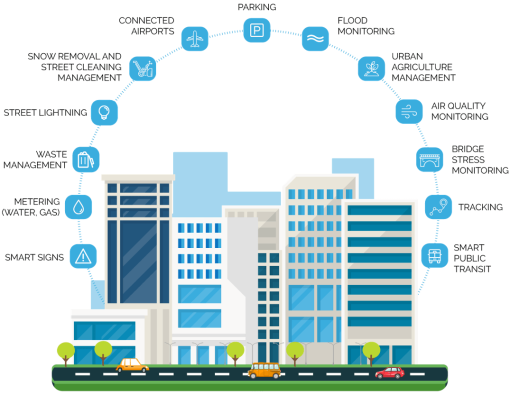
Figure 1. Smart technology solves the requirement of modern problem and provides smart services .
A smart city is a technologically advanced, and by utilizing various electronic methods and sensors—ranging from motion detectors for pedestrians to light sensors for automated systems—it collects real-the data to ensure peak technological performance and efficient urban management. For example, a light-detecting sensor enables a city to turn on the street lights automatically when necessary . Smart city solutions are an important component of a smart life, which soon be the only one way to live. The IoT solutions for smart cities are used by governments to make decisions regarding transportation and climate. The concept of a smart city involves bringing together a number of fields of knowledge. It includes public administration and e-government. The latest developments in this field have made it possible for cities to create and deploy their own intelligent systems . Developing a sustainable smart city is an important part of a city’s development, so the new concept of a sustainable smart city must be incorporated . Actually, there is a distinct gap to study, analysis and to evaluate the prospect of smart city, its potential, challenges, and what to do to solve those issues in contest of smart technology in 21st century. So, there are few specific questions need to solve as follows:
1) How to define and it is function of smart city in the era of smart technology?
2) How to solve the smart city business issues in 21st century?
3) How we can solve the economy of smart city?
4) What are the prospects of smart city in contest of 21st century?
5) What are the probable challenges of smart city in contest of 21st century?
6) What are the legal and ethical issues and challenges of smart city in contest of 21st century?
7) Why and how top smart cities uses IoT and AI to solve future challenges?
3. Smart City and Consequence of 21st Century
A smart city is a city that integrates digital technologies into its networks, services, and infrastructure in order to become more efficient and livable, thereby benefiting residents and businesses. According to the European Commission, a smart city requires: Smart urban transport networks; Improved water supply and waste disposal facilities; More efficient ways to light and heat buildings; More interactive and proactive city administration; Safer public spaces. In other words, a smart and sustainable city uses information and communication technologies (ICT) to improve quality of life, efficiency, and competitiveness, while ensuring that the needs of present and future generations are met. According to the United Nations Economic Commission for Europe (UNECE), the definition of a smart city includes elements such as widespread home connectivity and Wi-Fi in public areas, smart infrastructure, smart meters, the use of open data, and e-government solutions . The Smart City concept has become a key factor in sustainable urban development. It is a compilation of urban planning strategies with lots of far-reaching benefits, including efficient distribution of resources, speed of policy implementations, seamless communication, and a range of environmental benefits. A city’s “smartness” is determined using a set of characteristics, includes infrastructure based around technology, environmental initiatives, effective and highly functional public transportation, progressive city plans, people able to live and work within the city using its resources, etc. The success key of a smart city relies on the relationship between the public and private sectors as much of the work to create and maintain a data-driven environment .
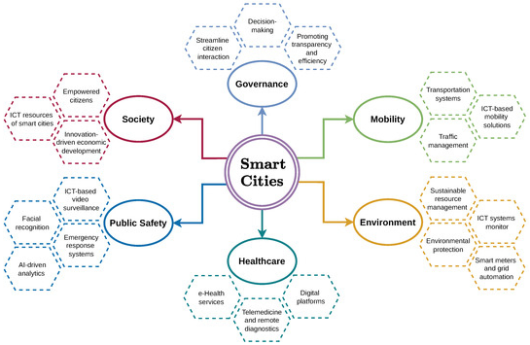
A smart city is a technologically advanced metropolitan region that combines explicit information from sensors and numerous electrical strategies. The information gathered from that data is used to effectively manage resources, assets, and administrations; as a result, that data is used to advance duties throughout the city . This includes data collected from inhabitants, devices, buildings, and resources that is processed and examined in order to track and control AI, web technologies, smart mobile platforms, telecommunications, e-commerce, e-business, and other technologies are all integrated in smart cities and smart businesses . As seen in Figure 2, the fields of utilization pertain to services for citizens and users, such as utilities, e-health, transportation, and structures. Information and communication technologies (ICTs) are used in smart cities to scale services like transportation and utilities for a growing population. Growing urbanization and population growth are igniting a fresh interest in incorporating technology into the planning of municipal services, which is what "smart cities" are all about . In order to detect variables like temperature, moisture, allergens, contaminants, traffic, and power matrix status, smart cities heavily rely on sensors. These parameters' values offer a context that aids a system in comprehending a citizen's condition at any given time .
Figure 2. Many useful and efficient utilities and comfort in smart city .
The multi-tier design is used in nearly all large, well-managed smart cities in an effort to combine the physical and ICT environments. Smart cities, however, seem to be adopting another intriguing strategy that involves the Internet of Things, artificial intelligence, robots, and automation. This means that many smart cities could use data from sensors, buildings, and users as sensors with their applications without having to install networks or other large-scale infrastructure from scratch. Any or all of the elements of smart cities could be mentioned in potential business models. For example, vendors in smart cities create and implement infrastructure; operators profit from the use of these facilities or the supply of services; service providers profit from the provision of their services, etc. To do this, a smart city might make use of a variety of modern business models. A city can be viewed from a number of perspectives, some of which are already present while others require design. The dimensions are:
1) The environment includes parks, buildings, lakes, rivers, and landscapes.
2) Public transportation is an example of infrastructure.
3) Open Data, innovation, synergy, cooperation, and creativity make up the Collaboration System.
4) E-government, e-learning, and e-traffic are solutions.
5) Living: working, recuperating, and having fun.
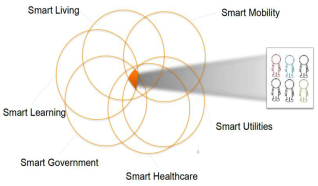
The interactions between the different disciplines in a smart city offer the greatest potential for value creation. Additionally, services made possible by technology should be mentioned while discussing smart cities. People and their needs are frequently disregarded in this situation. Figure 3 provides a visual representation of the importance of the value of people in a smart city. It is important to keep in mind that a smart city is built for the people, not for its own purpose. It is now necessary to connect disciplines and sectors that did not previously interact closely in a way that adds value. Smart city initiatives are frequently approached solely from a technological standpoint. Nonetheless, it is crucial to address a number of other non-technological factors, including organizational settings, societal culture, and the culture of city management departments (viz. municipalities, corporations, district councils etc.). As cities grow, smart solutions are essential to handle population density, moving from conceptual ideas to, in some regions, highly connected urban environments. While Western cities often focus on retrofitting existing infrastructure with smart solutions, other regions may focus on new, purpose-built smart developments .
Figure 3. Significance of the Value for People in a Smart City .
Smart Cities make life easier and better for those who live and work there by utilizing technology to enhance urban administration. They reduce their environmental impact by making the best use of natural resources. More precisely, sensors gather information from various urban locations, including hospitals, law enforcement, waste management, traffic, transit systems, and air quality. One of the Smart Cities of Europe is Barcelona. There are many different applications and services for smart city solutions. They can provide safer public areas, more efficient transportation networks, just-in-time waste management, better-balanced and less wasteful water supplies, and efficient building heating and lighting. All of this may sound futuristic, but many of the cities where we live have already adopted some clever solutions, like telemedicine, intelligent traffic signals, ride-hailing, emergency response optimization, and municipal water leak monitoring.
Smart systems are being adopted by city planners and authorities at an increasing rate due to the numerous issues posed by rising urbanization rates. Over 60% of the world's energy is consumed in cities, which also produce 70% of its CO2 emissions. Reducing the footprint of big cities is crucial, as most governments have promised to cut national emissions. Another contributing cause is declining air quality, which results in health issues and restricted access to clean water. Perennial traffic and overwhelming trash management have long been serious problems that are getting worse. According to the World Economic Forum, the pace of urbanization worldwide is predicted to increase from 56.2 percent in 2021 to 70 percent by 2050. By that time, an additional 300 million people are predicted to live in cities in China and 400 million in India alone. North America's current high rate of urbanization (83.6%) is expected to rise even further.
Smart City transformation. A smart city is built on the foundation of 5G technology. In contrast to 4G, 5G is ten times faster, has low latency (i.e., there is only a slight delay of 1 to 1,000 milliseconds before a data transfer begins following an instruction), and allows for the connection of millions of devices and sensors within a one-kilometer square area, whereas 4G only allows for a limited number of connections. Various 5G-related technologies are necessary for the development of a sophisticated Smart City. A city, for example, implements several Internet of Things sensors to supervise traffic. Once the data has been collected, it is transmitted across the 5G network. During this process, blockchain technology can facilitate secure data flow. Traffic authorities employ edge computing analytics to assess data in real-time in order to forecast traffic flows and devise feasible congestion management strategies, such as rerouting traffic or altering traffic signal sequences. Massive quantities of Big Data can be efficiently processed by AI. After that, the dataset is securely stored on a cloud server for future study and utilization. There are a number of players and aspects involved in bringing Smart Cities into reality:
1) Manufacturers of 4G, 5G, and WIFI equipment and service providers meet the growing need for dependable high-speed connectivity by sending sensor data over their networks.
2) High-capacity telecom towers and data centers that support edge computing are examples of communications infrastructure.
3) Manufacturers of semiconductors that provide sensors for data collection Software firms that control devices and sensors and offer intelligent solutions.
4) Businesses that use cloud storage to store the encrypted data.
5) Cybersecurity firms that defend systems against hackers and attacks during the data collection, transport, analysis, and storage process Businesses that offer building management solutions to maximize facility operations, such as waste management, energy, water, and energy consumption.
6) Businesses that facilitate the transition to electric cars and smart grids.
The character of cities has always been multifaceted. Cities must incorporate the use of big data and information and communication technology (ICT) into everyday operations and in the achievement of their urgent objectives if they are to become smart and sustainable—more ecologically sound, commercially successful, and socially just. Future city will become a more livable place if technological innovation is combined with smart connectivity that makes use of the expanding IoT to address the real problems of traffic congestion, waste/pollution control, and energy efficiency. Although smart city efforts are always a "work in progress," communities worldwide stand a better chance of receiving the most livable award when they are carried out with actual business results and the specific demands of end users in mind. Therefore, through multilateral trading systems like those provided by the WTO, smart cities as they are now defined and understood have immense potential to open up in the worldwide business arena. Most people's lives, whether or not they reside in a city, will be directly impacted by the shape, functionality, look, and atmosphere of cities in the future. Today, the biggest metropolitan marketplaces have already surpassed those of several countries. This article examines the importance, potential, and prospects of smart cities for global enterprises to meet the problems of the 21st century, keeping in mind the aforementioned vision of smart cities.
4. Smart Cities and Business in 21st Century
A smart city integrates digital technologies like ICT, IoT, and open data into urban infrastructure to improve efficiency, sustainability, and quality of life. According to the European Commission and UNECE, this involves optimizing transport, utilities, and governance through proactive administration and public-private partnerships. By leveraging data analysis and smart resource distribution, global leaders like Singapore and Amsterdam are successfully evolving into more livable, competitive, and environmentally friendly urban environments for both current and future generations . This includes data collected from inhabitants, devices, buildings, and resources that is processed and examined in order to track and control AI, web technologies, smart mobile platforms, telecommunications, e-commerce, e-business, and other technologies are all integrated in smart cities and smart businesses . As seen in Figure 2, the fields of utilization pertain to services for citizens and users, such as utilities, e-health, transportation, and structures. Information and communication technologies (ICTs) are used in smart cities to scale services like transportation and utilities for a growing population. Growing urbanization and population growth are igniting a fresh interest in incorporating technology into the planning of municipal services, which is what "smart cities" are all about . In order to detect variables like temperature, moisture, allergens, contaminants, traffic, and power matrix status, smart cities heavily rely on sensors. Most large smart cities utilize a multi-tier design to integrate physical and ICT environments. Business models in this ecosystem are diverse: vendors build infrastructure, operators manage facilities for profit, and service providers deliver technology-mediated services. The dimensions are:
1) The environment includes parks, buildings, lakes, rivers, and landscapes.
2) Public transportation is an example of infrastructure.
3) Open Data, innovation, synergy, cooperation, and creativity make up the Collaboration System.
4) E-government, e-learning, and e-traffic are solutions.
5) Living: working, recuperating, and having fun.
The greatest potential for value creation lies in the interaction between these disciplines. However, technology-driven initiatives often disregard human needs. Figure 3 provides a visual representation of the importance of the value of people in a smart city, reinforcing that these cities are built for residents, not for the sake of the technology itself. Beyond technical factors, success requires addressing organizational settings, societal culture, and the management culture of municipalities. While Western cities often retrofit existing systems, other regions focus on purpose-built smart developments to handle rising population density . Smart cities leverage technology to revolutionize urban administration and resource management, utilizing a vast network of sensors to gather real-time data from sectors like healthcare, law enforcement, and transit. The global urban population is projected to reach 70% by 2050, particularly in rapidly growing regions like Nigeria, Indonesia, India and China. Because cities currently consume over 60% of the world's energy and generate 70% of its CO2 emissions, adopting smart systems like intelligent traffic signals and emergency response optimization is essential to mitigating the environmental and logistical strains of rising urbanization.
Smart City transformation. 5G technology serves as the foundation for smart cities, providing speeds ten times faster than 4G, ultra-low latency, and the capacity to connect up to one million devices per square kilometer. This infrastructure enables IoT sensors to monitor traffic in real-time, utilizing blockchain for secure data transmission and edge computing for immediate congestion management through signal adjustments. Ultimately, AI processes the resulting Big Data for cloud storage and future analysis, requiring a collaborative effort between technology providers and municipal governments to bring these sophisticated urban environments into reality:
1) Manufacturers of 4G, 5G, and WIFI equipment and service providers meet the growing need for dependable high-speed connectivity by sending sensor data over their networks.
2) High-capacity telecom towers and data centers that support edge computing are examples of communications infrastructure.
3) Manufacturers of semiconductors that provide sensors for data collection Software firms that control devices and sensors and offer intelligent solutions
4) Businesses that use cloud storage to store the encrypted data
5) Cybersecurity firms that defend systems against hackers and attacks during the data collection, transport, analysis, and storage process Businesses that offer building management solutions to maximize facility operations, such as waste management, energy, water, and energy consumption
6) Businesses that facilitate the transition to electric cars and smart grids
To thrive in the 21st century, cities must integrate Big Data and ICT with IoT innovation to drive ecological, commercial, and social sustainability while solving urban issues like traffic and energy efficiency. This evolution creates vast opportunities in the global business arena, potentially leveraging multilateral systems like the WTO as these urban marketplaces increasingly outpace national economies. Driven by multidisciplinary, evidence-led dialogue, the design of these future cities will ultimately reshape resident lives and dictate broader global economic and environmental outcomes.
5. Smart Cities and Economy
In 21st century, smart cities drive economic growth and development by integrating IoT, AI, ML, big data, robotic, automation and data analytics to improve efficiency and comfort, fostering innovation, and enhancing competitiveness. Which will also create jobs in tech sectors, attract investment, and optimize urban infrastructure like transport, energy, health, finance, industry as well as boosting productivity distinctly and reducing operational costs for businesses. According to the smart city's economic dimension, the concept can be used to boost the urban economy by fight against poverty through employment generation, support the innovative economy and wealth of cities" . There is a wealth of research on regional competitive advantage and the traits include a culture of openness between businesses and the institutions in a region and collective innovation . The "presence of a creative class, the quality of and dedicated attention to the urban environment, the level of education, multimodal accessibility, and the use of ICTs for public administration" are all positively correlated with urban wealth. These components, which correspond with the six-part conception of the smart city are viewed as the cornerstone of a new strategic agenda for European cities, shown in Figure 2.
Smart city initiatives drive significant economic growth by creating specialized jobs in IT, engineering, and data management, attracting a skilled workforce that fosters innovation hubs and boosts local GDP. As the Internet of Things (IoT) expands—defined by Techopedia as a future where everyday items connect and identify themselves to other devices—the demand for data analytics services from organizations like "Recorded Future" will continue to surge. This connectivity has seen explosive growth; Cisco reported a leap from 500 million connected devices in 2003 to 12.5 billion in 2010, with projections reaching 50 billion by 2020. With over half the global population now urbanized, this trend impacts billions. While Singapore aims to be the first "Smart Nation" and India plans to construct 100 smart cities, the movement is truly global, encompassing participants in IBM's "Smarter Cities Challenge" like Glasgow, Rio de Janeiro, New Orleans, and Cape Town.
6. Prospects in Smart Cities
Smart cities are poised to revolutionize urban living by making our environments safer, faster, and more efficient, creating a fertile landscape for long-term growth in the sectors providing these solutions. The Internet of Things (IoT) serves as the backbone of this innovation, driving systemic efficiency through constant connectivity. However, as the digital footprint of our infrastructure expands, the role of cybersecurity becomes non-negotiable; integrating AI-driven defense mechanisms and rigorous best practices is essential to safeguarding data and protecting the vital systems that keep a modern city running. A smart city is an urban model that makes use of technology, human resources, and governance to enhance social inclusion, efficiency, and sustainability—all of which are regarded as objectives for cities of the future . Digital technology is used by smart cities to provide services and gather data. IoT and smart technology integration offers previously unheard-of possibilities for increased productivity, sustainability, and quality of life as smart cities develop. The advantages are numerous, ranging from smart grids improving energy management to connected gadgets optimizing traffic flow. However, new and complex cybersecurity concerns are also made possible by this interconnectedness. In order to optimize urban services and identify areas for development, this data can be analyzed . "Smart cities" were conceptualized as a result of the fast use of information and communication technology in global cities . The four elements that Deakin and Al Waer identify as contributing to the definition of a smart city are: to enhance innovation and knowledge, the integration of ICT into living and working environments, the use of ICT in government systems, and the use of a wide range of electronic and digital technologies . The very aspects that make smart cities intelligent and responsive—such as real-time data interchange and remote-control capabilities can be misused if they are not appropriately protected .
Smart cities operate through a three-layered framework—a foundation of sensors and high-speed connectivity, an application layer that converts raw data into intelligence, and a social layer for public adoption—all accelerated by the convergence of 5G, IoT, and mobile technology. This digital evolution has shifted healthcare from an individual-focused model to a community-centric "smart health" (s-health) approach, which differs from standard e-health or m-health by utilizing localized, distributed sensors to enhance inhabitant well-being. By analyzing real-time data, such as air quality or allergen levels, s-health systems can proactively guide residents away from environmental hazards and toward personalized care, effectively reducing the strain on traditional medical infrastructure through preventative, data-driven insights.
Every city's infrastructure serves as its foundation, and development can improve current connections in a variety of ways, such as by implementing green buildings, waste management programs, and traffic regulations. For instance, the goal of Singapore's Green Mark certification scheme is currently to make 80 percent of the city's buildings green. By 2028, according to Gartner, there will be several billion connected IoT devices in business-savvy buildings, driven by broadcast communications systems, 5G, and high-efficiency Wi-Fi in addition to smart utilities like water, garbage, and electricity. Platform assessment frameworks, IoT sensors for wastewater and obstruction detection, stopping sensor applications, lighting sensors, and fire detection frameworks are examples of moving innovations. Future metropolitan areas may become more conservative and close-knit as a result of this . Therefore, every resident of a smart city greatly benefits from smart infrastructure. Mart cities, thus, elevate their tenants' voices. While local area network platforms allow users to collaborate and share resources, applications allow inhabitants to temporarily report local problems. With increased investment and transparency, metropolitan areas are developing into cooperative settings. Metropolitan cities are getting ready to be more human-focused and multidirectional for the government, associations, and inhabitants alike thanks to open information and new advancements .
In addition to investing in sustainable energy, cities can employ development to monitor and improve energy use in real time. This involves the use of ethical and sustainable materials, carbon-friendly and resource-efficient strategies, frameworks powered by renewable energy sources, and cutting-edge innovations that adapt to their needs. According to Deloitte Insights, the energy transformation contributes to the construction of a circular economy by decentralizing the production of energy from limitless sources. This is getting ready for urban areas to become energy self-sufficient . Smart cities utilize surveillance technologies like biometrics and facial recognition to improve crime prediction and emergency response, yet these must be carefully managed to protect personal freedoms and prevent social division. Beyond safety, urban planning is shifting toward resilience through decarbonization and the "15-minute city" model, which ensures daily needs are met within a short walk or bike ride. As climate change intensifies, cities are increasingly integrating green innovations like vertical forests and floating infrastructures to ensure a sustainable, biodiverse, and equitable future for all residents [110].
Smart mobility leverages innovation to create efficient, resilient, and sustainable transportation systems, focusing on infrastructure, micro-mobility, and zero-emission solutions like autonomous vehicles and hyperloops. In these adaptable cities, intelligent traffic management and diverse transit options empower all residents while promoting eco-friendly movement. Complementing this, e-governance fosters transparency and collaboration by utilizing blockchain and IoT for secure, decentralized agreements. These digital tools—ranging from online voting to robust information security—strengthen citizen participation and the development of an e-democratic society. Additionally, local e-profession centers, online retraining programs, and digitalization of corporate functions like burden filing and permitting contribute to financial growth and an innovative business environment . In a smart city, e-governance guarantees citizens' satisfaction, accountability, and openness. Waste production rises in tandem with the continuous development of metropolitan populations and purchasing culture. IoT sensors are used by sophisticated and intelligent waste management systems to accurately track waste pickup, provide residents with usage advice, and incentivize them with financial benefits. Reusing e-waste also allows people to exchange equipment for cash. Smart containers manage the quantity of waste and sort uncategorized rubbish . By avoiding human interaction, artificial intelligence recycling robots precisely identify the types of materials during waste sorting, increasing total productivity and large efficiency. When combined, emerging waste management strategies lessen the impact of economic activity on the environment . Effective trash management keeps the city clean and healthy for its residents.
Divergent Aspect of Smart City development. Europe has pioneered smart city initiatives by prioritizing sustainable, integrated urban transit and bottom-up development driven by citizens and the private sector. Success in North American examples like Canada’s "Smart Cities Challenge" and Los Angeles' GeoHub—which consolidated 500 datasets to dismantle silos—proves that modern infrastructure requires resident participation and interconnected platforms. Meanwhile, Barcelona redefined the model by reclaiming data control from private firms to ensure transparency and prioritize local businesses. Ultimately, a truly responsive city necessitates a cultural shift in governance that balances technological integration with the protection of individual privacy and social capital. In contrast, Asian smart city development—notably in China and Singapore—is typically top-down, with central governments driving funding and regulation to enhance governance and infrastructure. While these models vary, a fully functional smart city requires a smooth flow of data and technology across public sectors like waste, power, and telecommunications . Although heritage Western cities may take longer to reach this level of integration, the global landscape continues to evolve through these diverse regional strategies.
Chicago’s smart city strategy centers on infrastructure investment, economic development, and community involvement, highlighted by its transition to an open fiber-optic ring and a modernized Smart Grid that empowers consumers through digital smart meters. To address connectivity gaps, the city collaborates with the FCC to dynamically share public safety radio spectrum for cellular use. The goal of the Smart Chicago Sustainable Broadband Adoption program is to promote economic growth in five underprivileged Chicago areas, providing training and hardware to over 11,000 residents while relaunching energy benchmarking initiatives to prioritize decarbonization. Since companies and applications are developed on their open data platforms, Chicago sees an economic growth justification for data accessibility , with outreach led by the Smart Chicago Collaborative, which is responsible for a large portion of Chicago's community engagement efforts . While Chicago measures success through cost savings—such as saving $400,000 by moving to cloud tools and utilizing the OpenGrid (formerly Windy-Grid) platform—quantifying the long-term impact of these diverse initiatives remains a significant challenge.
Singapore has evolved into a global benchmark for urban innovation by transforming developmental challenges—such as water scarcity and land constraints—into lucrative business opportunities through progressive leadership and a commitment to "life-ability." By integrating sustainable policies with advanced ICT, the city-state maintains a highly productive, innovation-driven economy that mirrors the R&D intensity of nations like the Netherlands. Central to this strategy is the Economic Development Board (EDB), which actively attracts foreign direct investment through targeted incentives, ensuring a steady influx of global expertise to bolster its skilled workforce. This holistic approach ensures that Singapore remains a "smart" city that prioritized not just technological efficiency, but a high quality of life that serves as a replicable model for urban centers worldwide. Businesses with significant R&D expenditures, advanced technology, and high productivity are of primary interest to the EDB. Foreign design and architecture also pique Singapore's curiosity. Singapore is constantly searching for talent . To draw gifted students and academics from the area and beyond, it offers unique programs.
In the 21st century, smart cities are revolutionizing urban development by leveraging data analytics and diverse public-private partnerships to tackle local challenges like traffic, housing, and environmental risks. Global leaders are defined by specialized technological strengths: Helsinki leads with its "Helsinki 3D+" digital twin project, while Dubai focuses on AI and autonomous taxis. Other frontrunners include Seoul for Samsung-powered transit, London for open-data social participation, and Tokyo for Hitachi-driven disaster response. This competitive landscape is rounded out by cities like New York, Copenhagen, and Singapore, which utilize advanced wireless management, Siemens-integrated transport, and urban mobility to enhance citizen quality of life and sustainable growth .
7. Challenges in Smart Cities
In smart cities, AI-driven healthcare advancements depend on large-scale data exchange, which frequently encounters hurdles regarding resident privacy and security. To address these concerns, researchers are investigating three primary mechanisms for privacy-preserving data handling. First, information can be "camouflaged" during collection to make it indecipherable. Second, privacy-preserving data mining ensures anonymity when sharing data with external parties , often through K-anonymity—a validation that an individual's identifiable attributes are identical to at least k-1 other clients . This is achieved by generalizing traits, introducing "noise," or periodically changing identifiers in crowded spaces to prevent long-term spatial tracking. Third, the results of data mining computations can be modified to limit the risk of re-identification while still meeting operational needs. Ultimately, success requires that city planners and tech providers maintain transparent security measures to ensure city residents understand the potentially sensitive information sharing that could occur with smart city developments .
Smart city healthcare initiatives focus on improving usability and accessibility, yet high upfront development costs remain a significant barrier to widespread adoption. While integrating ICT into large-scale medical systems promises long-term municipal savings, the initial investment often delays the deployment of these innovations. To address this, smart city platforms are shifting toward "plug-and-play" smart objects—adaptable, cost-effective technologies designed to blend into urban environments and provide healthcare services anywhere. Along with design observation, climate observation, security, and intelligent transportation, the things should aid in assessing well-being . A Smart City needs "shrewd" citizens who actively participate in and effectively navigate new developments if it is to actually exist and thrive. Local communities are more willing to take advantage of developments and encourage others to do the same when they wish to influence the alternatives that affect daily life and are being passed on in a clever and pragmatic way. This is essential to the success of a Smart City . Notwithstanding the wealthy and technologically advanced, it is crucial that Smart City orchestration incorporates the prospect, all else being equal. Development should always aim to bring people together rather than further dividing them based on factors like income or educational attainment . Examining these networks in relation to the various topics covered in this article will improve the overall result of a solution outside the domain of knowledgeable clients .
Smart cities integrate multiple domains, including transportation, energy, health, education, agriculture, business, social, banking, economy and governance, to create an interconnected and intelligent urban environment. The integration of smart technology and data-driven solutions in smart cities has all potential to revolutionize urban living by providing citizens with personalized and accessible services. However, the implementation also presents challenges, including data privacy concerns, unequal access to technology, and the need for collaboration across private, public, and government sectors . Even though technology has a lot of appeal, becoming a Smart City will not be easy. Because it's simpler to start from a relatively fresh slate than to upgrade outdated infrastructures, legacy cities face considerable challenges. In this sense, newer cities in Asia and the Middle East have a clear advantage. Another encumbrance that can make the adoption of some clever solutions more difficult is very big populations [135]. New technologies can be adopted more quickly in smaller cities like Zurich (400,000) or Helsinki (1.3 million). In the 2020 IMD Smart City Index, they came in second and third place worldwide, respectively. The following are examples of typical points of vulnerability:
1) Data breaches and privacy issues: Cybercriminals are drawn to the enormous volumes of data produced by IoT devices or AI systems. Individual privacy is seriously threatened by unauthorized access to sensitive data, which can result in identity theft or other nefarious actions .
2) Infrastructure Vulnerabilities: Public services, electricity grids, and transportation networks are all susceptible to cyberattacks. The functioning of cities and public safety may be significantly impacted by disruptions in these vital services .
3) Device Manipulation: Malicious acts, such interfering with communication networks or changing data, can be carried out by compromised IoT devices or AI systems. The dependability and integrity of smart city operations are at stake as a result .
4) Denial of Service (DoS) Attacks: Critical services can be interrupted by flooding systems with so much traffic that they fail. This may result in grid outages, traffic jams, or compromised emergency response systems in the context of smart cities .
5) Risks of Surveillance Systems: Smart cities and security technologies coexist. However, having inexperienced staff and ineffective processes can be risky and lead to cyberattacks even with the strongest technology defenses. In the event of a cyberattack, security and emergency alarm systems are the most vulnerable and might have the most effects.
6) Device Hijack: Because a smart city's infrastructure is made up of millions of devices, attackers often try to take over a device in order to obtain control. Because the item has continued to function as intended, users might not be aware that someone has taken control of it. Once in control, a hacker can take advantage of other networked devices. For example, they might utilize smart meters to steal electricity from a municipality or employ ransomware to threaten a city's energy management system .
Deakin defines a smart city as one that utilizes ICT to meet the needs of the market (i.e., city people) through community participation . As an alternative to broad notions that are difficult to define, investigations of smart city projects could be employed to elucidate the concept of smart cities . Data is collected from individuals, devices, structures, or cameras. Smart cities are employed in a variety of applications, including traffic and transportation systems, power plants, utilities, urban forestry, water supply networks, trash disposal, criminal investigations, information systems, schools, libraries, hospitals, and other community services . The cornerstone of a smart city is the integration of people, technology, and processes, which connect and interact across industries such as infrastructure, healthcare, transportation, and education . The monitoring, analysis, planning, and governing procedures of their local governments are the defining characteristics of smart cities. In a smart city, the interchange of data involves businesses, people, and other parties who stand to benefit from its utilization . Outdoor lighting, public transportation, and visual surveillance were the three primary sources of expenditures associated with smart cities as of 2022 . In order to optimize city services and foster a relationship with their residents, smart cities integrate ICT (information and communication technologies) and IOT-connected devices . ICT has the potential to enhance the quality, performance, and interactivity of urban services, as well as to reduce resource consumption and costs, and to enhance communication between the public and the government. Smart city applications regulate urban flows and facilitate real-time responses .
Figure 4. Smart city surveillance system and ensure cyber security in smart city .
Compared to a city that has a traditional "transactional" relationship with its residents, a smart city might be more equipped to handle difficulties. However, there are numerous ways to interpret the phrase . Smart city technology has already been used in a number of cities. Initiatives for smart cities have drawn criticism for being corporate-driven , poorly tailored to the requirements of locals , generally unsuccessful, and a step toward totalitarian surveillance . Cybersecurity must be a key factor in the transition to smarter and more connected urban environments . Although there are many advantages to IoT and smart cities, there is also a duty to protect inhabitants' safety, privacy, and general well-being . Smart cities can create a secure foundation for the future and one where innovation and resilience go hand in hand by implementing preventive measures, adopting strong cybersecurity practices, and cultivating a culture of awareness. This will guarantee a connected urban landscape that is not only intelligent but also safe and reliable . IoT, AI, and smart city cybersecurity best practices:
1) Encryption and Secure Communication: Use strong encryption techniques to protect information sent between networks and devices. This guarantees that the information is kept private even in the event that it is intercepted .
2) Regular Software Updates and Patch Management: Update IoT systems and devices with the most recent security fixes. Frequent software updates aid in patching security holes that hackers might exploit .
3) Network Segmentation: To reduce the possible consequences of a security breach, isolate important systems and network parts. By doing this, vital portions of smart city infrastructure are shielded from unwanted access .
4) Authentication and Access Control: Put in place robust authentication procedures to confirm users' and devices' identities. Strict access restrictions should be implemented to guarantee that only authorized users can communicate with IoT systems. .
5) Security by Design: From the beginning of IoT devices and smart city initiatives, integrate cybersecurity measures. Instead of being an add-on, security should be a crucial component of the design and development process .
6) Incident Response and Recovery Plans: Create thorough incident response plans to quickly handle cybersecurity issues. A clear plan in place speeds up recovery efforts and lessens the impact of a security incident .
7) Public Awareness and Education; Inform stakeholders and the general public on the significance of cybersecurity in smart cities. To enable people to defend themselves and support citywide security, cultivate a culture of cyber awareness .
8. Legal and Ethical Challenges Due to Extensive Use of Digital and Smart Technology
Fragmented regional regulations hinder the global IoT ecosystem, as a lack of uniform data policies complicates cross-border deployment. Like Europe’s GDPR enforces strict transfer laws, California's CCPA and India's DPDP—with its focus on data localization create further scalability barriers. Similarly, frameworks like Singapore’s PDPA must stay flexible to keep pace with rapid IoT evolution. Standardizing these global data protection policies is essential to balance privacy and innovation, ultimately lowering compliance costs and fostering international cooperation . Unauthorized access to tracking devices is a critical IoT security risk, as hackers can hijack equipment designed to monitor sensitive data by exploiting firmware vulnerabilities or using compromised credentials. For "home digital twins," a single infiltration can expose deeply personal habits, health streams, and behavioral patterns . If mishandled, this data can facilitate fraud, identity theft, or even physical crimes like the theft of a home or vehicle. Cyberattacks on AI and IoT are on the rise, and the more sophisticated these attacks are, the more they target specific aspects of human lifestyle, such as homes, wearable technology (home space), or vehicle type .
Bluetooth beacons and wireless tracking offer limited protection against cybercriminals and remain highly vulnerable to privacy invasion. While biometric sensors provide better anonymization, they still raise significant privacy concerns, showing that IoT risks vary across different monitoring techniques. The widespread presence of insecure IoT devices—compounded by inconsistent manufacturer security methods and user neglect regarding updates—facilitates illegal access. Attackers often exploit weak encryption to retrieve important data . Unauthorized access to tracking devices also jeopardizes Home Digital Twin systems; tampering with smart thermostats or alarms could cause a system to malfunction and possibly turn malevolent. This underscores the crucial need for robust security measures as IoT devices become more integrated into daily life .
False data injection attacks over tracking devices in IoT systems could compromise the entire Home Digital Twin ecosystem's integrity and reliability . Attackers inject misleading information to taint IoT data streams, manipulating system behavior rather than disabling hardware. These false data injection attacks range from minor glitches to total system crashes, depending on the criticality of the compromised data. A common tactic involves intercepting communications between devices and cloud platforms, such as tampering with a smart home’s temperature, humidity, or energy usage sensors to trigger incorrect automated responses. It is possible for an attacker to inject the system with bogus data, leading it to incorrectly define normal ranges for environmental circumstances . For example, if no one is home, it's possible to fool a thermostat into thinking the house is hotter than it actually is by directing the heat to different areas or floors. At their worst, these might create catastrophic failures, like home systems breaking down, or even more dangerous safety risks, such a data breach that triggers false fire alarms. Redundancy and cross-checking by many devices are also critical safeguards against bogus data injection . In addition to finding discrepancies between different sensors or devices tracking the same data, this system has the ability to identify outliers as potentially fabricated data . When multiple smart thermostats in a building detect an anomalous temperature difference, for instance, they can coordinate an inspection to confirm the data's accuracy. Particularly in fields like security and health monitoring systems, where data manipulation is possible, having similar data from many sensors can help detect these incorrect attempts to enter false data . Again, ML algorithms can be used to identify these suspicious patterns of fake data injection. These models are able to learn normal behavior by rapidly identifying unusual data values that deviate from the expected pattern.
Legal frameworks and ethical considerations must align to address the risks of pervasive surveillance, algorithmic bias, and the loss of human agency in smart systems. While regulations in emerging economies like Bangladesh aim to balance innovation with individual rights, a holistic strategy—prioritizing transparency, cybersecurity, and manual overrides—is essential to prevent socio-economic disparities. Empowering data protection authorities and adopting UNESCO’s ethical guidelines can ensure technology serves as a fair tool rather than a source of prejudice . Ultimately, continuous legal evolution is required to protect privacy and confidentiality while preventing AI from reinforcing systemic discrimination in critical sectors like law enforcement and finance. Additionally, concerns including cybersecurity, the unlicensed practice of law via internet platforms, and the moral use of social media by attorneys are also relevant. Legal professionals need to keep up with technological developments, create ethical standards, and strike a balance between using technology for its advantages and adhering to ethical and professional requirements . Legal practitioners need to increase awareness and educate themselves on a constant basis. It is essential to keep up with technology developments and comprehend their ramifications. In a technologically advanced society, maintaining competency and ethical standards requires active participation in continuing education and training. It is crucial to create and adopt best practices and ethical standards tailored to smart technologies. In order to create thorough ethical frameworks, professional associations and governing bodies are essential. These frameworks ought to address issues like cybersecurity, privacy, data protection, bias reduction, and ethical social media use that are brought on by smart technology . In order to resolve complex legal or ethical crises or challenges in the near future, technology specialists and legal professionals must collaborate in the twenty-first century.
Effective implementation relies on frequent staff training in cybersecurity and ethical AI use, alongside deep interdisciplinary collaboration between technology experts and legal professionals. This cooperative approach fosters a comprehensive understanding of ethical implications, ensuring that innovation is balanced with accountability . As a result, regulatory frameworks are constantly evolving in tandem with technological advancements. In 21st century, it is essential for policy maker of developing nations considering critically to develop policies that promote lifelong learning and continuous smart skill development, ensuring that the workforce remains agile and adaptable to the rapidly changing demands of smart cities . For all stakeholders including citizen of smart city, relevant study emphasizes the importance of digital engagement and smart technology friendly approach as a key driver of skill development. Therefore, it is imperative to ensure digital and smart technology inclusivity and literacy, guaranteeing that all citizens, regardless of age or background, have access to the digital and smart resources and training necessary to flourish in a smart city environment . Additionally, developing and accessing specific policy and educational involvements need to be inform stakeholders in creating effective programs for lifelong learning of smart skill development across diverse demographics and career stages in smart city environments in 21st century .
9. Best Smart Cities Using IoT Devices
Smart cities go far beyond the mere installation of sensors; they require a sophisticated understanding of how to integrate IoT and AI to foster sustainability, resilience, and economic growth. By moving past the "buzzword" phase of technology, cities like Singapore, Zurich, and Oslo have demonstrated that real-time data analysis can revolutionize infrastructure—ranging from coordinating rescue robots through smart fire sensors to optimizing renewable energy grids and waste management. These innovations do more than just lower energy costs; they introduce sustainable commerce models and mitigate urban challenges like traffic congestion and air pollution . Ultimately, the success of a modern smart city depends on its ability to transform raw sensor data into immediate, actionable responses that directly improve the safety and daily quality of life for its residents.
Singapore. Since 2014, Singapore has evolved from a smart city into a comprehensive "Smart Island," anchored by a groundbreaking national digital twin that serves as a virtual replica for real-time urban optimization. This sophisticated infrastructure allows the city to move beyond reactive management to a predictive model that significantly enhances "life-ability" for its residents—from professionals enjoying streamlined commutes to an elderly population benefiting from proactive emergency services and safer, widened walkways. By integrating a vast IoT ecosystem and advanced 5G connectivity, the government has successfully deployed autonomous vehicle pilots, smart surveillance, and real-time monitoring of water levels and traffic congestion to create a truly citizen-centric environment. Ultimately, Singapore’s journey offers a roadmap for the future , proving that the synergy of digital twin technology, data-driven policy, and a commitment to public well-being can transform a high-density nation into a resilient, globally leading smart ecosystem where every street and building is part of an intelligent, constantly learning network.
Additionally, Singapore’s government remains deeply committed to environmental sustainability, implementing IoT-driven initiatives like smart waste bins that notify services when full to optimize collection, improve air quality, and align with United Nations environmental regulations. Beyond sanitation, the city-state has integrated innovative digital services into daily civic life, such as the Singapore Police Force’s web-based electronic center for seamless report filing and the Singapore Power mobile app, which empowers citizens to audit home energy usage and manage smart meters directly from their mobile devices. By leveraging a vast network of access points and allocating significant resources to these projects, Singapore is cementing its position as a global leader in utilizing the Internet of Things to create a more responsive, efficient, and ecologically conscious urban ecosystem.
Figure 6. Singapore: one of the smartest global cities .
Zurich. Topping the IMD Smart City Index for five consecutive years, Zurich sets the global standard for urban living by seamlessly blending technological innovation with exceptional livability and natural beauty. The city’s digital transformation is driven by a lean, transparent collaboration between the municipal government, Swiss Federal Railways (SBB), and local utilities, focusing on high-impact initiatives like 3D city mapping, smart grids, and the integration of IoT sensors to optimize energy consumption and digital security. Beyond its technical prowess, Zurich maintains its status as one of the world's most beautiful and sustainable cities, balancing modern smart infrastructure with its historic Altstadt, over 70 green spaces, and a circular waste management system. By prioritizing greenhouse gas reduction and public safety through data-driven planning , Zurich proves that a smart city's success lies in its ability to enhance both its economic efficiency and its rich cultural and geographic landscape.
Figure 7. Zurich is one of the smartest and best cities in the world .
Zurich has emerged as a premier role model for the Swiss smart city concept by prioritizing a deep understanding of social needs alongside its "climate-neutral" mobility and sustainability goals. While not an early pioneer like New York or Tokyo, the city has rapidly scaled its digital landscape through massive investments in fiber-optic networks and a unique "smart community" model that integrates outlying metropolitan areas into a unified service grid. A standout success of this strategy is the deployment of smart streetlights and a collaborative framework where transportation, energy, and water suppliers co-develop integrated IoT solutions, such as smart grids and advanced metering. Under the leadership of the municipal government, Zurich is currently developing a comprehensive mobility platform to streamline public transit in a resource-saving manner, ensuring that every technological layer—from smart traffic signals to the overarching digital infrastructure—serves to reduce costs while fundamentally elevating the inhabitant's quality of life .
Oslo. Oslo, recognized as the European Green Capital 2019, has solidified its status as a global smart city leader by prioritizing deep decarbonization and inclusive innovation. Central to its strategy is the E-Street project, an intelligent lighting initiative that has achieved over 70% energy savings while utilizing multi-purpose sensors to monitor environmental data like humidity and rain, which in turn optimizes waste collection operations. As the world leader in electric vehicle (EV) adoption, Oslo plans to phase out internal combustion engine sales by 2025, supporting this transition through aggressive incentives and a "Climate Dashboard" that allows citizens to track environmental progress in real-time. Beyond mobility and energy, the city addresses the social dimensions of urban aging through the "Alma’s House" project, a demonstration flat equipped with assistive technology for dementia patients, ensuring that technological advancement remains human-centric. By integrating autonomous parking guides, solar-powered infrastructure, and smart public transit, Oslo is actively pursuing its goal of carbon neutrality by 2050 while ensuring no citizen is left behind in the digital transition .
Figure 8. Oslo is one of the top sustainable smart cities in the world .
Oslo further strengthens its smart city profile through extensive public-private partnerships and the "Smart Oslo Pitch," a competition designed to harness entrepreneurial innovation for improving urban quality of life. The city's multi-phase development strategy includes six core smart projects focused on enhancing accessibility for both businesses and the local population, effectively mapping neighborhoods to identify and resolve resource constraints. By scaling initiatives such as automated streetlights, smart parking systems, and expanded bicycle rental networks, Oslo is streamlining the daily commute while fostering a more inclusive urban environment. These collaborative efforts, highlighted in recent development reports , underscore the city’s commitment to making sustainable infrastructure not just a technological achievement, but a practical tool for universal accessibility and green growth.
10. How to Make Successful Smart Cities
As the United Nations projects that 60% of the global population will reside in urban areas by 2030, cities are increasingly adopting smart technologies to address the complex challenges of rapid urbanization, including crime, congestion, and inefficient waste management. With global investment in smart initiatives rising toward an estimated $135 billion annually , the success of the city of the future hinges on a well-organized, multi-level strategy that prioritizes the "human" element of urban life. To prevent the loss of talent to competing regions, municipal leaders must deploy a suite of integrated services that reduce infrastructure costs while simultaneously boosting economic growth and sustainability. By utilizing data-driven applications to optimize public transportation, emergency response, and essential utilities, cities can create the efficient, high-quality environments necessary to satisfy and retain their growing populations .
Using geospatial technologies can help city leaders bring their smart city visions fully to life by turning location-based data into location intelligence to empower quality-of-life and safety-related city developments. For example, smart monitoring of power and water systems can lead to earlier identification of disruptions and get services back online quickly for public utilities, driving more efficient infrastructure operations and management . A smart city develops an advantage by delivering relevant geospatial data, workflows and analytics to any device in the hands of local government, services providers and residents interested in making the city a better place to live. By implementing this technology in different services, it is possible for city leaders to monitor changing environments and be better prepared for what’s to come. Identifying the community responsible for smart city development is a vital component of a smart city creation process. This will allow smart sustainable cities to secure the power of new information and technologies . It is important to identify the community’s attributes to create a smart city . What is more, it is incredibly important to study the social environment for effective smart systems management and integration.
Successful smart infrastructure requires a systematic investment approach in AI, IoT, and high-performance cloud platforms to transition from budget constraints to new revenue streams. By integrating real-time data for smart parking, green transit, and cross-departmental incident response, cities can optimize mobility and enhance public safety. Furthermore, specialized IoT solutions for air quality, water, and energy monitoring—including indoor sensors for CO2 and room management—provide the critical insights needed for sustainable, equitable urban policies . Ultimately, city leaders must partner with capable organizations that deliver scalable, customized gateways and sensors to manage assets in complex environments, ensuring a high quality of life through reliable, low-cost digital ecosystems.
11. Conclusion
In the 21st century, the convergence of AI, IoT, and the computing continuum is fundamentally reshaping the global economic fabric and urban landscape. While AI is forecasted to transform up to 375 million jobs by 2030, this shift creates a critical demand for "smart skills"—such as digital literacy and critical thinking—to navigate a complex, interconnected financial ecosystem. However, this rapid progression introduces profound ethical dilemmas; as noted by Warren Buffett, the power of AI carries risks comparable to nuclear technology, necessitating a firm commitment to accountability, integrity, and transparency to ensure that technology serves a human purpose.
Smart cities emerge as a creative solution to rapid urbanization, utilizing ICT to integrate public services, infrastructure, and environmental sustainability across six core domains. To move beyond a mere "technological push" from vendors, these cities must prioritize citizen-centric models that favor open data and resident participation. By leveraging the computing continuum—edge, fog, cloud, and HPC—metropolitan areas can handle data localization and scalability, allowing residents to interact directly with municipal platforms to manage energy consumption, transportation, and waste more efficiently.
As the global population shifts toward urban centers, the holistic integration of real-time AI and IoT is essential for ensuring public safety and environmental resilience. Success depends on the ability to transform raw sensor data into actionable insights while maintaining strict data anonymization and cybersecurity. Ultimately, the evolution of smart cities is not just an architectural change but a fundamental shift in the societal fabric, requiring adaptive e-governance and sustainable strategies to meet the needs of future generations and improve the overall quality of life.
Abbreviations

AI

Artificial Intelligence

CCPA

California Consumer Privacy Act

DGPR

General Data Protection Regulation

IoT

Internet of Things

ICT

Information and Communication Technologies

ML

Machine Learning

NGOs

Non-Governmental Organizations

HIPAA

Health Insurance Portability and Accountability Act

Author Contributions
Khandakar Akhter Hossain: Conceptualization, Data curation, Formal Analysis, Validation, Visualization, Writing – original draft, Writing – review & editing
Conflicts of Interest
The author declares no conflicts of interest.
References
[1] Hossain K A, (2015), Leadership qualities for 21st century leaders, Journal of Management, Social Science and Humanities, published on 19 May 2015, available at:
[2] Hossain K. A., (2015), “Essential Tips and Tactics of motivation, Journal of Management”, Social Science and Humanistic, Volume 1, Issue 1, April 2015, accessed on 29 Jul 2025.
[3] Hossain, K. A. (2025a). Digital transformation and entrepreneurial visibility. Journal of Digital Entrepreneurship, 8(1), 45-67, accessed on 17 Dec 2025.
[4] Saaman Nadeem, Noor Ismail, Paridah Daud and Tahir Mehmood, ‘Emerging Technologies and Ethical Challenges in AI and Cybersecurity’ (2025) 15 International Journal of Academic Research in Business and Social Sciences, Available from:
[5] Ron Chiong, (2016), What Exactly is a Smart City? Available from:
[6] eMudhra Blog, (2023), A Vision of Smart City: Digital Solutions for a Better Quality of Life, Available from:
[7] Nam, T., & Pardo, T. A. (2011a). Conceptualizing Smart City with Dimensions of Technology, People, and Institutions. DG.O. pp. 282-291, accessed on 11 Jul 2025.
[8] X Li et al, ‘Internet of things to network smart devices for ecosystem monitoring’ (2019) 64 Science Bulletin (17) 1234
[9] Lombardi, P., Giordano, S., Caragliu, A., Del Bo, C., Deakin, M., Nijkamp, & P., Kourtit, K. (2011). An advanced triple-helix network model for smart cities performance. accessed Jan 23 2026.
[10] Lee, Hoe S., Hoon Han, J., Taik Leem, Y., & Yigitcanlar, T. (2008). Towards ubiquitous city: concept, planning, and experiences in the Republic of Korea. In Yigitcanlar, T., Velibeyoglu, K., & Baum, S., (Eds.), Knowledge-Based Urban Development: Planning and Applications in the Information Era (pp. 148-169). Hershey, PA: Information Science Reference (PDF) Significance of Smart Cities in 21st Century: An International Business Perspective. accessed Jan 23 2026.
[11] Komninos, N. (2011). What makes cities smart? SC Conference, Edinburgh, 30 June, 2011, accessed Jan 23 2026.
[12] Hall R. E. (2000). The Vision of a Smart City. In Proceedings of the 2nd International Life Extension Technology Workshop (Paris, France, Sep. 28), 2000, accessed Jan 23 2026.
[13] Anthopoulos, L. & P., Fitsilis. (2014a). Exploring architectural and organizational features in Smart Cities. 16th International Conference on Advanced Communications Technology (ICACT2014), IEEE, 2014, accessed on 11 Jul 2025.
[14] Anthopoulos, L. & P., Fitsilis. (2014b). Smart Cities and their roles in city competition: A classification. International Journal of Electronic Government Research (IJEGR), 10(1): 67-81, accessed Jan 21 2026.
[15] Wealth Management, (2025), How are Smart Cities meeting the challenges of urbanization in the 21st century? Available from:
[16] City 4.0, (2025), What are smart cities? Available from:
[17] ENEL, (2024), What is a smart city? Available from:
[18] Al Nuaimi E, Al Neyadi H, Mohamed N, Al-Jaroodi Applications of big data to smart cities. Journal of Internet Services and Applications. 2015 Aug; 6(1): 1-5, accessed Jan 23 2026.
[19] Harrison C, Donnelly IA. A theory of smart cities. In Proceedings of the 55th Annual Meeting of the ISSS-2011, Hull, UK 2011 Sep 23, accessed Jan 23 2026.
[20] Baba SM, Banday MT. Application Development for Wearable Internet of Things using Hexi wear. In2020 7thInternational Conference on Signal Processing and Integrated Networks (SPIN) 2020 Feb 27 (pp. 542-548). IEEE (PDF) Recent Trends and Challenges in Smart Cities, accessed on 01 Jan 2026.
[21] Technology HQ, (2025), 10 Game-Changing Technology Trends Powering the Future of Smart Cities, Available from:
[22] Hossain, K. A. (2025b). Assessment of Global great Entrepreneurs, Life: Lesson for New Entrepreneurs for Success in 21st Century, Norwegian Journal of development of the International Science, 167/2025, accessed on 17 Dec 2025.
[23] Hossain, K. A. (2025c). Problem of Toxic Leadership Instead of Modern Leadership at New Age in 21st Century, Open Journal of Leadership, 2025, 14(3), ISSN Online: 2167-7751, accessed on 17 Dec 2025.
[24] Hossain, K. A. (2025d). Transformation of Contemporary Leadership in 21st century, International Journal of Advanced Research (IJAR), Int. J. Adv. Res. 13(09), September-2025, 352-390,
[25] Murthy BS, Peddoju SK. IoT-Based Patient Health Monitoring: A Comprehensive Survey. ICT Analysis and Applications. 2021: 349-56, accessed on 01 Jul 2025.
[26] Trigyn, (2024), Smart City Surveillance Technologies for Urban Safety, Available from:
[27] Marchesani, F. (2023). The global Smart City: Challenges and opportunities in the digital age. Emerald Publishing Limited., accessed on 01 Jul 2025.
[28] James, Peggy; Astoria, Ross; Castor, Theresa; Hudspeth, Christopher; Olstinske, Denise; Ward, John (2021). "Smart Cities: Fundamental Concepts". Handbook of Smart Cities. Springer International Publishing. pp. 3-33.
[29] Goldsmith, Stephen (16 September 2021), As the Chorus of Dumb City Advocates Increases, How Do We Define the Truly Smart City? Available from:
[30] McLaren Duncan, Agyeman Julian, (2015), Sharing Cities: A Case for Truly Smart and Sustainable Cities.
[31] McLaren, Duncan; Agyeman, Julian (2015). Sharing Cities: A Case for Truly Smart and Sustainable Cities. MIT Press, accessed on 11 Jul 2025.
[32] Musa, Sam (March 2018). "Smart Cities-A Road Map for Development". IEEE Potentials. 37(2): 19-23.
[33] Paiho, Satu; Tuominen, Pekka; Rökman, Jyri; Ylikerälä, Markus; Pajula, Juha; Siikavirta, Hanne (2022), Opportunities of collected city data for smart cities, IET Smart Cities. 4(4): 275-291.
[34] IDC, (2022), "IDC Forecasts Smart Cities Spending to Reach $158 Billion in 2022, with Singapore, Tokyo, and New York City Among Top Spenders", Available from:
[35] Zhitao Li, (2026), Construction of Training Course System—The Synergistic Efforts of Traditional Chinese Culture and Artificial Intelligence, Available from:
[36] "Building a Smart City, Equitable City - NYC Forward". Archived from the original on 4 December 2017, accessed on 11 Jul 2025.
[37] Hossain K A, (2023), Analysis of Present and Future Use of Artificial Intelligence (AI) in Line of 4th industrial Revolution (4IR), Scientific Research Journal 11(8), Aug 2023, accessed on 30 J1n 2026.
[38] Vicky Meek, (2022), Thinking smart: the rise of the smart city, Available from:
[39] Watson, Vanessa (6 December 2013). "African urban fantasies: dreams or nightmares?". Environment and Urbanization. 26(1): 215-231.
[40] Hossain, K. A., (2023), Evaluation of Influence of Artificial Intelligence (AI) on Technologies in 21st Century, Journal of Eiectronics and Communication Engineering Research, Quest Journal, accessed on 30 Dec 2025.
[41] Nele Coghe, (2021), What is a smart city? Available from:
[42] Hollands, R. G (2008). "Will the real smart city please stand up?". City. 12(3): 303-320.
[43] Chan, Karin (3 April 2017). "What Is A 'Smart City'?". Expatriate Lifestyle. Archived from the original on 24 January 2018, accessed on 11 Jul 2025.
[44] Komninos, Nicos (22 August 2013). "What makes cities intelligent?". In Deakin, Mark (ed.). Smart Cities: Governing, Modelling and Analysing the Transition. Taylor and Francis. p. 77., accessed on 05 Feb 2026.
[45] Lipman-Blumen, J. (2005). The Allure of Toxic Leaders: Why We Follow Destructive Bosses and Corrupt Politicians - and How We Can Survive Them. Oxford: Oxford University Press.
[46] Liao Er Dong, (2023), 4 Commonly-Used Smart City Technologies, Available from:
[47] Peris-Ortiz, Marta; Bennett, Dag R.; Yábar, Diana Pérez-Bustamante (2016). Sustainable Smart Cities: Creating Spaces for Technological, Social and Business Development. Springer. Archived from the original on 30 October 2020, accessed on 11 Jul 2025.
[48] Talari, Saber; Shafie-khah, Miadreza; Siano, Pierluigi; Loia, Vincenzo; Tommasetti, Aurelio; Catalão, João (2017). "A Review of Smart Cities Based on the Internet of Things Concept". Energies. 10(4): 421.
[49] Albino, V., Berardi, U., & Dangelico, R. M. (2015). Smart cities: Definitions, dimensions, performance, and initiatives. Journal of Urban Technology.
[50] Vanolo, A. (2014). Smart mentality: The smart city as disciplinary strategy. Urban Studies, 51(5), 883-898.
[51] Marsal-Llacuna, Maria-Lluïsa; Colomer-Llinàs, Joan; Meléndez-Frigola, Joaquim (2015). "Lessons in urban monitoring taken from sustainable and livable cities to better address the Smart Cities initiative". Technological Forecasting and Social Change. 90: 611-622.
[52] Marchesani, Filippo (2023). The Global Smart City. Emerald.
[53] Lim, Yirang; Edelenbos, Jurian; Gianoli, Alberto (2019). "Identifying the results of smart city development: Findings from systematic literature review". Cities. 95 102397.
[54] Hossain MS, Muhammad G, Alamri A. Smart healthcare monitoring: a voice pathology Multimedia Systems. 2019Oct; 25(5): 565-75, accessed on 11 Jan 2026.
[55] Batty, M.; Axhausen, K. W.; Giannotti, F.; Pozdnoukhov, A.; Bazzani, A.; Wachowicz, M.; Ouzounis, G.; Portugali, Y. (2012). "Smart cities of the future". The European Physical Journal Special Topics. 214(1): 481-518.
[56] Deakin, Mark; Al Waer, Husam, eds. (2011). "From Intelligent to Smart Cities". Journal of Intelligent Buildings International: From Intelligent Cities to Smart Cities. 3(3): 140-152.
[57] Deakin, Mark (22 August 2013). "From intelligent to smart cities". In Deakin, Mark (ed.). Smart Cities: Governing, Modelling and Analysing the Transition. Taylor and Francis. p. 15, accessed on 13 Jul 2025.
[58] Ni Tao, (2025), From Sensors to Smart Cities: China’s Digital Leap Forward, Available from:
[59] Camboim, Guilherme Freitas; Zawislak, Paulo Antônio; Pufal, Nathália Amarante (May 2019). "Driving elements to make cities smarter: Evidences from European projects". Technological Forecasting and Social Change. 142: 154-167.
[60] TechnologyHQ, (2025), 10 Game-Changing Technology Trends Powering the Future of Smart Cities, Available from:
[61] Matthew Marson and Mohamed Moselhy, (2025), Solving the Challenges of Smart Cities, Available from:
[62] Activesustainability, (2024), What is a Smartcity? Top 5 Smart Cities, Available from:
[63] Blueiot, (2024), Smart City Definition and Why Do We Need Them, Available from:
[64] Nagar, P. (2024) The Power of Technology: Driving Efficiency and Productivity in Business.
[65] Soni, A. (2023) Technology in Business Communication: Examples, Advantages & Types, Available from:
[66] Adel A., (2023), Unlocking the future: fostering human-machine collaboration and driving intelligent automation through industry 5.0 in smart cities, Smart Cities. (2023) 6, no. 5, 2742-2782,
[67] Aina, Y.A. Achieving smart sustainable cities with GeoICT support: The Saudi evolving smart cities. Cities 2017, 71, 49-58, accessed on 13 Jul 2025.
[68] Rost, J. C., (1993), Leadership for the twenty-first century, Greenwood Publishing Group, accessed on 13 Jul 2025.
[69] Di Stefano, G., Scrima, F., and Parry, E., (2019), The effect of organizational culture on deviant behaviors in the workplace. The International Journal of Human Resource Management, 30(17), 2482-2503, accessed on 11 Jul 2025.
[70] Yukl, G. (2006). Leadership in organizations (6th ed.). Upper Saddle River: Pearson, accessed on 11 Jul 2025.
[71] Nauman, S., Khan, A. M., and Ehsan, N. (2009), Patterns of empowerment and leadership style in project environment. International Journal of Project Management, 28, 638-649, accessed on 11 Jul 2025.
[72] Goulet, L. R., and Frank, M. L., (2002), Organizational commitment across three sectors: Public, non-profit, and forprofit. Public Personnel Management 31(2), 201-210, accessed on 11 Jul 2025.
[73] Einarsen, S., Aasland, M. S., and Skogstad, A., (2007), Destructive leadership behaviour: A definition and conceptual model. The leadership quarterly, 18(3), 207-216, accessed on 21 Dec 2025.
[74] Kellerman, B. (2004). Bad leadership: What it is, how it happens, why it matters. Harvard Business Press, accessed on 21 Dec 2025.
[75] Madzar, S., (2001), Subordinates’ informationinquiry: Exploring the effect of perceived leadership style and individual differences. Journal of Occupational and Organizational Psychology, 74,221-232, accessed on 13 Jul 2025.
[76] Patterson, N. (2023) What Is Cybersecurity and Why Is It Important? Available from:
[77] FM Contributors (2023) Compliance Challenges in a Digital World: Regtech’s Role in Evolving Regulations, Finance Magnates, Available from:
[78] Faster Capital (2024) What Are the Challenges of Using Technology in Business, Available from:
[79] Klein, A.Z. (2022) Ethical Issues of Digital Transformation. Organizacoes & Sociedade Journal, 29, 443-448, accessed on 21 Dec 2025.
[80] Trevino, L.K. (1986) Ethical Decision Making in Organizations: A Person-Situation Interactionist Model. Academy o Management Review, 11, 601-617, accessed on 21 Dec 2025.
[81] Hossain, K. A., (2023c), The Potential and Challenges of Quantum Technology in Modern Era, Scientific Research Journal 11(6), Jun 2023, accessed on 11 Jul 2025.
[82] Navigating the digital maze: privacy and security challenges in the era of cloud computing - Harsh Pandey, Chinmay Lunia, Er. Nisha Rathore - IJFMR Volume 6, Issue 3, May-June 2024.
[83] Greser J. Proceedings of the ETHICOMP 2020. Paradigm Shifts in ICT Ethics, Logroño, Spain. 2020. legal and ethical challenges for cybersecurity of medical IoT Devices; pp. 144-146. June, accessed on 13 Dec 2025.
[84] Anwar S., Panda U., Mohapatra H. Legal and ethical issues in IoT based smart city: data privacy, surveillance, and citizen rights. J. Comput. Sci. Eng. Softw. Test. 2024; 10(2): 17-26.
[85] AboBakr, Azer M.A. Proceedings of the 2017 12th International Conference on Computer Engineering and Systems (ICCES), Cairo. 2017. IoT ethics challenges and legal issues; pp. 233-237, accessed on 17 Dec 2025.
[86] Zeng Q., Pan Z., Zhang Q., Han T., Zheng W., Li J., Zhang Z., Feng W., Zhen Li, Ma L., Liu K., Yuan X., Xing S. CSR evolution: new opportunities and challenges for IoT in advancing ESG practices. Int. J. Front. Eng. Technol. 2024; 6(3): 1-8.
[87] Wachter S. Proceedings of the Living in the Internet of Things: Cybersecurity of the IoT - 2018, London. 2018. Ethical and normative challenges of identification in the Internet of Things; pp. 1-10, accessed on 17 Dec 2025.
[88] Zakerabasali S., Ayyoubzadeh S.M. Internet of Things and healthcare system: A systematic review of ethical issues. Health Sci. Rep. 2022; 5(6): e863.
[89] Falkowski P., Osiak T., Wilk J., Prokopiuk N., Leczkowski B., Pilat Z., Rzymkowski C. Study on the applicability of digital twins for home remote motor rehabilitation. Sensors. 2023; 23(2): 911.
[90] Dhinakaran D., Srinivasan L., Gopalakrishnan S., Anish T.P. An efficient data mining technique and privacy preservation model for healthcare data using improved darts game optimizer-based weighted deep neural network and hybrid encryption, accessed on 31 Dec 2025 Biomed. Signal. Process. Control. 2025; 100
[91] Philippen Maisonneuve, (2024), How Singapore Became the World’s First Super-Smart City, Available from:
[92] Timespro, (2025), Digital Transformation Trends: Top 6 Emerging Trends and Technologies, Available from:
[93] Classcentral, (20250, AI in Education Courses and Certifications, Available from:
[94] Taryn White, (2024), This European City Was Just Named the World's 'Smartest' — Here's Why? Available from:
[95] PDPC, (2021), Memorandum of Understanding Between OAIC and PDPC, Available from:
[96] PDPC, (2026), PDPC officers and report any suspicious activities to the Police, Available from:
[97] William Goddard, (2021), Smart City Solutions to Consider, Available from:
[98] Javed A. R., Shahzad F., ur Rehman S., Zikria Y. B., Razzak I., Jalil Z., and Xu G., (2022), Future smart cities: requirements, emerging technologies, applications, challenges, and future aspects, Cities. (2022) 129, article 103794,
[99] Schaffers H., Komninos N, Pallot M., Trousse B., Nilsson M., & Oliveira A. (2011). Smart cities and the Future Internet: towards cooperation frameworks for open innovation. In Domingue, J. et al. (eds.) Future Internet Assembly, LNCS 6656, pp.431-446, Springer accessed on Jan 22, 2026.
[100] Hin, L. T., & Subramaniam, R. (2012). Creating Smart Cities with intelligent transportation solutions: Experiences from Singapore. In O. Ercoskun (Ed.), Green and Ecological Technologies for Urban Planning: Creating Smart Cities (pp. 174-190). Hershey, PA: Information Science Reference, accessed on Jan 22, 2026.
[101] Giffinger, R., Fertner, C., Kramar, H., Kalasek, R., & Pichler-Milanovic, N. (2007). Smart cities-Ranking of European medium-sized cities. Vienna: Centre of Regional Science, available at:
[102] Institute for the Future (2011). The Future of Cities, Information, and Inclusion. A Planet of Civic Laboratories. Retrieved from
[103] Saxenian, A. (1994). Lessons from Silicon Valley. Technology Review, 97(5): 42-51, accessed on Jan 29, 2026.
[104] Caragliu, A., Del Bo, C., & Nijkamp, P. (2011). Smart cities in Europe. Journal of Urban Technology, 18(2): 65-82, accessed on Jan 29, 2026.
[105] United Nations. (2014). World Urbanization Problem. Available from:
[106] FIREBALL (2012). Landscape and Roadmap of Future Internet and Smart Cities. FP7-ICT-2009-5, accessed Jan 22, 2026.
[107] B. Bowerman, J. Braverman, J. Taylor, H. Todosow, U. Von Wimmersperg, (2000), The vision of a smart city, in: 2nd International Life Extension Technology Workshop, Paris, vol. 28, accessed on Feb 25, 2026.
[108] Roy, J. (2005). E-governance and international relations: A consideration of newly emerging capacities in a multi-level world. Journal of Electronic Commerce Research, 6(1): 44-55, accessed on Jan 29, 2026.
[109] Etzkowitz, H. (2008). The Triple Helix: University-Industry-Government Innovation in Action. London, UK: Routledge, accessed on Jan 22, 2026.
[110] Carayannis, E. G., Barth, T. R., & Campbell, D. F. J. (2012). The quintuple helix innovation model: global warming as a challenge and driver for innovation. Journal of Innovation and Entrepreneurship, 1-2. accessed on Jan 22, 2026.
[111] Bannister, F. & Connolly, R. (2012). The trouble with transparency: A critical review of openness in e-government. Policy & Internet, 3. accessed on Jan 22, 2026.
[112] Nam, T.; Pardo, T.A. Conceptualizing Smart City with Dimensions of Technology, People, and Institutions. In Proceedings of the 12th Annual International Digital Government Research Conference: Digital Government Innovation in Challenging Times, College Park, MD, USA, 12-15 June 2011; pp. 282-291, accessed Jan 22, 2026.
[113] Tripathi G, Abdul Ahad M, Paiva S. SMS: A secure healthcare model for smart cities. Electronics. 2020 Jul13; 9(7): 1135, accessed Jan 22, 2026.
[114] Poongodi M, Sharma A, Hamdi M, Maode M, Chilamkurti N. Smart healthcare in smart cities: wireless patient monitoring system using IoT. The Journal of Supercomputing. 2021 Nov; 77(11): 12230-55, accessed Jan 22, 2026.
[115] Deakin, M.; Al Waer, H. From Intelligent to Smart Cities. Intell. Build. Int. 2011, 3, 140-152, accessed Jan 22, 2026.
[116] Dante D. Sanchez-Gallegos, Diana E. Carrizales-Espinoza, Catherine Torres-Charles and Jesus Carretero, (2025), Smart Cities: A Sys tematic Review of Emerging Technologies, Smart Cities2025, 8(5), 173, Available from:
[117] Lashkarizadeh, M., & Salatin, P. (2012). The Effects of Infor mation and Communications Technology (ICT) on Air Pollu tion, Elixir Pollution, 46, 8058-8064, accessed on Jan 29, 2026.
[118] Majeed, M. T., & Ayub, T. (2018). Information and Communication Technology (ICT) and Economic Growth Nexus: A Comparative Global Analysis. Pakistan Journal of Commerce and Social Sciences, 12(2), 443-476, accessed on Jan 29, 2026.
[119] Dickey, T. Smart water solutions for smart cities. In Smart Cities; McClellan, S., Jimenez, J., Koutitas, G., Eds.; Springer: Cham, Switzerland, 2018.
[120] Webb, M. (2008). Smart 2020: Enabling the low carbon economy in the informationage. The Climate Group. London, 1(1), 1-1, accessed on Jan 29, 2026.
[121] Zhang, C., & Liu, C. (2015). The Impact of ICT Industry on CO2 Emissions: A Regional Analysis in China. Renewable and Sustainable Energy Reviews, 44(1), 12-19, accessed on Jan 30, 2026.
[122] Hong, V.N.H.; Anh, L.T. Development Trends of Smart Cities in the Future—Potential Security Risks and Responsive Solutions. Adv. Sci. Technol. Eng. Syst. J. 2020, 5, 548-556, accessed on Jan 30, 2026.
[123] Zekić-Sušac, M.; Mitrović, S.; Has, A. Machine learning based system for managing energy efficiency of public sector as an approach towards smart cities. Int. J. Inf. Manag. 2021, 58, 102074, accessed on Jan 30, 2026.
[124] Pacheco Rocha N, Dias A, Santinha G, Rodrigues M, Queirós A, Rodrigues C. Smart cities and healthcare: Asystematic review. Technologies. 2019 Aug 16; 7(3): 58, accessed Jan 24 2026.
[125] Dreamstime, (2024), Smart City Surveillance System Modern security technology network connectivity, Available from:
[126] Andrea Sorri, (2024), Cybersecurity as the foundation for smart cities, Available from:
[127] Hossain, K. A., (2023b), Evaluation of Influence of Internet of Things (IOT) Technologies and Devices in 21 Century, Scientific Research Journal 11(7), Jul 2023, accessed on 11 Jul 2025.
[128] HYPER-AI Project. Revolutionizing big data processing applications with self-abstracted and self-coordinated cloud-to-edge resources. 2024. Available online:
[129] Chen, X.; Deng, Y.; Ding, H.; Qu, G.; Zhang, H.; Li, P.; Fang, Y. Vehicle as a service (VaaS): Leverage vehicles to build service networks and capabilities for smart cities. IEEE Commun. Surv. Tutor. 2024, 26, 2048-2081, accessed on Jan 24, 2026.
[130] Selvan, C.; Senthil Kumar, R.; Swamidason, I.T.J.; Malin Bruntha, P.; Amanullah, M.; Arulkumar, V. Traffic Prediction Using GPS Based Cloud Data Through RNN-LSTM-CNN Models: Addressing Road Congestion, Safety, and Sustainability in Smart Cities. SN Comput. Sci. 2025, 6, 159, accessed on Jan 25, 2026.
[131] Moveglobal, (2025), Smart Cities: Urban Landscapes with More Innovation, Sustainability, and Comfort, Available from:
[132] Bibri S. E., (2019), The anatomy of the data-driven smart sustainable city: instrumentation, datafication, computerization and related applications, Journal of Big Data. (2019) 6, no. 1, 1-43,
[133] Eremia M., Toma L., and Sanduleac M., (2017), The smart city concept in the 21st century, Procedia Engineering. (2017) 181, 12-19,
[134] Rochet C. and Belemlih A., J. C. Augusto, (2020), Social emergence, cornerstone of smart city governance as a complex citizen-centric system, Handbook of Smart Cities, 2020, Springer, Cham,
[135] Sibiya B., (2023), Digital Transformation of Cities through Emerging Industry 4.0 Smart Technologies and Infrastructure in South Africa, 2023, Dissertation, University of Johannesburg,
[136] Ghonge M. M., Pradeep N., Jhanjhi N. Z., and Kulkarni P. M., (2024), Advances in Explainable AI Applications for Smart Cities, 2024, IGI Global,
[137] Joshi, M., Vaidya, A., (2018), Deshmukh, M. Sustainable transport solutions for the concept of smart city. In Sustainable Energy andTransportation; Gupta, J.G., De, S., Gautam, A., Dhar, A., Pandey, A., Eds.; Springer: Singapore, 2018, accessed on Jan 25, 2026.
[138] Ahmad K., Maabreh M., Ghaly M., Khan K., Qadir J., and Al-Fuqaha A., (2022), Developing future human-centered smart cities: critical analysis of smart city security, data management, and ethical challenges, Computer Science Review, 43, article 100452,
[139] Ratten V., (2017), Entrepreneurship, Innovation and Smart Cities, 1st edition, Routledge,
[140] Mahmud M. M. and Wong S. F., (2022), Stakeholder’s perspectives of the twenty-first century skills, Frontiers in Education, 7, article 931488,
[141] LoRaWAN Sensors, (2025), Ready?to?Deploy IoT Sensors for Real?World Insights, TEKTELIC, Available from:
[142] FutureBuilt, (2019), Oslo leads the way in green and inclusive smart cities, Available from:
Cite This Article
  • APA Style

    Hossain, K. A. (2026). Investigation of Prospects and Challenges of Smart Cities in 21st Century. International Journal of Sustainability Management and Information Technologies, 12(1), 1-22. https://doi.org/10.11648/j.ijsmit.20261201.11

    Copy | Download

    ACS Style

    Hossain, K. A. Investigation of Prospects and Challenges of Smart Cities in 21st Century. Int. J. Sustain. Manag. Inf. Technol. 2026, 12(1), 1-22. doi: 10.11648/j.ijsmit.20261201.11

    Copy | Download

    AMA Style

    Hossain KA. Investigation of Prospects and Challenges of Smart Cities in 21st Century. Int J Sustain Manag Inf Technol. 2026;12(1):1-22. doi: 10.11648/j.ijsmit.20261201.11

    Copy | Download

  • @article{10.11648/j.ijsmit.20261201.11,
      author = {Khandakar Akhter Hossain},
      title = {Investigation of Prospects and Challenges of Smart Cities in 21st Century},
      journal = {International Journal of Sustainability Management and Information Technologies},
      volume = {12},
      number = {1},
      pages = {1-22},
      doi = {10.11648/j.ijsmit.20261201.11},
      url = {https://doi.org/10.11648/j.ijsmit.20261201.11},
      eprint = {https://article.sciencepublishinggroup.com/pdf/10.11648.j.ijsmit.20261201.11},
      abstract = {In 21st century the use of smart technology presents many distinct prospects along with significant challenges. Those prospects included transforming industries, agricultural and service sectors by improving daily life with sustainability. These technologies develop smart homes, smart cities by improving healthcare, transportation, connectivity, finance, business etc. with comfort, safety and security. On the other hand, it creates challenges in technological, economical, legal and ethical facet along with data privacy, security, and accountability. Today’s top-notch and cutting-edge technologies such as mobile phone, digital/quantum computers, camera surveillance, robotics, Internet of Things (IoT), artificial intelligence (AI), machine learning (ML), Big Data, Digital Twin, etc. make radical changes on human culture, law, religion, work, etc., and that have greatly up-sated the normal order of things in the society. The use of these smart technologies in smart cities and business enterprises has been met with certain technological, economical, legal and ethical consequences. Smart cities in the 21st century utilize IoT, AI, ML, Big Data, Digital Twin, and data analytics to enhance sustainability, efficiency, and quality of life, with greater urbanization and climate challenges toward peaceful and smart living. Important prospects like intelligent traffic, smart grids, and citizen-centric services, though high implementation costs and cybersecurity risks remain significant challenges. This study will appraise the prospect and challenges along with ethical aspect of extensive and wide use of smart technology to develop smart cities. Beside many prospects there are some major challenges need to handle to a balance between technological innovation and the protection of individual rights and societal values. This is a research study on smart technology to evaluate the prospects and challenges of smart cities in 21st century.},
     year = {2026}
    }
    

    Copy | Download

  • TY  - JOUR
    T1  - Investigation of Prospects and Challenges of Smart Cities in 21st Century
    AU  - Khandakar Akhter Hossain
    Y1  - 2026/04/13
    PY  - 2026
    N1  - https://doi.org/10.11648/j.ijsmit.20261201.11
    DO  - 10.11648/j.ijsmit.20261201.11
    T2  - International Journal of Sustainability Management and Information Technologies
    JF  - International Journal of Sustainability Management and Information Technologies
    JO  - International Journal of Sustainability Management and Information Technologies
    SP  - 1
    EP  - 22
    PB  - Science Publishing Group
    SN  - 2575-5110
    UR  - https://doi.org/10.11648/j.ijsmit.20261201.11
    AB  - In 21st century the use of smart technology presents many distinct prospects along with significant challenges. Those prospects included transforming industries, agricultural and service sectors by improving daily life with sustainability. These technologies develop smart homes, smart cities by improving healthcare, transportation, connectivity, finance, business etc. with comfort, safety and security. On the other hand, it creates challenges in technological, economical, legal and ethical facet along with data privacy, security, and accountability. Today’s top-notch and cutting-edge technologies such as mobile phone, digital/quantum computers, camera surveillance, robotics, Internet of Things (IoT), artificial intelligence (AI), machine learning (ML), Big Data, Digital Twin, etc. make radical changes on human culture, law, religion, work, etc., and that have greatly up-sated the normal order of things in the society. The use of these smart technologies in smart cities and business enterprises has been met with certain technological, economical, legal and ethical consequences. Smart cities in the 21st century utilize IoT, AI, ML, Big Data, Digital Twin, and data analytics to enhance sustainability, efficiency, and quality of life, with greater urbanization and climate challenges toward peaceful and smart living. Important prospects like intelligent traffic, smart grids, and citizen-centric services, though high implementation costs and cybersecurity risks remain significant challenges. This study will appraise the prospect and challenges along with ethical aspect of extensive and wide use of smart technology to develop smart cities. Beside many prospects there are some major challenges need to handle to a balance between technological innovation and the protection of individual rights and societal values. This is a research study on smart technology to evaluate the prospects and challenges of smart cities in 21st century.
    VL  - 12
    IS  - 1
    ER  - 

    Copy | Download

Author Information