Abstract
Dar es Salaam, Tanzania’s commercial capital, continues to experience severe urban mobility challenges driven by rapid population growth, increasing motorization, and limited transport infrastructure capacity. These challenges manifest in chronic traffic congestion, environmental degradation, productivity losses, and reduced quality of urban life. The introduction of the Dar es Salaam Rapid Transit (DART) Bus Rapid Transit (BRT) system represented a critical intervention aimed at providing high-capacity and affordable public transport. However, despite its success in reducing travel times along key corridors, the system continues to face operational inefficiencies that constrain its long-term sustainability and scalability. This study investigates the potential role of Intelligent Transport Systems (ITS) in enhancing the operational performance and sustainability of the DART BRT system. Using a mixed-methods approach, the research combines a diagnostic assessment of existing operational challenges within DART, a comparative analysis of ITS-enabled public transport systems in selected cities, and a stakeholder-oriented contextual evaluation. Key ITS components examined include Real-Time Passenger Information (RTPI), Automated Fare Collection (AFC), Transit Signal Priority (TSP), and fleet management systems. Based on the findings, the study proposes a phased and context-sensitive ITS integration framework tailored to Dar es Salaam’s socio-economic, institutional, and infrastructural conditions. The results indicate that strategic ITS adoption can significantly improve service reliability, operational efficiency, passenger satisfaction, data-driven decision-making, and financial sustainability, while also contributing to reduced emissions and enhanced social equity. The study concludes that ITS integration should be viewed not merely as a technological enhancement, but as a critical enabler for sustainable urban mobility. The proposed framework offers a replicable model for other rapidly urbanizing cities in Sub-Saharan Africa seeking to modernize public transport systems through intelligent, inclusive, and scalable solutions.
Keywords
Intelligent Transport Systems, Sustainable Urban Mobility, Public Transportation, Bus Rapid Transit, Real-time Information,
Urban Mobility
1. Introduction
Rapid urbanization in the Global South presents profound challenges for urban mobility. In Sub-Saharan Africa, cities are expanding at an unprecedented rate, often outpacing the development of their transport infrastructure
| [1] | Diaz, R. B, Ochieng, W. Y. & Schuster, W. Urban Transport Challanges in Developing Countries: The Case Study of Dar es Salaam. Dar es Salaam: Tanzania Journal of Transport and Land Use, 2019, Vol. 12(1). 455-473. |
[1]
. Dar es Salaam, Tanzania, epitomizes this trend, with a population exceeding 6 million and a vehicle growth rate that has led to chronic congestion
| [2] | Shao, W. Assessing the Impact of Bus Rapid Trnsit on Urban Development in Dar es Salaam. 90, Dar es Salaam: Tanzania Journal of Transport Geography, 2021. 102922. |
[2]
. The city's response was the implementation of a Bus Rapid Transit (BRT) system, the Dar es Salaam Rapid Transit (DART), which began operations in 2016. DART has successfully introduced a mass transit corridor but faces operational challenges including scheduling inconsistencies, overcrowding, and fare collection inefficiencies
| [3] | Sitoki, L. Githira, D. & Mbeche, R. Operation challanges facing Bus Rapid Transit systems in developing countries: Lessons from Dar es Salaam. 40-60, Dar es Salaam: Tanzania African Journal of Transport Studies, 2022, Vol. 5(1). |
[3]
.
Intelligent Transport Systems (ITS) represent a paradigm shift, applying information and communication technologies (ICT) to transportation networks to improve safety, efficiency, and sustainability
| [17] | Ahmed, S., Dey, K., & Tasnim, S. Journal of Traffic and Transportation Engineering. A comprehensive review of Intelligent Transport Systems for sustainable urban mobility. 7(4), 2020, Vols. 447-467. |
[17]
. While extensively deployed in the Global North, ITS adoption in African contexts is nascent and requires context-specific strategies
| [4] | Jennings, G., & Rogan, A. Leapfrogging to Smart Mobility: Harnessing digital disruption in Africa transport. In Transport Mobility Futures in Africa. s.l.: Emerald Publishing Limited, 2021. |
[4]
. This paper argues that the strategic integration of core ITS components into the DART system is the logical next step to overcome its current limitations and fully realize its potential as a backbone for sustainable urban mobility in Dar es Salaam.
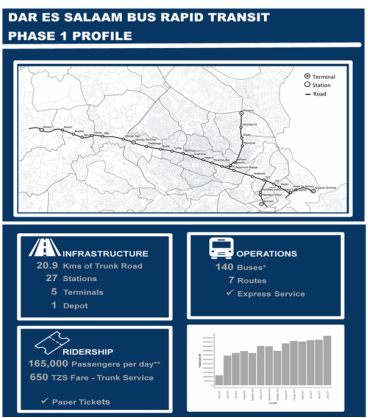
Figure 1. shows the phase 1 profile of Dar es Salaam Bus Rapid Transit.
While
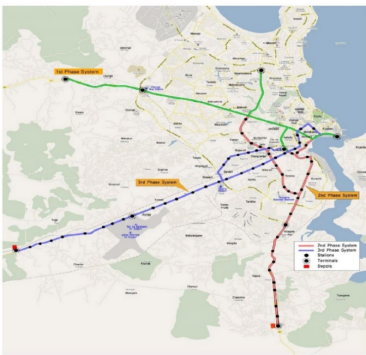
Figure 2 show the map of Dar es Salaam BRT for three routes ie phase one, phase two and phase three.
This research aims to undertake a comprehensive diagnostic assessment of the current operational performance of the Dar es Salaam Rapid Transit (DART) system, with particular emphasis on identifying the critical challenges that undermine its efficiency, reliability, and long-term sustainability. Establishing this assessment as a robust analytical baseline, the study systematically identifies, evaluates, and prioritizes context-appropriate Intelligent Transport Systems (ITS) solutions—including real-time passenger information systems, automated fare collection, and transit signal priority—carefully aligned with the city’s unique socio-economic, institutional, and infrastructural conditions. Building upon this prioritization, the research develops a pragmatic and phased implementation framework that outlines clearly defined short-, medium-, and long-term roadmaps for ITS integration, while explicitly accounting for existing financial, technical, and governance constraints as well as emerging opportunities within Dar es Salaam. The study ultimately advances a forward-looking impact assessment that examines and, where feasible, quantifies the anticipated multi-dimensional benefits of ITS adoption on the sustainability of the city’s urban transport system. These impacts include projected gains in operational and economic efficiency, improved cost recovery, enhanced commuter experience and social equity, and measurable environmental benefits through reduced emissions, optimized traffic flow, and improved system resilience.
2. Literature Review
2.1. Diagnostic Assessment and Strategic Framework for ITS Integration in DART
African cities require transport solutions that are high-capacity, affordable, and low-carbon. Conventional car-centric development, modeled on Western cities, is profoundly unsustainable in the African context
| [7] | Gwilliam, K. Africa's Transport Infrastructure: Mainstreaming Maintenance and Management. s.l.: World Bank, 2013. |
[7]
. It leads to crippling congestion, toxic air pollution, and deep social inequity, as the poor are priced out of mobility and spend a disproportionate amount of their income and time on inadequate transport.
In response, Bus Rapid Transit (BRT) systems have emerged as a leading solution, offering rail-like capacity and reliability at a fraction of the cost and implementation time
| [8] | Hildalgo, D., & Gutierrez, L. BRT and BHLS around world: Explosive growth, large positive impacts and many issues outstanding. 8-13, s.l.: Reseacher Transpostation Economics, 2013, Vol. 39(1). |
[8]
. The appeal of BRT lies in its core components: dedicated bus lanes that ensure speed and bypass traffic, off-board fare collection for faster boarding, platform-level boarding for accessibility, and clear routes and schedules. This creates a "surface subway" system that can move over 20,000 passengers per hour in each direction, directly addressing the capacity needs of densely populated corridors.
The Scale of the Urban Challenge
The urgency of this transition is underscored by Africa's unprecedented urbanization. Cities like Lagos, Kinshasa, and Dar es Salaam are among the fastest-growing in the world. This rapid growth is overwhelming existing, often informal, transport systems. The predominant use of privately operated minibuses (known as daladalas), while filling a critical gap, often results in chaotic, unsafe, and highly polluting services. The shift to formalized, high-quality mass transit is therefore not just a logistical improvement but a fundamental public health and economic necessity.
Beyond BRT: An Integrated Ecosystem
However, a single BRT line is not a panacea. The most successful cases, such as Lagos's BRT Lite system, demonstrate that BRT must be part of an integrated mobility ecosystem. This includes:
1) Feeder Systems - Formalized minibuses or smaller buses that bring passengers from neighborhoods to the high-capacity BRT trunk lines.
2) Active Mobility - Safe, dedicated infrastructure for walking and cycling, which are the primary modes of transport for a significant portion of the population, especially for the first and last mile of any journey.
3) Digital Integration - The use of mobile technology for unified ticketing, real-time arrival information, and ride-planning apps can seamlessly connect these different modes.
A Catalyst for Urban Development
Furthermore, sustainable mobility is a catalyst for broader urban development. By structuring growth along efficient transit corridors, cities can combat sprawl, promote higher-density, mixed-use neighborhoods, and increase land values. This creates opportunities for Transit-Oriented Development (TOD), where revenue from land value capture can be reinvested into the transit system itself, creating a virtuous cycle of investment and improvement.
Moreover, the imperative for sustainable urban mobility in Africa is clear. Moving away from car-centric models towards integrated, high-capacity systems like BRT is essential for building cities that are not only more efficient and less polluted but also more equitable and economically vibrant.
2.2. Bus Rapid Transit (BRT) as a Mass Transit Solution
A genuine Bus Rapid Transit (BRT) system is characterized by specific core components that collectively deliver high-capacity, metro-like service. The international standard, as defined by the Institute for Transportation and Development Policy (ITDP), mandates a combination of dedicated lanes, off-board fare collection, platform-level boarding, and efficient, high-frequency operations
| [9] | Institute of Transport and Development Policy. “The BRT Standards”. Available from:
https://www.itdp.org/2017/06/21/the-brt-standards/ [Accessed 21 June 2017]. |
| [10] | Brakewood, C., Watkins, K. A literature review of the passanger benefits of real time transit information. 201-225, s.l.: Transport Reviews, 2019, Vol. 39(2). |
[9, 10]
. The Dar es Salaam Rapid Transit (DART) system was conceptually designed in alignment with these principles, aiming to create a transformative public transport solution for the city.
However, the operational realities on the ground have led to significant deviations from these global best practices, creating a performance gap between the system's potential and its actual service delivery
| [2] | Shao, W. Assessing the Impact of Bus Rapid Trnsit on Urban Development in Dar es Salaam. 90, Dar es Salaam: Tanzania Journal of Transport Geography, 2021. 102922. |
[2]
. These deviations can be detailed as follows:
1) Compromised Dedicated Lanes: While DART has segregated trunk corridors, their exclusivity is often compromised. Traffic congestion, illegal parking, and incursions by private vehicles and informal par transit (like daladalas) into the BRT lanes are common, especially at intersections and during peak hours. This undermines the primary advantage of a BRT-unimpeded movement-leading to reduced speeds and schedule unreliability, which directly diminishes the system's capacity and appeal.
2) Inefficiencies in Fare Collection and Boarding: DART implemented a closed system with off-board fare collection at station turnstiles. While this aligns with the principle, operational challenges have emerged. The reliance on a single-trip paper ticket system, rather than a reusable smart card, creates friction and increases boarding times per passenger compared to more advanced electronic systems. Furthermore, although stations are designed for platform-level boarding, even minor gaps or inconsistencies between the platform and bus floors can slow down the process, particularly for passengers with disabilities, the elderly, and those with strollers or heavy luggage, negating the speed advantage of level boarding.
3) Insufficient Fleet and Operational Scale: A critical shortfall has been the chronic undersupply of buses relative to the planned operational scale. Pre-implementation models called for 177 trunk buses, but initial operations began with only 39, a figure that has remained insufficient to meet demand
| [6] | Morten, M., Bryan, G., Siddiqi, B., & Balboni, C. Evaluating the impact of Dar es Salaam Bus Rapid Transit System. Dar es Salaam: 3ie, 2020. https://doi.org/10.23846/DPW11E110 |
[6]
. This shortage leads to overcrowding at stations, longer wait times for passengers, and forces the system to operate at a fraction of its designed capacity. Consequently, many potential riders are discouraged from using the service, and the overall impact on urban mobility is diluted.
4) Incomplete Feeder Route Integration: The BRT's effectiveness is heavily dependent on a well-integrated feeder network that brings passengers from surrounding areas to the high-speed trunk corridors. In Dar es Salaam, many planned feeder routes have not been fully implemented or serviced reliably. This creates "first/last-mile" problems, limiting the system's catchment area and accessibility for a large portion of the population who cannot easily reach the trunk line stations.

 2.3. Intelligent Transport Systems (ITS) in Public Transport
 ITS encompasses a wide range of technologies.
Real-Time Passenger Information (RTPI): Provides users with arrival times via mobile apps, signage, and SMS, reducing perceived wait times and improving user experience (10). Automated Fare Collection (AFC): Smart cards or mobile payments streamline boarding, reduce revenue leakage, and provide valuable ridership data
| [11] | Pelletier, M. P., Trepanier, M., & Morency, C. Smart card data used in public transit: A literature review. 557-568, s.l.: Transport Research Part C, 2011, Vol. 19(4). |
[11]
. Transit Signal Priority (TSP): Grants green-light extensions or early greens to approaching buses, reducing journey time and improving schedule adherence
| [12] | Christofa, E., & Skabardonis, A. Traffic signal for full transit buses: A review of th literature and a case study. 1-9, s.l.: Transportation Research Record, 2011, Vol. 2255(1). |
[12]
. Fleet Management Systems (FMS): Use GPS and GIS to monitor vehicle location, speed, and idling, enabling dynamic scheduling and driver behavior monitoring
| [13] | Zannat, U. E., & Choudhury, C. F. Journal of Intelligent Transportation Systems. Emerging real-time transit data applications in public transportation: A review of literaturre and practice. 23(1), 2019, Vols. 1-17. |
[13]
.

 2.4. ITS in Developing World Contexts
 The transfer of Intelligent Transportation Systems (ITS) technology from developed to developing countries is not a simple transplantation; it requires significant contextual adaptation. While the potential benefits of improved efficiency, safety, and sustainability are universal, the path to implementation is fraught with unique socio-technical challenges.
Significant Implementation Hurdles
1) Financial and Technical Constraints: High initial capital investment for hardware, software, and infrastructure is a major barrier
| [14] | Goyal, S., & Pandey, M. Intelligent Transport Systems in India. In Proceedings of the 2019 IEEE. s.l.: IEEE, 2019. 4502-4507. |
[14]
. This is often compounded by a scarcity of local technical expertise for system installation, long-term maintenance, and troubleshooting, leading to risks of system failure and obsolescence.
2) Institutional and Regulatory Fragmentation: Urban transport planning is often siloed across multiple agencies (e.g., traffic police, road authorities, city councils, and private operators). This lack of a central, coordinating authority hinders the integrated data sharing and operational coordination that ITS relies upon
| [15] | Nkurunzinza, A., & Zuidgeest, M. Case Study of Transport Policy. The potential mobile applications for public transport in low-income countries: A case study ofnDar es Salaam. 8(2), 2020, Vols. 472-481. |
[15]
.
3) Socio-Economic and Digital Equity Concerns: The digital divide is a critical consideration. A singular focus on Smartphone-based applications can exclude low-income, elderly, or less tech-literate populations
| [14] | Goyal, S., & Pandey, M. Intelligent Transport Systems in India. In Proceedings of the 2019 IEEE. s.l.: IEEE, 2019. 4502-4507. |
[14]
. Furthermore, in contexts with a large informal cash-based economy, mandating digital payments can be disruptive without inclusive strategies.
The Leapfrogging Opportunity
Despite these challenges, the potential for technological "leapfrogging" is a compelling narrative. Developing nations can bypass legacy systems and adopt cutting-edge, context-appropriate solutions directly. The most prominent example is in Automated Fare Collection (AFC). While developed countries grappled with the transition from cash to magnetic stripe cards to contactless bank cards, cities in sub-Saharan Africa can leapfrog directly to mobile-money-based systems
| [4] | Jennings, G., & Rogan, A. Leapfrogging to Smart Mobility: Harnessing digital disruption in Africa transport. In Transport Mobility Futures in Africa. s.l.: Emerald Publishing Limited, 2021. |
[4]
. This leverages the existing, widespread penetration of mobile phones and the robust ecosystem of services like M-Pesa and Airtel Money, ensuring rapid public adoption and building on familiar technology.
Beyond Fare Collection: A Phased and Pragmatic Approach
The leapfrogging potential extends beyond AFC. Cloud-based ITS solutions can avoid costly on-premise server infrastructure, while open-source software can reduce licensing fees. The key to success lies in a phased, pragmatic approach:
1) Start with Core Systems: Prioritize foundational technologies that offer the highest immediate impact, such as AFC and basic Fleet Management Systems (FMS) for vehicle tracking.
2) Build Local Capacity: Invest in training local staff and fostering public-private partnerships to ensure sustainable operation and maintenance.
3) Design for Inclusivity: Ensure ITS solutions are multi-modal, offering options for both feature phones (e.g., USSD-based payments) and Smartphone to guarantee digital equity.
Therefore, successful ITS implementation in contexts like Dar es Salaam is less about adopting the most advanced technology and more about selecting the most appropriate technology that is affordable, sustainable, and inclusive, ultimately tailoring global innovations to local realities.
3. Case Study: The Dar es Salaam Rapid Transit System
3.1. Overview and Current Status
DART Phase 1, which became fully operational in 2016, represents a transformative investment in Dar es Salaam's urban infrastructure. The system runs along a 21.1 km dedicated corridor from the densely populated suburb of Kimara to the central business district of Kivukoni
| [16] | Agency, DART. DART System Overview. Dar es Salaam: Dar es Salaam Rapid Transit Agency, 2022. |
| [17] | Ahmed, S., Dey, K., & Tasnim, S. Journal of Traffic and Transportation Engineering. A comprehensive review of Intelligent Transport Systems for sustainable urban mobility. 7(4), 2020, Vols. 447-467. |
| [18] | Kanyama, A., Nassen, J., & Benders, R. Journal of Industrial Ecology. Shifting expenditure on food, holidays and furnishings could lower greenhouse gas by almost 40%. 25(6), 2021, Vols. 1602-1616. |
| [19] | Lupala, J. M. Urban types in rapidly urbanising cities: The case of Dar es Salaam, Tanzania. s.l.: KTH Royal Institute of Technology, 2002. |
| [20] | Moshi, I. J., & Mwasyete, C. F. African Journal of Economic Review. The role of mobile money in financial inclusion in Tanzania. 8(2), 2020, Vols. 1-16. |
| [21] | AfDB. Tanzania Dar es Salaam Bus Rapid Transit System Project-Phase 2 Appraisal Report. s.l.: African Development Bank, 2015. |
[16-21]
. This trunk line is supported by a network of complementary feeder routes that collect passengers from surrounding neighborhoods, channeling them into the main BRT system.
The system's infrastructure is designed for high efficiency, featuring:
Dedicated Lanes - Physically segregated bus-only lanes that ensure reliable travel times by avoiding general traffic congestion.
Modern Stations - Forty-eight (48) fully enclosed, elevated stations with pre-paid fare collection, level boarding, and basic passenger amenities.
Depots and Terminals - Key terminals at Kimara, Morocco, and Kivukoni facilitate passenger exchange, bus staging, and fleet maintenance.
DART operates a fleet of over 140 high-capacity, articulated and rigid buses, each with a passenger capacity ranging from 160 to 200 individuals. This robust fleet enables DART to serve an estimated 400,000 passengers on a typical weekday, a figure that underscores its critical role in the city's mobility landscape. The system has significantly reduced travel times along the corridor, with journeys that previously took over two hours in peak traffic now being completed in approximately 45 minutes.
Despite its remarkable success, the system faces operational challenges. High passenger demand often leads to overcrowding during peak hours, and bus bunching where multiple buses arrive simultaneously can occur due to traffic interference at non-segregated sections and payment delays. Furthermore, the reliance on a single, cash-based fare collection system presents inefficiencies in revenue management and passenger throughput. These challenges highlight the pressing need for the technological upgrades and strategic expansions discussed in the subsequent sections of this paper.
3.2. Identified Operational Challenges
Unpredictable Schedules: Lack of real-time data leads to bus bunching and long waits. Manual Fare Collection: Cash-based transactions slow boarding, create security risks, and enable revenue leakage. Traffic Signal Delays: Buses get caught at intersections, negating the speed advantage of dedicated lanes. Data Deficiency: Lack of accurate, granular data on ridership patterns hinders effective planning and expansion.
4. Proposed ITS Integration Framework for DART
A phased, modular approach is recommended to manage cost and complexity.
Phase 1: Foundation (Short-Term: 0-18 months)
Technology: GPS-enabled Fleet Management System (FMS) and mobile-based AFC integrated with Tanzania's prevalent mobile money platforms (e.g., M-Pesa, Tigo Pesa).
Rationale: Creates the data backbone for all other systems. Mobile-money AFC leverages existing infrastructure and user familiarity.
Key Stakeholders: DART Agency, bus operators, mobile network operators (MNOs).
Phase 2: Enhancement (Medium-Term: 18-36 months)
Technology: Real-Time Passenger Information (RTPI) displays at major stations and a public API for third-party app developers. Pilot Transit Signal Priority (TSP) on the most congested intersections.
Rationale: Builds directly on Phase 1 data. Dramatically improves the customer experience and operational reliability.
Key Stakeholders: Dar es Salaam City Council, Traffic Police, app developers.
Phase 3: Optimization (Long-Term: 36+ months)
Technology: Integrated Multi-Modal Ticketing (connecting BRT, daladalas, ferries), predictive analytics for demand-responsive scheduling, and advanced driver assistance systems (ADAS).
Rationale: Creates a truly seamless and efficient city-wide mobility ecosystem.
5. Discussion: Towards Sustainable Mobility
The integration of ITS promises multi-faceted benefits:
Economic Sustainability: AFC reduces revenue leakage. Efficiency gains lower operational costs per passenger. Reduced congestion boosts city-wide productivity.
Social Sustainability: RTPI empowers users and makes the system more accessible. Shorter, more reliable travel times improve quality of life. Safety can be enhanced through better monitoring.
Environmental Sustainability: Efficient operations and TSP reduce fuel consumption and greenhouse gas emissions. By making public transport more attractive, ITS can catalyze a modal shift from private vehicles.
Challenges and Mitigation: Key hurdles include funding (potential for public-private partnerships), institutional coordination, cyber security of systems, and ensuring digital inclusion for all segments of society.
6. Conclusion and Recommendations
6.1. Conclusion
The DART BRT system has laid a critical foundation for structured public transport in Dar es Salaam. However, to future-proof the system and maximize its contribution to urban sustainability, embracing technology is non-negotiable. This paper has outlined a feasible pathway for integrating ITS, starting with core foundational technologies like FMS and mobile-money AFC.
The strategic implementation of these systems will generate a virtuous cycle of improvement: the data harvested from electronic fares and vehicle tracking will enable dynamic scheduling and reduce bus bunching, leading to greater reliability.
This improved service, coupled with real-time passenger information accessible via mobile phones, will enhance the user experience and attract higher ridership. Ultimately, this technological transformation will solidify DART's role as the efficient and reliable backbone of a comprehensive, multi-modal transport network for Dar es Salaam, reducing congestion, lowering emissions, and fostering more equitable urban mobility.
6.2. Recommendations
For the DART Agency: Develop a formal ITS Strategy and seek strategic partnerships with technology providers and MNOs.
For Policymakers: Create a supportive regulatory environment for data sharing and integrated ticketing across different transport modes.
For Researchers: Conduct further studies on the specific willingness-to-pay for ITS-enhanced services and the impact of TSP on mixed traffic in Dar es Salaam's unique road environment.
By proactively pursuing this technological integration, Dar es Salaam can transform DART from a transport project into an intelligent mobility network, serving as a beacon for other African cities on the path to sustainable urban development.
Abbreviations
DART | Dar es Salaam Rapid Transit |
BRT | Bus Rapid Transit |
ITS | Intelligent Transport System |
ADAS | Advanced Driver Assistance Systems |
ICT | Information and Communication Technology |
ITDP | Institute for Transportation and Development Policy |
RTPI | Real-Time Passenger Information |
AFS | Automated Fare Collection |
TSP | Transit Signal Priority |
FMS | Fleet Management Systems |
Author Contributions
Mazuri Erasto Lutema: Conceptualization, Data curation, Investigation, Methodology, Resources, Writing – original draft, Writing – review & editing
Funding
The authors have no funding to declare.
Conflicts of Interest
The authors have no competing interests to disclose.
References
| [1] |
Diaz, R. B, Ochieng, W. Y. & Schuster, W. Urban Transport Challanges in Developing Countries: The Case Study of Dar es Salaam. Dar es Salaam: Tanzania Journal of Transport and Land Use, 2019, Vol. 12(1). 455-473.
|
| [2] |
Shao, W. Assessing the Impact of Bus Rapid Trnsit on Urban Development in Dar es Salaam. 90, Dar es Salaam: Tanzania Journal of Transport Geography, 2021. 102922.
|
| [3] |
Sitoki, L. Githira, D. & Mbeche, R. Operation challanges facing Bus Rapid Transit systems in developing countries: Lessons from Dar es Salaam. 40-60, Dar es Salaam: Tanzania African Journal of Transport Studies, 2022, Vol. 5(1).
|
| [4] |
Jennings, G., & Rogan, A. Leapfrogging to Smart Mobility: Harnessing digital disruption in Africa transport. In Transport Mobility Futures in Africa. s.l.: Emerald Publishing Limited, 2021.
|
| [5] |
Clare Balboni et al. Dar es Salaam Bus Rapid Transit Impact Evalution: Policy Brief. Wahington DC: World Bank, 2019.
|
| [6] |
Morten, M., Bryan, G., Siddiqi, B., & Balboni, C. Evaluating the impact of Dar es Salaam Bus Rapid Transit System. Dar es Salaam: 3ie, 2020.
https://doi.org/10.23846/DPW11E110
|
| [7] |
Gwilliam, K. Africa's Transport Infrastructure: Mainstreaming Maintenance and Management. s.l.: World Bank, 2013.
|
| [8] |
Hildalgo, D., & Gutierrez, L. BRT and BHLS around world: Explosive growth, large positive impacts and many issues outstanding. 8-13, s.l.: Reseacher Transpostation Economics, 2013, Vol. 39(1).
|
| [9] |
Institute of Transport and Development Policy. “The BRT Standards”. Available from:
https://www.itdp.org/2017/06/21/the-brt-standards/
[Accessed 21 June 2017].
|
| [10] |
Brakewood, C., Watkins, K. A literature review of the passanger benefits of real time transit information. 201-225, s.l.: Transport Reviews, 2019, Vol. 39(2).
|
| [11] |
Pelletier, M. P., Trepanier, M., & Morency, C. Smart card data used in public transit: A literature review. 557-568, s.l.: Transport Research Part C, 2011, Vol. 19(4).
|
| [12] |
Christofa, E., & Skabardonis, A. Traffic signal for full transit buses: A review of th literature and a case study. 1-9, s.l.: Transportation Research Record, 2011, Vol. 2255(1).
|
| [13] |
Zannat, U. E., & Choudhury, C. F. Journal of Intelligent Transportation Systems. Emerging real-time transit data applications in public transportation: A review of literaturre and practice. 23(1), 2019, Vols. 1-17.
|
| [14] |
Goyal, S., & Pandey, M. Intelligent Transport Systems in India. In Proceedings of the 2019 IEEE. s.l.: IEEE, 2019. 4502-4507.
|
| [15] |
Nkurunzinza, A., & Zuidgeest, M. Case Study of Transport Policy. The potential mobile applications for public transport in low-income countries: A case study ofnDar es Salaam. 8(2), 2020, Vols. 472-481.
|
| [16] |
Agency, DART. DART System Overview. Dar es Salaam: Dar es Salaam Rapid Transit Agency, 2022.
|
| [17] |
Ahmed, S., Dey, K., & Tasnim, S. Journal of Traffic and Transportation Engineering. A comprehensive review of Intelligent Transport Systems for sustainable urban mobility. 7(4), 2020, Vols. 447-467.
|
| [18] |
Kanyama, A., Nassen, J., & Benders, R. Journal of Industrial Ecology. Shifting expenditure on food, holidays and furnishings could lower greenhouse gas by almost 40%. 25(6), 2021, Vols. 1602-1616.
|
| [19] |
Lupala, J. M. Urban types in rapidly urbanising cities: The case of Dar es Salaam, Tanzania. s.l.: KTH Royal Institute of Technology, 2002.
|
| [20] |
Moshi, I. J., & Mwasyete, C. F. African Journal of Economic Review. The role of mobile money in financial inclusion in Tanzania. 8(2), 2020, Vols. 1-16.
|
| [21] |
AfDB. Tanzania Dar es Salaam Bus Rapid Transit System Project-Phase 2 Appraisal Report. s.l.: African Development Bank, 2015.
|
Cite This Article
-
APA Style
Lutema, M. E., Julius, E., Nyangasa, F. (2026). Integrating Intelligent Transport Systems (ITS) for Sustainable Urban Mobility: A Case Study of Dar es Salaam, Tanzania's Bus Rapid Transit. International Journal of Transportation Engineering and Technology, 12(1), 49-56. https://doi.org/10.11648/j.ijtet.20261201.15
 Copy
|
Copy
|
 Download
ACS Style
Lutema, M. E.; Julius, E.; Nyangasa, F. Integrating Intelligent Transport Systems (ITS) for Sustainable Urban Mobility: A Case Study of Dar es Salaam, Tanzania's Bus Rapid Transit. Int. J. Transp. Eng. Technol. 2026, 12(1), 49-56. doi: 10.11648/j.ijtet.20261201.15
Copy
|
Download
AMA Style
Lutema ME, Julius E, Nyangasa F. Integrating Intelligent Transport Systems (ITS) for Sustainable Urban Mobility: A Case Study of Dar es Salaam, Tanzania's Bus Rapid Transit. Int J Transp Eng Technol. 2026;12(1):49-56. doi: 10.11648/j.ijtet.20261201.15
Copy
|
Download
-
@article{10.11648/j.ijtet.20261201.15,
  author = {Mazuri Erasto Lutema and Edward Julius and Faraja Nyangasa},
  title = {Integrating Intelligent Transport Systems (ITS) for Sustainable Urban Mobility: A Case Study of Dar es Salaam, Tanzania's Bus Rapid Transit},
  journal = {International Journal of Transportation Engineering and Technology},
  volume = {12},
  number = {1},
  pages = {49-56},
  doi = {10.11648/j.ijtet.20261201.15},
  url = {https://doi.org/10.11648/j.ijtet.20261201.15},
  eprint = {https://article.sciencepublishinggroup.com/pdf/10.11648.j.ijtet.20261201.15},
  abstract = {Dar es Salaam, Tanzania’s commercial capital, continues to experience severe urban mobility challenges driven by rapid population growth, increasing motorization, and limited transport infrastructure capacity. These challenges manifest in chronic traffic congestion, environmental degradation, productivity losses, and reduced quality of urban life. The introduction of the Dar es Salaam Rapid Transit (DART) Bus Rapid Transit (BRT) system represented a critical intervention aimed at providing high-capacity and affordable public transport. However, despite its success in reducing travel times along key corridors, the system continues to face operational inefficiencies that constrain its long-term sustainability and scalability. This study investigates the potential role of Intelligent Transport Systems (ITS) in enhancing the operational performance and sustainability of the DART BRT system. Using a mixed-methods approach, the research combines a diagnostic assessment of existing operational challenges within DART, a comparative analysis of ITS-enabled public transport systems in selected cities, and a stakeholder-oriented contextual evaluation. Key ITS components examined include Real-Time Passenger Information (RTPI), Automated Fare Collection (AFC), Transit Signal Priority (TSP), and fleet management systems. Based on the findings, the study proposes a phased and context-sensitive ITS integration framework tailored to Dar es Salaam’s socio-economic, institutional, and infrastructural conditions. The results indicate that strategic ITS adoption can significantly improve service reliability, operational efficiency, passenger satisfaction, data-driven decision-making, and financial sustainability, while also contributing to reduced emissions and enhanced social equity. The study concludes that ITS integration should be viewed not merely as a technological enhancement, but as a critical enabler for sustainable urban mobility. The proposed framework offers a replicable model for other rapidly urbanizing cities in Sub-Saharan Africa seeking to modernize public transport systems through intelligent, inclusive, and scalable solutions.},
 year = {2026}
}
Copy
|
Download
-
TY  - JOUR
T1  - Integrating Intelligent Transport Systems (ITS) for Sustainable Urban Mobility: A Case Study of Dar es Salaam, Tanzania's Bus Rapid Transit
AU  - Mazuri Erasto Lutema
AU  - Edward Julius
AU  - Faraja Nyangasa
Y1  - 2026/03/26
PY  - 2026
N1  - https://doi.org/10.11648/j.ijtet.20261201.15
DO  - 10.11648/j.ijtet.20261201.15
T2  - International Journal of Transportation Engineering and Technology
JF  - International Journal of Transportation Engineering and Technology
JO  - International Journal of Transportation Engineering and Technology
SP  - 49
EP  - 56
PB  - Science Publishing Group
SN  - 2575-1751
UR  - https://doi.org/10.11648/j.ijtet.20261201.15
AB  - Dar es Salaam, Tanzania’s commercial capital, continues to experience severe urban mobility challenges driven by rapid population growth, increasing motorization, and limited transport infrastructure capacity. These challenges manifest in chronic traffic congestion, environmental degradation, productivity losses, and reduced quality of urban life. The introduction of the Dar es Salaam Rapid Transit (DART) Bus Rapid Transit (BRT) system represented a critical intervention aimed at providing high-capacity and affordable public transport. However, despite its success in reducing travel times along key corridors, the system continues to face operational inefficiencies that constrain its long-term sustainability and scalability. This study investigates the potential role of Intelligent Transport Systems (ITS) in enhancing the operational performance and sustainability of the DART BRT system. Using a mixed-methods approach, the research combines a diagnostic assessment of existing operational challenges within DART, a comparative analysis of ITS-enabled public transport systems in selected cities, and a stakeholder-oriented contextual evaluation. Key ITS components examined include Real-Time Passenger Information (RTPI), Automated Fare Collection (AFC), Transit Signal Priority (TSP), and fleet management systems. Based on the findings, the study proposes a phased and context-sensitive ITS integration framework tailored to Dar es Salaam’s socio-economic, institutional, and infrastructural conditions. The results indicate that strategic ITS adoption can significantly improve service reliability, operational efficiency, passenger satisfaction, data-driven decision-making, and financial sustainability, while also contributing to reduced emissions and enhanced social equity. The study concludes that ITS integration should be viewed not merely as a technological enhancement, but as a critical enabler for sustainable urban mobility. The proposed framework offers a replicable model for other rapidly urbanizing cities in Sub-Saharan Africa seeking to modernize public transport systems through intelligent, inclusive, and scalable solutions.
VL  - 12
IS  - 1
ER  -
Copy
|
Download







 Share This Article
 Twitter
 Linked In
 Facebook