
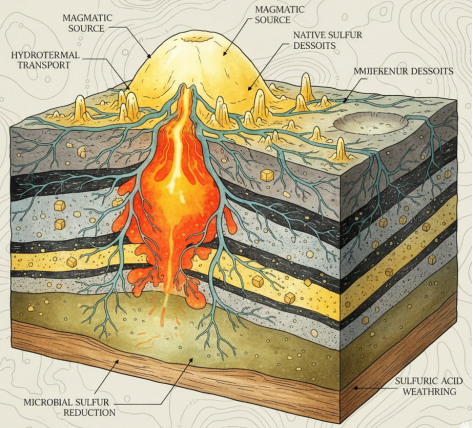
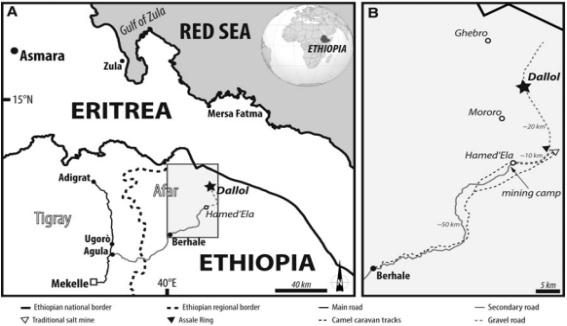
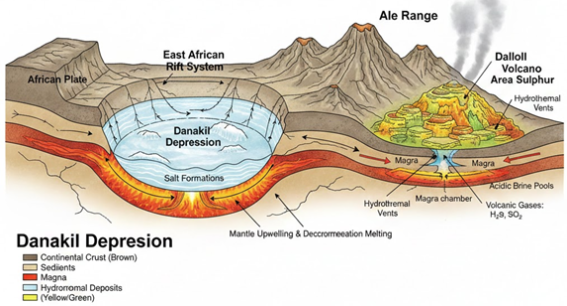
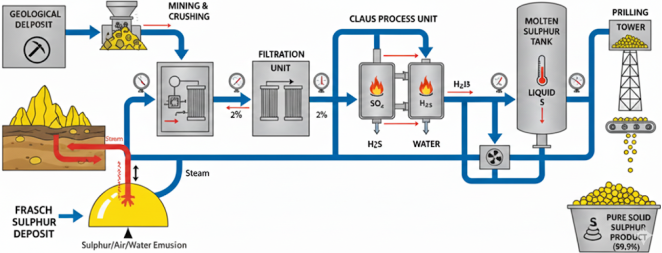
The geological architecture of the East African Rift System, specifically within the Afar Triple Junction and the Main Ethiopian Rift, provides a unique tectono-magmatic environment for the formation of extensive volcanogenic sulphur deposits. This review synthesizes the geochemical characteristics and potential processing pathways for Ethiopia’s dormant sulphur resources, which are becoming strategically vital as the nation seeks to mitigate its 100% dependency on mineral imports for its agricultural and industrial sectors. Current assessments identify significant native sulphur reserves at Dallol (7 million tons) and Dofan/Chebrit Ale (6 million tons), alongside over 2.5 billion tons of inferred mixed sulphates in the Danakil Basin. Geochemical investigations, supported by stable sulphur isotope systematics (δ34S), reveal a polygenetic origin for these deposits: primary magmatic degassing of H2S and SO2 at centers like Erta Ale (δ34S) of -0.5‰ to +0.9‰) contrasts with complex hydrothermal recycling and bacterial sulphate reduction in evaporitic sequences. While the study evaluates the technical feasibility of extraction methods including the Frasch process, froth flotation, and solvent extraction it notes that these pathways, despite recovery efficiencies exceeding 90%, must be meticulously adapted to the hyper-arid, high-enthalpy conditions of the Ethiopian Rift. Ultimately, the integration of domestic sulphur recovery with existing geothermal energy projects is proposed as a critical step toward establishing a self-sustaining industrial ecosystem. By addressing existing knowledge gaps in pilot-scale validation and environmental lifecycle assessments, Ethiopia can leverage its volcanic heritage to ensure national food security and regional economic influence.
| Published in | Journal of Energy, Environmental & Chemical Engineering (Volume 11, Issue 1) |
| DOI | 10.11648/j.jeece.20261101.13 |
| Page(s) | 28-37 |
| Creative Commons |
This is an Open Access article, distributed under the terms of the Creative Commons Attribution 4.0 International License (http://creativecommons.org/licenses/by/4.0/), which permits unrestricted use, distribution and reproduction in any medium or format, provided the original work is properly cited. |
| Copyright |
Copyright © The Author(s), 2026. Published by Science Publishing Group |
Sulphur Recovery, Geochemistry, Isotope Fractionation, Frasch Process, Fertilizer Industry, Hydrothermal Mineralization
Deposit Location | Estimated Tonnage | Mineral Type | Geological Setting | Resource Status |
|---|---|---|---|---|
Danakil Basin (General) | ~2.54 Billion | Mixed Sulphates/Potash | Evaporitic Sequence | Inferred Resource |
Dallol / Assale | ~1,200 - 7M | Native Sulphur (S0) | Hydrothermal Dome | Indicated / Inferred |
Dofan & Chebrit Ale | ~6 Million | Native Sulphur (S0) | Volcanic Fumarolic | Indicated Resource |
Zariga & Inkafala | ~200,000+ | Native Sulphur / Mn | Hydrothermal / Rift | Exploration Stage |
Meli / Tigray Range | Significant | Volcanogenic Massive Sulphides (VMS) | Neoproterozoic Basement | Active Prospecting |
National (Gypsum) | ~57.4 Million | Gypsum / Anhydrite | Sedimentary Basins | Proved / Measured |
Deposit Location | Estimated Reserves (Metric Tons) | Geological Context | Observed Sulfur Form |
|---|---|---|---|
Dallol | ~7,000,000 | Hydrothermal field in thick evaporites | Mounds, precipitates, fumarolic crusts |
Dofan and Chebrit Ale | ~6,000,000 | Rhyolitic shield volcano; flank craters Volcanic-sedimentary interface | Fumarolic sulfur, steam deposits Native sulfur in evaporite sequences |
Non-Volcanic Areas | Significant (Unquantified) | Mesozoic and Tertiary sediments | Gypsum, Anhydrite, Kieserite |
Trace Element | Concentration/Prevalence | Implications |
|---|---|---|
Arsenic (As) | Up to 405 mg/L in Rift surface waters | High toxicity; human health risk (arsenicosis) |
Nickel (Ni) | Average 106.3 mg/L in tailings water | Exceeds WHO drinking water guidelines |
Lead (Pb) | Up to 24.6 mg/L in community wells | Geogenic and mining-related contamination |
Selenium (Se) | Present in mafic-associated sulfides | High Co, Ni, and Se in specific massive sulfides |
Aluminum (Al) | 30% of samples above MAC | High concentration in acid mine drainage areas |
Economic Factor | Impact of Domestic Production | Strategic Value |
|---|---|---|
Foreign Exchange | Conservation of hard currency reserves | Reduces pressure on national currency [5] |
Fertilizer Cost | Lower farm-gate prices for farmers | Enhances agricultural productivity and food self-sufficiency [2] |
Industrial Base | Growth of sulfuric acid and chemical plants | Facilitates broader industrial modernization [5] |
Regional Trade | Export potential to the Horn of Africa | Strengthens fertilizer diplomacy and regional influence [5] |
ICP-MS | Inductively Coupled Plasma Mass Spectrometry |
AAS | Atomic Absorption Spectrometry |
G-IRMS | Gas Source Isotope Ratio Mass Spectrometry |
SIMS | Secondary Ion Mass Spectrometry |
VCDT | Vienna Canyon Diablo Troilite |
XRD | X-ray Diffraction |
SEM-EDS | Scanning Electron Microscopy with Energy-Dispersive X-ray Spectroscopy |
GIS | Geographic Information Systems |
EGI | Ethiopian Geological Institute |
TOC | Total Organic Carbon |
PASDEP | Plan for Accelerated and Sustained Development to End Poverty |
| [1] | Britannica, The Editors of Encyclopaedia. "Frasch process." Encyclopedia Britannica. Last modified January 9, 2026. |
| [2] |
UNIDO. Indicative Programme for the Integrated Development of the Fertilizer Industrial System in Ethiopia. January 9, 2026.
https://downloads.unido.org/ot/48/40/4840899/15001-20000_18463 |
| [3] | Battaglia, Stefano, Anna Gioncada, and Renzo Mazzuoli. "The Volcanic History of the Dofan-Fantale Magmatic Segment (Main Ethiopian Rift): Implications for the Transition from Continental Rifting to Seafloor Spreading." Journal of African Earth Sciences 59, no. 4-5 (2011): 329–346. |
| [4] | Darrah, Thomas H., Dario Tedesco, Franco Tassi, Orlando Vaselli, Elena Cuoco, and Robert J. Poreda. "Gas Chemistry of the Dallol Region of the Danakil Depression in the Afar Region of Ethiopia." Chemical Geology 339 (2013): 133–144. |
| [5] | Horn Review. "Fertilizer Diplomacy: Ethiopia's Strategic Turn Toward Domestic Production and Regional Influence." Horn Review, July 08, 2025. |
| [6] |
IUGS Geological Heritage Sites. "The Danakil Rift Depression and its Volcanism." Accessed January 9, 2026.
https://iugs-geoheritage.org/geoheritage-sites/the-danakil-rift-depression-and-its-volcanism/ |
| [7] | Techane, G., B. Gebremedhin, T. Woldearegay, and S. Tesfaye. "Assessment of Volcanogenic Sulphur Resource Potential in the Ethiopian Rift." Innovation 6, no. 4 (2025): 165–170. |
| [8] | Shahrood, M. J. "Assessing Structural Challenges in Potash Mining." Journal of Mining and Environment. Accessed January 9, 2026. |
| [9] | Kotopoulou, E., D. Amairou, E. Gatzia, J. M. López-García, and F. García-Ruiz. "A Polyextreme Hydrothermal System Controlled by Iron: The Case of Dallol at the Afar Triangle." ACS Earth and Space Chemistry 3, no. 1 (2018): 90–99. |
| [10] | López-García, J. M., D. Amairou, E. Gatzia, E. Kotopoulou, and F. García-Ruiz. "Origin and Evolution of the Halo-Volcanic Complex of Dallol: Proto-Volcanism in Northern Afar." Frontiers in Earth Science 7 (2020). |
| [11] | Tesfaye, S., D. J. Harding, and T. M. Kusky. "Early Continental Breakup Boundary and Migration of the Afar Triple Junction, Ethiopia." Geological Society of America Bulletin 115, no. 9 (2003): 1053–1067. |
| [12] | Ethiopian Investment Commission. "Mineral and Mining Investment Profile." Addis Ababa, Ethiopia, 2024. |
| [13] | Hagos, M. G. "Geochemical Characterization of Native Sulfur Deposits in the Northern Afar Rift." Ethiopian Journal of Earth Sciences 14, no. 2 (2024): 112–125. |
| [14] | Ministry of Mines and Petroleum. "Annual Mineral Trade and Requirement Report." Technical Report 2024-01. Ethiopia, January 2024. |
| [15] | Gebresilassie, S., H. Tsegab, and K. Kabeto. "Preliminary Study on Geology, Mineral Potential and Characteristics of Hot Springs from Dallol Area, Afar Rift, Northeastern Ethiopia: Implications for Natural Resource Exploration." Momona Ethiopian Journal of Science 3, no. 2 (2011): 17–44. |
| [16] | Seal, Robert R. "Sulfur Isotope Geochemistry of Sulfide Minerals." Reviews in Mineralogy and Geochemistry 61, no. 1 (2006): 633–677. |
| [17] | Seal, Robert R. "Sulfur Isotope Geochemistry of Sulfide Minerals." USGS Staff Publications, paper 1354 (2006). |
| [18] | Cavalazzi, B., R. Barbieri, S. L. Cady, G. G. Melaku, and L. Coscieme. "The Dallol Geothermal Area, Northern Afar (Ethiopia): An Exceptional Planetary Field Analog on Earth." Astrobiology 19, no. 4 (2019): 553–578. |
| [19] | Wikipedia. "Frasch process." Last modified January 9, 2026. |
| [20] | Al-Lami, H. "Recovery of Pure Sulfur from Residual Foam at Al-Mishraq Sulfur Plant-Iraq by Solvent Extraction." Egyptian Journal of Petroleum 26, no. 3 (2017): 607–612. |
| [21] | Gebre-Mariam, K. S. "Geology of Volcanogenic Massive Sulfide Deposit near Meli, Northwestern Tigray, Northern Ethiopia." ResearchGate. Accessed January 9, 2026. |
| [22] | Tykhyi, O., V. Goshovska, I. Semenova, and Y. Khomenko. "Issues of the Impact of Granulated Sulfur Transportation on the Environmental Components." Journal of Ecological Engineering 24, no. 3 (2023): 138–147. |
| [23] | Wikipedia. "Dallol (hydrothermal system)." Last modified January 9, 2026. |
| [24] | Oppenheimer, C., P. Fischer, and B. Scaillet. "Sulfur Degassing at Erta Ale (Ethiopia) and Masaya (Nicaragua) Volcanoes: Implications for Degassing Processes and Oxygen Fugacities of Basaltic Systems." Journal of Geophysical Research: Solid Earth 111, no. B5 (2006). |
| [25] | Melaku, G. G., S. Gebresilassie, and H. Tsegab. "Trace Elements Geochemistry in High-Incidence Areas of Liver-Related Diseases, Northwestern Ethiopia." Scientific Reports 10, no. 1 (2020). |
| [26] | Melaku, T. S., W. S. Yohannes, and M. G. Hagos. "Metal Contamination of the Environment by Placer and Primary Gold Mining in the Adola Region of Southern Ethiopia." Environmental Geochemistry and Health 25 (2003): 285–298. |
| [27] | Gebresilassie, S. "Sulfur and Salt Deposits from the Crater on Top of Mount Dallol." ResearchGate. Accessed January 9, 2026. |
| [28] | World Bank. Environmental and Social Management Framework (E4392-V1). World Bank Documents, January 9, 2026. |
| [29] |
Metallurgist. "SRU Sulphur Recovery Process." Metallurgist Blog. Accessed January 9, 2026.
https://www.911metallurgist.com/blog/sru-sulphur-recovery-process/ |
| [30] | Walsh, D. E., and P. D. Rao. "Hydrometallurgy Process Development." MIRL Report No. 81. University of Alaska Fairbanks, 1988. |
| [31] |
Brilliant Ethiopia. "Danakil Depression." Accessed January 9, 2026.
https://www.brilliant-ethiopia.com/regions/danakil-depression |
| [32] | Beyene, D. "Assessment of Heavy Metal Pollution Associated with Tailing Dam in Gold Mining Area, Southern Ethiopia." ResearchGate, December 2022. |
| [33] | Liu, J., K. Wu, J. Zhang, and X. Li. "Cd Accumulation and Phytostabilization Potential of Dominant Plants Surrounding Mining Tailings." ResearchGate. Accessed January 9, 2026. |
| [34] | De Natale, G. "The 'Valle del Sabato' and the Sulphur Mines of Tufo and Altavillairpina." European Scientific Journal 10, no. 12 (2014). |
| [35] | Richards, R. W., and J. H. Bridges. "Sulphur and Pyrite." USGS Bulletin 530-H (1913). |
| [36] | Gebru, T. B. "Sub-surface Geology, Hydrothermal Alteration and 3D Modelling of Wells LA-9D and LA-10D in the Aluto Langano Geothermal Field, Ethiopia." UNU-GTP, Rep. 6 (2016). |
| [37] | JICA. The Project for Formulating Master Plan on Development of Geothermal Energy in Ethiopia: Final Report. Japan International Cooperation Agency, 2015. |
APA Style
Tesfaye, W. (2026). A Review of the Geochemistry and Processing Pathways for Sulphur Recovery from Ethiopian Volcanic Deposits. Journal of Energy, Environmental & Chemical Engineering, 11(1), 28-37. https://doi.org/10.11648/j.jeece.20261101.13
ACS Style
Tesfaye, W. A Review of the Geochemistry and Processing Pathways for Sulphur Recovery from Ethiopian Volcanic Deposits. J. Energy Environ. Chem. Eng. 2026, 11(1), 28-37. doi: 10.11648/j.jeece.20261101.13
@article{10.11648/j.jeece.20261101.13,
  author = {Wakjira Tesfaye},
  title = {A Review of the Geochemistry and Processing Pathways for Sulphur Recovery from Ethiopian Volcanic Deposits},
  journal = {Journal of Energy, Environmental & Chemical Engineering},
  volume = {11},
  number = {1},
  pages = {28-37},
  doi = {10.11648/j.jeece.20261101.13},
  url = {https://doi.org/10.11648/j.jeece.20261101.13},
  eprint = {https://article.sciencepublishinggroup.com/pdf/10.11648.j.jeece.20261101.13},
  abstract = {The geological architecture of the East African Rift System, specifically within the Afar Triple Junction and the Main Ethiopian Rift, provides a unique tectono-magmatic environment for the formation of extensive volcanogenic sulphur deposits. This review synthesizes the geochemical characteristics and potential processing pathways for Ethiopia’s dormant sulphur resources, which are becoming strategically vital as the nation seeks to mitigate its 100% dependency on mineral imports for its agricultural and industrial sectors. Current assessments identify significant native sulphur reserves at Dallol (7 million tons) and Dofan/Chebrit Ale (6 million tons), alongside over 2.5 billion tons of inferred mixed sulphates in the Danakil Basin. Geochemical investigations, supported by stable sulphur isotope systematics (δ34S), reveal a polygenetic origin for these deposits: primary magmatic degassing of H2S and SO2 at centers like Erta Ale (δ34S) of -0.5‰ to +0.9‰) contrasts with complex hydrothermal recycling and bacterial sulphate reduction in evaporitic sequences. While the study evaluates the technical feasibility of extraction methods including the Frasch process, froth flotation, and solvent extraction it notes that these pathways, despite recovery efficiencies exceeding 90%, must be meticulously adapted to the hyper-arid, high-enthalpy conditions of the Ethiopian Rift. Ultimately, the integration of domestic sulphur recovery with existing geothermal energy projects is proposed as a critical step toward establishing a self-sustaining industrial ecosystem. By addressing existing knowledge gaps in pilot-scale validation and environmental lifecycle assessments, Ethiopia can leverage its volcanic heritage to ensure national food security and regional economic influence.},
 year = {2026}
}
TY  - JOUR
T1  - A Review of the Geochemistry and Processing Pathways for Sulphur Recovery from Ethiopian Volcanic Deposits
AU  - Wakjira Tesfaye
Y1  - 2026/02/21
PY  - 2026
N1  - https://doi.org/10.11648/j.jeece.20261101.13
DO  - 10.11648/j.jeece.20261101.13
T2  - Journal of Energy, Environmental & Chemical Engineering
JF  - Journal of Energy, Environmental & Chemical Engineering
JO  - Journal of Energy, Environmental & Chemical Engineering
SP  - 28
EP  - 37
PB  - Science Publishing Group
SN  - 2637-434X
UR  - https://doi.org/10.11648/j.jeece.20261101.13
AB  - The geological architecture of the East African Rift System, specifically within the Afar Triple Junction and the Main Ethiopian Rift, provides a unique tectono-magmatic environment for the formation of extensive volcanogenic sulphur deposits. This review synthesizes the geochemical characteristics and potential processing pathways for Ethiopia’s dormant sulphur resources, which are becoming strategically vital as the nation seeks to mitigate its 100% dependency on mineral imports for its agricultural and industrial sectors. Current assessments identify significant native sulphur reserves at Dallol (7 million tons) and Dofan/Chebrit Ale (6 million tons), alongside over 2.5 billion tons of inferred mixed sulphates in the Danakil Basin. Geochemical investigations, supported by stable sulphur isotope systematics (δ34S), reveal a polygenetic origin for these deposits: primary magmatic degassing of H2S and SO2 at centers like Erta Ale (δ34S) of -0.5‰ to +0.9‰) contrasts with complex hydrothermal recycling and bacterial sulphate reduction in evaporitic sequences. While the study evaluates the technical feasibility of extraction methods including the Frasch process, froth flotation, and solvent extraction it notes that these pathways, despite recovery efficiencies exceeding 90%, must be meticulously adapted to the hyper-arid, high-enthalpy conditions of the Ethiopian Rift. Ultimately, the integration of domestic sulphur recovery with existing geothermal energy projects is proposed as a critical step toward establishing a self-sustaining industrial ecosystem. By addressing existing knowledge gaps in pilot-scale validation and environmental lifecycle assessments, Ethiopia can leverage its volcanic heritage to ensure national food security and regional economic influence.
VL  - 11
IS  - 1
ER  -
Ethiopian Mineral Industry Development Institute, Ministry of Mines, Addis Ababa, Ethiopia

Information



 Share This Article
 Twitter
 Linked In
 Facebook
 Copy
Copy Download