Research Article | | Peer-Reviewed

Performance of Mixed Solar Dryer for Meat in the Sahel Area of Niger

Received: 3 February 2026     Accepted: 16 March 2026     Published: 28 March 2026
Views:       Downloads:
Abstract

In this article, we investigate the possibility of improving the performance of a mixed solar dryer designed for meat drying. The drying process takes place under an average ambient temperature of 35.5°C. The maximum solar radiation intensities recorded during the two test days were 999 W/m² and 1072 W/m², respectively. The average solar radiation measured between 9:00 a.m. and 4:00 p.m. during the test days was 841.91 W/m². The experiments were conducted on fresh meat over two (2) days. On the first day, the mass of fresh meat, or initial mass (min), was 32.9 kg. At the end of drying, the final mass (mf) was 9.03 kg, corresponding to a mass reduction rate (MRR) of 72.5%. On the second day, the initial mass (min) was 30 kg, and after drying, the final mass (mf) was 9.90 kg, corresponding to a mass reduction rate (MRR) of 67%. To ensure proper drying, the meat was cut and spread to a thickness of 0.5 cm. The loaded test results indicate a temperature range between 33°C and 68°C, with an average drying temperature of 50.5°C across the different tray levels inside the dryer. An average air velocity of 1.8 m/s was recorded at the inlet and 6 m/s at the outlet. The exact drying time was 3 hours.

Published in Journal of Energy and Natural Resources (Volume 15, Issue 1)
DOI 10.11648/j.jenr.20261501.15
Page(s) 33-44
Creative Commons

This is an Open Access article, distributed under the terms of the Creative Commons Attribution 4.0 International License (http://creativecommons.org/licenses/by/4.0/), which permits unrestricted use, distribution and reproduction in any medium or format, provided the original work is properly cited.

Copyright

Copyright © The Author(s), 2026. Published by Science Publishing Group

Keywords

Contribution, Drying, Mixed Dryer, Drying Time, Performance, Climatic Parameters

1. Introduction
Drying is a process that removes almost all the water contained in a wet product by evaporation using solar radiation . Drying is carried out either in the open air or in a solar dryer. The latter is used both in rural areas and in the industrial sector, particularly in industry, agribusiness, textiles, etc.
The dryer is constructed using locally available tools and materials and can operate by natural or forced convection . It is equipped with instruments to measure the most important climatic parameters influencing its performance, namely ambient temperature, relative humidity, wind speed at the dryer inlet, wind speed at the dryer outlet, and global radiation on a horizontal plane. To date, the drying of agrifood products such as meat, rice, cassava, tomatoes, mint, etc., has experienced significant development. Solar dryers are generally classified into several categories according to the heating mode and the mode of heat transfer between the product and the heat source, namely: conduction, convection, and radiation . Solar dryers are distinguished as direct dryers, indirect dryers, hybrid dryers, and mixed dryers . The latter type was selected in this study because of its advantages. The mixed solar dryer combines the operating principles of direct dryers (radiation drying) and indirect dryers (convective drying). Its system consists of a solar air heater (solar collector) integrated into the drying chamber and four rotary fans—two at the front and two at the top of the drying chamber . The aim of this work is to study the performance of a mixed solar dryer for meat drying in Niger.
2. Materials and Methods
2.1. Materials
The following equipment was used to take measurements during drying:
1) A data logger, which allows data to be saved, with a 7-inch LCD touch screen, 32 isolated universal signal input channels, 64 MB of storage, and AC power supply. The recorded data is retrieved using a USB key;
2) A laptop computer for viewing the measured parameters;
3) Two dual-function sensors for measuring the temperature and relative humidity of the air at the chamber inlet at the air supply point provided by the fans and at the chamber outlet at the extractors; T +/- 0,3°C, RH +/- 0,3%;
4) Two speed sensors to measure the air speed at the inlet (fan air supply) and at the outlet of the chamber (extractors); T +/- 0,3°C, RH +/- 0,3%;
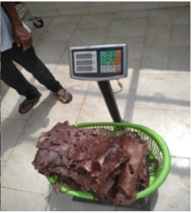
5) A scale to determine the quantity of raw meat placed in the dryer and the quantity that comes out; ±0,01 kg;
6) A pyranometer to measure the solar radiation received, placed above the drying chamber;: ±3 W/m²;
7) Two trolleys for placing the racks on which the fresh meat is spread out;
8) Eight racks for spreading out the meat to be dried, with four racks per trolley;
9) Eight temperature probes to measure the temperature on each rack installed during the drying process.
2.2. Drying Methodology and Test Procedure
The drying method consists of removing moisture from a product. Drying is achieved through direct solar radiation striking the product (the meat) through the transparent side (the glass cover). Then, the indirect part of the mixed solar dryer uses a solar collector (the absorber) to capture solar radiation in order to heat the air. This heated air is then directed into the drying chamber .
The advantage of drying in the Sahel is that Niger is one of the sunniest countries in Africa, with daily sunshine ranging from 5 kWh/m² to 7 kWh/m² . Characterisation under load shows that the drying time for kilichi is 3 to 4 hours. To harness this energy potential, the National Solar Energy Agency (ANERSOL) has done a great deal of work on solar dryers as part of its research and development programme. It is in this context that the ECO-KILICHI Complex project has built a mixed solar dryer, whose main objective is to dry meat, as it deteriorates easily due to its acidity, the presence of pathogens and climatic factors. Therefore, the use of solar dryers is currently the best solution for drying a product, preserving it, maintaining its organoleptic properties and retaining its nutritional qualities . In addition, the capacity of the drying chamber, the speed of drying, the cleanliness of the product, the climatic conditions of the environment, the lifespan of the dryer and the maintenance of the equipment are the most important parameters to be taken into account during this drying process. During this work, the activity was carried out in two phases, from 16/04/2025 to 22/04/2025, and took place during the day between 9 a.m. and 5 p.m. Experiments with this dryer contribute to its good performance. To this end, a drying system needs to be put in place that optimises the drying process, ensures its availability, and mitigates the risks of meat contamination from dust, insects, birds, animals, etc.
In this work, the method used is based on the operating principle of the mixed dryer, whose technique combines convection drying and radiation drying . We followed the following process:
1) Clean the direct and indirect sensors with water.
2) Dust and clean the drying chamber and trolleys.
3) Weigh and cut the meat, then spread it out on the racks (Figures 1 and 2).
4) Place the racks on the trolleys (Figure 2) in the dryer, then close the dryer to start the drying process. After a while, check the progress of the drying process until that the thin slices of meat begin to detach from the racks because when they are laid out, the slices stick to the racks.
5) Place the temperature probes on the racks (one per rack).
6) Check that the various sensors mentioned above are in place, properly connected to the data logger, and in good working order.
7) Once the thin slices of meat have come away from the racks, the next step is to turn the meat over for 30 minutes to 1 hour, so that the other side can dry as well. The duration depends on the position of the rack on the trolley.
8) Open the dryer from time to time to check the progress of the drying process and turn the meat if necessary.
9) The final step is to fold the slices into 3 equal parts and leave them to dry for another hour.
2.3. Determining the Water Content
All products contain water in different forms: free water, bound water, water vapour and constitutional water : This is referred to as the water content, which is the amount of water contained in a product. It can also be defined as the mass of water in the product per unit mass of the product. In this case, it is expressed either on a dry basis, denoted by X, or on a wet basis, denoted by Xh :
Water content on a dry basis:
x=m-msms (1)
Water content on a wet basis:
xh =m-msm (2)
Combining the two expressions gives:
x=xh1-Xh and xh=x1+X (3)
m and ms: are respectively the masses of the wet product and the dry product (kg).
X and Xh: expressed respectively in kg of water/kg of dry matter and in kg of water/kg of product.
Figure 1. Dried meat (kilichi).
Figure 2. Meat being dried.
In order to conduct the study on the performance of the mixed dryer for drying meat, we followed a protocol that includes a description of the conditions and the test procedure. The tests were carried out between 9 a.m. and 5 p.m. Control of climatic parameters contributes significantly to the performance of the dryer.
1) Solar radiation,
2) Ambient temperatures and temperatures at each rack level,
3) Relative air humidity,
4) Wind speed at the entrance and exit of the mixed dryer,
5) Fresh meat weights at the start and end of drying.
This requires the entire apparatus to be in operation for at least 30 minutes before the loaded racks are placed in the drying unit and the exact duration of the meat drying process.
3. Results
3.1. Mixed Solar Dryer
Several dryers built by ANERSOL incorporated storage systems whose efficiency was not evaluated through experimental testing, such as the Type C dryer and the dryer designed by Rabi . Drawing inspiration from their work, we opted for this configuration, namely a mixed solar dryer.
The total surface area of the dryer is calculated as:
S=× l(4)
The surface area of the direct section is:
S₁= 5 m×4 m = 20m²
The surface area of the indirect section is:
S₂= 6 m×4 m = 24m²
The total surface area is:
S = S₁+ S₂= 44m²
The height of the dryer is 2.7 m.
However, only the direct section corresponds to the drying chamber (20 m²), while the indirect section serves to transfer heat by convection.
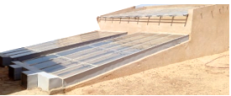
Figure 3. Photo of the mixed solar dryer.
Drying Rate
Ts=min- mf min * t(5)
Ts = drying rate (%)
min = initial mass of the product (kg)
mf = final mass of the product (kg)
t = drying time (h)
Drying rate for April 16, 2025
Ts=32,9-9,0332,9 *3
Ts = 0,24 kg/h ou 24%
Drying rate for April 22, 2025
Ts=30-9,93O*3
Ts = 0,22 kg/h ou 22%
Specific Moisture Extraction Rate (SMER)
SMER=Mass of water removed kgEnergy input (kWh)(6)
With
SMER: Specific moisture extraction rate of water
m_ev = mass of water evaporated from the product (kg)
E_con = energy consumed (kWh)
The mass of water evaporated from the meat was:
23.87 kg on April 16, 2025
20.10 kg on April 22, 2025
The fan power is 150 W, and with 6 fans, the total power is 900 W. The drying time is 3 hours.
Specific moisture extraction rate (SMER) for April 16, 2025
SMER =23, 87 kg O,8419 * 44 + (0,15 * 6 *3) kWh= 0,59 kg /kWh
Specific moisture extraction rate (SMER) for April 22, 2025
SMER =20,1 kg O,8419 * 44 + 0, 15 * 6 *3  kWh= 0,50 kg /kWh
Solar Collector Efficiency
The energy efficiency of a dryer represents the ratio between the energy used to evaporate a mass mem_eme of water from the product being dried and the energy supplied to the dryer. It is defined as follows:
η=Q utilEsol + Eele (7)
η = energy efficiency of the solar dryer
Qutil = useful energy for evaporating the water from the product (kWh or J)
Esol = solar energy supplied to the dryer (kWh or J)
Eele = electrical energy consumed by auxiliary devices, such as fans (kWh or J)
η=mw * Lv * I + (* t)(8)
the total mass of evaporated water that the dryer can withstand.
mw: 41,9 kg
Lv: 2400000 J/kg
A: 44 m²
Imoy: 841,9 W/ m²
t: 10800 s
P: 150 W
n: 6
η=Q utilEsol + Eele =100583999,999400070880 + 9720000=0,245
η25%
3.2. Results of Dried Meat
Figure 4. Fresh meat spread out.
3.3. Water Content Results
Table 1. Water content results for meat drying.

Product condition

Day 1

Day 2

Water content (kg water/kg)

16-04-2025

22-04-2025

Wet product mass: m (kg)

32.9

30

Dry product mass: ms (kg)

9.03

9.9

Water content in dry basis: X (kg water/kg)

2.6

2.03

Moisture content on a wet basis: Xh (kg of water/kg)

0.72

0.67

1) On the first day, there is a decrease in the quantity of meat, as shown in Table 1: the dry basis water content, denoted by X, is 2.6 kg of water/kg, and the wet basis water content, denoted by Xh, is 0.72 kg of water/kg.
2) On the second day of testing, a value of 2.03 kg of water/kg of dry matter water content (X) was recorded, and 0.67 kg of water/kg corresponds to the wet matter water content (Xh).
3.4. Solar Radiation Received on the Overall Horizontal Plane of the Site
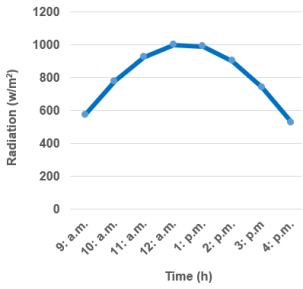
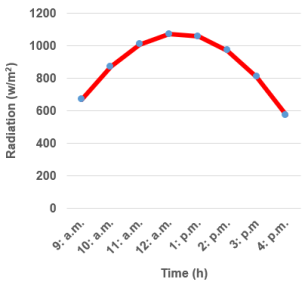
We measured the solar radiance received at the site. It is located in the southeast of the city of Niamey in the Tondi Gamey district, at a latitude of 13.50° N, a longitude of 2.12° E and an altitude of 0 m. Figures 5 and 6 show the evolution of solar flux densities on the global horizontal plane as a function of the hours of the day, respectively for 16 and 22 April 2025. These fluxes increase to a maximum value between 12 noon and 2 p.m. and then decrease. The fluctuations observed are less significant and are due to the passage of clouds and dust haze during the day. These two figures show that the adiation values measured during this month (April) are high, as it is one of the sunniest months in Niger.
Figure 5. Global solar radiation on the horizontal plane for the test day 16-04-25.
Figure 6. Global solar radiation on the horizontal plane for the test day 22-04-25.
For the two days of testing, we observe a gradual increase in irradiation from 9 a.m. to 2 p.m., with maximum radiation of 999 W/m² at 12 p.m. (local time) on 16/04/2025 (Figure 5). Figure 8 then shows an increase radiation, reaching 1072 W/m² at 2 p.m. (local time) on 22/04/2025. From this time onwards, there is a slight fluctuation, resulting in a decrease in the radiation value until the end of the day (Figure 6). It should be noted that the optimum time slot is between 9 a.m. and 4 p.m. (7 hours). However, in this study, the drying time does not reach seven hours.
3.5. Temperature and Humidity (April 16, 2025)
Interpretation:
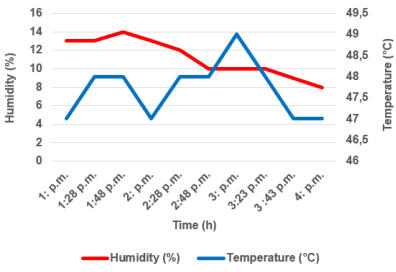
In Figure 7, two curves are observed: the moisture curve in red and the temperature curve in blue. The temperature varies over time. On the same graph, we can also see the evolution of moisture during the first hour of the test (between 1:00 PM and 2:00 PM), reaching a peak of 14.2% before gradually decreasing. This high initial moisture content at the start of drying is explained by the water content of the meat, meaning that evaporation is rapid at the beginning of drying, while it slows down toward the end. Consequently, moisture decreases by the end of the test.
As for the temperature curve, it rises gradually before decreasing around 2:00 PM, at the moment when evaporation is rapid. This drop is due to energy absorption during the evaporation process. However, after the meat’s moisture decreases, the temperature increases rapidly from 2:00 PM, reaching a maximum value of 49°C around 3:00 PM. Finally, as the product begins to dehydrate and solar radiation starts to decline, the temperature decreases until the end of the day.
Figure 7. Variation in humidity and temperature over time.
3.6. Temperature and Humidity (April 22, 2025)
Figure 8. Variation in humidity and temperature over time.
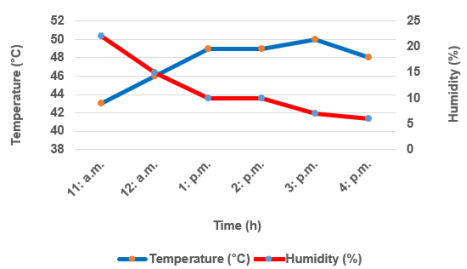
Interpretation: In Figure 8, the moisture curve (in red) and the temperature curve (in blue) are shown superimposed. The temperature curve, shown in blue, varies throughout the day, as does the moisture curve. The temperature increases until 3:00 PM, reaching a peak of 50°C, and then decreases toward the end of the test.
Moisture, represented by the red curve on the same graph, decreases throughout the test day, starting at a value of 22%. Fluctuations are observed during the day before it finally drops to a minimum value of 6% at the end of the test.
This variation is explained by the moisture state of the dried product.
During the first hour of drying, the product is fresh, so evaporation occurs rapidly. As a result, moisture is high, and a relatively low temperature is observed at the beginning of the drying process (11:00 AM).
3.7. Air Velocity
The direction of the airflow in Niger depends on the season. In April, the dominant airflow comes from the northeast (the Harmattan). Additionally, the dryer is built along a north-south orientation. In the drying chamber, two air velocity sensors were installed. One sensor is placed in the indirect section (exhaust fans) at 1 cm above the floor on the south side, and the second sensor is located in the direct section (extractor fans) on the north side, above the entrance door of the drying chamber, precisely at 2 m above the floor (see Figure 3).
3.7.1. Air Inlet and Outlet Velocity Curves for 16/04/2025
Figure 9. Variation in air inlet and outlet velocities on 16/04/2025.
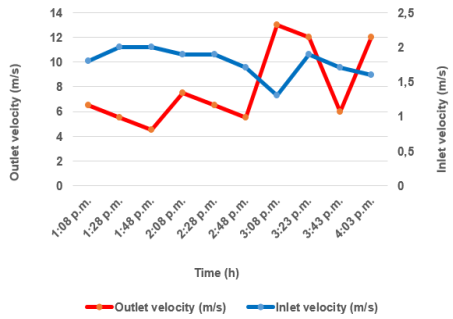
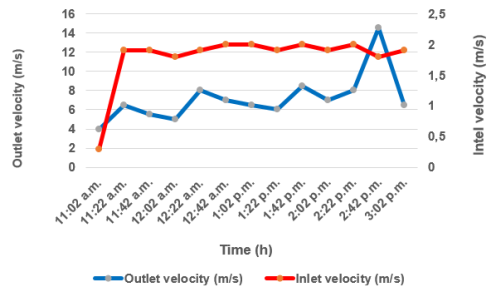
Interpretation: In Figure 9, the red curve, representing the air velocity at the outlet (Vs) at the extractor fan, shows fluctuations ranging approximately between 4 m/s and 8 m/s. The blue curve represents the air velocity at the fan inlet (Ve), that is, at the suction fan. It can be observed that the variation in air velocity is negligible until 2:28 PM. From this time onward, fluctuations occur, with a drop in velocity to 1.2 m/s, followed by a peak of 1.9 m/s at 3:23 PM, before decreasing again for the remainder of the day.
3.7.2. Air Inlet and Outlet Velocity Curves for 22/04/2025
Figure 10. Variation in air inlet and outlet velocities for the day of 22/04/2025.
Interpretation: Figure 10 shows two curves: the red curve, which corresponds to the air velocity at the dryer inlet (Vs), and the blue curve, representing the variation of velocity at the dryer outlet (Ve).
For the blue curve, fluctuations in air velocity are observed, generally ranging between 4 m/s and 8 m/s. This high velocity is due to the position of the sensor at the extractor fan, located 2 m above the floor (see Figure 3).
The red curve, showing the behavior of the air velocity at the suction fan inlet (Ve), starts at a low value, then reaches 1.9 m/s at 11:22 AM. This velocity is maintained throughout the day until 2:11 PM, when it increases slightly to reach 2.07 m/s.
3.8. Drying Chamber
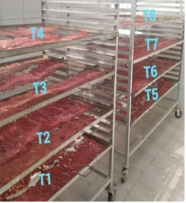
The results below show the evolution of solar radiation during drying and the temperature behavior on the different trays within the drying chamber. There are two trolleys, each containing four (4) trays (see Figure 4) .
3.8.1. Temperature Change Curves at Trolley 1
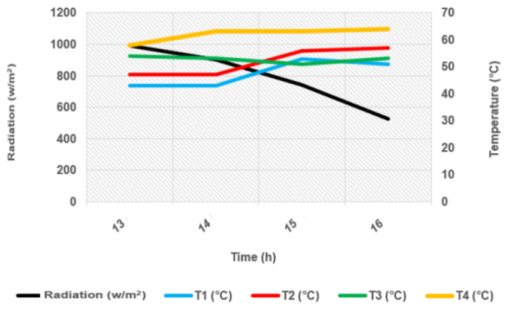
Figure 11. Variation in temperatures (T1, T2, T3 and T4) and radiation as a function of time on 16/04/2025.
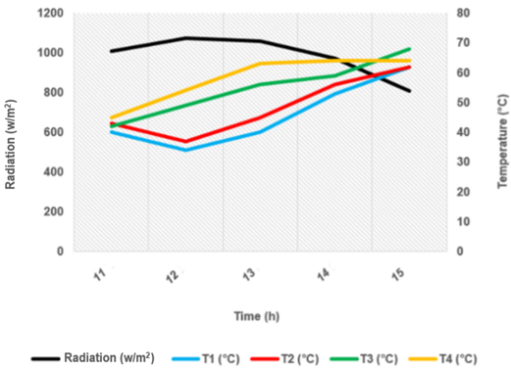
Figure 12. Variation in temperatures (T1, T2, T3 and T4) and radiation over time on 22/04/2025.
Interpretation:
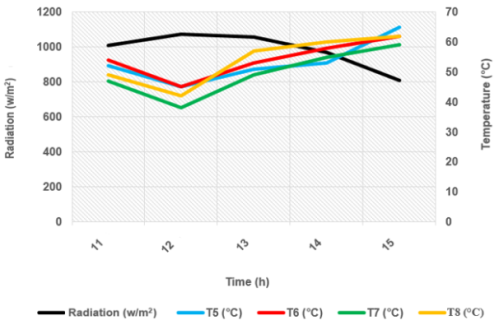
The principle is the same for both test days considered. The four temperature curves (T1, T2, T3, T4) shown in Figures 11 and 12 represent the temperatures recorded on a single trolley at different levels (see the arrangement of trolleys and trays in Figure 2).
It is observed that the temperature curves vary according to the incident global solar radiation and time. The temperatures measured by probe number 1 (placed at the lower position of the trolley) are generally the lowest on the trolley, while those measured by probe number 4 (placed at the top of the trolley) are the highest. This is consistent, since the radiation transmitted by the direct sensor reaches the tray at level 4 of the trolley first, before reaching level 1, which is lower. Therefore, level 4 has a higher temperature than level 3, level 3 is higher than level 2, and level 2 is higher than level 1, despite the transfer of hot air by the fans from the indirect sensor.
3.8.2. Temperature Evolution Curves at Trolley Level 2
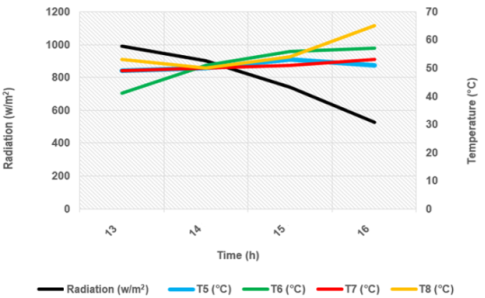
Figure 13. Variation in temperatures (T5, T6, T7 and T8) and radiation as a function of time on 16/04/2025.
Figure 14. Variation in temperatures (T5, T6, T7 and T8) and radiation over time on 22/04/2025.
Interpretation: For the two test days considered, the four temperature curves (T5, T6, T7, T8) shown in Figures 13 and 14 represent the temperatures recorded on a single trolley at different levels (see the arrangement of trolleys and trays in Figure 2, which shows the placement of trays and probes). The temperature curves vary according to the incident global solar radiation and time.
Interpretation: For the two test days considered, it is observed that, depending on the position of the trolley in the dryer (left or right), temperatures at the same level vary from one trolley to another and from one position to another. For levels 1 and 2, temperatures T5 and T6 are higher than T1 and T2, respectively. Conversely, for levels 3 and 4, temperatures T3 and T4 are higher than T7 and T8. This can be explained by the fact that trolley 1 is positioned in front of the air supply from the first indirect sensor on the left (with only one fan functioning normally), while trolley 2 is positioned in front of the air supply from the second indirect sensor on the right, where both fans are operational, thus receiving more hot air.
It should be noted that:
Temperatures T1, T2, T3, and T4 come from trolley 1, located on the left side of the drying chamber, with probes arranged from bottom to top. T1, T2, T3, and T4 correspond to trays 1, 2, 3, and 4, respectively.
Temperatures T5, T6, T7, and T8 come from trolley 2, located on the right side of the drying chamber, with probes arranged from bottom to top. T5, T6, T7, and T8 correspond to trays 5, 6, 7, and 8, respectively.
4. Conclusion
According to the tests carried out on the mixed solar dryer built in collaboration with ANERSOL, the study showed that the dryer makes it possible to achieve very favorable temperatures for drying, exceeding the ambient temperature, which averaged 35.5°C, with an average temperature inside the dryer of 50.5°C.
It demonstrated satisfactory performance, with a SMER of 0.5 kg/kWh and a simplified energy efficiency of 25%. With a drying time of 3 hours, it can be concluded that the drying process is rapid. The system removed a sufficient amount of water contained in the meat and reduced its mass; thus, it achieved a significant reduction in moisture, with drying rates of 24% and 22% respectively for the two test days of April 16, 2025 and April 22, 2025.
This demonstrates the quality of the dryer and leads to proper preservation of the meat. However, it would be important to check the airtightness of the system, as well as the fans, to ensure uniform drying and to further optimize air circulation inside the dryer.
Abbreviations

AC

Alternating Current

ANERSOL

National Solar Energy Agency

USB

Universal Serial Bus

LCD

Liquid Crystal Display

MB

Megabyte

h

Hour

kWh

Kilowatt-hour

m2

Square Meter

x

Dry Basis Moisture Content

xh

West Basis Moisture Content

m

Mass of Meat in Its Wet State

ms

Mass of Dried Meat

kg

Kilogram

W

Watt

Ve

Inlet Velocity

Vs

Outlet Velocity

Ts

Drying Rate

min

Initial Mass of the Product

mf

Final Mass of the Product

t

Drying Time

L

Length

l

Width

h

Height

SMER

Specific Moisture Extraction Rate SMER

Qutil

Useful Energy for Evaporating the Water from the Product

Esol

Solar Energy Supplied to the Dryer

Eele

Electrical Energy Consumed by Auxiliary Devices

η

Solar Collector Efficiency

m_ev

Mass of Water Evaporated from the Product

E_con

Energy Consumed

T

Temperature

min

Minute

s

Second

n

Number of Fans

J

Joule

Ac

Collector Area

P

Electrical Power

mw

Mass of Water Evaporated

Lv

Latent Heat of Vaporization of Water

I

Average Solar Irradiance

ECOWAS

Economic Community of West Africain States

Acknowledgments
I address my heartfelt thanks to Dr SIDO ¨Mariama (Director General of the National Solar Energy Agency (ANERSOL)), for allowing the access to ANERSOL.
I also thank the ECOWAS Régional Agency for Agriculture and food for funding the construction of the mixed solar dryer in which the experiments were carried out.
I would like to thank Elhaj Mahaman Saydou (producer of kilishi at EKO-Kilichi center in Niamey-Niger) for his advice and his help in the preparation of thin slices of meat in the form of kilishi.
Author Contributions
Saley Moussa Ahmed Roufaï: Conceptualization, Data curation, Writing – original draft
Arouna Saley Hamidou: Writing – review & editing
Souley Hassane Safiatou: Data curation, Investigation
Issaka Nomao Hadiza: Project administration, Resources
Makinta Boukar: Project administration, Resources, Supervision, Validation
Funding
This work is not supported by any external funding.
Data Availability Statement
The data supporting the outcome of this research work has been reported in this manuscript.
Conflicts of Interest
The authors declare no conflicts of interest.
References
[1] Benseddik, Abdellouahab. 2018. Improvement of the Quality and Performance of Solar Drying of Agro-Food Products by the Application of Controlled Instantaneous Relaxation (DIC) Treatment: Experimental Analysis, Empirical and Phenomenological Modeling. Doctoral Thesis in Energy Mechanics, Abou-Bekr Belkaid University, Tlemcen, p. 6.
[2] Tarminzi, M. A. S. M., Razak, A. A., Azmi, M. A. A., Ming, Y. H., Akramin, M. R. M., Mokhtar, N. M., & Sharol, A. F. (2021). [Title of the article]. International Journal of Engineering Technology and Sciences, 8(1), 1–13.
[3] Jiang, N., Ma, J., Ma, R., Zhang, Y., Chen, P., Ren, M., & Wang, C. (2023). Effect of slice thickness and hot-air temperature on the kinetics of hot-air drying of crabapple slices. Food Science and Technology, Campinas, 43, e100422.
[4] Tomar, V., Tiwari, G., & Norton, B. (2017). Solar dryers for tropical food preservation: Thermophysics of crops, systems and components. Solar Energy, 154, pp. 2-13.
[5] Rasamitiavina, A. F. (2020). Design and fabrication of a solar dryer for vegetables: Application for dehydrated soup. Master’s Thesis, University of Antananarivo, Higher Polytechnic School of Antananarivo, Field: Engineering Sciences and Techniques, Specialization: Chemical and Industrial Process Engineering, Degree: Engineer in Chemical and Industrial Process Engineering.
[6] “Solar air collectors – PDF Free Download.” (n.d.). Retrieved October 3, 2022, from.
[7] IRRAD in NIG. (n.d.). Solar radiation measurement data in Niger. Retrieved March 10, 2024, from
[8] Gupta, V., Sabharwal Gupta, K., & Khare, R. (2021). Experimental analysis for drying of potato slices on a detachable solar greenhouse dryer. Materials Today: Proceedings, 47, 6269–6273.
[9] Nadir, N. (2021). Theoretical and experimental approach to solar drying of agro-food products. Doctoral Thesis in Energy Physics, Kasdi Merbah University of Ouargla, Faculty of Mathematics and Physical Sciences, Department of Physics.
[10] Damene, D. (2022). Effect of permeability variation in a porous medium under natural convection. Doctoral Thesis, Kasdi Merbah University of Ouargla, Department of Mechanical Engineering. Publicly defended on June 30, 2022.
[11] O. Aumporn, "Contribution to the Study of the performance of a greenhouse dryer with heat storage in phase change materials", University of Perpignan Via Domitia, France, 2018.
[12] Kadi, R. A. M. (2021). Drying of tchoukou (dry Nigerien cheese) using a direct solar dryer: Technical and economic aspects. Master’s Thesis for the Engineer Diploma, International Institute for Water and Environnement Engineering (2iE), Specialization: Electrical and Energy Engineering. July 23, 2021.
[13] Ennissioui, J., Benghoulam, E. M., & El Rhafiki, T. (2023). Experimental study of a natural convection indirect solar dryer. Heliyon, 9(8), e18893.
Cite This Article
  • APA Style

    Roufaï, S. M. A., Hamidou, A. S., Safiatou, S. H., Hadiza, I. N., Boukar, M. (2026). Performance of Mixed Solar Dryer for Meat in the Sahel Area of Niger. Journal of Energy and Natural Resources, 15(1), 33-44. https://doi.org/10.11648/j.jenr.20261501.15

    Copy | Download

    ACS Style

    Roufaï, S. M. A.; Hamidou, A. S.; Safiatou, S. H.; Hadiza, I. N.; Boukar, M. Performance of Mixed Solar Dryer for Meat in the Sahel Area of Niger. J. Energy Nat. Resour. 2026, 15(1), 33-44. doi: 10.11648/j.jenr.20261501.15

    Copy | Download

    AMA Style

    Roufaï SMA, Hamidou AS, Safiatou SH, Hadiza IN, Boukar M. Performance of Mixed Solar Dryer for Meat in the Sahel Area of Niger. J Energy Nat Resour. 2026;15(1):33-44. doi: 10.11648/j.jenr.20261501.15

    Copy | Download

  • @article{10.11648/j.jenr.20261501.15,
      author = {Saley Moussa Ahmed Roufaï and Arouna Saley Hamidou and Souley Hassane Safiatou and Issaka Nomao Hadiza and Makinta Boukar},
      title = {Performance of Mixed Solar Dryer for Meat in the Sahel Area of Niger},
      journal = {Journal of Energy and Natural Resources},
      volume = {15},
      number = {1},
      pages = {33-44},
      doi = {10.11648/j.jenr.20261501.15},
      url = {https://doi.org/10.11648/j.jenr.20261501.15},
      eprint = {https://article.sciencepublishinggroup.com/pdf/10.11648.j.jenr.20261501.15},
      abstract = {In this article, we investigate the possibility of improving the performance of a mixed solar dryer designed for meat drying. The drying process takes place under an average ambient temperature of 35.5°C. The maximum solar radiation intensities recorded during the two test days were 999 W/m² and 1072 W/m², respectively. The average solar radiation measured between 9:00 a.m. and 4:00 p.m. during the test days was 841.91 W/m². The experiments were conducted on fresh meat over two (2) days. On the first day, the mass of fresh meat, or initial mass (min), was 32.9 kg. At the end of drying, the final mass (mf) was 9.03 kg, corresponding to a mass reduction rate (MRR) of 72.5%. On the second day, the initial mass (min) was 30 kg, and after drying, the final mass (mf) was 9.90 kg, corresponding to a mass reduction rate (MRR) of 67%. To ensure proper drying, the meat was cut and spread to a thickness of 0.5 cm. The loaded test results indicate a temperature range between 33°C and 68°C, with an average drying temperature of 50.5°C across the different tray levels inside the dryer. An average air velocity of 1.8 m/s was recorded at the inlet and 6 m/s at the outlet. The exact drying time was 3 hours.},
     year = {2026}
    }
    

    Copy | Download

  • TY  - JOUR
    T1  - Performance of Mixed Solar Dryer for Meat in the Sahel Area of Niger
    AU  - Saley Moussa Ahmed Roufaï
    AU  - Arouna Saley Hamidou
    AU  - Souley Hassane Safiatou
    AU  - Issaka Nomao Hadiza
    AU  - Makinta Boukar
    Y1  - 2026/03/28
    PY  - 2026
    N1  - https://doi.org/10.11648/j.jenr.20261501.15
    DO  - 10.11648/j.jenr.20261501.15
    T2  - Journal of Energy and Natural Resources
    JF  - Journal of Energy and Natural Resources
    JO  - Journal of Energy and Natural Resources
    SP  - 33
    EP  - 44
    PB  - Science Publishing Group
    SN  - 2330-7404
    UR  - https://doi.org/10.11648/j.jenr.20261501.15
    AB  - In this article, we investigate the possibility of improving the performance of a mixed solar dryer designed for meat drying. The drying process takes place under an average ambient temperature of 35.5°C. The maximum solar radiation intensities recorded during the two test days were 999 W/m² and 1072 W/m², respectively. The average solar radiation measured between 9:00 a.m. and 4:00 p.m. during the test days was 841.91 W/m². The experiments were conducted on fresh meat over two (2) days. On the first day, the mass of fresh meat, or initial mass (min), was 32.9 kg. At the end of drying, the final mass (mf) was 9.03 kg, corresponding to a mass reduction rate (MRR) of 72.5%. On the second day, the initial mass (min) was 30 kg, and after drying, the final mass (mf) was 9.90 kg, corresponding to a mass reduction rate (MRR) of 67%. To ensure proper drying, the meat was cut and spread to a thickness of 0.5 cm. The loaded test results indicate a temperature range between 33°C and 68°C, with an average drying temperature of 50.5°C across the different tray levels inside the dryer. An average air velocity of 1.8 m/s was recorded at the inlet and 6 m/s at the outlet. The exact drying time was 3 hours.
    VL  - 15
    IS  - 1
    ER  - 

    Copy | Download

Author Information
  • Laboratory of Energetics, Electronics, Electrical Engineering, Automation and Industrial Computing (L3EA2I), Abdou Moumouni University, Niamey, Niger

    Biography: Saley Moussa Ahmed Roufaï was born on 20-05-1991 in Maradi. He attended primary school in Zarrya 2 and secondary school in Maradi. He continued his university studies at the Faculty of Sciences of the Abdou Moumouni University in Niamey, after obtaining his Baccalauréat série D in 2011 at the Lycée dan Baskorée in Maradi. His school and university education includes the CFEPD (Certificat de Fin d'Études de Premier Degré) in 2003, the BEPC (Brevet d'Études du Premier Cycle) in 2007, the Baccalauréat in 2011, and a research Master's degree in 2021. He has registered for a PhD thesis in 2023. He is currently author of scientific publication.

    Research Fields: Renewable energies, Solar pumping, Solar thermal, Solar drying and fossil fuels

  • Department of Physics, Dan Dicko Dan Koulodo University, Maradi, Niger

    Biography: Arouna Saley Hamidou is currently a full professor in the Department of the Faculty of Science and Technology at the Dan Dicko Dan Koulodo University in Maradi. He holds the following degrees: Doctorate unique in environmental physics The Gaston Berger University of Saint-Louis, Senegal. 2009- 2010: Master in Applied Physics (Image-remote sensing, satellite meteorology and global climate) at the African Center for Science and Technology of Space (Crast) of Rabat, Morrocco. He was coordinator of the "Renewable Energies" (photovoltaic, thermal, biomass / photovoltaic, wind and hydropower). May 2024 Today: Director of the Department Training and Research in Nuclear Science and Technology at HEEA (High Authority to May 2024: Director of Research at the Ministry of Higher Education, Research and Technological Innovation.

    Research Fields: Wind energy, thermal energy, Industrial Property Facilitator, Appliied Physics (Image-remote sensing, satellite meteorology and global climate and fossil fuels

  • Research and Development Department, National Solar Energy Agency (ANERSOL), Niamey, Niger

    Biography: Souley Hassane Safiatou is an engineer at the Research and Development Department of the National Agency for Solar Energy of Niger (ANERSOL). She obtained her engineering degree in 2021 from the International Institute for Water and Environmental Engineering (2iE), Burkina Faso. Her work focuses on solar thermal energy, particularly on the promotion of solar technologies adapted to Sahelian socio-economic contexts.

    Research Fields: Solar drying, Photovoltaic solar and software engineering

  • Research and Development Department, National Solar Energy Agency (ANERSOL), Niamey, Niger

    Biography: Born in 1994, Issaka Nomao Hadiza attended primary and secondary school in her hometown of Arlit. After graduating from high school in Niamey in 2012, she enrolled in preparatory classes at the International Institute of Water and Environmental Engineering in Ouagadougou. She obtained her engineering degree with a master's in electrical and energy engineering in 2017 from the same institute. Currently Director of the Research and Development Department at the National Solar Energy Agency of Niger, she has had a rich career in project coordination, technical assistance, training, and research and development of sustainable solutions and innovative technologies in the field of solar energy.

    Research Fields: Renewable energies, Solar thermal, Solar drying

  • Laboratory of Energetics, Electronics, Electrical Engineering, Automation and Industrial Computing (L3EA2I), Abdou Moumouni University, Niamey, Niger

    Biography: Makinta Boukar is currently a full professor in the Department of the Faculty of Science and Technology at the Abdou Moumouni University in Niamey. He holds the following degrees: Docteuar d'Etat (Doctorate of State) in 2013; (Doctorate-Engineering) in 1992; DEA (Master's equivalent) in 1986; DUES (second year in university) in 1983; Baccalauréat in 1980. He was coordinator of the "Renewable Energies" master's degree in the Physics department, head of the thermal team at the energetics laboratory, head of the central service for monitoring teaching at the Rectorat, member of the scientific council of Abdou Moumouni University and one of Niger's two representatives on the Specialized Technical Commission (CTS) of the African and Malagasy Council for Higher Education (CAMES). He has also been awarded the distinction of “Chevalier dans l'ordre des palmes académiques” of Niger.

    Research Fields: Renewable energies, Materials, characterization, Cold production, Solar drying, Thermal storage, Thermal comfort
  • Abstract
  • Keywords
  • Document Sections

    1. 1. Introduction
    2. 2. Materials and Methods
    3. 3. Results
    4. 4. Conclusion
    Show Full Outline
  • Abbreviations
  • Acknowledgments
  • Author Contributions
  • Funding
  • Data Availability Statement
  • Conflicts of Interest
  • References
  • Cite This Article
  • Author Information