Research Article | | Peer-Reviewed

Consumers’ Proposals for Food Service in Portugal

Received: 4 March 2026     Accepted: 16 March 2026     Published: 13 April 2026
Views:       Downloads:
Abstract

Introduction: Meals served in the Food Service industry represent a significant part of the daily diet of many consumers, including at least one of their main meals. Changes in the needs and expectations of both customers and consumers have led to the evolution of the sector. Gaining in-depth insight into the consumer perspective is a huge competitive advantage for companies. Aim: To analyse consumers’ proposals for the future of food service in Portugal, aiming to identify changes to be implemented in the industry from the consumers’ perspective. Methods: A cross-sectional survey was conducted among Portuguese adults with experience in food service. The questionnaire included closed and open-ended questions and was distributed on paper and online in 2020 and 2021. The online version was disseminated by email, through social media, in food service companies and the food service industry, and the paper version was sent to some food service companies. Data were analysed using descriptive and inferential statistics, and qualitative content analysis was applied to open-ended responses. Results and Discussion: Consumers’ proposals for products are meals with fresh, regional/local, sustainable, organic products that are nutritionally balanced. Regarding services, consumers suggest environmentally friendly spaces, portion sizes adjusted to consumers’ needs, services of meals made to order and convenience services. Consumers mainly suggest improving products and services, but also new products and services and human resources. Overall, the proposals identified in this study are consistent with several global megatrends, particularly ethical living, healthier lifestyles and new ways of shopping. In the Portuguese context, these trends are reflected in consumers’ preference for fresh and sustainably produced foods, the growing demand for convenience services such as takeaway and Grab and Go options, and the increasing interest in personalised or made-to-order meals. These results also suggest the emergence of premiumization, through the preference for higher-quality ingredients, and the influenced of connected consumers, reflected in the demand for digital ordering systems and customised services. Conclusions/Originality: The outcome of this research is to provide important information enabling the food service industry to remain updated and competitive in the market.

Published in Journal of Food and Nutrition Sciences (Volume 14, Issue 2)
DOI 10.11648/j.jfns.20261402.16
Page(s) 151-161
Creative Commons

This is an Open Access article, distributed under the terms of the Creative Commons Attribution 4.0 International License (http://creativecommons.org/licenses/by/4.0/), which permits unrestricted use, distribution and reproduction in any medium or format, provided the original work is properly cited.

Copyright

Copyright © The Author(s), 2026. Published by Science Publishing Group

Keywords

Food Service, Consumers, Proposals, Megatrends, Portugal

1. Introduction
The food service industry includes all establishments that are open to a specific target audience (e.g., canteens, cafeterias, bars, and meal services), acting in several sectors such as education, health, social, and companies . Food service also refers to a type of food that is neither individual nor familial, with meals being prepared and served in specific places and in a similar way to consumers . The main goal of this industry is to provide nutritionally balanced, safe, and sustainable meals, aiming to be compatible with both the financial and contractual conditions of the client institution, and to be suitable for consumers .
Since the 90s of the 20th century, the analysis of major trends in consumer behaviour in industrialized countries highlighted several aspects, such as diversity (products, services, eating places), convenience (simplification of mealtimes), restructuring mealtimes, socialization during meals, escaping monotony (different meals), ethnic or religious eating, dietary balance, valuing the natural, and valuing meals outside .
However, in the 21st century, the products that consumers seek must respond to their demands in terms of time, convenience, and affordability . Therefore, companies must adapt the offer to consumers, innovatively combining solutions to respond to their demands . Currently, consumers are looking to reevaluate their values and priorities, focusing on getting the most out of life, prioritizing experiences, sharing, and time over money .
Megatrend analysis allows companies to build a long-term strategy, ensuring that they have a plan to remain relevant in the future . A megatrend is characterized by a trend in longevity (10 to 15 years), and by a long-term fundamental change in consumer behaviour, presenting a global impact on the market in several sectors .
Among the most influential megatrends set to shape the world by 2030, those that will have the most far-reaching impact on industries and consumers in the upcoming years are as follows:
1) Regression of the middle class: in developed markets, the middle class is struggling to maintain the economic position it has enjoyed over the last half-century, leading consumers to switch to more frequent purchases in smaller stores, and in more convenient locations .
2) More experiences: this trend is having a huge impact, whether in-store or online, and involves creating experiences that are increasingly closer to more demanding consumers .
3) Changing market boundaries: to ensure future growth, companies will have to adapt to new demographic, economic and technological realities, bringing new locations into the spotlight. The biggest obstacle for companies will be to precisely establish consumer recognition and distribution channels in areas that were previously underdeveloped .
4) “Premiumization”: with more products available at a wide range of prices, consumers tend to spend more on the things that are important to them, establishing priorities .
5) Ethical living: among consumers and companies, increased attention is paid to ethics and moral values, based, for instance, on concerns about sustainability, the environment, animal welfare, good production practices and work, as well as the desire to impact communities and people positively. This megatrend is driven by awareness, availability, and accessibility .
6) A new way of shopping: the way we buy goods and services is constantly changing, as the economic and technological reality also changes for companies and consumers. Consumers shop on many different platforms and increasingly expect companies to engage with them in ways that fulfil their interests and lifestyle .
7) Healthy living: this trend is becoming the normal way of life. Consumers are increasingly looking for “personalised health”, a more holistic approach to well-being, covering the spiritual and mental aspects in addition to physical health .
8) Connected consumers: they use computers, smartphones, tablets, navigation devices, games and other audio and video devices that connect to the internet to experience and interact with digital content, completely transforming the way consumers live, work, buy, and have fun .
Under this scenario, the main goal of this study is to analyse consumer proposals for food service in Portugal, aiming to establish the changes to be implemented in this industry according to consumers’ perspectives.
2. Methods
This study, based on a cross-sectional descriptive design, analyses the proposed changes to food service activity in Portugal through a survey that was carried out among consumers. The subjects of this investigation were the Portuguese population aged above 18 years old, and food service consumers.
The survey distributed to the population included two groups of questions: 1st) consumer sociodemographic data and 2nd) proposed changes to food service in Portugal, including closed and open questions. The questionnaire was developed in accordance with the recommendations provided in the seventh revision of the “Helsinki Declaration”. Participants were informed about the study’s objective and methodology, and informed consent was obtained. The survey was applied on paper and online, being available on the LimeSurvey® digital platform.
The survey was disseminated in the food service units of several establishments (schools, higher education institutions, care institutions, health units, and private companies, among others), both in the public and private sectors. Data collection was carried out between July and October 2020 and between March and August 2021. The data were manually entered into the platform by the researcher and two properly trained assistants. All unanswered questions were placed in the “I don’t know/I don’t answer” category. The confidentiality and anonymity of respondents were maintained throughout the process.
The statistical analysis of the data was performed by using the Statistical Package for the Social Sciences (SPSS®) software version 28.0 for Windows® and Microsoft® Excel® software for Microsoft 365 MSO (version 2202 Build 16. 0. 14931. 20128). This analysis included descriptive statistics measures (absolute and relative frequencies, means, and respective standard deviations) and inferential statistics. The significance level to reject the null hypothesis was set at α ≤ 0.05. To assess the dependence between pairs of variables, the Chi-square test and Fisher’s exact test of independence were used. For statistically significant associations, the corresponding p-values were reported in the text, and the interpretation of the results was based on the Chi-square statistics obtained from the SPSS output.
Regarding the analysis of open-ended responses, an a posteriori categorisation process was conducted based on thematic similarity among the responses. An initial coding framework was developed by the main researcher after a preliminary reading of the responses. Subsequently, two trained research assistants independently reviewed and categorised the responses according to the established framework. Discrepancies were discussed collectively until consensus was reached, thereby improving the reliability of the qualitative analysis and reducing potential researcher bias. The final categories were organised into intervention areas, categories and subcategories according to the frequency and thematic relevance of the references provided by respondents.
3. Results and Discussion
The study’s sample is composed of 1900 individuals. The individuals are mostly Portuguese (95%), female (95%), aged between 26 and 55 years old (67%), higher educated (56%). The majority are married or living with a partner (46%) with a household of 3 to 4 members (53%). In terms of their area of residence, 37% live in the North area, 37% in the Lisbon metropolitan area, and 36% in the Centre area of the country (Table 1).
Table 1. Sociodemographic characterization of the sample (n=1 900).

Sociodemographic variable

n

%

Gender

Female

1 360

71,6

Male

432

22,7

I don’t know/I don’t answer

108

5,7

Age (years old)

18 to 25

333

17,5

26 to 35

420

22,1

36 to 45

499

26,3

46 to 55

345

18,2

56 to 65

217

11,4

More than 66

86

4,5

Education

None

4

0,2

Primary education

126

6,6

Lower secondary education

138

7,3

Upper secondary education

417

22,0

Post-secondary non-tertiary education/Post-Graduation/MBA

148

7,8

Bachelor’s

33

1,7

Degree

571

30,1

Master’s

305

16,1

Doctoral

110

5,8

I don’t know/I don’t answer

48

2,5

Other

0

0,0

Marital status

Single

787

41,4

Married/Living with a partner

865

45,5

Divorced/Separated

160

8,4

Widow

23

1,2

I don’t know/I don’t answer

64

3,4

Other

1

0,1

Household, including self (number of members)

1

239

12,6

2

395

20,8

3

517

27,2

4

498

26,2

5

129

6,8

More than 5

36

1,9

I don’t know/I don’t answer

86

4,5

Nationality

Portuguese

1 809

95,2

I don’t know/I don’t answer

47

2,5

Other

44

2,3

Region of the current residence in the country (NTUS II)

North

699

36,8

Centre

401

21,1

Lisbon metropolitan area

688

36,2

Alentejo

39

2,1

Algarve

20

1,1

Autonomous region of the Azores

12

0,6

Autonomous region of Madeira

8

0,4

Living outside Portugal

3

0,2

I don’t know/I don’t answer

29

1,5

Other

1

0,1

n – amount of sample data; % - Percentage of relative frequency; NTUS – Nomenclature of Territorial Units for Statistics; MBA - Master in Business Administration.
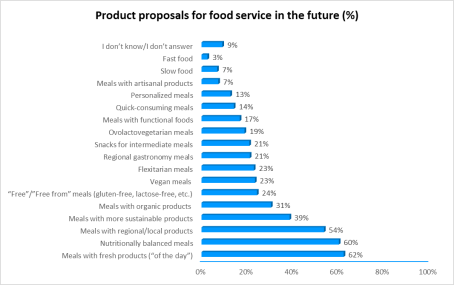
In terms of products, consumers’ main proposals for the future of food service were based on: 1) meals with fresh products (62%); 2) nutritionally balanced meals (60%); 3) meals with regional or local products (54%); 4) meals with more sustainable products (39%); and 5) meals with organic products (31%) (Figure 1). Whenever statistically significant differences were observed, these proposals were associated with consumers’ region of residence or type of food service unit. Specifically, meals prepared with fresh products were more frequently proposed by consumers from the Lisbon metropolitan area (p=0.003), while meals prepared with more sustainable products were mainly proposed by consumers from the North region (p=0.013) and in public cafeterias (p=0.001).
Figure 1. Product proposals for food service in the future (n=1 900).
These findings are consistent with trends reported in several European studies, which indicate an increasing consumer preference for fresh, locally sourced and nutritionally balanced meals in out-of-home eating contexts . However, the Portuguese case appears to emphasise the integration of regional or local products within institutional food service settings, reflecting the cultural importance of regional gastronomy and the growing public debate on sustainable public procurement. This highlights the relevance of the Portuguese context as a case where consumer expectations intersect strongly with national food culture and sustainability policies.
To promote a diet based on more sustainable products, the public sector is an area with great potential impact, as the public sector is a large-scale and sustained buyer, which would theoretically allow for the creation and sustainment of markets in terms of innovative and sustainable agri-food practices . Hence, in educational establishments, this strategy would be beneficial, as it would educate consumers, from an early age, to adopt healthy and sustainable eating patterns that can be maintained throughout their lives . Nonetheless, despite the importance of the education sector, the public sector must lead by example in all public meals (e.g., hospitals, senior residences, ministerial cafeterias, or prisons) . Based on the obtained data, the inclusion of sustainable foods will be the most appreciated measure by Northern consumers, while meals with fresh products will be more appreciated by consumers in the Lisbon metropolitan area.
In terms of healthier food alternatives in cafeterias, it is important to highlight that acceptance of this change depends on several factors, such as culture, the local environment, actions, and the individual’s educational model . Some studies pointed out that the success of implementing a healthier menu is directly related to food literacy, which corroborates the importance of the educational model from an early age (childhood/adolescence) .
Serving healthier options in cafeterias presupposes an assessment of consumers’ ability to make better choices . Despite the efforts of the food service industry to provide healthy meals, this does not always result in better food intake. This goal is dependent on consumers’ awareness and willingness to change eating behaviours .
Within the scope of sustainability, the food service industry must also attain social responsibility. In general, promoting a healthy diet also reduces the environmental impact .
Although there is no universal definition of local foods, the World Health Organisation’s (WHO) recommendation is the provision of meals with regional/local products . Overall, a local product is one that is produced in the surroundings of the food service unit, although some people consider these products to be those that are produced in the national territory . There is a tendency to consider local products more natural and healthier . Still, it is important to clarify that a local product does not always have a lower environmental impact when compared to products from longer chains . Despite these products having several nutritional benefits in terms of freshness, flavour, and nutritional value, the shorter time between harvest and consumption contributes to quality .
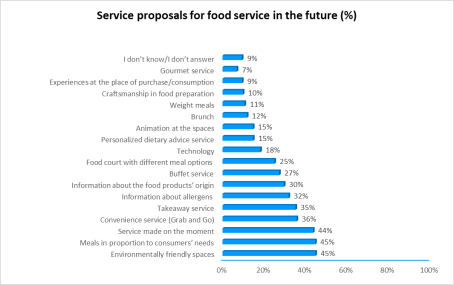
The product-related proposals identified in this study were preferably chosen by highly educated consumers, young, single, and from households of up to 2 members, demonstrating the desire to introduce new things into their daily food routine. Regarding services, the main proposals presented by consumers for services provided by the food service industry are: 1) environmentally friendly spaces (45%), mainly by consumers in the North region (p=0.014) and in public cafeterias (p=0.008); 2) meals in proportion to consumers’ needs (45%), namely in public cafeterias (p=0.022); and 3) services of meals by order (44%), particularly male consumers (p<0.001) and residents in the Lisbon metropolitan area (p=0.011) (Figure 2).
Figure 2. Service proposals for the food service industry in the future (n=1 900).
Different perceptions were found between men and women regarding the services provided at the time . However, when analysing regional preferences, distinct trends emerged. According to the obtained results, the move to more environmentally friendly spaces will be a more appreciated measure by consumers in the North of the country, while the inclusion of more meals made on the moment, and possibly more customizable, will be a more appreciated measure by consumers in the Lisbon metropolitan area (Figure 2).
Responsibility for environmental issues in food service has grown considerably in recent years, contributing to the rationalisation of the use of natural and energy resources, and the search for new technologies to preserve the environment . In terms of service, more environmentally friendly spaces may also mean a greater commitment to measures aimed at reducing the ecological footprint of products and/or meals, as well as at reducing food waste . The inclusion of sustainability concepts in meal production processes will have several benefits, namely differentiation in terms of the establishment’s image, attracting new consumers .
Although some consumers associate generous portion sizes with value and satisfaction in food service, professional guidelines recommend portion control as a strategy to promote both public health and environmental sustainability . Larger portions are associated with increased energy intake and higher levels of food waste, which may negatively affect both nutritional outcomes and environmental impact.
This situation illustrates a potential tension between consumer expectations and public health objectives. To address this challenge, food service providers may adopt strategies such as offering flexible portion sizes, providing smaller default portions with optional additions, or promoting balanced menu combinations. Such approaches allow companies to maintain customer satisfaction while simultaneously supporting healthier eating behaviours and sustainability goals.
Other proposals include: 1) the convenience service (Grab and Go) (36%), especially in the North region (p<0.001) and in public cafeterias (p=0.014); 2) the takeaway service (35%), mainly in food service units from consumers mostly with households with 2 members (p=0.042), probably with less predisposition and availability to cook daily; and 3) the presentation of information about allergens on the menus (32%), particularly in public cafeterias (p<0.001) and by female consumers (p=0.019) (Figure 2).
According to Kwun (2011) women pay more attention and are more concerned about food choices than their male counterparts . Men value food based on taste, pleasure, quality, and cost, while women value nutritional quality and health issues, which is congruent with our results .
The information about allergens is mandatory for all food and beverage establishments . Considering the inclusive and health-promoting role of food service units, especially for the education sector, it is important to disseminate this information and ensure that professionals know about this topic . In these cases, the lack of differentiated treatment can be a factor of social exclusion, as well as a situation of food and nutritional insecurity .
In turn, the use of delivery and takeaway services was intensified during the COVID-19 pandemic, which is corroborated by the results obtained in this study . There is research that highlights the importance of the possibility of ordering meals or takeaway services as a characteristic of food service emphasising that convenience continues to be one of the relevant factors in consumers’ purchasing and consumption behaviour, as indicated by the trends .
Some respondents (27%) provided some suggestions in terms of changes and/or solutions for food service, comprising a total of 1661 references, which were grouped into different areas of possible intervention, with different categories (Table 2). However, most changes and/or solutions proposed by consumers for food service in Portugal fall within the product or service area (197%), with the quality parameter being mostly referred (76%), followed by variety (35%) and physical environment (25%).
Table 2. Changes and/or solutions proposed by consumers to improve food service in Portugal (n=510).

Intervention areas:

Relative frequency (%)

Products or services

197

New products or services

63

Human resources

34

Food service companies

17

Consumers expect quality from food service products or services, expressed by a wide range of varied foods, a comfortable and aesthetically pleasing environment, appealing and varied distribution methods, appreciation of the nutritional value, and exemplary hygiene and safety of food, as well as information about the meals being served . Consumers also suggest the inclusion of more vegetables, less fried foods, fat, salt, and sugar, as well as avoiding the use of processed products and preparing simpler dishes. Therefore, the quality of meals is the aspect that individuals want the most to improve, with nutritional balance increasingly becoming a priority, with the emergence of a growing need to adopt healthy lifestyles .
Respondents made several references to the variety of meals (24%), including vegetarian meals and vegan meals (5%). After the pandemic 30% of consumers in Europe report that it will be more important to eat more varied meals with a greater variety of foods . Some studies show that consumers often complain about food monotony, asking for an increase in the variety of meals, as it occurs in this study. Even though menus may present several dishes, the selection tends to be made between the same dishes, with people complaining about poor variety . Regarding vegetarian meals, they currently have a variety of options available, both in terms of products and culinary preparations, requiring, however, the guarantee of qualified human resources who know how to plan and prepare these meals properly .
The parameters most mentioned by respondents about the physical environment were the room space (10%) and the environment in general (9%). It was suggested that the modernisation of spaces, larger and multifunctional spaces, with controlled temperature and outdoor living spaces. About the environment, there were suggestions aligned with creating a calm, peaceful, and more welcoming environment (less noisy and with fewer people). The quality and environment of the dining room, the level of comfort, the atmosphere, and the capacity of the spaces have significant effects on consumer satisfaction, as already reported by others . Hence, food service companies must pay more attention to the quality of room spaces (indoors and outdoors) to be able to provide a relaxed and comfortable atmosphere .
Service innovation stands out (9%), with suggestions in terms of the concept of a service line, booking meal alternatives (e.g., through a mobile phone application), payment methods, and the creation of mini gardens to supply the cafeterias (Table 2). Food service can apply merchandising and marketing techniques that are being used by public catering, such as investing in the improvement of establishments, with positive results in terms of the quality of the service provided and consumer satisfaction .
On the other hand, concerning environmental sustainability, respondents referred to the general improvement of environmental strategies (6%) and waste control (5%). Indeed, sustainability is also a relevant topic in the food service industry . Nonetheless, in most food service units there is already a waste separation and disposal policy, both for employees and consumers . During the pandemic, a study demonstrated that Portuguese consumers are more receptive to buying brands that reveal the impact of their products on the planet, are more attentive to environmental issues, and are more willing to pay an additional price for sustainable products and services .
Regarding new products and services, respondents suggested new meals (37%), new products (13%), and new services (13%). The new meals proposed by consumers include healthy meals and vegetarian meals, the new products include the use of regional or local products, and the new services include the personalised meal service, the takeaway service, and the convenience service (Grab and Go), but also the creation of the service of meals made on the spot (Figures 1 and 2). Overall, all these suggestions fit into the trends initially mentioned in this study .
The most obvious way to create more healthy meals is by improving the offering or providing more detailed information about products/meals so that consumers are more knowledgeable and can make better choices . As for vegetarian meals, these have been widely suggested in terms of dishes to include on the cafeteria menu largely due to the change in the population’s eating behaviour towards a plant-based diets, particularly among more educated individuals, young adults, and females .
The suggestion to use regional or local products arises within the scope of the growing demand for local suppliers, with greater proximity and flexibility, being characterised as a suggestion that also impacts the level of environmental and social responsibility . Lastly, the suggestion of services with personalised meals or convenience services is directly associated with the driving attributes for individuals’ consumption decisions . Indeed, a recent study proves that consumers appreciate and even expect personalized recommendations from establishments, which is why this suggestion is included in consumers’ proposals for the future of food service .
Regarding human resources, respondents suggested improvements in their quality (18%), namely in the level of qualification and hiring more nutritionists, and in their training (10%) (Table 2). As human resources are one of the most important and valuable aspects for success, food service companies must pay maximum attention to recruitment and qualification, ensuring training and motivation, as well as the success of their human capital . Training is extremely important, especially in professions that involve contact with the public and those that involve preparing meals .
Regardless of whether a food service company is present, a consumer-centric business model must be applied . Most organisations regularly evaluate their consumer satisfaction, considering its impact on business success . Therefore, with the aim of positively influencing food consumption, measures such as asking all consumers about their food preferences and aversions, such as allergies or food intolerances and conditions (cultural, ethnic, or religious), must be implemented, ensuring the collection of sufficient information to guarantee action tailored to the target audience .
In terms of employee remuneration, it is pertinent to highlight that in an industry highly dependent on intensive labour, it is essential to ensure adequate working conditions and remuneration levels, complying with the collective agreements in force within the industry . Considering that food service companies depend on their workforce to provide quality services, it is important that they ensure that their employees are treated fairly, that they are guaranteed all rights, and that investments are made in terms of human resources, including training . Fair and transparent remuneration structures have a positive impact on the retention of experienced human resources, their motivation and job satisfaction and, consequently, the quality of their performance . Hence, interventions in this sense are necessary, despite this type of solution encompassing joint action between food service companies, client institutions, and political entities, to increase employees’ remuneration, given the fact that this involves, a priori, changes in hiring policies and prices charged in this industry.
Comparing the results of this study with the megatrends previously analysed, it is already noticeable a tendency to search for food quality, not only considering its nutritional value, but also with concerns about its production and conservation processes, valuing everything that is more natural (ecological awareness) . Food service industry has increased its responsibility in relation to environmental issues, contributing to the rationalization of natural and energy resources and the preservation of the environment .
4. Conclusion
The consumers’ proposals for food service in Portugal refer to changes/solutions to be implemented in the future by food service companies, including products, services, and the industry in general. In terms of products, consumers’ suggestions are associated with preparing meals with fresh products, nutritionally balanced, more sustainable, and organic. In turn, regarding the services, consumers suggest more environmentally friendly spaces, meals in proportion to consumers’ needs, and services of meals made on the spot.
Consumers mostly suggested measures aimed at improving existing products or services based on their quality, variety, and physical environment, but also associated with innovation and environmental sustainability. The main suggestions about new products or services include the introduction of new meals (healthier and vegetarian meals), regional or local products, and services with personalized meals, takeaway and convenience services.
Consumers’ proposals for future food service changes/solutions in Portugal are congruent with the main megatrends, as they presuppose, in a broader sense, a change in behaviour when shopping (more convenient places and new ways of shopping), new experiences, changing market boundaries, premiumization, a change in values and priorities (sustainability, environment, positive impact on the community), a healthier life, and consumers connected through technology.
Abbreviations

MBA

Master in Business Administration

NTUS

Nomenclature of Territorial Units for Statistics

SPSS®

Statistical Package for the Social Sciences

WHO

World Health Organisation

Author Contributions
Carmen Costa: Conceptualization, Data curation, Formal Analysis, Investigation, Methodology, Writing – Original draft
Claudia Viegas: Supervision, Validation, Writing – Review & editing
Ada Rocha: Supervision, Validation, Writing – Review & editing
Conflicts of Interest
The authors declare no conflicts of interest.
References
[1] Czarniecka-Skubina E, Górska-Warsewicz H, Trafiałek J. Attitudes and Consumer Behavior toward Foods Offered in Staff Canteens. International Journal of Environmental Research and Public Health. 2020; 17(17): 6239.
[2] Reis ICP. Evolution of consumers’ perceptions of collective catering after the implementation of a healthy and sustainable food service [dissertation on the Internet]. Porto: University of Porto; 2021. Available from:
[3] Miguel E, Longo G, Santana A, Cardoso L, Anunciaçao P, Pinheiro-Sant AH. Evaluation of the adequacy of human resources in commercial restaurants. Journal of Human Nutrition. 2017; 22(1): 21-33.
[4] World Business Council for Sustainable Development (WBCSD). Transforming Menus, Transforming Diets: The Power of Procurement for Health and Sustainability [Internet]. Genebra: WBCSD; 2025 Mar 12. Available from:
[5] Mores L, Dos Santos TR, Malinverno E. Food trends: an analysis of the history of food. ESPACIOS. 2023; 44(1): 1–10.
[6] Euromonitor International. Convenience Megatrend: Understanding the Impact [Internet]. London: Euromonitor International; 2023. Available from:
[7] Marques HMÁC. The food sector and the characterisation of out-of-home food consumption – Portugal: 1990-2000 [master’s dissertation]. Porto: University of Porto; 2009.
[8] Boumphrey S, Brehmer Z. Megatrend Analysis: Putting the Consumer at the Heart of Business [Internet]. London: Euromonitor International; 2017. Available from:
[9] Kuhn B, Margellos D. Global perspectives on megatrends: the future as seen by analysts and researchers from different world regions. Ibidem – Verlag; 2022.
[10] Deloitte. 2025 Digital Media Trends: Social platforms are becoming a dominant force in media and entertainment [Internet]. New York: Deloitte; 2025 Mar 25. Available from:
[11] ADM Group. What is Premiumization? Key Strategies & Insights Report [Internet]. London: ADM Group; 2025. Available from:
[12] Euromonitor International. Top Global Consumer Trends 2025 [Internet]. London: Euromonitor International; 2024. Available from:
[13] Axios. Tech, trends and touchdowns: The future of digital connectivity [Internet]. Washington DC: Axios; 2025 Feb 11. Available from:
[14] Ares G, Rosso S, Mueller C, et al. Development of food literacy in children and adolescents: implications for the design of strategies to promote healthier and more sustainable diets. Nutrition Reviews. 2024; 82(4): 536-552.
[15] EIT Food. COVID-19 study: European food behaviours. COVID-19 impact on consumer food behaviours in Europe [Market research]. EIT Food; 2021.
[16] Santos GDST. Sustainable food in Portuguese public schools: education and public procurement [master’s dissertation]. Lisbon: University Institute of Lisbon; 2020.
[17] Colombo PE, Patterson E, Lindroos AK, Parlesak A, Elinder LS. Sustainable and acceptable school meals through optimization analysis: an intervention study. Nutrition Journal. 2020; 19(1): 1-15.
[18] Bordignon CL. Impact of a nutrition education strategy on adherence to the Mediterranean diet among school-aged children in the municipality of Cascais [master’s dissertation]. Porto: University of Porto; 2024.
[19] Piasetzki CTR, Boff ETO, Anastácio ZFC. Food and nutrition education: a possibility for teamwork. Portuguese Journal of Education. 2023; 36(1).
[20] Wooten R, Lambert LG, Joung H-W. Evaluation of students’ satisfaction with three all-you-can-eat university dining facilities. Journal of Foodservice Business Research. 2018; 21(5): 539-52.
[21] Stern D, Blanco I, Olmos LA, et al. Facilitators and barriers to healthy eating in a worksite cafeteria: a qualitative study. BMC Public Health. 2021; 21: 973.
[22] Wansink B, Love K. Slim by design: Menu strategies for promoting high-margin, healthy foods. International Journal of Hospitality Management. 2014; 42: 137-43.
[23] Marchioni DM, Carvalho AMd, Villar BS. Sustainable diets and food systems: new challenges for public health nutrition. USP Journal. 2021; 1(128): 61-76.
[24] Magkos F, Tetens I, Bügel SG, Felby C, Schacht SR, Hill JO, et al. A Perspective on the Transition to Plant-Based Diets: a Diet Change May Attenuate Climate Change, but Can It Also Attenuate Obesity and Chronic Disease Risk? Adv Nutr. 2020; 11(1): 1-9.
[25] Sousa RMAd. Food, public procurement and sustainable development – the case of schools [doctoral dissertation]. Lisbon: University of Lisbon; 2019.
[26] Johns N, Hartwell H, Morgan M. Improving the provision of meals in hospital. The patients’ viewpoint. Appetite. 2010; 54(1): 181-5.
[27] Monteiro MAM, Henriques GS, Garcia MAVT. Organisation and management of the food service sector in the post-COVID-19 period: challenges and perspectives. Brazilian Journal of Development. 2021; 7(10): 97134-58.
[28] Pineda E, Poelman MP, Aaspõllu A, Bica M, Bouzas C, Carrano E, et al. Policy implementation and priorities to create healthy food environments using the Healthy Food Environment Policy Index (Food-EPI): A pooled level analysis across eleven European countries. The Lancet Regional Health Eur. 2022; 23: 100522.
[29] Kwun DJ-W. Effects of campus foodservice attributes on perceived value, satisfaction, and consumer attitude: A gender-difference approach. International Journal of Hospitality Management. 2011; 30(2): 252-61.
[30] European Union. Regulation (EU) No. 1169/2011 of the European Parliament and of the Council of 25 October 2011 on the provision of food Information to consumers. Official Journal of the European Union. 2011 Nov 22; L304: 18-63.
[31] Matias LdS, Machado JF. Evaluation of the perception of education professionals and school cooks regarding food allergies and intolerances in childhood. Multidisciplinary Health Journal. 2020; 2(01): 21-38.
[32] Lassen AD, Ernst L, Poulsen S, Andersen KK, Hansen GL, Biltoft-Jensen A, et al. Effectiveness of a Canteen Take Away concept in promoting healthy eating patterns among employees. Public Health Nutrition. 2012; 15(3): 452-8.
[33] Liang X, Zhang S. Investigation of customer satisfaction in student food service: An example of student cafeteria in NHH. International Journal of Quality and Service Sciences. 2009; 1(3): 302-14.
[34] European Federation of Food, Unions AaTT, FoodServiceEurope. Choosing best value in the procurement of food services: a guide for private and public organisations [Internet]. Brussels: European Federation of Food, Agriculture and Tourism Trade Unions, FoodServiceEurope. [cited 2022 jul 29]. Available from:
[35] Abreu ESd, Spinelli MGN, Pinto AMdS. Management of food and nutrition service units: a way of doing. Metha Publishing; 2019.
[36] Serhan M, Serhan C. The impact of food service attributes on customer satisfaction in a rural university campus environment. International Journal of Food Science. 2019; 2019: 1-12.
[37] Pereira N, Ávila H. New technologies in the development of collective catering. Portuguese Journal of Nutrition. 2015; 02: 14-20.
[38] Alves ABdB. Food trends in the food service sector in Portugal [master’s dissertation]. Porto: University of Porto; 2021.
[39] Dias NA, Oliveira ALd. Sustainability in food and nutrition service units: challenges for nutritionists in the 21st century. Food Hygiene. 2016; 30(254/255): 26-31.
[40] EY. EY Future Consumer Index. National survey: impacts of COVID-19 on consumer sentiment and behaviour [Internet]. Ernst & Young, S. A.; 2020.
[41] Arrazat L, Cambriels C, Noan CL, Nicklaus S, Marty L. Effects of increasing the availability of vegetarian options on main meal choices, meal offer satisfaction and liking: a pre-post analysis in a French university cafeteria. The International Journal of Behavioral Nutrition and Physical Activity. 2024; 21(1): 75.
[42] Lamy E, Viegas C, Rocha A, Raquel Lucas M, Tavares S, Capela e Silva F, et al. Changes in food behavior during the first lockdown of COVID-19 pandemic: A multi-country study about changes in eating habits, motivations, and food-related behaviors. Food Quality and Preference. 2022; 99: 104559.
[43] Santana AIP. Impact of food product claims on consumer choice [master’s dissertation]. Lisbon: University of Lisbon; 2019.
[44] Islam T, Joyita AR, Alam MGR, Hassan MM, Hassan MR, Gravina R. Human Behavior-based Personalized Meal Recommendation and Menu Planning Social System [preprint]. arXiv. 2023. arXiv: 2308.06549.
[45] Oracle. Restaurant Scene 2022: 4 Global Trends | 30 UAE Stats [Internet]. Oracle and/or its affiliates; 2022. Available from:
[46] Pinto A, Ávila H. The challenges of collective catering and the nutritionist as a driver of its development. Portuguese Journal of Nutrition. 2015; 02: 22-32.
[47] Order of Nutritionists (ON). 2nd study on the socio-professional career paths of members of the Order of Nutritionists – Observatory of the Profession and Employability (OPE). Porto: Order of Nutritionists; 2019.
[48] Lunt G. How do you identify Customer Centricity in the Foodservice Supply Chain? [Internet]. Customer Attuned; 2021. Available from:
[49] Reis F, Dias S. Outsourcing and consumer satisfaction in food services: Case study of the school of dance and the school of music of the national conservatory. R-LEGO- Lusophone Journal of Economics and Organisational Management. 2017; 6: 75-98.
[50] Leitao EJC. The influence of religion on food practices: an exploratory study [master’s dissertation]. Open University; 2016.
[51] Martinez EM, Blackstone NT, Wilde PE, Herforth AW, Masters WA. Environmental impacts, nutritional profiles, and retail prices of commonly sold retail food items in 181 countries: an observational study [preprint]. arXiv. 2024. arXiv: 2401.13159.
Cite This Article
  • APA Style

    Costa, C., Viegas, C., Rocha, A. (2026). Consumers’ Proposals for Food Service in Portugal. Journal of Food and Nutrition Sciences, 14(2), 151-161. https://doi.org/10.11648/j.jfns.20261402.16

    Copy | Download

    ACS Style

    Costa, C.; Viegas, C.; Rocha, A. Consumers’ Proposals for Food Service in Portugal. J. Food Nutr. Sci. 2026, 14(2), 151-161. doi: 10.11648/j.jfns.20261402.16

    Copy | Download

    AMA Style

    Costa C, Viegas C, Rocha A. Consumers’ Proposals for Food Service in Portugal. J Food Nutr Sci. 2026;14(2):151-161. doi: 10.11648/j.jfns.20261402.16

    Copy | Download

  • @article{10.11648/j.jfns.20261402.16,
      author = {Carmen Costa and Claudia Viegas and Ada Rocha},
      title = {Consumers’ Proposals for Food Service in Portugal},
      journal = {Journal of Food and Nutrition Sciences},
      volume = {14},
      number = {2},
      pages = {151-161},
      doi = {10.11648/j.jfns.20261402.16},
      url = {https://doi.org/10.11648/j.jfns.20261402.16},
      eprint = {https://article.sciencepublishinggroup.com/pdf/10.11648.j.jfns.20261402.16},
      abstract = {Introduction: Meals served in the Food Service industry represent a significant part of the daily diet of many consumers, including at least one of their main meals. Changes in the needs and expectations of both customers and consumers have led to the evolution of the sector. Gaining in-depth insight into the consumer perspective is a huge competitive advantage for companies. Aim: To analyse consumers’ proposals for the future of food service in Portugal, aiming to identify changes to be implemented in the industry from the consumers’ perspective. Methods: A cross-sectional survey was conducted among Portuguese adults with experience in food service. The questionnaire included closed and open-ended questions and was distributed on paper and online in 2020 and 2021. The online version was disseminated by email, through social media, in food service companies and the food service industry, and the paper version was sent to some food service companies. Data were analysed using descriptive and inferential statistics, and qualitative content analysis was applied to open-ended responses. Results and Discussion: Consumers’ proposals for products are meals with fresh, regional/local, sustainable, organic products that are nutritionally balanced. Regarding services, consumers suggest environmentally friendly spaces, portion sizes adjusted to consumers’ needs, services of meals made to order and convenience services. Consumers mainly suggest improving products and services, but also new products and services and human resources. Overall, the proposals identified in this study are consistent with several global megatrends, particularly ethical living, healthier lifestyles and new ways of shopping. In the Portuguese context, these trends are reflected in consumers’ preference for fresh and sustainably produced foods, the growing demand for convenience services such as takeaway and Grab and Go options, and the increasing interest in personalised or made-to-order meals. These results also suggest the emergence of premiumization, through the preference for higher-quality ingredients, and the influenced of connected consumers, reflected in the demand for digital ordering systems and customised services. Conclusions/Originality: The outcome of this research is to provide important information enabling the food service industry to remain updated and competitive in the market.},
     year = {2026}
    }
    

    Copy | Download

  • TY  - JOUR
    T1  - Consumers’ Proposals for Food Service in Portugal
    AU  - Carmen Costa
    AU  - Claudia Viegas
    AU  - Ada Rocha
    Y1  - 2026/04/13
    PY  - 2026
    N1  - https://doi.org/10.11648/j.jfns.20261402.16
    DO  - 10.11648/j.jfns.20261402.16
    T2  - Journal of Food and Nutrition Sciences
    JF  - Journal of Food and Nutrition Sciences
    JO  - Journal of Food and Nutrition Sciences
    SP  - 151
    EP  - 161
    PB  - Science Publishing Group
    SN  - 2330-7293
    UR  - https://doi.org/10.11648/j.jfns.20261402.16
    AB  - Introduction: Meals served in the Food Service industry represent a significant part of the daily diet of many consumers, including at least one of their main meals. Changes in the needs and expectations of both customers and consumers have led to the evolution of the sector. Gaining in-depth insight into the consumer perspective is a huge competitive advantage for companies. Aim: To analyse consumers’ proposals for the future of food service in Portugal, aiming to identify changes to be implemented in the industry from the consumers’ perspective. Methods: A cross-sectional survey was conducted among Portuguese adults with experience in food service. The questionnaire included closed and open-ended questions and was distributed on paper and online in 2020 and 2021. The online version was disseminated by email, through social media, in food service companies and the food service industry, and the paper version was sent to some food service companies. Data were analysed using descriptive and inferential statistics, and qualitative content analysis was applied to open-ended responses. Results and Discussion: Consumers’ proposals for products are meals with fresh, regional/local, sustainable, organic products that are nutritionally balanced. Regarding services, consumers suggest environmentally friendly spaces, portion sizes adjusted to consumers’ needs, services of meals made to order and convenience services. Consumers mainly suggest improving products and services, but also new products and services and human resources. Overall, the proposals identified in this study are consistent with several global megatrends, particularly ethical living, healthier lifestyles and new ways of shopping. In the Portuguese context, these trends are reflected in consumers’ preference for fresh and sustainably produced foods, the growing demand for convenience services such as takeaway and Grab and Go options, and the increasing interest in personalised or made-to-order meals. These results also suggest the emergence of premiumization, through the preference for higher-quality ingredients, and the influenced of connected consumers, reflected in the demand for digital ordering systems and customised services. Conclusions/Originality: The outcome of this research is to provide important information enabling the food service industry to remain updated and competitive in the market.
    VL  - 14
    IS  - 2
    ER  - 

    Copy | Download

Author Information