Abstract
Against the backdrop of increasingly fierce market competition, team innovation (TI) has become a core approach for organizations to build sustainable competitive advantages. Based on the expectancy theory, this study constructs a mediated moderation model to explore the mechanism underlying the impact of the interaction between creative process engagement (CPE) and innovation-oriented human resource management (HRM) practices on team innovation. An empirical test is conducted with a research sample consisting of 364 employees from 96 teams across multiple industries including scientific research, architecture and design. The results show that: innovative leadership (IL) has a significant positive impact on TI, with CPE playing a partial mediating role between them; innovation-oriented HRM practices exert a significant positive moderating effect on the relationship between CPE and TI, meaning that the higher the level of innovation-oriented HRM practices, the stronger the promotional effect of CPE on TI; the interaction between CPE and innovation-oriented HRM practices can further amplify the indirect impact of IL on team innovation through CPE. This study reveals the internal logic of how the interaction between CPE and innovation-oriented HRM practices influences TI, enriches the theoretical research in the field of TI, and provides practical guidance for organizations to improve team innovation performance by optimizing CPE and innovation-oriented HRM practices.
|
Published in
|
Journal of Human Resource Management (Volume 14, Issue 2)
|
|
DOI
|
10.11648/j.jhrm.20261402.16
|
|
Page(s)
|
158-166 |
|
Creative Commons
|

This is an Open Access article, distributed under the terms of the Creative Commons Attribution 4.0 International License (http://creativecommons.org/licenses/by/4.0/), which permits unrestricted use, distribution and reproduction in any medium or format, provided the original work is properly cited.
|
|
Copyright
|
Copyright © The Author(s), 2026. Published by Science Publishing Group
|
Keywords
Team Innovation, Creative Process Engagement, Innovation-oriented HRM Practices, Innovative Leadership
1. Introduction
With the continuous increase in the complexity and uncertainty of the market environment, the realization logic of team innovation (TI) has undergone a profound transformation, no longer simply relying on the independent output of individual members' creativity
| [1] | Acar, O. A., Tuncdogan, A., van Knippenberg, D., & Lakhani, K. R. (2024). Collective creativity and innovation: An interdisciplinary review, integration, and research agenda. Journal of Management, 50(6), 2119-2151.
https://doi.org/10.1177/01492063231212416 |
[1]
. Only through in-depth collaboration at the team level can innovation intentions be effectively converted into substantive innovation outcomes
| [18] | Reif, J. A., Feldmeier, C. L., Georganta, E., Kugler, K. G., & Brodbeck, F. C. (2025). From ideation to implementation: A model of team innovation. Group & Organization Management, 0(0), 1-37. https://doi.org/10.1177/10596011251334678 |
[18]
. In this context, how to promote internal team collaboration and drive the transformation of innovation outcomes has become one of the core issues concerned by team leaders. Innovative leadership (IL) is an innovation-oriented leadership behavior model
, yet its internal mechanism and boundary conditions of influencing team innovation remain to be further clarified, especially with research gaps in aspects such as improving team creative process engagement (CPE) and optimizing the organizational institutional environment to facilitate innovation realization.
CPE strengthens individuals' and teams' cognitive understanding of the instrumental relationship between innovation input and innovation outcomes through a series of behaviors including problem identification, information search and idea generation
| [20] | Zhang, X., & Bartol, K. M. (2010). Linking empowering leadership and employee creativity: The influence of psychological empowerment, intrinsic motivation, and creative process engagement. Academy of management journal, 53(1), 107-128.
https://doi.org/10.5465/amj.2010.48037118 |
[20]
. innovation-oriented human resource management (HRM) practices, on the other hand, provide important institutional support for team innovation. Through institutional arrangements such as incentive mechanisms and training and development, they enhance the value valence of innovation outcomes and improve the efficiency of converting innovation input into actual outcomes
| [6] | Ferrarini, F., & Curzi, Y. (2023). AMO-enhancing practices, open innovation and organizations’ innovation in the European context: testing a mediation model. European Journal of Innovation Management, 26(6), 1697-1720.
https://doi.org/10.1108/EJIM-01-2022-0005 |
[6]
. Then, how can IL effectively promote team CPE? Under what HRM practice contexts can the positive effect of CPE be maximized to ultimately improve team innovation performance? To address the above questions, this study constructs a moderated mediation model based on the expectancy theory to systematically explain the realization path of TI. It is proposed that IL can improve team CPE by influencing members' innovation cognition; meanwhile, high-quality innovation-oriented HRM practices can strengthen the collaborative mechanism of "cognition-value valence", further enhancing the positive effect of CPE on TI. This study aims to fill the research gaps in existing literature, enrich and improve the theoretical system in the field of TI, and provide practical insights for organizations to comprehensively strengthen employees' "expectancy-instrumentality-valence" cognition of innovation and continuously improve TI by optimizing CPE and innovation-oriented HRM practices.
2. Theoretical Foundation and Hypothesis Development
2.1. The Direct Impact of IL on TI
IL represents a core driving force for TI, as it comprehensively facilitates team innovation via three key functions: image management, relationship development, and resource allocation
| [3] | Chemers, M. M., Watson, C. B., & May, S. T. (2000). Dispositional affect and leadership effectiveness: A comparison of self-esteem, optimism, and efficacy. Personality and Social Psychology Bulletin, 26(3), 267–277.
https://doi.org/10.1177/0146167200265001 |
| [22] | Zhang H., Zhang J., Xu H., Xiong D., Liu W. (2024). Research on the mechanism of innovative leader to promote employees' radical innovation. Research Management, (05), 172-181.
https://doi.org/10.19571/j.cnki.1000-2995.2024.05.018 |
[3, 22]
. Leaders model innovative behaviors for their teams, thereby setting a benchmark for others to follow. By tolerating failures in the innovation process and encouraging exploratory attempts, leaders boost members’ trust in and recognition of innovation
| [23] | Zhu, D. H., Zhao, Z., & Semadeni, M. (2025). How and why top executives influence innovation: A review of mechanisms and a research agenda. Journal of Management, 51(6), 2320-2354. https://doi.org/10.1177/01492063241284962 |
[23]
. Meanwhile, they gain a thorough understanding of team members’ individual needs, implement targeted incentives and guidance, cultivate an inclusive and open climate for team innovation, and thereby stimulate members’ intrinsic motivation to innovate. Furthermore, innovative leaders rationally allocate innovation resources in line with members’ innovation capabilities and contributions, improving resource utilization efficiency
| [18] | Reif, J. A., Feldmeier, C. L., Georganta, E., Kugler, K. G., & Brodbeck, F. C. (2025). From ideation to implementation: A model of team innovation. Group & Organization Management, 0(0), 1-37. https://doi.org/10.1177/10596011251334678 |
[18]
and offering solid resource backing for team innovation. Therefore, we propose:
H1: IL has a significant positive impact on TI.
2.2. The Positive Impact of IL on CPE
Leadership constitutes a pivotal determinant shaping multiple facets of members’ behaviors
| [13] | Mahmood, M., Uddin, M. A., & Fan, L. (2019). The influence of transformational leadership on employees’ creative process engagement: A multi-level analysis. Management Decision, 57(3), 741-764. https://doi.org/10.1108/MD-07-2017-0707 |
[13]
. Through behavioral modeling and managerial practices
, IL motivates leaders to engage proactively in innovation activities, stimulates employees’ creative thinking through flexible approaches, and sets a behavioral example for CPE via leaders’ own actions. This enables members to clearly perceive the organization’s emphasis on and expectations toward innovation input, thereby strengthening their belief that “effortful input can improve innovation effectiveness” and elevating the overall level of team CPE. Leaders also assign appropriate innovation tasks to members in accordance with their capabilities and exert moderate innovation pressure
| [7] | Gilson, Lucy L. (2024). Why be creative: A review of the practical outcomes associated with creativity at the individual, group, and organizational levels. Handbook of organizational creativity, 303-322. Psychology Press: New York.
https://doi.org/10.4324/9781003573326 |
[7]
, effectively stimulating members’ intrinsic motivation. As a consequence, members perceive that innovation input is closely associated with personal growth and value realization, making them more willing to devote cognitive and behavioral resources within their capacity to creative work. In addition, leaders play a dominant role in team resource allocation
| [14] | More, A., & Lau, N. K. C. (2024, September). Exploratory Literature Review on Shared Leadership to Aid Collaboration and Function Allocation in Human-Autonomy Teams. In Proceedings of the Human Factors and Ergonomics Society Annual Meeting (Vol. 68, No. 1, pp. 1491-1495). Sage CA: Los Angeles, CA: SAGE Publications.
https://doi.org/10.1177/10711813241273500 |
[14]
and provide tailored resource support for key innovation processes, including problem identification, information retrieval, and idea generation. This strengthens members’ instrumental cognition that “innovation input can be effectively converted into innovation outcomes,” thereby continuously sustaining the team’s investment behavior throughout the entire innovation process. Therefore, we propose:
H2: IL has a significant positive impact on CPE.
2.3. The Positive Impact of CPE on TI
The innovation process is widely regarded as a necessary precursor and prerequisite for generating innovation outcomes and enhancing performance, as well as an essential input for achieving ultimate innovation success
. Innovative behavior should not rely solely on outcomes; instead, greater emphasis should be placed on process-oriented investment in innovation
| [9] | Jiang, J., & Yang, B. (2015). Roles of creative process engagement and leader–member exchange in critical thinking and employee creativity. Social Behavior and Personality: An International Journal, 43(7), 1217-1231.
https://doi.org/10.2224/sbp.2015.43.7.1217 |
[9]
. Team members will only exert sustained effort throughout the innovation process when they believe that their inputs can improve the likelihood of innovation success, that such inputs can be effectively translated into innovation outcomes, and that these outcomes will deliver meaningful value returns
.
Team engagement in problem identification helps to precisely define key tasks and core challenges
| [17] | Reiter-Palmon, R., & Robinson, E. J. (2009). Problem identification and construction: What do we know, what is the future?. Psychology of Aesthetics, Creativity, and the Arts, 3(1), 43-47. https://doi.org/10.1037/a0014629 |
[17]
, strengthens members’ perceptions of innovation goal clarity, and improves expectancy judgments regarding the likelihood of innovation success. Comprehensive investment in information retrieval enables the integration of multi-dimensional and multi-source knowledge and information, provides support for viable innovation pathways, and enhances the instrumental cognition that innovation input can be converted into outcomes. Diversified input during idea generation helps break cognitive stereotypes, facilitates the formation of feasible solutions, and improves the novelty and practicality of innovation schemes, thereby strengthening members’ valence perceptions toward the value of innovation outcomes. At the same time, team interaction and collaboration throughout the innovation process promote idea sharing, capability complementarity, and experiential integration
| [8] | Gheller, B. M. (2025). Fostering Innovation: The Mediating Role of Need Satisfaction between Managerial Need Support and Team Innovation Behavior (Master’s thesis). University of Gothenburg, Gothenburg, Sweden.
https://hdl.handle.net/2077/88472 |
[8]
, further strengthening the team’s confidence in the input-process-outcome chain and enhancing the efficiency of innovation implementation. In short, the higher the level of team input across the entire innovation process, the more positive their expectancy, instrumentality, and valence judgments will be; the greater the potential to generate high-quality innovation outcomes; and ultimately, the more significant team innovation performance will be. Therefore, we propose:
H3: CPE has a significant positive impact on TI.
2.4. The Moderating Effect of Innovation-oriented HRM Practices
Innovation-oriented HRM practices refer to a series of HRM practices that support organizational members’ innovation in terms of motivation, opportunity, and capability, encourage them to put forward novel and useful ideas, and thus drive organizational innovation
| [12] | Kui, Y., Zhao, J., & Nie, Q. (2022). How to improve team creative performance with two brushes simultaneously: Creative leadership and innovation-oriented human resource management practices. Journal of Capital University of Economics and Business, 24(2), 86-100.
https://doi.org/10.13504/j.cnki.issn1008-2700.2022.02.007 |
| [16] | Rasheed, M. A., Elahi, N. S., Nisar, Q. A., & Nasir, N. (2026, February). Interplay between innovation-oriented HRM and leadership to promote intrapreneurial behavior for innovation performance in small-and medium-sized enterprises. In Evidence-based HRM: a Global Forum for Empirical Scholarship, 14(1) 68-86. https://doi.org/10.1108/EBHRM-05-2024-0183 |
[12, 16]
, as well as provide institutional guarantees for TI
| [11] | Jotabá, M. N., Fernandes, C. I., Gunkel, M., & Kraus, S. (2022). Innovation and human resource management: a systematic literature review. European Journal of Innovation Management, 25(6), 1-18. https://doi.org/10.1108/EJIM-07-2021-0330 |
| [15] | Purcell, J., & Hutchinson, S. (2007). Front-line managers as agents in the HRM-performance causal chain: theory, analysis and evidence. Human Resource management journal, 17(1), 3-20. https://doi.org/10.1111/j.1748-8583.2007.00022.x |
[11, 15]
. When the level of innovation-oriented HRM practices is high, the organization provides positive feedback on the team’s CPE through a sound innovation reward and promotion mechanism, enabling members to perceive the value of CPE; it enhances members’ innovation capabilities through systematic training and development, rendering CPE more targeted and effective; it facilitates information sharing and idea collision among members through smooth communication and participation channels, improving the conversion efficiency of CPE; and it endows members with work autonomy through scientific job design, providing sound situational support for CPE. Under such circumstances, the promotional effect of CPE on TI will be significantly strengthened. Conversely, when the level of innovation-oriented HRM practices is low, the team’s CPE lacks institutional support, the efficiency of converting input into innovation outcomes is low, and its promotional effect on TI will also be weakened. Therefore, we propose:
H4: Innovation-oriented HRM practices have a significant positive moderating effect on the relationship between CPE and TI, that is, the higher the level of innovation-oriented HRM practices, the stronger the positive impact of CPE on TI.
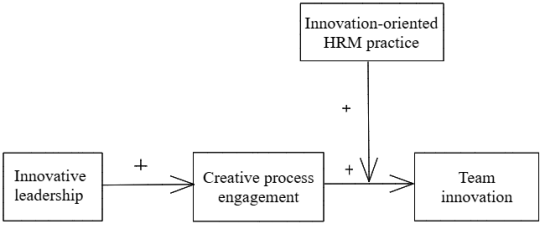
Based on the above analysis, the following theoretical model is proposed (
Figure 1).
Figure . 1. Theoretical framework.. Theoretical framework.
3. Research Design
3.1. Sample and Procedure
In the scale selection stage, except for the IL variable which adopts a locally adapted scale, the other core variables all adopt mature scales widely verified in international authoritative journals to ensure the scientificity, validity and reliability of the measurement tools. In the back-translation revision stage, for all English scales, the back-translation procedure proposed by Brislin
is adopted to complete the Chinese-English conversion. Experts in the fields of management and applied linguistics are invited to review and revise the item expression, semantic connotation and cultural adaptability to ensure that the item translation is accurate, the expression is clear and in line with the Chinese organizational context.
This study adopts a three-stage longitudinal follow-up survey for data collection, and the entire survey process lasts four months. In the first stage, team leaders receive a unified envelope containing employee questionnaires and survey guidelines, register the basic information (surname, gender, age) of 5 to 16 participating members, assign a unique code to each employee, and fill in the department and team size they belong to; team members fill in the innovative leadership perception scale and personal basic information, and provide the last four digits of their mobile phone numbers for subsequent multi-stage data matching. All questionnaires are filled out independently by members, sealed, and then uniformly collected and returned by leaders. In this stage, 122 leader questionnaires and 411 employee questionnaires are distributed to 122 teams, and finally 110 valid leader questionnaires and 390 valid employee questionnaires are recovered. In the second stage, two months later, the researchers distribute follow-up questionnaires to the teams that completed the first stage of the survey. Leaders evaluate team innovation performance, and employees evaluate their perceived creative process engagement. Both parties fill in the department, surname and the last four digits of their mobile phone numbers to achieve sample matching. A total of 109 leader questionnaires and 402 employee questionnaires are recovered in this stage. In the third stage, four months later, employees evaluate innovation-oriented innovation-oriented human resource management practices and fill in their personal surnames and the last four digits of their mobile phone numbers again to complete the full-cycle sample matching. Finally, 102 teams return the questionnaires completely. After all questionnaires are recovered, data cleaning is carried out in accordance with unified standards: questionnaires with more than 50% missing items, questionnaires with unsuccessful three-stage information matching, and team questionnaires with a response rate of less than 1/3 among team members are excluded. Finally, valid paired samples for formal data analysis are obtained, including 96 team leaders and 364 employees from 96 teams.
3.2. Variable Measurement
All scales adopt a 5-point Likert scale, where 1 represents "strongly disagree" and 5 represents "strongly agree". The specific measurement scales are as follows:
IL: A scale is constructed based on the grounded theory combined with the results of semi-structured interviews, which finally includes 4 dimensions (inclusiveness, synergy, leadership professional competence, and employee creativity motivation) with 18 items. A representative item is "The leader gives me a high degree of autonomy in work." The Cronbach’s α coefficient is .947.
CPE: The scale compiled by Zhang & Bartol
| [20] | Zhang, X., & Bartol, K. M. (2010). Linking empowering leadership and employee creativity: The influence of psychological empowerment, intrinsic motivation, and creative process engagement. Academy of management journal, 53(1), 107-128.
https://doi.org/10.5465/amj.2010.48037118 |
[20]
is adopted, including 3 dimensions (problem identification, information retrieval, idea generation) with 13 items. The items include "I spend a lot of time trying to understand the nature of the problem" and "I search for information from multiple sources". The Cronbach’s α coefficient of the scale is .934.
Innovation-oriented HRM practices: The innovation-oriented human resource management practices practice scale developed by Zhang
is adopted, including 4 dimensions (reward and promotion, training and development, communication and participation, job design) with 18 items. Exemplary items are "Innovative work teams can obtain generous rewards" and "The organization provides us with systematic knowledge and skill training". The Cronbach’s α coefficient is .902.
TI: The adapted scale by De Dreu et al.
| [5] | De Dreu, C. K., Nijstad, B. A., Bechtoldt, M. N., & Baas, M. (2011). Group creativity and innovation: A motivated information processing perspective. Psychology of aesthetics, creativity, and the arts, 5(1), 81.
https://doi.org/10.1037/a0017986 |
[5]
is used, with a total of 4 items. A representative item is "Team members often implement new ideas to improve the quality of our products and services." The Cronbach’s α coefficient is .913.
Control Variables: According to existing research, leaders' education level and team size may have an impact on team innovation, so they are taken as control variables. Among them, leaders' education level is coded as: 1 = senior high school and below, 2 = college, 3 = undergraduate, 4 = master and above; team size refers to the actual number of team members.
4. Results
4.1. Confirmatory Factor Analysis
Since IL, CPE and innovation-oriented HRM practices are filled in by employees, it is necessary to aggregate individual-level data into team-level data. Therefore, the ICC1, ICC2 and rwg are calculated. The results show that for innovative leadership, ICC1 =.632, ICC2 =.867, rwg =.97; for creative process engagement, ICC1 =.455, ICC2 =.760, rwg =.95; for innovation-oriented HRM practices, ICC1 =.505, ICC2 =.794, rwg =.94. The ICC1 of all variables is greater than .12, ICC2 is greater than .60, and rwg is greater than .60, which meets the aggregation requirements, and individual data can be aggregated into team data for subsequent analysis.
4.2. Descriptive Statistics and Correlation Analysis
4.2.1. Reliability and Validity Analysis
Mplus 7.0 is used to conduct confirmatory factor analysis (CFA), and the fit of the four-factor model, three-factor model, two-factor model and single-factor model are compared. The results are shown in
Table 1. It can be seen from
Table 1 that the four-factor model has the optimal fit indices (χ²/df = 1.65, CFI = 0.912, TLI = 0.908, SRMR = 0.033), which is significantly better than other models, indicating that each variable has good discriminant validity.
Table 1. Validation Factor Analysis.
Model | χ² | df | χ²/df | CFI | TLI | SRMR |
Hypothetical model (four-factor model) | 2179.33 | 1319 | 1.65 | .912 | .908 | .033 |
Three-factor model | 2349.48 | 1322 | 1.78 | .895 | .890 | .034 |
Two-factor model | 2330.85 | 1324 | 1.76 | .897 | .893 | .023 |
One-factor model | 2536.22 | 1325 | 1.91 | .876 | .871 | .026 |
Note: four-factor model = innovative leadership, team innovation, creative process engagement, innovation-oriented HRM practices; three-factor model = innovative leadership + creative process engagement, innovation-oriented HRM practices, team innovation; two-factor model = innovative leadership + creative process engagement + innovation-oriented HRM practices, team innovation; one-factor model = innovative leadership + creative process engagement + innovation-oriented HRM practices + team innovation. |
4.2.2. Descriptive Statistics
The results of descriptive statistical analysis on the main variables of the study are shown in
Table 2.
Table 2. Descriptive Statistics and Correlation Coefficients of Variables.
| Mean | SD | 1 | 2 | 3 | 4 | 5 | 6 | 7 | 8 | 9 |
Sex | .54 | .499 | 1 | | | | | | | | |
Age | 2.66 | .813 | -.11* | 1 | | | | | | | |
Tenure | 3.47 | 1.71 | -.07 | .68** | 1 | | | | | | |
L_EDU | 3.28 | .70 | .01 | .04 | -.02 | 1 | | | | | |
L_AGE | 4.11 | .80 | .08 | .15** | .16** | -.04 | 1 | | | | |
IL | 3.94 | .39 | .05 | .08 | .10 | .51** | .03 | 1 | | | |
TI | 3.37 | .48 | .04 | .03 | .05 | .40** | .04 | 0.11* | 1 | | |
CPE | 3.76 | .34 | .02 | -.01 | .01 | .42** | -.02 | .46** | .49** | 1 | |
HRM | 3.703 | .34 | -.05 | .02 | .08 | -.06 | .04 | -.13* | -.07 | .07 | 1 |
Note: n= 96, * p<0.05 ** p<0.01 Sex = employees’ sex; Age = employees’s age; Tenure = employees’ tenure; L_EDU = Leaders' education; L_AGE = Leaders’ age; IL=Innovative Leadership; TI=Team Innovation; CPE=creative process engagement; HRM=Innovation-oriented innovation-oriented human resource management practices |
4.3. Hypothesis Testing
Table 3. Hypothesis testing on IL, TI, LMXD, and RT.
Variance | CPE | TI |
Model 1 | Model 2 | Model 3 | Model 4 | Model 5 | Model 6 | Model 7 | Model 8 |
Sex | .01 | 0 | .03 | .01 | .03 | .02 | .02 | .01 |
Age | -.03 | -.02 | -.03 | -.03 | -.02 | -.02 | -.02 | -.02 |
Tenure | .01 | .01 | .03 | .01 | .02 | .02 | .01 | .01 |
L_EDU | .20 | .121** | .28 | .06* | .17 | .16 | .02 | .02 |
IL | - | .29** | | .77** | | | .68** | .68** |
CPE | | | | | .55 | .52** | .31* | -1.26* |
HRM | | | | | | -.08 | | -1.54** |
CPE*HRM | | | | | | .41** | | .42** |
R2 | .18 | .26 | .17 | .46 | .29 | .31 | .49 | .51 |
Adjust R2 | .17 | .25 | .16 | .45 | .28 | .30 | .48 | .49 |
F | 15.65 | 21.12 | 14.87 | 49.91 | 24.68 | 20.28 | 49.22 | 40.29 |
Note: * p<0.05, ** p<0.01. Sex = employees’ sex; Age = employees’s age; Tenure = employees’ tenure; L_EDU = Leaders' education; L_AGE = Leaders’ age; IL=Innovative Leadership; TI=Team Innovation; CPE=creative process engagement; HRM=Innovation-oriented innovation-oriented human resource management practices |
Hierarchical regression analysis is adopted to test the research hypotheses, and all continuous variables are centralized to avoid the problem of multicollinearity. The regression results are shown in
Table 3. Model 4 is constructed with TI as the dependent variable. After controlling for employee gender, employee age, employee tenure, leader's education level and leader's age, IL has a significant positive predictive effect on TI (β=.77,
p<.01), supporting H1.
Subsequently, H2 is tested by constructing model 2 with team CPE as the dependent variable. After the same control of variables, IL has a significant positive impact on team CPE (β=.29, p<.01), supporting H2. The study further constructs model 5 with team innovation as the dependent variable, and the results show that team CPE has a significant positive impact on TI (β=.55, p<.01), thus supporting H3.
The Bootstrap method is used to verify the mediating effect of team CPE (
Table 4), with the sample size set to 5000. Under the 95% confidence interval, the bias-corrected confidence interval does not contain zero, which indicates that team CPE plays a partial mediating role in the effect of IL on TI, further verifying Hypothesis 3.
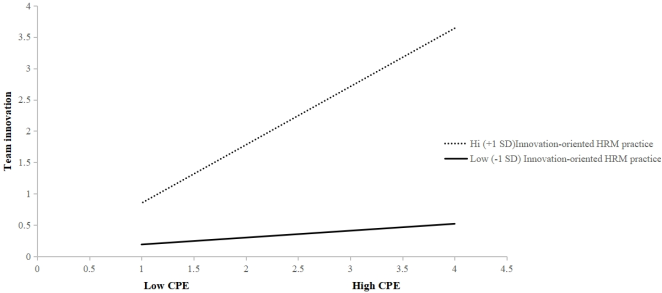
Figure 2. Interaction Effect Plot for Innovation-oriented HRM Practice.
Table 4. Test of the mediating effects (Bootstrap).
Variance | Effect | LLCI | ULCI |
IL→TI | .68 | .57 | .79 |
IL→CPE→TI | .09 | .05 | .14 |
As shown in
Table 3, after controlling for covariates including employee gender, age, organizational tenure, and leaders' educational level, model 6 incorporated the independent variable (CPE), the innovation-oriented HRM practices, and their interaction term in sequence. The results revealed that the main effect of CPE on TI was significant (β =.52, p <.01). More importantly, the interaction term of CPE and innovation-oriented HRM practices exerted a significantly positive impact on TI (β =.41, p <.01). These findings confirm that innovation-oriented HRM practices positively moderate the relationship between CPE and TI, thus supporting Hypothesis H4. As
Figure 2, the slope for the high innovation-oriented HRM practices is steep and significantly positive, indicating that team innovation increases substantially as CPE rises. In contrast, the slope for the low innovation-oriented HRM practices is much flatter, showing that the positive relationship between CPE and team innovation is markedly weakened when HRM support is insufficient. This pattern provides intuitive evidence that innovation-oriented HRM practices strengthen the positive impact of CPE on team innovation, consistent with the results of the hierarchical regression analysis.
5. Discussion and Conclusion
5.1. Discussion
This study finds that IL promotes TI through team CPE. It also finds that the relationship between team CPE and TI depends on the level of innovation-oriented HRM practices. Specifically, the impact of team CPE on TI is stronger in the group with high-level innovation-oriented HRM practices than in the group with low-level ones.
IL own professional competence and their adoption of a management model featuring inclusiveness, synergy and creativity motivation enable team members to generally perceive the leader's expectations for innovation, thus being more willing to invest more time and effort in TI work. The mutual cooperation among members improves the overall level of the team's CPE.
First, the inclusiveness and synergy of IL create a psychologically safe environment, reduce members' concerns about innovation risks, and strengthen their belief that "CPE can be effectively converted into TI"; their professional competence provides technical support and resource guarantee for the team, improving members' evaluation of the feasibility of innovation goals; creativity motivation directly strengthens the expectation that "innovation outcomes bring positive returns" by recognizing the value of innovation efforts (such as rewards and career development). The combined effect of these three factors significantly raises the team's overall motivation level of "expectancy×instrumentality×valence", thereby promoting team creative process engagement.
Second the promotional effect of team creative process engagement on team innovation is not linearly constant, but significantly depends on the "performance-reward" support system provided by the organizational context. This study confirms that innovation-oriented HRM practices (such as innovation performance appraisal, flexible compensation, and cross-border training) play a key moderating role here. When the level of such practices is high, the organization explicitly institutionalizes the connection between innovation output and individual/team rewards (compensation, promotion, recognition), which greatly enhances the credibility of the instrumental chain of "CPE - innovation outcomes-organizational rewards" (i.e., improving the perception of "instrumentality"), thus making the team more determined to convert creative process engagement into substantive innovation. On the contrary, in the absence of innovation-oriented HRM practices, members may reduce the efficiency of input due to the negative expectation that "innovation efforts may not bring rewards", weakening the conversion efficiency from creativity to innovation outcomes.
5.2. Theoretical Implications
First, existing research on leadership styles rarely involves innovative leadership. This study's focus on innovative leadership not only enriches the research on leadership styles, but also provides new ideas for the research on team innovation. Second, based on the expectancy theory, this study finds that innovative leadership influences team innovation through creative process engagement from the perspective of creative process engagement. It explores the mechanism of innovative leadership on team innovation, enriches the existing research results on innovation, and expands the application scope of the expectancy theory, providing a new perspective for future research. Finally, this study discusses the differentiated impact of innovation-oriented human resource management practices at different levels on the relationship between creative process engagement and team innovation, enriches the existing research on the boundary conditions of team innovation, and also supplements the research on innovation-oriented human resource management practices.
5.3. Managerial Implications
The research results of this paper show that, first of all, there should be a guarantee for creative process engagement. creative process engagement is a normal state for employees and teams, and effective team creative process engagement is regarded as an important and key team activity acting on team innovation. Necessary creative process engagement enables employees to obtain important information resources for realizing creative behaviors, which provides valuable support and help for effectively solving work difficulties and generating creative ideas.
Secondly, enterprises' advocacy for innovation should be implemented in specific innovation-oriented human resource management practices. Through the design of specific links, signals are transmitted to employees, making them understand what behaviors are encouraged and guiding them to develop in the expected direction. Leaders should also fully recognize employees' innovation efforts and innovation-related outcomes, and formulate corresponding reward plans. In addition, more innovation-related training should be provided for employees, and the assessment of innovation capabilities should be taken as part of employees' performance evaluation to urge employees to show more innovative behaviors in their work.
Finally, on the basis of effective creative process engagement, combined with specific innovation-oriented human resource management practices, the improvement of team innovation can be maximized. Team creative process engagement and innovation-oriented human resource management practices play different roles in promoting team innovation. creative process engagement exerts a more direct effect, while the implemented innovation-oriented human resource management practices play a more indirect role. creative process engagement is reflected in the degree of participation and input of individuals in specific work activities, which is a specific behavior generation process. Due to individuals' autonomous capabilities, driven by goal achievement, individuals can put into specific practices with a positive attitude at work (especially in how to come up with valuable problem solutions). In the process of this input, in terms of promoting the implementation of innovation-oriented human resource management practices, innovation-oriented human resource management practices can improve individuals' participation and input in innovation activities through diversified training, a combination of team and individual assessment, and compensation design, making positive behaviors for team innovation, and thus maximizing team innovation. This enlightens team managers that improving team innovation by increasing creative process engagement and implementing human resource management systems is an important path to enhance team vitality and achieve sustainable development.
5.4. Research Limitations and Future Research
Firstly, the sample data adopts cross-sectional data with one-to-many paired evaluation by superiors and subordinates. Future research can continuously track the changes of variables and collect more dynamic data for research, so as to more comprehensively understand the changes of variables and their relationships with other factors, and provide more accurate data to support research conclusions. Secondly, the data of this study are obtained from employee self-evaluation and leader filling. In the future, methods such as employee mutual evaluation and a combination of leader and employee joint evaluation can be adopted to enrich data sources and improve universality. Finally, from the perspective of the Pygmalion Effect, this study finds the mediating role of creative process engagement and the moderating role of innovation-oriented human resource management practices, which also reflects that the influence mechanism of innovative leadership on team innovation will be very complex. Future research can further explore the role of knowledge sharing, team job crafting and other factors between innovative leadership and team innovation.
Abbreviations
IL | Innovative Leadership |
CPE | Creative Process Engagement |
innovation-oriented HRM practices | Innovation-oriented Human Resource Management Practices |
TI | Team Innovation |
Author Contributions
Lin-Qin Xu: Conceptualization, Resources, Data curation, Writing – original draft, Writing – review & editing
Hsiow-Ling Hsieh: Methodology, Supervision
Conflicts of Interest
The authors declare no conflicts of interest.
References
| [1] |
Acar, O. A., Tuncdogan, A., van Knippenberg, D., & Lakhani, K. R. (2024). Collective creativity and innovation: An interdisciplinary review, integration, and research agenda. Journal of Management, 50(6), 2119-2151.
https://doi.org/10.1177/01492063231212416
|
| [2] |
Brislin, R. W. (1970). Back-translation for cross-cultural research. Journal of Cross-Cultural Psychology, 1(3), 185–216.
https://doi.org/10.1177/135910457000100301
|
| [3] |
Chemers, M. M., Watson, C. B., & May, S. T. (2000). Dispositional affect and leadership effectiveness: A comparison of self-esteem, optimism, and efficacy. Personality and Social Psychology Bulletin, 26(3), 267–277.
https://doi.org/10.1177/0146167200265001
|
| [4] |
Cavanagh, T., & Dowden, L. (2023). Effectively leading innovation. In The Business of Innovating Online, 69-84. Routledge: New York.
https://doi.org/10.4324/9781003447641
|
| [5] |
De Dreu, C. K., Nijstad, B. A., Bechtoldt, M. N., & Baas, M. (2011). Group creativity and innovation: A motivated information processing perspective. Psychology of aesthetics, creativity, and the arts, 5(1), 81.
https://doi.org/10.1037/a0017986
|
| [6] |
Ferrarini, F., & Curzi, Y. (2023). AMO-enhancing practices, open innovation and organizations’ innovation in the European context: testing a mediation model. European Journal of Innovation Management, 26(6), 1697-1720.
https://doi.org/10.1108/EJIM-01-2022-0005
|
| [7] |
Gilson, Lucy L. (2024). Why be creative: A review of the practical outcomes associated with creativity at the individual, group, and organizational levels. Handbook of organizational creativity, 303-322. Psychology Press: New York.
https://doi.org/10.4324/9781003573326
|
| [8] |
Gheller, B. M. (2025). Fostering Innovation: The Mediating Role of Need Satisfaction between Managerial Need Support and Team Innovation Behavior (Master’s thesis). University of Gothenburg, Gothenburg, Sweden.
https://hdl.handle.net/2077/88472
|
| [9] |
Jiang, J., & Yang, B. (2015). Roles of creative process engagement and leader–member exchange in critical thinking and employee creativity. Social Behavior and Personality: An International Journal, 43(7), 1217-1231.
https://doi.org/10.2224/sbp.2015.43.7.1217
|
| [10] |
Jing, B. (2024). Research progress and prospects of innovative leadership. Journal of Chongqing Technology and Business University (Social Science Edition), 41(02), 90-102.
https://doi.org/10.3969/j.issn.1672-0598.2024.02.007
|
| [11] |
Jotabá, M. N., Fernandes, C. I., Gunkel, M., & Kraus, S. (2022). Innovation and human resource management: a systematic literature review. European Journal of Innovation Management, 25(6), 1-18.
https://doi.org/10.1108/EJIM-07-2021-0330
|
| [12] |
Kui, Y., Zhao, J., & Nie, Q. (2022). How to improve team creative performance with two brushes simultaneously: Creative leadership and innovation-oriented human resource management practices. Journal of Capital University of Economics and Business, 24(2), 86-100.
https://doi.org/10.13504/j.cnki.issn1008-2700.2022.02.007
|
| [13] |
Mahmood, M., Uddin, M. A., & Fan, L. (2019). The influence of transformational leadership on employees’ creative process engagement: A multi-level analysis. Management Decision, 57(3), 741-764.
https://doi.org/10.1108/MD-07-2017-0707
|
| [14] |
More, A., & Lau, N. K. C. (2024, September). Exploratory Literature Review on Shared Leadership to Aid Collaboration and Function Allocation in Human-Autonomy Teams. In Proceedings of the Human Factors and Ergonomics Society Annual Meeting (Vol. 68, No. 1, pp. 1491-1495). Sage CA: Los Angeles, CA: SAGE Publications.
https://doi.org/10.1177/10711813241273500
|
| [15] |
Purcell, J., & Hutchinson, S. (2007). Front-line managers as agents in the HRM-performance causal chain: theory, analysis and evidence. Human Resource management journal, 17(1), 3-20.
https://doi.org/10.1111/j.1748-8583.2007.00022.x
|
| [16] |
Rasheed, M. A., Elahi, N. S., Nisar, Q. A., & Nasir, N. (2026, February). Interplay between innovation-oriented HRM and leadership to promote intrapreneurial behavior for innovation performance in small-and medium-sized enterprises. In Evidence-based HRM: a Global Forum for Empirical Scholarship, 14(1) 68-86.
https://doi.org/10.1108/EBHRM-05-2024-0183
|
| [17] |
Reiter-Palmon, R., & Robinson, E. J. (2009). Problem identification and construction: What do we know, what is the future?. Psychology of Aesthetics, Creativity, and the Arts, 3(1), 43-47.
https://doi.org/10.1037/a0014629
|
| [18] |
Reif, J. A., Feldmeier, C. L., Georganta, E., Kugler, K. G., & Brodbeck, F. C. (2025). From ideation to implementation: A model of team innovation. Group & Organization Management, 0(0), 1-37.
https://doi.org/10.1177/10596011251334678
|
| [19] |
Woodman, R. W., Sawyer, J. E., & Griffin, R. W. (1993). Toward a theory of organizational creativity. Academy of management review, 18(2), 293-321.
https://doi.org/10.5465/amr.1993.3997517
|
| [20] |
Zhang, X., & Bartol, K. M. (2010). Linking empowering leadership and employee creativity: The influence of psychological empowerment, intrinsic motivation, and creative process engagement. Academy of management journal, 53(1), 107-128.
https://doi.org/10.5465/amj.2010.48037118
|
| [21] |
Zhang, R. (2016). How does innovation-oriented HRM influence organizational innovation? The roles of innovation climate and organizational structure. Human Resources Development of China, (15), 57-65.
https://doi.org/10.16471/j.cnki.11-2822/c.2016.15.009
|
| [22] |
Zhang H., Zhang J., Xu H., Xiong D., Liu W. (2024). Research on the mechanism of innovative leader to promote employees' radical innovation. Research Management, (05), 172-181.
https://doi.org/10.19571/j.cnki.1000-2995.2024.05.018
|
| [23] |
Zhu, D. H., Zhao, Z., & Semadeni, M. (2025). How and why top executives influence innovation: A review of mechanisms and a research agenda. Journal of Management, 51(6), 2320-2354.
https://doi.org/10.1177/01492063241284962
|
Cite This Article
-
APA Style
Xu, L., Hsieh, H. (2026). Team Innovation: The Impact of the Interaction Between Creative Process Engagement and Innovation-oriented HRM Practices. Journal of Human Resource Management, 14(2), 158-166. https://doi.org/10.11648/j.jhrm.20261402.16
 Copy
|
Copy
|
 Download
ACS Style
Xu, L.; Hsieh, H. Team Innovation: The Impact of the Interaction Between Creative Process Engagement and Innovation-oriented HRM Practices. J. Hum. Resour. Manag. 2026, 14(2), 158-166. doi: 10.11648/j.jhrm.20261402.16
Copy
|
Download
AMA Style
Xu L, Hsieh H. Team Innovation: The Impact of the Interaction Between Creative Process Engagement and Innovation-oriented HRM Practices. J Hum Resour Manag. 2026;14(2):158-166. doi: 10.11648/j.jhrm.20261402.16
Copy
|
Download
-
@article{10.11648/j.jhrm.20261402.16,
  author = {Lin-Qin Xu and Hsiow-Ling Hsieh},
  title = {Team Innovation: The Impact of the Interaction Between Creative Process Engagement and Innovation-oriented HRM Practices},
  journal = {Journal of Human Resource Management},
  volume = {14},
  number = {2},
  pages = {158-166},
  doi = {10.11648/j.jhrm.20261402.16},
  url = {https://doi.org/10.11648/j.jhrm.20261402.16},
  eprint = {https://article.sciencepublishinggroup.com/pdf/10.11648.j.jhrm.20261402.16},
  abstract = {Against the backdrop of increasingly fierce market competition, team innovation (TI) has become a core approach for organizations to build sustainable competitive advantages. Based on the expectancy theory, this study constructs a mediated moderation model to explore the mechanism underlying the impact of the interaction between creative process engagement (CPE) and innovation-oriented human resource management (HRM) practices on team innovation. An empirical test is conducted with a research sample consisting of 364 employees from 96 teams across multiple industries including scientific research, architecture and design. The results show that: innovative leadership (IL) has a significant positive impact on TI, with CPE playing a partial mediating role between them; innovation-oriented HRM practices exert a significant positive moderating effect on the relationship between CPE and TI, meaning that the higher the level of innovation-oriented HRM practices, the stronger the promotional effect of CPE on TI; the interaction between CPE and innovation-oriented HRM practices can further amplify the indirect impact of IL on team innovation through CPE. This study reveals the internal logic of how the interaction between CPE and innovation-oriented HRM practices influences TI, enriches the theoretical research in the field of TI, and provides practical guidance for organizations to improve team innovation performance by optimizing CPE and innovation-oriented HRM practices.},
 year = {2026}
}
Copy
|
Download
-
TY  - JOUR
T1  - Team Innovation: The Impact of the Interaction Between Creative Process Engagement and Innovation-oriented HRM Practices
AU  - Lin-Qin Xu
AU  - Hsiow-Ling Hsieh
Y1  - 2026/04/23
PY  - 2026
N1  - https://doi.org/10.11648/j.jhrm.20261402.16
DO  - 10.11648/j.jhrm.20261402.16
T2  - Journal of Human Resource Management
JF  - Journal of Human Resource Management
JO  - Journal of Human Resource Management
SP  - 158
EP  - 166
PB  - Science Publishing Group
SN  - 2331-0715
UR  - https://doi.org/10.11648/j.jhrm.20261402.16
AB  - Against the backdrop of increasingly fierce market competition, team innovation (TI) has become a core approach for organizations to build sustainable competitive advantages. Based on the expectancy theory, this study constructs a mediated moderation model to explore the mechanism underlying the impact of the interaction between creative process engagement (CPE) and innovation-oriented human resource management (HRM) practices on team innovation. An empirical test is conducted with a research sample consisting of 364 employees from 96 teams across multiple industries including scientific research, architecture and design. The results show that: innovative leadership (IL) has a significant positive impact on TI, with CPE playing a partial mediating role between them; innovation-oriented HRM practices exert a significant positive moderating effect on the relationship between CPE and TI, meaning that the higher the level of innovation-oriented HRM practices, the stronger the promotional effect of CPE on TI; the interaction between CPE and innovation-oriented HRM practices can further amplify the indirect impact of IL on team innovation through CPE. This study reveals the internal logic of how the interaction between CPE and innovation-oriented HRM practices influences TI, enriches the theoretical research in the field of TI, and provides practical guidance for organizations to improve team innovation performance by optimizing CPE and innovation-oriented HRM practices.
VL  - 14
IS  - 2
ER  -
Copy
|
Download





 Share This Article
 Twitter
 Linked In
 Facebook