Research Article | | Peer-Reviewed

The Relationship Between the Impostor Phenomenon and Employee Experience: The Moderating Role of Transformational Leadership

Received: 19 February 2026     Accepted: 25 March 2026     Published: 8 May 2026
Views:       Downloads:
Abstract

A considerable number of employees experience impostor thoughts during their professional careers, characterized by persistent self-doubt and the belief that their achievements are undeserved. Previous research suggests that the impostor phenomenon is associated with negative work-related attitudes, whereas transformational leadership has been shown to positively influence employee outcomes such as self-efficacy and well-being. However, empirical evidence on how transformational leadership relates to employees experiencing impostor tendencies remains limited. The present study aims to examine the relationship between the impostor phenomenon, transformational leadership, and employee experience, as well as the potential moderating role of transformational leadership. A quantitative cross-sectional design was employed, surveying N = 199 employees across various industries, age groups, and genders. Transformational leadership, employee experience, and impostor characteristics were assessed using the Multifactor Leadership Questionnaire (Felfe, 2006b), the Employee Experience Questionnaire (Fischer et al., 2021), and the Impostor Self-Concept Questionnaire (Rohrmann et al., 2020). The results indicate that the impostor phenomenon is negatively associated with several dimensions of employee experience, including organizational commitment and individual engagement (b = −.14 to b = −.32, p < .05), while no significant effects were found for job satisfaction and collective engagement. Transformational leadership showed a significant positive relationship with all dimensions of employee experience (b = .63 to b = .96, p < .001). However, no significant direct effect of transformational leadership on the impostor self-concept was observed. A moderating effect of transformational leadership was identified only for job satisfaction (interaction effect: b = .18, p < .05). These findings contribute to a better understanding of the work-related consequences of the impostor phenomenon and highlight the role of leadership in shaping employee experience. Implications for leadership practice and future research directions are discussed.

Published in Journal of Human Resource Management (Volume 14, Issue 2)
DOI 10.11648/j.jhrm.20261402.17
Page(s) 167-178
Creative Commons

This is an Open Access article, distributed under the terms of the Creative Commons Attribution 4.0 International License (http://creativecommons.org/licenses/by/4.0/), which permits unrestricted use, distribution and reproduction in any medium or format, provided the original work is properly cited.

Copyright

Copyright © The Author(s), 2026. Published by Science Publishing Group

Keywords

Impostor Phenomenon, Job Satisfaction, Engagement, Commitment, Transformational Leadership, Moderation Analysis

1. Introduction
Individuals facing the Impostor Phenomenon suffer from a biased self-perception, which is closely linked to negative central self-assessments. Thus, the Impostor Phenomenon can also have a negative Impact on the well-being and professional progress of employees . The designated aspects represent sub-facets of a psychological construct - Employee Experience, which unites job satisfaction and organizational commitment as well as individual and collective engagement as an aggregate . In this context, managers are facing the challenge to convey confidence, safety, and support towards their self-doubting subordinates . Thus, leadership behavior contributes critically to a company’s success and functionality, as it has an impact on the well-being and performance of employees that should not be underestimated, .
Transformational leadership is a management concept that is considered successful. It focuses on individual support and development of their employees needs and performance as well as their motivation . Therefore, it is of interest to take a closer look on the impact of transformational leaderships on the impostor phenomenon. Previous research focused on leaders facing the impostor phenomenon themselves . This opens up a research gap, which the present study aims to fill. The present study not only helps to understand the impostor phenomenon’s characteristics and consequences better but also contributes to gathering findings about a potential moderating effect of transformational leadership on the impostor self-concept and employee experience relationship.
1.1. The Impostor Phenomenon Framework
The impostor syndrome is not an illness. Clance and Imes where the first to introduce the impostor phenomenon to psychological literature. The original term impostor refers to persons who pretend to have a prestigious social position, e.g. an academic degree, through fraudulent behavior in order to gain any kind of advantage . In contrast to real impostors, people suffering from impostor self-concept, feel like impostors even though they achieved their successes legitimately . However, the impostor phenomenon is often called impostor syndrome. Since it is not a part of international systems for classifying mental disorders (ICD 11) it cannot be defined as pathological illness or personality disorder, but rather as a self-concept .
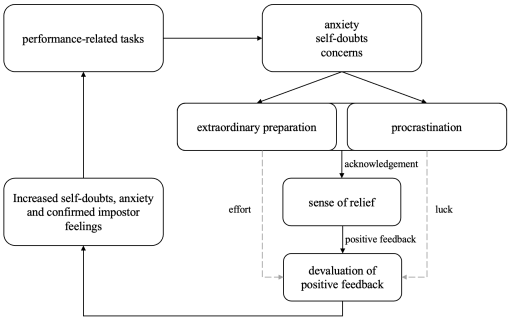
Figure 1. Impostor Cycle (own adaptation based on Clance ).
Characteristics. Affected individuals tend to attribute their successes to external causes rather than to their own abilities . Such courses of thought can be explained by several theories of causal attribution . Individuals with an impostor self-concept tend to attribute failures to internal and stable causes, while attributing successes to external and variable factors. This self-concept is characterized by the belief that one’s achievements are not genuinely deserved, but rather the result of external circumstances. As a consequence, affected individuals often perceive themselves as deceiving others and experience a persistent fear of being exposed due to their subjectively perceived inadequacies. .
Besides (1) the need to be the best, Clance describes four central characteristics the impostor phenomenon comes with: (2) denial of own abilities, (3) Superman-/woman complex, (4) fear of failure, (5) Guilt about success and (6) the appearance of an impostor cycle.
Clance’s impostor cycle (Fig. 1) illustrates that individuals with impostor self-concept tend to compensate their perceived shortcomings by placing unrealistically high demands on themselves. They are also prone to experiencing thoughts of concerns, fears and self-doubt when they are tasked with performance related assignments . Coping strategies serve the protection of one’s own self-esteem. Impostor self-concept related coping strategies focus on procrastination and excessive preparation. As Individuals with impostor self-concept sense fear of failure, they are likely to prepare their tasks extremely thoroughly. However, an extraordinarily perfectionistic way of working can be dysfunctional, as an uneconomical amount of effort is invested into completing e.g. a single task .
1.2. Transformational Leadership
Bass and Avolio created one of the most important leadership models in scientific literature and summarized three dimensions of leadership within the full range of leadership model: laissez faire, transactional- and transformational leadership style. Furthermore, researchers postulated that transformational leadership can be seen as an addition to the transactional leadership style . This additive effect is also referred to as the augmentation effect, which has been replicated by most studies . Transformational leadership focuses on motivating subordinates beyond their expected performance, creates awareness of success-critical organizational challenges while increasing their follower’s self-confidence . According to Bass and Avolio , transformational leadership can be further sub-categorized into four dimensions: (1) idealized influence, (2) intellectual stimulation, (3) individualized consideration and (4) inspirational motivation. However, the concept of transformational leadership has also been criticized in scientific literature. One named shortcoming of the concept is a missing differentiation to other leadership concepts for instance as charismatic leadership, which shows content-wise overlaps to the concept of transformational leadership. Nevertheless, transformational leadership is considered to be one of the most effective leadership concepts of the modern age . For instance, transformational leadership showed stronger positive relationships to job satisfaction and work motivation than the transactional leadership style, as it focuses more on employee performance .
1.3. Employee Experience: A Conglomerate Made of Job Satisfaction, Job Engagement and Organizational Commitment
Employee Experience describes work-related perceptions, attitudes, and behaviors of employees. It contains four facets (1) job satisfaction, (2) organizational commitment as well as (3) individual and (4) collective work engagement .
Job satisfaction can be described as emotional reactions and opinions towards work. It deals with the cognitive evaluation of job characteristics and contextual factors . Organizational commitment describes the loyalty of employees to the organization they work in, respectively on an affective, normative and calculative level . Kahn explains individual engagement as a proactive behavior that is characterized by physical, cognitive and emotional effort. Whereas collective work engagement is defined as shared and perceived positive and fulfilling motivational state of a group of employees .
1.4. Transformational Leadership and Employee Experience Among Individuals Facing Impostor Self-Concept
Previous findings show that the impostor phenomenon brings forth numerous characteristics which already have been explored in relation to transformational leadership and employee experience sub-facets. Existing empirical knowledge suggests that the impostor self-concept can have a negative impact on employee experience dimensions as the impostor phenomenon is associated with a generally negative attitude and is linked to neuroticism as well as job anxiety . Moreover, personality research has shown, that individual dispositions can impact the general well-being, life satisfaction and, in a reciprocal relationship, the job satisfaction of employees . Vergauwe et al. reported low levels of affective commitment in individuals with impostor self-concept. Additionally, self-efficacy was found to be a significant predictor of individual engagement (β = .36), while low self-efficacy levels have been found to predict impostor thoughts (β = -.71). These findings are supported by more recent studies . According to Langford and Clance (1993), personal worth is often related to attained accomplishments. Since individuals harboring impostor thoughts tend to depreciate their achievements, which leads to a constant diminishment of self-worth. Therefore, a negative impact of the impostor self-concept on the employee experience (sub-dimensions) can be expected.
Despite extensive research on the impostor phenomenon and transformational leadership, these constructs have rarely been examined in an integrated framework. In particular, it remains unclear whether transformational leadership can shape or mitigate the negative work-related experiences associated with impostor tendencies. The present study addresses this gap by investigating both the direct and moderating relationships between these variables. Hence, the following hypothesis is proposed:
H1: It is expected that the impostor self-concept
1) has a significantly negative impact on employee experience (index value)
2) has a significantly negative impact on job satisfaction
3) has a significantly negative impact on organizational commitment
4) has a significantly negative impact on individual engagement
5) has a significantly negative impact on collective engagement
In terms of employee experience facets, a positive impact of transformational leadership style can be assumed. A meta-analysis by Judge and Piccolo presented that transformational leadership has a positive effect on job satisfaction (β = .52) and motivation (β = .32) of employees. They additionally stated that transformational leadership is positively related to organizational performance (ρ = .26). Furthermore, Hoch et al. support those findings with another meta-analysis as they found positive relationships of transformational leadership and job satisfaction (r = .37), employee engagement (r = .44) and affective commitment (r = .39). These findings are also supported by further studies on a positive impact of transformational leadership on job satisfaction , collective engagement as well as organizational citizenship behavior and organizational commitment . Therefore, following hypothesis is formulated for the present study:
H2: It is expected that transformational leadership
1) has a significantly positive impact on employee experience (index value)
2) has a significantly positive impact on job satisfaction
3) has a significantly positive impact on organizational commitment
4) has a significantly positive impact on individual engagement
5) has a significantly positive impact on collective engagement
In light of the fact that transformational leadership aims to support employees individually and focuses on encouraging, challenging and motivating subordinates, it is assumed that transformational leadership has a mitigating effect on the appearance of impostor feelings.
The impostor self-concept is characterized by anxiety, self-doubts, worries, overly high-performance standards and guilt in case of success . Simultaneously, transformational leaders convey confidence in the fulfillment of demanding objectives by their employees and engage them by conveying desirable visions . In addition, former research shows that the impostor self-concept can be mitigated by healthy formal and informal relationships . A study also showed that transformational leadership has a positive impact on employees’ self-confidence . Therefore, following hypothesis is proposed:
H3: It is expected that transformational leadership has a significantly negative impact on the impostor self-concept.
It is additionally assumed, that transformational leadership mitigates the negative relationship between employee experience and impostor self-concept. This assumption is based on the previous explanations about transformational leaders’ abilities to reduce the expression of impostor self-concept. Transformational leadership is also associated with positive effects on employee experience dimensions. Former research showed similarly a moderating effect of work-related social support on the relationship between job satisfaction and organizational citizenship behavior . The characteristics of social support are similar to transformational leadership characteristics since transformational leaders consider individual dispositions of their employees as well as enable and support in independent and creative processes of thoughts and problem solving . Therefore, an interaction effect between transformational leadership and impostor self-concept is expected.
H4: It is expected that transformational leadership moderates the relationship between impostor self-concept and
employee experience.
job satisfaction.
organizational commitment.
individual engagement.
collective engagement.
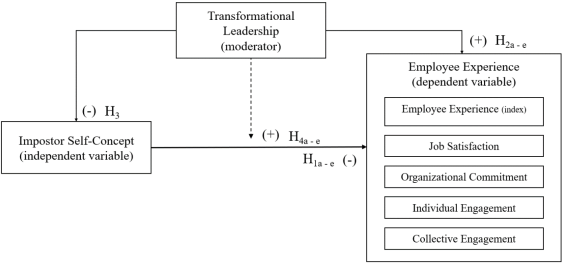
All hypotheses of the study are summarized in Figure 2.
Figure 2. Proposed model including hypotheses.
2. Methods
2.1. Procedure and Sample
The study was conducted between March and May 2023. Participants received a link to an Online questionnaire with a duration of five to ten minutes. Individuals with manifestations of the impostor self-concept are difficult to identify externally unless they publicly express their self-image . Thus, to test the hypotheses, individuals across all age groups, genders, and organizational characteristics were surveyed. The only prerequisites were the presence of a direct supervisor who was to be assessed in the questionnaire and knowledge of German language, as the study had to be conducted among German-speaking individuals to ensure the participation of all age groups. Participation was voluntary. Acquisition of participants took place through distribution via E-Mail and Social Media channels.
In total, 283 participants were recruited for the survey. Ultimately, the number of usable datasets reduced to N = 199.84 datasets were excluded due to unfinished surveys and missing conformity with the screening question. A power analysis specified a sample size of N = 99 individuals at a significance level of α = .05, an effect size of R² = .13, and a power of .8 . The final sample of 199 participants exceeds the a priori sample calculation.
2.2. Measures
The questionnaire consisted of demographical questions collecting information about the participants’ age, gender, presence of a supervisor, organizational size and industry, as well as three measurement scales. The measurements employed in this study were the Multifactor Leadership Questionnaire (MLQ) , Employee Experience Questionnaire (EXQ) and the Impostor self-concept questionnaire (ISF) have been developed or translated and validated in Germany and already utilized in previous studies.
Employee experience was assessed using EXQ. EXQ consists of 21 Items measuring four dimensions of employee experience, which constituted employee experience as overall score. The questionnaire was examined for its psychometric quality criteria by Fischer et al. with a sample of 467 individuals. Regarding the reliability of the scales, Cronbach's Alpha ranged between α = .79 and α = .91, indicating good to very good reliability .
The external assessment of the supervisors’ leadership style was conducted by using the translated German version of MLQ by Felfe . Overall, 19 items from the MLQ by Felfe were used. They are divided into 5 scales, as idealized influence shows two dimensions: Idealized Influence attributed (IIa) and Idealized Influence behavior (IIb). Considering research economy, the other scales of MLQ were not adopted, as the operationalization of this studys moderating variable relates only to the transformational leadership dimension . Felfe examined the measurements’ psychometric quality with a sample of N = 3.500 individuals. The internal consistencies of the scales range between a Cronbach's Alpha of α = .73 and α = .84 , and are considered satisfactory to good given the brevity of the scales .
To test impostor phenomenon expressions among the participants, ISF by Rohrmann et al. was used. ISF includes 15 items and presents a self-description. The scale has been empirically validated, showing a reliability of α = .93 und α = .94 .
2.3. Analytic Procedure for Hypothesis Testing
The data analysis was conducted using SPSS (Statistical Package for the Social Sciences) Version 29 with PROCESS Macro 4.2 . Sample description occurred by examining descriptive statistics. For hypotheses testing, linear regression and moderation models were computed. Seven models were tested: one multiple regression model for the influence of the impostor self-concept and transformational leadership on each sub-variable of Employee Experience, and one each in which transformational leadership serves as moderator variable in the relationship between impostor self-concept and employee experience as well as employee experience sub-variables. For the moderation analyses, bootstrapping with 5000 iterations, along with heteroskedasticity-robust standard errors using HC3 method , was applied to calculate confidence intervals (CI). Additional exploratory investigations focused on gender-specific differences as well as associations of the three main variables with demographics.
3. Results
3.1. Description of Study Sample
As Table 1 shows, one-third of the surveyed individuals were male (N = 63), while approximately two-thirds were female (N = 136). About 50% of the participants reported an age between 16 and 29, 40% between 30 and 49, and approximately 10% were older than 50 years. Concerning company size, at the time of the survey, 144 (72%) individuals stated they worked in a large company, while one-third of the respondents were equally distributed in medium-sized (12.1%) and small-sized enterprises (15.6%). Notably, around half of the respondents worked within IT and telecommunications industry. Approximately 17% of the participants were employed in the public sector. Among the 199 participants, 58 individuals (29%) showed average scores of M > 3 relating to the impostor self-concept Scale (M = 3.39, SD = .29). According to Clance , one third of the participants were categorized in their impostor self-concept manifestation as at least moderate.
Table 1. Sample sociodemographic characteristics.

Mean (SD)

n (%)

Range

Age (years)

33.95

10.5

19 - 65

Gender

Female

136 (68)

Male

63 (32)

Professional Experience (years)

13.65

10.94

Company Size

Large

144 (72)

Medium-sized

24 (12.1)

Small

31 (15.6)

Industry

IT & Telecommunication

98 (51.8)

Public sector

34 (17.6)

Health & social affairs

16 (8)

Other

10 (22)

Note. N = 199

3.2. Preliminary Analyses
Assumption checks were conducted for moderation analysis and linear regression, as both procedures were mainly used for hypotheses testing. The checks revealed no significant anomalies, except for homoscedasticity within individual engagement and organizational commitment. Therefore, the regression analysis significance outcomes were cross-validated using robust standard errors. The PROCESS tool used for conducting moderation analyses, provided heteroskedasticity-robust estimators.
3.3. Hypothesis Testing
The first hypothesis posited a significant negative influence of the impostor self-concept on employee experience facets as well as its overall score, while the second hypothesis assumed a positive influence of transformational leadership on these variables. The impostor self-concept statistically significantly predicted Employee Experience (total value) and thus negatively influenced Employee Experience (H1a), b = -.14, 95% CI [-0.256, -0.018], p = .02. Furthermore, a positive impact of transformational leadership on employee experience was found (H2a), b = .78, CI [0.678, 0.897], p < .001. Transformational leadership, (H1b), b = .91, 95% CI [0.780, 1.042], p < .001, turned out to be a significant predictor of job satisfaction, while impostor self-concept showed no effects on the variable, (H2b), b = -.11, 95% CI [-0.251, 0.034], p = .13. Both transformational leadership (H2c), b = .95, 95% CI [0.763, 1.15], p < .001, and impostor self-concept (H1c), b = -.32, 95% CI [-0.535, -0.113], p = .003, were significant predictors for organizational commitment.
With regard to individual engagement, the impostor self-concept as well as transformational leadership were identified as significant predictors. As shown in Table 2, the impostor self-concept (H1d) exerted a weak negative influence on individual engagement according to Cohen (1988). Impostor self-concept (H1d) affected individual engagement weakly negative, b = -.16, 95% CI [-0.299, -0.019], p = .027, while transformational leadership (H2d) showed a significantly positive effect on individual engagement, b = .65, 95% CI [0.524, -0.781], p < .001. Furthermore, impostor self-concept (H1e) resulted in not having did predictive power regarding employees' collective engagement, b = .04, 95% CI [- 0.119, 0.205], p < .001, while transformational leadership (H2b) significantly predicted collective engagement (b = .63, 95% CI [0.481, 0.778], p < .001).
H3 assumed that transformational leadership negatively influences the occurrence of the impostor self-concept. However, the regression model turned out to be non-significant., F (1, 197) = 3.66, p = .05.
Table 2. Regression analyses of the hypothesized variables with the impostor self-concept and transformational leadership as predictors.

b

SE

β

t

p

Employee Experience (total value)

Impostor self-concept

-.14

.06

-.11

-.26

.02

Transformational Leadership

.79

.06

.70

14.2

< .001

Job Satisfaction

Impostor Self-Concept

-.11

.07

-.08

-1.51

.134

Transformational Leadership

.91

.07

.70

15.74

< .001

Organizational Commitment

Impostor Self-Concept

-.32

.11

-.17

-3.03

.003

Transformational Leadership

.96

.098

.56

9.73

< .001

Individual Engagement

Impostor Self-Concept

-.16

.071

-.13

-2.24

.027

Transformational Leadership

.65

.065

.574

9.99

< .001

Collective Engagement

Impostor Self-Concept

.04

.08

.03

.52

.60

Transformational Leadership

.63

.08

.52

8.34

< .001

Impostor Self-Concept

Transformational Leadership

-.13

.07

-.14

-1.91

.050

Notes. N =199; dependent variable (DV), Employee Experience (total value): R² = .53, corr. R² = .53, F(2, 196) = 110.36, p < .001; DV job satisfaction: R² = .51, corr. R² = .50, F(2, 196) = 100.33, p < .001; DV Organizational commitment: R² = .37, corr. R² = .36, F(2, 196) = 57.16, p < .001; DV Individual engagement: R² = .37, corr. R² = .36, F(2, 196) = 56.67, p < .001; DV Collective engagement: R² = .26, corr. R² = .26, F(2, 196) = 35.02, p < .001; Impostor self-concept (ISK): R² = .019, corr. R² = .014, F(1, 197) = 3.89, p = .05

3.4. Moderation Analyses
In order to test hypotheses H4a-e, moderation analyses were conducted for transformational leadership as moderator, the independent variable impostor self-concept, and the dependent variables employee experience, job satisfaction, organizational commitment, individual engagement, and collective engagement to test hypotheses H4a-e.
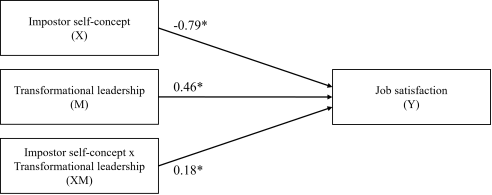
However, only a moderating effect of transformational leadership on the subfacet of job satisfaction was identified, Δ = 1.64%, F(1, 195) = 5.17, 95% CI [0.011, 0.316], p = .024 (H4b). Figure 3 shows the moderational effect of transformational leadership on the relationship between impostor self-concept and job satisfaction.
Figure 3. Moderating effect of transformational leadership on the relationship between the impostor self-concept and employee experience.
Notes. N = 199; X = Predictor, M = Moderator, Y = Independent variable. The interaction term XM predicts Y significantly.
Significance level * p < .05.
The results failed to reveal a moderational effect of transformational leadership on the relationship between the impostor self-concept and employee experience, Δ = 0.97%, F(1, 195) = 59.11, 95% CI [-0.036, 0.242], p = .121, (H4a). Furthermore, no moderation effect of transformational leadership could be found in the model with organizational commitment as the dependent variable, Δ = 0.29%, F(1, 195) = 0.822, 95% CI [-0.136, 0.292], p = .366 (H4c). No moderational effect of transformational leadership was observed for both dimensions of engagement. Referring to individual engagement (H4d) a significance value of p = .20 yielded, Δ = 1.38%, F(1, 195) = 1.64, 95% CI [-0.080, 0.333]. In addition, the interaction term did not contribute more variance explanation than the moderator and predictor themselves (H4e), Δ = 0.15%, F(1, 195) = 0.1937, p = .66, 95% CI [-0.0185, 0.235]. The results of the moderation analyses are summarized in Table 3. Interaction effects are presented for each criterion.
Table 3. Interactional effects as results of moderation analyses.

b

SEa

t

95% CIb

p

Employee Experience (total value)

Int. TF GES x ISK

.12

0.08

1.56

[-0.036, 0.242]

.12

Job Satisfaction

Int. TF GES x ISK

.18

0.08

2.27

[0.011, 0.316]

.02

Organizational Commitment

Int. TF GES x ISK

.10

0.11

0.91

[-0.136, 0.292]

.37

Individual Engagement

Int. TF GES x ISK

.15

0.12

1.28

[-0.080, 0.333]

.20

Collective Engagement

Int. TF GES x ISK

.05

0.12

0.44

[-0.185,0.235]

.66

Notes. N = 199; Int. TF GES x ISK = Interaction term of transformational leadership and impostor self-concept; CI = confidence interval. a Robust standard error (HC3) according to Davidson and MacKinnon

12]. b CI retrieved from bootstrapping.

4. Discussion
This study aimed at investigating the impact of transformational leadership on work-related experiences of employees facing the impostor self-concept. For this purpose, the moderating role of transformational leadership in the relationship between the impostor self-concept and dimensions of employee experience was examined. Findings revealed that the impostor phenomenon has a negative impact on all Employee Experience facets (job satisfaction, individual engagement, organizational commitment), except for collective engagement. Regarding the missing impact on collective engagement, recent empirical findings have revealed positive characteristics associated with the impostor self-concept, as indicated by Tewfik . Further exploration of these traits is recommended for future research.
Transformational leadership was found to have a negative, albeit marginally nonsignificant effect on impostor self-concept, and thus on employees’ low self-efficacy expectations and dysfunctional thoughts and behaviors. This could be attributed to bias effects resulting from the external assessment by supervisors, combined with the tendency toward neuroticism in individuals with impostor self-concept. Previous research identified patterns in the personality traits of employees who prefer a transformational leadership style in their supervisors . In this context, psychological theory delineates two approaches: the similarity approach and, respectively, the complementarity approach. The complimentary approach describes individuals who are low in self-efficacy, tend to insecurities and prefer to orient themselves toward their supervisor to compensate deficits . According to Klein and House , employees with personality traits that are similar to those of their supervisors, are more capable of recognizing and positively assessing a transformational leadership style. Bono and Judge examined transformational leadership in the context of the Big Five personality traits and found extraversion to be a characteristic of transformational leadership, while neuroticism turned out to correlate negatively to a transformational leadership style. Simultaneously, the impostor phenomenon is positively correlated to neuroticism, as demonstrated in multiple studies .
The present study supported the existing findings in theory and research regarding the impact of transformational leadership on employee experience facets. Transformational leadership was found to have a significantly strong and positive effect on job satisfaction, organizational commitment as well as individual- and collective engagement. In this study, transformational leadership did not emerge as a moderating variable affecting the strength of the relationship between the impostor phenomenon and Employee Experience, except for job satisfaction. Johnson-Neyman-Intervals revealed that only the absence of transformational leadership has a significantly negative impact on job satisfaction of individuals facing impostor phenomenon. Significance was found at low transformational leadership values of 1.00, p = .018, CI [-1.111, -.111], to 3.40, p = .04, CI [-.333, -.008]. Beyond these intervals, the interaction was found to be non-significant. Individuals with an impostor self-concept are inter alia characterized by having high performance standards. According to the Superman- / Superwoman-Complex, they tend to set unrealistic goals for themselves . In accordance with the Two-Factor Theory, transformational leadership could be considered as a hygiene factor, which may lead to dissatisfaction in its absence and does not solely serve the purpose of satisfying employees. However, this aspect of the Two-Factor Theory has already been criticized in academic literature (Becker, 2019). This is supported by the present study, as transformational leadership style turned out as significantly strong predictor of job satisfaction. Possibly, the aspect of whether transformational leadership acts as a hygiene or motivational factor may depend on additional variables, such as values and standards of subordinates. Thus, it can be concluded that further internal as well as external factors referring to the work environment should be considered when conducting future research on impostor phenomenon in the work context.
5. Limitations and Directions for Future Research
The sample of the study should be critically questioned in terms of external validity. Approximately half of the participants belonged to the IT and telecommunications industry. Consequently, the results cannot be generalized across all industries. For future research, industry-specific inquiries in the context of the impostor self-concept would be of interest.
The hypotheses in this study were tested using a two-tailed approach to avoid an exclusion of possible a-priori unexpected effects and thus enhance objectivity. However, it is crucial to note critically that, inter alia, the influence of transformational leadership on the impostor self-concept, p = .05, would have been significant in an one-tailed test, which constitutes a limitation of the present study .
Transformational leadership was measured by using the external assessment version of the MLQ. Therefore, the actual degree of transformational leadership was unknown, as subjective perception can by distorted by factors such as personality traits . Consequently, the actual effect of transformational leadership on impostor self-concept and employee experience could not be determined. The results of a study based on a research design that evaluates transformational leadership not only through an external assessment but also through self-assessment and assessments from both employees and colleagues would be highly interesting .
The present study focused on transformational leadership. For research economy reasons, additional leadership styles were not measured. Since the moderation model revealed that transformational leadership, as a moderating variable, negatively influences the relationship between impostor self-concept and job satisfaction in its absence, it would have been additionally interesting to examine the consequences of laissez-faire leadership in this context, as laissez-faire leadership can be categorized as a destructive leadership style and may potentially show even stronger negative effects .
6. Practical Implications
Every company should strive to create a work environment that supports the well-being and performance of its employees. The present study has shown that the impostor self-concept is a prevalent phenomenon that requires the attention of leaders, colleagues, and organizations in general, as it is associated with negative effects on the work-related experience of employees.
Despite the lack of a moderating effect of transformational leadership on the relationship between the impostor self-concept and employee experience, leaders should be aware that behaviors such as procrastination, excessive preparation, and devaluing positive feedback could be indicators of impostor thoughts in their employees . Previous research showed that intervention measures such as coaching and cognitive-behavioral interventions can effectively contribute in reducing impostor tendencies . Additionally, positive psychological interventions aim to strengthen factors that tend to be underdeveloped in individuals with an impostor self-concept . Leaders who suspect impostor thoughts in their employees should initiate appropriate intervention measures in order to support them.
7. Conclusion
In summary, the present study contributes to a better understanding of characteristics and effects associated with impostor self-concept. It presents the importance of transformational leadership for the work experience of employee. It can thus serve as a foundation for further investigations focusing on different contexts, also positive attributes of individuals facing impostor self-concept, and intervention possibilities.
Abbreviations

CI

Confidence Interval

DV

Dependent Variable

EXQ

Employee Experience Questionnaire

ISF

Impostor Self-Concept Questionnaire

MLQ

Multifactor Leadership Questionnaire

SPSS

Statistical Package for the Social Sciences

Author Contributions
Sarah Jasmin Kulaga: Conceptualization, Data curation, Formal Analysis, Methodology, Writing – original draft
Thomas Olbrecht: Conceptualization, Data curation, Methodology, Writing – review & editing
Saskia Pilger: Conceptualization, Methodology, Writing – review & editing
Data Availability Statement
The data that support the findings of this study are available from the corresponding author upon reasonable request.
Conflicts of Interest
The authors declare no competing interests.
References
[1] Ali, Mazhar & Puah, C. H. (2018). Transformational leadership, organizational commitment and innovative success. Munich Personal RePEc Archive.
[2] Aparna, K. & Preetha, M. (2022). Impostor Syndrome. An integrative framework of its antecedents, consequences and moderating factors on sustainable leader behaviors. European Journal of Training and Development, 46(9), 847-860.
[3] Bass, B. M. & Avolio, B. J. (1990). Developing transformational leadership: 1992 and beyond. Journal of European Industrial Training, 14(5), 22-27.
[4] Bass, B. M. & Avolio, B. J. (1993). Transformational leadership: A response to critiques. In M. Chemers & R. Ayman (Hrsg.), Leadership theory and research. Perspectives and directions (S. 49–88). Academic.
[5] Bass, B. M. & Avolio, B. J. (1995). MLQ Multifactor Leadership Questionnaire, Leader Form, Rater Form, and Scoring. Mind Garden California.
[6] Barrick, M., Thurgood, G. R., Smith, T. A. & Courtright, S. H. (2015). Collective organizational engagement: Linking motivational antecedents, strategic implementation and firm performance. Academy of Management Journal, 58(1),
[7] Bono, J. E. & Judge, T. A. (2003). Core self-evaluations: A review of the trait and its role in job satisfaction and job performance. European Journal of Personality, 17, 5-18.
[8] Braun, O. L., Gail, K. & Greinert, A. (2020). Das Modell des positiven Selbstmanagements und seine bisherige empirische Bestätigung. In O. L. Braun (Hrsg.), Positive Psychologie, Kompetenzförderung und Mentale Stärke (S. 3-20). Springer.
[9] Bühner, M. (2011). Einführung in die Test- und Fragebogenkonstruktion. Pearson.
[10] Clance, P. R. & Imes, S. (1978). The Impostor Phenomenon in high achieving women: dynamics and therapeutic intervention. Psychotherapy, Theory, Research and Practice, 15(3), 241-247.
[11] Clance, P. R. (1985). Erfolgreiche Versager. Das Hochstapler Phänomen. Heyne.
[12] Davidson, R. & MacKinnon, J. G. (2021). Estimation and inference in econometrics. Oxford University Press.
[13] Döring, N. & Bortz, D. (2016). Forschungsmethoden und Evaluation in den Sozial- und Humanwissenschaften. Springer.
[14] Duncan, L., Taasoobshirazi, G., Vaudreuil, A., Sai Kota, J. & Sneha, S. (2023). An evaluation of impostor phenomenon in data science students. International Journal of Environmental Research and Public Health, 20(5).
[15] DWDS. (25.03.2023). Hochstapler.
[16] Einarsen, S., Aasland, M. S. & Skogstad, A. (2007). Destructive leadership behaviour: A definition and conceptual model. The Leadership Quarterly, 18, 207-216.
[17] Eldor, L. (2019). How collective engagement creates competitive advantage for organizations: A business-level model of shared vision, competitive intensity, and service performance. Journal of Management Studies, 57(2), 177-209.
[18] Feenstra, S., Begeny, C. T., Ryan, M. K., Rink, F. A., Stoker, J. L. & Jordan, J. (2020). Contextualizing the Impostor “Syndrome”. Frontiers in Psychology, 11, 1-6.
[19] Felfe, J., Tartler, K. & Liepmann, D. (2004). Advanced research in the field of transformational leadership. Zeitschrift für Personalforschung, 3, 262 – 288.
[20] Felfe, J. (2006a). Transformationale und charismatische Führung – Stand der Forschung und aktuelle Entwicklungen. Hogrefe.
[21] Felfe, J. (2006b). Validierung einer deutschen Version des „Multifactor Leadership Questionnaire“ (MLQ Form 5 x Short) von Bass und Avolio (1995). Zeitschrift für Arbeits- und Organisationspsychologie, 50(2), 61 – 78.
[22] Field, A. (2018). Discovering statistics using IBM SPSS statistics. SAGE.
[23] Fischer, J. A., Hüttermann, H. & Werther, S. (2021). Employee Experience Questionnaire (EXQ): Fragebogen zur Messung von Zufriedenheit, Commitment und Engagement. Zusammenstellung sozialwissenschaftlicher Items und Skalen (ZIS).
[24] Furtner, M. & Baldegger, U. (2013). Self-Leadership und Führung. Springer.
[25] Gardner, R. & Bednar, J. (2022). 4 ways to combat impostor syndrome on your team. Harvard Business Publishing.
[26] Haar, J. Jong, K. (2024). Impostor phenomenon and employee mental health: what role do organizations play? Personnel Review, 53(1), 221-227.
[27] Hayes, A. F. (2022). Introduction to mediation, moderation, and conditional process analysis. A Regression-Based Approach. Guilford Press.
[28] Hill, S., Seo, M. G., Kang, J. H. & Taylor, M. S. (2012). Building employee commitment to change of hierarchical distance and direct managers transformational leadership. Organization Science, 23(3), 758-777.
[29] Heckhausen, J., & Heckhausen, H. (2018). Motivation and Action. New York: Springer.
[30] Heckhausen, H. (2018). Historical Trends in Motivation Research. New York: Springer.
[31] Hemmerich, W. (2020). StatistikGuru: Poweranalyse und Stichprobenberechnung für Moderationsanalysen.
[32] Heyna, P. & Fittkau, K. H. (2021). Transformationale Führung kompakt. Genese, Theorie, Empirie, Kritik. Springer.
[33] Hoch, J., Bommer, W. H., Dulebohn J. H. & Wu, D. (2018). Do ethical, authentic, and servant leadership explain variance above and beyond transformational leadership? A meta-analysis. Journal of Management, 44(2), 501-529.
[34] Hudson, S. & Gonzalez-Gomez, H. V. (2021). Can impostors thrive at work? The impostor phenomenon’s role in work and career outcomes. Journal of Vocational Behavior, 125, 1-48.
[35] IBM. (2023). IBM SPSS Statistics for MAC OS (Version 29.0). IBM Corporation.
[36] Jha, S. (2012). Transformational leadership and psychological empowerment. Determinants of organizational citizenship behavior. South Asian Journal of Business Research, 3(1), 18-35.
[37] Judge, T. A. & Piccolo, R. F. (2004). Transformational and transactional leadership: a meta-analytic test of their relative validity. Journal of Applied Psychology, 89 (5), 755-768.
[38] Judge, T. A. & Kammeyer-Mueller, J. (2012). Job attitudes. Annual Review of Psychology, 63, 341–367.
[39] Judge, T. A. & Watanabe, S. (1993). Another look at the job satisfaction - life satisfaction relationship. Journal of Applied Psychology, 78(6), 939-948.
[40] Kahn, W. A. (1990). Psychological conditions of personal engagement and disengagement at work. Academy of Management Journal, 33(4), 692–724.
[41] Klein, J. K. & House, R. J. (1990). On fire: charismatic leadership and levels of analysis. Leadership Quarterly, 6(2), 183-198.
[42] Klinkhammer, M. & Saul-Soprun, G. (2009). Das Hochstaplersyndrom in der Wissenschaft. Organisationsberatung, Supervision, Coaching, 16(2), 165-182.
[43] Liu, J., Siu, O. L. & Shi, K. (2010). Transformational leadership and employee well-being: the mediating role of trust in the leader and self-efficacy. Applied Psychology: An International Review, 59(3), 454-479.
[44] Mathieu, J. E. & Zajac, D. M. (1990). A review and meta-analysis of the antecedents, correlates and consequences of organizational commitment. Psychological Bulletin Journal, 108, 171-194.
[45] Matthews, G. & Clance, P. (1985). Treatment of the impostor phenomenon in psychotherapy clients. Psychotherapy in Private Practice, 3(1), 71-81.
[46] Ngussa, B. & Mengo, S. (2017). Correlations between leadership styles and self-esteem of employees. Journal of Research Innovation and Implications in Education, 1(4), 1-12.
[47] O’Reilly, C. & Chatman, J. (1986). Organizational commitment and psychological attachment: the effects of compliance, identification and internalization on prosaic behavior. Journal of Applied Psychology, 71(3), 492-499.
[48] Pillai, R. & Williams, E. (2004). Transformational leadership, self-efficacy, group cohesiveness, commitment and performance. Journal of Organizational Change Management, 17(2), 144-159.
[49] Rohrmann, S., Bechtoldt, M. & Leonhardt, M. (2016). Validation of the Impostor Phenomenon among managers. Frontiers in Psychology, 7, 821.
[50] Rohrmann, S. (2019). Wenn große Leistungen zu großen Selbstzweifeln führen. Das Hochstapler-Selbstkonzept und seine Auswirkungen. Hogrefe.
[51] Sakulku, J. & Alexander, J. (2011). The Impostor Phenomenon. International Journal of Behavioral Science, 6(1), 73-92.
[52] Tewfik, B. (2022). The Impostor Phenomenon revisited: Examining the relationship between workplace impostor thoughts and interpersonal effectiveness at work. Academy of Management Journal, 65(3), 988-1018.
[53] Thompson, T., Foreman, P. & Martin, F. (2000). Impostor fears and perfectionistic concern over mistakes. Personality and Individual Differences, 29(4), 629-647.
[54] Vergauwe, J., Wille, B., Feys, M. De Fruyt, F. & Anseel, F. (2015). Fear of being exposed: the trait relatedness of the impostor phenomenon and its relevance in the work context. Journal of Business and Psychology, 30(3), 565-581.
[55] Wang, G., Van Iddekinge, C. H., Zhang, L. & Bishoff, J. (2019). Metaanalytic and primary investigations of the role of followers in ratings of leadership behavior in organizations. Journal of Applied Psychology, 104(1), 70-106.
[56] Yuwono, H., Kurniawan, M., Syamsudin, N., Eliyana, A., Saputra, D., Emur, A., Jalil, N. (2023). Do psychological capital and transformational leadership make differences in organizational citizenship behavior?
[57] Zanchetta, M., Junker, S., Wolf, A. M. & Traut-Mattausch, E. (2020). Overcoming the fear that haunts your success – the effectiveness of interventions for reducing the Impostor Phenomenon. Frontiers in Psychology, 11, 405.
Cite This Article
  • APA Style

    Kulaga, S. J., Olbrecht, T., Pilger, S. (2026). The Relationship Between the Impostor Phenomenon and Employee Experience: The Moderating Role of Transformational Leadership. Journal of Human Resource Management, 14(2), 167-178. https://doi.org/10.11648/j.jhrm.20261402.17

    Copy | Download

    ACS Style

    Kulaga, S. J.; Olbrecht, T.; Pilger, S. The Relationship Between the Impostor Phenomenon and Employee Experience: The Moderating Role of Transformational Leadership. J. Hum. Resour. Manag. 2026, 14(2), 167-178. doi: 10.11648/j.jhrm.20261402.17

    Copy | Download

    AMA Style

    Kulaga SJ, Olbrecht T, Pilger S. The Relationship Between the Impostor Phenomenon and Employee Experience: The Moderating Role of Transformational Leadership. J Hum Resour Manag. 2026;14(2):167-178. doi: 10.11648/j.jhrm.20261402.17

    Copy | Download

  • @article{10.11648/j.jhrm.20261402.17,
      author = {Sarah Jasmin Kulaga and Thomas Olbrecht and Saskia Pilger},
      title = {The Relationship Between the Impostor Phenomenon and Employee Experience: The Moderating Role of Transformational Leadership},
      journal = {Journal of Human Resource Management},
      volume = {14},
      number = {2},
      pages = {167-178},
      doi = {10.11648/j.jhrm.20261402.17},
      url = {https://doi.org/10.11648/j.jhrm.20261402.17},
      eprint = {https://article.sciencepublishinggroup.com/pdf/10.11648.j.jhrm.20261402.17},
      abstract = {A considerable number of employees experience impostor thoughts during their professional careers, characterized by persistent self-doubt and the belief that their achievements are undeserved. Previous research suggests that the impostor phenomenon is associated with negative work-related attitudes, whereas transformational leadership has been shown to positively influence employee outcomes such as self-efficacy and well-being. However, empirical evidence on how transformational leadership relates to employees experiencing impostor tendencies remains limited. The present study aims to examine the relationship between the impostor phenomenon, transformational leadership, and employee experience, as well as the potential moderating role of transformational leadership. A quantitative cross-sectional design was employed, surveying N = 199 employees across various industries, age groups, and genders. Transformational leadership, employee experience, and impostor characteristics were assessed using the Multifactor Leadership Questionnaire (Felfe, 2006b), the Employee Experience Questionnaire (Fischer et al., 2021), and the Impostor Self-Concept Questionnaire (Rohrmann et al., 2020). The results indicate that the impostor phenomenon is negatively associated with several dimensions of employee experience, including organizational commitment and individual engagement (b = −.14 to b = −.32, p b = .63 to b = .96, p b = .18, p < .05). These findings contribute to a better understanding of the work-related consequences of the impostor phenomenon and highlight the role of leadership in shaping employee experience. Implications for leadership practice and future research directions are discussed.},
     year = {2026}
    }
    

    Copy | Download

  • TY  - JOUR
    T1  - The Relationship Between the Impostor Phenomenon and Employee Experience: The Moderating Role of Transformational Leadership
    AU  - Sarah Jasmin Kulaga
    AU  - Thomas Olbrecht
    AU  - Saskia Pilger
    Y1  - 2026/05/08
    PY  - 2026
    N1  - https://doi.org/10.11648/j.jhrm.20261402.17
    DO  - 10.11648/j.jhrm.20261402.17
    T2  - Journal of Human Resource Management
    JF  - Journal of Human Resource Management
    JO  - Journal of Human Resource Management
    SP  - 167
    EP  - 178
    PB  - Science Publishing Group
    SN  - 2331-0715
    UR  - https://doi.org/10.11648/j.jhrm.20261402.17
    AB  - A considerable number of employees experience impostor thoughts during their professional careers, characterized by persistent self-doubt and the belief that their achievements are undeserved. Previous research suggests that the impostor phenomenon is associated with negative work-related attitudes, whereas transformational leadership has been shown to positively influence employee outcomes such as self-efficacy and well-being. However, empirical evidence on how transformational leadership relates to employees experiencing impostor tendencies remains limited. The present study aims to examine the relationship between the impostor phenomenon, transformational leadership, and employee experience, as well as the potential moderating role of transformational leadership. A quantitative cross-sectional design was employed, surveying N = 199 employees across various industries, age groups, and genders. Transformational leadership, employee experience, and impostor characteristics were assessed using the Multifactor Leadership Questionnaire (Felfe, 2006b), the Employee Experience Questionnaire (Fischer et al., 2021), and the Impostor Self-Concept Questionnaire (Rohrmann et al., 2020). The results indicate that the impostor phenomenon is negatively associated with several dimensions of employee experience, including organizational commitment and individual engagement (b = −.14 to b = −.32, p b = .63 to b = .96, p b = .18, p < .05). These findings contribute to a better understanding of the work-related consequences of the impostor phenomenon and highlight the role of leadership in shaping employee experience. Implications for leadership practice and future research directions are discussed.
    VL  - 14
    IS  - 2
    ER  - 

    Copy | Download

Author Information
  • Abstract
  • Keywords
  • Document Sections

    1. 1. Introduction
    2. 2. Methods
    3. 3. Results
    4. 4. Discussion
    5. 5. Limitations and Directions for Future Research
    6. 6. Practical Implications
    7. 7. Conclusion
    Show Full Outline
  • Abbreviations
  • Author Contributions
  • Data Availability Statement
  • Conflicts of Interest
  • References
  • Cite This Article
  • Author Information