Abstract
Kenya’s fisheries sector holds strategic potential for food security, livelihoods, youth employment, and Blue Economy transformation, yet governance performance and development outcomes remain uneven across inland and marine fisheries and aquaculture systems. This study assessed the effectiveness of Kenya’s fisheries governance framework using qualitative document analysis combined with stakeholder consultations to identify priority governance domains, implementation bottlenecks, and opportunities for strengthening sector performance. The analysis revealed eight key governance areas: licensing and access rights, monitoring, control and surveillance (MCS), fisheries data systems, co-management institutions, institutional coordination under devolution, aquaculture development, value addition and market upgrading, and equity and livelihoods safeguards. Results indicate that while policy frameworks strongly emphasise regulatory design and institutional mandates, weaker attention is given to operational systems necessary for effective implementation. Major constraints include limited MCS capacity, weak fisheries data and traceability systems, insufficient safeguards in offshore licensing, high aquaculture input costs, inconsistent seed quality, and inadequate extension and financing support. Policy benchmarking further demonstrates that successful fisheries systems combine strong legal frameworks with robust enforcement capacity, integrated data platforms, and market-oriented traceability infrastructure. The study concludes that enhancing Kenya’s fisheries contribution to the Blue Economy requires prioritising implementation capacity over further policy expansion. Key actions include strengthening enforcement operations, establishing national digital fisheries information systems, improving licensing transparency, supporting co-management institutions, enabling urban aquaculture regulation, and investing in cold chain and processing infrastructure to promote value addition and competitiveness.
|
Published in
|
Journal of Public Policy and Administration (Volume 10, Issue 1)
|
|
DOI
|
10.11648/j.jppa.20261001.21
|
|
Page(s)
|
123-136 |
|
Creative Commons
|

This is an Open Access article, distributed under the terms of the Creative Commons Attribution 4.0 International License (http://creativecommons.org/licenses/by/4.0/), which permits unrestricted use, distribution and reproduction in any medium or format, provided the original work is properly cited.
|
|
Copyright
|
Copyright © The Author(s), 2026. Published by Science Publishing Group
|
Keywords
Fisheries Governance, Blue Economy, Kenya, Beach Management Units (BMUs), Monitoring,
Control and Surveillance (MCS), Traceability
1. Introduction
Fisheries and aquaculture constitute a strategic sector in Kenya’s socio-economic development landscape, contributing to food and nutrition security, employment generation, and livelihood support particularly in communities around major inland water bodies such as Lake Victoria and along the Indian Ocean coastline. The sector’s development significance is reinforced by the growing demand for fish protein in urban markets, increasing diversification of fisheries value chains, and the potential of aquaculture to stabilise supply and reduce pressure on capture fisheries resources. However, Kenya’s fisheries systems continue to experience sustainability and governance pressures typical of small-scale fisheries across Sub-Saharan Africa, including overexploitation risks, illegal, unreported and unregulated (IUU) fishing incentives, weak compliance systems, and climate- and ecosystem-related stressors that interact to undermine long-term stock resilience and livelihood stability
.
Kenya has made notable progress in strengthening the legal and institutional architecture for fisheries governance, particularly over the past decade. The promulgation of the Constitution of Kenya (2010) established an important foundational framework for natural resource management, public participation, accountability and devolved governance, which has direct implications for fisheries management responsibilities at both national and county levels. Building on this, Kenya enacted the Fisheries Management and Development Act (2016), which modernised fisheries governance by providing for sustainable use principles, ecosystem-based management approaches, participatory co-management, fisheries data collection, monitoring, control and surveillance (MCS), and the promotion of aquaculture in appropriate zones as a pathway for wealth generation and food security
| [3] | Republic of Kenya. The Constitution of Kenya (2010). Nairobi, Kenya: Government Printer; 2010. |
[3]
. At the global governance level, Kenya’s reforms align in principle with internationally recognised fisheries frameworks, including the FAO Code of Conduct for Responsible Fisheries and the FAO Voluntary Guidelines for Securing Sustainable Small-Scale Fisheries, both of which emphasise the precautionary approach, stakeholder inclusion, social equity and sustainability in fisheries decision-making
| [4] | Republic of Kenya. Fisheries Management and Development Act, No. 35 of 2016. Nairobi, Kenya: Government Printer; 2016. |
| [5] | Food and Agriculture Organization of the United Nations (FAO). Code of Conduct for Responsible Fisheries. Rome, Italy: FAO; 1995. |
[4, 5]
.
Nonetheless, the sector continues to exhibit uneven implementation outcomes, reflecting persistent governance and institutional constraints that limit the ability of the legal framework to deliver sustainable development results. Evidence from policy implementation studies in Lake Victoria highlights that co-management institutions such as Beach Management Units (BMUs) represent an important governance innovation, yet their performance is frequently constrained by capacity limitations, financing gaps, accountability weaknesses, and complex local political economy dynamics that influence enforcement and rule compliance
| [1] | Nunan, F. The political economy of fisheries co-management: Challenging the potential for success in Lake Victoria. Marine Policy. 2020, 122, 104236.
https://doi.org/10.1016/j.marpol.2020.104236 |
| [6] | Food and Agriculture Organization of the United Nations (FAO). Voluntary Guidelines for Securing Sustainable Small-Scale Fisheries in the Context of Food Security and Poverty Eradication. Rome, Italy: FAO; 2015. |
[1, 6]
. These governance challenges are not unique to inland fisheries; broader analyses of decentralised marine fisheries governance in East Africa similarly show that transitions to co-management require sustained institutional investments and clear role coordination to avoid fragmentation and uneven enforcement outcomes
| [8] | Cinner, J. E., Daw, T., McClanahan, T. R. Transitions toward co-management: The process of marine resource management decentralization in three East African countries. Global Environmental Change. 2012, 22(3), 651-658.
https://doi.org/10.1016/j.gloenvcha.2012.03.002 |
[8]
. In Kenya, stakeholder experiences consistently point to enforcement constraints driven by limited logistics and operational budgets, inconsistent compliance incentives, and weak data systems factors that reduce predictability of fisheries governance and undermine effective decision-making
| [6] | Food and Agriculture Organization of the United Nations (FAO). Voluntary Guidelines for Securing Sustainable Small-Scale Fisheries in the Context of Food Security and Poverty Eradication. Rome, Italy: FAO; 2015. |
| [7] | Obiero, K. O., Hara, M., Njaya, F. The challenges of management: Recent experiences in implementing fisheries co-management in Lake Victoria, Kenya. Lakes & Reservoirs: Research & Management. 2015, 20(2), 139-152.
https://doi.org/10.1111/lre.12095 |
[6, 7]
.
The increased prominence of the Blue Economy agenda has further elevated fisheries as a pillar sector for economic transformation, placing emphasis on value addition, job creation, investment attraction and sustainable use of aquatic resources. Sector planning documents and Blue Economy synthesis reports underscore Kenya’s significant potential across capture fisheries, aquaculture, mariculture, processing, and coastal development, positioning fisheries within national growth pathways
| [9] | Etiegni, C. A., Kooy, M., Irvine, K. Participatory governance in Lake Victoria (Kenya) fisheries: Whose voices are heard? Maritime Studies. 2020, 19, 69-82.
https://doi.org/10.1007/s40152-020-00195-x |
| [10] | Nairobi Convention Secretariat; University of Nairobi Maritime Centre. An Assessment of the Status of the Blue Economy Sectors in Kenya: Synthesis Report. Nairobi, Kenya; 2023. |
[9, 10]
. However, emerging literature also warns that Blue Economy frameworks may face implementation gaps where policy ambition outpaces regulatory capacity, and where economic development narratives risk marginalising small-scale fishing communities unless inclusion and governance safeguards are strengthened
| [11] | Republic of Kenya. Kenya Vision 2030: Third Medium Term Plan (2018-2022): Blue Economy Sector Plan. Nairobi, Kenya; 2018. |
[11]
. Within this context, governance “grey areas” become increasingly important, especially in marine and offshore fisheries where licensing of industrial and foreign fishing access requires robust transparency mechanisms, enforceable monitoring systems (VMS/AIS), observer coverage and traceability provisions to ensure sustainability and national benefit
| [2] | Parker, J. Citation analysis for the 1995 FAO Code of Conduct for Responsible Fisheries and its impact on the UN Fish Stocks Agreement. Marine Policy. 2010, 34(1), 45-52.
https://doi.org/10.1016/j.marpol.2009.04.009 |
| [11] | Republic of Kenya. Kenya Vision 2030: Third Medium Term Plan (2018-2022): Blue Economy Sector Plan. Nairobi, Kenya; 2018. |
[2, 11]
.
Alongside capture fisheries, aquaculture development is increasingly recognised as central to Kenya’s Blue Economy outcomes, particularly in relation to employment creation and urban food system resilience. Yet aquaculture scaling remains constrained by structural barriers, notably high feed costs, inconsistent fingerling quality, and limited investment in quality assurance systems challenges widely documented as constraints to productivity and profitability in the region
| [12] | Thoya, P., Munyi, F., Owuor, M. A., Abuodha, P. A., Ndiritu, K., Osei, E. E. Policy gaps in the East African Blue Economy and implications for sustainable development. Frontiers in Marine Science. 2022, 9, 933111.
https://doi.org/10.3389/fmars.2022.933111 |
[12]
. At the value chain level, limited cold chain capacity, uneven infrastructure at landing sites and markets, and weak traceability systems reduce competitiveness and hinder expansion of fish processing and diversification into higher-value products. In systems where governance is effective, evidence suggests that traceability, science-informed management, and predictable enforcement frameworks support both sustainability and market upgrading, thereby strengthening linkages between fisheries management and economic transformation goals
| [2] | Parker, J. Citation analysis for the 1995 FAO Code of Conduct for Responsible Fisheries and its impact on the UN Fish Stocks Agreement. Marine Policy. 2010, 34(1), 45-52.
https://doi.org/10.1016/j.marpol.2009.04.009 |
| [8] | Cinner, J. E., Daw, T., McClanahan, T. R. Transitions toward co-management: The process of marine resource management decentralization in three East African countries. Global Environmental Change. 2012, 22(3), 651-658.
https://doi.org/10.1016/j.gloenvcha.2012.03.002 |
[2, 8]
.
Against this background, this paper provides an evidence-based assessment of Kenya’s fisheries governance framework and its capacity to deliver Blue Economy development outcomes. The study applies a qualitative research design combining document analysis of constitutional, legal and policy frameworks with stakeholder consultations involving fisheries technical personnel, fisheries officers, BMU leaders, fish farmers and value chain actors. By triangulating documentary evidence with stakeholder perspectives and applying policy benchmarking lessons from high-performing fisheries governance systems, the paper identifies practical governance priorities to support improved compliance, transparency, aquaculture expansion, value addition, and inclusive livelihood outcomes. Specifically, the paper addresses three guiding questions: (i) What policy and legal instruments shape fisheries governance in Kenya and how are they aligned with Blue Economy priorities? (ii) What implementation bottlenecks and governance grey areas constrain intended fisheries development outcomes? and (iii) What policy priorities and reform options can strengthen fisheries governance and unlock sustainable growth, livelihoods and enterprise opportunities within Kenya’s Blue Economy agenda?
2. Research Methodology
2.1. Study Design and Analytical Approach
This study adopted a qualitative policy research design that combined systematic document analysis with stakeholder consultations to generate an evidence-based assessment of fisheries governance in Kenya and identify priority areas for strengthening under the Blue Economy agenda. Document analysis was selected as the primary method because fisheries governance is largely constituted through constitutional provisions, statutory instruments, and sector policies that define mandates, institutional roles, licensing arrangements, compliance systems, and development priorities. In policy research, official texts are recognised as valid empirical data because they reflect both formal governance intent and the institutional architecture through which implementation is expected to occur
| [16] | Creswell, J. W., Poth, C. N. Qualitative Inquiry and Research Design: Choosing Among Five Approaches. 4th ed. Thousand Oaks, USA: SAGE Publications; 2018. |
[16]
. To enhance interpretive depth and ensure that documentary findings reflected operational realities, the study supplemented documentary evidence with stakeholder consultations, consistent with triangulation practices recommended in qualitative inquiry and governance research
| [17] | Food and Agriculture Organization of the United Nations (FAO). Agreement on Port State Measures to Prevent, Deter and Eliminate IUU Fishing. Rome, Italy: FAO; 2009. |
| [18] | Food and Agriculture Organization of the United Nations (FAO). The State of World Fisheries and Aquaculture 2022: Towards Blue Transformation. Rome, Italy: FAO; 2022.
https://doi.org/10.4060/cc0461en |
[17, 18]
.
The analytical strategy followed a governance-performance lens, focusing on how policy intent translates into implementation capacity and development outcomes. This approach enabled the paper to examine not only whether Kenya’s fisheries governance framework is aligned with international principles of responsible fisheries, but also how institutional constraints, incentive structures and implementation “grey areas” shape outcomes for sustainability, value addition and job creation. Benchmarking against internationally recognised fisheries governance standards was used to improve analytical rigour, drawing particularly on the FAO Code of Conduct for Responsible Fisheries and the FAO Voluntary Guidelines for Securing Sustainable Small-Scale Fisheries, which serve as globally accepted reference points for good governance, equity and sustainability in fisheries systems
| [7] | Obiero, K. O., Hara, M., Njaya, F. The challenges of management: Recent experiences in implementing fisheries co-management in Lake Victoria, Kenya. Lakes & Reservoirs: Research & Management. 2015, 20(2), 139-152.
https://doi.org/10.1111/lre.12095 |
| [8] | Cinner, J. E., Daw, T., McClanahan, T. R. Transitions toward co-management: The process of marine resource management decentralization in three East African countries. Global Environmental Change. 2012, 22(3), 651-658.
https://doi.org/10.1016/j.gloenvcha.2012.03.002 |
[7, 8]
.
2.2. Document Corpus, Sources and Selection Procedure
A structured document selection procedure was applied to compile a corpus of constitutional, legal and policy documents relevant to fisheries governance and the Blue Economy development pathway in Kenya. Documents were identified from authoritative repositories and institutional platforms, including Kenya Law (for statutory instruments), government policy archives, and international governance repositories (particularly FAO documentation platforms for global fisheries governance instruments). The document selection criteria emphasised relevance and legitimacy: eligible documents were required to (i) contain substantive provisions relating to fisheries management, aquaculture development, licensing/access rights, enforcement, or value chain upgrading; (ii) possess official status (constitution, enacted law, formally released policy/strategy, or internationally recognised governance framework); and (iii) have clear interpretive relevance to Kenya’s Blue Economy aspirations, including sustainable growth, livelihoods, investment and employment.
The final corpus included the Constitution of Kenya (2010), which provides the governance foundation for natural resource management and devolved responsibilities; the Fisheries Management and Development Act, No. 35 of 2016, which modernises fisheries regulation, licensing and co-management provisions; and international governance instruments including the FAO Code of Conduct for Responsible Fisheries and the FAO SSF Guidelines
| [7] | Obiero, K. O., Hara, M., Njaya, F. The challenges of management: Recent experiences in implementing fisheries co-management in Lake Victoria, Kenya. Lakes & Reservoirs: Research & Management. 2015, 20(2), 139-152.
https://doi.org/10.1111/lre.12095 |
| [8] | Cinner, J. E., Daw, T., McClanahan, T. R. Transitions toward co-management: The process of marine resource management decentralization in three East African countries. Global Environmental Change. 2012, 22(3), 651-658.
https://doi.org/10.1016/j.gloenvcha.2012.03.002 |
| [9] | Etiegni, C. A., Kooy, M., Irvine, K. Participatory governance in Lake Victoria (Kenya) fisheries: Whose voices are heard? Maritime Studies. 2020, 19, 69-82.
https://doi.org/10.1007/s40152-020-00195-x |
| [10] | Nairobi Convention Secretariat; University of Nairobi Maritime Centre. An Assessment of the Status of the Blue Economy Sectors in Kenya: Synthesis Report. Nairobi, Kenya; 2023. |
[7-10]
. In addition, Blue Economy policy/strategy documents and sectoral synthesis outputs were reviewed where publicly accessible, as they provide the contemporary national development framing for fisheries and aquaculture investment planning
| [11] | Republic of Kenya. Kenya Vision 2030: Third Medium Term Plan (2018-2022): Blue Economy Sector Plan. Nairobi, Kenya; 2018. |
[11]
.
Table 1 summarises the core document corpus analysed in this study, including the governance focus and the relevance of each document to fisheries development and Blue Economy outcomes.
Table 1. Core documents reviewed in the fisheries governance assessment for Kenya.
Document | Year | Level | Primary governance focus | Relevance to Blue Economy outcomes |
Constitution of Kenya | 2010 | National | Devolution, public participation, accountability, natural resource governance | Institutional coordination, county roles in sector development |
Fisheries Management and Development Act (No. 35 of 2016) | 2016 | National | Licensing, compliance, MCS, BMUs/co-management, aquaculture development | Sustainability, enforcement credibility, enabling environment |
FAO Code of Conduct for Responsible Fisheries | 1995 | International | Responsible fisheries principles, precautionary management, compliance | Benchmark for sustainability and governance standards |
FAO Voluntary Guidelines for Securing Sustainable Small-Scale Fisheries (SSF Guidelines) | 2015 | International | Inclusion, equity, livelihoods, participatory governance | Safeguards for small-scale actors under Blue Economy |
Blue Economy sector planning/strategy documents (where accessible) | 2018-2023 | National/Regional | Blue Economy priorities, investment and coordination agenda | Jobs, value addition, trade competitiveness, enterprise growth |
Source: Document analysis (compiled by authors).
2.3. Stakeholder Consultations and Triangulation Logic
To validate and contextualise documentary findings, the study incorporated stakeholder consultations with fisheries governance implementers and sector actors. Stakeholder consultations are widely used in policy studies to reduce the risk of “policy-as-written” bias by incorporating real-world implementation perspectives, and they strengthen credibility through data triangulation
| [17] | Food and Agriculture Organization of the United Nations (FAO). Agreement on Port State Measures to Prevent, Deter and Eliminate IUU Fishing. Rome, Italy: FAO; 2009. |
| [18] | Food and Agriculture Organization of the United Nations (FAO). The State of World Fisheries and Aquaculture 2022: Towards Blue Transformation. Rome, Italy: FAO; 2022.
https://doi.org/10.4060/cc0461en |
[17, 18]
. Participants were selected purposively to capture diverse governance and value chain perspectives, including fisheries officers involved in enforcement and licensing functions, research and technical personnel supporting fisheries data and science-policy integration, representatives of co-management institutions, and aquaculture/value chain actors who experience policy implementation through markets and regulatory environments. Consultation categories therefore represented national-level implementers and county-level service delivery actors, Beach Management Unit leadership and capture fishers, fish farmers (including those operating or attempting to operate in urban/peri-urban contexts), traders/processors involved in value addition, and private input suppliers whose experiences capture constraints in seed and feed systems.
Data were collected using semi-structured discussions focused on implementation realities, institutional coordination, and development constraints. The consultation guide explored perceived strengths of the legal framework, operational barriers affecting enforcement and service delivery, transparency and safeguards in licensing (including offshore and foreign fishing access), functionality of co-management structures, and constraints affecting aquaculture expansion, urban aquaculture regulation, and value addition. Stakeholder views were documented as anonymised response notes (group-level summaries) and used to triangulate documentary findings. This approach permitted evidence-based identification of implementation bottlenecks and governance grey areas without attributing shortcomings to individual offices or actors, consistent with ethical and political sensitivity in governance research.
2.4. Data Analysis and Coding Procedures
Data analysis proceeded through qualitative content analysis and thematic synthesis. Document texts were reviewed systematically using an extraction framework that captured both manifest provisions (explicit mandates, enforcement clauses, institutional roles, licensing provisions, development incentives) and latent governance assumptions (priority framing, coordination logic, accountability intent). Coding followed a hybrid approach combining deductive categories derived from fisheries governance literature such as licensing/access rights, enforcement and monitoring systems, fisheries data and traceability, co-management institutions, devolution and role coordination, aquaculture development and value addition with inductive coding to capture emerging themes specific to Kenya’s governance context
| [16] | Creswell, J. W., Poth, C. N. Qualitative Inquiry and Research Design: Choosing Among Five Approaches. 4th ed. Thousand Oaks, USA: SAGE Publications; 2018. |
| [18] | Food and Agriculture Organization of the United Nations (FAO). The State of World Fisheries and Aquaculture 2022: Towards Blue Transformation. Rome, Italy: FAO; 2022.
https://doi.org/10.4060/cc0461en |
[16, 18]
. Stakeholder consultation notes were coded thematically and mapped onto document-derived themes, allowing systematic comparison between policy intent and implementation realities.
The analysis further incorporated a policy benchmarking lens to identify transferable governance practices associated with favourable sustainability and development outcomes. Benchmarking was treated as a learning-oriented approach rather than a comparative ranking exercise, focusing on governance features that support stock recovery, compliance, traceability and investment confidence. Consistent with governance performance literature, the benchmarking component emphasised regulatory clarity, monitoring capacity, science-policy integration and traceability as core determinants of policy effectiveness and Blue Economy development outcomes
| [1] | Nunan, F. The political economy of fisheries co-management: Challenging the potential for success in Lake Victoria. Marine Policy. 2020, 122, 104236.
https://doi.org/10.1016/j.marpol.2020.104236 |
| [7] | Obiero, K. O., Hara, M., Njaya, F. The challenges of management: Recent experiences in implementing fisheries co-management in Lake Victoria, Kenya. Lakes & Reservoirs: Research & Management. 2015, 20(2), 139-152.
https://doi.org/10.1111/lre.12095 |
| [8] | Cinner, J. E., Daw, T., McClanahan, T. R. Transitions toward co-management: The process of marine resource management decentralization in three East African countries. Global Environmental Change. 2012, 22(3), 651-658.
https://doi.org/10.1016/j.gloenvcha.2012.03.002 |
[1, 7, 8]
.
2.5. Trustworthiness and Quality Assurance
To improve analytical rigour, the study adopted credibility strategies common in qualitative research, including triangulation across documentary and stakeholder evidence, maintenance of an audit trail through extraction templates and coding matrices, and validation against internationally recognised governance standards. The use of the FAO Code of Conduct and SSF Guidelines as normative benchmarks further strengthened interpretive reliability by anchoring judgments about governance strengths and gaps in globally accepted fisheries principles
| [7] | Obiero, K. O., Hara, M., Njaya, F. The challenges of management: Recent experiences in implementing fisheries co-management in Lake Victoria, Kenya. Lakes & Reservoirs: Research & Management. 2015, 20(2), 139-152.
https://doi.org/10.1111/lre.12095 |
| [8] | Cinner, J. E., Daw, T., McClanahan, T. R. Transitions toward co-management: The process of marine resource management decentralization in three East African countries. Global Environmental Change. 2012, 22(3), 651-658.
https://doi.org/10.1016/j.gloenvcha.2012.03.002 |
[7, 8]
. In addition, the study focused on identifying patterns and systemic constraints rather than isolated incidents, consistent with best practice in governance assessment and institutional analysis.
2.6. Ethical Considerations
The study relied predominantly on publicly available documents and anonymised stakeholder consultations. Participation in stakeholder consultations was voluntary and conducted with informed consent. No personal identifiers were recorded and findings were reported in aggregated form to reduce reputational or institutional risk. This design conforms to ethical expectations for policy research that involves minimal risk and emphasises confidentiality, particularly where institutional performance and governance constraints are discussed
| [18] | Food and Agriculture Organization of the United Nations (FAO). The State of World Fisheries and Aquaculture 2022: Towards Blue Transformation. Rome, Italy: FAO; 2022.
https://doi.org/10.4060/cc0461en |
[18]
.
3. Results
3.1. Document Corpus and Policy Coverage
Document analysis confirmed that Kenya’s fisheries governance framework is anchored in a strong and evolving legal architecture, with explicit attention to sustainability, institutional coordination, public participation, and sector development. The Constitution of Kenya (2010) provides the overarching governance basis for devolved service delivery and natural resource stewardship, creating expectations for multi-level coordination in fisheries management. The Fisheries Management and Development Act (2016) further operationalises governance intent by detailing licensing rules, enforcement powers, co-management arrangements through Beach Management Units (BMUs), fisheries research linkages, and aquaculture development provisions. International normative frameworks reviewed within the corpus, particularly the FAO Code of Conduct for Responsible Fisheries and the FAO SSF Guidelines, reinforced standards around precautionary management, transparency, inclusion, rights-based considerations, and protection of small-scale fisheries livelihoods. Collectively, the reviewed corpus demonstrated substantial policy intent and alignment with global best practices, especially in formalising co-management, strengthening enforcement provisions, and recognising aquaculture as a national development lever (
Table 1).
3.2. Thematic Governance Priorities Emerging from Document Analysis
Thematic coding of policy and legal texts yielded eight dominant governance domains that consistently structured Kenya’s fisheries governance agenda. These domains included licensing and access rights; enforcement and monitoring systems; fisheries data and reporting; co-management/BMU governance; institutional coordination under devolution; aquaculture development (including emerging urban aquaculture); value addition and market upgrading; and equity/livelihoods safeguards. As conceptualised in
Figure 1, these domains interact through institutional coordination and implementation systems (such as enforcement capacity, data infrastructure and service delivery), ultimately shaping fisheries sustainability, investment confidence and Blue Economy outcomes including jobs and value addition (
Figure 1).
Figure 1. Governance-to-development pathway linking fisheries policy implementation to Blue Economy outcomes.
Thematic coding of policy and legal texts yielded eight dominant governance domains that consistently structured Kenya’s fisheries governance agenda. These domains included licensing and access rights; enforcement and monitoring systems; fisheries data and reporting; co-management/BMU governance; institutional coordination under devolution; aquaculture development (including emerging urban aquaculture); value addition and market upgrading; and equity/livelihoods safeguards. Across documents, the strongest emphasis was placed on regulatory design (licensing, enforcement authority, and institutional mandates), while relatively weaker emphasis was observed in the operational systems required to translate policy intent into development outcomes particularly financing mechanisms, traceability and information infrastructure, and the enabling environment for urban aquaculture as a structured Blue Economy job-creation pathway (
Table 2).
Table 2. Key governance themes identified from document analysis and their implications for Blue Economy outcomes.
Governance theme | Policy intent in reviewed documents | Implementation constraints reported by stakeholders | Implications for Blue Economy development | Priority strengthening actions |
Licensing and access rights (including offshore/foreign access) | Establish licensing system and access regulation; manage resource use and benefit sharing | Limited transparency of access conditions; weak monitoring capacity; inconsistent enforcement of reporting obligations | Risk of limited national benefit, reduced sustainability, weak investment confidence | Strengthen licensing safeguards, publish access terms, require VMS/AIS, landing/inspection obligations |
Enforcement and MCS | Strong enforcement provisions; deterrence and compliance systems | Inadequate patrol logistics, staffing constraints, uneven enforcement incentives | Sustains IUU incentives; stock pressure; reduced supply stability for value chains | Invest in MCS, joint enforcement protocols, predictable penalties, operational funding |
Fisheries data systems and reporting | Improve fisheries information systems and evidence-based management | Incomplete catch reporting, weak data integration, limited funding for assessments | Weak planning and stock recovery; undermines traceability and market upgrading | Digital catch reporting, integrate KMFRI science, strengthen national data platform |
Co-management and BMUs | Participatory governance; co-management via BMUs | Uneven BMU functionality; limited financing; leadership disputes; politicisation risks | Reduces compliance credibility, weak community enforcement ownership | Professionalise BMUs, stable financing models, transparent governance, capacity building |
Devolution and coordination | Clear roles across national and county levels | Mandate overlap; fragmented coordination; inconsistencies in enforcement approaches | Weak policy coherence; uneven county performance | Intergovernmental coordination framework, harmonised guidelines, joint workplans |
Aquaculture and urban aquaculture development | Promote aquaculture as food security and wealth creation pathway | High feed costs, seed quality variability, unclear urban regulatory frameworks (zoning/water/effluent) | Missed job creation, enterprise growth and urban food supply resilience | Aquaculture quality standards, financing tools, urban aquaculture guidelines and extension |
Value addition and markets | Encourage processing and value chain upgrading | Cold chain gaps; weak hygiene infrastructure; informal markets; supply inconsistency | Limits higher-value products, exports, and SME growth | Invest in landing sites, cold chain, processing infrastructure, certification pathways |
Equity and livelihoods safeguards | Support small-scale fisheries rights and inclusion | Conservation-livelihood tensions; inadequate inclusion mechanisms in decisions | Risks marginalisation of artisanal fishers; undermines social legitimacy | Strengthen participatory planning, livelihood safeguards, equitable benefit sharing |
Source: Document analysis and stakeholder triangulation (compiled by authors).
When triangulated with stakeholder perspectives, the thematic results suggested a persistent pattern: Kenya’s fisheries governance is characterised by high policy ambition but uneven institutional delivery capacity, resulting in fragmented implementation and variable performance across inland and marine fisheries settings.
Figure 2 illustrates that enforcement/MCS capacity, data/traceability limitations, and licensing safeguards (especially offshore and foreign access conditions) dominated stakeholder concerns and were frequently referenced within policy instruments as critical success factors, indicating convergence between policy intent and perceived implementation constraints (
Figure 2;
Table 2).
Figure 2. Frequency of governance themes identified across documents and stakeholder consultations.
3.3. Stakeholder Perspectives on Implementation Bottlenecks
Stakeholder consultations yielded strong convergence across categories on the most binding implementation constraints affecting fisheries governance and Blue Economy performance. County-level fisheries officers emphasised that enforcement consistency is limited by operational resourcing constraints, including inadequate budgets for fuel, boats, and staffing. They further observed that inter-agency coordination in licensing and compliance processes sometimes remains unclear, especially where devolved operations interface with national regulatory mandates. National-level officers acknowledged the strength of the legal framework but highlighted persistent gaps in MCS systems, data reporting compliance, and offshore monitoring safeguards.
KMFRI technical personnel consistently framed the fisheries data gap as a critical limiting factor, noting that incomplete reporting undermines stock assessment, planning, and evidence-informed decision-making on closures, effort controls, and gear management. Across BMU leaders and capture fishers, the most dominant narrative related to unequal compliance incentives, where illegal gears and IUU practices remain profitable relative to the perceived risk of sanction. BMU leaders also emphasised institutional constraints such as limited financing for routine surveillance, sensitisation, and recordkeeping. Fish farmers, especially those operating in urban/peri-urban contexts, highlighted a different but equally binding development barrier: high feed costs, inconsistent fingerling quality, limited access to credit, and insufficient extension capacity for intensive systems. Traders and processors focused on value addition constraints, including cold chain gaps and inadequate infrastructure for hygiene and certification.
Overall, the consultation results reinforce the finding that fisheries development outcomes jobs, value addition, enterprise growth depend on strengthening implementation systems rather than expanding policy statements. Governance predictability and transparency were repeatedly identified as determinants of investor confidence and market upgrading capacity, especially in offshore licensing and traceability.
Table 3. Stakeholder consultation synthesis: dominant concerns and proposed solutions (triangulated results).
Stakeholder category (n) | Dominant implementation concerns | Priority solutions proposed | Direct link to Blue Economy outcomes |
County fisheries officers (4) | Weak operational funding for enforcement; unclear coordination; variable BMU performance; limited extension | Increased operational financing, harmonised coordination framework, BMU capacity support | Stronger compliance → stable stocks → more reliable fish supply; stronger aquaculture extension → jobs |
National fisheries officers (3) | Need for stronger MCS; offshore licensing safeguards; inter-agency alignment | Strengthen monitoring systems, transparent licensing conditions, coordination protocols | Credible governance → investment confidence, revenue, value chain upgrading |
KMFRI technical staff (3) | Incomplete catch data; weak research uptake; limited traceability systems | Strengthen fisheries information system, science-policy integration, traceability roll-out | Evidence-based management → sustainability; traceability → market upgrading/export readiness |
BMU leaders/capture fishers (5) | Profitable illegal fishing incentives; limited BMU financing; access conflicts; livelihood pressures | Predictable penalties, BMU financing, structured participation, livelihood safeguards | Increased legitimacy & compliance → improved resource sustainability & livelihoods |
Fish farmers (6) | Feed cost; inconsistent fingerlings; unclear urban aquaculture regulation; limited credit and extension | Feed/seed quality enforcement, finance instruments, urban aquaculture guidelines | Aquaculture growth → youth jobs, SMEs, urban food supply stability |
Traders/processors (3) | Cold chain gaps; weak processing infrastructure; inconsistent supply | Invest in cold chain/landing sites; certification support; supply stabilisation | Value addition → enterprise growth, incomes, market competitiveness |
Input suppliers (2) | Fragmented markets; weak quality assurance for inputs | Enforce standards for feed/fingerlings; strengthen market coordination | Trust in inputs → higher production and sector investment |
Source: Stakeholder consultation synthesis (compiled by authors).
3.4. Results of Governance Theme Frequency Analysis
The frequency analysis of themes across the combined dataset (documents + consultations) highlighted three dominant governance concerns: enforcement/MCS constraints, fisheries data and traceability limitations, and licensing safeguards in offshore settings. Enforcement-related issues were the most recurrent theme across groups, reflecting shared recognition that legal design requires stronger operational delivery capacity to deter IUU practices and support sustainable stock recovery. The second most frequent theme data and traceability was strongly emphasised by KMFRI personnel and market-oriented actors who associated information quality with planning, investment credibility, certification readiness, and high-value market access. Licensing safeguards, particularly in relation to offshore and foreign access, emerged as a high-salience theme because it links both sustainability concerns and national development outcomes such as revenue mobilisation, local value chain participation, and compliance legitimacy.
3.5. Stakeholder Ranking of Key Bottlenecks
Stakeholders consistently prioritised MCS/enforcement limitations as the most binding bottleneck constraining sustainable fisheries management and Blue Economy development. Data system weaknesses ranked second, reflecting consensus that effective fisheries planning and traceability depend on reliable catch statistics and reporting compliance. Infrastructure deficits (cold chain and processing) ranked prominently because of their direct impact on post-harvest losses and constrained value addition. Aquaculture constraints (feed costs, fingerling quality, and limited extension) were ranked as high priority for Blue Economy job creation and enterprise growth. Institutional coordination issues under devolution and uneven BMU functionality were also viewed as cross-cutting factors shaping compliance effectiveness and policy coherence.
Figure 3. Stakeholder ranking of implementation bottlenecks constraining fisheries development and Blue Economy outcomes.
3.6. Policy Benchmarking Findings
Benchmarking analysis indicated that jurisdictions with favourable fisheries governance outcomes tend to combine strong regulation with high implementation capacity in enforcement, science-policy integration and market systems. The analysis highlighted that sustainability and development outcomes improve where access rights and licensing conditions are transparent and enforceable; monitoring systems use advanced vessel tracking and inspection systems; fisheries data are integrated into routine decision-making; and traceability systems provide the foundation for value chain upgrading and export competitiveness. Importantly, benchmarking reinforced the view that Blue Economy outcomes are directly dependent on governance credibility: stable rules, predictable enforcement, and strong information systems reduce investment risk and support private sector participation in value addition. Kenya’s policy framework reflects recognition of these elements, but implementation constraints remain the principal barrier to achieving comparable outcomes.
Table 4. Policy benchmarking: governance features associated with favourable outcomes and lessons for Kenya.
Benchmark governance feature | What enables favourable outcomes in high-performing systems | Practical implementation tools used internationally | Adaptable lessons for Kenya |
Transparent access rights & licensing safeguards | Predictability and accountability in access regimes | Public access registers, enforceable licensing conditions | Publish licensing/access terms, strengthen safeguards in foreign/offshore access |
Strong MCS systems | Deters IUU and improves compliance | VMS/AIS tracking, observers, port inspections | Invest in MCS capacity and inter-agency enforcement protocols |
Science-policy integration | Evidence-informed management and stock recovery | Routine stock assessments, science-led TACs/closures | Strengthen KMFRI-policy uptake and data funding |
Digital fisheries data and traceability | Market upgrading, certification readiness | Electronic catch documentation, landing declarations | Implement national traceability and digital reporting systems |
Value chain upgrading infrastructure | Reduced losses and stronger competitiveness | Cold chain systems, quality assurance facilities | Prioritise landing site modernisation and processing support |
Co-management support systems | Improves legitimacy and compliance | Stable financing and accountability structures | Professionalise BMUs; provide stable support and transparent governance |
Source: Policy benchmarking synthesis (compiled by authors).
Overall, the results demonstrate strong convergence between Kenya’s policy intent and stakeholder perceptions of what is required for fisheries development under the Blue Economy framework. While legal and policy reforms provide clear sustainability and development goals, delivery remains constrained by enforcement capacity gaps, inadequate fisheries information systems and traceability infrastructure, and implementation grey areas in licensing safeguards especially in offshore settings. Equally, aquaculture development remains under-optimised as a Blue Economy job creation pathway due to input cost barriers, seed quality variability and limited urban aquaculture regulatory clarity. These results collectively suggest that strengthening fisheries governance for the Blue Economy requires shifting emphasis from policy articulation toward implementation systems, financing models, and accountability mechanisms that support compliance, transparency, and value chain upgrading.
4. Discussion
4.1. Governance Intent Versus Implementation Capacity: A “Strong Framework-weak Delivery” Paradox
The results indicate that Kenya’s fisheries governance landscape is built on a relatively strong and evolving policy and legal foundation, with constitutional anchoring of devolved governance, a dedicated fisheries statute, and alignment with internationally recognised normative frameworks such as the FAO Code of Conduct for Responsible Fisheries and the FAO SSF Guidelines
| [5] | Food and Agriculture Organization of the United Nations (FAO). Code of Conduct for Responsible Fisheries. Rome, Italy: FAO; 1995. |
| [6] | Food and Agriculture Organization of the United Nations (FAO). Voluntary Guidelines for Securing Sustainable Small-Scale Fisheries in the Context of Food Security and Poverty Eradication. Rome, Italy: FAO; 2015. |
| [7] | Obiero, K. O., Hara, M., Njaya, F. The challenges of management: Recent experiences in implementing fisheries co-management in Lake Victoria, Kenya. Lakes & Reservoirs: Research & Management. 2015, 20(2), 139-152.
https://doi.org/10.1111/lre.12095 |
| [8] | Cinner, J. E., Daw, T., McClanahan, T. R. Transitions toward co-management: The process of marine resource management decentralization in three East African countries. Global Environmental Change. 2012, 22(3), 651-658.
https://doi.org/10.1016/j.gloenvcha.2012.03.002 |
[5-8]
. This architecture signals high national ambition and a clear recognition that fisheries resources require rules-based management, participatory governance, and sustainability safeguards
| [5] | Food and Agriculture Organization of the United Nations (FAO). Code of Conduct for Responsible Fisheries. Rome, Italy: FAO; 1995. |
| [6] | Food and Agriculture Organization of the United Nations (FAO). Voluntary Guidelines for Securing Sustainable Small-Scale Fisheries in the Context of Food Security and Poverty Eradication. Rome, Italy: FAO; 2015. |
| [8] | Cinner, J. E., Daw, T., McClanahan, T. R. Transitions toward co-management: The process of marine resource management decentralization in three East African countries. Global Environmental Change. 2012, 22(3), 651-658.
https://doi.org/10.1016/j.gloenvcha.2012.03.002 |
[5, 6, 8]
. However, the thematic and stakeholder synthesis reveals a recurring paradox: governance intent is more developed than governance delivery systems. As shown in
Figure 1, the translation of policy intent into Blue Economy outcomes depends on institutions, operational capacity, and supporting systems
| [1] | Nunan, F. The political economy of fisheries co-management: Challenging the potential for success in Lake Victoria. Marine Policy. 2020, 122, 104236.
https://doi.org/10.1016/j.marpol.2020.104236 |
| [2] | Parker, J. Citation analysis for the 1995 FAO Code of Conduct for Responsible Fisheries and its impact on the UN Fish Stocks Agreement. Marine Policy. 2010, 34(1), 45-52.
https://doi.org/10.1016/j.marpol.2009.04.009 |
| [4] | Republic of Kenya. Fisheries Management and Development Act, No. 35 of 2016. Nairobi, Kenya: Government Printer; 2016. |
| [11] | Republic of Kenya. Kenya Vision 2030: Third Medium Term Plan (2018-2022): Blue Economy Sector Plan. Nairobi, Kenya; 2018. |
[1, 2, 4, 11]
. Yet, the evidence demonstrates that enforcement logistics, data systems, traceability infrastructure, and financing instruments remain insufficiently strengthened to sustain predictable implementation across counties and fishing grounds
| [1] | Nunan, F. The political economy of fisheries co-management: Challenging the potential for success in Lake Victoria. Marine Policy. 2020, 122, 104236.
https://doi.org/10.1016/j.marpol.2020.104236 |
| [3] | Republic of Kenya. The Constitution of Kenya (2010). Nairobi, Kenya: Government Printer; 2010. |
| [4] | Republic of Kenya. Fisheries Management and Development Act, No. 35 of 2016. Nairobi, Kenya: Government Printer; 2016. |
| [11] | Republic of Kenya. Kenya Vision 2030: Third Medium Term Plan (2018-2022): Blue Economy Sector Plan. Nairobi, Kenya; 2018. |
| [17] | Food and Agriculture Organization of the United Nations (FAO). Agreement on Port State Measures to Prevent, Deter and Eliminate IUU Fishing. Rome, Italy: FAO; 2009. |
[1, 3, 4, 11, 17]
. This produces variable performance between locations and between inland and marine fisheries contexts
| [1] | Nunan, F. The political economy of fisheries co-management: Challenging the potential for success in Lake Victoria. Marine Policy. 2020, 122, 104236.
https://doi.org/10.1016/j.marpol.2020.104236 |
| [11] | Republic of Kenya. Kenya Vision 2030: Third Medium Term Plan (2018-2022): Blue Economy Sector Plan. Nairobi, Kenya; 2018. |
| [12] | Thoya, P., Munyi, F., Owuor, M. A., Abuodha, P. A., Ndiritu, K., Osei, E. E. Policy gaps in the East African Blue Economy and implications for sustainable development. Frontiers in Marine Science. 2022, 9, 933111.
https://doi.org/10.3389/fmars.2022.933111 |
[1, 11, 12]
.
A major implication is that policy reform alone without commensurate investment in operational delivery may yield limited returns. The stakeholder ranking (
Figure 3) reinforces this point, positioning enforcement capacity and fisheries information systems as the most binding bottlenecks
| [1] | Nunan, F. The political economy of fisheries co-management: Challenging the potential for success in Lake Victoria. Marine Policy. 2020, 122, 104236.
https://doi.org/10.1016/j.marpol.2020.104236 |
| [11] | Republic of Kenya. Kenya Vision 2030: Third Medium Term Plan (2018-2022): Blue Economy Sector Plan. Nairobi, Kenya; 2018. |
| [17] | Food and Agriculture Organization of the United Nations (FAO). Agreement on Port State Measures to Prevent, Deter and Eliminate IUU Fishing. Rome, Italy: FAO; 2009. |
[1, 11, 17]
. In practical terms, strong laws without sustained monitoring and compliance capability can unintentionally create an environment where illegal fishing becomes a rational economic choice, because the probability of detection and sanction is perceived as low relative to the returns
| [1] | Nunan, F. The political economy of fisheries co-management: Challenging the potential for success in Lake Victoria. Marine Policy. 2020, 122, 104236.
https://doi.org/10.1016/j.marpol.2020.104236 |
| [11] | Republic of Kenya. Kenya Vision 2030: Third Medium Term Plan (2018-2022): Blue Economy Sector Plan. Nairobi, Kenya; 2018. |
| [18] | Food and Agriculture Organization of the United Nations (FAO). The State of World Fisheries and Aquaculture 2022: Towards Blue Transformation. Rome, Italy: FAO; 2022.
https://doi.org/10.4060/cc0461en |
[1, 11, 18]
. This finding is consistent with governance literature showing that compliance is shaped less by legal wording and more by enforcement probability, legitimacy of institutions, and the perceived fairness of rules across user groups
| [1] | Nunan, F. The political economy of fisheries co-management: Challenging the potential for success in Lake Victoria. Marine Policy. 2020, 122, 104236.
https://doi.org/10.1016/j.marpol.2020.104236 |
| [11] | Republic of Kenya. Kenya Vision 2030: Third Medium Term Plan (2018-2022): Blue Economy Sector Plan. Nairobi, Kenya; 2018. |
| [18] | Food and Agriculture Organization of the United Nations (FAO). The State of World Fisheries and Aquaculture 2022: Towards Blue Transformation. Rome, Italy: FAO; 2022.
https://doi.org/10.4060/cc0461en |
[1, 11, 18]
.
4.2. Enforcement, Monitoring and Control Systems: Why MCS Dominates as the Leading Bottleneck
Across documents and consultations, enforcement and MCS were the most recurrent governance theme (
Figure 2) and the highest ranked implementation constraint (
Figure 3)
| [1] | Nunan, F. The political economy of fisheries co-management: Challenging the potential for success in Lake Victoria. Marine Policy. 2020, 122, 104236.
https://doi.org/10.1016/j.marpol.2020.104236 |
| [4] | Republic of Kenya. Fisheries Management and Development Act, No. 35 of 2016. Nairobi, Kenya: Government Printer; 2016. |
| [11] | Republic of Kenya. Kenya Vision 2030: Third Medium Term Plan (2018-2022): Blue Economy Sector Plan. Nairobi, Kenya; 2018. |
[1, 4, 11]
. This convergence suggests that stakeholders recognise enforcement as the core enabling condition for sustainability and development
| [1] | Nunan, F. The political economy of fisheries co-management: Challenging the potential for success in Lake Victoria. Marine Policy. 2020, 122, 104236.
https://doi.org/10.1016/j.marpol.2020.104236 |
| [11] | Republic of Kenya. Kenya Vision 2030: Third Medium Term Plan (2018-2022): Blue Economy Sector Plan. Nairobi, Kenya; 2018. |
| [18] | Food and Agriculture Organization of the United Nations (FAO). The State of World Fisheries and Aquaculture 2022: Towards Blue Transformation. Rome, Italy: FAO; 2022.
https://doi.org/10.4060/cc0461en |
[1, 11, 18]
. While Kenya’s fisheries laws provide broad enforcement mandates
| [7] | Obiero, K. O., Hara, M., Njaya, F. The challenges of management: Recent experiences in implementing fisheries co-management in Lake Victoria, Kenya. Lakes & Reservoirs: Research & Management. 2015, 20(2), 139-152.
https://doi.org/10.1111/lre.12095 |
[7]
, stakeholders reported recurring gaps in patrol logistics, staffing, operational funding, and coordination across agencies
| [1] | Nunan, F. The political economy of fisheries co-management: Challenging the potential for success in Lake Victoria. Marine Policy. 2020, 122, 104236.
https://doi.org/10.1016/j.marpol.2020.104236 |
| [4] | Republic of Kenya. Fisheries Management and Development Act, No. 35 of 2016. Nairobi, Kenya: Government Printer; 2016. |
| [11] | Republic of Kenya. Kenya Vision 2030: Third Medium Term Plan (2018-2022): Blue Economy Sector Plan. Nairobi, Kenya; 2018. |
| [17] | Food and Agriculture Organization of the United Nations (FAO). Agreement on Port State Measures to Prevent, Deter and Eliminate IUU Fishing. Rome, Italy: FAO; 2009. |
[1, 4, 11, 17]
. This has two major policy consequences. First, weak enforcement sustains incentives for IUU fishing and destructive gears, which accelerates stock pressure and undermines long-term supply stability required for value chain upgrading
| [1] | Nunan, F. The political economy of fisheries co-management: Challenging the potential for success in Lake Victoria. Marine Policy. 2020, 122, 104236.
https://doi.org/10.1016/j.marpol.2020.104236 |
| [2] | Parker, J. Citation analysis for the 1995 FAO Code of Conduct for Responsible Fisheries and its impact on the UN Fish Stocks Agreement. Marine Policy. 2010, 34(1), 45-52.
https://doi.org/10.1016/j.marpol.2009.04.009 |
| [11] | Republic of Kenya. Kenya Vision 2030: Third Medium Term Plan (2018-2022): Blue Economy Sector Plan. Nairobi, Kenya; 2018. |
| [18] | Food and Agriculture Organization of the United Nations (FAO). The State of World Fisheries and Aquaculture 2022: Towards Blue Transformation. Rome, Italy: FAO; 2022.
https://doi.org/10.4060/cc0461en |
[1, 2, 11, 18]
. Second, enforcement gaps can erode the legitimacy of local governance institutions especially where compliant fishers perceive enforcement to be selective, inconsistent, or politicised
| [1] | Nunan, F. The political economy of fisheries co-management: Challenging the potential for success in Lake Victoria. Marine Policy. 2020, 122, 104236.
https://doi.org/10.1016/j.marpol.2020.104236 |
| [11] | Republic of Kenya. Kenya Vision 2030: Third Medium Term Plan (2018-2022): Blue Economy Sector Plan. Nairobi, Kenya; 2018. |
[1, 11]
.
Importantly, enforcement should be understood not as “policing only”, but as a coordinated system that integrates licensing conditions, vessel monitoring, landing inspections, routine surveillance, and predictable sanctions
| [5] | Food and Agriculture Organization of the United Nations (FAO). Code of Conduct for Responsible Fisheries. Rome, Italy: FAO; 1995. |
| [7] | Obiero, K. O., Hara, M., Njaya, F. The challenges of management: Recent experiences in implementing fisheries co-management in Lake Victoria, Kenya. Lakes & Reservoirs: Research & Management. 2015, 20(2), 139-152.
https://doi.org/10.1111/lre.12095 |
| [19] | Food and Agriculture Organization of the United Nations (FAO). Blue Growth Initiative: Partnering for Sustainable Growth in Fisheries and Aquaculture. Rome, Italy: FAO; 2014. |
[5, 7, 19]
. The prominence of licensing safeguards in offshore and foreign vessel access as a stakeholder concern highlights that MCS systems must match the technological realities of modern fisheries
| [2] | Parker, J. Citation analysis for the 1995 FAO Code of Conduct for Responsible Fisheries and its impact on the UN Fish Stocks Agreement. Marine Policy. 2010, 34(1), 45-52.
https://doi.org/10.1016/j.marpol.2009.04.009 |
| [10] | Nairobi Convention Secretariat; University of Nairobi Maritime Centre. An Assessment of the Status of the Blue Economy Sectors in Kenya: Synthesis Report. Nairobi, Kenya; 2023. |
| [19] | Food and Agriculture Organization of the United Nations (FAO). Blue Growth Initiative: Partnering for Sustainable Growth in Fisheries and Aquaculture. Rome, Italy: FAO; 2014. |
[2, 10, 19]
. Without VMS/AIS integration, robust port state measures, and inspection capacity, licensing systems risk becoming administratively functional but operationally weak
| [10] | Nairobi Convention Secretariat; University of Nairobi Maritime Centre. An Assessment of the Status of the Blue Economy Sectors in Kenya: Synthesis Report. Nairobi, Kenya; 2023. |
| [19] | Food and Agriculture Organization of the United Nations (FAO). Blue Growth Initiative: Partnering for Sustainable Growth in Fisheries and Aquaculture. Rome, Italy: FAO; 2014. |
[10, 19]
. Consequently, strengthening MCS offers a high-leverage policy pathway because it simultaneously supports sustainability, revenue mobilisation, and private sector confidence key components of Blue Economy outcomes
| [2] | Parker, J. Citation analysis for the 1995 FAO Code of Conduct for Responsible Fisheries and its impact on the UN Fish Stocks Agreement. Marine Policy. 2010, 34(1), 45-52.
https://doi.org/10.1016/j.marpol.2009.04.009 |
| [10] | Nairobi Convention Secretariat; University of Nairobi Maritime Centre. An Assessment of the Status of the Blue Economy Sectors in Kenya: Synthesis Report. Nairobi, Kenya; 2023. |
| [19] | Food and Agriculture Organization of the United Nations (FAO). Blue Growth Initiative: Partnering for Sustainable Growth in Fisheries and Aquaculture. Rome, Italy: FAO; 2014. |
[2, 10, 19]
.
4.3. Data Systems and Traceability: The missing Foundation for Planning and Market Upgrading
The second most dominant governance concern was fisheries data and traceability (
Figure 2), emphasised particularly by KMFRI technical personnel and market-oriented actors
| [1] | Nunan, F. The political economy of fisheries co-management: Challenging the potential for success in Lake Victoria. Marine Policy. 2020, 122, 104236.
https://doi.org/10.1016/j.marpol.2020.104236 |
| [2] | Parker, J. Citation analysis for the 1995 FAO Code of Conduct for Responsible Fisheries and its impact on the UN Fish Stocks Agreement. Marine Policy. 2010, 34(1), 45-52.
https://doi.org/10.1016/j.marpol.2009.04.009 |
| [4] | Republic of Kenya. Fisheries Management and Development Act, No. 35 of 2016. Nairobi, Kenya: Government Printer; 2016. |
| [11] | Republic of Kenya. Kenya Vision 2030: Third Medium Term Plan (2018-2022): Blue Economy Sector Plan. Nairobi, Kenya; 2018. |
[1, 2, 4, 11]
. The discussion suggests that data limitations produce multiple cascading constraints: weak stock assessment capability, reduced ability to set or justify effort control measures, and limited evidence for resource recovery interventions
| [1] | Nunan, F. The political economy of fisheries co-management: Challenging the potential for success in Lake Victoria. Marine Policy. 2020, 122, 104236.
https://doi.org/10.1016/j.marpol.2020.104236 |
| [11] | Republic of Kenya. Kenya Vision 2030: Third Medium Term Plan (2018-2022): Blue Economy Sector Plan. Nairobi, Kenya; 2018. |
| [12] | Thoya, P., Munyi, F., Owuor, M. A., Abuodha, P. A., Ndiritu, K., Osei, E. E. Policy gaps in the East African Blue Economy and implications for sustainable development. Frontiers in Marine Science. 2022, 9, 933111.
https://doi.org/10.3389/fmars.2022.933111 |
[1, 11, 12]
. Data gaps also compromise traceability and market upgrading, which increasingly require electronic catch documentation and compliance with sanitary and certification requirements
| [2] | Parker, J. Citation analysis for the 1995 FAO Code of Conduct for Responsible Fisheries and its impact on the UN Fish Stocks Agreement. Marine Policy. 2010, 34(1), 45-52.
https://doi.org/10.1016/j.marpol.2009.04.009 |
| [10] | Nairobi Convention Secretariat; University of Nairobi Maritime Centre. An Assessment of the Status of the Blue Economy Sectors in Kenya: Synthesis Report. Nairobi, Kenya; 2023. |
| [20] | Parker, J., Cinner, J. E., Daw, T. Governance systems linking sustainability and market upgrading in fisheries. Marine Policy. 2012, 36(5), 1056-1064. |
[2, 10, 20]
.
This creates an important development implication: even when production is stable, limited traceability systems restrict Kenya’s ability to integrate into premium domestic and export markets, where buyers demand verified origin, legality and quality assurance
| [2] | Parker, J. Citation analysis for the 1995 FAO Code of Conduct for Responsible Fisheries and its impact on the UN Fish Stocks Agreement. Marine Policy. 2010, 34(1), 45-52.
https://doi.org/10.1016/j.marpol.2009.04.009 |
| [10] | Nairobi Convention Secretariat; University of Nairobi Maritime Centre. An Assessment of the Status of the Blue Economy Sectors in Kenya: Synthesis Report. Nairobi, Kenya; 2023. |
| [20] | Parker, J., Cinner, J. E., Daw, T. Governance systems linking sustainability and market upgrading in fisheries. Marine Policy. 2012, 36(5), 1056-1064. |
[2, 10, 20]
. As a result, fisheries may remain trapped in low-value marketing structures dominated by informal channels
| [2] | Parker, J. Citation analysis for the 1995 FAO Code of Conduct for Responsible Fisheries and its impact on the UN Fish Stocks Agreement. Marine Policy. 2010, 34(1), 45-52.
https://doi.org/10.1016/j.marpol.2009.04.009 |
| [20] | Parker, J., Cinner, J. E., Daw, T. Governance systems linking sustainability and market upgrading in fisheries. Marine Policy. 2012, 36(5), 1056-1064. |
[2, 20]
. To unlock Blue Economy potential, Kenya requires an integrated fisheries information platform connecting national and county reporting, BMU record systems, landing site declarations, and KMFRI science uptake
| [1] | Nunan, F. The political economy of fisheries co-management: Challenging the potential for success in Lake Victoria. Marine Policy. 2020, 122, 104236.
https://doi.org/10.1016/j.marpol.2020.104236 |
| [11] | Republic of Kenya. Kenya Vision 2030: Third Medium Term Plan (2018-2022): Blue Economy Sector Plan. Nairobi, Kenya; 2018. |
| [20] | Parker, J., Cinner, J. E., Daw, T. Governance systems linking sustainability and market upgrading in fisheries. Marine Policy. 2012, 36(5), 1056-1064. |
[1, 11, 20]
. Such investment is not merely technical it is institutional, requiring incentives for reporting compliance, enforcement of reporting obligations, and financing to sustain data operations over time
| [1] | Nunan, F. The political economy of fisheries co-management: Challenging the potential for success in Lake Victoria. Marine Policy. 2020, 122, 104236.
https://doi.org/10.1016/j.marpol.2020.104236 |
| [11] | Republic of Kenya. Kenya Vision 2030: Third Medium Term Plan (2018-2022): Blue Economy Sector Plan. Nairobi, Kenya; 2018. |
| [18] | Food and Agriculture Organization of the United Nations (FAO). The State of World Fisheries and Aquaculture 2022: Towards Blue Transformation. Rome, Italy: FAO; 2022.
https://doi.org/10.4060/cc0461en |
| [20] | Parker, J., Cinner, J. E., Daw, T. Governance systems linking sustainability and market upgrading in fisheries. Marine Policy. 2012, 36(5), 1056-1064. |
[1, 11, 18, 20]
.
4.4. Co-management and BMU Governance: Legitimacy, Participation, and Operational Sustainability
Kenya’s policy documents reflect strong intent to formalise co-management through BMUs, consistent with global best practices in small-scale fisheries governance
| [5] | Food and Agriculture Organization of the United Nations (FAO). Code of Conduct for Responsible Fisheries. Rome, Italy: FAO; 1995. |
| [6] | Food and Agriculture Organization of the United Nations (FAO). Voluntary Guidelines for Securing Sustainable Small-Scale Fisheries in the Context of Food Security and Poverty Eradication. Rome, Italy: FAO; 2015. |
| [7] | Obiero, K. O., Hara, M., Njaya, F. The challenges of management: Recent experiences in implementing fisheries co-management in Lake Victoria, Kenya. Lakes & Reservoirs: Research & Management. 2015, 20(2), 139-152.
https://doi.org/10.1111/lre.12095 |
| [8] | Cinner, J. E., Daw, T., McClanahan, T. R. Transitions toward co-management: The process of marine resource management decentralization in three East African countries. Global Environmental Change. 2012, 22(3), 651-658.
https://doi.org/10.1016/j.gloenvcha.2012.03.002 |
| [11] | Republic of Kenya. Kenya Vision 2030: Third Medium Term Plan (2018-2022): Blue Economy Sector Plan. Nairobi, Kenya; 2018. |
[5-8, 11]
. This is an important governance strength because compliance and sustainability improve when communities perceive rules as legitimate and participatory
| [1] | Nunan, F. The political economy of fisheries co-management: Challenging the potential for success in Lake Victoria. Marine Policy. 2020, 122, 104236.
https://doi.org/10.1016/j.marpol.2020.104236 |
| [6] | Food and Agriculture Organization of the United Nations (FAO). Voluntary Guidelines for Securing Sustainable Small-Scale Fisheries in the Context of Food Security and Poverty Eradication. Rome, Italy: FAO; 2015. |
| [11] | Republic of Kenya. Kenya Vision 2030: Third Medium Term Plan (2018-2022): Blue Economy Sector Plan. Nairobi, Kenya; 2018. |
[1, 6, 11]
. However, stakeholder findings point to uneven BMU functionality due to financing constraints, leadership disputes, capacity gaps, and politicisation risks (
Table 3)
| [1] | Nunan, F. The political economy of fisheries co-management: Challenging the potential for success in Lake Victoria. Marine Policy. 2020, 122, 104236.
https://doi.org/10.1016/j.marpol.2020.104236 |
| [11] | Republic of Kenya. Kenya Vision 2030: Third Medium Term Plan (2018-2022): Blue Economy Sector Plan. Nairobi, Kenya; 2018. |
| [12] | Thoya, P., Munyi, F., Owuor, M. A., Abuodha, P. A., Ndiritu, K., Osei, E. E. Policy gaps in the East African Blue Economy and implications for sustainable development. Frontiers in Marine Science. 2022, 9, 933111.
https://doi.org/10.3389/fmars.2022.933111 |
[1, 11, 12]
. This unevenness undermines the consistency of co-management outcomes across the country
| [1] | Nunan, F. The political economy of fisheries co-management: Challenging the potential for success in Lake Victoria. Marine Policy. 2020, 122, 104236.
https://doi.org/10.1016/j.marpol.2020.104236 |
| [11] | Republic of Kenya. Kenya Vision 2030: Third Medium Term Plan (2018-2022): Blue Economy Sector Plan. Nairobi, Kenya; 2018. |
[1, 11]
.
The evidence implies that co-management cannot be treated as a purely administrative arrangement; it requires structured support systems
| [1] | Nunan, F. The political economy of fisheries co-management: Challenging the potential for success in Lake Victoria. Marine Policy. 2020, 122, 104236.
https://doi.org/10.1016/j.marpol.2020.104236 |
| [11] | Republic of Kenya. Kenya Vision 2030: Third Medium Term Plan (2018-2022): Blue Economy Sector Plan. Nairobi, Kenya; 2018. |
| [12] | Thoya, P., Munyi, F., Owuor, M. A., Abuodha, P. A., Ndiritu, K., Osei, E. E. Policy gaps in the East African Blue Economy and implications for sustainable development. Frontiers in Marine Science. 2022, 9, 933111.
https://doi.org/10.3389/fmars.2022.933111 |
[1, 11, 12]
. Professionalisation of BMUs through training, transparent governance standards, digital recordkeeping tools, and stable financing mechanisms (such as shared revenue models, licensing-related allocations, or performance-based support) may strengthen co-management sustainability
| [1] | Nunan, F. The political economy of fisheries co-management: Challenging the potential for success in Lake Victoria. Marine Policy. 2020, 122, 104236.
https://doi.org/10.1016/j.marpol.2020.104236 |
| [11] | Republic of Kenya. Kenya Vision 2030: Third Medium Term Plan (2018-2022): Blue Economy Sector Plan. Nairobi, Kenya; 2018. |
| [12] | Thoya, P., Munyi, F., Owuor, M. A., Abuodha, P. A., Ndiritu, K., Osei, E. E. Policy gaps in the East African Blue Economy and implications for sustainable development. Frontiers in Marine Science. 2022, 9, 933111.
https://doi.org/10.3389/fmars.2022.933111 |
| [21] | Nunan, F., Hara, M. Strengthening co-management institutions for small-scale fisheries sustainability. World Development. 2016, 79, 142-155. |
[1, 11, 12, 21]
. The integration of BMUs into enforcement strategies also enhances legitimacy: where BMUs are engaged in surveillance and compliance sensitisation, rules become more socially embedded, reducing enforcement costs over time
| [1] | Nunan, F. The political economy of fisheries co-management: Challenging the potential for success in Lake Victoria. Marine Policy. 2020, 122, 104236.
https://doi.org/10.1016/j.marpol.2020.104236 |
| [11] | Republic of Kenya. Kenya Vision 2030: Third Medium Term Plan (2018-2022): Blue Economy Sector Plan. Nairobi, Kenya; 2018. |
| [12] | Thoya, P., Munyi, F., Owuor, M. A., Abuodha, P. A., Ndiritu, K., Osei, E. E. Policy gaps in the East African Blue Economy and implications for sustainable development. Frontiers in Marine Science. 2022, 9, 933111.
https://doi.org/10.3389/fmars.2022.933111 |
[1, 11, 12]
.
4.5. Aquaculture and Emerging Urban Aquaculture: Underutilised Blue Economy Job Creation Pathway
One of the most important development-oriented findings is that aquaculture especially urban and peri-urban aquaculture remains relatively under-supported in operational terms compared to the ambition reflected in policy statements [7, 9, 13]. Stakeholders identified high feed costs, inconsistent fingerling quality, limited credit access, and inadequate extension services as binding constraints (
Table 3;
Figure 3)
| [9] | Etiegni, C. A., Kooy, M., Irvine, K. Participatory governance in Lake Victoria (Kenya) fisheries: Whose voices are heard? Maritime Studies. 2020, 19, 69-82.
https://doi.org/10.1007/s40152-020-00195-x |
| [13] | Munguti, J., Muthoka, M., Chepkirui, M., Kyule, D., Obiero, K., Ogello, E., Madalla, N. A., Kwikiriza, G. The fish feed sector in East Africa: Status, challenges and strategies. Aquaculture Nutrition. 2024, 2024, 8484451.
https://doi.org/10.1155/2024/8484451 |
| [22] | Ogello, E. O., Munguti, J. M., Sakakura, Y., Hagiwara, A. Sustainable aquaculture development in East Africa. Journal of Aquaculture Research & Development. 2013, 4(3), 1-10. |
[9, 13, 22]
. These constraints explain why aquaculture growth often remains below potential despite repeated policy emphasis
| [9] | Etiegni, C. A., Kooy, M., Irvine, K. Participatory governance in Lake Victoria (Kenya) fisheries: Whose voices are heard? Maritime Studies. 2020, 19, 69-82.
https://doi.org/10.1007/s40152-020-00195-x |
| [13] | Munguti, J., Muthoka, M., Chepkirui, M., Kyule, D., Obiero, K., Ogello, E., Madalla, N. A., Kwikiriza, G. The fish feed sector in East Africa: Status, challenges and strategies. Aquaculture Nutrition. 2024, 2024, 8484451.
https://doi.org/10.1155/2024/8484451 |
| [22] | Ogello, E. O., Munguti, J. M., Sakakura, Y., Hagiwara, A. Sustainable aquaculture development in East Africa. Journal of Aquaculture Research & Development. 2013, 4(3), 1-10. |
[9, 13, 22]
.
Urban aquaculture presents a specific governance opportunity. It can function as a structured pathway for youth employment, SME growth, and urban food supply resilience
| [9] | Etiegni, C. A., Kooy, M., Irvine, K. Participatory governance in Lake Victoria (Kenya) fisheries: Whose voices are heard? Maritime Studies. 2020, 19, 69-82.
https://doi.org/10.1007/s40152-020-00195-x |
| [13] | Munguti, J., Muthoka, M., Chepkirui, M., Kyule, D., Obiero, K., Ogello, E., Madalla, N. A., Kwikiriza, G. The fish feed sector in East Africa: Status, challenges and strategies. Aquaculture Nutrition. 2024, 2024, 8484451.
https://doi.org/10.1155/2024/8484451 |
| [23] | FAO. Urban and peri-urban aquaculture for food security and employment. Rome, Italy: FAO; 2017. |
[9, 13, 23]
. However, the enabling environment remains underdeveloped, especially regarding zoning requirements, water access, effluent and environmental standards, and the institutional clarity needed for licensing and extension
| [9] | Etiegni, C. A., Kooy, M., Irvine, K. Participatory governance in Lake Victoria (Kenya) fisheries: Whose voices are heard? Maritime Studies. 2020, 19, 69-82.
https://doi.org/10.1007/s40152-020-00195-x |
| [23] | FAO. Urban and peri-urban aquaculture for food security and employment. Rome, Italy: FAO; 2017. |
[9, 23]
. Without clear guidelines, urban aquaculture risks either remaining informal and unregulated or facing constraints due to conflicting regulatory requirements
| [9] | Etiegni, C. A., Kooy, M., Irvine, K. Participatory governance in Lake Victoria (Kenya) fisheries: Whose voices are heard? Maritime Studies. 2020, 19, 69-82.
https://doi.org/10.1007/s40152-020-00195-x |
| [23] | FAO. Urban and peri-urban aquaculture for food security and employment. Rome, Italy: FAO; 2017. |
[9, 23]
. Therefore, strengthening urban aquaculture governance could yield high development returns, particularly if linked with training, certification pathways, feed/seed quality assurance, and finance instruments suitable for intensive systems
| [9] | Etiegni, C. A., Kooy, M., Irvine, K. Participatory governance in Lake Victoria (Kenya) fisheries: Whose voices are heard? Maritime Studies. 2020, 19, 69-82.
https://doi.org/10.1007/s40152-020-00195-x |
| [13] | Munguti, J., Muthoka, M., Chepkirui, M., Kyule, D., Obiero, K., Ogello, E., Madalla, N. A., Kwikiriza, G. The fish feed sector in East Africa: Status, challenges and strategies. Aquaculture Nutrition. 2024, 2024, 8484451.
https://doi.org/10.1155/2024/8484451 |
| [22] | Ogello, E. O., Munguti, J. M., Sakakura, Y., Hagiwara, A. Sustainable aquaculture development in East Africa. Journal of Aquaculture Research & Development. 2013, 4(3), 1-10. |
| [23] | FAO. Urban and peri-urban aquaculture for food security and employment. Rome, Italy: FAO; 2017. |
[9, 13, 22, 23]
.
4.6. Value Addition, Cold Chain and Markets: Why Governance Must Address Post-harvest Systems
Both documents and stakeholders highlight that value addition is central to Blue Economy transformation
| [10] | Nairobi Convention Secretariat; University of Nairobi Maritime Centre. An Assessment of the Status of the Blue Economy Sectors in Kenya: Synthesis Report. Nairobi, Kenya; 2023. |
| [14] | Bowen, G. A. Document analysis as a qualitative research method. Qualitative Research Journal. 2009, 9(2), 27-40. https://doi.org/10.3316/QRJ0902027 |
| [15] | Patton, M. Q. Enhancing the quality and credibility of qualitative analysis. Health Services Research. 1999, 34(5), 1189-1208. |
[10, 14, 15]
. Yet, weak landing site infrastructure, cold chain gaps, informal markets, hygiene constraints and certification limitations reduce Kenya’s ability to capture high value from fisheries products
| [10] | Nairobi Convention Secretariat; University of Nairobi Maritime Centre. An Assessment of the Status of the Blue Economy Sectors in Kenya: Synthesis Report. Nairobi, Kenya; 2023. |
| [14] | Bowen, G. A. Document analysis as a qualitative research method. Qualitative Research Journal. 2009, 9(2), 27-40. https://doi.org/10.3316/QRJ0902027 |
| [20] | Parker, J., Cinner, J. E., Daw, T. Governance systems linking sustainability and market upgrading in fisheries. Marine Policy. 2012, 36(5), 1056-1064. |
[10, 14, 20]
. This challenge was strongly emphasised by traders and processors (
Table 3) and ranked as prominent due to the direct link with post-harvest losses and constrained competitiveness (
Figure 3)
| [10] | Nairobi Convention Secretariat; University of Nairobi Maritime Centre. An Assessment of the Status of the Blue Economy Sectors in Kenya: Synthesis Report. Nairobi, Kenya; 2023. |
| [14] | Bowen, G. A. Document analysis as a qualitative research method. Qualitative Research Journal. 2009, 9(2), 27-40. https://doi.org/10.3316/QRJ0902027 |
| [20] | Parker, J., Cinner, J. E., Daw, T. Governance systems linking sustainability and market upgrading in fisheries. Marine Policy. 2012, 36(5), 1056-1064. |
[10, 14, 20]
.
A central point for policy discussion is that value addition is not only a “private sector issue” but also a governance and public investment issue
| [10] | Nairobi Convention Secretariat; University of Nairobi Maritime Centre. An Assessment of the Status of the Blue Economy Sectors in Kenya: Synthesis Report. Nairobi, Kenya; 2023. |
| [14] | Bowen, G. A. Document analysis as a qualitative research method. Qualitative Research Journal. 2009, 9(2), 27-40. https://doi.org/10.3316/QRJ0902027 |
| [15] | Patton, M. Q. Enhancing the quality and credibility of qualitative analysis. Health Services Research. 1999, 34(5), 1189-1208. |
[10, 14, 15]
. Development outcomes depend on stable supply, infrastructure, and regulatory capacity for hygiene and standards
| [10] | Nairobi Convention Secretariat; University of Nairobi Maritime Centre. An Assessment of the Status of the Blue Economy Sectors in Kenya: Synthesis Report. Nairobi, Kenya; 2023. |
| [14] | Bowen, G. A. Document analysis as a qualitative research method. Qualitative Research Journal. 2009, 9(2), 27-40. https://doi.org/10.3316/QRJ0902027 |
| [20] | Parker, J., Cinner, J. E., Daw, T. Governance systems linking sustainability and market upgrading in fisheries. Marine Policy. 2012, 36(5), 1056-1064. |
[10, 14, 20]
. Therefore, modernisation of landing sites, cold chain investments, and certification support should be treated as strategic enablers of both livelihoods and national revenue
| [10] | Nairobi Convention Secretariat; University of Nairobi Maritime Centre. An Assessment of the Status of the Blue Economy Sectors in Kenya: Synthesis Report. Nairobi, Kenya; 2023. |
| [14] | Bowen, G. A. Document analysis as a qualitative research method. Qualitative Research Journal. 2009, 9(2), 27-40. https://doi.org/10.3316/QRJ0902027 |
| [15] | Patton, M. Q. Enhancing the quality and credibility of qualitative analysis. Health Services Research. 1999, 34(5), 1189-1208. |
| [20] | Parker, J., Cinner, J. E., Daw, T. Governance systems linking sustainability and market upgrading in fisheries. Marine Policy. 2012, 36(5), 1056-1064. |
[10, 14, 15, 20]
.
4.7. Devolution, Coordination and Policy Coherence: Strengthening Multi-level Delivery
Devolution provides opportunities for context-specific service delivery and strengthened local participation
| [6] | Food and Agriculture Organization of the United Nations (FAO). Voluntary Guidelines for Securing Sustainable Small-Scale Fisheries in the Context of Food Security and Poverty Eradication. Rome, Italy: FAO; 2015. |
| [7] | Obiero, K. O., Hara, M., Njaya, F. The challenges of management: Recent experiences in implementing fisheries co-management in Lake Victoria, Kenya. Lakes & Reservoirs: Research & Management. 2015, 20(2), 139-152.
https://doi.org/10.1111/lre.12095 |
[6, 7]
. However, the findings indicate mandate overlap, fragmented coordination, and uneven enforcement approaches across counties, leading to variable performance
| [1] | Nunan, F. The political economy of fisheries co-management: Challenging the potential for success in Lake Victoria. Marine Policy. 2020, 122, 104236.
https://doi.org/10.1016/j.marpol.2020.104236 |
| [11] | Republic of Kenya. Kenya Vision 2030: Third Medium Term Plan (2018-2022): Blue Economy Sector Plan. Nairobi, Kenya; 2018. |
| [12] | Thoya, P., Munyi, F., Owuor, M. A., Abuodha, P. A., Ndiritu, K., Osei, E. E. Policy gaps in the East African Blue Economy and implications for sustainable development. Frontiers in Marine Science. 2022, 9, 933111.
https://doi.org/10.3389/fmars.2022.933111 |
[1, 11, 12]
. The policy implication is that Kenya requires a stronger intergovernmental coordination framework for fisheries governance, with harmonised guidelines, joint work plans, and routine coordination mechanisms linking national agencies, counties, BMUs and KMFRI
| [1] | Nunan, F. The political economy of fisheries co-management: Challenging the potential for success in Lake Victoria. Marine Policy. 2020, 122, 104236.
https://doi.org/10.1016/j.marpol.2020.104236 |
| [6] | Food and Agriculture Organization of the United Nations (FAO). Voluntary Guidelines for Securing Sustainable Small-Scale Fisheries in the Context of Food Security and Poverty Eradication. Rome, Italy: FAO; 2015. |
| [7] | Obiero, K. O., Hara, M., Njaya, F. The challenges of management: Recent experiences in implementing fisheries co-management in Lake Victoria, Kenya. Lakes & Reservoirs: Research & Management. 2015, 20(2), 139-152.
https://doi.org/10.1111/lre.12095 |
| [11] | Republic of Kenya. Kenya Vision 2030: Third Medium Term Plan (2018-2022): Blue Economy Sector Plan. Nairobi, Kenya; 2018. |
[1, 6, 7, 11]
. Such coordination also improves efficiency by reducing duplication and clarifying responsibilities across enforcement, licensing, and extension
| [1] | Nunan, F. The political economy of fisheries co-management: Challenging the potential for success in Lake Victoria. Marine Policy. 2020, 122, 104236.
https://doi.org/10.1016/j.marpol.2020.104236 |
| [7] | Obiero, K. O., Hara, M., Njaya, F. The challenges of management: Recent experiences in implementing fisheries co-management in Lake Victoria, Kenya. Lakes & Reservoirs: Research & Management. 2015, 20(2), 139-152.
https://doi.org/10.1111/lre.12095 |
| [11] | Republic of Kenya. Kenya Vision 2030: Third Medium Term Plan (2018-2022): Blue Economy Sector Plan. Nairobi, Kenya; 2018. |
[1, 7, 11]
.
5. Conclusion and Recommendations
5.1. Conclusion
This study confirms that Kenya’s fisheries governance system is anchored in a robust and evolving legal and policy architecture that reflects strong national ambition and alignment with international responsible fisheries standards. The Constitution of Kenya (2010), the Fisheries Management and Development Act (2016), and FAO normative frameworks jointly provide a clear governance intent around sustainability, participation, institutional coordination, and sector development. However, evidence from thematic coding and stakeholder consultations indicates that governance outcomes are primarily constrained by implementation capacity rather than the absence of policy direction.
The study concludes that the most binding constraints affecting fisheries sustainability and Blue Economy outcomes include weak enforcement and monitoring systems, limited fisheries data and traceability infrastructure, insufficient licensing safeguards in offshore contexts, uneven BMU functionality, fragmented coordination under devolution, and persistent aquaculture development constraints (notably feed and fingerling quality, finance and extension gaps). These constraints reduce compliance credibility, limit investment confidence, and restrict value chain upgrading, thereby weakening the sector’s contribution to jobs, incomes, and food security.
5.2. Recommendations
To strengthen fisheries governance outcomes and accelerate Blue Economy development, the following priority actions are recommended:
1. Strengthen MCS and enforcement capacity as a national enabling system
Kenya should prioritise operational investment in patrol logistics, staffing, fuel budgets, and coordinated enforcement protocols. Predictable penalty systems, joint enforcement mechanisms, and integrated monitoring approaches will reduce IUU incentives and improve stock sustainability.
2. Enhance offshore licensing safeguards and transparency for national development gains
Licensing of offshore and foreign vessels should be strengthened through enforceable conditions, public disclosure of access terms, landing/inspection obligations, and mandatory VMS/AIS tracking. This increases sustainability, credibility, and revenue mobilisation.
3. Invest in national fisheries data systems and traceability infrastructure
Kenya should implement digital catch reporting tools, integrate county reporting systems with national platforms, and strengthen science-policy linkages with KMFRI. Traceability implementation should be treated as a market-upgrading strategy that supports export readiness and domestic value chain competitiveness.
4. Professionalise BMU co-management through sustainable support systems
BMUs should be strengthened via transparent governance standards, capacity building, digital recordkeeping, and stable financing models. BMUs should be integrated into compliance mechanisms to improve legitimacy and local surveillance efficiency.
5. Develop a structured enabling environment for aquaculture and urban aquaculture
Feed and fingerling quality standards should be enforced, and aquaculture finance instruments established for SMEs and youth. For urban aquaculture, clear regulatory guidelines on zoning, water access and effluent standards should be developed alongside extension services to support intensive production systems.
6. Prioritise value addition infrastructure and certification support
Government and development partners should invest in landing sites, cold chain systems, processing infrastructure, and hygiene/certification facilities. This reduces losses, increases competitiveness, and supports SME growth and job creation.
7. Strengthen devolution coordination through harmonised implementation frameworks
Kenya should strengthen multi-level delivery through intergovernmental coordination frameworks, harmonised guidelines, shared work plans, and routine national-county-BMU coordination platforms. This will reduce inconsistency and improve policy coherence across jurisdictions.
Abbreviations
AIS | Automatic Identification System |
BMU | Beach Management Unit |
CEC | County Executive Committee |
CIDP | County Integrated Development Plan |
CO2 | Carbon Dioxide |
DO | Dissolved Oxygen |
FAO | Food and Agriculture Organization of the United Nations |
GIS | Geographic Information System |
GPS | Global Positioning System |
IUU | Illegal, Unreported and Unregulated (fishing) |
KAP | Knowledge, Attitudes and Practices |
KMFRI | Kenya Marine and Fisheries Research Institute |
KNBS | Kenya National Bureau of Statistics |
MCS | Monitoring, Control and Surveillance |
NACOSTI | National Commission for Science, Technology and Innovation |
SME | Small and Medium Enterprise |
SPSS | Statistical Package for the Social Sciences |
SSF | Small-Scale Fisheries |
TAC | Total Allowable Catch |
VIF | Variance Inflation Factor |
VMS | Vessel Monitoring System |
Acknowledgments
The authors acknowledge the fish farming households of Kisumu County for their participation and willingness to share information. We are grateful to county fisheries officers and extension staff for logistical support and facilitation during field data collection. Special appreciation is extended to the research assistants for their dedication during household surveys. This study was conducted without external commercial funding, and the authors declare no conflict of interest.
Author Contributions
Anne Mokoro is the sole author. The author read and approved the final manuscript.
Data Availability Statement
The data is available from the corresponding author upon reasonable request.
Conflicts of Interest
The authors declare no conflicts of interest.
References
| [1] |
Nunan, F. The political economy of fisheries co-management: Challenging the potential for success in Lake Victoria. Marine Policy. 2020, 122, 104236.
https://doi.org/10.1016/j.marpol.2020.104236
|
| [2] |
Parker, J. Citation analysis for the 1995 FAO Code of Conduct for Responsible Fisheries and its impact on the UN Fish Stocks Agreement. Marine Policy. 2010, 34(1), 45-52.
https://doi.org/10.1016/j.marpol.2009.04.009
|
| [3] |
Republic of Kenya. The Constitution of Kenya (2010). Nairobi, Kenya: Government Printer; 2010.
|
| [4] |
Republic of Kenya. Fisheries Management and Development Act, No. 35 of 2016. Nairobi, Kenya: Government Printer; 2016.
|
| [5] |
Food and Agriculture Organization of the United Nations (FAO). Code of Conduct for Responsible Fisheries. Rome, Italy: FAO; 1995.
|
| [6] |
Food and Agriculture Organization of the United Nations (FAO). Voluntary Guidelines for Securing Sustainable Small-Scale Fisheries in the Context of Food Security and Poverty Eradication. Rome, Italy: FAO; 2015.
|
| [7] |
Obiero, K. O., Hara, M., Njaya, F. The challenges of management: Recent experiences in implementing fisheries co-management in Lake Victoria, Kenya. Lakes & Reservoirs: Research & Management. 2015, 20(2), 139-152.
https://doi.org/10.1111/lre.12095
|
| [8] |
Cinner, J. E., Daw, T., McClanahan, T. R. Transitions toward co-management: The process of marine resource management decentralization in three East African countries. Global Environmental Change. 2012, 22(3), 651-658.
https://doi.org/10.1016/j.gloenvcha.2012.03.002
|
| [9] |
Etiegni, C. A., Kooy, M., Irvine, K. Participatory governance in Lake Victoria (Kenya) fisheries: Whose voices are heard? Maritime Studies. 2020, 19, 69-82.
https://doi.org/10.1007/s40152-020-00195-x
|
| [10] |
Nairobi Convention Secretariat; University of Nairobi Maritime Centre. An Assessment of the Status of the Blue Economy Sectors in Kenya: Synthesis Report. Nairobi, Kenya; 2023.
|
| [11] |
Republic of Kenya. Kenya Vision 2030: Third Medium Term Plan (2018-2022): Blue Economy Sector Plan. Nairobi, Kenya; 2018.
|
| [12] |
Thoya, P., Munyi, F., Owuor, M. A., Abuodha, P. A., Ndiritu, K., Osei, E. E. Policy gaps in the East African Blue Economy and implications for sustainable development. Frontiers in Marine Science. 2022, 9, 933111.
https://doi.org/10.3389/fmars.2022.933111
|
| [13] |
Munguti, J., Muthoka, M., Chepkirui, M., Kyule, D., Obiero, K., Ogello, E., Madalla, N. A., Kwikiriza, G. The fish feed sector in East Africa: Status, challenges and strategies. Aquaculture Nutrition. 2024, 2024, 8484451.
https://doi.org/10.1155/2024/8484451
|
| [14] |
Bowen, G. A. Document analysis as a qualitative research method. Qualitative Research Journal. 2009, 9(2), 27-40.
https://doi.org/10.3316/QRJ0902027
|
| [15] |
Patton, M. Q. Enhancing the quality and credibility of qualitative analysis. Health Services Research. 1999, 34(5), 1189-1208.
|
| [16] |
Creswell, J. W., Poth, C. N. Qualitative Inquiry and Research Design: Choosing Among Five Approaches. 4th ed. Thousand Oaks, USA: SAGE Publications; 2018.
|
| [17] |
Food and Agriculture Organization of the United Nations (FAO). Agreement on Port State Measures to Prevent, Deter and Eliminate IUU Fishing. Rome, Italy: FAO; 2009.
|
| [18] |
Food and Agriculture Organization of the United Nations (FAO). The State of World Fisheries and Aquaculture 2022: Towards Blue Transformation. Rome, Italy: FAO; 2022.
https://doi.org/10.4060/cc0461en
|
| [19] |
Food and Agriculture Organization of the United Nations (FAO). Blue Growth Initiative: Partnering for Sustainable Growth in Fisheries and Aquaculture. Rome, Italy: FAO; 2014.
|
| [20] |
Parker, J., Cinner, J. E., Daw, T. Governance systems linking sustainability and market upgrading in fisheries. Marine Policy. 2012, 36(5), 1056-1064.
|
| [21] |
Nunan, F., Hara, M. Strengthening co-management institutions for small-scale fisheries sustainability. World Development. 2016, 79, 142-155.
|
| [22] |
Ogello, E. O., Munguti, J. M., Sakakura, Y., Hagiwara, A. Sustainable aquaculture development in East Africa. Journal of Aquaculture Research & Development. 2013, 4(3), 1-10.
|
| [23] |
FAO. Urban and peri-urban aquaculture for food security and employment. Rome, Italy: FAO; 2017.
|
Cite This Article
-
APA Style
Mokoro, A. (2026). Strengthening Fisheries Governance for Kenya’s Blue Economy: Policy Priorities for Sustainable Growth and Livelihoods. Journal of Public Policy and Administration, 10(1), 123-136. https://doi.org/10.11648/j.jppa.20261001.21
 Copy
|
Copy
|
 Download
ACS Style
Mokoro, A. Strengthening Fisheries Governance for Kenya’s Blue Economy: Policy Priorities for Sustainable Growth and Livelihoods. J. Public Policy Adm. 2026, 10(1), 123-136. doi: 10.11648/j.jppa.20261001.21
Copy
|
Download
AMA Style
Mokoro A. Strengthening Fisheries Governance for Kenya’s Blue Economy: Policy Priorities for Sustainable Growth and Livelihoods. J Public Policy Adm. 2026;10(1):123-136. doi: 10.11648/j.jppa.20261001.21
Copy
|
Download
-
@article{10.11648/j.jppa.20261001.21,
  author = {Anne Mokoro},
  title = {Strengthening Fisheries Governance for Kenya’s Blue Economy: Policy Priorities for Sustainable Growth and Livelihoods},
  journal = {Journal of Public Policy and Administration},
  volume = {10},
  number = {1},
  pages = {123-136},
  doi = {10.11648/j.jppa.20261001.21},
  url = {https://doi.org/10.11648/j.jppa.20261001.21},
  eprint = {https://article.sciencepublishinggroup.com/pdf/10.11648.j.jppa.20261001.21},
  abstract = {Kenya’s fisheries sector holds strategic potential for food security, livelihoods, youth employment, and Blue Economy transformation, yet governance performance and development outcomes remain uneven across inland and marine fisheries and aquaculture systems. This study assessed the effectiveness of Kenya’s fisheries governance framework using qualitative document analysis combined with stakeholder consultations to identify priority governance domains, implementation bottlenecks, and opportunities for strengthening sector performance. The analysis revealed eight key governance areas: licensing and access rights, monitoring, control and surveillance (MCS), fisheries data systems, co-management institutions, institutional coordination under devolution, aquaculture development, value addition and market upgrading, and equity and livelihoods safeguards. Results indicate that while policy frameworks strongly emphasise regulatory design and institutional mandates, weaker attention is given to operational systems necessary for effective implementation. Major constraints include limited MCS capacity, weak fisheries data and traceability systems, insufficient safeguards in offshore licensing, high aquaculture input costs, inconsistent seed quality, and inadequate extension and financing support. Policy benchmarking further demonstrates that successful fisheries systems combine strong legal frameworks with robust enforcement capacity, integrated data platforms, and market-oriented traceability infrastructure. The study concludes that enhancing Kenya’s fisheries contribution to the Blue Economy requires prioritising implementation capacity over further policy expansion. Key actions include strengthening enforcement operations, establishing national digital fisheries information systems, improving licensing transparency, supporting co-management institutions, enabling urban aquaculture regulation, and investing in cold chain and processing infrastructure to promote value addition and competitiveness.},
 year = {2026}
}
Copy
|
Download
-
TY  - JOUR
T1  - Strengthening Fisheries Governance for Kenya’s Blue Economy: Policy Priorities for Sustainable Growth and Livelihoods
AU  - Anne Mokoro
Y1  - 2026/03/17
PY  - 2026
N1  - https://doi.org/10.11648/j.jppa.20261001.21
DO  - 10.11648/j.jppa.20261001.21
T2  - Journal of Public Policy and Administration
JF  - Journal of Public Policy and Administration
JO  - Journal of Public Policy and Administration
SP  - 123
EP  - 136
PB  - Science Publishing Group
SN  - 2640-2696
UR  - https://doi.org/10.11648/j.jppa.20261001.21
AB  - Kenya’s fisheries sector holds strategic potential for food security, livelihoods, youth employment, and Blue Economy transformation, yet governance performance and development outcomes remain uneven across inland and marine fisheries and aquaculture systems. This study assessed the effectiveness of Kenya’s fisheries governance framework using qualitative document analysis combined with stakeholder consultations to identify priority governance domains, implementation bottlenecks, and opportunities for strengthening sector performance. The analysis revealed eight key governance areas: licensing and access rights, monitoring, control and surveillance (MCS), fisheries data systems, co-management institutions, institutional coordination under devolution, aquaculture development, value addition and market upgrading, and equity and livelihoods safeguards. Results indicate that while policy frameworks strongly emphasise regulatory design and institutional mandates, weaker attention is given to operational systems necessary for effective implementation. Major constraints include limited MCS capacity, weak fisheries data and traceability systems, insufficient safeguards in offshore licensing, high aquaculture input costs, inconsistent seed quality, and inadequate extension and financing support. Policy benchmarking further demonstrates that successful fisheries systems combine strong legal frameworks with robust enforcement capacity, integrated data platforms, and market-oriented traceability infrastructure. The study concludes that enhancing Kenya’s fisheries contribution to the Blue Economy requires prioritising implementation capacity over further policy expansion. Key actions include strengthening enforcement operations, establishing national digital fisheries information systems, improving licensing transparency, supporting co-management institutions, enabling urban aquaculture regulation, and investing in cold chain and processing infrastructure to promote value addition and competitiveness.
VL  - 10
IS  - 1
ER  -
Copy
|
Download


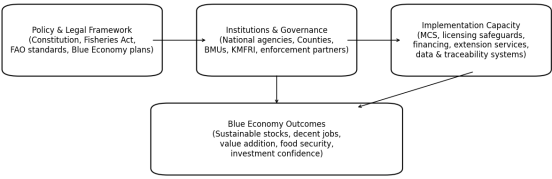
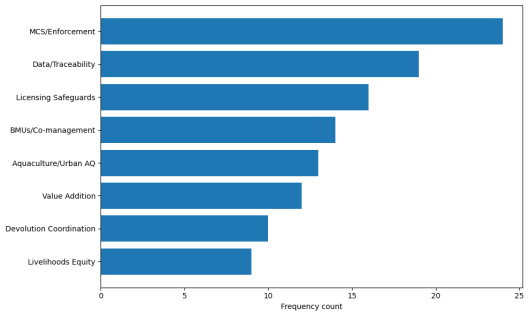
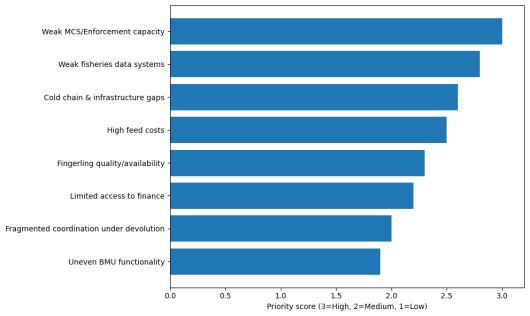




 Share This Article
 Twitter
 Linked In
 Facebook