
Bayesian methods are effective statistical one that combine prior information with samples, but the inference results are different because subjectivity is involved in representing prior information as a prior distribution. The empirical Bayes approach is a statistical method that performs continuous Bayesian decision making when the prior distribution is unknown but given a large number of past data, which overcomes the above drawback and is now a common way because of a vast amount of data available. The inference for truncation parameters is important in evaluating the lower or upper bounds of the population and is required in many fields such as reliability, meteorology, medicine, etc. Many authors have considered the case of one-sided truncated distribution in the empirical Bayes framework, but in practice we are faced with the case of two-sided one. We consider the empirical Bayes estimation for truncation parameters of two-sided truncated distribution under the squared error loss. First, Bayesian estimators of the truncation parameters are derived to minimize the Bayes risk using sample of size two. And, based on the Bayesian estimators and kernel density estimate of the population density function, empirical Bayes estimators of the truncation parameters are constructed. Next, under some assumptions asymptotic optimality of empirical Bayes estimators is proved when the sample size goes to infinity, and the convergence rate is also evaluated. It is also proved that the probability that the lower and upper bounds are reversely estimated approaches zero. Finally, an example is presented to show the validity of the assumptions and the performance of the proposed empirical Bayes estimators is evaluated through simulation on the example. New proposal of using size two samples could be extended to the case of multi-dimensional truncated distributions defined on hyper-cubic domain.
| Published in | Research & Development (Volume 7, Issue 1) |
| DOI | 10.11648/j.rd.20260701.15 |
| Page(s) | 54-62 |
| Creative Commons |
This is an Open Access article, distributed under the terms of the Creative Commons Attribution 4.0 International License (http://creativecommons.org/licenses/by/4.0/), which permits unrestricted use, distribution and reproduction in any medium or format, provided the original work is properly cited. |
| Copyright |
Copyright © The Author(s), 2026. Published by Science Publishing Group |
Asymptotic Optimality, Empirical Bayes Estimator, Squared Error Loss, Truncation Parameter, Size Two Samples
 ,
,  [a2,b2],(1)
 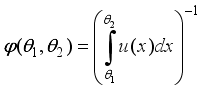 and I(A) is indicate function of A. We assume that truncation parameter
  has a prior distribution function G(<i></i>) on Θ with G(a1, a2) = 0 and G(b1, b2) = 1 and its probability density function (pdf) g(<i></i>).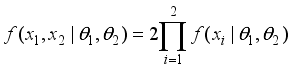
 (2)
(2)  , the marginal pdf of (X1, X2) is written as
  ,(3)
,(3) 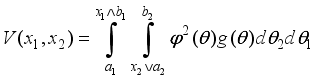 .(4)
.(4) 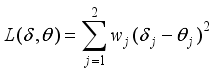 ,
,  ,
, 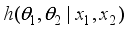 is the conditional pdf of (<i></i>1, <i></i>2) given (X1, X2) = (x1, x2). Let δB = (δ1B, δ2B) be the Bayesian estimator of <i></i>, i.e.
 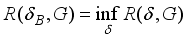 , then we have
 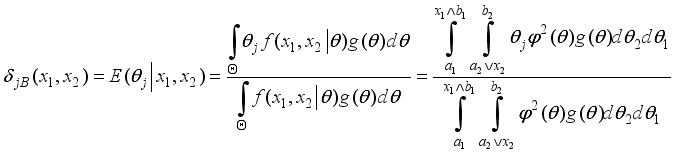 (5)
(5)  .(6)
.(6)  .
.  )
)  ,(7)
,(7) 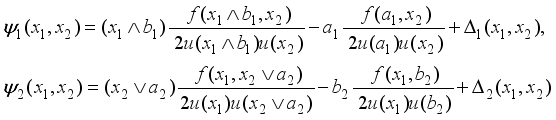 (8)
(8)  (9)
(9) 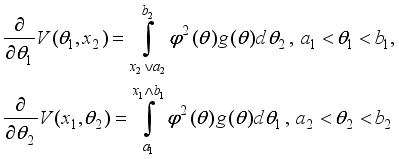 (10)
(10) 


 .
.  , i=1, ・・・ n, we use a kernel estimator of f(x1, x2) defined as
  ,
, 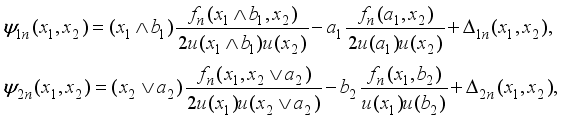 (11)
(11) 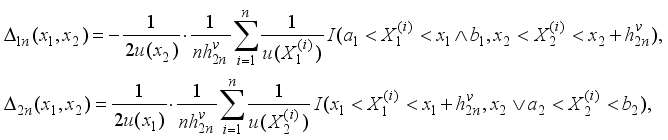 (12)
(12) 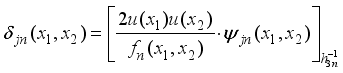 ,(13)
,(13) 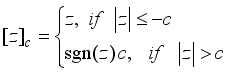
 ,(15)
,(15) 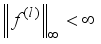 , l=0, 1, 2, where f(l) denotes any partial derivative of order l. Let
  , then from theorem 3 in Bosq
  .
.  .(16)
.(16) 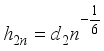 and ν=2, we have
  .(17)
.(17) 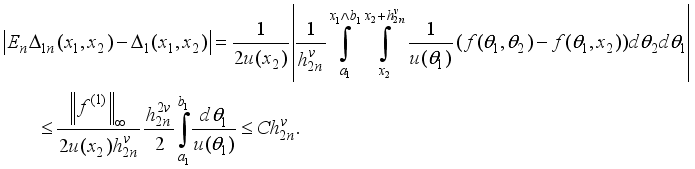



 .
.  .
.  .(18)
.(18)  .
.  .
. 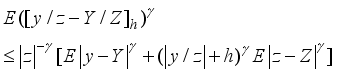 .(19)
.(19) 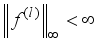 , l=0, 1, 2 and the assumption K holds. If u(x)>0, a1≤x≤b2 is continuous and for any γ∈(0, 2],
 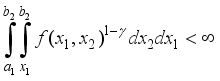 ,(20)
,(20) 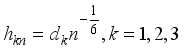 and ν=2, we have
  .
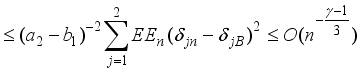
.  , for sufficiently great n. Using Eq. (16), Eq. (18) and Eq. (19), for j=1, 2.


 (21)
(21)  .
. 



 ,(22)
,(22)  [a2, b2] and 0≤ a1< b1 ≤ a2< b2< ∞. Then
  , and 0<C1≤
  ≤ C2. Let G(<i></i>1, <i></i>2) is a prior distribution with the pdf given by
  (23)
(23)  by
by 



 the interior of Di. We can see that for the function V(x1, x2) of Eq. (4), it holds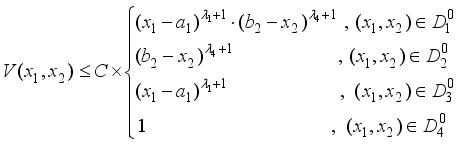
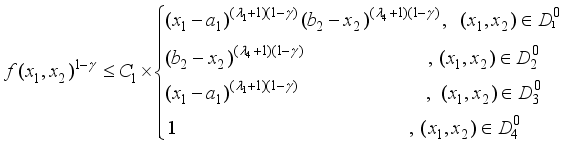 ,
,  , l=0, 1, 2, furthermore
 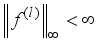 , l=0, 1, 2. Therefore we can see that if
 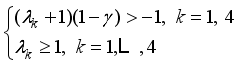 (24)
(24)  from the pdf of Eq. (23) and generate two samples
  from the pdf of Eq. (22). Then we set
 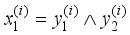 ,
, 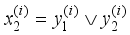 , i = 1,…, n (past data) and
 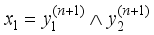 ,
, 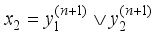 (present data).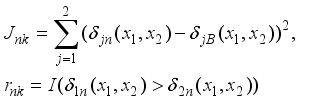
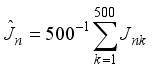 ,
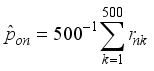
, 

 ,
,  ,
,  and
and  for n ∈ M = {10, 50, 100, 200, 300, 500, 700, 1,000, 1,500, 2,000} are presented in Table 1. Finally, solving the minimization problem.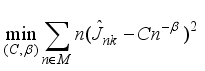
 are filled in 4th column of Table 1 and all they are close to 1. Numerical computations are carried by Matlab.
  and
and  According to Different n.
n |
|
|
|
|
|
|---|---|---|---|---|---|
10 | 12.0427 | 23.029 | 1.7591 | 5.8 | 0.7392 |
20 | 7.5427 | 5.3255 | 1.1907 | 1.5 | 0.3844 |
30 | 6.7558 | 4.9921 | 1.116 | 1.4 | 0.3715 |
40 | 6.5257 | 4.9932 | 1.1133 | 1.6 | 0.3968 |
50 | 5.5564 | 4.44 | 0.972 | 0.6 | 0.2442 |
70 | 5.1461 | 4.692 | 0.9348 | 0.2 | 0.1413 |
100 | 4.9181 | 4.5479 | 0.9297 | 0.8 | 0.2817 |
150 | 4.3617 | 3.9638 | 0.8629 | 0.2 | 0.1413 |
200 | 4.3447 | 4.2461 | 0.8876 | 0.3 | 0.1729 |
300 | 4.4198 | 4.1612 | 0.9449 | 0.1 | 0.0999 |
600 | 4.365 | 3.8058 | 1.0086 | 0 | 0 |
1000 | 4.3067 | 3.8096 | 1.0537 | 0 | 0 |
 and variances of it tend to zero, as n→∞, respectively. We can also see that
  and variances of it tend to zero, as n→∞, respectively. Therefore, Jn, the difference between empirical risk and theoretical risk, and pon, the probability of reversely estimating, tend to zero, as n→∞, respectively. However, the speeds of the convergences are relatively slow as usual in empirical Bayes inferences.
 i.i.d. | Independent and Identically Distributed |
LINEX | Linear Exponential |
| [1] | Atchade, Y. F., (2011). A computational framework for empirical Bayes inference. Stat Comput., 21: 463-473, |
| [2] | Bosq, D., (1995). Optimal asymptotic quadratic error of density estimators for strong mixing or chaotic data. Statist. Probab. Lett., 22, 339-347. |
| [3] | Carlin, B. P., Louis, T. A., (1996). Bayes and Empirical Bayes Methods for Data Analysis. Chapman & Hall, London. |
| [4] | Chaoyu, Y., Hoff P. D., (2019). Adaptive sign error control. Journal of Statistical Planning and Inference, 201, 133-145. |
| [5] | Huang, S. Y., Liang, T. C., (1997). Empirical Bayes estimation of the truncation parameter with linex loss. Statist. Sinica, 7, 755-769. |
| [6] | Huang, W. T, Huang, H. H., (2006). Empirical Bayes estimation of guarantee lifetime in a two-parameter exponential distribution. Statist. Probab. Lett., 76, 1821-1829. |
| [7] | Karunamuni, R. J., (1988). On empirical Bayes testing with sequential components. Ann. Statist., 16, 1270-1282. |
| [8] | Karunamuni, R. J., Li J., Wu J., (2010). Robust empirical Bayes tests for continuous distributions. Journal of Statistical Planning and Inference, 140, 268-282. |
| [9] | Li, J., Gupta, S. S., (2001). Monotone empirical Bayes tests with optimal rate of convergence for a truncation parameter. Statist. Decisions, 19, 223-237. |
| [10] | Li, J., Gupta, S. S., (2003). Optimal rate of empirical Bayes tests for lower truncation parameters. Statist. Probab. Lett., 65, 177-185. |
| [11] | Liang, T. C., (2009). Empirical Bayes estimation for Borel-Tanner distributions. Statist. Probab. Lett., 79, 2212-2219. |
| [12] | Murray, T. A., Hobbs, B. P., Lystig, T. C., Carlin, B. P., (2014). Semiparametric Bayesian commensurate survival model for post-market medical device surveillance with non-exchangeable historical data. Biometrics, 70(1), 185-191. |
| [13] | Robbins, H., (1956). An empirical Bayes approach to statistics. Proceedings of the Third Berkeley Symposium on Mathematical Statistics and Probability, vol. 1. University of California Press, Berkeley, CA, USA, pp. 157-163. |
| [14] | Robbins, H., (1964). The empirical Bayes approach to statistical decision problems. Ann. Math. Statist., 35, 1-20. |
| [15] | Singh, R. S., (1977). Applications of estimators of a density and its derivatives to certain statistical problems. J. Roy. Statist. Soc. Ser. B, 39, 357-363. |
| [16] | Varian, H. R., (1975). A Bayesian approach to real estimate assessment, In: Feinberg, S. E., Zellner, A. (Eds.), Studies in Bayesian Econometrics and Statistics in honor of L. J. Savage. North-Holland, Amsterdam, 195-208. |
| [17] | Xu, X., Zhou, D., (2011). Empirical Bayes predictive densities for high-dimensional normal models. Journal of Multivariate Analysis, 102, 1417-1428. |
| [18] | Yimin, M., Balakrishnan, N., (2000). Empirical Bayes estimation for truncation parameters. J. Statist. Plann. Inference, 84, 111-120. |
| [19] | Yimin, S., (2000). Empirical Bayes estimate for the perameter of two-side truncated distribution families. Appl. Math. J. Chinese Univ. Ser A, 15(4), 475-483. |
APA Style
Ri, S., Ryu, H., Jang, S. (2026). Construction of Empirical Bayes Estimators for Truncation Parameters of Two-sided Truncated Distributions Using Size Two Samples and Their Asymptotic Optimality. Research & Development, 7(1), 54-62. https://doi.org/10.11648/j.rd.20260701.15
ACS Style
Ri, S.; Ryu, H.; Jang, S. Construction of Empirical Bayes Estimators for Truncation Parameters of Two-sided Truncated Distributions Using Size Two Samples and Their Asymptotic Optimality. Res. Dev. 2026, 7(1), 54-62. doi: 10.11648/j.rd.20260701.15
@article{10.11648/j.rd.20260701.15,
  author = {Sung-Hyon Ri and Hyon-A Ryu and Su-Ryon Jang},
  title = {Construction of Empirical Bayes Estimators for Truncation Parameters of Two-sided Truncated Distributions Using Size Two Samples and Their Asymptotic Optimality},
  journal = {Research & Development},
  volume = {7},
  number = {1},
  pages = {54-62},
  doi = {10.11648/j.rd.20260701.15},
  url = {https://doi.org/10.11648/j.rd.20260701.15},
  eprint = {https://article.sciencepublishinggroup.com/pdf/10.11648.j.rd.20260701.15},
  abstract = {Bayesian methods are effective statistical one that combine prior information with samples, but the inference results are different because subjectivity is involved in representing prior information as a prior distribution. The empirical Bayes approach is a statistical method that performs continuous Bayesian decision making when the prior distribution is unknown but given a large number of past data, which overcomes the above drawback and is now a common way because of a vast amount of data available. The inference for truncation parameters is important in evaluating the lower or upper bounds of the population and is required in many fields such as reliability, meteorology, medicine, etc. Many authors have considered the case of one-sided truncated distribution in the empirical Bayes framework, but in practice we are faced with the case of two-sided one. We consider the empirical Bayes estimation for truncation parameters of two-sided truncated distribution under the squared error loss. First, Bayesian estimators of the truncation parameters are derived to minimize the Bayes risk using sample of size two. And, based on the Bayesian estimators and kernel density estimate of the population density function, empirical Bayes estimators of the truncation parameters are constructed. Next, under some assumptions asymptotic optimality of empirical Bayes estimators is proved when the sample size goes to infinity, and the convergence rate is also evaluated. It is also proved that the probability that the lower and upper bounds are reversely estimated approaches zero. Finally, an example is presented to show the validity of the assumptions and the performance of the proposed empirical Bayes estimators is evaluated through simulation on the example. New proposal of using size two samples could be extended to the case of multi-dimensional truncated distributions defined on hyper-cubic domain.},
 year = {2026}
}
TY  - JOUR
T1  - Construction of Empirical Bayes Estimators for Truncation Parameters of Two-sided Truncated Distributions Using Size Two Samples and Their Asymptotic Optimality
AU  - Sung-Hyon Ri
AU  - Hyon-A Ryu
AU  - Su-Ryon Jang
Y1  - 2026/03/26
PY  - 2026
N1  - https://doi.org/10.11648/j.rd.20260701.15
DO  - 10.11648/j.rd.20260701.15
T2  - Research & Development
JF  - Research & Development
JO  - Research & Development
SP  - 54
EP  - 62
PB  - Science Publishing Group
SN  - 2994-7057
UR  - https://doi.org/10.11648/j.rd.20260701.15
AB  - Bayesian methods are effective statistical one that combine prior information with samples, but the inference results are different because subjectivity is involved in representing prior information as a prior distribution. The empirical Bayes approach is a statistical method that performs continuous Bayesian decision making when the prior distribution is unknown but given a large number of past data, which overcomes the above drawback and is now a common way because of a vast amount of data available. The inference for truncation parameters is important in evaluating the lower or upper bounds of the population and is required in many fields such as reliability, meteorology, medicine, etc. Many authors have considered the case of one-sided truncated distribution in the empirical Bayes framework, but in practice we are faced with the case of two-sided one. We consider the empirical Bayes estimation for truncation parameters of two-sided truncated distribution under the squared error loss. First, Bayesian estimators of the truncation parameters are derived to minimize the Bayes risk using sample of size two. And, based on the Bayesian estimators and kernel density estimate of the population density function, empirical Bayes estimators of the truncation parameters are constructed. Next, under some assumptions asymptotic optimality of empirical Bayes estimators is proved when the sample size goes to infinity, and the convergence rate is also evaluated. It is also proved that the probability that the lower and upper bounds are reversely estimated approaches zero. Finally, an example is presented to show the validity of the assumptions and the performance of the proposed empirical Bayes estimators is evaluated through simulation on the example. New proposal of using size two samples could be extended to the case of multi-dimensional truncated distributions defined on hyper-cubic domain.
VL  - 7
IS  - 1
ER  -
Faculty of Applied Mathematics, Kim Chaek University of Technology, Pyongyang, Democratic People’s Republic of Korea
Faculty of Applied Mathematics, Kim Chaek University of Technology, Pyongyang, Democratic People’s Republic of Korea
Faculty of Applied Mathematics, Kim Chaek University of Technology, Pyongyang, Democratic People’s Republic of Korea

Information



 Share This Article
 Twitter
 Linked In
 Facebook


 Copy
Copy Download