Abstract
The use of functional foods and nutraceuticals agent has grown rapidly. Delivering bioactive compounds like vitamins, polyphenols, essential oils, and probiotics faces a significant challenge due to their poor aqueous solubility, stability and low bioavailability and called for development of innovative delivery systems that is capable to enhance the stability, bioavailability, and controlled release of sensitive bioactive compounds. Among various encapsulation techniques, Ionic gelation, stands out as its essay, solvent-free encapsulation procedure that involved use of natural biopolymers such as chitosan and alginate, has emerged as a promising and eco-friendly strategy for protecting and delivering these compound. This review offers a comprehensive overview of the principles, mechanisms, and advantages of ionic gelation compared to conventional encapsulation methods. The review also critically discussed physicochemical interactions between oppositely charged polymers during gel formation and the factors affecting microcapsule properties, such as particle size, encapsulation efficiency, and release study. The application of ionic gelation-based microcapsules in the delivery of antioxidants, probiotics, polyphenols, vitamins, and essential oils within functional food matrices are examined. Furthermore, the review highlights the recent advancements in improving stability of microcapsules during processing and digestion, industrial scalability, regulatory aspects, and future perspectives in personalized nutrition and smart food systems. Overall, ionic gelation offers a flexible and eco-friendly system with significant potential to enhance the delivery and effectiveness of bioactive compounds in food and nutraceutical industries.
|
Published in
|
Science Discovery Food (Volume 1, Issue 1)
|
|
DOI
|
10.11648/j.sdf.20260101.16
|
|
Page(s)
|
68-77 |
|
Creative Commons
|

This is an Open Access article, distributed under the terms of the Creative Commons Attribution 4.0 International License (http://creativecommons.org/licenses/by/4.0/), which permits unrestricted use, distribution and reproduction in any medium or format, provided the original work is properly cited.
|
|
Copyright
|
Copyright © The Author(s), 2026. Published by Science Publishing Group
|
Keywords
Ionic Gelation Microencapsulation, Functional Foods, Polymers, Bioactive Delivery, Controlled Release
1. Introduction
The increased demand for functional foods and nutraceuticals ingredients has led to the development of advanced delivery systems to enhance the stability, bioavailability, and efficacy of bioactive compounds. Functional foods, which provide health benefits beyond basic nutrition, often incorporate sensitive bioactive such as vitamins, polyphenols, probiotics, and essential oils that are likely to degrade during processing, storage, or gastrointestinal tract transit. Similarly, Nutraceuticals compound, refer to products derived from food sources with extra health benefits in addition to their nutritional value. However, the application of these compounds is often limited due to challenges such as poor aqueous solubility, low permeability, volatility, and rapid metabolism
| [1] | Augustin, M. A., & Hemar, Y. (2009). Nano- and micro-structured assemblies for encapsulation of food ingredients. Chemical Society Reviews, 38(4), 902–912.
https://doi.org/10.1039/B801739P |
| [2] | McClements, D. J. (2018). Delivery by design (DbD): A standardized approach to the development of efficacious nanoparticle- and microparticle-based delivery systems. Comprehensive Reviews in Food Science and Food Safety, 17(1), 200–219.
https://doi.org/10.1111/1541-4337.12321 |
[1, 2]
.
Microencapsulation has emerged as a promising strategy to overcome these limitations by entrapping bioactive compounds within a protective matrix. Among various encapsulation techniques, ionic gelation stands out due to its mild, solvent-free processing, biocompatibility, and ability to encapsulate a wide range of hydrophilic and hydrophobic compounds without the use of heat or toxic chemicals
| [3] | Yeo, Y., & Park, K. (2004). Control of encapsulation efficiency and initial burst in polymeric microparticle systems. Archives of Pharmacal Research, 27(1), 1–12.
https://doi.org/10.1007/BF02980000 |
[3]
. This technique is useful for bioactive compounds used in functional food systems, preserving their biological activity throughout processing and digestion and enabling controlled or targeted release
| [4] | George, M., & Abraham, T. E. (2006). Polyionic hydrocolloids for the intestinal delivery of protein drugs: Alginate and chitosan—a review. Journal of Controlled Release, 114(1), 1–14. https://doi.org/10.1016/j.jconrel.2006.04.017 |
[4]
.
Ionic gelation operates through electrostatic interactions between oppositely charged biopolymers, such as chitosan (a cationic polysaccharide) and sodium alginate (an anionic polysaccharide), which form hydrogels or microbeads through cross-linking with multivalent counterions like calcium (Ca
2+) or tripolyphosphate (TPP) and is capable of encapsulating bioactive ingredients
. These structures serve as efficient delivery vehicles with tunable properties, offering specific release profiles and improved physicochemical stability, making them highly relevant in the food and nutraceutical industries. Recent studies have demonstrated the effectiveness of ionic gelation-based microcapsules in enhancing the functionality of various bioactive such as curcumin, resveratrol, omega-3 fatty acids, and probiotics
| [6] | de Souza Simões, L., Madalena, D. A., Pinheiro, A. C., Teixeira, J. A., & Vicente, A. A. (2019). Micro- and Nano-bio-based delivery systems for food applications: In vitro and in vivo bioactivity. Food Hydrocolloids, 87, 212–226.
https://doi.org/10.1016/j.foodhyd.2018.07.001 |
| [7] | Bagheri, L., Madadlou, A., & Yarmand, M. S. (2020). Recent advances in application of chitosan-based micro/nanogels for encapsulation of nutraceuticals and food bioactive. Critical Reviews in Food Science and Nutrition, 60(6), 902–926.
https://doi.org/10.1080/10408398.2018.1546676 |
[6, 7]
. Furthermore, these encapsulated systems can be incorporated into a wide range of food products, such as beverages, dairy products, baked goods, and dietary supplements, without negatively impacting sensory qualities. This review explores the fundamental principles and mechanisms of ionic gelation, the properties of the main polymers involved, and the current applications of ionic gelation microcapsules formulation in functional foods and nutraceuticals. It also discusses the benefits, challenges, and future prospects of this encapsulation approach in enhancing the delivery of health-promoting bioactive compounds in food systems.
2. Fundamental Principles of Ionic Gelation and Microencapsulation
Microencapsulation is a technique used to entrap bioactive compounds within a coating material to form particles in the size ranges from micrometer to millimeter. Among various encapsulation strategies, ionic gelation is specifically suitable for food and nutraceutical applications because it operates under mild, aqueous conditions without requiring heat or harsh chemicals and best for bioactive compounds like antioxidants, probiotics, and polyphenols
| [8] | Anal, A. K., & Singh, H. (2007). Recent advances in microencapsulation of probiotics for industrial applications and targeted delivery. Trends in Food Science & Technology, 18(5), 240–251. https://doi.org/10.1016/j.tifs.2007.01.004 |
| [9] | Kriegel, C., Kit, K. M., McClements, D. J., & Weiss, J. (2012). Electrostatic deposition of chitosan onto liposomes for improved mucoadhesive properties. Journal of Food Science, 77(9), N68–N72. https://doi.org/10.1111/j.1750-3841.2012.02841.x |
[8, 9]
.
2.1. Principle of Ionic Gelation
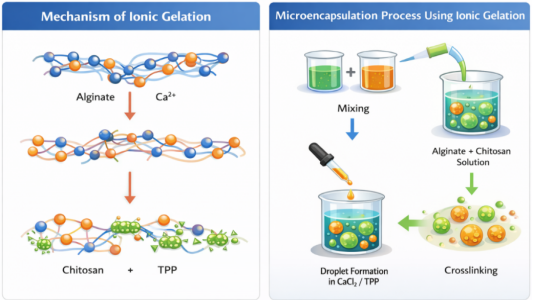
Ionic gelation involves electrostatic interactions between oppositely charged polymers or between a polymer and a multivalent ion. This interaction results in the formation of a three-dimensional hydrogel network that entraps the active compound. The most commonly used anionic polymer in this method is sodium alginate, which undergoes gelation in the presence of divalent cations like calcium (Ca
2+), forming "egg-box" structures. Chitosan, a cationic polysaccharide derived from chitin, is frequently used to form polyelectrolyte complexes with anionic polymers or to cross-link with tripolyphosphate (TPP)
| [4] | George, M., & Abraham, T. E. (2006). Polyionic hydrocolloids for the intestinal delivery of protein drugs: Alginate and chitosan—a review. Journal of Controlled Release, 114(1), 1–14. https://doi.org/10.1016/j.jconrel.2006.04.017 |
[4]
. The process of gelation typically includes:
Preparation of the polymer solution (e.g., alginate or chitosan with the active ingredient), Addition into a cross-linking solution (e.g., CaCl₂ for alginate or TPP for chitosan), and Formation of gel beads or particles, followed by washing, drying, or further coating.
2.2. Polymers Used in Ionic Gelation
Sodium Alginate: Alginate is a naturally occurring polysaccharide extracted from brown seaweed. It comprises mannuronic (M) and guluronic (G) acid residues, with the G-blocks primarily responsible for calcium-mediated gelation. Alginate gels are biocompatible, non-toxic, and approved by regulatory bodies like the FDA, making them highly suitable for food applications
| [10] | Draget, K. I., Skjåk-Bræk, G., & Smidsrød, O. (2005). Alginates from algae. In Polysaccharides and polyamides in the food industry (pp. 1–30). Wiley-VCH Verlag GmbH & Co. |
[10]
.
Chitosan: Chitosan is derived from the deacetylation of chitin and carries a positive charge in acidic environments. It has antimicrobial, mucoadhesive, and film-forming properties, making it particularly effective for encapsulating bioactive in controlled-release food systems
. Chitosan-TPP microcapsules are often used for hydrophilic compounds due to their pH-sensitive swelling behavior.
Other Polymers: Other biopolymers such as carrageenan, pectin, gellan gum, and gelatin have also been used in ionic gelation systems, often in combination with alginate or chitosan to modify encapsulation efficiency, release behavior, and mechanical strength.
2.3. Advantages of Ionic Gelation in Food Systems
Mild Conditions: No high temperatures or organic solvents are needed, protecting heat-sensitive bioactive compounds.
Biocompatibility and Biodegradability: Natural polymers used are generally recognized as safe (GRAS).
Controlled Release: Release of bioactive can be modulated by manipulating polymer concentration, crosslinking time, and pH responsiveness.
Cost-Effectiveness: Materials and processing requirements are relatively inexpensive compared to other techniques like spray drying or freeze drying.
Customizability: Particle size, porosity, and surface characteristics can be tailored for specific applications.
2.4. Limitations and Considerations
Despite its advantages, ionic gelation has limitations. The formed microcapsules can have poor mechanical strength, limited shelf stability, and unpredictable release profiles under certain food processing conditions
| [12] | Bansal, V., Mishra, M., & Jaggi, M. (2011). Chitosan-alginate nanoparticles as novel delivery systems for therapeutic proteins. International Journal of Biological Macromolecules, 49(1), 3–8. https://doi.org/10.1016/j.ijbiomac.2011.03.005 |
[12]
. These issues can be addressed by coating with additional polymers, combining ionic gelation with other encapsulation techniques, or using multi-layer systems for better protection and controlled release.
3. Bioactive Compounds for Encapsulation in Functional Foods
Functional foods are specifically formulated not just to provide nutrition but also to deliver health benefits through the inclusion of bioactive compounds. However, despite their benefits, many of these compounds face challenges such as poor aqueous solubility, stability, or bioavailability during processing, storage, and digestion. Microencapsulation using ionic gelation has been seen as an effective technique to protect these compounds, enhance their stability, and improved their controlled delivery in various food systems
| [13] | Augustin, M. A., & Sanguansri, L. (2008). Encapsulation of bioactives. In G. O. Phillips & P. A. Williams (Eds.), Handbook of hydrocolloids (pp. 889–910). Woodhead Publishing. |
[13]
.
3.1. Polyphenols and Flavonoids
Polyphenols, such as Luteolin, Quercetin, catechins, and resveratrol, are known for their antioxidant, anti-inflammatory, and cardioprotective activities. However, their practical use in food is limited by their sensitivity to heat, pH changes, and light, as well as their poor water solubility. Encapsulating these compounds in chitosan or alginate-based microbead/gels may significantly improves their stability and sustained control release in the gastrointestinal tract
| [14] | Ribeiro, A. M., Freitas, M. R., Gonçalves, A. C., & Duarte, M. F. (2021). Alginate–chitosan nanoparticles for luteolin delivery: Characterization and in vitro release profile. Pharmaceutics, 13(3), 406. https://doi.org/10.3390/pharmaceutics13030406 |
[14]
. For example, luteolin encapsulated in alginate-chitosan microparticles showed enhanced aqueous solubility and antioxidant activity compared to free luteolin
| [14] | Ribeiro, A. M., Freitas, M. R., Gonçalves, A. C., & Duarte, M. F. (2021). Alginate–chitosan nanoparticles for luteolin delivery: Characterization and in vitro release profile. Pharmaceutics, 13(3), 406. https://doi.org/10.3390/pharmaceutics13030406 |
[14]
.
3.2. Omega-3 Fatty Acids and Lipophilic Nutrients
Essential fatty acids, such as DHA and EPA, are highly prone to oxidative degradation which reduced their efficacy in food applications. Encapsulation using ionic gelation, especially when combined with emulsification techniques, helps enclosed lipophilic nutrients into a stable microcapsules, oxygen-resistant and preserved their functional efficacy
| [15] | Tamjidi, F., Shahedi, M., Varshosaz, J., & Nasirpour, A. (2013). Nanostructured lipid carriers (NLC): A potential delivery system for bioactive food molecules. Innovative Food Science & Emerging Technologies, 19, 29–43.
https://doi.org/10.1016/j.ifset.2013.03.002 |
[15]
. Chitosan-coated alginate capsules have been used to not only extend their shelf life but also to protect from odor associated with fish oil and reduce its undesirable fishy smell in food systems.
3.3. Vitamins
Both Water-soluble vitamins (like Vitamin C and B-complex) and fat-soluble vitamins (e.g., Vitamin D, Vitamin E) are commonly encapsulated in functional foods. Vitamin C is particularly sensitive to oxidation, while Vitamin D has low bioavailability. Microencapsulation of these vitamins in biopolymers like alginate and chitosan can stabilizes them during food processing, storage, and enhances intestinal absorption
| [16] | Bai, Y., Wang, H., Shi, Y., et al. (2020). Vitamin D3-loaded chitosan/alginate nanoparticles promote osteogenic differentiation. Colloids and Surfaces B: Biointerfaces, 192, 111012.
https://doi.org/10.1016/j.colsurfb.2020.111012 |
[16]
.
3.4. Probiotics
Probiotics are live microorganisms that confer health benefits to the host but are highly sensitive to environmental stress, specifically stomach acid and bile salts. Ionic gelation encapsulate probiotics like Lactobacillus and Bifidobacterium to protect them during gastrointestinal tract transit. Chitosan-coated alginate beads have been shown to promote the gradual release of probiotic in the colon and improve they survival under simulated gastric conditions
| [17] | Cook, M. T., Tzortzis, G., Charalampopoulos, D., & Khutoryanskiy, V. V. (2012). Microencapsulation of probiotics for gastrointestinal delivery. Journal of Controlled Release, 162(1), 56–67. https://doi.org/10.1016/j.jconrel.2012.06.003 |
[17]
.
3.5. Peptides and Proteins
Bioactive peptides and proteins, such as casein-derived antihypertensive peptides or soy isoflavones are susceptible to degradation by digestive enzymes before absorption. Microencapsulation of these compounds using ionic gelation protects these molecules from proteolysis and facilitates their targeted release in the small intestine and enhanced their physiological effects
.
3.6. Plant Extracts and Essential Oils
Essential oils and plant extracts like curcumin, eucalyptol, and oregano oil are widely recognized for their antimicrobial and antioxidant properties but they are highly volatile, sensitive to light and heat. Ionic gelation helps stabilize these compounds and enables their controlled release in functional nutraceutical beverages, snacks, or dairy products. For instance, curcumin encapsulated in chitosan-alginate beads exhibited improved dispensability and sustained release properties
| [19] | Ahmad, N., Ahmad, R., Alam, M. A., et al. (2020). Investigation of anti-inflammatory activity of curcumin-loaded chitosan nanoparticles in carrageenan-induced rat paw edema model. Drug Development and Industrial Pharmacy, 46(4), 617–626. https://doi.org/10.1080/03639045.2020.1733664 |
[19]
.
4. Formulations and Optimization Parameters of Ionic Gelation Microcapsules Methods
Ionic gelation technique is an easy, solvent-free and no heat require methods used to encapsulate bioactive compounds within a natural polymers, like chitosan (cationic) and alginate (anionic) polysaccharide. The process depend on the crosslinking of these oppositely charged polymers in the presence of divalent or multivalent ions, such as Ca
2+ for alginate or tripolyphosphate (TPP) for chitosan. This technique is especially attractive for functional food and nutraceutical product applications due to its simplicity, biocompatibility, and no use of organic solvents or high temperatures
| [4] | George, M., & Abraham, T. E. (2006). Polyionic hydrocolloids for the intestinal delivery of protein drugs: Alginate and chitosan—a review. Journal of Controlled Release, 114(1), 1–14. https://doi.org/10.1016/j.jconrel.2006.04.017 |
[4]
.
4.1. Core Principles of Ionic Gelation
The in external gelation, the polymer solution (e.g., sodium alginate) is mixed with the drug solution and dropped into a bath containing calcium ions (CaCl₂), leading to the formation of beads through immediate ionic crosslinking. The in internal gelation, calcium is released from insoluble calcium salts (e.g., CaCO₃) in a controlled release within the polymer matrix upon acidification. For chitosan, ionic gelation typically uses TPP as the crosslinking agent to form nanoparticles or microspheres
.
4.2. Steps in Microcapsule Formulation
Firstly, the Preparation of polymer solutions (e.g., alginate 1–3% w/v; chitosan 0.5–2% w/v).
Secondly, the mixture of the bioactive compound (e.g., curcumin, probiotic cells, or essential oils) with the polymer solution using homogenization or ultrasonication.
Thirdly, dropwisely of the mixture solutions into the Ionic crosslinking (e.g., CaCl₂ for alginate or TPP for chitosan) solution using extruder or syringe and needle.
Lastly, allowed to Cured for some minute (30min), filter and washed the beads formed to stabilize, purify and Dried (e.g., freeze-drying, oven-drying, or air-drying) to enhance shelf stability
.
Figure 1. Steps involved in microcapsule formations.
4.3. Key Optimization Parameters
The functional properties of ionic gelation microcapsules depend significantly on formulation and process parameters, which influence encapsulation efficiency, release profile, morphology, and stability. Optimizing these parameters is essential for modifying microcapsules for specific food applications.
Table 1. Key parameters for optimization process.
Parameter | Description | Influence |
Polymer concentration | Higher alginate or chitosan concentration leads to stronger matrices | Increases mechanical strength but may reduce release rate |
Crosslinker concentration | Typically 1–5% CaCl₂ or 0.1–1% TPP | Affects bead size and porosity |
Stirring rate | 500–1500 rpm during mixing or droplet formation | Controls uniformity and particle size |
Droplet size | Controlled by syringe/nozzle size (100–500 µm) | Influences surface area and release rate |
pH and ionic strength | pH of crosslinking solution and polymer affects gelation kinetics | Alters crosslinking density and bioactive protection |
Bioactive loading | Ratio of drug to polymer mass | Affects encapsulation efficiency and payload release |
Drying method | Freeze-drying vs. air-drying | Impacts morphology, porosity, and shelf life |
4.4. Equipment and Process Enhancements
Scaling up ionic gelation requires improved control over particle formation and consistency. Several advanced techniques and equipment have been used. These equipment enhance scalability and improve the reproducibility of encapsulation outcomes
| [21] | Zhang, X., Wu, Z., Zhang, W., & Zhang, L. (2022). Microfluidics-assisted fabrication of biopolymeric microcapsules for food and nutraceutical delivery: A review. Food Hydrocolloids, 124, 107252. https://doi.org/10.1016/j.foodhyd.2021.107252 |
[21]
.
Extrusion devices (e.g., peristaltic pumps, vibrating nozzles) offer precise droplet formation and are commonly used for generating uniform microbeads size for industrial applications
| [21] | Zhang, X., Wu, Z., Zhang, W., & Zhang, L. (2022). Microfluidics-assisted fabrication of biopolymeric microcapsules for food and nutraceutical delivery: A review. Food Hydrocolloids, 124, 107252. https://doi.org/10.1016/j.foodhyd.2021.107252 |
[21]
.
Microfluidic systems offer high precise control over particle size and morphology, enabling consistent production of monodisperse capsules
| [21] | Zhang, X., Wu, Z., Zhang, W., & Zhang, L. (2022). Microfluidics-assisted fabrication of biopolymeric microcapsules for food and nutraceutical delivery: A review. Food Hydrocolloids, 124, 107252. https://doi.org/10.1016/j.foodhyd.2021.107252 |
[21]
.
Electrostatic droplet generators are particularly effective for encapsulating sensitive materials like probiotics, minimizing aggregation and improving viability
| [21] | Zhang, X., Wu, Z., Zhang, W., & Zhang, L. (2022). Microfluidics-assisted fabrication of biopolymeric microcapsules for food and nutraceutical delivery: A review. Food Hydrocolloids, 124, 107252. https://doi.org/10.1016/j.foodhyd.2021.107252 |
[21]
.
4.5. Challenges in Scale-Up
While ionic gelation is suitable for lab-scale applications, scale-up challenges include:
Maintaining uniform droplet formation and consistent bead size at high volumes
Ensuring batch-to-batch reproducibility
Managing environmental factors such as temperature and humidity during curing and drying
Ensuring food-grade quality of reagents and compliance with regulatory standards.
To address these limitations, novel approaches such as co-axial droplet generators, in-line homogenizers, and continuous-flow systems are being used to streamline production and improve process control.
5. Release Kinetics and Stability
The effectiveness of ionic gelation microcapsules in functional foods and nutraceuticals product lays on their ability to protect bioactive compounds during processing, storage and release them in a controlled or targeted release under physiological conditions. The release kinetics and stability of these microcapsules are influenced by factors such as polymer composition, crosslinking density, environmental pH, temperature and the properties of the encapsulated compound
| [22] | Liu, Y., Zhang, L., Lin, S., & Guo, J. (2020). Encapsulation of flavonoids using protein-based carriers for functional foods and nutraceuticals. Foods, 9(7), 857.
https://doi.org/10.3390/foods9070857 |
[22]
.
5.1. Release Mechanisms
The release of encapsulated bioactive compounds from ionic gelation microcapsules follows various mechanisms:
Diffusion-Controlled Release: The bioactive compound gradually diffuses out from microcapsule through the hydrated polymer matrix. This is commonly saw in lightly crosslinked systems
| [22] | Liu, Y., Zhang, L., Lin, S., & Guo, J. (2020). Encapsulation of flavonoids using protein-based carriers for functional foods and nutraceuticals. Foods, 9(7), 857.
https://doi.org/10.3390/foods9070857 |
[22]
.
Swelling-Induced Release: hydrophilic Polymers like alginate absorb aqueous or gastric fluids, swell up, and enlarged pore sizes and promote release of the entrapped drug.
pH-Responsive Release: Many biopolymers are pH-sensitive, alginate dissolves in alkaline conditions (intestinal pH), while chitosan dissolves in acidic gastric environments pH.
Erosion and Degradation: Gradual enzymatic or hydrolytic breakdown of the polymers matrix allows release of encapsulated bioactive.
A typical example is the biphasic release mechanism observed in alginate-chitosan capsules, limited in the stomach (acidic) and followed by rapid release in the small intestine (alkaline)
| [8] | Anal, A. K., & Singh, H. (2007). Recent advances in microencapsulation of probiotics for industrial applications and targeted delivery. Trends in Food Science & Technology, 18(5), 240–251. https://doi.org/10.1016/j.tifs.2007.01.004 |
[8]
.
5.2. Mathematical Models for Release Kinetics
To understand and predict the release pattern of encapsulated bioactive various released kinetic models are proposed and fitted
| [23] | Dash, S., Murthy, P. N., Nath, L., & Chowdhury, P. (2010). Kinetic modeling on drug release from controlled drug delivery systems. Acta Poloniae Pharmaceutica, 67(3), 217–223. |
[23]
:
Zero-order model:
(Constant release rate over time)
First-order model:
(Release rate proportional to remaining drug)
Higuchi model:
(Diffusion-controlled release)
Korsmeyer–Peppas model:
Where n indicates the mechanism:
If n < 0.5 = Fickian diffusion, 0.5 < n < 1 = anomalous transport, n = 1 = zero-order (Case-II transport). These models assist in optimizing formulation parameters by comparing the experimental data with theoretical data of release studies
| [23] | Dash, S., Murthy, P. N., Nath, L., & Chowdhury, P. (2010). Kinetic modeling on drug release from controlled drug delivery systems. Acta Poloniae Pharmaceutica, 67(3), 217–223. |
[23]
.
5.3. Factors Influencing Stability of Ionic Gelation Microcapsules
pH Sensitivity: Alginate microcapsules degrade in basic (alkaline) environments, while chitosan dissolves in acidic media. Blending polymer (alginate-chitosan) enhances capsules structure and can withstand pH changes throughout the gastrointestinal (GI) tract
| [24] | Tripathi, M. K., & Giri, S. K. (2014). Probiotic functional foods: Survival of probiotics during processing and storage. Journal of Functional Foods, 9, 225–241.
https://doi.org/10.1016/j.jff.2014.04.030 |
[24]
.
Temperature Effects: Exposure to heat during processing (e.g., baking, extrusion) can denature sensitive bioactive or deform the polymer structure. Freeze-drying helps maintain thermal stability, making the capsules more suitable for high-temperature food applications
| [24] | Tripathi, M. K., & Giri, S. K. (2014). Probiotic functional foods: Survival of probiotics during processing and storage. Journal of Functional Foods, 9, 225–241.
https://doi.org/10.1016/j.jff.2014.04.030 |
[24]
.
Moisture and Oxygen Sensitivity: Bioactive such as essential oils and polyphenols are highly sensitive to oxidation. Microcapsules are require to act as barriers to moisture and oxygen to prevent degradation and maintain efficacy
| [24] | Tripathi, M. K., & Giri, S. K. (2014). Probiotic functional foods: Survival of probiotics during processing and storage. Journal of Functional Foods, 9, 225–241.
https://doi.org/10.1016/j.jff.2014.04.030 |
[24]
.
Storage Conditions: Microcapsules should be protected from humidity, UV light, and microbial contamination to ensure shelf stability. Encapsulated probiotics, for example, need low water activity (aw < 0.25) and refrigeration for survival
| [24] | Tripathi, M. K., & Giri, S. K. (2014). Probiotic functional foods: Survival of probiotics during processing and storage. Journal of Functional Foods, 9, 225–241.
https://doi.org/10.1016/j.jff.2014.04.030 |
[24]
. The long-term functionality and bioavailability of encapsulated compounds in functional foods are highly dependent on the stability of the microcapsules under various environmental and physiological conditions.
5.4. Strategies to Enhance Functional Stability
Layer-by-Layer Coating: Applying multiple polymer layers (e.g., chitosan–alginate–chitosan) enhances stability against enzymatic degradation and permits controlled or delayed release
| [22] | Liu, Y., Zhang, L., Lin, S., & Guo, J. (2020). Encapsulation of flavonoids using protein-based carriers for functional foods and nutraceuticals. Foods, 9(7), 857.
https://doi.org/10.3390/foods9070857 |
[22]
.
Blending with Proteins or Lipids: Incorporation of whey protein, casein, or lecithin can improve structural barrier properties and prevent leakage of hydrophobic actives
| [22] | Liu, Y., Zhang, L., Lin, S., & Guo, J. (2020). Encapsulation of flavonoids using protein-based carriers for functional foods and nutraceuticals. Foods, 9(7), 857.
https://doi.org/10.3390/foods9070857 |
[22]
.
Cryoprotectants and Antioxidants: Additives like trehalose, mannitol, or ascorbic acid during encapsulation help preserve sensitive compounds and drying and long-term storage
| [22] | Liu, Y., Zhang, L., Lin, S., & Guo, J. (2020). Encapsulation of flavonoids using protein-based carriers for functional foods and nutraceuticals. Foods, 9(7), 857.
https://doi.org/10.3390/foods9070857 |
[22]
.
6. Applications in Functional Food Systems
The use of ionic gelation microcapsules has gained significant attention in the development of functional foods due to their stabilization, protection, and controlled delivery of bioactive compounds. Their application spans a wide range of ingredients (vitamins, probiotics, polyphenols, essential oils, and enzymes) that enhanced the product efficacy and health benefits
.
6.1. Microencapsulation of Vitamins and Minerals
Challenges: Vitamins such as vitamin C and folic acid are highly sensitive to environmental factors like light, heat, and oxidation during food processing and storage. Ionic gelation microcapsules these compounds using alginate, chitosan, or their combinations protect these micronutrients from degradation. Vitamin C encapsulated in alginate beads showed improved stability in fruit juice matrices
. Iron encapsulated in chitosan-alginate microcapsules demonstrated controlled release and reduced taste impact in beverages
| [26] | Singh, R., Kaur, S., & Singh, H. (2017). Iron fortification of beverages using chitosan–alginate microcapsules. Journal of Food Science and Technology, 54(6), 1609–1618.
https://doi.org/10.1007/s13197-017-2573-1 |
[26]
.
6.2. Delivery of Probiotics
Probiotics must survive the gastric acidic environment and reach the small intestine in sufficient amount to confer their health benefits. Encapsulating them in Alginate and chitosan microcapsules may provide a protective matrix against low pH and bile salts during digestion or storage of the probiotics. Alginate–chitosan microcapsules has help maintained the viability of Lactobacillus acidophilus probiotics through simulated gastrointestinal transit
| [17] | Cook, M. T., Tzortzis, G., Charalampopoulos, D., & Khutoryanskiy, V. V. (2012). Microencapsulation of probiotics for gastrointestinal delivery. Journal of Controlled Release, 162(1), 56–67. https://doi.org/10.1016/j.jconrel.2012.06.003 |
[17]
. Incorporation in yogurt enhanced probiotic stability during refrigerated storage
| [27] | Kailasapathy, K. (2002). Microencapsulation of probiotic bacteria: Technology and potential applications. Current Issues in Intestinal Microbiology, 3(2), 39–48. |
[27]
.
6.3. Encapsulation of Polyphenols and Antioxidants
Challenge: Polyphenols (e.g., catechins, anthocyanins) are prone to degradation and has a poor bioavailability. Ionic gelation microcapsules protect them from oxidative stress and control target delivery. Microcapsules protect from oxidation and control release in targeted gut regions. Anthocyanins encapsulated in alginate-pectin beads demonstrated enhanced antioxidant and controlled release in the intestinal
. Green tea catechins encapsulated using chitosan microcapsules improved stability in functional beverages
.
6.4. Encapsulation of Essential Oils and Fatty Acids
Essential oils (e.g., oregano oil) and omega-3 fatty acids are volatile and prone to oxidative rancidity thereby limiting their health benefits. Ionic gelation microcapsules provide physical protection and mask strong odors. Oregano oil encapsulated in alginate microcapsules exhibited sustained antimicrobial activity in meat products
| [30] | Mundargi, R. C., Babu, V. R., Rangaswamy, V., Patel, P., & Aminabhavi, T. M. (2011). Encapsulation of essential oils in alginate microspheres for antimicrobial applications. Journal of Agricultural and Food Chemistry, 59(3), 1237–1243.
https://doi.org/10.1021/jf103876n |
[30]
. Omega-3 fatty acids protected against oxidation and rancidity when microencapsulated in chitosan-alginate beads
| [31] | Klinkesorn, U. (2013). Microencapsulation of omega-3 fatty acids using ionic gelation technique. In: McClements, D. J. (Ed.), Nanotechnology in Nutraceuticals. Woodhead Publishing, pp. 275–294. https://doi.org/10.1533/9780857095962.2.275 |
[31]
.
6.5. Enzyme Immobilization for Functional Foods
Immobilized enzymes in functional foods enhance their shelf life, digestibility, and sensory properties. Ionic gelation microcapsules serve as carriers for enzymes like lactase and lipase. Lactase encapsulated in alginate microcapsules retained enzymatic activity and improved lactose hydrolysis in dairy products
. Lipase microencapsulation improved flavor profiles and cheese ripening
| [33] | Gübitz, G. M., & Koschella, A. (2006). Immobilization of enzymes in chitosan and alginate beads for food applications. Biotechnology Advances, 24(5), 446-452. |
[33]
.
7. Challenges and Future Perspectives
Despite the growing use of ionic gelation systems, several challenges such as technical and regulatory challenges limit their application along with emerging opportunities and research future prospective.
7.1. Technical Challenges
Encapsulation Efficiency: Achieving high drug loading and uniform encapsulation of hydrophobic or heat-sensitive bioactive compounds remains difficult, especially with single-polymer systems like alginate or chitosan alone
.
Particle Size Control: Consistency in microcapsule size and morphology is essential for stability and controlled release, but remains highly sensitive to gelation parameters (e.g., pH, crosslinker concentration, stirring speed)
.
Release Kinetics: Designing systems with predictable and targeted release under gastrointestinal conditions requires advanced modeling and structural tuning of the matrix
.
Processing Stability: Many Microcapsules often degrade under thermal or mechanical stress during food processing, limiting their compatibility with many products
.
7.2. Regulatory and Safety Considerations
GRAS Status: While alginate and chitosan are generally regarded as safe (GRAS), composite materials or chemically modified polymers may raise further safety assessments
| [35] | Ahmad, U. F., & Ibrahim, M. I. (2025). Comprehensive Overview of Eugenol: Focusing on Sources, Structure, Pharmacological Activities, Mechanisms of Action, Safety Profile, and Applications. Journal of drug designed and medicinal chemistry, 11(3), 39-47.
https://doi.org/10.11648/j.jddmc.20251103.11 |
[35]
.
Labeling and Claims: Strict regulations govern the health claims of encapsulated bioactive. Demonstrating bioavailability and efficacy through clinical studies is often required
| [35] | Ahmad, U. F., & Ibrahim, M. I. (2025). Comprehensive Overview of Eugenol: Focusing on Sources, Structure, Pharmacological Activities, Mechanisms of Action, Safety Profile, and Applications. Journal of drug designed and medicinal chemistry, 11(3), 39-47.
https://doi.org/10.11648/j.jddmc.20251103.11 |
[35]
.
Toxicity and Biocompatibility: Residual crosslinkers (e.g., calcium, zinc) or impurities from synthesis processes may introduce safety concerns if not adequately removed or controlled
| [35] | Ahmad, U. F., & Ibrahim, M. I. (2025). Comprehensive Overview of Eugenol: Focusing on Sources, Structure, Pharmacological Activities, Mechanisms of Action, Safety Profile, and Applications. Journal of drug designed and medicinal chemistry, 11(3), 39-47.
https://doi.org/10.11648/j.jddmc.20251103.11 |
[35]
.
7.3. Consumer Acceptance
Perception of Encapsulation: Some consumers may associate encapsulated ingredients with artificial additives or heavily processed foods, which can affect market acceptance. Transparent communication on the use of natural, food-grade materials is essential to address such concerns
| [35] | Ahmad, U. F., & Ibrahim, M. I. (2025). Comprehensive Overview of Eugenol: Focusing on Sources, Structure, Pharmacological Activities, Mechanisms of Action, Safety Profile, and Applications. Journal of drug designed and medicinal chemistry, 11(3), 39-47.
https://doi.org/10.11648/j.jddmc.20251103.11 |
[35]
.
Sensory Impact: Improper encapsulation can alter texture, taste, or appearance of foods, reducing acceptability. For example, gritty mouth feel or visible particulates can reduce palatability
| [35] | Ahmad, U. F., & Ibrahim, M. I. (2025). Comprehensive Overview of Eugenol: Focusing on Sources, Structure, Pharmacological Activities, Mechanisms of Action, Safety Profile, and Applications. Journal of drug designed and medicinal chemistry, 11(3), 39-47.
https://doi.org/10.11648/j.jddmc.20251103.11 |
[35]
.
Demand for Clean Label: The growing trend toward clean-label ingredients limits the use of synthetic coatings, pushing demand for natural, recognizable materials in encapsulation systems
| [35] | Ahmad, U. F., & Ibrahim, M. I. (2025). Comprehensive Overview of Eugenol: Focusing on Sources, Structure, Pharmacological Activities, Mechanisms of Action, Safety Profile, and Applications. Journal of drug designed and medicinal chemistry, 11(3), 39-47.
https://doi.org/10.11648/j.jddmc.20251103.11 |
[35]
.
7.4. Opportunities and Future Directions
Smart and Stimuli-Responsive Delivery: Development of microcapsules responsive to pH, enzymes, or temperature enables site-specific and controlled release of bioactive in the GI tract or targeted tissues
.
Multilayer and Hybrid Systems: Advanced designs using multi-polymer coatings such as alginate–chitosan–pectin trilayers to enhance structural protection, delayed release profiles, and improved compatibility with diverse food matrices
.
Nanoencapsulation: Transition from microscale to nanoscale gelation systems opens up possibilities for improved cellular uptake, solubility, and bioavailability, particularly for compounds like curcumin, resveratrol, and polyphenols
.
3D Food Printing and Personalized Nutrition: Microcapsules are being integrated into food inks for 3D-printed foods, offering customized delivery of nutraceutical based on individual health needs, dietary preferences, or clinical conditions
| [35] | Ahmad, U. F., & Ibrahim, M. I. (2025). Comprehensive Overview of Eugenol: Focusing on Sources, Structure, Pharmacological Activities, Mechanisms of Action, Safety Profile, and Applications. Journal of drug designed and medicinal chemistry, 11(3), 39-47.
https://doi.org/10.11648/j.jddmc.20251103.11 |
[35]
.
7.5. Recommendations for Research and Development
Standard protocols for uniform encapsulation and characterization methods across labs for reproducibility should be established.
Beyond in vitro studies, In Vivo Confirmation on human clinical trials and animal models are essential to confirm the bioavailability, release behavior, and health benefits of encapsulated bioactive under physiological conditions.
Develop scale-up processes using advanced equipment like vibrating nozzle generators, spray gelation reactors, and continuous microfluidic devices, to facilitate commercial production.
Interdisciplinary Collaboration: Bridging expertise between food technologists, polymer chemists, biomedical researchers, and nutritionists will foster the design of targeted, application-specific delivery systems with optimized functionality.
8. Conclusion
Ionic gelation has become a valuable technique in the development of functional foods and nutraceuticals products, offering a way to stabilize and deliver sensitive bioactive ingredients. Its ability to operate under easy, aqueous-based process and its biocompatibility with food-grade, biodegradable polymers like alginate and chitosan make it particularly interesting for health-drug formulations. While the method shows promise in improving shelf life, protecting compounds through digestion, and allowing targeted release, some practical issues remain unresolved. These include challenges in large-scale production, sensory impacts on food texture or taste, and variability in release performance under different conditions. However, innovations such as multilayer encapsulation, Nano-gelation, and responsive delivery systems are been developed. Future research should focus on, collaborative research involving food science, polymer chemistry, and nutrition to improve these systems and ensuring their success. As the demand for cleaner labels and personalized nutrition grows, ionic gelation offers a flexible system for the future of functional food innovation.
Abbreviations
Ca2+ | Calcium Ion |
CaCl₂ | Calcium Chloride |
TPP | Sodium Tripolyphosphate |
DHA | Docosahexaenoic Acid |
EPA | Eicosapentaenoic Acid |
FDA | Food and Drug Administration |
GRAS | Generally Recognized as Safe |
GI | Gastrointestinal |
w/v | Weight per Volume |
rpm | Revolutions per Minute |
µm | Micrometer |
aw | Water Activity |
UV | Ultraviolet |
DbD | Delivery by Design |
NLC | Nanostructured Lipid Carriers |
M | Mannuronic Acid (Alginate Unit) |
G | Guluronic Acid (Alginate Unit) |
Qt | Amount of Drug Released at Time t |
Q0 | Initial Drug Amount |
Q∞ | Total Drug Released at Infinite Time |
K₀ | Zero-order Rate Constant |
K₁ | First-order Rate Constant |
KH | Higuchi Constant |
K | Release Rate Constant |
n | Diffusion Exponent |
Author Contributions
Ibrahim Mohammed Ibrahim: Conceptualization, Data curation, Methodology, Writing – original draft
Ahmad Umar Faruq: Data curation, Writing – review & editing
Hafsat Sulyman Muhammad: Data curation, Writing – review & editing
Kontongs Ruth Umar: Methodology, Validation, Writing – review & editing
Olime Moses Nkemakonam: Formal Analysis, Resources, Writing – review & editing
Ndatsu Yakubu: Supervision, Validation, Writing – review & editing
Conflicts of Interest
The authors declare no conflicts of interest.
References
| [1] |
Augustin, M. A., & Hemar, Y. (2009). Nano- and micro-structured assemblies for encapsulation of food ingredients. Chemical Society Reviews, 38(4), 902–912.
https://doi.org/10.1039/B801739P
|
| [2] |
McClements, D. J. (2018). Delivery by design (DbD): A standardized approach to the development of efficacious nanoparticle- and microparticle-based delivery systems. Comprehensive Reviews in Food Science and Food Safety, 17(1), 200–219.
https://doi.org/10.1111/1541-4337.12321
|
| [3] |
Yeo, Y., & Park, K. (2004). Control of encapsulation efficiency and initial burst in polymeric microparticle systems. Archives of Pharmacal Research, 27(1), 1–12.
https://doi.org/10.1007/BF02980000
|
| [4] |
George, M., & Abraham, T. E. (2006). Polyionic hydrocolloids for the intestinal delivery of protein drugs: Alginate and chitosan—a review. Journal of Controlled Release, 114(1), 1–14.
https://doi.org/10.1016/j.jconrel.2006.04.017
|
| [5] |
Anal, A. K., & Stevens, W. F. (2005). Chitosan–alginate multilayer beads for controlled release of ampicillin. International Journal of Pharmaceutics, 290(1–2), 45–54.
https://doi.org/10.1016/j.ijpharm.2004.11.002
|
| [6] |
de Souza Simões, L., Madalena, D. A., Pinheiro, A. C., Teixeira, J. A., & Vicente, A. A. (2019). Micro- and Nano-bio-based delivery systems for food applications: In vitro and in vivo bioactivity. Food Hydrocolloids, 87, 212–226.
https://doi.org/10.1016/j.foodhyd.2018.07.001
|
| [7] |
Bagheri, L., Madadlou, A., & Yarmand, M. S. (2020). Recent advances in application of chitosan-based micro/nanogels for encapsulation of nutraceuticals and food bioactive. Critical Reviews in Food Science and Nutrition, 60(6), 902–926.
https://doi.org/10.1080/10408398.2018.1546676
|
| [8] |
Anal, A. K., & Singh, H. (2007). Recent advances in microencapsulation of probiotics for industrial applications and targeted delivery. Trends in Food Science & Technology, 18(5), 240–251.
https://doi.org/10.1016/j.tifs.2007.01.004
|
| [9] |
Kriegel, C., Kit, K. M., McClements, D. J., & Weiss, J. (2012). Electrostatic deposition of chitosan onto liposomes for improved mucoadhesive properties. Journal of Food Science, 77(9), N68–N72.
https://doi.org/10.1111/j.1750-3841.2012.02841.x
|
| [10] |
Draget, K. I., Skjåk-Bræk, G., & Smidsrød, O. (2005). Alginates from algae. In Polysaccharides and polyamides in the food industry (pp. 1–30). Wiley-VCH Verlag GmbH & Co.
|
| [11] |
Rinaudo, M. (2006). Chitin and chitosan: Properties and applications. Progress in Polymer Science, 31(7), 603–632.
https://doi.org/10.1016/j.progpolymsci.2006.06.001
|
| [12] |
Bansal, V., Mishra, M., & Jaggi, M. (2011). Chitosan-alginate nanoparticles as novel delivery systems for therapeutic proteins. International Journal of Biological Macromolecules, 49(1), 3–8.
https://doi.org/10.1016/j.ijbiomac.2011.03.005
|
| [13] |
Augustin, M. A., & Sanguansri, L. (2008). Encapsulation of bioactives. In G. O. Phillips & P. A. Williams (Eds.), Handbook of hydrocolloids (pp. 889–910). Woodhead Publishing.
|
| [14] |
Ribeiro, A. M., Freitas, M. R., Gonçalves, A. C., & Duarte, M. F. (2021). Alginate–chitosan nanoparticles for luteolin delivery: Characterization and in vitro release profile. Pharmaceutics, 13(3), 406.
https://doi.org/10.3390/pharmaceutics13030406
|
| [15] |
Tamjidi, F., Shahedi, M., Varshosaz, J., & Nasirpour, A. (2013). Nanostructured lipid carriers (NLC): A potential delivery system for bioactive food molecules. Innovative Food Science & Emerging Technologies, 19, 29–43.
https://doi.org/10.1016/j.ifset.2013.03.002
|
| [16] |
Bai, Y., Wang, H., Shi, Y., et al. (2020). Vitamin D3-loaded chitosan/alginate nanoparticles promote osteogenic differentiation. Colloids and Surfaces B: Biointerfaces, 192, 111012.
https://doi.org/10.1016/j.colsurfb.2020.111012
|
| [17] |
Cook, M. T., Tzortzis, G., Charalampopoulos, D., & Khutoryanskiy, V. V. (2012). Microencapsulation of probiotics for gastrointestinal delivery. Journal of Controlled Release, 162(1), 56–67.
https://doi.org/10.1016/j.jconrel.2012.06.003
|
| [18] |
Fang, Z., & Bhandari, B. (2010). Encapsulation of polyphenols–a review. Trends in Food Science & Technology, 21(10), 510–523.
https://doi.org/10.1016/j.tifs.2010.08.003
|
| [19] |
Ahmad, N., Ahmad, R., Alam, M. A., et al. (2020). Investigation of anti-inflammatory activity of curcumin-loaded chitosan nanoparticles in carrageenan-induced rat paw edema model. Drug Development and Industrial Pharmacy, 46(4), 617–626.
https://doi.org/10.1080/03639045.2020.1733664
|
| [20] |
Calvo, P., Remuñán-López, C., Vila-Jato, J. L., & Alonso, M. J. (1997). Novel hydrophilic chitosan–polyethylene oxide nanoparticles as protein carriers. Journal of Applied Polymer Science, 63(1), 125–132.
https://doi.org/10.1002/(SICI)1097-4628(19970103)63:1<125::AID-APP15>3.0.CO;2-4
|
| [21] |
Zhang, X., Wu, Z., Zhang, W., & Zhang, L. (2022). Microfluidics-assisted fabrication of biopolymeric microcapsules for food and nutraceutical delivery: A review. Food Hydrocolloids, 124, 107252.
https://doi.org/10.1016/j.foodhyd.2021.107252
|
| [22] |
Liu, Y., Zhang, L., Lin, S., & Guo, J. (2020). Encapsulation of flavonoids using protein-based carriers for functional foods and nutraceuticals. Foods, 9(7), 857.
https://doi.org/10.3390/foods9070857
|
| [23] |
Dash, S., Murthy, P. N., Nath, L., & Chowdhury, P. (2010). Kinetic modeling on drug release from controlled drug delivery systems. Acta Poloniae Pharmaceutica, 67(3), 217–223.
|
| [24] |
Tripathi, M. K., & Giri, S. K. (2014). Probiotic functional foods: Survival of probiotics during processing and storage. Journal of Functional Foods, 9, 225–241.
https://doi.org/10.1016/j.jff.2014.04.030
|
| [25] |
Ma, M., Zhang, H., Wang, Y., & Li, B. (2021). Stabilization of vitamin C in fruit juice using alginate microencapsulation. Food Chemistry, 350, 129218.
https://doi.org/10.1016/j.foodchem.2021.129218
|
| [26] |
Singh, R., Kaur, S., & Singh, H. (2017). Iron fortification of beverages using chitosan–alginate microcapsules. Journal of Food Science and Technology, 54(6), 1609–1618.
https://doi.org/10.1007/s13197-017-2573-1
|
| [27] |
Kailasapathy, K. (2002). Microencapsulation of probiotic bacteria: Technology and potential applications. Current Issues in Intestinal Microbiology, 3(2), 39–48.
|
| [28] |
Chen, X., Li, X., Li, Y., & Xu, Y. (2019). Controlled release and antioxidant activity of anthocyanins encapsulated in alginate–pectin beads. Food Hydrocolloids, 87, 82–89.
https://doi.org/10.1016/j.foodhyd.2018.08.025
|
| [29] |
Luo, Y., Teng, Z., Wang, Q., & Zhang, Y. (2017). Stability enhancement of green tea catechins by chitosan microencapsulation. Food Chemistry, 231, 230–237.
https://doi.org/10.1016/j.foodchem.2017.03.122
|
| [30] |
Mundargi, R. C., Babu, V. R., Rangaswamy, V., Patel, P., & Aminabhavi, T. M. (2011). Encapsulation of essential oils in alginate microspheres for antimicrobial applications. Journal of Agricultural and Food Chemistry, 59(3), 1237–1243.
https://doi.org/10.1021/jf103876n
|
| [31] |
Klinkesorn, U. (2013). Microencapsulation of omega-3 fatty acids using ionic gelation technique. In: McClements, D. J. (Ed.), Nanotechnology in Nutraceuticals. Woodhead Publishing, pp. 275–294.
https://doi.org/10.1533/9780857095962.2.275
|
| [32] |
Sanchez, A., Cruz, J., & Garcia, M. (2016). Lactase immobilization in alginate beads for improved lactose digestion in dairy products. Food Chemistry, 190, 494–500.
https://doi.org/10.1016/j.foodchem.2015.05.127
|
| [33] |
Gübitz, G. M., & Koschella, A. (2006). Immobilization of enzymes in chitosan and alginate beads for food applications. Biotechnology Advances, 24(5), 446-452.
|
| [34] |
Woranuch, S., & Yoksan, R. (2013). Eugenol-loaded chitosan nanoparticles: Characterization and antioxidant activity. Carbohydrate Polymers, 96(2), 578–585.
https://doi.org/10.1016/j.carbpol.2013.04.071
|
| [35] |
Ahmad, U. F., & Ibrahim, M. I. (2025). Comprehensive Overview of Eugenol: Focusing on Sources, Structure, Pharmacological Activities, Mechanisms of Action, Safety Profile, and Applications. Journal of drug designed and medicinal chemistry, 11(3), 39-47.
https://doi.org/10.11648/j.jddmc.20251103.11
|
Cite This Article
-
APA Style
Ibrahim, I. M., Faruq, A. U., Muhammad, H. S., Umar, K. R., Nkemakonam, O. M., et al. (2026). Ionic Gelation Microencapsulation for Bioactive Delivery in Functional Foods and Nutraceuticals: Mechanistic Insight, Formulation Strategies, Release Kinetics, and Applications. Science Discovery Food, 1(1), 68-77. https://doi.org/10.11648/j.sdf.20260101.16
 Copy
|
Copy
|
 Download
ACS Style
Ibrahim, I. M.; Faruq, A. U.; Muhammad, H. S.; Umar, K. R.; Nkemakonam, O. M., et al. Ionic Gelation Microencapsulation for Bioactive Delivery in Functional Foods and Nutraceuticals: Mechanistic Insight, Formulation Strategies, Release Kinetics, and Applications. Sci. Discov. Food 2026, 1(1), 68-77. doi: 10.11648/j.sdf.20260101.16
Copy
|
Download
AMA Style
Ibrahim IM, Faruq AU, Muhammad HS, Umar KR, Nkemakonam OM, et al. Ionic Gelation Microencapsulation for Bioactive Delivery in Functional Foods and Nutraceuticals: Mechanistic Insight, Formulation Strategies, Release Kinetics, and Applications. Sci Discov Food. 2026;1(1):68-77. doi: 10.11648/j.sdf.20260101.16
Copy
|
Download
-
@article{10.11648/j.sdf.20260101.16,
  author = {Ibrahim Mohammed Ibrahim and Ahmad Umar Faruq and Hafsat Sulyman Muhammad and Kontongs Ruth Umar and Olime Moses Nkemakonam and Ndatsu Yakubu},
  title = {Ionic Gelation Microencapsulation for Bioactive Delivery in Functional Foods and Nutraceuticals: Mechanistic Insight, Formulation Strategies, Release Kinetics, and Applications},
  journal = {Science Discovery Food},
  volume = {1},
  number = {1},
  pages = {68-77},
  doi = {10.11648/j.sdf.20260101.16},
  url = {https://doi.org/10.11648/j.sdf.20260101.16},
  eprint = {https://article.sciencepublishinggroup.com/pdf/10.11648.j.sdf.20260101.16},
  abstract = {The use of functional foods and nutraceuticals agent has grown rapidly. Delivering bioactive compounds like vitamins, polyphenols, essential oils, and probiotics faces a significant challenge due to their poor aqueous solubility, stability and low bioavailability and called for development of innovative delivery systems that is capable to enhance the stability, bioavailability, and controlled release of sensitive bioactive compounds. Among various encapsulation techniques, Ionic gelation, stands out as its essay, solvent-free encapsulation procedure that involved use of natural biopolymers such as chitosan and alginate, has emerged as a promising and eco-friendly strategy for protecting and delivering these compound. This review offers a comprehensive overview of the principles, mechanisms, and advantages of ionic gelation compared to conventional encapsulation methods. The review also critically discussed physicochemical interactions between oppositely charged polymers during gel formation and the factors affecting microcapsule properties, such as particle size, encapsulation efficiency, and release study. The application of ionic gelation-based microcapsules in the delivery of antioxidants, probiotics, polyphenols, vitamins, and essential oils within functional food matrices are examined. Furthermore, the review highlights the recent advancements in improving stability of microcapsules during processing and digestion, industrial scalability, regulatory aspects, and future perspectives in personalized nutrition and smart food systems. Overall, ionic gelation offers a flexible and eco-friendly system with significant potential to enhance the delivery and effectiveness of bioactive compounds in food and nutraceutical industries.},
 year = {2026}
}
Copy
|
Download
-
TY  - JOUR
T1  - Ionic Gelation Microencapsulation for Bioactive Delivery in Functional Foods and Nutraceuticals: Mechanistic Insight, Formulation Strategies, Release Kinetics, and Applications
AU  - Ibrahim Mohammed Ibrahim
AU  - Ahmad Umar Faruq
AU  - Hafsat Sulyman Muhammad
AU  - Kontongs Ruth Umar
AU  - Olime Moses Nkemakonam
AU  - Ndatsu Yakubu
Y1  - 2026/05/13
PY  - 2026
N1  - https://doi.org/10.11648/j.sdf.20260101.16
DO  - 10.11648/j.sdf.20260101.16
T2  - Science Discovery Food
JF  - Science Discovery Food
JO  - Science Discovery Food
SP  - 68
EP  - 77
PB  - Science Publishing Group
UR  - https://doi.org/10.11648/j.sdf.20260101.16
AB  - The use of functional foods and nutraceuticals agent has grown rapidly. Delivering bioactive compounds like vitamins, polyphenols, essential oils, and probiotics faces a significant challenge due to their poor aqueous solubility, stability and low bioavailability and called for development of innovative delivery systems that is capable to enhance the stability, bioavailability, and controlled release of sensitive bioactive compounds. Among various encapsulation techniques, Ionic gelation, stands out as its essay, solvent-free encapsulation procedure that involved use of natural biopolymers such as chitosan and alginate, has emerged as a promising and eco-friendly strategy for protecting and delivering these compound. This review offers a comprehensive overview of the principles, mechanisms, and advantages of ionic gelation compared to conventional encapsulation methods. The review also critically discussed physicochemical interactions between oppositely charged polymers during gel formation and the factors affecting microcapsule properties, such as particle size, encapsulation efficiency, and release study. The application of ionic gelation-based microcapsules in the delivery of antioxidants, probiotics, polyphenols, vitamins, and essential oils within functional food matrices are examined. Furthermore, the review highlights the recent advancements in improving stability of microcapsules during processing and digestion, industrial scalability, regulatory aspects, and future perspectives in personalized nutrition and smart food systems. Overall, ionic gelation offers a flexible and eco-friendly system with significant potential to enhance the delivery and effectiveness of bioactive compounds in food and nutraceutical industries.
VL  - 1
IS  - 1
ER  -
Copy
|
Download

 ,
Ahmad Umar Faruq
,
Ahmad Umar Faruq


 Share This Article
 Twitter
 Linked In
 Facebook