
This study examines associations between adolescents’ exposure to violent content on social media and behavioural and mental-health outcomes using aggregated cross-sectional data from the Youth Endowment Fund’s 2024 Children, Violence and Vulnerability Survey (N = 10,385 adolescents aged 13–17 years in England and Wales). Logistic regression models were estimated on grouped data within a symbolic data analysis framework to assess three outcomes: violence perpetration, concern about victimization, and psychological distress captured by trouble eating, sleeping, or concentrating. Exposure to online violence was common (78.6%), as were witnessing violence in person (56.4%), victimization (17.5%), and perpetration (16.3%), and engagement with major social media platforms was widespread. In regression analyses, higher engagement with the platform most strongly associated with violent-content exposure was positively related to violence perpetration in the base model (β = 0.703, p = 0.013) but became non-significant after inclusion of an interaction with violent-content exposure, whereas the interaction between platform engagement and viewing violence was strongly associated with concern about victimization (β = 153.795, p < 0.001) and psychological distress (β = 161.422, p < 0.001). Across outcomes, a higher proportion of females was consistently associated with greater perpetration, concern, and distress (β = 1.43–3.41, p < 0.001). Overall, these findings suggest that platform engagement alone is not uniformly associated with harm, but its combination with exposure to violent content corresponds to substantially higher levels of reported perpetration, concern, and psychological distress. Given the aggregated cross-sectional design, results should be interpreted as population-level associations rather than causal effects, while still highlighting important public-health implications and the need for age- and gender-sensitive prevention strategies including media-literacy and digital-safety interventions.
| Published in | Science Discovery Psychology (Volume 1, Issue 1) |
| DOI | 10.11648/j.sdps.20260101.15 |
| Page(s) | 52-60 |
| Creative Commons |
This is an Open Access article, distributed under the terms of the Creative Commons Attribution 4.0 International License (http://creativecommons.org/licenses/by/4.0/), which permits unrestricted use, distribution and reproduction in any medium or format, provided the original work is properly cited. |
| Copyright |
Copyright © The Author(s), 2026. Published by Science Publishing Group |
Public Health, Social Media, Youth Mental Health, Logistic Regression, Cyberbullying, Violence Perpetration, Fear of Victimisation
Category | Subgroup | Age 13 | Age 14 | Age 15 | Age 16 | Age 17 | N |
|---|---|---|---|---|---|---|---|
Gender | Male | 1185 (11.41%) | 1240 (11.94%) | 1176 (11.32%) | 914 (8.80%) | 819 (7.89%) | 5334 |
Female | 976 (9.40%) | 859 (8.27%) | 861 (8.29%) | 1142 (11.00%) | 1213 (11.66%) | 5051 | |
Region | City (total urban) | 1197 (21.93%) | 1227 (22.48%) | 1152 (21.10%) | 978 (17.92%) | 905 (16.58%) | 5459 |
Inner city area | 504 (21.80%) | 580 (25.09%) | 493 (21.32%) | 405 (17.52%) | 330 (14.27%) | 2312 | |
Suburban area | 694 (22.04%) | 647 (20.55%) | 659 (20.93%) | 574 (18.23%) | 575 (18.26%) | 3149 | |
Town | 690 (19.04%) | 660 (18.22%) | 652 (18.00%) | 804 (22.19%) | 817 (22.55%) | 3623 | |
Village / rural | 274 (21.00%) | 212 (16.25%) | 234 (17.93%) | 275 (21.07%) | 310 (23.75%) | 1305 | |
Education Type | In any education | 2097 (21.01%) | 2039 (20.42%) | 1988 (19.91%) | 1978 (19.81%) | 1881 (18.84%) | 9983 |
Mainstream secondary (≤ age 16) | 1915 (26.48%) | 1854 (25.64%) | 1793 (24.79%) | 1391 (19.23%) | 280 (3.87%) | 7233 | |
College / 6th form / apprenticeship | 53 (2.33%) | 71 (3.13%) | 73 (3.21%) | 523 (23.02%) | 1552 (68.31%) | 2272 | |
Other | 170 (25.11%) | 163 (24.07%) | 165 (24.37%) | 104 (15.36%) | 75 (11.08%) | 677 | |
Not in education / or unknown | 24 (0.23%) | 12 (0.12%) | 7 (0.07%) | 38 (0.37%) | 124 (1.19%) | 205 | |
Household Structure | Single Parents | 519 (19.92%) | 507 (19.46%) | 438 (16.81%) | 590 (22.64%) | 552 (21.18%) | 2606 |
Married | 1341 (20.52%) | 1343 (20.55%) | 1343 (20.55%) | 1246 (19.06%) | 1263 (19.32%) | 6536 | |
Cohabiting | 301 (24.37%) | 249 (20.16%) | 258 (20.89%) | 229 (18.54%) | 198 (16.03%) | 1235 | |
Gang Membership | Been in a gang | 165 (22.21%) | 216 (29.07%) | 181 (24.36%) | 102 (13.73%) | 79 (10.63%) | 743 |
Not been in a gang | 1928 (20.62%) | 1833 (19.61%) | 1800 (19.25%) | 1896 (20.28%) | 1892 (20.24%) | 9349 | |
Not sure/skipped | 49 (20.68%) | 49 (20.68%) | 49 (20.68%) | 44 (18.57%) | 46 (19.41%) | 237 | |
Weapons carrying | Carried a weapon | 125 (23.54%) | 147 (27.68%) | 122 (22.98%) | 74 (13.94%) | 63 (11.87%) | 531 |
Not carrying a weapon | 1841 (20.34%) | 1805 (19.94%) | 1756 (19.40%) | 1830 (20.22%) | 1820 (20.11%) | 9052 | |
Not sure | 35 (20.71%) | 46 (27.22%) | 44 (26.04%) | 19 (11.24%) | 25 (14.79%) | 169 | |
Drug Use | Never Used | 1768 (21.55%) | 1651 (20.13%) | 1599 (19.49%) | 1570 (19.14%) | 1616 (19.70%) | 8204 |
Ever Used | 202 (15.71%) | 262 (20.39%) | 263 (20.47%) | 308 (23.97%) | 250 (19.46%) | 1285 | |
Not Sure | 15 (33.33%) | 9 (20.00%) | 5 (11.11%) | 9 (20.00%) | 7 (15.56%) | 45 | |
Viewed Violence Online | Hasn’t Viewed | 484 (24.46%) | 416 (21.02%) | 392 (19.81%) | 306 (15.46%) | 381 (19.26%) | 1979 |
Has Viewed | 1424 (19.63%) | 1454 (20.04%) | 1425 (19.64%) | 1523 (20.99%) | 1428 (19.68%) | 7254 | |
Not sure | 80 (26.94%) | 46 (15.49%) | 39 (13.13%) | 74 (24.92%) | 58 (19.53%) | 297 | |
Witnessed Violence In Person | Not Witnessed in past year | 912 (20.50%) | 843 (18.95%) | 847 (19.04%) | 873 (19.62%) | 973 (21.87%) | 4448 |
Witnessed in past year | 1221 (21.21%) | 1218 (21.13%) | 1160 (20.14%) | 1149 (19.94%) | 1012 (17.57%) | 5760 | |
Not Sure | 11 (14.86%) | 18 (24.32%) | 6 (8.11%) | 15 (20.27%) | 24 (32.43%) | 74 | |
Victim of Violence | Not Victim in past year | 1702 (20.55%) | 1639 (19.78%) | 1602 (19.34%) | 1644 (19.84%) | 1698 (20.49%) | 8285 |
Victim in past year | 455 (25.90%) | 460 (26.19%) | 434 (24.71%) | 408 (23.23%) | 332 (18.90%) | 1757 | |
Not sure | 6 (37.50%) | 1 (6.25%) | 2 (12.50%) | 4 (25.00%) | 3 (18.75%) | 16 | |
Perpetrator of Violence | Not Perpetrator in past year | 1761 (20.27%) | 1690 (19.45%) | 1685 (19.39%) | 1762 (20.28%) | 1792 (20.63%) | 8690 |
Perpetrator in past year | 394 (23.22%) | 409 (24.10%) | 379 (22.33%) | 286 (16.85%) | 229 (13.49%) | 1697 | |
Not sure | 247 (22.52%) | 203 (18.51%) | 168 (15.31%) | 235 (21.42%) | 244 (22.25%) | 1097 | |
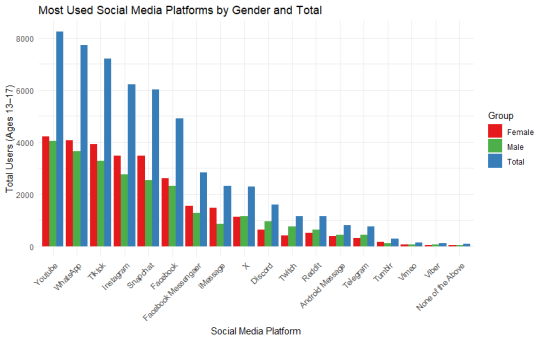
Use of Social Media | Youtube | 1684 (20.43%) | 1547 (18.77%) | 1546 (18.75%) | 1736 (21.06%) | 1729 (20.96%) | 8242 |
1485 (19.25%) | 1451 (18.81%) | 1444 (18.72%) | 1653 (21.44%) | 1681 (21.79%) | 7714 | ||
Tiktok | 1325 (18.42%) | 1278 (17.77%) | 1354 (18.82%) | 1643 (22.84%) | 1593 (22.15%) | 7193 | |
920 (14.80%) | 1034 (16.63%) | 1209 (19.45%) | 1476 (23.74%) | 1576 (25.36%) | 6215 | ||
Snapchat | 1063 (17.70%) | 973 (16.19%) | 1103 (18.35%) | 1456 (24.23%) | 1414 (23.53%) | 6009 | |
818 (16.64%) | 924 (18.79%) | 1021(20.77%) | 1073 (21.82%) | 1081 (21.98%) | 4917 | ||
Note: Education categories were grouped to improve interpretability and avoid sparse cells; “other education” includes special educational needs schools, pupil referral/alternative provision, and home-schooled adolescents. Social media platform use was measured as a multi-response variable, and only the most widely used platforms are presented. Social media is multi-response (respondents pick ≥1 platform), so raw counts > individuals (N=10,385). Percentages are row-wise within category (e.g., YouTube 1684/8242 total YT users =20.43% age 13), not column totals. Column sums >100% expected/normal. | |||||||
Perpetrator (base) | Perpetrator (+interaction) | Concerned (base) | Concerned (+interaction) | EatSleep (base) | EatSleep (+interaction) | |
|---|---|---|---|---|---|---|
Intercept | -4.352*** (p=<0.001) | 43.601 (p=0.183) | 1.582*** (p=<0.001) | -112.214*** (p=<0.001) | -1.144* (p=0.019) | -119.796*** (p=<0.001) |
TikTok users (1000s) | 0.703* (p=0.013) | -64.654 (p=0.146) | -1.084*** (p=<0.001) | 153.795*** (p=<0.001) | -0.119 (p=0.680) | 161.422*** (p=<0.001) |
Interaction: TikTok × Viewed_Violence | 22.218 (p=0.140) | -52.593*** (p=<0.001) | -54.869*** (p=<0.001) | |||
2.505*** (p=<0.001) | 2.223*** (p=<0.001) | |||||
Proportion Female | 3.271*** (p=<0.001) | 3.409*** (p=<0.001) | 1.679*** (p=<0.001) | 1.430*** (p=<0.001) | 2.505*** (p=<0.001) | 2.223*** (p=<0.001) |
YEF | Youth Endowment Fund |
SDA | Symbolic Data Analysis |
| [1] | Nesi, J., The Impact of Social Media on Youth Mental Health: Challenges and Opportunities. N C Med J, 2020. 81(2). |
| [2] | Advisory, T. U.S. S. G. s., Social Media and Youth Mental Health. 2023. |
| [3] | Natasha Ramsey, M. O. a. A. A., Impact of COVID-19 on adolescent health and use of social media. Current opinion in pediatrics, 2023. 35(3): p. 362-367. |
| [4] | Carolina Falcón-Linares, S. G.-Y., Marta Mauri, Maria Jesus Cardoso, Impact of Social Media on Adolescence: Mapping Emerging Needs to Build Resilient Skills. Societies, 2023. 13(11). |
| [5] | Corinne David-Ferdon, M. F. H., Electronic media, violence, and adolescents: An emerging public health problem. Journal of Adolescent Health, 2007. 41(6): p. 1-5. |
| [6] | Xing Zhao, J. C., Vitriol on Social Media: Curation and Investigation, in International Conference on Social Informatics. Cham: Springer International Publishing. 2018. |
| [7] | Domalewska, D., Online Verbal Aggression on Social Media During Times of Political Turmoil: Discursive Patterns from Poland’s 2020 Protests and Election. Media, 2025. 6(3). |
| [8] | Martinez, L., The Impact of Social Media Usage Among Teens During COVID-19. J Comm Med and Pub Health Rep, 2023. 4(6). |
| [9] | Daisy Mui Hung Kee, M. A. L. A.-A., Sarah Ammar Lutf Al-Anesi, Cyberbullying on social media under the influence of COVID‐19. Global Business and Organizational Excellence, 2022. 41(6). |
| [10] | Jacek Pyżalski, P. K. S., Nationality and ethnicity-based (cyber)bullying: how should we tackle this phenomenon in survey studies? Psychology, Society & Education. Psychology, Society & Education, 2022. 14(3): p. 11-17. |
| [11] | Eric Rice, R. P., Harmony Rhoades, Hailey Winetrobe, Jeremy Goldbach, Aaron Plant, Jorge Montoya, Timothy Kordic, Cyberbullying perpetration and victimization among middle-school students. Am J Public Health, 2015. 105(3): p. 66-72. |
| [12] | Richard M. Lerner, N. L. G., Adolescent development: Challenges and opportunities for research, programs, and policies. Annual review of psychology, 1998. 49(1): p. 413-446. |
| [13] | Kathleen Thiede Call, A. A. R., Karen Hein, Vonnie McLoyd, Anne Petersen, Michele Kipke, Adolescent health and well‐being in the twenty‐first century: a global perspective. Journal of research on adolescence 2022. 69(98): p. 69-98. |
| [14] | Lewis Aptekar, D. S., Children in particularly difficult circumstances, in Handbook of cross-cultural psychology: Basic processes and human development. 1997, Allyn & Bacon. p. 377–412. |
| [15] | Sefa Awaworyi Churchill, R. S., Locus of control and the mental health effects of local area crime. Social Science & Medicine, 2022. 301. |
| [16] | Anjali Popat, C. T., Exploring adolescents’ perspectives on social media and mental health and well-being – A qualitative literature review. Clinical Child Psychology and Psychiatry, 2022. 28(1). |
| [17] | Zuxing Wang, Y. D., Xiao Yang, Xiaoyun Guo, Xiaohong Ma, Bo Zhou, Wei Zhang Global, regional, and national burden of mental disorders among adolescents and young adults, 1990–2021: a systematic analysis for the Global Burden of Disease Study 2021. Translational Psychiatry, 2025. 15(397). |
| [18] | Fiona M Gore, P. J. N. B., George C Patton, Jane Ferguson, Véronique Joseph, Carolyn Coff ey, Susan M Sawyer, Colin D Mathers, Global burden of disease in young people aged 10–24 years: a systematic analysis. The Lancet, 2011. 377. |
| [19] | Amand-Eeckhout, L., Mental health in the EU. 2023, EPRS | European Parliamentary Research Service. |
| [20] | Vanessa Jantzer, M. S., Johann Haffner, Peter Parzer, Sarah Trick, Franz Resch, Michael Kaess, The cost incurred by victims of bullying from a societal perspective: estimates based on a German online survey of adolescents. European Child & Adolescent Psychiatry 2019. 282: p. 585–594. |
| [21] | Frederico Cardoso, Z. M., The Economic and Social Costs of Mental Health: Review of methodology and update of calculations. Centre For Mental Health. |
| [22] | Tyler C Hein, L. G. G., Vonnie C McLoyd, Jeanne Brooks-Gunn, Sara S McLanahan, Colter Mitchell, Nestor L Lopez-Duran, Luke W Hyde, Christopher S Monk, Childhood violence exposure and social deprivation are linked to adolescent threat and reward neural function. Social cognitive and affective neuroscience, 2020. 15(11): p. 1252-1259. |
| [23] | Shek, D. T. L., Quality of Life in Young People in the Pandemic and Post-Pandemic Eras: Empirical, Theoretical, Methodological, and Intervention Considerations. Applied Research in Quality of Life, 2025: p. 1-22. |
| [24] | Sebastian Trautmann, J. R., Hans‐Ulrich Wittchen, The economic costs of mental disorders: Do our societies react appropriately to the burden of mental disorders? EMBO reports, 2016. 17(9): p. 1245-1249. |
| [25] | Huesmann, L. R., The Impact of Electronic Media Violence: Scientific Theory and Research. Journal of Adolescent health, 2007. 41(6): p. 6-13. |
| [26] | Tom Whitaker, B. B., Scott A. Sisson, Logistic regression models for aggregated data. Journal of Computational and Graphical Statistics. 30(4): p. 1049-1067. |
| [27] |
Yates, J. Social Media and Violence Amongst Young People: A Growing Concern. 2024; Available from:
http://youthendowmentfund.org.uk/social-media-and-violence-amongst-young-people-a-growing-concern/ |
| [28] | Ainzara Favini, C. L., Alessia Teresa Virzì, Loreta Cannito, Flavia Culcasi, Tiziana Quarto, Paola Palladino, Online and Offline Aggressive Behaviors in Adolescence: The Role of Self-Regulatory Self-Efficacy Beliefs. Behav. Sci., 2024. 14(9). |
| [29] | Isaiah Sypher, L. W. H., Melissa K. Peckins, Rebecca Waller, Kelly Klump, S. Alexandra Burt Effects of parenting and community violence on aggression-related social goals: A monozygotic twin differences study. Journal of abnormal child psychology, 2019. 47(6): p. 1001-1012. |
| [30] | Josélia Fonseca, T. B.-T., Digital Literacy Education and Cyberbullying Combat: Scope and Perspectives, in Strategic Innovative Marketing and Tourism. 2023, Springer Proceedings in Business and Economics. |
| [31] | Matías E. Rodriguez-Rivas, J. J. V., Constanza González, María Josefina Chuecas, The role of family support and conflict in cyberbullying and subjective well-being among Chilean adolescents during the Covid-19 period. Heliyon, 2022. 8(4). |
| [32] | Jaffe, E. M., Looking for liability for harmful social media content. Marquette Intellectual Pr quette Intellectual Property & Inno ty & Innovation Law Re ation Law Review 2024. 28(1). |
| [33] | Lidia Piccerillo, S. D., Adolescent Social Media Use and Emotional Intelligence: A Systematic Review. Adolescent Research Review 2025. 10: p. 201–218. |
| [34] | Süleyman Ünlü, K. U., Gökmen Arslan Mindfulness-Based Intervention in Schools: Addressing Social Media Burnout and Enhancing Well-Being in Adolescents. Children 2025. 12(7). |
APA Style
Yaylali, A. (2026). Predicting Youth Violence and Distress from Online Exposure: A Symbolic Analysis of Aggregated Data. Science Discovery Psychology, 1(1), 52-60. https://doi.org/10.11648/j.sdps.20260101.15
ACS Style
Yaylali, A. Predicting Youth Violence and Distress from Online Exposure: A Symbolic Analysis of Aggregated Data. Sci. Discov. Psychol. 2026, 1(1), 52-60. doi: 10.11648/j.sdps.20260101.15
@article{10.11648/j.sdps.20260101.15,
  author = {Ayshe Yaylali},
  title = {Predicting Youth Violence and Distress from Online Exposure: A Symbolic Analysis of Aggregated Data},
  journal = {Science Discovery Psychology},
  volume = {1},
  number = {1},
  pages = {52-60},
  doi = {10.11648/j.sdps.20260101.15},
  url = {https://doi.org/10.11648/j.sdps.20260101.15},
  eprint = {https://article.sciencepublishinggroup.com/pdf/10.11648.j.sdps.20260101.15},
  abstract = {This study examines associations between adolescents’ exposure to violent content on social media and behavioural and mental-health outcomes using aggregated cross-sectional data from the Youth Endowment Fund’s 2024 Children, Violence and Vulnerability Survey (N = 10,385 adolescents aged 13–17 years in England and Wales). Logistic regression models were estimated on grouped data within a symbolic data analysis framework to assess three outcomes: violence perpetration, concern about victimization, and psychological distress captured by trouble eating, sleeping, or concentrating. Exposure to online violence was common (78.6%), as were witnessing violence in person (56.4%), victimization (17.5%), and perpetration (16.3%), and engagement with major social media platforms was widespread. In regression analyses, higher engagement with the platform most strongly associated with violent-content exposure was positively related to violence perpetration in the base model (β = 0.703, p = 0.013) but became non-significant after inclusion of an interaction with violent-content exposure, whereas the interaction between platform engagement and viewing violence was strongly associated with concern about victimization (β = 153.795, p < 0.001) and psychological distress (β = 161.422, p < 0.001). Across outcomes, a higher proportion of females was consistently associated with greater perpetration, concern, and distress (β = 1.43–3.41, p < 0.001). Overall, these findings suggest that platform engagement alone is not uniformly associated with harm, but its combination with exposure to violent content corresponds to substantially higher levels of reported perpetration, concern, and psychological distress. Given the aggregated cross-sectional design, results should be interpreted as population-level associations rather than causal effects, while still highlighting important public-health implications and the need for age- and gender-sensitive prevention strategies including media-literacy and digital-safety interventions.},
 year = {2026}
}
TY  - JOUR
T1  - Predicting Youth Violence and Distress from Online Exposure: A Symbolic Analysis of Aggregated Data
AU  - Ayshe Yaylali
Y1  - 2026/03/27
PY  - 2026
N1  - https://doi.org/10.11648/j.sdps.20260101.15
DO  - 10.11648/j.sdps.20260101.15
T2  - Science Discovery Psychology
JF  - Science Discovery Psychology
JO  - Science Discovery Psychology
SP  - 52
EP  - 60
PB  - Science Publishing Group
UR  - https://doi.org/10.11648/j.sdps.20260101.15
AB  - This study examines associations between adolescents’ exposure to violent content on social media and behavioural and mental-health outcomes using aggregated cross-sectional data from the Youth Endowment Fund’s 2024 Children, Violence and Vulnerability Survey (N = 10,385 adolescents aged 13–17 years in England and Wales). Logistic regression models were estimated on grouped data within a symbolic data analysis framework to assess three outcomes: violence perpetration, concern about victimization, and psychological distress captured by trouble eating, sleeping, or concentrating. Exposure to online violence was common (78.6%), as were witnessing violence in person (56.4%), victimization (17.5%), and perpetration (16.3%), and engagement with major social media platforms was widespread. In regression analyses, higher engagement with the platform most strongly associated with violent-content exposure was positively related to violence perpetration in the base model (β = 0.703, p = 0.013) but became non-significant after inclusion of an interaction with violent-content exposure, whereas the interaction between platform engagement and viewing violence was strongly associated with concern about victimization (β = 153.795, p < 0.001) and psychological distress (β = 161.422, p < 0.001). Across outcomes, a higher proportion of females was consistently associated with greater perpetration, concern, and distress (β = 1.43–3.41, p < 0.001). Overall, these findings suggest that platform engagement alone is not uniformly associated with harm, but its combination with exposure to violent content corresponds to substantially higher levels of reported perpetration, concern, and psychological distress. Given the aggregated cross-sectional design, results should be interpreted as population-level associations rather than causal effects, while still highlighting important public-health implications and the need for age- and gender-sensitive prevention strategies including media-literacy and digital-safety interventions.
VL  - 1
IS  - 1
ER  -
Health Services Research, Maastricht University, Maastricht, Netherlands

Information



 Share This Article
 Twitter
 Linked In
 Facebook
 Copy
Copy Download