
The use of existing water distribution infrastructure for micro-hydropower generation offers a practical pathway toward decentralized and low-carbon energy production. Lift-type vertical-axis water turbines (VAWTs) are particularly attractive for in-pipe applications because they operate independently of flow direction and can achieve relatively high efficiency at moderate rotational speeds. However, their performance is often constrained by unsteady flow behavior, torque fluctuations, and associated pressure losses in confined pipeline environments. This study numerically investigates the effectiveness of a stationary flow deflector in enhancing the hydrodynamic performance of a lift-type vertical-axis in-pipe water turbine. Three-dimensional unsteady computational fluid dynamics (CFD) simulations were conducted to evaluate turbine operation with and without a deflector under gravity-fed pipeline conditions. The effects of blade number and tip-speed ratio were systematically examined. Key performance indicators, including instantaneous and time-averaged torque, power output, pressure drop, and hydraulic efficiency, were quantified and compared. The results show that the introduction of the flow deflector significantly improves flow guidance toward the windward blades, leading to stronger lift generation and reduced flow separation. Across the investigated operating range, the deflector-assisted turbine achieved torque increases of approximately 20-30% and power output improvements of up to 30-40% relative to the baseline configuration without a deflector. Peak hydraulic efficiency was observed at moderate tip-speed ratios, with efficiency gains of approximately 15-25%. At the same time, the additional pressure loss introduced by the deflector remained limited, typically below 5% of the equivalent pressure head. Furthermore, torque fluctuations were noticeably reduced, indicating more stable turbine operation. These findings demonstrate that flow deflectors can effectively mitigate the unsteady hydrodynamic limitations of lift-type in-pipe turbines while preserving acceptable pressure losses, providing new design insights for micro-hydropower energy recovery in water distribution networks.
| Published in | Science Journal of Energy Engineering (Volume 14, Issue 1) |
| DOI | 10.11648/j.sjee.20261401.12 |
| Page(s) | 7-20 |
| Creative Commons |
This is an Open Access article, distributed under the terms of the Creative Commons Attribution 4.0 International License (http://creativecommons.org/licenses/by/4.0/), which permits unrestricted use, distribution and reproduction in any medium or format, provided the original work is properly cited. |
| Copyright |
Copyright © The Author(s), 2026. Published by Science Publishing Group |
Lift-type Vertical-axis Water Turbine, In-pipe Hydropower, Flow Deflector, Computational Fluid Dynamics (CFD), Micro-hydropower
Parameter | Value/Range |
|---|---|
Pipe inner diameter (Dp) | 200 mm |
Total pipeline length (Lp) | 3800 mm |
Upstream pipe length (Lu) | 1400 mm |
Downstream pipe length (Ld) | 2400 mm |
Turbine rotor diameter (Dr) | 0.85 Dp |
Turbine height (H) | = Dp |
Number of blades (N) | 3, 4, 5 |
Blade chord length (c) | 0.15 Dr |
Blade profile | Lift-type hydrofoil/thin plate arc |
Turbine solidity (σ) | 0.2, 0.3, 0.4 |
Solidity range | 0.2-0.6 |
Deflector shrinkage ratio (ε) | 0.58 |
Boundary / Parameter | Specification | Description |
|---|---|---|
Inlet boundary condition | Velocity inlet | Uniform inlet velocity |
Inlet flow direction | Axial | Aligned with pipe centerline |
Outlet boundary condition | Pressure outlet | 0 Pa (gauge pressure) |
Pipe wall | No-slip wall | Stationary |
Turbine blades | No-slip wall | Rotating |
Turbine shaft | No-slip wall | Rotating |
Deflector surface | No-slip wall | Stationary |
Fluid type | Water | Incompressible |
Fluid density | ρ | 998 kg.m-3 |
Dynamic viscosity | μ | 0.001 Pa.s |
Turbulence model | URANS, k-ε | Standard wall functions |
Reference pressure | - | Atmospheric |
Operating temperature | - | Constant |
Gravity | - | Neglected |
Mesh Level | Total Cell Count | Minimum Cell Size | Max Skewness | Avg. Torque Deviation |
|---|---|---|---|---|
Coarse mesh | 0.9 × 10⁶ | Larger | < 0.85 | Reference |
Medium mesh | 1.6 × 10⁶ | Moderate | < 0.80 | < 4% |
Fine mesh | 2.4 × 10⁶ | Refined near blades | < 0.75 | < 2% |
Final mesh selected | 2.4 × 10⁶ | Refined | < 0.75 | < 2% |
Case ID | Configuration | Number of blades, N | Solidity, σ | Tip-speed ratio, λ | Deflector |
|---|---|---|---|---|---|
B1 | Baseline | 3 | 0.2 | 1 | No |
B2 | Baseline | 3 | 0.2 | 1.5 | No |
B3 | Baseline | 3 | 0.2 | 2 | No |
B4 | Baseline | 4 | 0.3 | 1 | No |
B5 | Baseline | 4 | 0.3 | 1.5 | No |
B6 | Baseline | 4 | 0.3 | 2 | No |
B7 | Baseline | 5 | 0.4 | 1 | No |
B8 | Baseline | 5 | 0.4 | 1.5 | No |
B9 | Baseline | 5 | 0.4 | 2 | No |
D1 | Deflector-assisted | 3 | 0.2 | 1 | Yes |
D2 | Deflector-assisted | 3 | 0.2 | 1.5 | Yes |
D3 | Deflector-assisted | 3 | 0.2 | 2 | Yes |
D4 | Deflector-assisted | 4 | 0.3 | 1 | Yes |
D5 | Deflector-assisted | 4 | 0.3 | 1.5 | Yes |
D6 | Deflector-assisted | 4 | 0.3 | 2 | Yes |
D7 | Deflector-assisted | 5 | 0.4 | 1 | Yes |
D8 | Deflector-assisted | 5 | 0.4 | 1.5 | Yes |
D9 | Deflector-assisted | 5 | 0.4 | 2 | Yes |
CFD | Computational Fluid Dynamics |
VAWT | Vertical-Axis Water Turbine |
URANS | Unsteady Reynolds-Averaged Naiver-Stokes |
TSR | Tip-Speed Ratio |
VOF | Volume of Fluid |
PRV | Pressure Reducing Valve |
RANS | Reynolds-Averaged Naiver-Stokes |
| [1] | Singh, V. K., Singal, S. K. Operation of hydro power plants - A review. Renewable and Sustainable Energy Reviews. 2017, 69, 610-619. |
| [2] | Anaza, S. O., Abdulazeez, M. S., Yisah, Y. A., Yusuf, Y. O., Salawu, B. U., Momoh, S. U. Micro hydro-electric energy generation - An overview. American Journal of Engineering Research (AJER). 2017, 6(2), 5-12. |
| [3] | Yuksel, I., Kaygusuz, K. Renewable energy sources for clean and sustainable energy policies in Turkey. Renewable and Sustainable Energy Reviews. 2011, 15(8), 4132-4144. |
| [4] | Voltz, T. J., Grischek, T. Microturbines at drinking water tanks fed by gravity pipelines: A method and excel tool for maximizing annual energy generation based on historical tank outflow data. Water. 2019, 11(7), 1403. |
| [5] | Effiom, S. O., Abam, F., Ofem, S., Effiom, P. C., Onochie, O., Inah, O., Odu, P. CFD analysis and hydraulic performance of two-phase flow in a centrifugal pump with rotodynamic multi-impeller configurations. African Journal of Advances in Engineering and Technology. 2025, 1(2), 5-27. |
| [6] | Amjadi, H., Khashehchi, M., Soltani, J. Experimental investigation and numerical simulation of an inline low-head microhydroturbine for applications in water pipelines. IET Renewable Power Generation. 2020, 14(16), 3209-3219. |
| [7] | Yang, W., Hou, Y., Jia, H., Liu, B., Xiao, R. Lift-type and drag-type hydro turbine with vertical axis for power generation from water pipelines. Energy. 2019, 188, 116070. |
| [8] | Diab, G., Elhakeem, M., Sattar, A. M. Performance assessment of lift-based turbine for small-scale power generation in water pipelines using OpenFOAM. Engineering Applications of Computational Fluid Mechanics. 2022, 16(1), 536-550. |
| [9] | Oladosu, T. L., Koya, O. A. Numerical analysis of lift-based in-pipe turbine for predicting hydropower harnessing potential in selected water distribution networks for waterlines optimization. Engineering Science and Technology, an International Journal. 2018, 21(4), 672-678. |
| [10] | Yeo, H., Seok, W., Shin, S., Huh, Y. C., Jung, B. C., Myung, C. S., Rhee, S. H. Computational analysis of the performance of a vertical axis turbine in a water pipe. Energies. 2019, 12(20), 3998. |
| [11] | Chen, J., Yang, H., Yang, M., Xu, H., Hu, Z. A comprehensive review of the theoretical approaches for the airfoil design of lift-type vertical axis wind turbine. Renewable and Sustainable Energy Reviews. 2015, 51, 1709-1720. |
| [12] | Bianchini, A., Balduzzi, F., Ferrara, G., Ferrari, L. Virtual incidence effect on rotating airfoils in Darrieus wind turbines. Energy Conversion and Management. 2016, 111, 329-338. |
| [13] | Elsakka, M. M., Ingham, D. B., Ma, L., Pourkashanian, M. CFD analysis of the angle of attack for a vertical axis wind turbine blade. Energy Conversion and Management. 2019, 182, 154-165. |
| [14] | Xu, H. Y., Qiao, C. L., Yang, H. Q., Ye, Z. Y. Delayed detached eddy simulation of the wind turbine airfoil S809 for angles of attack up to 90 degrees. Energy. 2017, 118, 1090-1109. |
| [15] | Tonni, M. M. CFD Modelling of H-Darrieus Vertical Axis Wind Turbine. Doctoral Dissertation, Islamic University of Technology (IUT), Bangladesh, 2022. |
| [16] | Golecha, K., Eldho, T. I., Prabhu, S. V. Influence of the deflector plate on the performance of modified Savonius water turbine. Applied Energy. 2011, 88(9), 3207-3217. |
| [17] | Prasetyo, A., Kristiawan, B., Danardono, D., Hadi, S. The effect of deflector angle in Savonius water turbine with horizontal axis on the power output of water flow in pipe. In Journal of Physics: Conference Series. IOP Publishing, 2018, 979, 012043. |
| [18] | Sahim, K., Santoso, D., Sipahutar, R. Performance of combined water turbine Darrieus-Savonius with two stage Savonius buckets and single deflector. International Journal of Renewable Energy Research. 2015, 5(1), 217-221. |
| [19] | Setiawan, P. A., Yuwono, T., Widodo, W. A. Numerical simulation on improvement of a Savonius vertical axis water turbine performance to advancing blade side with a circular cylinder diameter variations. In IOP Conference Series: Earth and Environmental Science. IOP Publishing, 2018, 200, 012029. |
| [20] | Gautam, S., Sedai, A., Dhakal, R., Sedhai, B. K., Pol, S. CFD analysis of gravity-fed drag-type in-pipe water turbine to determine the optimal deflector-to-turbine position. International Journal of Low-Carbon Technologies. 2023, 18, 55-68. |
| [21] | Peczkis, G., Wiśniewski, P., Zahorulko, A. Experimental and numerical studies on the influence of blade number in a small water turbine. Energies. 2021, 14(9), 2604. |
| [22] | Basumatary, M., Biswas, A., Misra, R. D. CFD analysis of an innovative combined lift and drag (CLD) based modified Savonius water turbine. Energy Conversion and Management. 2018, 174, 72-87. |
| [23] | Acarer, S. Peak lift-to-drag ratio enhancement of the DU12W262 airfoil by passive flow control and its impact on horizontal and vertical axis wind turbines. Energy. 2020, 201, 117659. |
| [24] | Jang, H., Hwang, Y., Paek, I., Lim, S. Performance evaluation and validation of H-darrieus small vertical axis wind turbine. International Journal of Precision Engineering and Manufacturing-Green Technology. 2021, 8(6), 1687-1697. |
| [25] | Norahim, N. S., Didane, D. H., Ogab, M., Manshoor, B. Numerical study of a Darrius rotor for hydropower production. Journal of Design for Sustainable and Environment. 2022, 4(2). |
| [26] | Lahamornchaiyakul, W., Kasayapanand, N. The design and analysis of a novel vertical axis small water turbine generator for installation in drainage lines. International Journal of Renewable Energy Development. 2023, 12(2), 235-246. |
| [27] | Aziz, M. S., Khan, M. A., Jamil, H., Jamil, F., Chursin, A., Kim, D. H. Design and analysis of in-pipe hydro-turbine for an optimized nearly zero energy building. Sensors. 2021, 21(23), 8154. |
| [28] | Basumatary, M., Biswas, A., Misra, R. D. CFD study of a combined lift and drag-based novel Savonius vertical axis water turbine. Journal of Marine Science and Technology. 2023, 28(1), 27-43. |
| [29] | Chalaca, A., Velásquez, L., Rubio-Clemente, A., Chica, E. Design and optimization of a Gorlov-type hydrokinetic turbine array for energy generation using response surface methodology. Energies. 2024, 17(19), 4870. |
| [30] | Lee, J. H., Lee, Y. T., Lim, H. C. Effect of twist angle on the performance of Savonius wind turbine. Renewable Energy. 2016, 89, 231-244. |
| [31] | Wenehenubun, F., Saputra, A., Sutanto, H. An experimental study on the performance of Savonius wind turbines related with the number of blades. Energy Procedia. 2015, 68, 297-304. |
| [32] | Yusri, H. F. M., Ramsay, F. A., Xuan, T. W., Yong, N. Z., Khai, P. M., Didane, D. H., Manshoor, B. 2D numerical simulation of H-type Darrieus vertical-axis wind turbine (VAWT). Journal of Design for Sustainable and Environment. 2023, 5(1), 11-16. |
| [33] | Alom, N., Saha, U. K. Influence of blade profiles on Savonius rotor performance: Numerical simulation and experimental validation. Energy Conversion and Management. 2019, 186, |
| [34] | Pranta, M. H., Rabbi, M. S., Roshid, M. M. A computational study on the aerodynamic performance of modified Savonius wind turbine. Results in Engineering. 2021, 10, 100237. |
| [35] | Ramadan, A., Nawar, M. A., Mohamed, M. H. Performance evaluation of a drag hydro kinetic turbine for rivers current energy extraction - A case study. Ocean Engineering. 2020, 195, 106699. |
| [36] | Jamaldi, A., Purwono, A. H. Effect of blades number to performance of Savonius drag-type water turbine on flow of water in pipe. In AIP Conference Proceedings. AIP Publishing, 2024, 2952(1), 090001. |
| [37] | Rosyidi, M. A., Purwono, A. H., Tjahjana, D. D. D. P., Budiana, E. P., Hadi, S. Effect of the blade curvature angle to power generation on the drag type horizontal axis water turbine. Journal of Advanced Research in Fluid Mechanics and Thermal Sciences. 2018, 49(2), 115-120. |
| [38] | Mosbahi, M., Ayadi, A., Chouaibi, Y., Driss, Z., Tucciarelli, T. Performance improvement of a novel combined water turbine. Energy Conversion and Management. 2020, 205, 112473. |
| [39] | Mohammed, M., Sarip, S., Mustafa, W. A. Systematic review of computational fluid dynamics modelling and simulation techniques employed in vertical axis hydrokinetic turbines. Journal of Advanced Research in Applied Mechanics. 2024, 117(1), 51-71. |
| [40] | Fazlizan, A., Muzammil, W. K., Al-Khawlani, N. A. A review of computational fluid dynamics techniques and methodologies in vertical axis wind turbine development. Computer Modeling in Engineering & Sciences. 2025, 144(2), 1371. |
| [41] | Jiang, C., Shu, X., Chen, J., Bao, L., Xu, Y. Research on blade design of lift-drag-composite tidal-energy turbine at low flow velocity. Energies. 2021, 14(14), 4258. |
| [42] | Kumar, R., Nag, A. K., Sarkar, S. Performance analysis of spherically curbed hydrokinetic turbine arranged in in-line array in a closed conduit. Renewable Energy. 2024, 232, 121110. |
| [43] | Singh, D. K., Ranjan, S., & Patil, N. G. Wave behavior in a numerical wave tank at intermediate depth of water using Stokes wave theory. International Journal of Modern Physics C. 2024, 35(05), 1-16. |
| [44] | Singh, D. K., Yadav, S. S., & Deb Roy, P. Analysis of viscous wave generation at low Ursell number in an optimal numerical wave tank using inlet velocity method. Proceedings of the Institution of Mechanical Engineers, Part E: Journal of Process Mechanical Engineering. 2023, 237(3), 805-? |
| [45] | Singh, D. K., & Deb Roy, P. Study of water wave in the intermediate depth of water using second-order Stokes wave equation: a numerical simulation approach. Sādhanā - Academy Proceedings in Engineering Sciences. 2022, 47(1), 1-15. |
| [46] | Singh, A., Kumari, A., & Singh, D. K. Computational investigation of immiscible viscous fingering in a two-dimensional Hele-Shaw cell. International Journal of Modern Physics C. 2025, (in press). |
APA Style
Effiom, S., Enoh, M. K., Jimmy, O., Effiom, P., Ogarekpe, N. (2026). Hydrodynamic Performance Enhancement of a Lift-type Vertical-axis In-pipe Water Turbine Using a Flow Deflector: A CFD-based Parametric Study. Science Journal of Energy Engineering, 14(1), 7-20. https://doi.org/10.11648/j.sjee.20261401.12
ACS Style
Effiom, S.; Enoh, M. K.; Jimmy, O.; Effiom, P.; Ogarekpe, N. Hydrodynamic Performance Enhancement of a Lift-type Vertical-axis In-pipe Water Turbine Using a Flow Deflector: A CFD-based Parametric Study. Sci. J. Energy Eng. 2026, 14(1), 7-20. doi: 10.11648/j.sjee.20261401.12
AMA Style
Effiom S, Enoh MK, Jimmy O, Effiom P, Ogarekpe N. Hydrodynamic Performance Enhancement of a Lift-type Vertical-axis In-pipe Water Turbine Using a Flow Deflector: A CFD-based Parametric Study. Sci J Energy Eng. 2026;14(1):7-20. doi: 10.11648/j.sjee.20261401.12
@article{10.11648/j.sjee.20261401.12,
  author = {Samuel Effiom and Maria Kaka Enoh and Omini Jimmy and Precious-Chibuzo Effiom and Nkpa Ogarekpe},
  title = {Hydrodynamic Performance Enhancement of a Lift-type Vertical-axis In-pipe Water Turbine Using a Flow Deflector:
A CFD-based Parametric Study},
  journal = {Science Journal of Energy Engineering},
  volume = {14},
  number = {1},
  pages = {7-20},
  doi = {10.11648/j.sjee.20261401.12},
  url = {https://doi.org/10.11648/j.sjee.20261401.12},
  eprint = {https://article.sciencepublishinggroup.com/pdf/10.11648.j.sjee.20261401.12},
  abstract = {The use of existing water distribution infrastructure for micro-hydropower generation offers a practical pathway toward decentralized and low-carbon energy production. Lift-type vertical-axis water turbines (VAWTs) are particularly attractive for in-pipe applications because they operate independently of flow direction and can achieve relatively high efficiency at moderate rotational speeds. However, their performance is often constrained by unsteady flow behavior, torque fluctuations, and associated pressure losses in confined pipeline environments. This study numerically investigates the effectiveness of a stationary flow deflector in enhancing the hydrodynamic performance of a lift-type vertical-axis in-pipe water turbine. Three-dimensional unsteady computational fluid dynamics (CFD) simulations were conducted to evaluate turbine operation with and without a deflector under gravity-fed pipeline conditions. The effects of blade number and tip-speed ratio were systematically examined. Key performance indicators, including instantaneous and time-averaged torque, power output, pressure drop, and hydraulic efficiency, were quantified and compared. The results show that the introduction of the flow deflector significantly improves flow guidance toward the windward blades, leading to stronger lift generation and reduced flow separation. Across the investigated operating range, the deflector-assisted turbine achieved torque increases of approximately 20-30% and power output improvements of up to 30-40% relative to the baseline configuration without a deflector. Peak hydraulic efficiency was observed at moderate tip-speed ratios, with efficiency gains of approximately 15-25%. At the same time, the additional pressure loss introduced by the deflector remained limited, typically below 5% of the equivalent pressure head. Furthermore, torque fluctuations were noticeably reduced, indicating more stable turbine operation. These findings demonstrate that flow deflectors can effectively mitigate the unsteady hydrodynamic limitations of lift-type in-pipe turbines while preserving acceptable pressure losses, providing new design insights for micro-hydropower energy recovery in water distribution networks.},
 year = {2026}
}
TY  - JOUR
T1  - Hydrodynamic Performance Enhancement of a Lift-type Vertical-axis In-pipe Water Turbine Using a Flow Deflector:
A CFD-based Parametric Study
AU  - Samuel Effiom
AU  - Maria Kaka Enoh
AU  - Omini Jimmy
AU  - Precious-Chibuzo Effiom
AU  - Nkpa Ogarekpe
Y1  - 2026/02/11
PY  - 2026
N1  - https://doi.org/10.11648/j.sjee.20261401.12
DO  - 10.11648/j.sjee.20261401.12
T2  - Science Journal of Energy Engineering
JF  - Science Journal of Energy Engineering
JO  - Science Journal of Energy Engineering
SP  - 7
EP  - 20
PB  - Science Publishing Group
SN  - 2376-8126
UR  - https://doi.org/10.11648/j.sjee.20261401.12
AB  - The use of existing water distribution infrastructure for micro-hydropower generation offers a practical pathway toward decentralized and low-carbon energy production. Lift-type vertical-axis water turbines (VAWTs) are particularly attractive for in-pipe applications because they operate independently of flow direction and can achieve relatively high efficiency at moderate rotational speeds. However, their performance is often constrained by unsteady flow behavior, torque fluctuations, and associated pressure losses in confined pipeline environments. This study numerically investigates the effectiveness of a stationary flow deflector in enhancing the hydrodynamic performance of a lift-type vertical-axis in-pipe water turbine. Three-dimensional unsteady computational fluid dynamics (CFD) simulations were conducted to evaluate turbine operation with and without a deflector under gravity-fed pipeline conditions. The effects of blade number and tip-speed ratio were systematically examined. Key performance indicators, including instantaneous and time-averaged torque, power output, pressure drop, and hydraulic efficiency, were quantified and compared. The results show that the introduction of the flow deflector significantly improves flow guidance toward the windward blades, leading to stronger lift generation and reduced flow separation. Across the investigated operating range, the deflector-assisted turbine achieved torque increases of approximately 20-30% and power output improvements of up to 30-40% relative to the baseline configuration without a deflector. Peak hydraulic efficiency was observed at moderate tip-speed ratios, with efficiency gains of approximately 15-25%. At the same time, the additional pressure loss introduced by the deflector remained limited, typically below 5% of the equivalent pressure head. Furthermore, torque fluctuations were noticeably reduced, indicating more stable turbine operation. These findings demonstrate that flow deflectors can effectively mitigate the unsteady hydrodynamic limitations of lift-type in-pipe turbines while preserving acceptable pressure losses, providing new design insights for micro-hydropower energy recovery in water distribution networks.
VL  - 14
IS  - 1
ER  -
Department of Mechanical Engineering, University of Cross River State, Calabar, Nigeria
Department of Mechanical Engineering, University of Cross River State, Calabar, Nigeria
Department of Mechanical Engineering, University of Cross River State, Calabar, Nigeria
Department of Petroleum Engineering, University of Calabar, Calabar, Nigeria
Department of Civil Engineering, University of Cross River State, Calabar, Nigeria
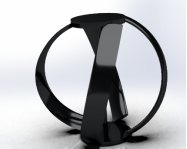
Figure 1. 3D modeled Gorlov pipe turbine geometry.
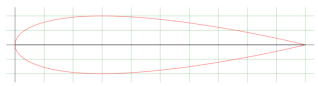
Figure 2. Hydrofoil NACA 0020 blade profile of the VAWT.
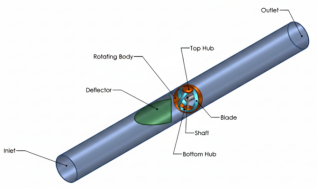
Figure 3. Computational domain.

Figure 4. Generated mesh.
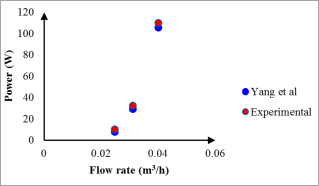
Figure 5. Comparison of predicted and reference power flowrate.
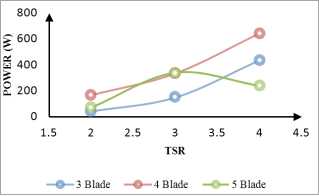
Figure 6. Power (W) vs TSR for different blade numbers.
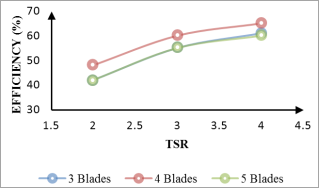
Figure 7. Efficiency (%) vs TSR for different blade numbers.
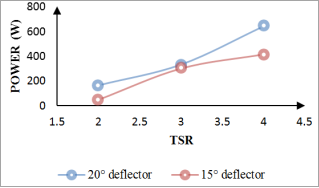
Figure 8. Power (W) vs TSR for different deflector angles.
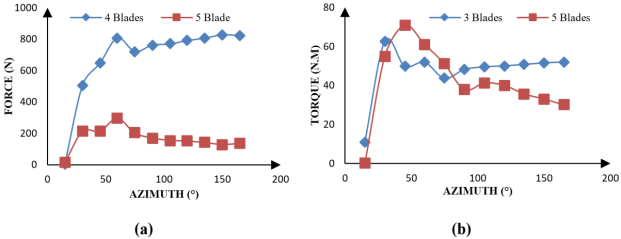
Figure 9. Turbine driving force and output torque over half revolution: (a) tangential driving force; (b) torque.
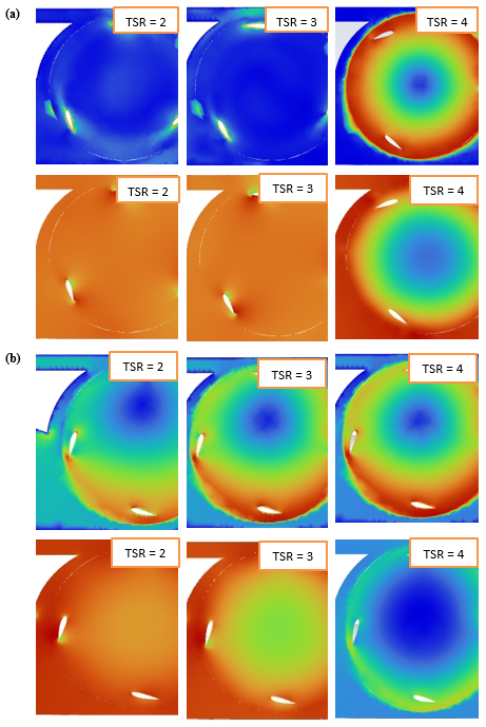
Figure 10. Mid-section flow fields showing pressure (Pa) and velocity magnitude (m/s) at different TSR values: (a) three-blade turbine; (b) four-blade turbine.

Information



 Share This Article
 Twitter
 Linked In
 Facebook
 Copy
Copy Download