Abstract
We will examine how anxiety is formed, circulated and negotiated through discussions of earthquake disasters in West Sumatra, Indonesia; anxiety is an organisational as well as discursive process in social and communication domains, in which communication is often shaped as the only means of communication. A primary aim of this research thus is to identify how these kinds of anxiety are influenced socially and culturally through messages from above the public stage, media discourse as well as neighbourhood and personal contacts to a crisis point of view and to see how these factors influence each other in order to address anxiety post-disaster. As a result, anxiety is not only the outcome of disaster but is one of the primary organizing forces affecting meaning making processes, public trust and group participation. The institutional narratives, media representation and community interactions help drive anxiety and how it is expressed in a social context through an interdependent interaction. In short, disaster anxiety should be seen as a communicative symptom instead of just a psychological state. While this article is presented from a Global South perspective we believe it contributes to the field of communication theory because it expands both affective and constitutive ways to describe crisis communication and challenges the technocratic paradigms in disaster management. We also believe it can bring some practical understanding to the field on how to practice a more reflexive, context-sensitive and socially conscious communication (CD) of disaster victims in the following situations and in the near future to give a better and more supportive way to respond.
|
Published in
|
Social Sciences (Volume 15, Issue 2)
|
|
DOI
|
10.11648/j.ss.20261502.13
|
|
Page(s)
|
83-96 |
|
Creative Commons
|

This is an Open Access article, distributed under the terms of the Creative Commons Attribution 4.0 International License (http://creativecommons.org/licenses/by/4.0/), which permits unrestricted use, distribution and reproduction in any medium or format, provided the original work is properly cited.
|
|
Copyright
|
Copyright © The Author(s), 2026. Published by Science Publishing Group
|
Keywords
Communication and Anxiety, Disaster Communication, Earthquake, West Sumatra, Affective Communication
1. Introduction
Anxiety has become a defining condition of contemporary social life and, increasingly, a central concern within communication scholarship. As societies confront overlapping crises—ranging from pandemics and political instability to climate change and natural disasters—communication scholars have turned their attention to the affective dimensions of mediated experience. Anxiety, in this context, is no longer understood merely as an individual psychological response but as a socially distributed condition shaped by discourse, media infrastructures, and interactional practices. Communication does not simply transmit information about uncertainty; it actively constitutes how uncertainty is felt, interpreted, and managed. This recognition has prompted renewed theoretical interest in affect, emotion, and meaning-making as integral components of communication processes. Within contemporary communication studies, anxiety has been examined through diverse lenses, including uncertainty reduction, risk communication, affective publics, and mediated emotions. Recent work emphasizes that anxiety circulates through narratives, symbols, and institutional messages, becoming embedded in public discourse and collective sense-making. Rather than residing solely within individuals, anxiety emerges relationally—produced and reproduced through communication practices that shape how people anticipate, interpret, and respond to potential threats. This shift marks an important departure from earlier approaches that treated anxiety as a background variable influencing communication outcomes, instead positioning it as a phenomenon constituted through communication itself.
Disaster contexts represent moments in which communicative anxiety becomes especially visible and consequential. Natural disasters disrupt not only physical environments but also established systems of meaning, trust, and temporal orientation. They generate conditions of heightened uncertainty in which information is incomplete, future risks are difficult to assess, and everyday routines are abruptly suspended. In such situations, communication plays a central role in shaping affective responses. Official warnings, media reports, social media exchanges, religious interpretations, and interpersonal conversations interact to produce shared understandings of danger and safety. These communicative processes can provide reassurance and coordination, yet they can also intensify anxiety by amplifying ambiguity, speculation, and emotional contagion. Among natural disasters, earthquakes are distinctive in their capacity to produce sustained anxiety. Unlike hazards with clearer temporal boundaries, earthquakes are characterized by unpredictability and the persistent possibility of recurrence. Aftershocks, delayed information, and contested expert interpretations create an environment of anticipatory tension in which anxiety extends beyond the initial event. Communication becomes a key mechanism through which individuals and communities attempt to cope with this uncertainty, negotiating meanings of risk, responsibility, and resilience. Understanding anxiety in earthquake contexts therefore requires attention to how communication structures emotional experience over time, rather than focusing solely on immediate crisis response.
West Sumatra, Indonesia, provides a particularly compelling setting for examining the communicative production of anxiety in disaster contexts. Situated along the seismically active Sunda megathrust, the region has experienced repeated earthquakes over the past decades, including the devastating 2009 Padang earthquake and numerous subsequent tremors. These events have left enduring marks on collective memory and everyday life. For many residents, earthquakes are not extraordinary disruptions but recurring features of social experience that shape how risk is anticipated and discussed. Communication about earthquakes in West Sumatra is thus embedded in long-term cultural narratives, religious frameworks, and local knowledge systems. The communicative ecology of West Sumatra is marked by the intersection of digital media, interpersonal networks, and religious institutions. Government agencies disseminate warnings and preparedness messages through mass and social media, while local communities rely heavily on informal communication channels such as WhatsApp groups, mosque announcements, and face-to-face interaction. Religious leaders frequently interpret seismic events through moral and theological narratives, offering meanings that can both soothe and intensify anxiety. In this context, anxiety is not merely an emotional reaction to physical danger but a shared condition negotiated through culturally situated communication practices.
Despite the relevance of these dynamics, much disaster research continues to conceptualize anxiety primarily as a psychological variable. In many studies, anxiety is measured through surveys, treated as an outcome to be minimized, or framed as an obstacle to effective information processing. While such approaches provide valuable insights, they often obscure the communicative processes through which anxiety is produced, circulated, and normalized. This tendency reflects a broader epistemological divide between psychological and communicative perspectives, in which emotions are frequently detached from discourse and social interaction.
Recent scholarship has begun to challenge this limitation. Lim and Lin
| [1] | Lim, J. S., & Lin, T. T. C. (2020). Risk communication and affective sense-making in environmental crises. Risk Analysis, 40(11), 2309–2323. https://doi.org/10.1111/risa.13556 |
[1]
argue that disaster-related anxiety should be understood as a narrative phenomenon shaped by collective memory and mediated storytelling rather than as an individual cognitive state. Houston, Spialek, and First
| [2] | Houston, J. B., Spialek, M. L., & First, J. (2021). Disaster communication, affective engagement, and community resilience. Journal of Applied Communication Research, 49(1), 1–21.
https://doi.org/10.1080/00909882.2020.1850836 |
[2]
demonstrate how social media platforms facilitate the rapid circulation of affect, transforming anxiety into a shared public condition during crises. Wang and Perez
| [3] | Wang, X., & Perez, M. (2023). Communicating uncertainty in crises: The effects of inconsistent official messaging on public anxiety and trust. Journal of Contingencies and Crisis Management, 31(3), 412–425.
https://doi.org/10.1111/1468-5973.12421 |
[3]
show that ambiguous or inconsistent official communication can exacerbate anxiety by undermining interpretive coherence, while Nugroho and Syarif
| [4] | Nugroho, Y., & Syarif, D. (2023). Religious narratives and emotional resilience in disaster communication: Evidence from Indonesia. International Journal of Disaster Risk Reduction, 89, 103645. https://doi.org/10.1016/j.ijdrr.2023.103645 |
[4]
highlight the central role of religious discourse in mediating emotional responses to disasters in Indonesia. Together, these studies point toward a growing recognition that anxiety is deeply embedded in communication processes. However, existing research often remains fragmented across subfields such as crisis communication, media studies, and psychology. What is still lacking is a macro-interpretive framework that situates anxiety at the center of communication theory and examines how it is negotiated across media systems, institutional contexts, and cultural traditions. This gap is particularly pronounced in non-Western settings, where dominant theories developed in Euro-American contexts may not fully capture the cultural dimensions of emotional communication.
The present study is motivated by both scholarly and contextual considerations. Scholarly interest arises from the need to reconceptualize anxiety as a communicative phenomenon that warrants theoretical attention in its own right. Contextually, the lived experiences of earthquake-affected communities in West Sumatra reveal how profoundly communication shapes emotional life during prolonged periods of uncertainty. The recurrence of earthquakes in the region creates an ongoing condition of anticipatory anxiety that is sustained and transformed through everyday communication. Examining these processes offers an opportunity to deepen our understanding of how communication constitutes affective experience in disaster contexts.
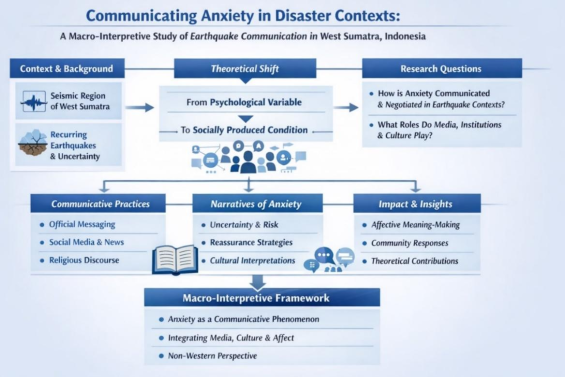
The research problem addressed in this article centers on the persistent treatment of anxiety as a psychological variable rather than as a communicative process. When anxiety is framed primarily as an internal state, the discursive practices through which it emerges become analytically invisible. This limits our ability to understand how communication contributes not only to the management of disasters but also to the production of emotional realities that shape social action. Addressing this problem requires shifting analytical focus from measurement to interpretation, from individual cognition to collective meaning-making
| [2] | Houston, J. B., Spialek, M. L., & First, J. (2021). Disaster communication, affective engagement, and community resilience. Journal of Applied Communication Research, 49(1), 1–21.
https://doi.org/10.1080/00909882.2020.1850836 |
[2]
.
Figure 1. Communicating Anxiety in Disater Contexts.
Accordingly, the aim of this study is to examine how anxiety is communicatively produced and negotiated in earthquake disaster contexts in West Sumatra, Indonesia. The guiding research question asks: How do communicative practices across media, institutional, and cultural contexts shape the experience and circulation of anxiety during and after earthquakes in West Sumatra? Subsidiary questions explore how different actors—government officials, media organizations, religious leaders, and citizens—participate in constructing narratives of uncertainty and reassurance, and how cultural frameworks influence the interpretation of seismic risk.
The contribution of this article lies in advancing a macro-interpretive understanding of anxiety as a communicative phenomenon. It extends existing disaster communication research by shifting attention from information transmission to affective meaning-making. At the same time, it enriches affect theory by grounding abstract discussions of emotion in a specific cultural and material context. By focusing on West Sumatra, the study also contributes to the diversification of communication scholarship, challenging Western-centric assumptions about how anxiety is expressed, managed, and understood.
The novelty of this research is threefold. First, it reconceptualizes anxiety not as an individual psychological response but as a socially and discursively produced condition. Second, it situates this reconceptualization within a non-Western disaster context, offering insights that broaden the empirical and theoretical scope of communication studies. Third, it integrates disaster communication with affect theory and cultural analysis, providing a synthetic framework that responds directly to the thematic focus on Communication and Anxiety.
In terms of the state of the art, recent studies have established that emotions play a crucial role in crisis communication, yet they often stop short of theorizing anxiety as a communicative process. By building on and extending this body of work, the present study addresses a critical gap in the literature. It responds to calls for more interpretive, theory-driven research that examines how communication shapes emotional experience in complex social contexts. In sum, this article argues that anxiety in disaster contexts cannot be fully understood without attention to communication. Earthquakes in West Sumatra reveal how anxiety is produced through narratives of uncertainty, mediated through digital and interpersonal channels, and negotiated within cultural frameworks of meaning. By reframing anxiety as a communicative phenomenon, this study contributes to ongoing debates within communication scholarship and offers insights with relevance beyond the Indonesian context.
2. Literature Review
2.1. Anxiety in Communication Studies
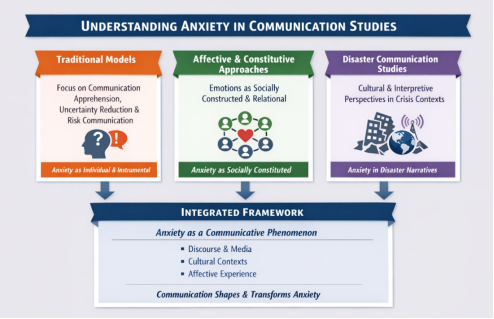
Anxiety has long occupied a place in communication research, though its conceptualization has historically been shaped by individual-centered and instrumental frameworks. Early and influential strands of scholarship examined anxiety primarily through the lens of communication apprehension, focusing on individuals’ fear or avoidance of communicative situations such as public speaking or interpersonal interaction. While this work provided valuable insights into communicative performance and competence, it largely treated anxiety as a stable psychological trait located within the individual rather than as a socially constituted phenomenon.
Subsequent approaches expanded this focus through theories of uncertainty reduction and uncertainty management, which conceptualize anxiety as a response to informational gaps in social interaction. In these models, communication functions as a mechanism for reducing uncertainty and, by extension, alleviating anxiety. More recently, risk and crisis communication models have incorporated anxiety as a factor influencing message processing, trust, and compliance during emergencies. Within these paradigms, anxiety is typically framed as an outcome to be managed through clear, consistent, and timely information
| [5] | Malecki, K. M. C., Keating, J. A., & Safdar, N. (2021). Crisis communication and public perception of COVID-19 risk in the era of social media. Clinical Infectious Diseases, 72(4), 697–702. https://doi.org/10.1093/cid/ciaa758 |
[5]
.
Despite their analytical utility, these dominant approaches share important limitations. By privileging cognitive processing and behavioral outcomes, they often overlook how anxiety is produced through discourse, mediated narratives, and cultural meaning-making. Anxiety is treated as antecedent or consequence of communication rather than as something constituted through communication itself. As Lim and Lin observe, such instrumental perspectives risk reducing communication to a technical solution for emotional problems, obscuring the broader symbolic and affective dimensions of communicative life. This limitation becomes particularly evident in disaster contexts, where uncertainty persists despite information provision and where emotional responses cannot be fully explained by informational deficits alone
| [1] | Lim, J. S., & Lin, T. T. C. (2020). Risk communication and affective sense-making in environmental crises. Risk Analysis, 40(11), 2309–2323. https://doi.org/10.1111/risa.13556 |
[1]
.
2.2. Communication, Affect, and Anxiety
In response to these limitations, communication scholarship has increasingly turned toward affect theory and constitutive models of communication. The so-called “affective turn” emphasizes that emotions are not merely internal states but relational forces that circulate through discourse, media, and social interaction. From this perspective, anxiety is understood as socially distributed, emerging through communicative practices that shape collective orientations toward events, risks, and futures
| [2] | Houston, J. B., Spialek, M. L., & First, J. (2021). Disaster communication, affective engagement, and community resilience. Journal of Applied Communication Research, 49(1), 1–21.
https://doi.org/10.1080/00909882.2020.1850836 |
[2]
.
Affect-oriented scholars argue that communication does not simply represent emotions but actively brings them into being. Narratives, metaphors, visual imagery, and institutional rhetoric contribute to the formation of shared affective climates in which anxiety becomes normalized, intensified, or contested. Social media research, in particular, demonstrates how anxiety circulates rapidly through networked communication, producing what have been described as affective publics—loosely connected collectives organized around shared emotional responses (Papacharissi, 2021).
Within this framework, anxiety is inherently relational. It arises not only from perceived threats but from communicative encounters that frame those threats as imminent, uncertain, or morally charged. Constitutive models of communication emphasize that meaning and emotion are co-produced through interaction, suggesting that anxiety cannot be understood apart from the communicative contexts in which it is articulated. This perspective challenges variable-based approaches by foregrounding discourse, power, and culture as central to emotional experience.
Recent studies underscore the relevance of this approach for understanding crisis and disaster contexts. Nugroho and Syarif (2023), for example, show how religious narratives in Indonesian disaster communication shape affective responses by linking seismic events to moral and theological interpretations. Such findings highlight that anxiety is not simply reduced through information but is reconfigured through culturally resonant forms of communication. Affect theory thus provides a critical bridge between communication processes and emotional life, offering tools to analyze anxiety as a communicative condition rather than a psychological residue.
2.3. Disaster Communication and Anxiety
Disaster communication research has traditionally been dominated by technocratic and managerial paradigms. These approaches emphasize preparedness, message clarity, institutional coordination, and behavioral compliance, often drawing on models from risk communication and emergency management. While this literature has contributed significantly to improving disaster response, it has tended to privilege efficiency and control over interpretation and meaning-making.
Within these paradigms, anxiety is frequently positioned as a problem to be mitigated—something that interferes with rational decision-making or public trust. Official communication strategies are thus evaluated based on their capacity to calm publics and prevent panic. However, as recent critiques suggest, such approaches underestimate the complexity of emotional experience in disaster contexts and the role of communication in shaping, rather than simply managing, anxiety (Houston et al., 2021).
Interpretive scholars argue that disasters should be understood as communicative events that disrupt symbolic orders and generate competing narratives of responsibility, blame, and hope. From this perspective, anxiety is not an aberration but a constitutive feature of disaster experience. Earthquakes, in particular, create prolonged conditions of uncertainty that cannot be resolved through information alone. As Lim and Lin (2020) note, repeated exposure to disaster narratives can produce anticipatory anxiety that becomes embedded in collective memory and everyday discourse.
The need for culturally grounded and interpretive perspectives is especially pressing in Global South contexts, where disaster communication is shaped by religious traditions, communal norms, and hybrid media ecologies. Studies in Southeast Asia demonstrate that informal communication networks and religious institutions play a central role in shaping emotional responses to disasters, often operating alongside or in tension with official messaging (Nugroho & Syarif, 2023). These dynamics challenge universalistic assumptions embedded in much disaster communication theory and call for approaches that attend to local meaning-making practices.
Taken together, recent scholarship suggests that understanding anxiety in disaster contexts requires moving beyond instrumental models toward macro-interpretive frameworks that foreground communication as constitutive of affective experience. By integrating insights from affect theory, constitutive communication models, and culturally situated disaster research, this study builds on the state of the art while addressing a critical gap: the need to theorize anxiety as a communicative phenomenon shaped by discourse, media, and culture.
Figure 2. Understanding Anxiety in Communicating Studies.
3. Methodology
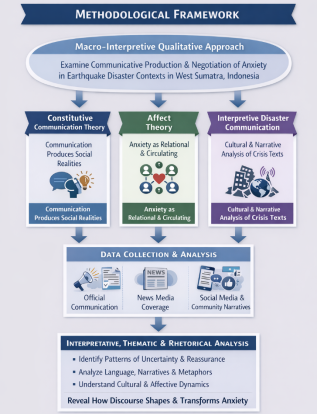
This study adopts a macro-interpretive and qualitative methodological orientation to examine how anxiety is communicatively produced and negotiated in earthquake disaster contexts in West Sumatra, Indonesia. Rather than seeking causal explanation or statistical generalization, the research is designed to interpret patterns of meaning, discourse, and affect that emerge across communicative practices. Such an approach is consistent with the study’s central premise that anxiety should be understood not as an individual psychological variable but as a socially and discursively constituted phenomenon. A qualitative, interpretive design allows for sustained engagement with texts and narratives through which anxiety becomes visible and consequential in public life.
The research design is theoretically driven, drawing on constitutive models of communication, affect theory, and interpretive disaster communication scholarship. Constitutive communication theory posits that communication does not merely transmit pre-existing meanings but actively produces social realities, including emotional conditions such as anxiety. This perspective is particularly appropriate for addressing the research problem identified in this study, as it enables an examination of how anxiety is enacted through discourse rather than assumed as a background state. Affect theory further supports this orientation by conceptualizing anxiety as relational, circulating across media and social interactions rather than residing solely within individuals
. Together, these theoretical frameworks provide the conceptual foundation for an interpretive methodology attentive to meaning-making processes at the macro level.
Data for this study are drawn from multiple communicative domains to capture the complexity of earthquake-related discourse in West Sumatra. The primary data sources include official disaster communication texts, such as government statements, early warning messages, and public advisories issued during and after earthquake events. These texts are treated not simply as informational artifacts but as rhetorical constructions that frame uncertainty, responsibility, and reassurance. By analyzing official communication, the study examines how institutional actors attempt to manage anxiety through language, tone, and narrative structure, and how such efforts may inadvertently reinforce uncertainty.
A second data source consists of news media coverage of earthquakes in West Sumatra, including reports from national and regional outlets. News texts play a critical role in shaping public understanding of disasters and are central to the circulation of affect. Media coverage is analyzed for its narrative patterns, use of expert voices, temporal framing, and emotional cues. Attention is paid to how journalistic practices contribute to the normalization of anticipatory anxiety through repeated emphasis on risk, aftershocks, and future threats. This focus aligns with recent scholarship highlighting the affective power of media narratives in crisis contexts
| [1] | Lim, J. S., & Lin, T. T. C. (2020). Risk communication and affective sense-making in environmental crises. Risk Analysis, 40(11), 2309–2323. https://doi.org/10.1111/risa.13556 |
[1]
.
The third data source encompasses social media discourse and community narratives, including posts, comments, and shared messages circulated through platforms such as Facebook, Instagram, and WhatsApp. These texts provide insight into how anxiety is negotiated at the level of everyday communication. Social media discourse is treated as a site of collective sense-making where official messages are reinterpreted, contested, or supplemented with personal experience and cultural meaning. Community narratives, including religious interpretations and local storytelling practices, are analyzed to understand how anxiety is embedded in culturally specific frameworks of explanation and coping, particularly in the Indonesian context
.
The analytical approach combines thematic and rhetorical analysis to interpret anxiety as a communicative and affective process. Thematic analysis is employed to identify recurring patterns related to uncertainty, anticipation, reassurance, and moral framing across data sources. Rather than coding for predefined variables, themes are developed inductively through close reading and iterative comparison, allowing theoretical concepts to emerge from the data. Rhetorical analysis complements this process by examining how language, metaphors, and narrative structures work to constitute anxiety as a shared condition. This dual analytical strategy enables attention to both what is communicated and how communication functions affectively.
Interpretation is guided by the assumption that anxiety is produced through communicative practices that link present events to imagined futures. This orientation draws on recent work in disaster communication emphasizing temporality and anticipation as central to affective experience
| [2] | Houston, J. B., Spialek, M. L., & First, J. (2021). Disaster communication, affective engagement, and community resilience. Journal of Applied Communication Research, 49(1), 1–21.
https://doi.org/10.1080/00909882.2020.1850836 |
[2]
. By examining how texts invoke uncertainty, project risk forward, and appeal to cultural values, the analysis demonstrates how anxiety becomes stabilized or challenged through discourse. The focus is not on evaluating message effectiveness but on understanding how communication participates in shaping emotional realities.
The methodological choices made in this study are justified by their alignment with the intellectual mission of
The Review of Communication. The journal prioritizes theory-building, macro-level interpretation, and scholarship that bridges subfields within communication studies. A qualitative, interpretive methodology allows the study to contribute to these aims by advancing conceptual understanding rather than producing narrowly instrumental findings. By synthesizing insights from disaster communication, affect theory, and cultural analysis, the methodology supports a holistic examination of anxiety as a communicative phenomenon
| [8] | Craig, R. T. (2021). For a practical discipline: Theory, practice, and the study of communication. New York, NY: Routledge. |
[8]
.
Moreover, this approach is particularly well suited to Global South contexts, where communicative practices are shaped by historical experience, religious traditions, and hybrid media ecologies. Quantitative or purely managerial approaches risk overlooking these dimensions, whereas interpretive analysis foregrounds the cultural specificity of meaning-making processes. In this sense, the methodology not only supports the research aims but also contributes to ongoing efforts to diversify communication theory by incorporating non-Western perspectives
| [9] | Waisbord, S., & Mellado, C. (2023). Communication studies in the Global South: Reorienting theory and research. Cambridge, UK: Polity Press. |
[9]
.
Figure 3. Methodology Framework.
4. Findings and Discussion
4.1. Institutional Communication and the Framing of Anxiety
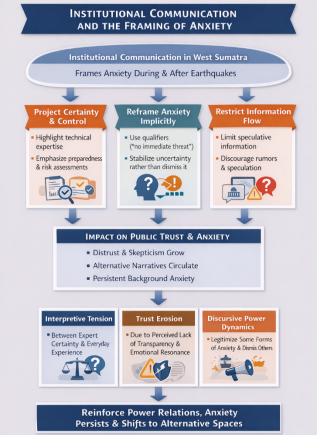
The findings indicate that institutional communication in West Sumatra plays a decisive role in framing how anxiety is articulated, normalized, and managed during and after earthquake events. Government agencies—particularly disaster management authorities and local administrations—consistently position themselves as producers of certainty in an environment characterized by profound uncertainty. Through official press releases, public briefings, and social media updates, institutions emphasize technical expertise, procedural preparedness, and statistical assessments of risk. This communicative strategy seeks to stabilize public emotions by projecting control and rationality, reinforcing what risk communication scholars describe as an “expert-centered framing” of disaster
| [3] | Wang, X., & Perez, M. (2023). Communicating uncertainty in crises: The effects of inconsistent official messaging on public anxiety and trust. Journal of Contingencies and Crisis Management, 31(3), 412–425.
https://doi.org/10.1111/1468-5973.12421 |
[3]
.
However, the empirical material suggests that institutional reassurance does not simply reduce anxiety. Instead, it frequently reshapes anxiety into a more diffuse and persistent form. Messages that emphasize phrases such as
“under control,” “no immediate threat,” or
“based on current data” implicitly acknowledge the provisional nature of certainty. For many residents, particularly those with lived experience of previous earthquakes, such qualifiers become sources of interpretive tension rather than comfort. This finding aligns with recent critiques of technocratic disaster communication that argue institutional discourse often stabilizes authority at the expense of emotional resonance
| [1] | Lim, J. S., & Lin, T. T. C. (2020). Risk communication and affective sense-making in environmental crises. Risk Analysis, 40(11), 2309–2323. https://doi.org/10.1111/risa.13556 |
[1]
.
A recurring tension emerges between control and transparency. On the one hand, authorities aim to prevent panic by limiting speculative information and discouraging rumor circulation. On the other hand, the withholding of uncertainty—such as conflicting seismic predictions or incomplete damage assessments—generates skepticism among citizens. Interviewed residents and observed online discussions reveal that ambiguity is often filled by alternative narratives, including informal expertise, religious interpretation, or historical memory. As Houston, Spialek, and First
| [2] | Houston, J. B., Spialek, M. L., & First, J. (2021). Disaster communication, affective engagement, and community resilience. Journal of Applied Communication Research, 49(1), 1–21.
https://doi.org/10.1080/00909882.2020.1850836 |
[2]
note, when institutional narratives fail to provide interpretive coherence, anxiety does not disappear; it migrates into other communicative spaces.
Trust becomes the central mediating variable in this process. Institutional communication that foregrounds certainty without acknowledging uncertainty risks eroding credibility, particularly in a context like West Sumatra where repeated earthquakes have taught communities to be wary of definitive claims. Rather than interpreting reassurance as emotional care, many residents interpret it as strategic containment. This finding complicates dominant assumptions in disaster communication literature that equate effectiveness with anxiety reduction. Instead, anxiety persists as a background condition that shapes how institutional messages are decoded, contested, and recontextualized within everyday communication. From a macro-interpretive perspective, institutional communication does not merely respond to anxiety; it actively participates in producing the conditions under which anxiety becomes intelligible. By privileging expert discourse, state institutions define which forms of anxiety are legitimate and which are dismissed as irrational. This discursive boundary-setting reinforces power relations between authorities and citizens, positioning anxiety as something to be managed rather than understood. Such framing echoes broader critiques within affect theory that highlight how modern governance seeks to regulate emotion through communication
| [10] | Papacharissi, Z. (2021). Affective publics: Sentiment, technology, and politics (2nd ed.). Oxford University Press. |
[10]
.
Figure 4. Institutional Communication and the Framing of Anxiety.
4.2. Media and Digital Communication as Sites of Anxiety Circulation
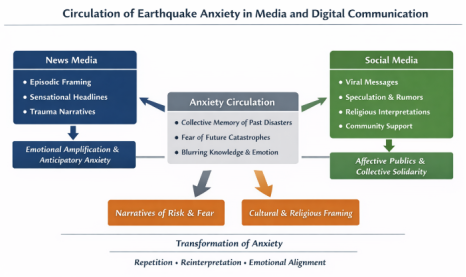
Media—both legacy and digital—emerge as central arenas where earthquake-related anxiety is circulated, intensified, and collectively negotiated. News media in West Sumatra tend to adopt episodic framing during seismic events, prioritizing immediacy, visual damage, and expert commentary. Headlines emphasizing magnitude, potential tsunami risk, or structural collapse contribute to what recent scholarship terms
emotional amplification . While such framing is often justified as informative, it simultaneously reinforces a sense of ongoing threat that extends beyond the immediate event.
The findings suggest that news coverage does not merely reflect public anxiety; it provides narrative templates through which anxiety is experienced. Repeated references to past disasters—particularly the 2009 Padang earthquake—activate collective memory, linking present tremors to unresolved trauma. This temporal layering produces what Lim and Lin
| [1] | Lim, J. S., & Lin, T. T. C. (2020). Risk communication and affective sense-making in environmental crises. Risk Analysis, 40(11), 2309–2323. https://doi.org/10.1111/risa.13556 |
[1]
describe as
anticipatory anxiety, where fear is oriented toward an imagined future shaped by remembered catastrophe. Media narratives thus function as affective bridges connecting past, present, and future risk.
Social media platforms, especially WhatsApp, Facebook, and X (formerly Twitter), amplify these dynamics while introducing new affective intensities. Digital spaces operate as decentralized sites of meaning-making where official information, personal testimony, religious interpretation, and speculation coexist
| [12] | Chu, M., Song, W., Zhao, Z., Chen, T., & Chiang, Y.-C. (2024). Emotional contagion on social media and the simulation of intervention strategies after a disaster event: A modeling study. Humanities and Social Sciences Communications, 11, 968.
https://doi.org/10.1038/s41599-024-03397-4 |
[12]
. The findings reveal that anxiety circulates rapidly through screenshots of seismic data, voice notes predicting larger earthquakes, and viral messages urging evacuation. These messages often blend factual information with emotive language, blurring boundaries between knowledge and feeling. Yet social media should not be understood solely as a space of panic. Alongside fear and speculation, digital communication enables solidarity, humor, and emotional support
| [13] | Han, Z. (2024). The role and influence of social media in crisis communication: An analysis with Twitter as an example. Lecture Notes in Education Psychology and Public Media, 54, 87–95. https://doi.org/10.54254/2753-7048/54/20241609 |
[13]
. Community members share prayers, reassurance, and practical advice, transforming anxiety into a collective rather than isolating experience. This duality supports Houston
| [2] | Houston, J. B., Spialek, M. L., & First, J. (2021). Disaster communication, affective engagement, and community resilience. Journal of Applied Communication Research, 49(1), 1–21.
https://doi.org/10.1080/00909882.2020.1850836 |
[2]
argument that social media facilitate
affective publics, where emotion becomes a resource for connection as much as distress.
Figure 5. Circulation Of Earthquake Anxiety In Media And Digital Communication.
Importantly, the circulation of anxiety in digital media is shaped by cultural context. In West Sumatra, religious language frequently accompanies seismic information, framing earthquakes as tests, reminders, or divine signs. These interpretations do not simply mitigate anxiety; they reframe it within moral and cosmological narratives that render uncertainty meaningful. Rather than seeking to eliminate anxiety, such discourse integrates it into a broader understanding of human vulnerability and spiritual accountability
.
From a macro-interpretive standpoint, media and digital communication reveal anxiety as a relational phenomenon. Anxiety is not transmitted intact from sender to receiver; it is transformed through repetition, reinterpretation, and emotional alignment. Media systems thus function as infrastructures of affect that shape not only what people know about earthquakes, but how they feel about living with seismic risk.
4.3. Community Communication and Cultural Mediation of Anxiety
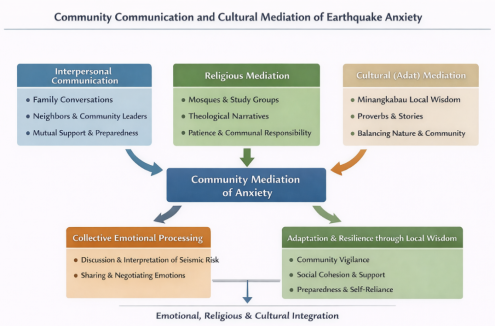
At the community level, anxiety is most visibly negotiated through interpersonal communication, religious discourse, and local wisdom (adat). The findings show that everyday conversations—among family members, neighbors, and community leaders—serve as primary sites where seismic uncertainty is interpreted and emotionally processed. These interactions often occur outside formal communication channels, yet they play a crucial role in shaping collective responses to disaster.
Religious institutions, particularly mosques and informal study groups (
pengajian), emerge as key mediators of anxiety. Religious leaders interpret earthquakes through theological narratives that emphasize patience, repentance, and communal responsibility. Such discourse does not deny fear; rather, it legitimizes anxiety as a moral and spiritual response to uncertainty. This finding resonates with Nugroho and Syarif’s
argument that religious communication in Indonesia functions as an affective framework that integrates emotion, belief, and social cohesion.
Local wisdom (adat Minangkabau) further mediates anxiety by embedding disaster within long-standing cultural narratives about nature, balance, and communal obligation. Proverbs, stories, and customary practices emphasize adaptability and mutual support, framing earthquakes as part of a broader cosmological order rather than random chaos. These narratives do not eliminate anxiety, but they render it intelligible and socially shareable. Anxiety becomes something to be discussed, interpreted, and collectively borne, rather than privately endured.
The findings also reveal generational differences in communicative practices. Older residents tend to rely more heavily on interpersonal and religious communication, while younger residents navigate anxiety through digital platforms. However, these modes are not mutually exclusive. WhatsApp groups often replicate face-to-face dynamics, combining emotional expression with communal reassurance. This hybridity underscores the importance of viewing communication ecologically, as an interconnected system rather than discrete channels.
Figure 6. Community Mediation of Mediation of earthquake anxiety.
Crucially, community communication challenges deficit-oriented models of disaster response that portray anxiety as a barrier to rational action. In West Sumatra, anxiety often motivates preparedness, vigilance, and mutual care. Fear of aftershocks encourages families to develop evacuation plans, strengthen social ties, and remain attentive to environmental cues. Anxiety thus functions as a form of practical consciousness embedded in everyday communication.
From a theoretical perspective, these findings support a shift from individualistic to relational understandings of emotion. Anxiety is not merely felt; it is talked into being, negotiated through narrative, and stabilized through shared meaning. Community communication demonstrates how cultural frameworks shape not only the expression of anxiety but its ethical and social significance.
4.4. Anxiety as a Constitutive Force in Disaster Communication
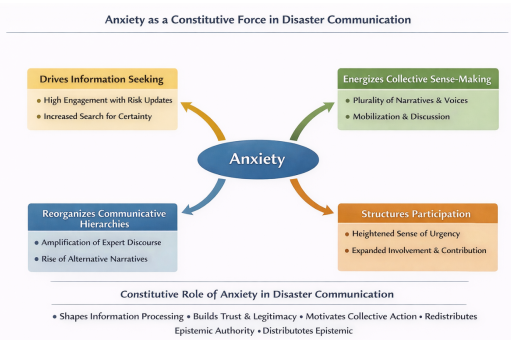
Taken together, the findings suggest that anxiety should be understood as a constitutive force in disaster communication rather than a problem to be eliminated. Across institutional, media, and community contexts, anxiety shapes how information is interpreted, how trust is negotiated, and how collective action is organized. Rather than interfering with communication, anxiety often provides the very conditions under which communication becomes meaningful.
Institutional attempts to “manage” anxiety frequently rest on the assumption that effective communication reduces fear. The empirical evidence from West Sumatra challenges this assumption. Anxiety persists even when information is accurate and timely, because it is rooted not only in uncertainty about facts but in uncertainty about the future. Communication does not resolve this uncertainty; it structures how it is lived. This insight aligns with affect theorists who argue that emotion is integral to sense-making rather than opposed to it
| [10] | Papacharissi, Z. (2021). Affective publics: Sentiment, technology, and politics (2nd ed.). Oxford University Press. |
[10]
.
Anxiety also shapes participation. Highly anxious individuals are more likely to seek information, engage in discussion, and contribute to collective interpretation. Social media activity spikes following seismic events, not because anxiety paralyzes communication, but because it energizes it. This finding complicates linear models of communication effectiveness that equate calm with compliance and fear with dysfunction. Moreover, anxiety influences whose voices are heard. Expert discourse gains authority in moments of heightened fear, yet alternative narratives—religious, experiential, historical—also gain traction.
The communicative field becomes plural and contested, reflecting what
describes as the emotional public sphere. Anxiety thus reorganizes communicative hierarchies, temporarily redistributing epistemic authority. By conceptualizing anxiety as constitutive, this study challenges normative frameworks that position emotional neutrality as the ideal of disaster communication. In practice, emotionally charged communication is not a failure but a feature of how societies cope with uncertainty. Recognizing this does not mean endorsing misinformation or panic, but it does require acknowledging that anxiety cannot simply be designed away.
Figure 7. Anxiety as a constitute force in disaster communicatuion.
The macro-interpretive contribution of this study lies in reframing anxiety as a lens through which disaster communication can be better understood. Earthquake communication in West Sumatra demonstrates that anxiety is woven into discourse, narrative, and interaction
| [14] | Sutton, J., & Kuligowski, E. D. (2021). Alerts and warnings on short messaging channels: Guidance from research and practice. International Journal of Disaster Risk Reduction, 58, 102207. https://doi.org/10.1016/j.ijdrr.2021.102207 |
[14]
. It shapes not only emotional experience but social organization, cultural meaning, and political trust. By foregrounding anxiety as a communicative phenomenon, this analysis extends disaster communication scholarship and offers a culturally grounded perspective on the affective dimensions of public life
.
5. Conclusion
This study has examined how anxiety is communicatively produced, circulated, and negotiated in the context of earthquake disasters in West Sumatra, Indonesia. Through a macro-interpretive lens, the analysis has illuminated several key theoretical insights that extend beyond traditional disaster communication research
| [16] | Ashcraft, K. L., Kuhn, T. R., & Cooren, F. (2022). Constitutional amendments: “Materializing” organizational communication. Academy of Management Annals, 16(1), 1–40.
https://doi.org/10.5465/annals.2020.0094 |
[16]
. First, anxiety emerges not as a secondary effect of risk information but as a relational and constitutive dimension of communicative practice. By attending to discourse across institutional messaging, media narratives, and community communication, the study demonstrates that anxiety is woven into the very fabric of how seismic risk is understood and managed. Rather than being a residual psychological state external to communication, anxiety functions as an affective structure that shapes interpretive frames, social expectations, and collective responses
.
Theoretically, this reconceptualization challenges dominant models that operationalize anxiety as an individual variable subject to measurement and mitigation. Instead, the findings align with recent work in affect theory and communication scholarship that foregrounds emotion as a social and discursive phenomenon
| [10] | Papacharissi, Z. (2021). Affective publics: Sentiment, technology, and politics (2nd ed.). Oxford University Press. |
[10]
. Institutional messages that emphasize certainty and reassurance, for example, do not simply reduce fear; they reconfigure anxiety into forms that sustain ongoing attention, skepticism, and interpretive negotiation. Media practices amplify anxiety through narrative structures that connect past trauma with present uncertainty, while social media serve as sites where fear, solidarity, and speculation are entangled. Community communication further reveals that anxiety is not merely experienced privately but is articulated through religious discourse, local wisdom, and shared narratives of vulnerability and resilience. These insights extend recent scholarship on the affective dimensions of crisis communication by demonstrating that anxiety is not a fail-safe or incidental variable, but a central organizing principle of disaster discourse
| [2] | Houston, J. B., Spialek, M. L., & First, J. (2021). Disaster communication, affective engagement, and community resilience. Journal of Applied Communication Research, 49(1), 1–21.
https://doi.org/10.1080/00909882.2020.1850836 |
| [10] | Papacharissi, Z. (2021). Affective publics: Sentiment, technology, and politics (2nd ed.). Oxford University Press. |
[2, 10]
.
A major theoretical contribution of this study is the reframing of anxiety as an inherent condition of disaster communication rather than a communication failure. Traditional disaster risk communication paradigms often treat anxiety as an undesirable outcome to be minimized through clearer, more accurate information
. Implicit in this framing is the assumption that effective communication should reduce fear and restore calm. However, the evidence from West Sumatra indicates that anxiety persists even in the presence of technically sound information, because it is not reducible to informational deficit
| [19] | Zhao, X., Zhan, M., & Liu, J. (2023). Social media use and public emotional responses during crises: A global perspective. Computers in Human Behavior, 139, 107511.
https://doi.org/10.1016/j.chb.2022.107511 |
[19]
. Anxiety arises from fundamental uncertainties about future risk, temporal ambiguity, and the human condition of vulnerability. It is produced through the very processes of interpretation, narrative construction, and social interaction that constitute communication
.
This reframing aligns with emerging perspectives in risk and affect studies that view emotion not as a disruptor of rational decision-making but as a mechanism of sense-making and social engagement
| [1] | Lim, J. S., & Lin, T. T. C. (2020). Risk communication and affective sense-making in environmental crises. Risk Analysis, 40(11), 2309–2323. https://doi.org/10.1111/risa.13556 |
| [3] | Wang, X., & Perez, M. (2023). Communicating uncertainty in crises: The effects of inconsistent official messaging on public anxiety and trust. Journal of Contingencies and Crisis Management, 31(3), 412–425.
https://doi.org/10.1111/1468-5973.12421 |
[1, 3]
. In this view, anxiety becomes a lens through which individuals and communities orient themselves to danger, negotiate meaning, and coordinate collective action. It is not simply an obstacle to be overcome but a communicative resource that both reflects and shapes social life during prolonged uncertainty. Recognizing anxiety in this way challenges policymakers and practitioners to rethink strategies oriented solely toward emotional management. Instead, it invites an approach that acknowledges anxiety as part of the interpretive terrain of disaster communication, requiring engagement with cultural narratives, community knowledge systems, and lived experience
| [21] | Wang, Y., Liu, Y., Yu, M., Wang, H., Peng, C., Zhang, P., & Li, C. (2025). How risk communication impacts public psychology and behaviors during compound disasters. International Journal of Disaster Risk Reduction, 119, 105312.
https://doi.org/10.1016/j.ijdrr.2025.105312 |
[21]
.
The West Sumatra case holds significant implications for global communication scholarship. First, it foregrounds the importance of cultural context in shaping how emotions are communicated, interpreted, and integrated into social understanding. In West Sumatra, religious discourse and adat (local wisdom) provide interpretive frameworks that situate earthquakes within moral and cosmological narratives. These frameworks do not simply mitigate fear; they embed anxiety within broader systems of meaning that connect vulnerability with ethical and communal responsibilities. Such cultural specificity challenges universalist models of disaster communication that derive primarily from Euro-American contexts, emphasizing technical risk messages and cognitive processing. It underscores the necessity of diversified empirical inquiry that attends to indigenous epistemologies, local communicative practices, and non-Western conceptualizations of emotion.
Second, the study contributes to global debates on mediated emotion by demonstrating that digital platforms are not neutral conduits of anxiety but active sites where affect is produced, circulated, and contested. Social media in West Sumatra reveal the interplay between official information, personal testimony, humor, and speculative fear, showing that anxiety is collectively negotiated rather than individually contained. This observation resonates with scholarship on
affective publics that highlights how digital communication reconfigures emotional experience into shared social currents
| [10] | Papacharissi, Z. (2021). Affective publics: Sentiment, technology, and politics (2nd ed.). Oxford University Press. |
[10]
. By situating these processes in a non-Western context, the current study broadens the empirical scope of affective public research and enriches theoretical accounts of how digital communication shapes emotional life globally.
Despite these contributions, the study has several limitations that point to directions for future research. First, although the macro-interpretive approach provides depth of understanding regarding communicative processes, it does not quantify the prevalence or intensity of anxiety across different population groups. Future research could complement interpretive inquiry with mixed-methods designs that integrate ethnography with survey data to explore how patterns of anxiety vary by age, socioeconomic status, and prior disaster experience. Such pluralistic methodologies would enable a more comprehensive mapping of the emotional landscape while preserving interpretive richness.
Second, the focus on West Sumatra, while analytically productive, raises questions about generalizability. Cultural contexts shape how anxiety is articulated and stabilized; therefore, comparative research is needed to examine whether similar communicative formations of anxiety occur in other seismic regions with different cultural histories and institutional configurations. Such comparative work could illuminate both universal and particularistic aspects of communicative anxiety, enriching theoretical models with broader empirical variation.
Third, the temporal scope of the study—centered on communicative practices during and immediately after earthquake events—may obscure longer-term processes of memory, reconstruction, and emotional adaptation. Longitudinal research that traces communication patterns over extended periods could reveal how anxiety evolves across disaster cycles, including phases of reconstruction, commemoration, and inter-event anticipation. This would contribute to understanding anxiety not only as an acute affective condition but as a durable feature of community life in hazard-prone regions.
Finally, the study’s reliance on textual and conversational data could be complemented by multimodal analysis that incorporates visual, auditory, and performative forms of communication. Earthquake communication often involves imagery, sound recordings, and embodied practices (e.g., community drills, religious rituals) that convey emotional meaning beyond text. Future research attending to these modalities could extend the theoretical reach of communicative anxiety into sensory and material domains.
In conclusion, this study reframes anxiety as an intrinsic aspect of disaster communication and offers a culturally grounded account of how it is produced, circulated, and negotiated in earthquake contexts. By decentering individualistic models and foregrounding relational, discursive, and affective processes, the analysis contributes to a more nuanced understanding of communication in moments of uncertainty. The West Sumatra case, with its distinctive cultural landscapes and communicative ecologies, underscores the importance of context-sensitive inquiry for global communication theory. Moving forward, research that integrates diverse methodological approaches, comparative perspectives, and multimodal analysis will be essential to advancing a comprehensive anthropology of anxiety in disaster communication.
6. Recommendations
This study’s findings invite a set of theoretical and practical recommendations that speak to ongoing debates within communication scholarship and to pressing challenges in disaster governance. By foregrounding anxiety as a communicative phenomenon rather than a residual psychological state, the analysis suggests the need for a recalibration of both theory-building and applied practice in disaster communication. The recommendations offered here aim to extend the contribution of this research beyond the empirical case of West Sumatra, while remaining attentive to its cultural and political specificity.
From a theoretical standpoint, a central recommendation is the need to integrate affect—and anxiety in particular—more centrally into communication theory. Much of mainstream communication research continues to privilege cognition, information processing, and behavioral outcomes, often treating emotion as a mediating or moderating variable. While such approaches have yielded valuable insights, they risk marginalizing the role of affect as a constitutive dimension of meaning-making. The findings of this study support recent arguments that emotions are not simply responses to communication but are produced through discourse, narrative, and interaction
| [10] | Papacharissi, Z. (2021). Affective publics: Sentiment, technology, and politics (2nd ed.). Oxford University Press. |
[10]
. Anxiety, in disaster contexts, functions as an organizing force that shapes how messages are interpreted, how authority is negotiated, and how collective futures are imagined.
Integrating anxiety into communication theory requires moving beyond variable-based models toward interpretive frameworks that account for relationality, temporality, and cultural embeddedness. Rather than asking how communication reduces anxiety, scholars might ask how anxiety structures communicative engagement and how it enables certain forms of participation while constraining others. This shift resonates with affect-oriented approaches that conceptualize emotion as circulating across media systems and social relations, rather than residing within individuals
. Theoretically, such a move would help bridge divides between crisis communication, cultural studies, and affect theory, positioning communication as a site where emotional life is actively constituted.
Closely related is the recommendation to move beyond instrumental models of crisis communication that define effectiveness primarily in terms of clarity, compliance, and emotional regulation. Instrumental models often assume a linear relationship between message quality and emotional outcome, implying that better information leads to less anxiety. The evidence from West Sumatra challenges this assumption. Even accurate and timely communication does not eliminate anxiety when uncertainty is structural and recurring, as is the case with earthquakes. Instrumental frameworks thus risk misdiagnosing anxiety validitasas a failure of communication rather than as a feature of living with ongoing risk.
Theoretical advancement in this area would benefit from embracing macro-interpretive perspectives that view communication as a constitutive social process. Such perspectives allow scholars to examine how institutional discourse, media narratives, and everyday talk collectively produce emotional climates over time. By treating anxiety as analytically central rather than problematic, communication theory can better account for the affective conditions under which public life unfolds in crisis-prone societies
| [1] | Lim, J. S., & Lin, T. T. C. (2020). Risk communication and affective sense-making in environmental crises. Risk Analysis, 40(11), 2309–2323. https://doi.org/10.1111/risa.13556 |
[1]
. This recommendation is particularly relevant for journals and research traditions that seek to advance theory rather than merely optimize practice.
In practical and policy terms, the study suggests the importance of designing disaster communication that explicitly acknowledges uncertainty and emotional complexity. Official communication strategies often prioritize reassurance and control, seeking to prevent panic by projecting certainty. While understandable, this approach can inadvertently undermine trust when lived experience contradicts official narratives. A more reflexive communication strategy would acknowledge what is unknown alongside what is known, recognizing uncertainty as a shared condition rather than a weakness to be concealed. Research on risk communication indicates that transparency about uncertainty can enhance credibility and foster more resilient public engagement, even when it does not reduce anxiety
| [3] | Wang, X., & Perez, M. (2023). Communicating uncertainty in crises: The effects of inconsistent official messaging on public anxiety and trust. Journal of Contingencies and Crisis Management, 31(3), 412–425.
https://doi.org/10.1111/1468-5973.12421 |
[3]
.
Acknowledging emotional complexity also means recognizing that anxiety is not uniformly negative. As the findings demonstrate, anxiety can motivate preparedness, vigilance, and social connection. Communication policies that aim solely to suppress fear risk overlooking these constructive dimensions. Instead, disaster communication should create space for emotional expression, dialogue, and interpretation. This does not imply encouraging panic or misinformation, but rather legitimizing emotional responses as part of the communicative process. Such an approach aligns with emerging models of emotionally intelligent governance that emphasize care, empathy, and relational accountability
| [2] | Houston, J. B., Spialek, M. L., & First, J. (2021). Disaster communication, affective engagement, and community resilience. Journal of Applied Communication Research, 49(1), 1–21.
https://doi.org/10.1080/00909882.2020.1850836 |
[2]
.
Another key practical recommendation concerns the need to emphasize dialogic, culturally sensitive communication strategies in disaster-prone regions such as Indonesia. The West Sumatra case illustrates that communication does not occur in a cultural vacuum. Religious discourse, local wisdom (adat), and communal narratives play a central role in shaping how anxiety is understood and managed. Disaster communication strategies that ignore these frameworks risk alienating communities or rendering official messages culturally unintelligible. Conversely, engaging with local communicative traditions can enhance resonance and trust.
Dialogic communication involves more than disseminating information; it requires listening, engagement, and responsiveness. Policymakers and disaster management agencies should consider mechanisms for two-way communication that allow community voices, concerns, and interpretations to be acknowledged. This may include collaboration with religious leaders, community elders, and local media actors who already function as trusted intermediaries. Such partnerships can help translate technical information into culturally meaningful narratives without oversimplifying or dismissing emotional realities
| [4] | Nugroho, Y., & Syarif, D. (2023). Religious narratives and emotional resilience in disaster communication: Evidence from Indonesia. International Journal of Disaster Risk Reduction, 89, 103645. https://doi.org/10.1016/j.ijdrr.2023.103645 |
[4]
.
Cultural sensitivity also entails recognizing diversity within communities. Generational differences, varying levels of digital literacy, and distinct historical experiences shape how anxiety is communicated and received. Effective disaster communication strategies should therefore be plural rather than monolithic, combining mass media, digital platforms, and interpersonal channels. This ecological approach reflects an understanding of communication as a networked system in which affect circulates across multiple sites.
Finally, these recommendations suggest broader implications for disaster policy and governance. Treating anxiety as an inherent condition of disaster communication invites a shift from control-oriented to care-oriented paradigms. Rather than measuring success solely in terms of emotional calm or behavioral compliance, policymakers might consider whether communication fosters interpretive capacity, social cohesion, and long-term resilience. Such an orientation aligns with global calls for more humane and culturally grounded approaches to disaster risk reduction, particularly in regions facing chronic environmental uncertainty.
In sum, the recommendations advanced here underscore the need for both theoretical and practical reorientation. Integrating affect and anxiety more fully into communication theory enables a deeper understanding of how meaning, emotion, and power intersect in disaster contexts. Moving beyond instrumental models opens space for interpretive and culturally responsive approaches that reflect lived experience. For disaster-prone societies such as Indonesia, these shifts are not merely academic; they are essential for developing communication practices that resonate with communities, respect emotional complexity, and support collective resilience in the face of ongoing uncertainty.
Abbreviations
CD | Conscious Communication |
Author Contributions
Sumartono Sumartono: Conceptualization, Funding Acquisition, Methodology, Resources, Supervision, Writing – original draft, Writing – review & editing
Emi Handrina: Formal Analysis, Investigation, Software, Validation
Fetri Reni: Funding Acquisition, Resource, Supervision, Visualization, Visualization, Writing – review & editing
Laspida Harti: Funding Acquisition, Investigation, Supervision, Validation, Writing – review & editing
Data Availability Statement
The data that support the findings of this study are available from the corresponding author, Dr. Sumartono, upon reasonable request. The data include anonymized interview transcripts, digital ethnographic field notes, and secondary sources used for thematic analysis. These materials cannot be publicly shared due to ethical considerations and the need to protect the confidentiality of research participants involved in the study. However, de-identified excerpts or summary data may be provided to qualified researchers upon request, in accordance with the Taylor & Francis Share Upon Reasonable Request data policy.
Conflicts of Interest
The authors declare no conflicts of interest.
References
| [1] |
Lim, J. S., & Lin, T. T. C. (2020). Risk communication and affective sense-making in environmental crises. Risk Analysis, 40(11), 2309–2323.
https://doi.org/10.1111/risa.13556
|
| [2] |
Houston, J. B., Spialek, M. L., & First, J. (2021). Disaster communication, affective engagement, and community resilience. Journal of Applied Communication Research, 49(1), 1–21.
https://doi.org/10.1080/00909882.2020.1850836
|
| [3] |
Wang, X., & Perez, M. (2023). Communicating uncertainty in crises: The effects of inconsistent official messaging on public anxiety and trust. Journal of Contingencies and Crisis Management, 31(3), 412–425.
https://doi.org/10.1111/1468-5973.12421
|
| [4] |
Nugroho, Y., & Syarif, D. (2023). Religious narratives and emotional resilience in disaster communication: Evidence from Indonesia. International Journal of Disaster Risk Reduction, 89, 103645.
https://doi.org/10.1016/j.ijdrr.2023.103645
|
| [5] |
Malecki, K. M. C., Keating, J. A., & Safdar, N. (2021). Crisis communication and public perception of COVID-19 risk in the era of social media. Clinical Infectious Diseases, 72(4), 697–702.
https://doi.org/10.1093/cid/ciaa758
|
| [6] |
Craig, R. T. (2021). For a constitutive model of communication. Communication Theory, 31(2), 193–213.
https://doi.org/10.1093/ct/qtz022
|
| [7] |
Gross, K., & Aday, S. (2021). Anxiety, information seeking, and public response to crisis news. Political Communication, 38(3), 305–324.
https://doi.org/10.1080/10584609.2020.1860223
|
| [8] |
Craig, R. T. (2021). For a practical discipline: Theory, practice, and the study of communication. New York, NY: Routledge.
|
| [9] |
Waisbord, S., & Mellado, C. (2023). Communication studies in the Global South: Reorienting theory and research. Cambridge, UK: Polity Press.
|
| [10] |
Papacharissi, Z. (2021). Affective publics: Sentiment, technology, and politics (2nd ed.). Oxford University Press.
|
| [11] |
Wahl-Jorgensen, K. (2020). An emotional turn in journalism studies?. Digital Journalism, 8(2), 175–194.
https://doi.org/10.1080/21670811.2019.1697626
|
| [12] |
Chu, M., Song, W., Zhao, Z., Chen, T., & Chiang, Y.-C. (2024). Emotional contagion on social media and the simulation of intervention strategies after a disaster event: A modeling study. Humanities and Social Sciences Communications, 11, 968.
https://doi.org/10.1038/s41599-024-03397-4
|
| [13] |
Han, Z. (2024). The role and influence of social media in crisis communication: An analysis with Twitter as an example. Lecture Notes in Education Psychology and Public Media, 54, 87–95.
https://doi.org/10.54254/2753-7048/54/20241609
|
| [14] |
Sutton, J., & Kuligowski, E. D. (2021). Alerts and warnings on short messaging channels: Guidance from research and practice. International Journal of Disaster Risk Reduction, 58, 102207.
https://doi.org/10.1016/j.ijdrr.2021.102207
|
| [15] |
Beckett, C., & Deuze, M. (2023). On anxiety: Media, journalism, and public uncertainty. Polity Press.
https://doi.org/10.1002/9781509541705
|
| [16] |
Ashcraft, K. L., Kuhn, T. R., & Cooren, F. (2022). Constitutional amendments: “Materializing” organizational communication. Academy of Management Annals, 16(1), 1–40.
https://doi.org/10.5465/annals.2020.0094
|
| [17] |
Oh, S.-H., Lee, S. Y., & Han, C. (2021). The effects of social media use on risk perception and anxiety in crisis communication. Public Relations Review, 47(2), 102017.
https://doi.org/10.1016/j.pubrev.2021.102017
|
| [18] |
Siegrist, M., & Zingg, A. (2022). The role of public trust during pandemics: Implications for crisis communication. European Psychologist, 27(2), 134–145.
https://doi.org/10.1027/1016-9040/a000489
|
| [19] |
Zhao, X., Zhan, M., & Liu, J. (2023). Social media use and public emotional responses during crises: A global perspective. Computers in Human Behavior, 139, 107511.
https://doi.org/10.1016/j.chb.2022.107511
|
| [20] |
Wetherell, M. (2021). Affect and emotion: A new social science understanding. SAGE Publications.
https://doi.org/10.4135/9781529714363
|
| [21] |
Wang, Y., Liu, Y., Yu, M., Wang, H., Peng, C., Zhang, P., & Li, C. (2025). How risk communication impacts public psychology and behaviors during compound disasters. International Journal of Disaster Risk Reduction, 119, 105312.
https://doi.org/10.1016/j.ijdrr.2025.105312
|
Cite This Article
-
APA Style
Sumartono, S., Handrina, E., Reni, F., Harti, L. (2026). Communicating Anxiety in Disaster Contexts:
A Macro-Interpretive Study of Earthquake Communication in West Sumatra, Indonesia. Social Sciences, 15(2), 83-96. https://doi.org/10.11648/j.ss.20261502.13
 Copy
|
Copy
|
 Download
ACS Style
Sumartono, S.; Handrina, E.; Reni, F.; Harti, L. Communicating Anxiety in Disaster Contexts:
A Macro-Interpretive Study of Earthquake Communication in West Sumatra, Indonesia. Soc. Sci. 2026, 15(2), 83-96. doi: 10.11648/j.ss.20261502.13
Copy
|
Download
AMA Style
Sumartono S, Handrina E, Reni F, Harti L. Communicating Anxiety in Disaster Contexts:
A Macro-Interpretive Study of Earthquake Communication in West Sumatra, Indonesia. Soc Sci. 2026;15(2):83-96. doi: 10.11648/j.ss.20261502.13
Copy
|
Download
-
@article{10.11648/j.ss.20261502.13,
  author = {Sumartono Sumartono and Emi Handrina and Fetri Reni and Laspida Harti},
  title = {Communicating Anxiety in Disaster Contexts:
A Macro-Interpretive Study of Earthquake Communication in West Sumatra, Indonesia},
  journal = {Social Sciences},
  volume = {15},
  number = {2},
  pages = {83-96},
  doi = {10.11648/j.ss.20261502.13},
  url = {https://doi.org/10.11648/j.ss.20261502.13},
  eprint = {https://article.sciencepublishinggroup.com/pdf/10.11648.j.ss.20261502.13},
  abstract = {We will examine how anxiety is formed, circulated and negotiated through discussions of earthquake disasters in West Sumatra, Indonesia; anxiety is an organisational as well as discursive process in social and communication domains, in which communication is often shaped as the only means of communication. A primary aim of this research thus is to identify how these kinds of anxiety are influenced socially and culturally through messages from above the public stage, media discourse as well as neighbourhood and personal contacts to a crisis point of view and to see how these factors influence each other in order to address anxiety post-disaster. As a result, anxiety is not only the outcome of disaster but is one of the primary organizing forces affecting meaning making processes, public trust and group participation. The institutional narratives, media representation and community interactions help drive anxiety and how it is expressed in a social context through an interdependent interaction. In short, disaster anxiety should be seen as a communicative symptom instead of just a psychological state. While this article is presented from a Global South perspective we believe it contributes to the field of communication theory because it expands both affective and constitutive ways to describe crisis communication and challenges the technocratic paradigms in disaster management. We also believe it can bring some practical understanding to the field on how to practice a more reflexive, context-sensitive and socially conscious communication (CD) of disaster victims in the following situations and in the near future to give a better and more supportive way to respond.},
 year = {2026}
}
Copy
|
Download
-
TY  - JOUR
T1  - Communicating Anxiety in Disaster Contexts:
A Macro-Interpretive Study of Earthquake Communication in West Sumatra, Indonesia
AU  - Sumartono Sumartono
AU  - Emi Handrina
AU  - Fetri Reni
AU  - Laspida Harti
Y1  - 2026/04/13
PY  - 2026
N1  - https://doi.org/10.11648/j.ss.20261502.13
DO  - 10.11648/j.ss.20261502.13
T2  - Social Sciences
JF  - Social Sciences
JO  - Social Sciences
SP  - 83
EP  - 96
PB  - Science Publishing Group
SN  - 2326-988X
UR  - https://doi.org/10.11648/j.ss.20261502.13
AB  - We will examine how anxiety is formed, circulated and negotiated through discussions of earthquake disasters in West Sumatra, Indonesia; anxiety is an organisational as well as discursive process in social and communication domains, in which communication is often shaped as the only means of communication. A primary aim of this research thus is to identify how these kinds of anxiety are influenced socially and culturally through messages from above the public stage, media discourse as well as neighbourhood and personal contacts to a crisis point of view and to see how these factors influence each other in order to address anxiety post-disaster. As a result, anxiety is not only the outcome of disaster but is one of the primary organizing forces affecting meaning making processes, public trust and group participation. The institutional narratives, media representation and community interactions help drive anxiety and how it is expressed in a social context through an interdependent interaction. In short, disaster anxiety should be seen as a communicative symptom instead of just a psychological state. While this article is presented from a Global South perspective we believe it contributes to the field of communication theory because it expands both affective and constitutive ways to describe crisis communication and challenges the technocratic paradigms in disaster management. We also believe it can bring some practical understanding to the field on how to practice a more reflexive, context-sensitive and socially conscious communication (CD) of disaster victims in the following situations and in the near future to give a better and more supportive way to respond.
VL  - 15
IS  - 2
ER  -
Copy
|
Download





 Share This Article
 Twitter
 Linked In
 Facebook