
Intermittent fasting (IF) has been reported to improve metabolic health in diabetes but the underlying mechanisms by which intermittent fasting promotes metabolic health in streptozotocin-induced diabetes have not been fully elucidated. This study investigated the effects of Time-Restricted (TR) and Alternate- Day (AD) Intermittent Fasting (IF) on body weight, liver enzymes, liver glycogen, blood glucose, and oral glucose tolerance test (OGTT) in streptozotocin-induced diabetic male Wistar rats. Sixty male Wistar rats (200-250g) were grouped into six groups (n=10). Group 1 (non-diabetic control) and Group 2 (non-diabetic +time-restricted intermittent fasting). Groups 3 - 6 received streptozotocin (50mg/kg) intraperitoneally (i.p.). After diabetes was confirmed, animals in groups 3, 5 and 6 were treated with Time-restricted intermittent fasting, metformin (200mg/kg) orally, and Alternate- day intermittent fasting protocols respectively, while group 4 animals were untreated (Diabetic control) for 28days. After 28 days, oral glucose tolerance test (OGTT), fasting blood glucose (FBG), liver function enzymes, Aspartate Aminotransferase (AST), Alanine Transaminase (ALT), and Alkaline Phosphatase (ALP) were measured. The results showed that while there was significant decrease in body weight, there was significant increase in fasting blood glucose and concentrations of liver enzymes AST, ALT and ALP in group 4 compared to group 1. Time- restricted fasting, metformin treatment and Alternate day intermittent fasting caused significant decrease in body weight, fasting blood glucose and serum levels of AST, ALT and ALP in groups 3, 5 and 6 compared to group 4. Liver glycogen was significantly reduced in group 4 and increased in groups 3, 5 and 6 of diabetic rats. The study showed that Time-restricted (18: 6) and Alternate-Day intermittent fasting regimens ameliorated diabetes through improved glucose tolerance, liver glycogen synthesis and liver function enzymes.
| Published in | Advances in Applied Physiology (Volume 11, Issue 1) |
| DOI | 10.11648/j.aap.20261101.12 |
| Page(s) | 10-17 |
| Creative Commons |
This is an Open Access article, distributed under the terms of the Creative Commons Attribution 4.0 International License (http://creativecommons.org/licenses/by/4.0/), which permits unrestricted use, distribution and reproduction in any medium or format, provided the original work is properly cited. |
| Copyright |
Copyright © The Author(s), 2026. Published by Science Publishing Group |
Diabetes, Streptozotocin, Time-Restricted Intermittent Fasting, Alternate-Day Intermittent Fasting, Metformin, Blood Glucose, Liver Enzymes, Liver Glycogen
DM | Diabetes Mellitus |
IF | Intermittent Fasting |
TRIF | Time-Restricted Intermittent Fasting |
ADIF | Alternate-Day Intermittent Fasting |
OGTT | Oral Glucose Tolerance Test |
FBG | Fasting Blood Glucose |
AST | Aspartate Aminotransferase |
ALT | Alanine Transaminase |
ALP | Alanine Phosphatase |
BMI | Body Mass Index |
STZ | Streptozotocin |
AMPK | Adenosine Monophosphate Kinase |
| [1] | M. Khalafi, S. K. Rosenkranz, F. Ghasemi, S. Kheradmand, A. Habibi Maleki, M. Korivi, J. P, Tsao, Efficacy of intermittent fasting on improving liver function in individuals with metabolic disorders: a systematic review and meta-analysis. Nutrition & Metabolism. 22(1): 1, 2025. |
| [2] | V. D. Longo and S. Panda. Fasting, circadian rhythms, and time‑restricted feeding in healthy lifespan. Cell Metabolism 23: 1048‑1059, 2016. |
| [3] | R. E. Patterson and D. D. Sears, Metabolic effects of intermittent fasting. Annual Review Nutrition 37: 371‑393 2017. |
| [4] | R. de Cabo and M. P. Mattson., Effects of intermittent fasting on health, aging, and disease. New England Journal of Medicine 381: 2541‑2551, 2019. |
| [5] | Y. Cho, N. Hong, K. W. Kim, S. J. Cho, M. Lee, Y. H. Lee, Y. H. Lee, E. S. Kang, B. S. Cha, B. W. Lee., The effectiveness of intermittent fasting to reduce body mass index and glucose metabolism: a systematic review and meta-analysis. Journal of clinical Medicine 8(10): 1645, 2019. |
| [6] | S. Furmli, R. Elmasry, M. Ramos, and J. Fung., Therapeutic use of intermittent fasting for people with type 2 diabetes as an alternative to insulin, B. M. J. Case Reports, 2018. |
| [7] | A. S. Alghamdi, K. A. Alghamdi, R. O. Jenkins, M. N. Alghamdi and P. I. Haris., “Impact of ramadan on physical activity and sleeping patterns in individuals with type2 diabetes: the first study using fitbit device,” Diabetes Therapy, vol. 11, no. 6, pp. 1331–1346, 2020. |
| [8] | H. Sun, P. Saeedi, S. Karuranga, M. Pinkepank, K. Ogurtsova, B. B. Duncan, C. Stein, A. Basit, J. C. N. Chan, J. C. Mbanya, M. E. Pavkov, A. Amachandaran, S. H. Wild, S. James, W. H. Herman, P. Zhang, C. Bommer, S. Kuo, E. J. Boyko and D. J. Magliano, IDF Diabetes Atlas: Global, regional and country-level diabetes prevalence estimates for 2021 and projections for 2045. Diabetes Research Clinical Practice 183: 109119, 2022. |
| [9] | Y. A. Lawrence, B. C. Guard, J. M. Steiner, J. S. Suchodolski and J. A. Lidbury., Untargeted metabolomic profiling of urine from healthy dogs and dogs with chronic hepatic disease. PLoS One 14: e0217797, 2019. |
| [10] | A. Besse‑Patin, S. Jeromson, P. Levesque‑Damphousse, B. Secco, M. Laplante and J. L. Estall., PGC1A regulates the IRS1: IRS2 ratio during fasting to influence hepatic metabolism downstream of insulin. Proc. Natl. Academy Science USA 116: 4285‑4290. 2019. |
| [11] | S. Özkan and M. Koyutürk., Assessment of Liver Damage in an Experimental Model of Streptozotocin-Induced Diabetes in Sprague Dawley Rats: Focusing on Morphological and Oxidative Stress Status. Medical Journal of Bakirkoy, 21(3): 267-27, 2025. M. J. Galenos, 1-25, 2025. |
| [12] | 20. A. Ghasemi and S. Jeddi., Streptozotocin as a tool for induction of rat models of diabetes: a practical guide. EXCLI. Journal 22: 274-94, 2023. |
| [13] | G. O. Isehunwa, I. O. Oluranti and E. O. Adewoye., Effects of Aqueous Extract of Launaea taraxacifolia Leaf on Glucose, Glycogen Levels and Lactate Dehydrogenase Activity in Male Wistar Rats Arch. Bas. App. Med. 5, 43–46, 2017. |
| [14] | X. Yuan, J. Wang, S. Yang, M. Gao, L. Cao, X. Li, D. Hong, S. Tian, and C. Sun., Effect of Intermittent Fasting Diet on Glucose and Lipid Metabolism and Insulin Resistance in Patients with Impaired Glucose and Lipid Metabolism: A Systematic Review and Meta-Analysis. Hindawai International Journal of Endocrinology Volume 2022, 9 pages. |
| [15] | M. Safitri, H. Harliansyah, S. Wuryanti., Effect of intermittent fasting on fasting blood glucose, sirtuin 1, and total antioxidant capacity in rat models of diabetes mellitus. Indonesian Journal of Medicine and Health. JKKI: 15(1): 27-36, 2024. Vol 15. Iss 1. Art 5. |
| [16] | H. Alfheeaid, A. Alhowail, F. Ahmed, A. Zaki, A. Alkhaldy., Influence of various intermittent fasting regimens on body weight and glycemic control in streptozotocin induced diabetic rats. European Review Medical Pharmacology Science 27 (23): 11433-11444, 2023. |
| [17] | M. Albosta and J. Bakke., Intermittent fasting: is there a role in the treatment of diabetes? A review of literature and guide for primary care physicians. Clinical Diabetes and Endocrinology 7: 3, 2021. |
| [18] | S. Msane, A. Khathi and A. M. Sosibo., The Effect of the 14: 10-Hour Time-Restricted Feeding (TRF) Regimen on Selected Markers of Glucose Homeostasis in Diet-Induced Prediabetic Male Sprague Dawley Rats. Nutrition. 17, 292, 2025, |
| [19] | B. T. Corley, R. W. Carroll, R. M. Hall, M. Weatherall, A. Parry‐Strong, J. Krebs., Intermittent fasting in type 2 diabetes mellitus and the risk of hypoglycaemia: a randomized controlled trial. Diabetes Medicine 35(5): 588-94, 2018. |
| [20] | S. Carter, P. M. Clifton, & J. B. Keogh., Effect of intermittent with continuous energy restricted diet on glycemic control in patients with type 2 diabetes: a randomized noninferiority trial. JAMA netw. open, 1, e180756, 2018. |
| [21] | S. Carter, P. M. Clifton, J. B. Keogh, The effect of intermittent with continuous energy restriction on glycaemic control in patients with type 2 diabetes: 24-month follow-up of a randomized noninferiority trial. Diabetes. Research Clinical Practice. 151, 11-19, 2019. |
| [22] | M. J. McAllister, B. L. Pigg, L. I. Renteria and H. S. Waldman, Time-restricted feeding improves markers of cardiometabolic health in physically active college-age men: a 4-week randomized pre-post pilot study. Nutrition Research 75, 32-43, 2020. |
| [23] | R. Antoni, K. L. Johnston, A. L. Collins, & M. D. Robertson, Intermittent v. continuous energy restriction: differential effects on postprandial glucose and lipid metabolism following matched weight loss in overweight/obese participants. British Journal of Nutrition 119(5), 507-516, 2018. |
| [24] | J. Ma, Y. Cheng, Q. Su, W. Ai, L. Gong, Y. Wang, L. li, Z. Ma, Q. Pan, Z. Qiao and K. Chen. Effects of intermittent fasting on liver physiology and metabolism in mice. Experimental and Therapeutic Medicine 22: 950, 2021. |
| [25] | T. Sanvictores, J. Casale, M. R. Huecker., Physiology, Fasting. In: StatPearls. Publishing, Treasure Island (FL). PMID: 30521298, 2023. |
| [26] | E. Agbonifo-Chijiokwu, K. E. Nwangwa, M. O. Oyovwi, B. Ben-Azu, A. O. Naiho, V. Emojevwe, E. P. Ohwin, A. P. Ehiwarior, E. T. Ojugbeli, S. U. Nwabuoku, E. G. Moke, B. O. Oghenetega. Underlying biochemical effects of intermittent fasting, exercise and honey on streptozotocin-induced liver damage in rats. Journal Diabetes & Metabolism Disorder 22(1): 515-527, 2023. |
| [27] | S. Alam, M. M. Sarker, T. N. Sultana, M. N. Chowdhury, M. A. Rashid, N. I. Chaity., Antidiabetic potential of dietary polyphenols: a review of the mechanisms of action and molecular targets. Antioxidants (Basel). 11(4): 713, 2022. |
| [28] | M. O. Germoush, H. A. Elgebaly, S. Hassan, E. M. Kamel, M. BinJumah, & A. M. Mahmoud., Consumption of terpenoids-rich padina pavonia extract attenuates hyperglycemia, insulin resistance and oxidative stress, and upregulates PPARγ in a rat model of type 2 diabetes. Antioxidants, 9(1), 22, 2019. |
| [29] | S. Lodhi, & M. L. Kori, Structure – Activity relationship and therapeutic benefits of flavonoids in the management of diabetes and associated disorders. Pharmaceutical Chemistry Journal, 54, 1106–1125, 2021. |
| [30] | E. A. Chijiokwu, E. K. Nwanga, M. O. Oyovwi, A. O. Naiho, V. Emojevwe V et al, Intermittent fasting and exercise therapy abates STZ-induced diabetotoxicity in rats through modulation of adipocytokines hormone, oxidative glucose metabolic, and glycolytic pathway Physiological Reports. 10: e15279. | 1 of 19, 2022. |
| [31] | M. Ranjbar, S. Shab-Bidar, H. Mohammadi, K. Djafarian, Effect of intermittent fasting on liver function tests: A Systematic review and meta-analysis of randomized clinical trials. Nutrition Reviews. Mar; 83(3): e965-79, 2025. |
| [32] | A. Tavakoli, C. Akhgarjand, H. Ansar, H. Houjaghani, A. Khormani, K. Djafarian, A. Rostamian, M. Ranjbar, G. M. Farsani, The effects of intermittent fasting on antioxidant and inflammatory markers and liver enzymes in postmenopausal, overweight and obese women with rheumatoid arthritis: a randomized controlled trial. Scientific Reports. Jan 18; 15(1): 2357, 2025. |
| [33] | N. M. Rabeh, O. G. Refaat, M. T. Hama, The Effect of Intermittent Fasting and Caloric Restricted Diet on Diabetic rats. Journal of Advanced Zoology ISSN: 0253-7214 Volume 44 Issue S-6, Page 1333: 1340, 2023. |
| [34] | S. Jiang, J. L. Young, K. Wang, Y. Qian, L. Cai., Diabetic‑induced alterations in hepatic glucose and lipid metabolism: the role of type 1 and type 2 diabetes mellitus (Review). Mo. L. Med. Rep. 22: 603-11, 2020. |
APA Style
Olufunmilayo, I. G., Nafisat, A. O., Toyin, S. S., Alli, S. S. (2026). Effects of Time-Restricted and Alternate- Day Intermittent Fasting on Liver Enzymes, Glycogen and Oral Glucose Tolerance Test in Streptozotocin-induced Diabetic Rats. Advances in Applied Physiology, 11(1), 10-17. https://doi.org/10.11648/j.aap.20261101.12
ACS Style
Olufunmilayo, I. G.; Nafisat, A. O.; Toyin, S. S.; Alli, S. S. Effects of Time-Restricted and Alternate- Day Intermittent Fasting on Liver Enzymes, Glycogen and Oral Glucose Tolerance Test in Streptozotocin-induced Diabetic Rats. Adv. Appl. Physiol. 2026, 11(1), 10-17. doi: 10.11648/j.aap.20261101.12
AMA Style
Olufunmilayo IG, Nafisat AO, Toyin SS, Alli SS. Effects of Time-Restricted and Alternate- Day Intermittent Fasting on Liver Enzymes, Glycogen and Oral Glucose Tolerance Test in Streptozotocin-induced Diabetic Rats. Adv Appl Physiol. 2026;11(1):10-17. doi: 10.11648/j.aap.20261101.12
@article{10.11648/j.aap.20261101.12,
  author = {Isehunwa Grace Olufunmilayo and Akanji Omolola Nafisat and Shittu Shehu-Tijani Toyin and Shittu Seyyid Alli},
  title = {Effects of Time-Restricted and Alternate- Day Intermittent Fasting on Liver Enzymes, Glycogen and Oral Glucose Tolerance Test in Streptozotocin-induced Diabetic Rats},
  journal = {Advances in Applied Physiology},
  volume = {11},
  number = {1},
  pages = {10-17},
  doi = {10.11648/j.aap.20261101.12},
  url = {https://doi.org/10.11648/j.aap.20261101.12},
  eprint = {https://article.sciencepublishinggroup.com/pdf/10.11648.j.aap.20261101.12},
  abstract = {Intermittent fasting (IF) has been reported to improve metabolic health in diabetes but the underlying mechanisms by which intermittent fasting promotes metabolic health in streptozotocin-induced diabetes have not been fully elucidated. This study investigated the effects of Time-Restricted (TR) and Alternate- Day (AD) Intermittent Fasting (IF) on body weight, liver enzymes, liver glycogen, blood glucose, and oral glucose tolerance test (OGTT) in streptozotocin-induced diabetic male Wistar rats. Sixty male Wistar rats (200-250g) were grouped into six groups (n=10). Group 1 (non-diabetic control) and Group 2 (non-diabetic +time-restricted intermittent fasting). Groups 3 - 6 received streptozotocin (50mg/kg) intraperitoneally (i.p.). After diabetes was confirmed, animals in groups 3, 5 and 6 were treated with Time-restricted intermittent fasting, metformin (200mg/kg) orally, and Alternate- day intermittent fasting protocols respectively, while group 4 animals were untreated (Diabetic control) for 28days. After 28 days, oral glucose tolerance test (OGTT), fasting blood glucose (FBG), liver function enzymes, Aspartate Aminotransferase (AST), Alanine Transaminase (ALT), and Alkaline Phosphatase (ALP) were measured. The results showed that while there was significant decrease in body weight, there was significant increase in fasting blood glucose and concentrations of liver enzymes AST, ALT and ALP in group 4 compared to group 1. Time- restricted fasting, metformin treatment and Alternate day intermittent fasting caused significant decrease in body weight, fasting blood glucose and serum levels of AST, ALT and ALP in groups 3, 5 and 6 compared to group 4. Liver glycogen was significantly reduced in group 4 and increased in groups 3, 5 and 6 of diabetic rats. The study showed that Time-restricted (18: 6) and Alternate-Day intermittent fasting regimens ameliorated diabetes through improved glucose tolerance, liver glycogen synthesis and liver function enzymes.},
 year = {2026}
}
TY  - JOUR
T1  - Effects of Time-Restricted and Alternate- Day Intermittent Fasting on Liver Enzymes, Glycogen and Oral Glucose Tolerance Test in Streptozotocin-induced Diabetic Rats
AU  - Isehunwa Grace Olufunmilayo
AU  - Akanji Omolola Nafisat
AU  - Shittu Shehu-Tijani Toyin
AU  - Shittu Seyyid Alli
Y1  - 2026/06/26
PY  - 2026
N1  - https://doi.org/10.11648/j.aap.20261101.12
DO  - 10.11648/j.aap.20261101.12
T2  - Advances in Applied Physiology
JF  - Advances in Applied Physiology
JO  - Advances in Applied Physiology
SP  - 10
EP  - 17
PB  - Science Publishing Group
SN  - 2471-9714
UR  - https://doi.org/10.11648/j.aap.20261101.12
AB  - Intermittent fasting (IF) has been reported to improve metabolic health in diabetes but the underlying mechanisms by which intermittent fasting promotes metabolic health in streptozotocin-induced diabetes have not been fully elucidated. This study investigated the effects of Time-Restricted (TR) and Alternate- Day (AD) Intermittent Fasting (IF) on body weight, liver enzymes, liver glycogen, blood glucose, and oral glucose tolerance test (OGTT) in streptozotocin-induced diabetic male Wistar rats. Sixty male Wistar rats (200-250g) were grouped into six groups (n=10). Group 1 (non-diabetic control) and Group 2 (non-diabetic +time-restricted intermittent fasting). Groups 3 - 6 received streptozotocin (50mg/kg) intraperitoneally (i.p.). After diabetes was confirmed, animals in groups 3, 5 and 6 were treated with Time-restricted intermittent fasting, metformin (200mg/kg) orally, and Alternate- day intermittent fasting protocols respectively, while group 4 animals were untreated (Diabetic control) for 28days. After 28 days, oral glucose tolerance test (OGTT), fasting blood glucose (FBG), liver function enzymes, Aspartate Aminotransferase (AST), Alanine Transaminase (ALT), and Alkaline Phosphatase (ALP) were measured. The results showed that while there was significant decrease in body weight, there was significant increase in fasting blood glucose and concentrations of liver enzymes AST, ALT and ALP in group 4 compared to group 1. Time- restricted fasting, metformin treatment and Alternate day intermittent fasting caused significant decrease in body weight, fasting blood glucose and serum levels of AST, ALT and ALP in groups 3, 5 and 6 compared to group 4. Liver glycogen was significantly reduced in group 4 and increased in groups 3, 5 and 6 of diabetic rats. The study showed that Time-restricted (18: 6) and Alternate-Day intermittent fasting regimens ameliorated diabetes through improved glucose tolerance, liver glycogen synthesis and liver function enzymes.
VL  - 11
IS  - 1
ER  -
Department of Physiology, University of Ibadan, Ibadan, Nigeria
Department of Physiology, University of Ibadan, Ibadan, Nigeria
Department of Physiology, University of Ibadan, Ibadan, Nigeria
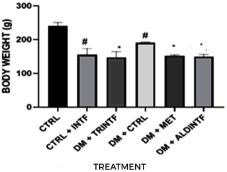
Figure 1. Effects of time-restricted intermittent fasting, metformin treatment and alternate day intermittent fasting on body weight of streptozotocin-induced diabetes rats. *p˂0.05 when compared with diabetic control group (DM+CTTRL), # p˂0.05 when compared with non-diabetic control rats (CTRL).
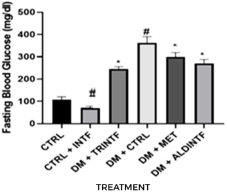
Figure 2. Effects of time-restricted intermittent fasting, metformin treatment and alternate day intermittent fasting on fasting blood glucose of streptozotocin-induced diabetes rats. *p˂0.05 when compared with diabetic control group (DM+CTTRL), # p˂0.05 when compared with non-diabetic control rats (CTRL).
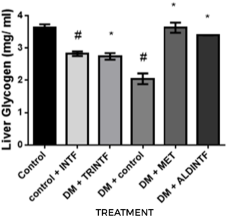
Figure 3. Effects of time-restricted intermittent fasting, metformin treatment and alternate day intermittent fasting on liver glycogen of streptozotocin-induced diabetes rats. *p˂0.05 when compared with diabetic control group (DM+CTTRL), # p˂0.05 when compared with non-diabetic control rats (CTRL).
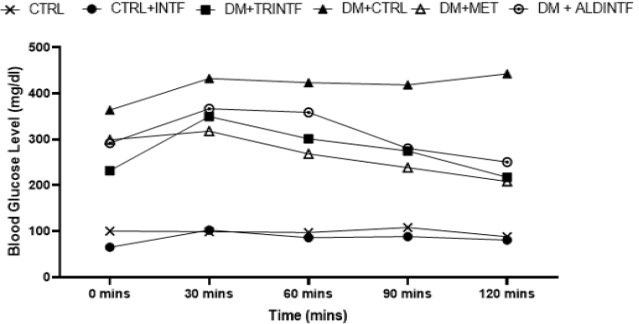
Figure 4. Effects of time-restricted, metformin treatment and alternate day intermittent fasting on fasting blood glucose and Oral Glucose Tolerance Test of streptozotocin-induced diabetic rats. *p˂0.05 when compared with DM + CTTRL, # p˂0.05 when compared with the non-diabetic control.
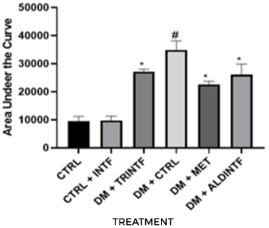
Figure 5. Area under the curve (AUC) showing glucose tolerance test on the effects of time-restricted, metformin treatment and alternate day intermittent fasting on fasting blood glucose in streptozotocin-induced diabetic rats. *p˂0.05 when compared with DM + CTTRL, # p˂0.05 when compared with the non-diabetic control. Area under the curve is (mg/dl×min).
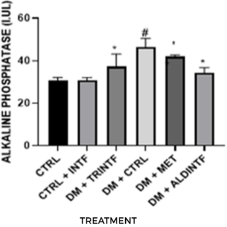
Figure 6. Effects time-restricted intermittent fasting, metformin treatment and alternate day intermittent fasting on Alkaline phosphatase (ALP) of streptozotocin-induced diabetes rats. *p˂0.05 when compared with DM + CTRL, # p˂0.05 when compared with CTRL (non-diabetic control).
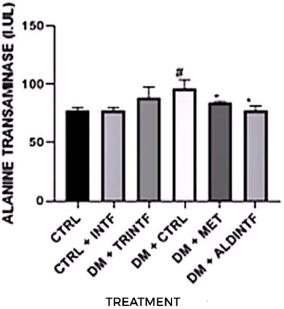
Figure 7. Effects time-restricted intermittent fasting, metformin treatment and alternate day intermittent fasting on Alanine Transaminase (ALT) of streptozotocin-induced diabetes rats. *p˂0.05 when compared with DM + CTTRL group, # p˂0.05 when compared with the CTRL control.
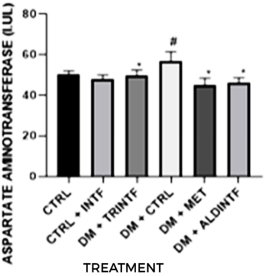
Figure 8. Effects time-restricted intermittent fasting, metformin treatment and alternate day intermittent fasting on Aspartate Aminotransferase (AST) of streptozotocin-induced diabetes rats. *p˂0.05 when compared with DM + CTTRL group, # p˂0.05 when compared with (CTRL) non-diabetic control.

Information



 Share This Article
 Twitter
 Linked In
 Facebook
 Copy
Copy Download