
Star formation rate (SFR), metallicity, and mass have been identified as the key to understanding how galaxies form and evolve. To show the actual contribution of star-formation to the growth of galaxies, specific star formation rate (SSFR) is used in place of SFR. SSFR is defined as a quantity that measures the SFR per unit galaxy stellar mass. It is the measure of time taken by a galaxy to form its stellar mass at its current star formation rate. The relation between SSFR and mass separates galaxies into two populations: those with active star formation and those with little or no star formation. Metallicity is the mass fraction of baryonic components in metals; it traces the fraction of baryonic mass already converted to stars. The purpose of this paper is to present results obtained from the investigation of mass, metallicity, and star formation rate relations in dwarf galaxies using data from Sloan Digital Sky Survey matched with Galaxy and Mass Assembly. 863 emission-line classified star-forming galaxies were used for this study. Stellar mass was estimated based on an empirical relation from the (g - i) band colour. Hα luminosity was used to estimate the star formation rate (SFR). Metallicities were estimated using three methods, namely Z94, T04 and D02, which are based on theoretical methods, empirical methods and a combination of both, respectively. Results obtained showed an increase in star formation rate with mass, with a lot of scatter, which is greater among dwarf galaxies. Towards normal galaxies, the star formation rate dropped, which may be due to AGN feedback. A decreasing SSFR with mass was obtained, with dwarf galaxies having higher SSFR than normal galaxies, indicating that star formation contributes more to the growth of dwarf galaxies, thereby rapidly increasing their stellar mass more than in the normal galaxies. Also, the downsizing effect can be used to explain this observation. Generally, the results for mass-metallicity (M-Z) relations showed that for all populations, metallicity increased with mass, with increased scatter in the dwarf galaxy region. The scatter observed in the dwarf galaxy region is due to the presence of lower metallicity objects. Z94 M-Z relation has more scatter than other M-Z relations and has higher metallicities. Even though the metallicity values for my dwarf galaxies are low compared with other galaxies, they are higher than those of dwarf irregular galaxies, suggesting that my dwarf galaxy sample is dominated by dwarf galaxies with different morphologies that have high metallicity, such as dwarf spirals.
| Published in | American Journal of Astronomy and Astrophysics (Volume 13, Issue 3) |
| DOI | 10.11648/j.ajaa.20261303.11 |
| Page(s) | 88-96 |
| Creative Commons |
This is an Open Access article, distributed under the terms of the Creative Commons Attribution 4.0 International License (http://creativecommons.org/licenses/by/4.0/), which permits unrestricted use, distribution and reproduction in any medium or format, provided the original work is properly cited. |
| Copyright |
Copyright © The Author(s), 2026. Published by Science Publishing Group |
Abundances, Evolution, Star Formation, Dwarf Galaxies
SDSS | Sloan Digital Sky Survey |
GAMA | Galaxy And Mass Assembly |
DR | Data Release |
NGC | New General Catalogue of Nebulae and Clusters of Stars |
T04 | Tremonti Et Al. (2004) |
Z94 | Zarisky Et Al 1994 |
D02 | Denicoló 2002 |
PP04 | Pettini and Pagel 2004 |
MZ | Mass-metallicity Relations |
SF | Star Forming |
SFR | Star Formation Rate |
sSFR | Specific Star Formation Rate |
BPT | Baldwin, Phillipps and Terlevich |
AGN | Active Galactic Nuclei |
Hα | Hydrogen Alpha Line |
Hβ | Hydrogen Beta Line |
EWHα, | Hydrogen Alpha Equivalent Width |
λ | Wavelength |
HII | Hydrogen 2 Emission Line |
[OI]λ6300 | Oxygen 1 Emission Line |
[OII] | Oxygen 2 Emission Line |
[OIII] or [OIII]λ5007 | Oxygen 3 Emission Line |
[NII] or [NII]λ6583 | Nitrogen 2 Emission Line |
[SII]λλ6717,6731 | Sulphur 2 Emission Line Wavelengths 6717 and 6731 |
Te | Electron Temperature |
MB | Absolute B-magnitude |
Mg | Absolute G-magnitude |
MΘ | Solar Mass |
z | Redshift |
nQ | Redshift Warning |
R23 | The Ratio of [OII] and [OIII] to Hydrogen Beta Line |
Mi | I-band Absolute Magnitude |
Mi,ʘ | Absolute Magnitude of the Sun in the I-band |
[12+log(O/H)] | The Unit of Metallicity Derived Using Oxygen Abundance |
Dex | Decimal exponent |
| [1] | Alam, S., Albareti, F. D., Allende P. C., Anders, F., Anderson, S. F., Anderton, T., Andrews, B. H., Armengaud, E., Aubourg, É., Bailey, S., Basu, S., Bautista, J. E., Beaton, R. L., Beers, T. C., Bender, C. F., Berlind, A. A., Beutler, F., Bhardwaj, V., Bird, Jonathan C., …, Zhu, G. (2015). The Eleventh and Twelfth Data Releases of the Sloan Digital Sky Survey: Final Data from SDSS-III. The Astrophysical Journal Supplement Series, 219(1), 27. |
| [2] | Baldwin, J. A., Phillips, M. M. & Terlevich, R. (1981). Classification parameters for the emission-line spectra of extragalactic objects. Publications of the Astronomical Society of the Pacific, 93(551), 5-19. |
| [3] | Bauer, A. E., Drory, N. & Hill G. J. (2006). Specific star formation rates. In LeBrun V., Mazure A., Arnouts S., Burgarella D., (Eds). The Fabulous Destiny of Galaxies: Bridging Past and Present. Paris: Frontier Group, p. 279. |
| [4] | Bidaran B., Puertas S. D., Pérez I., Zurita A., Espada D., Argudo-Fernández M., García-Benito R., Sánchez-Menguiano R., Verley S., Sánchez S. F., Falcón-Barroso J., Ferré-Mateu A., Villalba-Gonzalez P., Jiménez A., Peletier R. F., Ruiz-Lara T. (2026). The Gas-Phase Mass-Metallicity Relation of Dwarf Galaxies Across Large-Scale Environments Using the CAVITY Parent Sample. Astronomy & Astrophysics. |
| [5] | Bulichi, T., Fahrion, K., Mernier, F., Hilker, M., Leaman, R., Lyubenova, M., Müller, O., Neumayer, N., Martin-Navarro, I., Pinna, F., Rejkuba, M., Scholz-Diaz, L. & van de Ven, G. (2023). Expanding on the fundamental metallicity relation in dwarf galaxies with MUSE. Astronomy & Astrophysics. 679, A98. |
| [6] | Ciambur, B. C., Kauffmann, G. & Wuyts, S. (2013). On the evolution of the bi-modal distribution of galaxies in the plane of specific star formation rate versus stellar mass. Monthly Notices of the Royal Astronomical Society, 432(3), 2488 - 2495. |
| [7] | Curti M., Maiolino R., Curtis-Lake E., Chevallard J., Carniani S., D’Eugenio F., Looser T. J., Scholtz J., Charlot S., Cameron A., Übler H., Witstok J., Boyett K., Laseter I., Sandles L, Arribas S., Bunker A., Giardino G., Maseda M. V… Sun F. (2024). JADES: Insights into the low-mass end of the mass-metallicity-SFR relation at 3 < z < 10 from deep JWST/NIRSpec spectroscopy. Astronomy & Astrophysics. 684, A75. |
| [8] | Cowie L. L., Songaila A., Hu E. M., Cohen J. G. (1996). New Insight on Galaxy Formation and Evolution From Keck Spectroscopy of the Hawaii Deep Fields. Astronomical Journal, 112, 839. |
| [9] | Denicoló, G., Terlevich, R. & Terlevich, E. (2002). New light on the search for low-metallicity galaxies - I. The N2 calibrator. Monthly Notices of the Royal Astronomical Society, 330(1), 69-74. |
| [10] | Foster, C., Hopkins, A. M., Gunawardhana, M., Lara-López, M. A., Sharp, R. G., Steele, O., Taylor, E. N., Driver, S. P., Baldry, I. K., Bamford, S. P., Liske, J., Loveday, J., Norberg, P., Peacock, J. A., Alpaslan, M., Bauer, A. E., Bland-Hawthorn, J. Brough, S., Cameron, E.,… Wijesinghe, D. (2012). Galaxy And Mass Assembly (GAMA): the mass-metallicity relationship. Astronomy & Astrophysics, 547, A79, 9 pp. |
| [11] | Groves B., Kewley L. (2008). Distinguishing Active Galactic Nuclei and Star Formation. In Knapen J. H., Mahoney T. J., Vazdekis A. (Eds). Pathways Through an Eclectic Universe. Astronomical Society of the Pacific Conference Series. 390, 283. |
| [12] | Gunawardhana, M. L. P., Hopkins, A. M., Sharp, R. G., Brough, S., Taylor, E., Bland-Hawthorn, J., Maraston, C., Tuffs, R. J., Popescu, C. C., Wijesinghe, D., Jones, D. H., Croom, S., Sadler, E., Wilkins, S., Driver, S. P., Liske, J., Norberg, P. Baldry, I. K., Bamford, S. P., …van Kampen, E. (2011). Galaxy and Mass Assembly (GAMA): the star formation rate dependence of the stellar initial mass function. Monthly Notices of the Royal Astronomical Society, 415(2), 1647-1662. |
| [13] | Hansson, K. S. A., Lisker, T., & Grebel, E. K., (2012). Observed versus modelled u-, g-, r-, i-, z-band photometry of local galaxies - evaluation of model performance. Monthly Notices of the Royal Astronomical Society. 427(3), 2376-2391. |
| [14] | Hopkins, A. M., Miller, C. J., Nichol, R. C., Connolly, A. J., Bernardi, M., Gómez, P. L., Goto, T., Tremonti, C. A., Brinkmann, J., Ivezić, Ž. & Lamb, D. Q. (2003). Star Formation Rate Indicators in the Sloan Digital Sky Survey. The Astrophysical Journal, 599(2), 971 - 991. |
| [15] | Kauffmann, G., Heckman, T. M., Tremonti, C., Brinchmann, J., Charlot, S., White, S. D. M., Ridgway, S. E., Brinkmann, J., Fukugita, M., Hall, P. B., Ivezić, Ž., Richards, G. T. & Schneider, D. P. (2003). The host galaxies of active galactic nuclei. Monthly Notices of the Royal Astronomical Society, 346(4), 1055-1077. |
| [16] | Kewley, L. J., Dopita, M. A., Sutherland, R. S., Heisler, C. A., & Trevena, J. (2001) Theoretical modeling of starburst galaxies. The Astrophysical Journal, 556(1), 121 - 140. |
| [17] | Kewley L. J. & Ellison S. L. (2008). Metallicity Calibrations and the Mass-Metallicity Relation for Star-forming Galaxies. AJ, 681, 1183 - 1204. |
| [18] | Lara-López, M. A., Bongiovanni, A., Cepa, J., Pérez García, A. M. Sánchez-Portal, M., Castañeda, H. O., Fernández Lorenzo, M. & Pović, M. (2010). Study of star-forming galaxies in SDSS up to redshift 0.4. II. Evolution from the fundamental parameters: mass, metallicity and star formation rate. Astronomy & Astrophysics, 519, A31. |
| [19] | Lara-López, M. A., Hopkins, A. M., López-Sánchez, A. R., Brough, S., Gunawardhana, M. L. P., Colless, M., Robotham, A. S. G., Bauer, A. E., Bland-Hawthorn, J., Cluver, M., Driver, S., Foster, C., Kelvin, L. S., Liske, J., Loveday, J., Owers, M. S., Ponman, T. J., Sharp, R. G., Steele, O., …. Thomas, D. (2013). Galaxy And Mass Assembly (GAMA): a deeper view of the mass, metallicity and SFR relationships. Monthly Notices of the Royal Astronomical Society, 434 (1), 451 - 470. |
| [20] | Lequeux J., Peimbert M., Rayo J. F., Serrano A., Torres-Peimbert S. (1979). Chemical composition and evolution of irregular and blue compact galaxies. Astronomy & Astrophysics, 80, 155-166. |
| [21] | Li M., Cai Z., Bian F., Lin X., Li Z., Wu Y., Sun F., Zhang S., Golden-Marx E., Sun Z, Zou S., Fan X., Egami E., Charlot S., Bruzual G., Chevallard J. (2023). The mass-metallicity relation of dwarf galaxies at cosmic noon from jwst observations. The Astrophysical Journal Letters. 955, L18 (14pp). |
| [22] | Liske, J., Baldry, I. K., Driver, S. P., Tuffs, R. J., Alpaslan, M., Andrae, E., Brough, S., Cluver, M. E., Grootes, M. W., Gunawardhana, M. L. P., Kelvin, L. S., Loveday, J., Robotham, A. S. G., Taylor, E. N., Bamford, S. P., Bland-Hawthorn, J., Brown, M. J. I. Drinkwater, M. J., Hopkins, A. M., … Wright, A. H. (2015). Galaxy And Mass Assembly (GAMA): end of survey report and data release 2. Monthly Notices of the Royal Astronomical Society, 452, (2), 2087-2126. |
| [23] | Lisker, T., Glatt, K., Westera, P., & Grebel, E. K., (2006). Virgo Cluster Early-Type Dwarf Galaxies with the Sloan Digital Sky Survey. II. Early-Type Dwarfs with Central Star Formation. The Astrophysical Journal, 132, 2432-2452. |
| [24] | Mahajan S., Drinkwater M. J., Driver S., Kelvin L. S., Hopkins A. M., Baldry I., Phillipps S., Bland-Hawthorn J., Brough S., Loveday J., Penny S. J., & Robotham A. S. J. (2015). Galaxy And Mass Assembly (GAMA): the unimodal nature of the dwarf galaxy population. Monthly Notices of the Royal Astronomical Society, 446 (3), 2967-2984. |
| [25] | Mateo, M., (1998). Dwarf galaxies in the Local Group. Annual Review Astronomy and Astrophysics, 36, 435-506. |
| [26] | Mo, H., van den Bosch, F. C., & White, S. (2010). Galaxy Formation and Evolution. Cambridge University Press. |
| [27] | Pettini, M. & Pagel, B. E. J. (2004). [OIII]/ [NII] as an abundance indicator at high redshift. Monthly Notices of the Royal Astronomical Society, 348(3), L59 - L63. |
| [28] | Phillipps S., (2005). The Structure and Evolution of Galaxies. Wiley-VCH. |
| [29] | Sánchez-Janssen, R., Amorín, R., García-Vargas, M., Gomes, J. M., Huertas-Company, M., Jiménez-Esteban, F., Mollá, M., Papaderos, P., Pérez-Montero, E., Rodrigo, C., Sánchez Almeida, J., & Solano, E., (2013). A Virtual Observatory Census to Address Dwarfs Origins (AVOCADO). I. Science goals, sample selection, and analysis tools. Astronomy & Astrophysics, 554. A20. |
| [30] | Taylor, E. N., Hopkins, A. M., Baldry, I. K., Brown, M. J. I., Driver, S. P., Kelvin, L. S., Hill, D. T., Robotham, A. S. G., Bland-Hawthorn, J., Jones, D. H., Sharp, R. G., Thomas, D. Liske, J., Loveday, J., Norberg, P., Peacock, J. A., Bamford, S. P. Brough, S., Colless, M., … Wijesinghe, D. (2011). Galaxy And Mass Assembly (GAMA): stellar mass estimates. Monthly Notices of the Royal Astronomical Society, 418(3), 1587-1620. |
| [31] | Tolstoy, E., Hill, V., Tosi. M. (2009). Star-Formation Histories, Abundances, and Kinematics of Dwarf Galaxies in the Local Group. Annual Review Astronomy and Astrophysics, 47, 371-425. |
| [32] | Tremonti, C. A., Heckman, T. M., Kauffmann, G., Brinchmann, J., Charlot, S., White, S. D. M., Seibert, M., Peng, E. W., Schlegel, D. J., Uomoto, A., Fukugita, M. & Brinkmann, J. (2004). The Origin of the Mass-Metallicity Relation: Insights from 53,000 Star-forming Galaxies in the Sloan Digital Sky Survey. The Astrophysical Journal, 613, 898 - 913. |
| [33] | Zahid H. J., Bresolin F., Kewley L. J., Coil A. L. & Davé, R., (2012). The Metallicities of Low Stellar Mass Galaxies and the Scatter in the Mass-Metallicity Relation. The Astrophysical Journal, 750, 120 - 136. |
| [34] | Zaritsky D., Kennicutt Jr. R. C., Huchra J. P. (1994). H II regions and the abundance properties of spiral galaxies. The Astrophysical Journal, 420, 87 - 109. |
APA Style
Nwaokoro, E. (2026). Investigating Star Formation Rate, Metallicity and Mass Relations in Dwarf Galaxies. American Journal of Astronomy and Astrophysics, 13(3), 88-96. https://doi.org/10.11648/j.ajaa.20261303.11
ACS Style
Nwaokoro, E. Investigating Star Formation Rate, Metallicity and Mass Relations in Dwarf Galaxies. Am. J. Astron. Astrophys. 2026, 13(3), 88-96. doi: 10.11648/j.ajaa.20261303.11
@article{10.11648/j.ajaa.20261303.11,
  author = {Emenike Nwaokoro},
  title = {Investigating Star Formation Rate, Metallicity and Mass Relations in Dwarf Galaxies},
  journal = {American Journal of Astronomy and Astrophysics},
  volume = {13},
  number = {3},
  pages = {88-96},
  doi = {10.11648/j.ajaa.20261303.11},
  url = {https://doi.org/10.11648/j.ajaa.20261303.11},
  eprint = {https://article.sciencepublishinggroup.com/pdf/10.11648.j.ajaa.20261303.11},
  abstract = {Star formation rate (SFR), metallicity, and mass have been identified as the key to understanding how galaxies form and evolve. To show the actual contribution of star-formation to the growth of galaxies, specific star formation rate (SSFR) is used in place of SFR. SSFR is defined as a quantity that measures the SFR per unit galaxy stellar mass. It is the measure of time taken by a galaxy to form its stellar mass at its current star formation rate. The relation between SSFR and mass separates galaxies into two populations: those with active star formation and those with little or no star formation. Metallicity is the mass fraction of baryonic components in metals; it traces the fraction of baryonic mass already converted to stars. The purpose of this paper is to present results obtained from the investigation of mass, metallicity, and star formation rate relations in dwarf galaxies using data from Sloan Digital Sky Survey matched with Galaxy and Mass Assembly. 863 emission-line classified star-forming galaxies were used for this study. Stellar mass was estimated based on an empirical relation from the (g - i) band colour. Hα luminosity was used to estimate the star formation rate (SFR). Metallicities were estimated using three methods, namely Z94, T04 and D02, which are based on theoretical methods, empirical methods and a combination of both, respectively. Results obtained showed an increase in star formation rate with mass, with a lot of scatter, which is greater among dwarf galaxies. Towards normal galaxies, the star formation rate dropped, which may be due to AGN feedback. A decreasing SSFR with mass was obtained, with dwarf galaxies having higher SSFR than normal galaxies, indicating that star formation contributes more to the growth of dwarf galaxies, thereby rapidly increasing their stellar mass more than in the normal galaxies. Also, the downsizing effect can be used to explain this observation. Generally, the results for mass-metallicity (M-Z) relations showed that for all populations, metallicity increased with mass, with increased scatter in the dwarf galaxy region. The scatter observed in the dwarf galaxy region is due to the presence of lower metallicity objects. Z94 M-Z relation has more scatter than other M-Z relations and has higher metallicities. Even though the metallicity values for my dwarf galaxies are low compared with other galaxies, they are higher than those of dwarf irregular galaxies, suggesting that my dwarf galaxy sample is dominated by dwarf galaxies with different morphologies that have high metallicity, such as dwarf spirals.},
 year = {2026}
}
TY  - JOUR
T1  - Investigating Star Formation Rate, Metallicity and Mass Relations in Dwarf Galaxies
AU  - Emenike Nwaokoro
Y1  - 2026/07/22
PY  - 2026
N1  - https://doi.org/10.11648/j.ajaa.20261303.11
DO  - 10.11648/j.ajaa.20261303.11
T2  - American Journal of Astronomy and Astrophysics
JF  - American Journal of Astronomy and Astrophysics
JO  - American Journal of Astronomy and Astrophysics
SP  - 88
EP  - 96
PB  - Science Publishing Group
SN  - 2376-4686
UR  - https://doi.org/10.11648/j.ajaa.20261303.11
AB  - Star formation rate (SFR), metallicity, and mass have been identified as the key to understanding how galaxies form and evolve. To show the actual contribution of star-formation to the growth of galaxies, specific star formation rate (SSFR) is used in place of SFR. SSFR is defined as a quantity that measures the SFR per unit galaxy stellar mass. It is the measure of time taken by a galaxy to form its stellar mass at its current star formation rate. The relation between SSFR and mass separates galaxies into two populations: those with active star formation and those with little or no star formation. Metallicity is the mass fraction of baryonic components in metals; it traces the fraction of baryonic mass already converted to stars. The purpose of this paper is to present results obtained from the investigation of mass, metallicity, and star formation rate relations in dwarf galaxies using data from Sloan Digital Sky Survey matched with Galaxy and Mass Assembly. 863 emission-line classified star-forming galaxies were used for this study. Stellar mass was estimated based on an empirical relation from the (g - i) band colour. Hα luminosity was used to estimate the star formation rate (SFR). Metallicities were estimated using three methods, namely Z94, T04 and D02, which are based on theoretical methods, empirical methods and a combination of both, respectively. Results obtained showed an increase in star formation rate with mass, with a lot of scatter, which is greater among dwarf galaxies. Towards normal galaxies, the star formation rate dropped, which may be due to AGN feedback. A decreasing SSFR with mass was obtained, with dwarf galaxies having higher SSFR than normal galaxies, indicating that star formation contributes more to the growth of dwarf galaxies, thereby rapidly increasing their stellar mass more than in the normal galaxies. Also, the downsizing effect can be used to explain this observation. Generally, the results for mass-metallicity (M-Z) relations showed that for all populations, metallicity increased with mass, with increased scatter in the dwarf galaxy region. The scatter observed in the dwarf galaxy region is due to the presence of lower metallicity objects. Z94 M-Z relation has more scatter than other M-Z relations and has higher metallicities. Even though the metallicity values for my dwarf galaxies are low compared with other galaxies, they are higher than those of dwarf irregular galaxies, suggesting that my dwarf galaxy sample is dominated by dwarf galaxies with different morphologies that have high metallicity, such as dwarf spirals.
VL  - 13
IS  - 3
ER  -
Department of Physics, Abia State University, Uturu, Nigeria
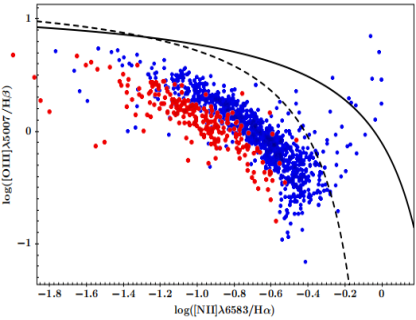
Figure 1. BPT diagram for the total SDSS-GAMA matched galaxies. The red dots on the matched sample are dwarf galaxies; the solid line is the [16] relation and the dashed line is [15] relation.
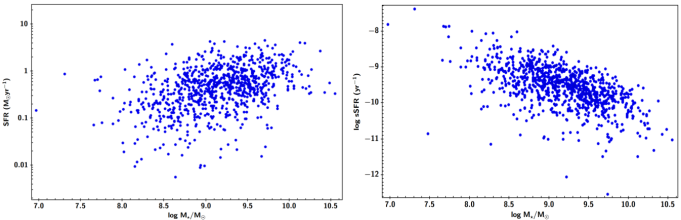
Figure 2. The relationship between (a) SFR and (b) sSFR with mass.
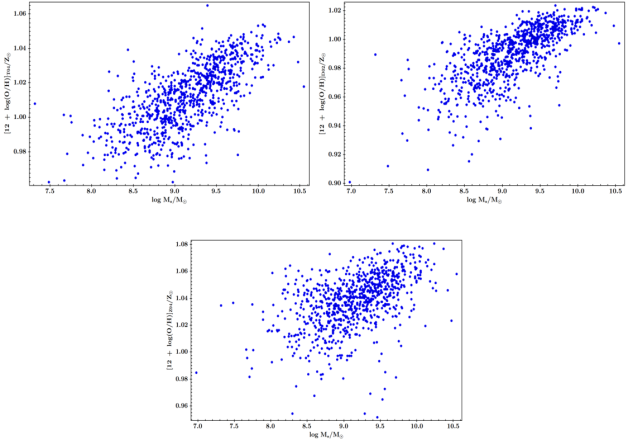
Figure 3. Metallicity versus stellar mass plots for SDSS-GAMA matched galaxy sample using the three different calibrations: (a) T04, (b) D02 and (c) Z94 respectively. The estimated metallicity values are solar metallicities.
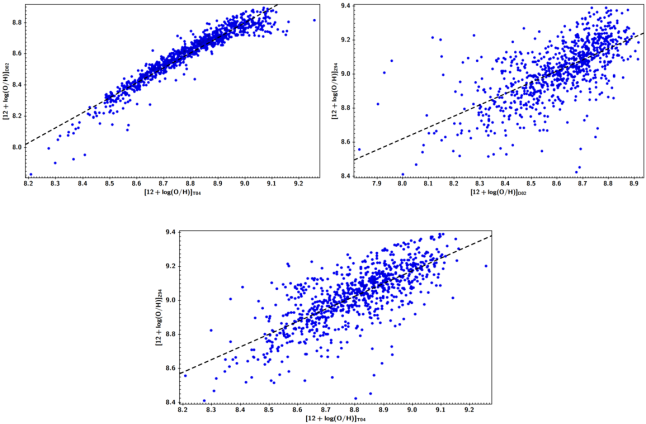
Figure 4. Plots comparing the three different metallicity calibrations. (a) D02 versus T04, (b) Z94 versus D02 and (c) Z94 versus T04. The metallicity values are not solar.

Information



 Share This Article
 Twitter
 Linked In
 Facebook
 Copy
Copy Download