The increasing integration of information and communication technology (ICT) in design education has significantly influenced contemporary design pedagogy, particularly through blended learning approaches, online studios, and virtual design studio (VDS) environments. Although considerable scholarly attention has been given to ICT-supported ideation in architecture and engineering education, its instructional application during the ideation phase of graphic design, especially within virtual learning contexts, has received limited empirical attention. In many graphic design programmes, digital technologies are predominantly utilized for production and final output, with insufficient pedagogical structuring to support early-stage idea generation. This situation has resulted in noticeable disparities between students’ digitally driven ideation practices and lecturers’ pedagogical expectations. This study examines the applicability of an ICT-mediated pedagogical framework proposed by Appiah (2014) as a means of supporting virtual ideation within the graphic design process. Adopting a qualitative research design, the framework was implemented and tested within virtual studio environments to evaluate its effectiveness in supporting ideation. Data were gathered through observation of virtual studio ideation, unstructured interviews, and analysis of outcomes produced during virtual ideation activities. The findings reveal that structured mediation of ICT use promotes deeper student engagement in ideation, strengthens conceptual clarity, and encourages reflective design. The study provides empirical support for the role of purposeful ICT mediation in aligning students’ informal technology use with formal instructional goals. It concludes by recommending the integration of Appiah’s (2014) ICT-mediated framework to enhance virtual ideation practices within graphic design pedagogy in Ghana.
This is an Open Access article, distributed under the terms of the Creative Commons Attribution 4.0 International License (http://creativecommons.org/licenses/by/4.0/), which permits unrestricted use, distribution and reproduction in any medium or format, provided the original work is properly cited.
ICT-mediated Framework, Virtual Ideation, Graphic Design Pedagogy, Digital Tools in Design Education
1. Introduction
The integration of computers and digital technologies has significantly reshaped contemporary design education, particularly the pedagogy of ideation within instructional environments. Information and communication technology (ICT) now plays a central role in blended learning, online studios, and collaborative design activities, especially through virtual design studios
[8]
Laurillard, D. (2012). Teaching as a design science: Building pedagogical patterns for learning and technology. Routledge.
[8]
. These developments have increased access to design resources, expanded modes of interaction, and challenged traditional studio-based teaching practices.
Research on ICT integration in design education has been more developed in architecture and engineering, where digital tools are embedded across multiple stages of the design process
[4]
Chiou, C. C., Lee, S. J. and Hsu, J. C. (2021) ‘Reflective practices in design education: A framework for iterative ideation and feedback’, International Journal of Art & Design Education, 40(1), pp. 25–36.
[4]
. In contrast, graphic design education has largely emphasized ICT use for production and final output, with limited attention to its pedagogical role during early-stage in idea development activity. most especially in virtual ideation. This imbalance has resulted in empirical tensions in the early stages of the graphic design process. These tensions have been attributed to lack of a deliberately structured IC-Mediated framework that can support concept generation and idea development.
Ideation remains a critical yet underdeveloped area of graphic design pedagogy in virtual studio activities. Although students increasingly rely on digital tools when developing concepts, this use is often informal and poorly supported by structured teaching frameworks. This situation frequently produces tension between students’ technology-driven ideation practices and lecturers’ instructional expectations.
To address this gap, the present study tests an ICT-mediated framework developed by
[2]
Appiah, E. (2014) An exploration of ICT for graphic design education at a public university: issues of ideation and pedagogy. Doctoral thesis. Cape Peninsula University of Technology. Available at:
as a model for supporting virtual ideation in graphic design education. By focusing on ideation as a core element of design problem-solving, the study contributes empirical evidence to discussions on ICT-mediated learning within graphic design studios.
2. Literature Review
The Potential of Virtual Studios for Pedagogical Alignment
ICT integration in online graphic design studios is widely recognized for enhancing creative workflows, collaboration, and access to professional tools. Research suggests that virtual studio environments are particularly effective in aligning technology with pedagogical goals because ICT is embedded within the learning environment rather than added as a supplementary resource.
Chiou, C. C., Lee, S. J. and Hsu, J. C.
[4]
Chiou, C. C., Lee, S. J. and Hsu, J. C. (2021) ‘Reflective practices in design education: A framework for iterative ideation and feedback’, International Journal of Art & Design Education, 40(1), pp. 25–36.
[4]
argues that frameworks such as Technological Pedagogical Content Knowledge (TPACK) are more easily implemented in virtual studios, where technology, pedagogy, and content are naturally interconnected. Similarly,
[11]
Wang et al. (2020) argue that ICT integration within virtual studio environments can function transformatively, restructuring learning activities rather than serving as a supplementary support mechanism (as cited in Arts and Design Studies, 2025).
[11]
describe ICT in virtual studios as transformative, noting that it reshapes learning activities rather than merely supporting existing practices.
This transformation is evident in the use of purpose-built digital platforms.
[10]
Koehler, M. J., & Mishra, P. (2009). What is technological pedagogical content knowledge (TPACK)? Contemporary Issues in Technology and Teacher Education, 9(1), 60–70.
[10]
found that platforms such as Miro and FigJam function as active spaces for brainstorming, discussion, and feedback, moving ICT beyond organizational functions toward creative participation. Similarly,
[5]
Izadpanah, S. (2021) ‘Evaluating the role of Pinterest in education and the profession of interior architecture’, Idil Journal of Art and Language, 10, pp. 1559–1572.
highlights the role of Pinterest in supporting visual exploration and access to diverse visual resources within design education and professional practice. Wong et al. (2021) further argue that virtual studios promote student-centered learning by endcouraging exploration, peer interaction, and shared knowledge construction.
The effectiveness of virtual studios is closely linked to the nature of the digital environment itself. Because collaboration mostly occurs online, both students and educators must engage meaningfully with ICT tools.
[12]
Dooly, M., & Sadler, R. (2016). Becoming little scientists: Technologically-enhanced project-based language learning. Language Learning & Technology, 20(1), 54–78.
noted that this requirement often improves educators’ digital pedagogical skills, leading to more interactive teaching and increased access to guidance and feedback for students.
From this perspective, ICT functions as a cultural tool for learning in line with Vygotsky’s (1978) theory. Using a technology-mediated activity model (TMAM)
[1]
Appiah, E. and Cronje, J. (2013) ‘Information communication and technology (ICT) and the challenges of ideat ion in graphic design: an activity theory focus’, International Journal of Computer Applications, 63, pp. 13–23.
, ICT reshapes relationships between students, educators, learning tasks, and the studio community, supporting deeper learning outcomes.
2.1. ICT in Design Education
ICT has become central to contemporary design education by enabling flexible learning environments, remote collaboration, and access to diverse visual and conceptual resources. Virtual design studios support both synchronous and asynchronous interaction, peer critique, and reflective learning
[8]
Laurillard, D. (2012). Teaching as a design science: Building pedagogical patterns for learning and technology. Routledge.
[8]
.
Despite these advantages, ICT adoption in graphic design education often prioritizes technical efficiency over pedagogical transformation. Digital tools are often treated as execution instruments rather than as mediators of conceptual thinking, limiting their impact during ideation
[1]
Appiah, E. and Cronje, J. (2013) ‘Information communication and technology (ICT) and the challenges of ideat ion in graphic design: an activity theory focus’, International Journal of Computer Applications, 63, pp. 13–23.
Ideation is a core stage in graphic design, involving the generation, exploration, and refinement of ideas. It is iterative, non-linear, and reflective, requiring designers to balance form, meaning, and context.
[9]
Schön, D. A. (1983). The reflective practitioner: How professionals think in action. Basic Books.
[9]
concept of reflective practice highlights the importance of experimentation and reflection during this stage.
However, ideation in digital environments is often weakly structured. When ICT use is not supported by educator guidance or collaborative interaction, students risk engaging in surface-level exploration or imitation rather than critical ideation
[4]
Chiou, C. C., Lee, S. J. and Hsu, J. C. (2021) ‘Reflective practices in design education: A framework for iterative ideation and feedback’, International Journal of Art & Design Education, 40(1), pp. 25–36.
[4]
.
2.3. ICT-Mediated Framework
The ICT-mediated framework, grounded in activity theory, conceptualizes learning as a dynamic system involving subjects, tools, rules, community, and division of roles.
[2]
Appiah, E. (2014) An exploration of ICT for graphic design education at a public university: issues of ideation and pedagogy. Doctoral thesis. Cape Peninsula University of Technology. Available at:
Within this framework, ICT functions as a mediating tool that shapes thinking, interaction, and learning outcomes. Applying this framework to graphic design ideation allows for the examination of both productive learning outcomes and tensions within virtual studio environments.
Appiah, E. (2014) An exploration of ICT for graphic design education at a public university: issues of ideation and pedagogy. Doctoral thesis. Cape Peninsula University of Technology. Available at:
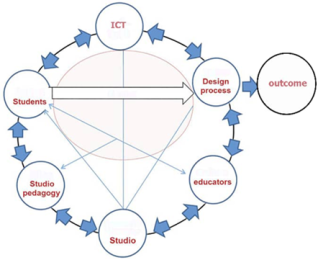
The conceptual diagram illustrates the ICT-mediated ideation process as an interconnected activity system. At the centre of the model is ICT, positioned as the mediating tool that connects students and lecturers (subjects) to the ideation outcome (object) within the virtual studio. Surrounding this core interaction are rules (studio guidelines and assessment expectations), the community of practice (virtual studio), and the division of roles (roles of lecturers as facilitators and students as creators). These elements interact dynamically to produce the outcome, which is meaningful idea development and enhanced ideation in graphic design education. The diagram reflects
[2]
Appiah, E. (2014) An exploration of ICT for graphic design education at a public university: issues of ideation and pedagogy. Doctoral thesis. Cape Peninsula University of Technology. Available at:
view that learning emerges from the interaction of tools, people, and context rather than from linear instructional processes.
3. Methodology
This study adopted a qualitative research approach grounded in an interpretivist paradigm to explore the effectiveness of ICT-Mediated framework to support virtual ideation in the graphic design process. This approach enabled an in-depth understanding of participants’ experiences and the meanings they attached to ICT-mediated ideation in a virtual environment.
[6]
Creswell, J. W. (2013). Qualitative inquiry and research design: Choosing among five approaches (3rd ed.). Sage.
[6]
Data were collected through non-participant observation and unstructured interviews. Online studio ideation sessions were observed in the Graphic Design Technology Department at Takoradi Technical University, involving students and lecturers. Observations focused on ICT use in teaching, collaboration, access to lecturers, educator guidance, critique and feedback, peer inspiration and feedback and idea development.
Students were randomly selected to ensure diverse perspectives, while lecturers were purposively selected based on their experience with virtual teaching. Observation notes focused on ICT’s usage in ideation and interaction, while interviews explored participants’ perceptions of pedagogical change and learning outcomes.
Data were analyzed thematically following
[3]
Braun, V. & Clarke, V. (2006) ‘Using thematic analysis in psychology’, Qualitative Research in Psychology, 3(2), pp. 77–101.
[3]
. Emerging themes were interpreted using
[2]
Appiah, E. (2014) An exploration of ICT for graphic design education at a public university: issues of ideation and pedagogy. Doctoral thesis. Cape Peninsula University of Technology. Available at:
ICT-mediated framework, with attention to interactions and contradictions within the ideation activity. Trustworthiness was ensured through triangulation and the criteria proposed by
[13]
Lincoln, Y. S., & Guba, E. G. (1985). Naturalistic Inquiry. Beverly Hills, CA: Sage Publications, Inc.
[13]
.
The Table below illustrates how
[2]
Appiah, E. (2014) An exploration of ICT for graphic design education at a public university: issues of ideation and pedagogy. Doctoral thesis. Cape Peninsula University of Technology. Available at:
ICT-mediated framework was operationalized within the virtual design studios investigated in this study, demonstrating the framework’s applicability to ICT-mediated ideation in graphic design pedagogy.
The table below demonstrates the Applicability of
[2]
Appiah, E. (2014) An exploration of ICT for graphic design education at a public university: issues of ideation and pedagogy. Doctoral thesis. Cape Peninsula University of Technology. Available at:
Graphic design students engaged in virtual ideation activity
Graphic design students and lecturers participating in virtual design studios
Students actively used ICT tools for ideation; lecturers provided guidance, feedback, and instructional support
Mediating Tool (ICT)
ICT as a tool that mediates ideation activity, interaction, and learning
Digital platforms, design software, and online collaboration tools used during ideation
ICT supported visual research, experimentation, collaboration, and iterative refinement of ideas
Object (Ideation outcome)
The outcome of the goal or the activity
Generation and development of ideas and concepts in virtual studios
Students explored, refined, and developed concepts digitally during ideation
Rules
Norms, guidelines, and pedagogical expectations shaping the activity
design briefs, assessment requirements, and lecturer expectations in virtual environments
ICT use followed studio guidelines while allowing flexibility for creative exploration
Community
Social community of practice involved in the virtual studio activity
Virtual studio community including students and lecturers
Enhanced Peer collaboration, idea sharing, and feedback were evident within online studio sessions
Division of roles
Distribution of roles and responsibilities
Lecturers facilitated, guided, and critiqued; students explored, created, and collaborated
Enhanced lecturer access and student autonomy during ideation activities
Outcome
Learning and ideation results achieved through ICT mediated activity
Improved ideation processes and meaningful idea development
ICT functioned effectively as a mediator, supporting exploration, collaboration, and conceptual growth
4. Findings
The findings revealed high levels of student engagement with ICT during ideation. Students used digital platforms for visual research, experimentation, collaboration, and iterative refinement of ideas. Peer interaction, inspiration sharing, and lecturer guidance were evident within the virtual studio environment.
Overall, the ICT-Mediated framework functioned effectively in supporting exploration, inspiration and feedback, enhanced lecturer access, promoted experimentation, collaboration, and idea development in virtual contexts.
Aligning Appiah’s (2014) ICT-Mediated Framework with Empirical Evidence from the Study.
Table 2. Theory–Findings Alignment Table.
Framework Element (Appiah, 2014)
Theoretical Expectation
Observed Practice in the Study
Implication for Framework Applicability
Subjects (Students & Lecturers)
Learners and educators jointly engage in mediated learning activities
Students actively used ICT for ideation; lecturers provided guidance, feedback, and access in virtual studios
Confirms active participation of subjects, collaboration, inspiration as proposed in the framework
Mediating Tool (ICT)
ICT mediates ideation, interaction, and creative activity
Digital platforms enabled visual research, experimentation, collaboration, and refinement
Validates the applicability of the framework and ICT’s role as a cognitive and social mediator, not just a technical tool
Object (outcome of Ideation Activity)
Learning activity is driven by a shared design goal
Focus on idea generation and development within virtual studio tasks
Demonstrates that ideation can be effectively supported through ICT mediation
Rules (Pedagogical Norms)
Rules guide how tools and tasks are carried out
Design briefs and assessment criteria structured ICT use while allowing creative flexibility
Shows that ICT mediated framework operates within pedagogical boundaries
Community of practice (Studio)
Learning is socially situated within a community
Peer interaction, idea sharing, and collaborative feedback were evident
Confirms the social dimension of learning emphasized in the framework
Division of roles
Roles are distributed among participants
Lecturers facilitated and critiqued; students explored, created, and collaborated
Supports the framework’s emphasis on shared responsibility in learning
Outcome
Mediated activity leads to meaningful learning outcomes
Improved ideation quality, enhanced engagement, and iterative idea development
Demonstrates successful realization of intended learning outcomes
This table demonstrates the alignment between
[2]
Appiah, E. (2014) An exploration of ICT for graphic design education at a public university: issues of ideation and pedagogy. Doctoral thesis. Cape Peninsula University of Technology. Available at:
ICT-mediated framework and the empirical findings of this study. Each component of the framework—students, mediating tools, object, rules, community, and division of roles was evident within the virtual design studio environment. ICT functioned as a central mediating tool that shaped interaction, collaboration, and ideation practices. The findings therefore confirm the applicability of the framework in supporting virtual ideation in graphic design education, showing that when ICT is pedagogically structured, it can effectively mediate creative learning activities.
5. Discussion
The findings of this study provide strong empirical support for Appiah’s (2014) ICT-mediated pedagogical framework. Contrary to views that ICT integration alone does not lead to pedagogical change
[7]
Engeström, Y. (2001). Expansive learning at work: To ward an activity theoretical reconceptualization. Journal of Education and Work, 14(1), 133–156.
[7]
, the evidence from this study shows that when ICT is intentionally positioned as a mediating tool within a structured framework, it significantly enhances ideation in graphic design pedagogy.
Students’ high engagement with ICT during ideation reflects the framework’s emphasis on tools as central mediators of learning activity rather than passive resources. ICT enabled students to explore ideas, collaborate with peers, and refine concepts iteratively, aligning closely with the ICT-Mediated framework underpinning this study. The presence of lecturer guidance within the virtual studio further demonstrates the framework’s capacity to support meaningful interaction between students, tools, and tasks.
From the frameworks’ perspective, the observed interactions confirm that ICT reshaped relationships within the learning community. Rather than creating disruptive tensions, ICT facilitated new forms of collaboration, feedback, and reflective practice. This suggests that the framework successfully addressed previously reported mismatches between technology use and pedagogy by providing a coherent structure for ICT-mediated ideation.
Importantly, the study reinforces
[2]
Appiah, E. (2014) An exploration of ICT for graphic design education at a public university: issues of ideation and pedagogy. Doctoral thesis. Cape Peninsula University of Technology. Available at:
argument that ideation is not a linear process but an experiential and socially mediated activity. The framework accommodates this complexity by allowing flexible movement between exploration, discussion, and refinement, consistent with
[9]
Schön, D. A. (1983). The reflective practitioner: How professionals think in action. Basic Books.
[9]
reflective practice model and interpretivist epistemology.
Overall, the findings demonstrate that Appiah’s ICT-mediated framework is not only theoretically sound but also practically effective in virtual design studios. It enables ICT to function as a cognitive and social mediator, supporting deeper engagement, creativity, and learning during ideation.
6. Conclusions
By empirically testing Appiah’s (2014) ICT-mediated framework, this study makes a significant contribution to knowledge on virtual ideation in graphic design education. The findings demonstrate that the framework effectively enhances ideation when ICT is deliberately integrated within a coherent pedagogical environment.
The study calls for a re-evaluation of graphic design pedagogy that moves beyond viewing ICT as a production tool toward adopting interpretivist and ICT-mediated approaches that place ideation at the center of learning. These insights are particularly relevant for graphic design education in increasingly digital and resource-constrained contexts.
Appiah, E. and Cronje, J. (2013) ‘Information communication and technology (ICT) and the challenges of ideat ion in graphic design: an activity theory focus’, International Journal of Computer Applications, 63, pp. 13–23.
Appiah, E. (2014) An exploration of ICT for graphic design education at a public university: issues of ideation and pedagogy. Doctoral thesis. Cape Peninsula University of Technology. Available at:
Braun, V. & Clarke, V. (2006) ‘Using thematic analysis in psychology’, Qualitative Research in Psychology, 3(2), pp. 77–101.
[4]
Chiou, C. C., Lee, S. J. and Hsu, J. C. (2021) ‘Reflective practices in design education: A framework for iterative ideation and feedback’, International Journal of Art & Design Education, 40(1), pp. 25–36.
[5]
Izadpanah, S. (2021) ‘Evaluating the role of Pinterest in education and the profession of interior architecture’, Idil Journal of Art and Language, 10, pp. 1559–1572.
Creswell, J. W. (2013). Qualitative inquiry and research design: Choosing among five approaches (3rd ed.). Sage.
[7]
Engeström, Y. (2001). Expansive learning at work: To ward an activity theoretical reconceptualization. Journal of Education and Work, 14(1), 133–156.
[8]
Laurillard, D. (2012). Teaching as a design science: Building pedagogical patterns for learning and technology. Routledge.
[9]
Schön, D. A. (1983). The reflective practitioner: How professionals think in action. Basic Books.
[10]
Koehler, M. J., & Mishra, P. (2009). What is technological pedagogical content knowledge (TPACK)? Contemporary Issues in Technology and Teacher Education, 9(1), 60–70.
[11]
Wang et al. (2020) argue that ICT integration within virtual studio environments can function transformatively, restructuring learning activities rather than serving as a supplementary support mechanism (as cited in Arts and Design Studies, 2025).
[12]
Dooly, M., & Sadler, R. (2016). Becoming little scientists: Technologically-enhanced project-based language learning. Language Learning & Technology, 20(1), 54–78.
Vanderpuye, P., Appiah, E. (2026). An ICT-Mediated Framework for Virtual Ideation in Graphic Design: The Issue of Pedagogy. American Journal of Art and Design, 11(3), 87-92. https://doi.org/10.11648/j.ajad.20261103.12
Vanderpuye, P.; Appiah, E. An ICT-Mediated Framework for Virtual Ideation in Graphic Design: The Issue of Pedagogy. Am. J. Art Des.2026, 11(3), 87-92. doi: 10.11648/j.ajad.20261103.12
Vanderpuye P, Appiah E. An ICT-Mediated Framework for Virtual Ideation in Graphic Design: The Issue of Pedagogy. Am J Art Des. 2026;11(3):87-92. doi: 10.11648/j.ajad.20261103.12
@article{10.11648/j.ajad.20261103.12,
  author = {Patience Vanderpuye and Edward Appiah},
  title = {An ICT-Mediated Framework for Virtual Ideation in Graphic Design: The Issue of Pedagogy},
  journal = {American Journal of Art and Design},
  volume = {11},
  number = {3},
  pages = {87-92},
  doi = {10.11648/j.ajad.20261103.12},
  url = {https://doi.org/10.11648/j.ajad.20261103.12},
  eprint = {https://article.sciencepublishinggroup.com/pdf/10.11648.j.ajad.20261103.12},
  abstract = {The increasing integration of information and communication technology (ICT) in design education has significantly influenced contemporary design pedagogy, particularly through blended learning approaches, online studios, and virtual design studio (VDS) environments. Although considerable scholarly attention has been given to ICT-supported ideation in architecture and engineering education, its instructional application during the ideation phase of graphic design, especially within virtual learning contexts, has received limited empirical attention. In many graphic design programmes, digital technologies are predominantly utilized for production and final output, with insufficient pedagogical structuring to support early-stage idea generation. This situation has resulted in noticeable disparities between students’ digitally driven ideation practices and lecturers’ pedagogical expectations. This study examines the applicability of an ICT-mediated pedagogical framework proposed by Appiah (2014) as a means of supporting virtual ideation within the graphic design process. Adopting a qualitative research design, the framework was implemented and tested within virtual studio environments to evaluate its effectiveness in supporting ideation. Data were gathered through observation of virtual studio ideation, unstructured interviews, and analysis of outcomes produced during virtual ideation activities. The findings reveal that structured mediation of ICT use promotes deeper student engagement in ideation, strengthens conceptual clarity, and encourages reflective design. The study provides empirical support for the role of purposeful ICT mediation in aligning students’ informal technology use with formal instructional goals. It concludes by recommending the integration of Appiah’s (2014) ICT-mediated framework to enhance virtual ideation practices within graphic design pedagogy in Ghana.},
 year = {2026}
}
TY  - JOUR
T1  - An ICT-Mediated Framework for Virtual Ideation in Graphic Design: The Issue of Pedagogy
AU  - Patience Vanderpuye
AU  - Edward Appiah
Y1  - 2026/08/24
PY  - 2026
N1  - https://doi.org/10.11648/j.ajad.20261103.12
DO  - 10.11648/j.ajad.20261103.12
T2  - American Journal of Art and Design
JF  - American Journal of Art and Design
JO  - American Journal of Art and Design
SP  - 87
EP  - 92
PB  - Science Publishing Group
SN  - 2578-7802
UR  - https://doi.org/10.11648/j.ajad.20261103.12
AB  - The increasing integration of information and communication technology (ICT) in design education has significantly influenced contemporary design pedagogy, particularly through blended learning approaches, online studios, and virtual design studio (VDS) environments. Although considerable scholarly attention has been given to ICT-supported ideation in architecture and engineering education, its instructional application during the ideation phase of graphic design, especially within virtual learning contexts, has received limited empirical attention. In many graphic design programmes, digital technologies are predominantly utilized for production and final output, with insufficient pedagogical structuring to support early-stage idea generation. This situation has resulted in noticeable disparities between students’ digitally driven ideation practices and lecturers’ pedagogical expectations. This study examines the applicability of an ICT-mediated pedagogical framework proposed by Appiah (2014) as a means of supporting virtual ideation within the graphic design process. Adopting a qualitative research design, the framework was implemented and tested within virtual studio environments to evaluate its effectiveness in supporting ideation. Data were gathered through observation of virtual studio ideation, unstructured interviews, and analysis of outcomes produced during virtual ideation activities. The findings reveal that structured mediation of ICT use promotes deeper student engagement in ideation, strengthens conceptual clarity, and encourages reflective design. The study provides empirical support for the role of purposeful ICT mediation in aligning students’ informal technology use with formal instructional goals. It concludes by recommending the integration of Appiah’s (2014) ICT-mediated framework to enhance virtual ideation practices within graphic design pedagogy in Ghana.
VL  - 11
IS  - 3
ER  -
Vanderpuye, P., Appiah, E. (2026). An ICT-Mediated Framework for Virtual Ideation in Graphic Design: The Issue of Pedagogy. American Journal of Art and Design, 11(3), 87-92. https://doi.org/10.11648/j.ajad.20261103.12
Vanderpuye, P.; Appiah, E. An ICT-Mediated Framework for Virtual Ideation in Graphic Design: The Issue of Pedagogy. Am. J. Art Des.2026, 11(3), 87-92. doi: 10.11648/j.ajad.20261103.12
Vanderpuye P, Appiah E. An ICT-Mediated Framework for Virtual Ideation in Graphic Design: The Issue of Pedagogy. Am J Art Des. 2026;11(3):87-92. doi: 10.11648/j.ajad.20261103.12
@article{10.11648/j.ajad.20261103.12,
  author = {Patience Vanderpuye and Edward Appiah},
  title = {An ICT-Mediated Framework for Virtual Ideation in Graphic Design: The Issue of Pedagogy},
  journal = {American Journal of Art and Design},
  volume = {11},
  number = {3},
  pages = {87-92},
  doi = {10.11648/j.ajad.20261103.12},
  url = {https://doi.org/10.11648/j.ajad.20261103.12},
  eprint = {https://article.sciencepublishinggroup.com/pdf/10.11648.j.ajad.20261103.12},
  abstract = {The increasing integration of information and communication technology (ICT) in design education has significantly influenced contemporary design pedagogy, particularly through blended learning approaches, online studios, and virtual design studio (VDS) environments. Although considerable scholarly attention has been given to ICT-supported ideation in architecture and engineering education, its instructional application during the ideation phase of graphic design, especially within virtual learning contexts, has received limited empirical attention. In many graphic design programmes, digital technologies are predominantly utilized for production and final output, with insufficient pedagogical structuring to support early-stage idea generation. This situation has resulted in noticeable disparities between students’ digitally driven ideation practices and lecturers’ pedagogical expectations. This study examines the applicability of an ICT-mediated pedagogical framework proposed by Appiah (2014) as a means of supporting virtual ideation within the graphic design process. Adopting a qualitative research design, the framework was implemented and tested within virtual studio environments to evaluate its effectiveness in supporting ideation. Data were gathered through observation of virtual studio ideation, unstructured interviews, and analysis of outcomes produced during virtual ideation activities. The findings reveal that structured mediation of ICT use promotes deeper student engagement in ideation, strengthens conceptual clarity, and encourages reflective design. The study provides empirical support for the role of purposeful ICT mediation in aligning students’ informal technology use with formal instructional goals. It concludes by recommending the integration of Appiah’s (2014) ICT-mediated framework to enhance virtual ideation practices within graphic design pedagogy in Ghana.},
 year = {2026}
}
TY  - JOUR
T1  - An ICT-Mediated Framework for Virtual Ideation in Graphic Design: The Issue of Pedagogy
AU  - Patience Vanderpuye
AU  - Edward Appiah
Y1  - 2026/08/24
PY  - 2026
N1  - https://doi.org/10.11648/j.ajad.20261103.12
DO  - 10.11648/j.ajad.20261103.12
T2  - American Journal of Art and Design
JF  - American Journal of Art and Design
JO  - American Journal of Art and Design
SP  - 87
EP  - 92
PB  - Science Publishing Group
SN  - 2578-7802
UR  - https://doi.org/10.11648/j.ajad.20261103.12
AB  - The increasing integration of information and communication technology (ICT) in design education has significantly influenced contemporary design pedagogy, particularly through blended learning approaches, online studios, and virtual design studio (VDS) environments. Although considerable scholarly attention has been given to ICT-supported ideation in architecture and engineering education, its instructional application during the ideation phase of graphic design, especially within virtual learning contexts, has received limited empirical attention. In many graphic design programmes, digital technologies are predominantly utilized for production and final output, with insufficient pedagogical structuring to support early-stage idea generation. This situation has resulted in noticeable disparities between students’ digitally driven ideation practices and lecturers’ pedagogical expectations. This study examines the applicability of an ICT-mediated pedagogical framework proposed by Appiah (2014) as a means of supporting virtual ideation within the graphic design process. Adopting a qualitative research design, the framework was implemented and tested within virtual studio environments to evaluate its effectiveness in supporting ideation. Data were gathered through observation of virtual studio ideation, unstructured interviews, and analysis of outcomes produced during virtual ideation activities. The findings reveal that structured mediation of ICT use promotes deeper student engagement in ideation, strengthens conceptual clarity, and encourages reflective design. The study provides empirical support for the role of purposeful ICT mediation in aligning students’ informal technology use with formal instructional goals. It concludes by recommending the integration of Appiah’s (2014) ICT-mediated framework to enhance virtual ideation practices within graphic design pedagogy in Ghana.
VL  - 11
IS  - 3
ER  -





 Share This Article
 Twitter
 Linked In
 Facebook
 Copy
Copy Download