Research Article | | Peer-Reviewed

Influence of Temperature-Dependent Internal Heating on Magnoteconvention in a Rotating Darcy Porous Layer

Received: 29 April 2026     Accepted: 13 May 2026     Published: 27 May 2026
Views:       Downloads:
Abstract

The commencement of conventions which are the stationary and oscillatory in the study of the influence of temperature-dependent internal heating on magnetoconvection in a rotating Darcy porous layer was systematically examined. The linear stability analysis was scrutinized with the boundary condition of the problem being free-free. A modified Boussinesq approximation is included in the momentum equation and the Coriolis force was taken into consideration. The given non-dimensional equations were linearized and the normal mode technique was used to obtain marginal stationary and the marginal oscillatory convection. The criteria for the onset of convection in the system are derived analytically. The effects of the parameters: heat source, , magnetic field, , rotation, and ratio of viscosities, on the onset of convection are presented and analyzed graphically in details. The investigation showed that the result of raising magnetic field, rotation and ratio of viscosity slowed down the commencement of the convections, that is both the stationary and oscillatory convections, hence making the system steady. In the other hand, increasing heat source parameter, catalyzes the commencement of convection and destabilizes the mechanism. Prandtl number was found to slow the onset of oscillatory convection. Hence we can infer that magnetic field parameter, Ha, rotation parameter, TD, and the Prandtl number, Pr, are balancing factors, while the heat source parameter, ℽ, speeds up the commencement of convection.

Published in American Journal of Applied Mathematics (Volume 14, Issue 3)
DOI 10.11648/j.ajam.20261403.14
Page(s) 139-147
Creative Commons

This is an Open Access article, distributed under the terms of the Creative Commons Attribution 4.0 International License (http://creativecommons.org/licenses/by/4.0/), which permits unrestricted use, distribution and reproduction in any medium or format, provided the original work is properly cited.

Copyright

Copyright © The Author(s), 2026. Published by Science Publishing Group

Keywords

Magnetoconvection, Rotating Darcy Porous Layer, Temperature – Dependent Heat Source, Free – free Boundaries

1. Introduction
Investigation of fluid convection in a rotating porous medium abounds due to its numerous practical applications in areas such as astrophysics, oceanic flows, chemical and material processing, metal casting such as in continuous casting or dendritic solidification in alloys, energy technology, and thermal management and engineering. The literature consistently demonstrates that whereas rotation and magnetic fields tend to stabilise the system by postponing the commencement of convective motion, internal heat generation generally destabilises the system, accelerating the onset of convection . Extensive research works are available concerning the problem of thermal convection in a rotating porous medium. Falsaperla and Mulone examined the traditional Bernard system, which is rotational and irrotational with specific boundary conditions and fixed heat fluxes for temperature field. Kang et al. studied the problem of high Rayleigh number steady state thermal convection in a rotating porous half space in which rotation gave rise to downward flow as against the upward thermal convection. Particularly, Vadasz consider the result of Coriolis force in the thermal convection when the Darcy model is prolonged by embracing the acceleration term in the momentum equation. Vadasz and Govender investigated the impact of gravity and centrifugal forces on the commencement of convection in a rotating porous layer.
In practical situations such as nuclear heat scores, nuclear waste disposal, oil extractions and crystals growth in geophysics and engineering in the porous medium, the beginning of convection is influenced by external heating. Alex and Patil studied the problem of thermal instability with combined effects of centrifugal acceleration and anisotropy for both Darcy and Brinkman limits.
The impact of external fields such as electric and magnetic fields becomes significant in many convective instability problems of practical applications involving electrically conducting fluids. Chandrasekhar investigated extensively, the linear theory of Rayleigh-Bernard magnetoconvection in which the onset of instability was affected by the vertically imposed magnetic field. It was particularly noticed that the effects of magnetic field was more dominant when the fluid is highly electrically conducting.
Investigation of the effects of of magnetic field on Darcy – Brinkman flow through a rotating porous channel system was considered in . A number of situations allow for concurrence circumstances of magnetic field and rotation in the same direction to the gravitational field, for example, showed the independence of the critical Rayleigh number, Ra on the magnetic field, Q and rotation, Ta for free-free boundaries when the medium adjoining the fluid is electrically non-conducting. The problem of the onset of thermal convection boussinesq fluid with simultaneous effects of rotation and magnetic field for rigid-rigid surfaces and adiabatic boundaries was considered.
considered the onset of magnetoconvection in a rotating Darcy porous layer heated from below with temperature – dependent heat source filled with an electrically conducting Newtonian fluid. Their investigation was done using linear stability analysis to show the effects of various parameters on the onset of convection. This paper is to complement the rotating Darcy model of with modified Boussinesq approximation involving temperature and solute concentration. This is to widen the applicability of problems of this nature. Analyzes a horizontal layer of a dielectric fluid-saturated rotating porous medium, the study indicates that the presence of both electric and magnetic fields is more effective at suppressing convention (stabilizing the system) than an electric field alone.
2. Mathematical Formulation
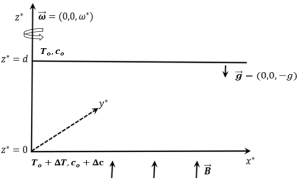
Consider double-diffusive convection due to temperature dependent internal heating in an infinitely horizontal layer of a fluid with electrical conduction saturated by Darcy layer of thickness d. This fluid layer is held between z*=0 andz*=d stress-free boundaries. The lower and upper plates are maintained at temperature and solute concentration Th*=T0+T, c*=c0+c and T0, c0, respectively such that Th*>T0,ch*>c0. The fluid system turns around the central axis consistently in the vertical direction with angular momentum, ω*=ωk andx*, y*, z* taken with z*=0 as the starting point and the gravitational field acts vertically downwards. A uniform magnetic field of strength B=0, 0,  B0 act vertically upwards. On account of small magnetic Reynolds number, induced magnetic field is neglected. The diagrammatic representation of the governing equation is given in Figure 1.
Figure 1. Schematic diagram of the physical problem.
2.1. Governing Equations
Employing Darcy model, Lorentz force and the Coriolis acceleration together with Boussinesq approximation, the governing equations are .
*.V*=0(1)
ρ0ϕV*t*=-*P*-ρ01-βtT*-T0*+βcc*-c*gk-μKV*-2ρ0ϕω× V*+μe*2V+ σcB02u*,v*,0(2)
AT*t*+(V*.*)T*=αm*2T *+QT*-T0(3)
ϕC*t*+(V*.*)c*=Dc*2c*(4)
The variables entering the equations are defined in the nomenclature.
The boundary conditions are
V*=0 onz*=0,d(5)
for the velocity, and
T*=T0+T, c*=c0+conz*=0(6)
T*=T0, c*=c0onz*=d(7)
The non-dimensional form of Eqs. (1) – (4) and the boundary conditions (5) and (6) can be written as
. V=0(8)
1Vat+1V= -P+RaTk-Rs ck+Da2V-KDV-TDk ×V-Ha2U, V, 0 (9)
Tt+.VT=2+γT(10)
ε ct+.Vc=1Le2c(11)
with boundary conditions
W=0, T=1, c=1 on z=0(12)
W=0, T=0, c=0 on z=1(13)
The dimensionless parameters are listed in the nomenclature.
2.2. Motionless State
The motionless system is
vb=0, T=Tbz, c=cbz, P=Pbz, here, the subscript b denotes basic state. Then from Eqs. (8) - (11) and the boundary conditions (12) and (13), the governing equations of the basic state are
Pbz=RaTbz-Rscb; d2Tbdz2+γTb=0;d2cbdz2=0(14)
Tb=cb=1 on z=0(15)
Tb=cb=0 on z=1(16)
On solving Eqs. (14) subject to boundary conditions (15) and (16), we obtain the basic state pressure, temperature and solute concentration profiles, respectively, as
Pbz=Ra Cos γ 1-zγSin γ+Rsz22-z;
Tbz= Sin [γ (1-z)] Sin [γ] ; cbz=1-z(17)
2.3. Linearized Equations
Let
V=v , T=Tbz+θ,P=pbz+p, c=cbz+s (18)
in which the perturbed quantities v , p, θ and s are assumed small compared to the equilibrium quantities. With Eq. (18), the governing Eqs. (8) - (11) and the boundary conditions (12) and (13) become
. v=0(19)
1Vat+1v+Ha2u, v, 0+P-Raθk+Rssk-TDk ×v(20)
θt+v. θ+ fzw=2+γθ(21)
Leεst+v. s-Le w=2s(22)
Where
-dTbdz=fz=γSinγCos [γ (1-z)]
isthebasicstatetemperaturedistributiongradient,andboundaryconditionsbecomes;
w= θ=s=0onz=0,1 (23)
2.4. Normal Mode Analysis
To facilitate our analysis, we take the curl and curl curl of equation (17) and keeping the z-component only we obtain
1Vat+1+Ha2ς-TDDw=0(24)
1Vat+12W+Ha2D2w+TD-Ra2hθ+Rs2hS=0(25)
Where
ς=Vx-uy,2h=x2-y2,Dz.
For linear stability analysis, we convert Eqs. (19), (20), (21) and (22) to an eigenvalue problem by writing W, ς, θ and s in the form
Wςθs=WzZzΘzSzfx,yeωt(26)
where the function fx,yis the planform which tiles the plane and 2h=-a2fx,y.
The substitution of Eq. (26) into Eqs. (19), (20), (21) and (22) yield the following system
D2-a2+γ-ωΘ+FzW=0(27)
D2-a2-LeεωS+LeW=0(28)
ωVa+1+Ha2Z-TDDW=0(29)
ωVa+1D2-a2W+Ha2D2W+TDDZ+a2RaΘ-a2RcS=0(30)
Now, the boundary conditions are
W=0=D2W=DZ=Θ=Sonz=0,1(31)
The elimination of Z between Eqs. (29) and (30) yields
ωVa+MωVa+1D2-a2W+ωVa+M Ha2D2W+TDD2W+ a2ωVa+MRa Θ-a2ωVa+MRs S=0(32)
Where M=1+Ha2.
The boundary conditions reduce to
W=Θ=S=0onz=0,1(33)
The boundary conditions suggest that we seek solutions of Eqs. (27), (28) and (32) in the form
W=W0Sinπz, Θ=Θ0Sinπz, S=S0Sinπ(34)
The substitution of Eq. (34) into Eqs. (27), (28) and (32) yield the following eigenvalue problem in matrix
HX¯=0(35)
where
H= -2Fzδ2-γ+ω0-Le0δ2+LeεωωVa+MωVa+1δ2+TDπ2-a2RaωVa+Ma2RsωVa+M
X¯T=W0,Θ0,S0,δ2=π2+a2 and
F=2π24π2-ɤ.
The solvability of system given in Eqs. (35) requires that H=0, from which
Ra=δ2-γ+ωδ2+LeωHa2π2Va+δ2Va+δ2ω2a2F Vaδ2+Leω+Le Rs2Fδ2+Leω+π2TD Va2a2FM Va+ω(36)
It would be remarked that the growth rates, given by
s=ωr+iωi, where ωr, ωi are real. Whenever
ωr<0 the system is stable, unstable when ωr>0 and neutrally or marginally stability when ωr=0.
2.5. Marginal Stationary Convection
In this case ω=0, so that ωr=ωi=0 at the margin of stability. Now, setting ω=0 and Ra=Rastin Eq. (36), gives
Rast=δ2-ɤ2Fπ2Ha2+δ2a2+LeRsδ2+π2TDa2H(37)
By setting the wavenumber a=ac in Eq. (37) and minimizing according to Rastac2=0, we obtain the following 8th order polynomial
a8ac8+a6ac6+a4ac4-a2ac2-a0=0(38)
where
a8=1+Ha2=M,
a6=2Mπ2,
a4=Mπ2+LeRsγ+π2Ha2γ-π2-π2π2-γTD,
a2=2π4π2-γM+TD,a0=π6γ-π2M2+TD
2.6. Marginal Oscillatory Convection
For oscillatory convection, we set ω=iωi0, Ra= Raosin Eq. (36) and obtain
Raos=1+iωi2(39)
Where
1=d1d2-δ22a2F Va+Le Rsd1δ2+Le εωi22Fδ4+Le2ε2ωi2+π2TDVaMVad1+ωi22a2FM2Va2+ωi2
2=d1δ2+d22a2F Va+Le Rsδ2-Leεd12Fδ4+Le2ε2ωi2+π2TDVaMVa-d12a2FM2Va2+ωi2
d1=δ2-γ, d2=VaHa2π2+δ2, δ2=π2+a2.
Since Raos>0 and setting 2=0, ωi0 in Eq. (39) yields the frequency of oscillation as
ωi2=12Le2ε2d1δ2+d2-d1δ4-δ2Le Vaa2Rs+LeM2Va ε2d1+d2+Le2Va εa2Rs d1-M2Va εd2+π2Va εd1-MVaTD+-4Le2Va2ε2d1δ2+d2M2δ4-a2Le2Rs Va εd1+δ2a2Le Rs Va+d2+δ2π2MVa-d1TD+a2δ2Le Rs Va+d1δ2-a2Le2Rs Va εd1+δ2Le2M2Va2ε2d1+δ2d2+Le2M2Va2ε2d2+Le2π2Va2ε2MVa-d1TD2)12(40)
3. Results and Discussions
The problem of rotating Darcy model with modified Boussinesq approximation involving temperature and solute concentration together with stress-free boundaries have been studied analytically for the determination of the conditions leading to the occurrence of stationary and oscillatory convections with vertical magnetic field and temperature -dependent internal heating. We are going to examine graphically and numerically the consequence of the parameters in the mathematical model and the stability curves Ra-a for the criteria leading to marginal stationary convection for the parameters Ha, Ta, Rs, Le, and γ.
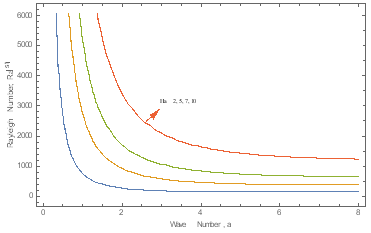
Figure 2. Marginal stability curves for electrically insulated walls for fixed Ta=10,γ=0.2, Rs=10, Le=1 and various values of Hartman Number, Ha.
Figure 2 illustrates variation of Ra(st)with a of marginal stability curves for electrically insulated walls. It is found that for fixed values of Ta=10, γ=0.2, Rs=10, Le=1 the stationary Rayleigh number increase with increased with increasing values of Ha. Hence, magnetic field act in such a manner that the system is stabilized. This result is consistent with earlier results of .
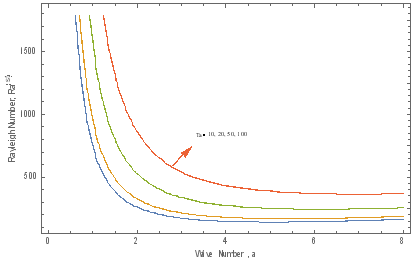
Figure 3. Marginal stability curves for electrically insulated walls for fixed Ha=2, γ=0.2, Rs=10, Le=1 and various values of rotation parameter, Ta.
Figure 3 depicts the contribution of rotation on conditions leading to instability with fixed other parameters. The result indicates that as the rotation increases, the stationary Rayleigh number, also increases. This implies that rotation raised the value of the control parameter Ra leading to more stability. This is agreement with the early result obtained by . Equally, increase in solutal Rayleigh number.
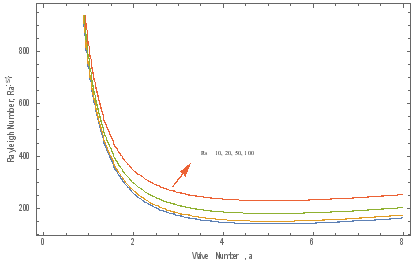
Figure 4. Marginal stability curves for electrically insulated walls for fixed Ha=2, γ=0.2, Ta=10, Le=1 and various values of solutal Rayleigh number, Rs.
Figure 4 lead to increased values of Ra. This delayed the onset of instability and enhanced stability.
Heating parameter, γ as depicted
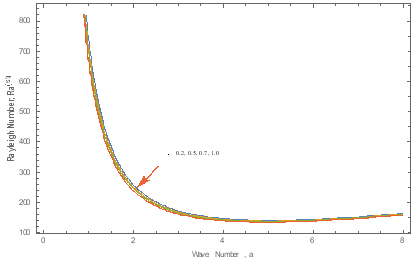
Figure 5. Marginal stability curves for electrically insulated walls for fixed Ha=2,Rs=10, Ta=10, Le=1 and various values of heat source parameter, γ.
Figure 5 is to hasten the breakdown of stability. In other words, it allows instability to set early, and therefore act as a destabilizing agent in the system . The illustration of the variation of Ra with a depicted
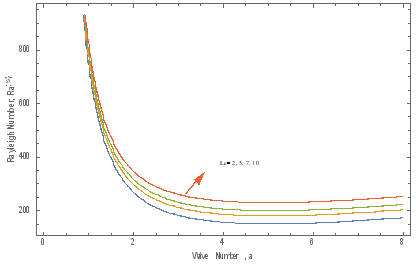
Figure 6. Marginal stability curves for electrically insulated walls for fixed Ha=2, γ=0.2, Rs=10, Ta=10, Le=1 and various values of Lewis number, Le.
Figure 6 show that increase in Lewis number delay the onset of instability. Hence, the Lewis number act in a manner that make the system more stable .
4. Conclusions
The pinnacle for the onset temperature-dependent internal heating magnetoconvection in a rotating Darcy porous layer heated from below with the given boundary conditions was systemically examined. The method used was the linear stability analysis to established the requirement for the commencement of stationary and oscillatory convection in the structure. The outcome of physical parameters in the mathematical model as given are illustrated with the appropriate graphs. The analysis shows that maximizing the magnetic field and rotation parameters moderates the commencement of both stationary and oscillatory convection, whereas Prnndtl number delay the commencement of oscillatory convection. The conclusion of this is that magnetic field parameter, Ha, rotation parameter, TD, and the Prandtl number, Pr, are balancing factors, while the heat source parameter, ℽ, speeds up the commencement of convection.
Abbreviations

EQS

Equations

Acknowledgments
This goes to my Ph.D supervisor, C. Israel Cookey and my family.
Author Contributions
Edmond Obiem Odok: Conceptualization, Data curation, Methodology, Validation, Writing – original draft
Liberty Ebiwareme: Formal Analysis, Supervision, Writing – review & editing
Conflicts of Interest
The authors declare no conflicts of interest.
References
[1] Alex, S. M., & Patil, P. R. (2000). Thermal instability in ananisotropic rotating medium. Heat & Mass Transfer, 36, 159– 163.
[2] Bangaraju, B. V., Gayathri, M. S. & Danesh, P. A. Onset of magnetoelectro thermo convection in adiaelectric fluid saturated rotating porous medium. International journal of scientific research in science and technology (IJSRST). 2021, Volume 8, No. 2.
[3] Chandrasekhar, S. Hydrodynamic and hydromagnetictability. Oxford UK; Clarendon Press; 1961.
[4] E. O. Odok, C. Israel-Cookey & E. Amos. Onset of Magnetoconvection in a Rotating Darcy Porous Layer Heated from Below with Temperature Dependent Heat Source. American. Journal of Fluid Mechanics; 2018, 8(4): 105 – 111,
[5] Falsaperla, P. and Mulone, G.. Stability in the rotating Benard problem with Newton-Robin and fixed heat boundary conditions. Mechanics Research communications; 2010, 37(1), 122–128.
[6] Greenspan, H. P. The theory of rotating fluids. United Kingdom, Cambridge University Press; 1968.
[7] Israel-Cookey C. AMOS E. and Ebiwareme, L. Effect of vertical magnetic field on the double diffusive convection in a horizontal porous layer with concentration based internal heat source. Asian research Journal of Mathematics; 2017, 7(1), 1 – 15.
[8] Kang, J., Xia, T., & Liu, Yingke.. Heat transfer and flows of thermal convection in a fluid saturated rotating porous medium. Mathematical Problems in Engineering; 2015, Ariticle ID 905458, 11 pages.
[9] Nield, D. A & Bejan, A. Convection in porous media, 5th ed, New York: Springer. 2006.
[10] Patil, P. R. and Vaidyanathan, G. On setting up of convection currents in a rotating porous medium under the influence of variable viscosity. International Journal of Engineering Science. 1983, 21, 123 – 130.
[11] Rudraiah N., Shivakumara, I. S. Friedrich, R. The effect of rotation on linear and nonlinear double diffusive convention in a sparsely packed porus medium. International Journal of Heat and Mass Transfer. 1986, 29(9), 1301-1317.
[12] Savitha, Y., Nanjundappa, C., & Shivakumara, I. Penetrative Brinkman ferroconvection via internal heating in high porosity anisotropic porous layer: influence of boundaries. Heliyon, 2021; 7.
[13] Vadasz, P.. Coriolis effect on gravity-driven convection in a rotating porous layer heated from below. Journal of Fluid Mechanics, 1998; 276, 351 – 375.
[14] Vadasz, S. and Govender, S.. Stability and stationary induced gravity and centrifugal forces in a rotating porous layer distant from the axis of rotation. International Journal of Engineering Science, 2001; 39, 715 – 732.
[15] Veneet, K. V. & Abdul, F. A.. Effects of magnetic field on Darcy – Brinkman flow through a rotating porous channel system. SpecialTopicsRev Porous Media – Volume 16, Issue 3, 2025, 99 – 110.
Cite This Article
  • APA Style

    Odok, E. O., Ebiwareme, L. (2026). Influence of Temperature-Dependent Internal Heating on Magnoteconvention in a Rotating Darcy Porous Layer. American Journal of Applied Mathematics, 14(3), 139-147. https://doi.org/10.11648/j.ajam.20261403.14

    Copy | Download

    ACS Style

    Odok, E. O.; Ebiwareme, L. Influence of Temperature-Dependent Internal Heating on Magnoteconvention in a Rotating Darcy Porous Layer. Am. J. Appl. Math. 2026, 14(3), 139-147. doi: 10.11648/j.ajam.20261403.14

    Copy | Download

    AMA Style

    Odok EO, Ebiwareme L. Influence of Temperature-Dependent Internal Heating on Magnoteconvention in a Rotating Darcy Porous Layer. Am J Appl Math. 2026;14(3):139-147. doi: 10.11648/j.ajam.20261403.14

    Copy | Download

  • @article{10.11648/j.ajam.20261403.14,
      author = {Edmond Obiem Odok and Liberty Ebiwareme},
      title = {Influence of Temperature-Dependent Internal Heating on Magnoteconvention in a Rotating Darcy Porous Layer},
      journal = {American Journal of Applied Mathematics},
      volume = {14},
      number = {3},
      pages = {139-147},
      doi = {10.11648/j.ajam.20261403.14},
      url = {https://doi.org/10.11648/j.ajam.20261403.14},
      eprint = {https://article.sciencepublishinggroup.com/pdf/10.11648.j.ajam.20261403.14},
      abstract = {The commencement of conventions which are the stationary and oscillatory in the study of the influence of temperature-dependent internal heating on magnetoconvection in a rotating Darcy porous layer was systematically examined. The linear stability analysis was scrutinized with the boundary condition of the problem being free-free. A modified Boussinesq approximation is included in the momentum equation and the Coriolis force was taken into consideration. The given non-dimensional equations were linearized and the normal mode technique was used to obtain marginal stationary and the marginal oscillatory convection. The criteria for the onset of convection in the system are derived analytically. The effects of the parameters: heat source, , magnetic field, , rotation,  and ratio of viscosities,  on the onset of convection are presented and analyzed graphically in details. The investigation showed that the result of raising magnetic field, rotation and ratio of viscosity slowed down the commencement of the convections, that is both the stationary and oscillatory convections, hence making the system steady. In the other hand, increasing heat source parameter, catalyzes the commencement of convection and destabilizes the mechanism. Prandtl number was found to slow the onset of oscillatory convection. Hence we can infer that magnetic field parameter, Ha, rotation parameter, TD, and the Prandtl number, Pr, are balancing factors, while the heat source parameter, ℽ, speeds up the commencement of convection.},
     year = {2026}
    }
    

    Copy | Download

  • TY  - JOUR
    T1  - Influence of Temperature-Dependent Internal Heating on Magnoteconvention in a Rotating Darcy Porous Layer
    AU  - Edmond Obiem Odok
    AU  - Liberty Ebiwareme
    Y1  - 2026/05/27
    PY  - 2026
    N1  - https://doi.org/10.11648/j.ajam.20261403.14
    DO  - 10.11648/j.ajam.20261403.14
    T2  - American Journal of Applied Mathematics
    JF  - American Journal of Applied Mathematics
    JO  - American Journal of Applied Mathematics
    SP  - 139
    EP  - 147
    PB  - Science Publishing Group
    SN  - 2330-006X
    UR  - https://doi.org/10.11648/j.ajam.20261403.14
    AB  - The commencement of conventions which are the stationary and oscillatory in the study of the influence of temperature-dependent internal heating on magnetoconvection in a rotating Darcy porous layer was systematically examined. The linear stability analysis was scrutinized with the boundary condition of the problem being free-free. A modified Boussinesq approximation is included in the momentum equation and the Coriolis force was taken into consideration. The given non-dimensional equations were linearized and the normal mode technique was used to obtain marginal stationary and the marginal oscillatory convection. The criteria for the onset of convection in the system are derived analytically. The effects of the parameters: heat source, , magnetic field, , rotation,  and ratio of viscosities,  on the onset of convection are presented and analyzed graphically in details. The investigation showed that the result of raising magnetic field, rotation and ratio of viscosity slowed down the commencement of the convections, that is both the stationary and oscillatory convections, hence making the system steady. In the other hand, increasing heat source parameter, catalyzes the commencement of convection and destabilizes the mechanism. Prandtl number was found to slow the onset of oscillatory convection. Hence we can infer that magnetic field parameter, Ha, rotation parameter, TD, and the Prandtl number, Pr, are balancing factors, while the heat source parameter, ℽ, speeds up the commencement of convection.
    VL  - 14
    IS  - 3
    ER  - 

    Copy | Download

Author Information
  • Department of Mathematics, University of Cross State, Calabar, Nigeria

    Biography: Edmond Obiem Odok is a Senior Lecturer in the Department of Mathematics, University of Cross River State. He completed his PhD in Mathematical Physics from River State University in 2019, and his Master in Applied Mathematics from University of Port Harcout in 2012. His research interest are Mathematical Physics, Fluid Mechanic, ODE, PDE, Numerical Method and Algebra. Recognized for his exceptional contributions, he’s the SIWES and Project coordinator, Mathematics Department, university of Cross River State. He has published several articles in reputable local and international journals, contributing to the advancement of applied mathematics research.

    Research Fields: Mathematical Physics, Numerical Methods, Partial Differential Equations and Numerical Analysis and Simulations.

  • Department of Mathematics, Rivers State University, Port Harcourt, Nigeria

    Biography: Liberty Ebiwareme is a Lecturer in Mathematics at Rivers State University, Nigeria, holding MSc and PhD degrees in Applied Mathematics with a focus on Magnetohydrodynamic fluid stability. His research covers fluid dynamics, heat and mass transfer in porous media, boundary layer theory, and MHD flow stability, among other areas. He has a strong publication record in both local and international journals and has contributed to book chapters and conference proceedings, advancing the field of Mathematical Sciences.

    Research Fields: Mathematical Physics, Boundary Layer Theorem, Computational Methods and Numerical Analysis