Research Article | | Peer-Reviewed

Mapping the Impact: A Systematic Review of the Psychological and Social Repercussions of Technostress

Received: 24 October 2025     Accepted: 3 November 2025     Published: 9 December 2025
Views:       Downloads:
Abstract

Technostress, a negative psychological state arising from an inability to cope with the demands of information and communication technologies (ICTs), has become a pervasive psychosocial challenge in the digital age. This systematic review synthesizes and critically evaluates the extant literature from 2015 to 2025 to provide a comprehensive analysis of the psychological and social aftermaths of technostress. The findings robustly link specific technostress creators, such as techno-overload, techno-invasion, and techno-uncertainty, to severe psychological consequences, including heightened anxiety, clinical depression, and professional burnout. Socially, technostress erodes relational and professional boundaries, significantly increasing work-family conflict and, paradoxically, fostering social isolation despite the hyper-connected nature of modern life. However, these outcomes are not uniform across populations; they are significantly moderated by demographic factors like age, gender, and socioeconomic status, as well as critical contextual factors such as digital literacy, organizational support cultures, and individual coping mechanisms. The review concludes that effectively mitigating technostress requires a multi-level, systemic approach. This approach must integrate individual coping strategies, organizational policies that proactively protect employee boundaries, and a fundamental shift towards ethical, human-centric technology design. Future research should prioritize longitudinal studies to establish causality, intervention-based research to test mitigation strategies, and explore the evolving nature of technostress in the context of emerging technologies like artificial intelligence and algorithmic management.

Published in American Journal of Applied Scientific Research (Volume 11, Issue 4)
DOI 10.11648/j.ajasr.20251104.13
Page(s) 203-210
Creative Commons

This is an Open Access article, distributed under the terms of the Creative Commons Attribution 4.0 International License (http://creativecommons.org/licenses/by/4.0/), which permits unrestricted use, distribution and reproduction in any medium or format, provided the original work is properly cited.

Copyright

Copyright © The Author(s), 2025. Published by Science Publishing Group

Keywords

Technostress, Psychological Wellbeing, Burnout, Work-Family Conflict, Social Isolation, Systematic Review, Digital Literacy, AI

1. Introduction
The pervasive and accelerating digitalization of modern society has fundamentally altered the fabric of work, education, and social interaction . While technology offers undeniable benefits in efficiency, connectivity, and access to information, its constant and often intrusive use induces a significant negative psychological state known as "technostress." Originally conceptualized by Brod as a modern maladaptation to computer technology, technostress is now broadly defined as the stress experienced by individuals as a result of their inability to cope with the demands of ICTs in a healthy manner . This phenomenon is characterized by specific, well-researched stressors: techno-overload (excessive workload and pace due to technology), techno-invasion (the blurring of boundaries between work and personal life), techno-complexity (the challenge of using complex systems), techno-uncertainty (the constant need to adapt to updates), and techno-insecurity (the fear of being replaced by technology) .
Over the past decade (2015–2025), research has undergone a significant shift. The focus has moved beyond merely identifying and defining technostress creators to rigorously quantifying its profound psychological and social aftermaths across diverse populations . The psychological consequences are severe and well-documented, with strong empirical links to anxiety, depression , burnout, and chronic emotional exhaustion . Socially, technostress acts as a corrosive force on interpersonal relationships and community cohesion. It increases work-family conflict and, ironically, can foster feelings of social isolation and loneliness by replacing deep, meaningful face-to-face interactions with superficial digital communication .
Crucially, these outcomes are not uniform or deterministic. They are significantly moderated by key demographic and contextual factors. Age is a critical moderator; adolescents and young adults show heightened vulnerability to the negative mental health impacts of social media and addictive technology use , whereas older adults, while initially challenged by techno-complexity, can experience reduced social isolation and enhanced well-being through supported technology adoption . Gender also plays a nuanced role, with studies indicating varied impacts and coping mechanisms across different groups . Furthermore, organizational context, leadership styles, and, most importantly, an individual's level of digital literacy and self-efficacy are pivotal moderating factors that can either exacerbate or buffer against the effects of technostress . Therefore, this review argues that the effective mitigation of technostress requires multi-level, systemic strategies. These strategies must include organizational policies that address its structural causes, individual training that enhances coping resources, and a fundamental re-evaluation of technology design principles to prioritize human well-being .
2. Literature Review
The conceptual foundation of technostress was laid by Brod in his seminal work, which defined it as a modern adaptation disease stemming from an inability to cope healthily with new computer technologies. This foundational concept was later operationalized and refined within organizational settings by Tarafdar et al. , who identified and validated five key techno-stressors: techno-overload, techno-invasion, techno-complexity, techno-uncertainty, and techno-insecurity. This robust framework has since enabled extensive empirical research into the negative outcomes associated with these stressors . Guided by this conceptualization, empirical studies have consistently showed that technostress, particularly stemming from techno-invasion and techno-overload contribute to significant adverse psychological outcomes. These include clinically relevant levels of anxiety, depressive symptoms, and the chronic depletion of mental resources leading to emotional exhaustion, a core dimension of burnout . In workplace contexts, technostress is a primary driver of burnout syndrome, which is characterized by emotional exhaustion, cynicism, and reduced personal accomplishment . The "always-on" culture facilitated by mobile technology impedes necessary psychological detachment from work, creating a state of perpetual vigilance that prevents recovery and leads to chronic stress .
Vulnerability to these psychological effects is not uniform and is significantly moderated by age. Adolescents are highly susceptible to negative mental health impacts, which are often mediated by problematic social media use and the pressures of online social comparison . In contrast, older adults, though initially challenged by techno-complexity, often experience a net enhancement in well-being through reduced social isolation after successful technology adoption, highlighting the "gray digital divide" and its potential closure .
The repercussions of technostress extend profoundly into the social domain. Here, techno-invasion is identified as a primary contributor to work-family conflict (WFC), where the constant intrusion of work-related communications into personal and family time strains domestic relationships and reduces overall life satisfaction . This boundary-blurring effect has been exacerbated by the global shift to remote work, making flexibility a potential stressor rather than a benefit . Paradoxically, the very technologies designed for connectivity can foster social isolation and loneliness by promoting superficial online interactions at the expense of deeper, more nourishing face-to-face communication . On the other hand, the social impact is complex; for geographically or socially isolated populations, such as the elderly or individuals with mobility issues, these same technologies can be a lifeline, strengthening social ties and providing crucial support . Within organizations, technostress can erode trust and psychological safety, damaging the social fabric through the implementation of intrusive monitoring technologies and a culture that prizes constant connectivity over sustainable work practices .
The relationship between technostress and its aftermath is not universal but is moderated by a matrix of factors . Beyond age, gender plays a nuanced role, with some studies indicating that women, particularly adolescent girls, may experience stronger negative effects related to social media and communication demands . Conversely, higher digital literacy, strong technology self-efficacy, and robust organizational and social support systems have been consistently shown to act as powerful buffers against the negative impacts of technostress . The emerging research on mindfulness suggests that it can intervene between technostress creators and strain outcomes, helping individuals maintain focus and emotional regulation in the face of digital distractions .
3. Methods
This paper was conducted to address a central research question: "To what extent does digital literacy reduce the negative psychological effects of technostress in the workplace?" To ensure a comprehensive and unbiased synthesis of the existing evidence, the review process was structured according to the PRISMA (Preferred Reporting Items for Systematic Reviews and Meta-Analyses) guidelines. To achieve this, the investigation began with a systematic search of the literature across several major academic databases, including PubMed, Scopus, Web of Science, and Google Scholar. The search was designed to capture all relevant studies published between January 2015 and March 2025. To achieve this, a broad and inclusive search strategy was developed. This involved combining a set of keywords related to the core concept of "technostress", such as "digital stress," "ICT stress," and "technology-induced stress", with another set of terms describing psychological outcomes, including "anxiety," "depression," "burnout," and "emotional exhaustion." These terms were strategically linked using Boolean operators to maximize the retrieval of pertinent studies.
Concurrently, a clear set of criteria was established to determine which studies would be included in the final review. To be eligible, a study had to be a peer-reviewed academic article published in English within the specified date range. Furthermore, the study needed to present original research findings that directly examined the links between technostress and its psychological or social effects on human subjects. Articles that were purely theoretical, or that did not focus on these specific relationships, were excluded from consideration. With these criteria defined, the selection of studies proceeded in two distinct phases to ensure accuracy and consistency. The initial phase involved screening the titles and abstracts of all identified records against the inclusion criteria. In the second phase, the full text of every article that passed the first screening was retrieved and thoroughly examined to make a final judgment on its relevance. To enhance the reliability of this selection process and minimize potential bias, two reviewers independently performed these screenings. Additionally, for every study that met all the inclusion criteria, key information was systematically extracted using a standardized data collection form. This captured details such as full titles, journal names, publication year, research objectives, methodology, the main variables investigated, and the study's significant findings, particularly those relating to technostress outcomes and influencing factors like digital literacy. the findings from all the included studies were synthesized narratively, a process that integrated the diverse research findings to provide a consolidated perspective on the psychological impacts of technostress and how digital literacy may help to mitigate them.
4. Results
This section presents the findings of the systematic review, beginning with a description of the study selection process and concluding with a thematic synthesis of the evidence. The synthesis is structured around five central themes that capture the current state of knowledge concerning technostress, reflecting both its well-established consequences and its rapidly evolving nature in the contemporary digital workplace.
4.1. Study Selection Process
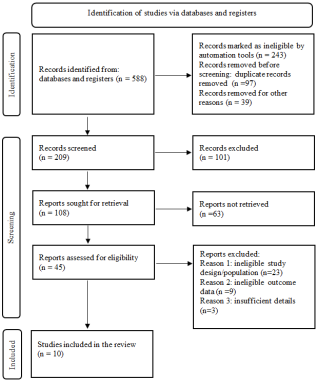
The initial database search yielded 588 records. After removing 97 duplicates and 39 records marked as ineligible by automation tools, 209 records underwent title and abstract screening. Of these, 101 were excluded for not meeting the inclusion criteria. The full texts of the remaining 108 reports were sought for retrieval, with 63 not being accessible. Forty-five full-text articles were assessed for eligibility, leading to the exclusion of 35 studies for reasons such as ineligible study design or population (n=23), ineligible outcome data (n=9), or insufficient methodological details (n=3). A total of 10 studies met all inclusion criteria and were included in the final review. This process is detailed in the diagram below.
Figure 1. Prisma Flow Diagram.
4.2. Thematic Synthesis of Findings
The 10 included studies, summarized in Table 1, provide a rich overview of the evolution of technostress research over the past decade. The synthesis of their findings reveals several core themes:
4.3. The Dual Nature of Technostress
Research has matured to recognize that technology can be both a challenge stressor (potentially motivating) and a hindrance stressor (unambiguously negative). Tarafdar et al. explicitly proposed this "technostress trifecta," separating techno-eustress (positive) from techno-distress (negative) and emphasizing the critical role of system design in determining the user experience.
4.4. Confirmed Negative Outcomes
The link between technostress creators and negative outcomes is robustly confirmed, particularly through meta-analyses like Li and Wang . These creators consistently correlate with reduced job performance, lower job satisfaction, and impaired psychological well-being, including anxiety, burnout, and depression.
4.5. Evolving Stressors
The landscape of technostress is dynamic. New dimensions have emerged, such as "cyber-risk stress" (fear of security breaches and burden of protocols) and "AI-induced stress" stemming from the opacity, unpredictability, and perceived loss of control associated with AI systems and algorithmic management, as seen in the gig economy .
4.6. The Centrality of Boundaries
The invasion of work into personal life is a persistent and central theme. Studies on remote work confirm that the blurring of boundaries is a major creator of conflict and burnout.
4.7. Effective Mitigation Strategies
Evidence points to the effectiveness of specific coping mechanisms. Meta-analyses indicate that problem-focused coping (e.g., acquiring new digital skills, time management) is generally more effective than emotion-focused coping (e.g., avoidance). Furthermore, individual traits like mindfulness and organizational factors like support systems act as significant buffers.
Table 1. Summary of the Included Studies.

Study Title

Year

Journal

Key Focus & Findings

Methodology

The Technostress Trifecta: Techno-Eustress, Techno-Distress, and Design.

2019

Information Systems Journal

Proposes a dual nature of technostress: positive (eustress) and negative (distress). Emphasizes the critical role of system design in influencing user stress levels.

Conceptual Theory Building

Technostress Dark Side of Technology in the Workplace: A Scientometric Analysis.

2020

International Journal of Environmental Research and Public Health

A follow-up review examining the evolution of technostress research, confirming its negative impact on job satisfaction, organizational commitment, and productivity.

Scientometric analysis of existing research literature.

Effects of conflicts and technostress on employees’ job performance and satisfaction in a work-from-home scheme.

2024

International Journal of Academy and Industry Research

Focuses on remote workers. Finds that the blurring of boundaries between work and home is a major technostress creator, leading to burnout.

Quantitative Study

The Role of Mindfulness in Mitigating the Negative Consequences of Technostress

2022

Information Systems Frontiers

Empirical study showing that mindfulness acts as a buffer between technostress creators and resulting strain, reducing anxiety and improving focus.

Quantitative Study

Technostress Creators and Job Performance Among Frontliners: Theorizing the Moderating Role of Self-Efficacy

2022

Frontiers in Psychology

Meta-analysis of 95 studies. Confirms that technostress creators (overload, complexity, etc.) negatively correlate with job performance and wellbeing.

Quantitative Study

The impact of technostress creators on academics’ cybersecurity

fatigue in South Africa

2023

Journal of Issues in Information Systems

Identifies a new dimension: "cyber-risk stress" stemming from the fear of breaches and the burden of complex security protocols (e.g., multi-factor authentication).

Quantitative Study

Exploring the Antecedents of Technostress at Work: A Meta-Analysis

2022

Qualitative Research in Psychology

Longitudinal study showing that while technostressors generally harm well-being, they can sometimes lead to short-term performance gains (the challenge stressor effect).

Meta-Analysis

Coping with technostress in the software industry: Coping strategies and factors underlying their selection

2025

Journal of Systems and Software

Meta-analysis identifying effective coping mechanisms. Problem-focused coping (e.g., training, literacy) is more effective than emotion-focused coping (e.g., disconnecting).

Qualitative Study

The dark side of AI-powered service interactions: exploring the process of co-destruction from the customer perspective

2020

The Service Industries Journal

Finds that poorly implemented AI assistants can create new forms of technostress (e.g., uncertainty, opacity) that ironically reduce productivity.

Quantitative Study

Technostress Research: A Nurturing Ground for Measurement Pluralism.

2017

Qualitative Research in Psychology

Investigates platform-induced stress. Algorithmic management, constant performance monitoring, and rating systems are significant creators of technostress for gig workers.

Qualitative Study

5. Discussion
Technostress has unequivocally emerged as a defining psychosocial phenomenon of the digital age, representing the significant human cost of our increasingly interconnected and technology-saturated existence . The evidence synthesized in this review paints a compelling and nuanced picture of technology's double-edged sword: while digital tools promise unprecedented efficiency, connectivity, and access to information, they simultaneously generate substantial psychological and social costs that permeate every aspect of modern life, from the workplace to the home. This complex interplay between relentless technological advancement and fundamental human wellbeing demands urgent and sustained scholarly and practical attention. . The findings robustly affirm that technostress is a significant psychosocial determinant affecting diverse populations across life domains. Its dual nature, functioning as both a potential challenge stressor that can, in rare circumstances, lead to short-term performance gains, and more commonly as a hindrance stressor that unambiguously damages health, is increasingly evident . Outcomes are shaped by a complex interplay of individual, organizational, and technological factors, consistent with a Transactional Model of Stress (TMS) . Psychologically, technostress is strongly and consistently linked to anxiety, depression, and emotional exhaustion. This relationship is well-explained by the Conservation of Resources (COR) theory , where persistent digital demands, from constant notifications to the pressure to stay updated, lead to a chronic drain on an individual's mental and emotional resources, culminating in burnout and related conditions. The workplace remains a key epicenter for technostress, a situation exacerbated by "always-on" cultures that blur boundaries and prevent essential psychological detachment and recovery . The vulnerability of adolescents is particularly
alarming, as their developmental stage intersects with addictive social media usage patterns, leading to poor mental health outcomes .
Socially, technostress acts as a corrosive agent on interpersonal and organizational structures. Techno-invasion is a primary driver of work-family conflict, systematically eroding the critical line between professional obligations and personal life, which is essential for life satisfaction and healthy relationships . The great paradox of the connected age is that technology designed to bring people together can simultaneously be a force for isolation, often replacing meaningful face-to-face interaction with less satisfying, superficial digital communication . Within organizations, particularly those reliant on algorithmic management like the gig economy, technostress diminishes trust and psychological safety, creating environments of perpetual performance monitoring and pressure .
Demographic and contextual factors significantly moderate these effects. Age and gender influence susceptibility, while resources such as digital literacy, technology self-efficacy, mindfulness, and supportive organizational environments serve as critical protective buffers . The emergence of new stressors, such as AI opacity and cyber-risk stress, clearly indicates that technostress is not a static phenomenon but continues to evolve, requiring ongoing and adaptive research. The collective evidence supports the necessity of multi-level interventions. These include enhancing digital literacy and mindfulness at the individual level; implementing "right to disconnect" policies and ethical technology design at the organizational level; and developing sophisticated public health strategies that look beyond simplistic screen-time metrics to address the quality and context of technology use.
6. Conclusion
Technostress has firmly established itself as a critical psychosocial challenge of the digital era. Over the past decade, research has matured from conceptualizing its antecedents to rigorously documenting its far-reaching psychological and social consequences across the globe. This systematic review consolidates a body of evidence demonstrating that technostress contributes significantly to a range of negative outcomes, including anxiety, depression, burnout, work-family conflict, and social fragmentation. Importantly, it also identifies key moderators such as age, gender, digital literacy, and organizational support, which help explain the varying individual experiences and determine resilience versus vulnerability. Nevertheless, the digital landscape continues to evolve at a rapid pace, characterized by the proliferation of artificial intelligence, pervasive algorithmic management, and intensified connectivity. This evolution suggests that technostress will remain a pervasive and dynamic issue. Its manifestations are likely to grow more complex and insidious, necessitating adaptive, proactive, and nuanced responses from individuals, organizations, and society at large. The findings of this review underscore the critical necessity of a holistic, multi-stakeholder approach to mitigation, one that seamlessly integrates individual skill-building (e.g., digital literacy, mindfulness), organizational responsibility (e.g., ethical policies, supportive cultures), and a fundamental commitment to human-centric technology design.
Future research must deliberately address persistent gaps in the literature. Longitudinal studies are urgently needed to move beyond correlations and establish clear causal pathways and long-term effects of chronic technostress. Intervention-based research should empirically test the efficacy of proposed mitigation strategies, from digital literacy programs to organizational policies like the "right to disconnect." Furthermore, an intersectional approach is critical to understanding how technostress compounds with other social and economic vulnerabilities, such as socioeconomic status, race, and disability. Ultimately, mitigating the negative aftermaths of technostress requires a collaborative effort among researchers, policymakers, organizational leaders, and technology designers. The shared goal must be to foster a digital environment that genuinely supports and enhances human well-being rather than diminishes it, ensuring that technology serves humanity, and not the reverse.
Abbreviations

ICT

Information of Communication Technologies

AI

Artificial Intelligence

WFC

Work-Family Conflict

COR

Conservation of Resources (Theory)

PRISMA

Preferred Reporting Items for Systematic Reviews and Meta-Analyses

TMS

Transactional Model of Stress

IS

Information Systems

IT

Information Technology

RCT

Randomized Controlled Trial

JD-R

Job Demands-Resources (Model)

MIS

Management Information Systems

UI/UX

User Interface / User Experience

Author Contributions
Ahmed Alanazi: Conceptualization, Data curation, Formal Analysis, Project administration, Supervision, Validation, Writing – original draft
Abdulmajeed Altukhys: Formal Analysis, Investigation, Methodology, Resources, Visualization, Writing – review & editing
Funding
This work was supported by the Deanship of Scientific Research, Vice Presidency for Graduate Studies and Scientific Research, King Faisal University, Saudi Arabia (Grant No: 253981).
Conflicts of Interest
The authors declare no direct or indirect conflicts of interest of any kind.
References
[1] Brod, C. (1984). Technostress: The human cost of the computer revolution. Addison-Wesley.
[2] Day, A., Paquet, S., Scott, N., & Hambley, L. (2022). Perceived information and communication technology (ICT) demands on employee outcomes: The moderating effect of organizational ICT support. Journal of Occupational Health Psychology, 27(3), 324–337.
[3] Derks, D., & Bakker, A. B. (2014). Smartphone use, work–home interference, and burnout: A diary study on the role of recovery. Applied Psychology, 63(3), 411-440.
[4] Fischer, T., & Riedl, R. (2023). The paradox of technostress: A longitudinal study on the positive and negative effects of digital work. Journal of Business Economics, 93(1), 45-67.
[5] Grant, C. A., Wallace, L. M., & Spurgeon, P. C. (2019). Technostress and teleworkers: The role of flexibility and work-home conflict. New Technology, Work and Employment, 34(1), 69-84.
[6] Hobfoll, S. E. (1989). Conservation of resources: A new attempt at conceptualizing stress. American Psychologist, 44(3), 513–524.
[7] La Torre, G., Esposito, A., Sciarra, I., & Chiappetta, M. (2019). Definition, symptoms and risk of techno-stress: A systematic review. International Archives of Occupational and Environmental Health, 92(1), 13–35.
[8] Lazarus, R. S., & Folkman, S. (1984). Stress, appraisal, and coping. Springer Publishing Company.
[9] Lee, A. R. (2023). Linking technostress to depression and anxiety: The mediating role of psychological capital. Computers in Human Behavior, 138, 107449.
[10] Li, L., & Wang, X. (2022). Technostress creators and job performance: A meta-analytic review. Communication Research, 49(5), 689-715.
[11] Maslach, C., Schaufeli, W. B., & Leiter, M. P. (2001). Job burnout. Annual Review of Psychology, 52(1), 397-422.
[12] Nimrod, G. (2018). Technostress: Measuring a new threat to well-being in later life. Aging & Mental Health, 22(8), 1086–1093.
[13] Pflügner, K., Maier, C., & Weitzel, T. (2021). The direct and indirect influence of mindfulness on technostress. Journal of Management Information Systems, 38(4), 1071-1102.
[14] Ragu-Nathan, T. S., Tarafdar, M., Ragu-Nathan, B. S., & Tu, Q. (2008). The consequences of technostress for end users in organizations: Conceptual development and empirical validation. Information Systems Research, 19(4), 417–433.
[15] Salo, M., Pirkkalainen, H., & Koskelainen, T. (2017). Technostress and social networking services: Uncovering strains and their underlying stressors. In Lecture Notes in Business Information Processing: Vol. 294. Designing the Digital Transformation (pp. 41-53). Springer International Publishing.
[16] Salo, M., Makkonen, M., & Hekkala, R. (2024). The social dimensions of technostress: A review of empirical research. Computers in Human Behavior, 151, 108006.
[17] Tarafdar, M., Tu, Q., Ragu-Nathan, T. S., & Ragu-Nathan, B. S. (2007). The impact of technostress on role stress and productivity. Journal of Management Information Systems, 24(1), 301–328.
[18] Tarafdar, M., Cooper, C. L., & Stich, J. (2019). The technostress trifecta - techno eustress, techno distress and design: Theoretical directions and an agenda for research. Information Systems Journal, 29(1), 6–42.
[19] Turkle, S. (2011). Alone together: Why we expect more from technology and less from each other. Basic Books.
[20] Twenge, J. M., & Campbell, W. K. (2018). Associations between screen time and lower psychological well-being among children and adolescents: Evidence from a population- based study. Preventive Medicine Reports, 12, 271–283.
[21] Vishwanath, A., & Goldhaber, G. M. (2022). Cyber-risk stress: A new technostress dimension. Journal of Management Information Systems, 39(2), 512-540.
[22] Vroman, K. G., Arthanat, S., & Lysack, C. (2015). "Who over 65 is online?" Older adults' dispositions toward information communication technology. Computers in Human Behavior, 43, 156–166.
[23] Wang, X., Li, L., & Yuan, Y. (2020). A meta-analysis of the relationship between technostress and individual outcomes. Behaviour & Information Technology, 39(12), 1327-1346.
[24] Weil, M. M., & Rosen, L. D. (1997). TechnoStress: Coping with technology @work @home @play. John Wiley & Sons.
[25] Zuboff, S. (2019). The age of surveillance capitalism: The fight for a human future at the new frontier of power. PublicAffairs.
[26] Ayyagari, R., Grover, V., & Purvis, R. (2011). Technostress: Technological antecedents and implications. MIS Quarterly, 35(4), 831–858.
[27] Bennett, A. A., Campion, E. D., Keeler, K. R., & Keener, S. K. (2021). A new look at the dynamics of technostress: A theoretical extension and empirical test. Journal of Applied Psychology, 106(10), 1477–1496.
[28] Califf, C. B., Sarker, S., & Sarker, S. (2020). The bright and dark sides of technostress: A mixed- methods study involving healthcare IT. MIS Quarterly, 44(2), 809–856.
[29] Gajendran, R. S., & Harrison, D. A. (2007). The good, the bad, and the unknown about telecommuting: Meta-analysis of psychological mediators and individual consequences. Journal of Applied Psychology, 92(6), 1524–1541.
[30] McDaniel, B. T., & Radesky, J. S. (2020). Technoference: Parent distraction with technology and associations with child behavior problems. Child Development, 91(1), e116–e127.
[31] Odgers, C. L., & Jensen, M. R. (2020). Annual Research Review: Adolescent mental health in the digital age: facts, fears, and future directions. Journal of Child Psychology and Psychiatry, 61(3), 336–348.
[32] Ragu-Nathan, T. S., Tarafdar, M., Ragu-Nathan, B. S., & Tu, Q. (2008). The consequences of technostress for end users in organizations: Conceptual development and empirical validation. Information Systems Research, 19(4), 417–433.
[33] Schueller, S. M., Hunter, J. F., Figueroa, C., & Aguilera, A. (2023). Digital mental health and the future of psychotherapy. Psychotherapy, 60(1), 73–78.
[34] Sonnentag, S., & Fritz, C. (2007). The Recovery Experience Questionnaire: Development and validation of a measure for assessing recuperation and unwinding from work. Journal of Occupational Health Psychology, 12(3), 204–221.
[35] Srivastava, S. C., Chandra, S., & Shirish, A. (2015). Technostress creators and job outcomes: Theorising the moderating influence of personality traits. Information Systems Journal, 25(4), 355–401.
Cite This Article
  • APA Style

    Alanazi, A., Altukhys, A. (2025). Mapping the Impact: A Systematic Review of the Psychological and Social Repercussions of Technostress. American Journal of Applied Scientific Research, 11(4), 203-210. https://doi.org/10.11648/j.ajasr.20251104.13

    Copy | Download

    ACS Style

    Alanazi, A.; Altukhys, A. Mapping the Impact: A Systematic Review of the Psychological and Social Repercussions of Technostress. Am. J. Appl. Sci. Res. 2025, 11(4), 203-210. doi: 10.11648/j.ajasr.20251104.13

    Copy | Download

    AMA Style

    Alanazi A, Altukhys A. Mapping the Impact: A Systematic Review of the Psychological and Social Repercussions of Technostress. Am J Appl Sci Res. 2025;11(4):203-210. doi: 10.11648/j.ajasr.20251104.13

    Copy | Download

  • @article{10.11648/j.ajasr.20251104.13,
      author = {Ahmed Alanazi and Abdulmajeed Altukhys},
      title = {Mapping the Impact: A Systematic Review of the Psychological and Social Repercussions of Technostress},
      journal = {American Journal of Applied Scientific Research},
      volume = {11},
      number = {4},
      pages = {203-210},
      doi = {10.11648/j.ajasr.20251104.13},
      url = {https://doi.org/10.11648/j.ajasr.20251104.13},
      eprint = {https://article.sciencepublishinggroup.com/pdf/10.11648.j.ajasr.20251104.13},
      abstract = {Technostress, a negative psychological state arising from an inability to cope with the demands of information and communication technologies (ICTs), has become a pervasive psychosocial challenge in the digital age. This systematic review synthesizes and critically evaluates the extant literature from 2015 to 2025 to provide a comprehensive analysis of the psychological and social aftermaths of technostress. The findings robustly link specific technostress creators, such as techno-overload, techno-invasion, and techno-uncertainty, to severe psychological consequences, including heightened anxiety, clinical depression, and professional burnout. Socially, technostress erodes relational and professional boundaries, significantly increasing work-family conflict and, paradoxically, fostering social isolation despite the hyper-connected nature of modern life. However, these outcomes are not uniform across populations; they are significantly moderated by demographic factors like age, gender, and socioeconomic status, as well as critical contextual factors such as digital literacy, organizational support cultures, and individual coping mechanisms. The review concludes that effectively mitigating technostress requires a multi-level, systemic approach. This approach must integrate individual coping strategies, organizational policies that proactively protect employee boundaries, and a fundamental shift towards ethical, human-centric technology design. Future research should prioritize longitudinal studies to establish causality, intervention-based research to test mitigation strategies, and explore the evolving nature of technostress in the context of emerging technologies like artificial intelligence and algorithmic management.},
     year = {2025}
    }
    

    Copy | Download

  • TY  - JOUR
    T1  - Mapping the Impact: A Systematic Review of the Psychological and Social Repercussions of Technostress
    AU  - Ahmed Alanazi
    AU  - Abdulmajeed Altukhys
    Y1  - 2025/12/09
    PY  - 2025
    N1  - https://doi.org/10.11648/j.ajasr.20251104.13
    DO  - 10.11648/j.ajasr.20251104.13
    T2  - American Journal of Applied Scientific Research
    JF  - American Journal of Applied Scientific Research
    JO  - American Journal of Applied Scientific Research
    SP  - 203
    EP  - 210
    PB  - Science Publishing Group
    SN  - 2471-9730
    UR  - https://doi.org/10.11648/j.ajasr.20251104.13
    AB  - Technostress, a negative psychological state arising from an inability to cope with the demands of information and communication technologies (ICTs), has become a pervasive psychosocial challenge in the digital age. This systematic review synthesizes and critically evaluates the extant literature from 2015 to 2025 to provide a comprehensive analysis of the psychological and social aftermaths of technostress. The findings robustly link specific technostress creators, such as techno-overload, techno-invasion, and techno-uncertainty, to severe psychological consequences, including heightened anxiety, clinical depression, and professional burnout. Socially, technostress erodes relational and professional boundaries, significantly increasing work-family conflict and, paradoxically, fostering social isolation despite the hyper-connected nature of modern life. However, these outcomes are not uniform across populations; they are significantly moderated by demographic factors like age, gender, and socioeconomic status, as well as critical contextual factors such as digital literacy, organizational support cultures, and individual coping mechanisms. The review concludes that effectively mitigating technostress requires a multi-level, systemic approach. This approach must integrate individual coping strategies, organizational policies that proactively protect employee boundaries, and a fundamental shift towards ethical, human-centric technology design. Future research should prioritize longitudinal studies to establish causality, intervention-based research to test mitigation strategies, and explore the evolving nature of technostress in the context of emerging technologies like artificial intelligence and algorithmic management.
    VL  - 11
    IS  - 4
    ER  - 

    Copy | Download

Author Information
  • Abstract
  • Keywords
  • Document Sections

    1. 1. Introduction
    2. 2. Literature Review
    3. 3. Methods
    4. 4. Results
    5. 5. Discussion
    6. 6. Conclusion
    Show Full Outline
  • Abbreviations
  • Author Contributions
  • Funding
  • Conflicts of Interest
  • References
  • Cite This Article
  • Author Information