
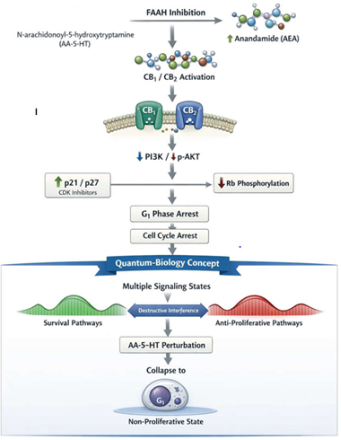
Acute promyelocytic leukemia (APL) remains one of the most aggressive hematological malignancies, necessitating the discovery of novel therapeutic agents with improved efficacy and reduced toxicity. N-arachidonoyl-5-hydroxytryptamine (AA-5-HT), a hybrid indole–fatty acid amide compound isolated from Dialium corbisieri, has demonstrated potent cytotoxic activity in HL-60 leukemia cells, characterized by G1 phase cell cycle arrest at low micromolar concentrations (2.3µM). Despite these promising findings, its mechanism of action remains incompletely understood. Here, we propose a quantum-biochemical hypothesis integrating molecular pharmacology with principles derived from quantum theory to explain AA-5-HT-induced cytotoxicity. We hypothesize that AA-5-HT inhibits fatty acid amide hydrolase (FAAH), leading to accumulation of anandamide (AEA), which in turn activates Gi/o-coupled cannabinoid receptors (CB1/CB2). This activation suppresses the PI3K/AKT signaling pathway, resulting in decreased AKT phosphorylation, upregulation of cyclin-dependent kinase inhibitors (p21, p27), reduced retinoblastoma protein phosphorylation, and consequent G1 arrest. From a quantum-biochemical perspective, AA-5-HT acts as a perturbator that shifts intracellular signaling probabilities, promoting destructive interference of pro-survival pathways and stabilizing a non-proliferative cellular state. This framework provides a novel conceptual model for understanding anticancer mechanisms and suggests new experimental directions for validating AA-5-HT as a therapeutic candidate.
| Published in | American Journal of Chemical and Biochemical Engineering (Volume 10, Issue 1) |
| DOI | 10.11648/j.ajcbe.20261001.12 |
| Page(s) | 22-27 |
| Creative Commons |
This is an Open Access article, distributed under the terms of the Creative Commons Attribution 4.0 International License (http://creativecommons.org/licenses/by/4.0/), which permits unrestricted use, distribution and reproduction in any medium or format, provided the original work is properly cited. |
| Copyright |
Copyright © The Author(s), 2026. Published by Science Publishing Group |
Acute Promyelocytic Leukemia (APL), N-arachidonoyl-5-hydroxytryptamine (AA-5-HT), FAAH Inhibition, Cytotoxicity, Quantum Biochemical
AA-5-HT | N-arachidonoyl-5-hydroxytryptamine |
AEA | Endocannabinoid ligand anandamide |
AKT | Protein Kinase B (Ak straintransforming) |
APL | Acute Promyelocytic Leukemia |
CB1/CB2 | As receptors are two primary cellular targets of the endocannabinoid system, which regulates critical bodily functions like mood, pain, appetite and immune response |
FAAH | Fatty Acid Amid Hydrolase |
HL-60 | Acute Promyelocytic Leukemia Cell |
PI3K | phosphatidylinositol-3kinase |
P21 | a cyclin-dependent kinase (CDK) inhibitor primarily regulates the cell cycle by enforcing G1 and G2/M phase arrests in response to DNA damage. |
P27 | is a critical regulatory that halts cell division by binding to and inhibiting cyclin-dependent kinases (CDKs). As a master gatekeeper of cell growth, its primary function is to prevent cells from the G1 phase to the (S) Phase, effectively stopping uncontrolled proliferation. |
TRPV1 | Transient Receptor Potential Vanilloid 1 |
| [1] | Abdel Mageed SS, Ammar RM, Nassar NN, et al. FAAH/CB1/PI3K-AKT axis. Neuropharmacology. 2022; 207: 108935. |
| [2] | Atanasov AG, Zotchev SB, Dirsch VM, Supuran CT. Natural products in drug discovery. Biotechnol Adv. 2021; 50: 107762. |
| [3] | Basdevant JL. Feynman’s principle in quantum mechanics. In: Variational Principles in Physics. New York: Springer; 2007. p. 125–150. |
| [4] | Beloribi-Djefaflia S, Vasseur S, Guillaumond F. Lipid metabolic reprogramming in cancer. Oncogenesis. 2016; 5: e189. |
| [5] | Blázquez C, González-Feria L, Alvarez L, et al. Cannabinoids inhibit tumor growth. Nat Med. 2006; 12: 313–319. |
| [6] | Cravatt BF, Giang DK, Mayfield SP, Boger DL, Lerner RA, Gilula NB. Molecular characterization of FAAH. Nature. 2001; 384: 83–87. |
| [7] | de Thé H, Chen Z. Acute promyelocytic leukemia. Nat Rev Cancer. 2010; 10: 775–783. |
| [8] | Di Marzo V. Endocannabinoid signaling. Nat Rev Neurosci. 2011; 12: 699–712. |
| [9] | Douglas W. Wilson et al. Chap 32 Quantum mechanics in biology and its application to cancer research: An overview. Molecular Medicine and Biomedical Research in the Era of Precision Medicine. 2025, Pp 695-715. |
| [10] | Dradre Atakuru P, Koseki T, Usukhbayar N, Kimura K, Shiono Y. Cytotoxicity in HL-60 cells. Biosci Biotechnol Biochem. 2023; 87: 825–832. |
| [11] | Ellert-Miklaszewska A, Kaminska B, Konarska L. Cannabinoids downregulate PI3K/AKT. Cell Signal. 2005; 17: 25–37. |
| [12] | Gómez del Pulgar T, Velasco G, Guzmán M. CB1 receptor coupling to AKT signaling. Biochem J. 2000; 347: 369–373. |
| [13] | Guzmán M. Cannabinoids: potential anticancer agents. Nat Rev Cancer. 2003; 3: 745–755. |
| [14] | Hameroff S, Penrose R. Consciousness in the universe. Phys Life Rev. 2014; 11: 39–78. |
| [15] | Howlett AC, Barth F, Bonner TI, et al. Cannabinoid receptor pharmacology. Pharmacol Rev. 2002; 54: 161–202. |
| [16] | Lambert N, Chen YN, Cheng YC, Li CM, Chen GY, Nori F. Quantum biology. Nat Phys. 2013; 9: 10–18. |
| [17] | Ligresti A, Bisogno T, Matias I, et al. Endocannabinoid control of tumor growth. Gastroenterology. 2003; 125: 677–687. |
| [18] | Malumbres M, Barbacid M. Cell cycle and cancer. Nat Rev Cancer. 2009; 9: 153–166. |
| [19] | Manning BD, Toker A. AKT/PKB signaling. Cell. 2017; 169: 381–405. |
| [20] | McFadden J, Al-Khalili J. Origins of quantum biology. Proc Natl Acad Sci USA. 2018; 115: 4639–4644. |
| [21] | Moreno E, Cavic M, Canela EI, et al. CB1 receptor signaling complexity. Mol Pharmacol. 2018; 93: 242–252. |
| [22] | Osei-Hyiaman D, DePetrillo M, Pacher P, et al. Endocannabinoid signaling in metabolism. J Clin Invest. 2005; 115: 1298–1305. |
| [23] | Pacher P, Kogan NM, Mechoulam R. Endocannabinoid system in disease. Annu Rev Pharmacol Toxicol. 2020; 60: 637–659. |
| [24] | Pertwee RG. Cannabinoid receptor pharmacology. Br J Pharmacol. 2008; 153: 199–215. |
| [25] | Piomelli D. Molecular logic of endocannabinoid signaling. Nat Rev Neurosci. 2003; 4: 873–884. |
| [26] | Santos CR, Schulze A. Lipid metabolism in cancer. FEBS J. 2012; 279: 2610–2623. |
| [27] | Sarfaraz S, Afaq F, Adhami VM, Mukhtar H. Cannabinoid-induced G1 arrest. J Biol Chem. 2006; 281: 39480–39491. |
| [28] | Sherr CJ, Roberts JM. CDK inhibitors. Genes Dev. 1999; 13: 1501–1512. |
| [29] | Tallman MS, Altman JK. Acute promyelocytic leukemia treatment. Blood. 2005; 106: 1154–1163. |
| [30] | Velasco G, Sánchez C, Guzmán M. Anticancer mechanisms of cannabinoids. Nat Rev Cancer. 2012; 12: 436–444. |
| [31] | Vivanco I, Sawyers CL. PI3K/AKT pathway in cancer. Nat Rev Cancer. 2002; 2: 489–501. |
APA Style
Paulin, A. D. (2026). A Quantum-Biochemical Model of AA-5-HT-Induced Cytotoxicity in HL-60 Cells via FAAH Inhibition and Cannabinoid Receptor–Mediated Signal Interference. American Journal of Chemical and Biochemical Engineering, 10(1), 22-27. https://doi.org/10.11648/j.ajcbe.20261001.12
ACS Style
Paulin, A. D. A Quantum-Biochemical Model of AA-5-HT-Induced Cytotoxicity in HL-60 Cells via FAAH Inhibition and Cannabinoid Receptor–Mediated Signal Interference. Am. J. Chem. Biochem. Eng. 2026, 10(1), 22-27. doi: 10.11648/j.ajcbe.20261001.12
AMA Style
Paulin AD. A Quantum-Biochemical Model of AA-5-HT-Induced Cytotoxicity in HL-60 Cells via FAAH Inhibition and Cannabinoid Receptor–Mediated Signal Interference. Am J Chem Biochem Eng. 2026;10(1):22-27. doi: 10.11648/j.ajcbe.20261001.12
@article{10.11648/j.ajcbe.20261001.12,
  author = {Atakuru Dradre Paulin},
  title = {A Quantum-Biochemical Model of AA-5-HT-Induced Cytotoxicity in HL-60 Cells via FAAH Inhibition and Cannabinoid Receptor–Mediated Signal Interference},
  journal = {American Journal of Chemical and Biochemical Engineering},
  volume = {10},
  number = {1},
  pages = {22-27},
  doi = {10.11648/j.ajcbe.20261001.12},
  url = {https://doi.org/10.11648/j.ajcbe.20261001.12},
  eprint = {https://article.sciencepublishinggroup.com/pdf/10.11648.j.ajcbe.20261001.12},
  abstract = {Acute promyelocytic leukemia (APL) remains one of the most aggressive hematological malignancies, necessitating the discovery of novel therapeutic agents with improved efficacy and reduced toxicity. N-arachidonoyl-5-hydroxytryptamine (AA-5-HT), a hybrid indole–fatty acid amide compound isolated from Dialium corbisieri, has demonstrated potent cytotoxic activity in HL-60 leukemia cells, characterized by G1 phase cell cycle arrest at low micromolar concentrations (2.3µM). Despite these promising findings, its mechanism of action remains incompletely understood. Here, we propose a quantum-biochemical hypothesis integrating molecular pharmacology with principles derived from quantum theory to explain AA-5-HT-induced cytotoxicity. We hypothesize that AA-5-HT inhibits fatty acid amide hydrolase (FAAH), leading to accumulation of anandamide (AEA), which in turn activates Gi/o-coupled cannabinoid receptors (CB1/CB2). This activation suppresses the PI3K/AKT signaling pathway, resulting in decreased AKT phosphorylation, upregulation of cyclin-dependent kinase inhibitors (p21, p27), reduced retinoblastoma protein phosphorylation, and consequent G1 arrest. From a quantum-biochemical perspective, AA-5-HT acts as a perturbator that shifts intracellular signaling probabilities, promoting destructive interference of pro-survival pathways and stabilizing a non-proliferative cellular state. This framework provides a novel conceptual model for understanding anticancer mechanisms and suggests new experimental directions for validating AA-5-HT as a therapeutic candidate.},
 year = {2026}
}
TY  - JOUR
T1  - A Quantum-Biochemical Model of AA-5-HT-Induced Cytotoxicity in HL-60 Cells via FAAH Inhibition and Cannabinoid Receptor–Mediated Signal Interference
AU  - Atakuru Dradre Paulin
Y1  - 2026/10/21
PY  - 2026
N1  - https://doi.org/10.11648/j.ajcbe.20261001.12
DO  - 10.11648/j.ajcbe.20261001.12
T2  - American Journal of Chemical and Biochemical Engineering
JF  - American Journal of Chemical and Biochemical Engineering
JO  - American Journal of Chemical and Biochemical Engineering
SP  - 22
EP  - 27
PB  - Science Publishing Group
SN  - 2639-9989
UR  - https://doi.org/10.11648/j.ajcbe.20261001.12
AB  - Acute promyelocytic leukemia (APL) remains one of the most aggressive hematological malignancies, necessitating the discovery of novel therapeutic agents with improved efficacy and reduced toxicity. N-arachidonoyl-5-hydroxytryptamine (AA-5-HT), a hybrid indole–fatty acid amide compound isolated from Dialium corbisieri, has demonstrated potent cytotoxic activity in HL-60 leukemia cells, characterized by G1 phase cell cycle arrest at low micromolar concentrations (2.3µM). Despite these promising findings, its mechanism of action remains incompletely understood. Here, we propose a quantum-biochemical hypothesis integrating molecular pharmacology with principles derived from quantum theory to explain AA-5-HT-induced cytotoxicity. We hypothesize that AA-5-HT inhibits fatty acid amide hydrolase (FAAH), leading to accumulation of anandamide (AEA), which in turn activates Gi/o-coupled cannabinoid receptors (CB1/CB2). This activation suppresses the PI3K/AKT signaling pathway, resulting in decreased AKT phosphorylation, upregulation of cyclin-dependent kinase inhibitors (p21, p27), reduced retinoblastoma protein phosphorylation, and consequent G1 arrest. From a quantum-biochemical perspective, AA-5-HT acts as a perturbator that shifts intracellular signaling probabilities, promoting destructive interference of pro-survival pathways and stabilizing a non-proliferative cellular state. This framework provides a novel conceptual model for understanding anticancer mechanisms and suggests new experimental directions for validating AA-5-HT as a therapeutic candidate.
VL  - 10
IS  - 1
ER  -
Laboratory of Natural Products and Medicinal Plant of CERVA, Centre d’Etude et de Recherche des Valeurs Africaines (CERVA), Kinshasa-Limete, Democratic Republic of Congo (DRC)

Information



 Share This Article
 Twitter
 Linked In
 Facebook

 Copy
 Download