Research Article | | Peer-Reviewed

Enhanced Access Control Management System in an Edge Computing Environment Using Bimodal Biometrics Technique

Received: 15 September 2026     Accepted: 24 September 2026     Published: 14 October 2026
Views:       Downloads:
Abstract

This study presents an enhanced access control management system for edge computing environments using bimodal biometrics, contextual risk analysis, and Chinese Wall policy enforcement. The work addresses a limitation in context-only access control frameworks, namely their inability to confirm that the person requesting access is the genuine enrolled user. To close this identity-verification gap, the proposed system integrates face recognition, fingerprint recognition, and contextual decision support into a unified edge-aware authentication workflow. The implementation was developed in Python using Flask, with MySQL for transactional data storage and IPFS for content-addressed storage of biometric-related artifacts. A hybrid dataset strategy was adopted. Public datasets such as VGGFace2 and SOCOFing supported preliminary experimentation, while locally captured biometric samples were emphasized for operational training and evaluation in order to reduce domain mismatch. A one-dimensional convolutional neural network was used for contextual access analysis, while transfer-learning-based convolutional neural networks were used for face and fingerprint recognition. The datasets were split into 70% training and 30% testing. Experimental results showed strong performance for the biometric and contextual modules. The face model achieved about 0.96 accuracy, the fingerprint model achieved about 93.36% classification accuracy with 95.83% precision, recall, and F1-score for the enrolled-user fingerprint class, and the contextual Conv1D model achieved 84.08% test accuracy. System-level testing further showed that integrating biometric evidence with contextual intelligence and policy enforcement improved access-decision reliability over the earlier context-only model. The study concludes that combining bimodal biometrics with edge-based contextual reasoning can provide stronger identity assurance, better real-time responsiveness, and more dependable access control for distributed computing environments.

Published in American Journal of Computer Science and Technology (Volume 9, Issue 4)
DOI 10.11648/j.ajcst.20260904.11
Page(s) 138-153
Creative Commons

This is an Open Access article, distributed under the terms of the Creative Commons Attribution 4.0 International License (http://creativecommons.org/licenses/by/4.0/), which permits unrestricted use, distribution and reproduction in any medium or format, provided the original work is properly cited.

Copyright

Copyright © The Author(s), 2026. Published by Science Publishing Group

Keywords

Edge Computing, Bimodal Biometrics, Access Control, Fingerprint Recognition, Face Recognition, Contextual Risk Analysis, Chinese Wall Policy, Ipfs

1. Introduction
Access control remains a fundamental security requirement in distributed systems because it determines who can access protected resources, under which conditions, and at what privilege level. In edge and IoT environments, this requirement becomes more demanding because users, devices, and services operate across heterogeneous and latency-sensitive infrastructures . Modern Zero Trust thinking further emphasizes that access should not be granted merely because a requester appears to be in a familiar location or on a trusted network; identity, device posture, and request context should all be evaluated explicitly before access is approved .
Although context-aware access control improves risk sensitivity, context alone does not always prove that the requester is the legitimate enrolled user. A trusted device, expected login time, or familiar location may still be exploited by an impostor. This study therefore extends a context-driven framework by adding bimodal biometric verification through face and fingerprint recognition, while retaining contextual reasoning and policy enforcement. The proposed system is intended to support low-latency decision making at the edge while improving resistance to impersonation, credential misuse, and unauthorized access .
2. Related Works
Related works on access control have proposed policy-based and attribute-based methods for controlling access in distributed systems. Attribute-Based Access Control (ABAC) improves flexibility by evaluating user, resource, action, and environmental attributes before granting access . More recently, adaptive and risk-aware models have been introduced for access control at the network edge. Muhammad et al. proposed an adaptive risk-based access control system for edge environments, using contextual factors such as resource sensitivity, action severity, and risk history to determine whether access should be granted or denied . However, such context-based systems may still be limited because they do not always verify whether the requester is the real authorized user. This creates a gap for biometric-enhanced access control, where face and fingerprint verification can strengthen identity assurance before edge-based access decisions are finalized . Within this setting, the key research gap is not the absence of contextual risk analysis, but the absence of strong identity assurance inside context-aware access workflows. The proposed study addresses this gap by combining biometric identity evidence with contextual and policy-based reasoning in a unified edge architecture.
2.1. Access Control at the Network Edge
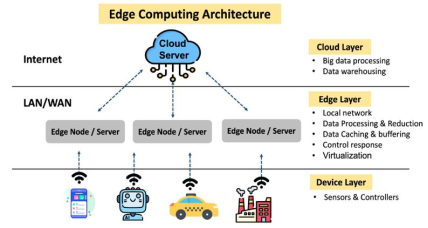
Access control at the network edge has become important because edge computing moves computation, storage, and security decisions closer to users, devices, and data sources. In this architecture, the Device Layer generates access requests through sensors, smartphones, biometric scanners, and IoT devices; the Edge Layer performs local authentication, risk evaluation, and policy enforcement; while the Cloud Layer supports long-term storage, model updates, and centralized management . Prior studies show that edge computing reduces latency and supports real-time decision-making, but its distributed structure also increases exposure to threats such as unauthorized access, compromised nodes, spoofing, and data leakage . Recent work on edge computing highlights the need to move security decisions closer to users and devices in order to reduce latency and support real-time services . At the same time, the distribution of computation across exposed edge nodes introduces new concerns for authentication, privacy, and policy enforcement. These concerns make adaptive and identity-sensitive access control more important than purely static credential checks .
2.2. Edge Computing Architecture
Edge computing brings computation and data storage closer to end-user devices and data sources instead of relying only on distant cloud servers . In an access-control environment, data from cameras, sensors, smartphones, and biometric scanners can be processed near the source, reducing latency, bandwidth use, and response time . The architecture can be viewed in three layers: Device Layer, where biometric scanners, cameras, sensors, and user devices generate access data; Edge Layer, where gateways or edge servers process biometric and contextual information for real-time access decisions; and Cloud Layer, where large-scale storage, model updates, backup records, and long-term analytics are maintained. This layered approach supports fast, secure, and responsive biometric access control in edge environments .
Figure 1. Edge computing architecture adapted from XenonStack .
2.3. Biometric System Theory
Biometric systems theory is based on the idea that individuals can be identified through measurable physiological or behavioral traits such as fingerprints, facial features, iris patterns, voice, and other unique human characteristics . Unlike passwords, cards, or tokens, biometric traits are directly linked to the individual and are more difficult to forget, share, steal, or duplicate. This makes biometrics useful for secure identity verification in access-control systems . The theory also emphasizes that effective biometric traits should possess qualities such as uniqueness, permanence, collectability, and reliability .
2.3.1. Biometric Technology
Biometric technology refers to the use of unique physiological or behavioural characteristics to identify or verify an individual. It converts human traits into digital templates that can be stored, matched, and used for authentication or registration . Unlike passwords or access cards, biometric features are directly linked to the person, making them useful in security, law enforcement, banking, healthcare, border control, and access-management systems . Commonly used biometric technologies include fingerprint recognition, face recognition , iris recognition, voice recognition, palmprint recognition, hand geometry, signature recognition, and behavioural biometrics such as keystroke dynamics and gait. Among these, fingerprint and face recognition are widely adopted because they are relatively easy to capture, cost-effective, and suitable for real-time authentication .
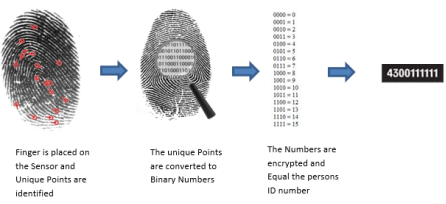
Figure 2. Fingerprint recognition process adapted from Maltoni et al. .
Bimodal biometric authentication combines complementary physiological evidence in order to reduce the weaknesses of unimodal verification. In this study, face recognition supported convenient and contact-light identity capture, while fingerprint recognition supplied a more stable and distinctive physiological factor. This design aligns with biometric theory and with recent multimodal authentication studies that seek stronger resilience against spoofing and identity misuse .
2.3.2. Edge Computing and Biometric Authentication Systems
Edge computing has become important in biometric authentication systems because identity verification often requires fast, secure, and reliable processing. Traditional cloud-based biometric systems may experience high latency, network dependence, and privacy concerns when raw biometric data must be transmitted to remote servers. By processing biometric data closer to the user, edge computing reduces response time, limits unnecessary data transmission, and supports real-time access-control decisions .
In bimodal biometric systems, edge devices can process facial and fingerprint data locally using deep learning models. Convolutional Neural Networks (CNNs) are useful for this purpose because they can extract discriminative features from biometric images. Lightweight CNN architectures such as MobileNetV2 and EfficientNetB0 are suitable for edge environments because they are computationally efficient and can support faster recognition on resource-constrained devices .
2.4. Machine Learning Models
Machine learning models improve access-control systems by enabling them to learn from historical data, detect patterns, assess contextual risk, and support adaptive decision-making. Instead of relying only on static rules, ML-based access control can evaluate factors such as user behavior, device trust, access history, and abnormal activity before granting or denying access . In this study, CNN-based models were applied to biometric recognition, while a 1D CNN/Conv1D model was used for contextual access-risk analysis.
2.4.1. Convolutional Neural Network
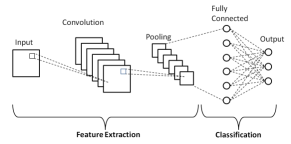
Figure 3. Structure of convolutional neural network (CNN).
A Convolutional Neural Network (CNN) is a deep learning model widely used for image processing, feature extraction, and pattern recognition. In the proposed enhanced access-control system, CNN models served as the core biometric recognition engines for processing face and fingerprint images. The CNN extracts discriminative features from biometric samples and converts them into numerical representations for identity verification . Its main components include the input layer, convolutional layer, ReLU activation layer, pooling layer, fully connected layer, and softmax/output layer. In this study, MobileNetV2 was used for facial recognition, while EfficientNetB0 was used for fingerprint recognition because both architectures support efficient image-based feature learning .
2.4.2. Transfer Learning Models
Transfer learning models were used to adapt pretrained convolutional networks to the biometric recognition tasks. In this study, MobileNetV2 supported face recognition because of its lightweight inverted residual structure, while EfficientNetB0 supported fingerprint recognition through balanced depth, width, and resolution scaling. These models reduced training cost and improved feature extraction for the locally captured biometric samples.
2.5. Edge Computing Deployment Models
Edge computing can be deployed in different ways depending on where computation and storage resources are placed. In a device-edge model, processing is performed directly on smart devices, sensors, cameras, or biometric scanners with limited dependence on external servers. In an edge-server model, nearby gateways, routers, or local edge servers handle real-time processing, authentication, and access-control decisions close to users. In a cloud-edge collaborative model, urgent tasks are processed at the edge, while the cloud supports large-scale storage, model training, backup, and long-term analytics . This layered deployment approach is suitable for biometric access control because identity verification and risk analysis can be performed quickly at the edge, while records and system updates can still be managed through the cloud.
2.5.1. Benefits of Edge Computing
Edge computing provides several benefits for real-time access-control systems. It reduces latency by processing data close to the source instead of sending every request to a distant cloud server. It reduces bandwidth consumption because only selected or processed data is transmitted to the cloud. Edge computing improves privacy by allowing sensitive biometric and contextual data to be processed locally. It supports faster decision-making, which is important for security systems that require immediate grant, step-up, or deny responses . In the proposed system, these benefits allow biometric verification, contextual risk analysis, and policy enforcement to occur close to the access point.
2.5.2. Edge Deployment Considerations
Edge deployment also requires attention to hardware capacity, model size, latency, network availability, storage protection, and privacy. For biometric access control, these considerations are important because face and fingerprint evidence must be processed quickly while preventing unnecessary exposure of sensitive biometric data.
3. Materials and Methods
The study adopted an object-oriented analysis and design methodology for developing the proposed access-control system. This methodology was suitable because the system consists of interacting entities such as users, biometric inputs, access requests, edge nodes, risk-analysis modules, policy enforcement components, and administrative records. The approach supported clear modelling of system actors, workflows, data objects, and decision processes before implementation. The proposed prototype was implemented as a web-based access-control platform using Python and Flask, with MySQL for structured records and IPFS for content-addressed storage of biometric-related artifacts .
3.1. Proposed System Architecture
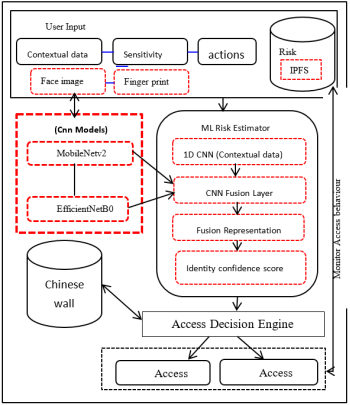
The proposed system architecture was implemented as an edge-aware web application using Python and Flask. MySQL stored structured entities such as users, biometric labels, access logs, contextual records, and historical access decisions, while IPFS stored biometric-related artifacts using content-addressed identifiers. The intelligence layer of the system integrated MobileNetV2 CNN for facial recognition, EfficientNetB0 CNN for fingerprint recognition, and a 1D CNN/Conv1D model for contextual risk analysis. These models worked together to verify user identity, analyze access conditions, and support real-time decision-making at the edge. During an access request, the face and fingerprint models generated biometric confidence scores, while the contextual model evaluated attributes such as device trust, login time, known location, resource sensitivity, and access history. The system then combined biometric evidence, contextual risk output, and policy restrictions to produce a grant, step-up, or deny decision. This combination allowed the system to provide transactional control, biometric identity assurance, contextual risk evaluation, policy-aware authorization, and verifiable storage of sensitive supporting files . Figure 2 shows the main architecture of the proposed system.
Figure 4. Proposed system architecture for the edge-based bimodal biometric access-control framework.
3.2. Dataset Analysis
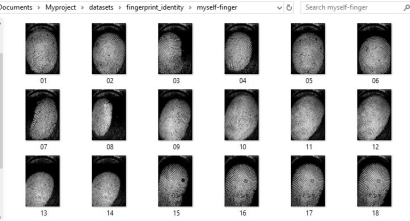
The study used both public and locally captured datasets to develop the proposed bimodal biometric access-control system. VGGFace2 and SOCOFing supported early experimentation with face and fingerprint recognition, while locally captured enrolled-user samples were used for the final operational training to reflect the real deployment environment . Face and fingerprint data were organized into identity-based folders for supervised learning, while contextual access records were prepared as tabular feature vectors for risk analysis. Preprocessing involved image resizing, normalization, labeling, contextual data cleaning, encoding, scaling, and class balancing. The datasets were split into 70% training and 30% testing. Evaluation was based on accuracy, precision, recall, F1-score, confusion matrices, and functional system testing to confirm support for identity verification, risk evaluation, and real-time edge-based access decisions.
Figure 5. Public face image dataset (VGGFace2 from Kaggle).
Figure 6. Public fingerprint dataset (SOCOFing from Kaggle).
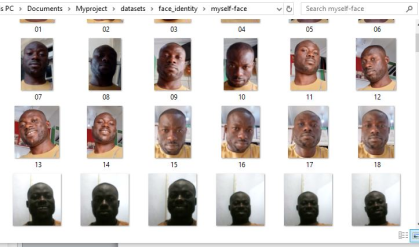
Figure 7. Locally captured face image dataset.
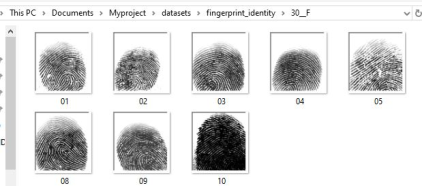
Figure 8. Locally captured fingerprint dataset.
3.3. Bias Mitigation
Bias mitigation was considered important because biometric and contextual access-control models can produce unfair or unreliable decisions when trained on imbalanced or poorly representative data. In the proposed system, bias was reduced by combining public datasets with locally captured enrolled-user samples, ensuring that the final model reflected the actual deployment environment. The face and fingerprint datasets were organized by user identity, while preprocessing steps such as resizing, normalization, labeling, and controlled class balancing were applied before training.
For contextual access analysis, records were cleaned, encoded, scaled, and balanced to reduce the effect of dominant classes on the 1D CNN/Conv1D model. Model performance was also evaluated using accuracy, precision, recall, F1-score, and confusion matrices instead of relying on accuracy alone. This helped identify whether the models performed consistently across classes. In addition, the system combined biometric confidence scores with contextual risk analysis and Chinese Wall policy enforcement, reducing overdependence on a single model output during final access decisions.
3.3.1. Technology Stack and Data Organization
Table 1 summarizes the main technologies and analytical components integrated into the proposed prototype. The system was implemented using Python and Flask for backend logic, routing, and web-based access-control operations, while MySQL was used to store structured records such as user profiles, biometric labels, access logs, contextual attributes, and decision history. IPFS supported decentralized and content-addressed storage of biometric-related artifacts, improving traceability and reducing dependence on a single storage point.
The analytical layer combined MobileNetV2 CNN for face recognition, EfficientNetB0 CNN for fingerprint recognition, and a 1D CNN/Conv1D model for contextual risk analysis. samples captured from the biometric scanner.
Table 1. Core technologies, analytical modules, and functions in the proposed system.

Component

Technology and function

Backend service

Python for core application logic and system integration

Web framework

Flask for routing, forms, dashboards, and API handling

Relational database

MySQL for structured storage of users, logs, and decisions

Decentralized storage

IPFS for content-addressed storage of biometric-related artifacts

Face module

MobileNetV2 CNN for face feature learning and identity verification

Fingerprint module

EfficientNetB0 CNN for primary fingerprint verification

Context module

Conv1D CNN for contextual risk analysis and decision support

Note: the table summarizes the primary implementation and decision-support components used in the prototype.
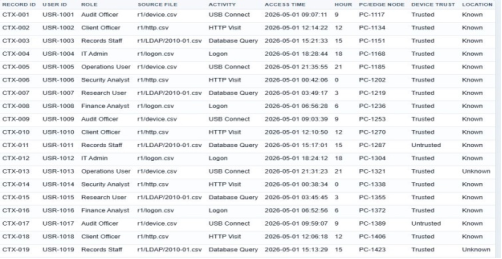
Figure 9. Contextual dataset.
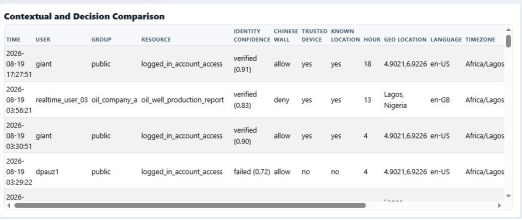
The contextual dataset contains access-related attributes used to evaluate the risk level of each access request. It includes factors such as device trust, known location, login time, resource sensitivity, access history, and user behavior. Unlike biometric datasets, which are image-based, the contextual dataset is structured as tabular data and is used by the 1D CNN/Conv1D model to learn access patterns and support risk-aware decision-making. In the proposed system, this dataset helped determine whether a verified user should be granted access, required to perform step-up verification, or denied access based on the surrounding access conditions.
3.3.2. CNN Model Training Process
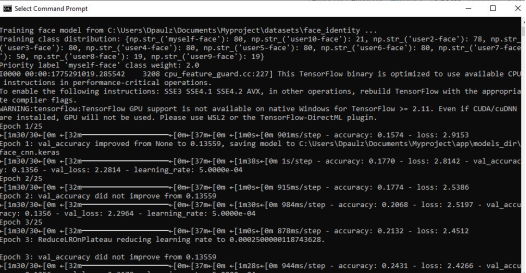
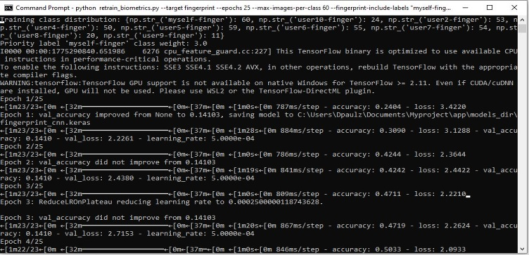
Figures 10 and 11 show the training process for the face and fingerprint recognition models used in the proposed system. Figure 10 presents the MobileNetV2 face-recognition model training, where facial images were resized, normalized, labeled, and passed through the CNN model to learn identity-based facial features. The model was trained to distinguish enrolled users and generate confidence scores during authentication. Figure 11 presents the EfficientNetB0 fingerprint-recognition model training, where fingerprint samples were preprocessed and organized into identity classes before training. The model learned distinctive fingerprint patterns and produced identity confidence scores for access-control decisions. Together, the face and fingerprint models formed the bimodal biometric layer of the system, improving identity verification and reducing dependence on a single biometric trait.
Figure 10. Model training process of facial biometric data.
Figure 11. Fingerprint model training.
3.3.3. Model Performance Evaluation
Figure 12. MobileNetV2 real face confusion matrix.
Figure 13. EfficientNetB0 real fingerprint confusion matrix.
Figure 14. Contextual Conv1D confusion matrix.
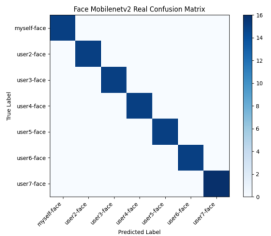
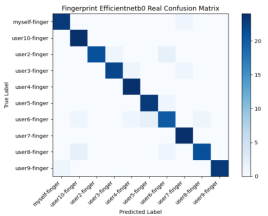
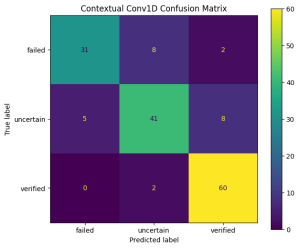
Figures 12, 13, and 14 show the confusion matrices for the three intelligent models used in the proposed system. Figure 12 presents the MobileNetV2 face-recognition confusion matrix, showing how well the model classified enrolled face identities. Figure 13 shows the EfficientNetB0 fingerprint-recognition confusion matrix, indicating the model’s ability to distinguish fingerprint classes. Figure 14 presents the Contextual Conv1D confusion matrix, which shows how accurately the contextual model classified access conditions for risk-aware decision-making. Together, the confusion matrices provide evidence of the classification performance of the biometric and contextual models used for final access control decisions.
3.4. System Deployment and Testing
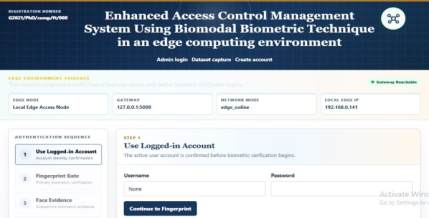
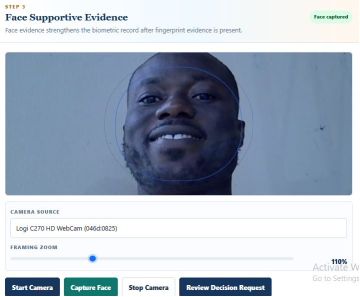
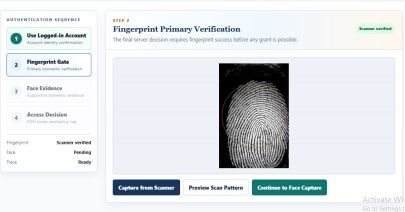
System deployment and testing covered registration, biometric capture, login, contextual scoring, Chinese Wall enforcement, and administrative reporting. Functional testing confirmed that enrolled face and fingerprint samples could be captured, stored, and evaluated within the unified application workflow.
Figure 15. Enrollment form page.
Figure 16. Biometric face-capture page.
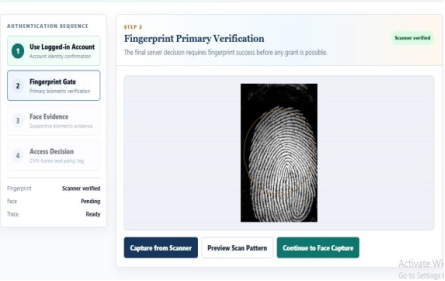
Figure 17. Biometric fingerprint-capture page.
3.5. Proposed System Workflow
The proposed workflow begins when a user submits credentials and biometric evidence at an access point. The edge node captures face and fingerprint inputs, verifies them using MobileNetV2 CNN and EfficientNetB0 CNN, and evaluates contextual attributes such as device trust, location, login time, resource sensitivity, and access history using a 1D CNN Conv1D model. The system then applies Chinese Wall policy restrictions before producing a final grant, step-up, or deny decision.
3.6. Contexts-Aware Authorization and Policy Enforcement
Context-aware authorization remains essential because authentication alone does not determine what a verified user should be allowed to access under a specific situation. In the proposed system, a user first submits biometric and access-request information through the edge-aware application. The system then verifies identity using facial recognition and fingerprint recognition, while contextual attributes such as device trust, known location, login hour, resource sensitivity, access history, and conflict-of-interest status are evaluated before the final decision is made. The 1D CNN/Conv1D contextual model supports risk analysis from these access conditions, while the Chinese Wall policy prevents access where organizational conflicts exist. This workflow aligns with attribute-based and risk-adaptive access control principles by combining identity assurance, contextual risk evaluation, and policy enforcement within a real-time edge computing environment .
4. Results
The biometric and contextual modules produced strong results. The MobileNetV2 face model achieved about 0.96 overall accuracy, while the enrolled-user face class recorded 0.92 precision, 0.94 recall, and 0.93 F1-score. The EfficientNetB0 fingerprint model achieved about 93.36% overall classification accuracy; the enrolled-user fingerprint class recorded 95.83% precision, 95.83% recall, and 95.83% F1-score, and the highest validation accuracy reached 93.78% during training. The contextual Conv1D model achieved 84.08% test accuracy on 157 records, with the verified class producing 96.77% recall and 90.91% F1-score. Integrated system testing showed that biometric evidence, contextual analysis, and Chinese Wall enforcement worked together to support real-time grant, step-up, and deny decisions.
4.1. Enhanced Performance Evaluation
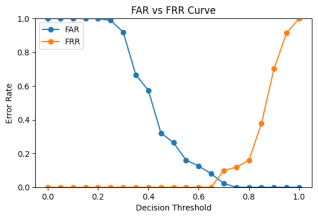
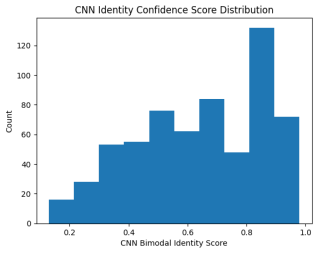
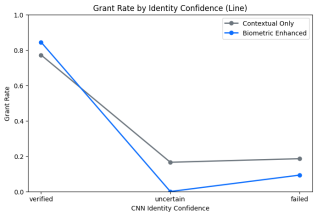
Figures 18, 20, and 21 show the FAR versus FRR curve, risk-score distribution, and grant-by-identity-confidence output of the biometric-enhanced access-control system. The FAR/FRR curve was used to examine the balance between false acceptance and false rejection during biometric verification. The risk-score distribution shows how access requests were grouped according to their computed risk levels, while the grant-by-identity-confidence result shows how biometric confidence influenced access approval. Together, these outputs demonstrate how the proposed system combines biometric reliability and contextual risk analysis to support secure access-control decisions.
Figure 18. FAR versus FRR curve.
Figure 19. CNN identity confidence score distribution.
Figure 20. Grant identity confidence score distribution.
4.2. Result Summary
The results indicate that the proposed system improves on context-only access control by adding direct biometric identity assurance to edge-based authorization. The study also showed that locally captured biometric samples improved operational dependability because they reduced the domain gap between training data and live deployment conditions. The proposed system shows clear improvements over context-only access control based on the following findings
1. Added direct identity verification to context-based access control.
2. Reduced the risk of granting access based only on trusted device or location.
3. Improved detection of uncertain or weak identity-confidence cases.
4. Supported better grant, step-up, and deny decision separation.
5. Strengthened edge-based authorization by combining biometric evidence, contextual risk, and policy enforcement.
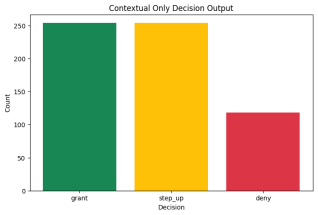
Figure 21. Contextual-only decision output.
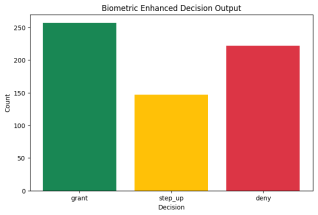
Figure 22. Biometric-enhanced decision output.
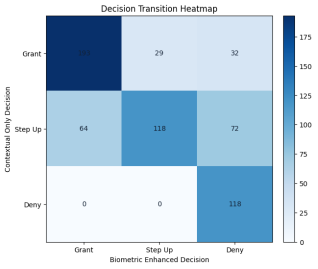
Figure 23. Decision transition heatmap.
5. Discussion
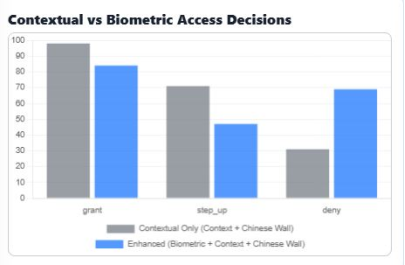
The Contextual Only Decision Output represents the baseline system, where access decisions were based on factors such as device trust, location, login time, access history, resource sensitivity, and policy restrictions. Although useful, this approach could still grant access when context appeared normal without confirming the requester’s real identity. The Biometric Enhanced Decision Output shows the improved model after face and fingerprint verification were added. This made the system more identity-aware and reduced overdependence on contextual trust. The Decision Transition Heatmap shows that some requests previously granted by the contextual-only model were changed to step-up or deny decisions when biometric confidence was weak, confirming stronger and more reliable access control.
6. Conclusions and Future Work
The study demonstrates that combining bimodal biometrics, contextual CNN analysis, and Chinese Wall policy enforcement can produce a more secure and adaptive access-control framework for edge computing environments. The final system delivered stronger identity verification, improved decision reliability, and practical real-time operation through edge-aware processing. Future work should expand the locally captured biometric dataset, refine multimodal score fusion, and validate the framework with a larger user population and more deployment sites.
Abbreviations

ABAC

Attribute-Based Access Control

CNN

Convolutional Neural Network

CID

Content Identifier

IPFS

InterPlanetary File System

MEC

Multi-Access Edge Computing

RBAC

Role-Based Access Control

Acknowledgments
I sincerely appreciate my supervisors, Professor F. E. Onuodu and Dr. (Mrs.) U. A. Okengwu, for their guidance, encouragement, constructive criticism, and scholarly support throughout this research. I also thank the Acting Head of the Department of Computer Science, Dr. (Mrs.) M. O. Musa, for her commitment to the growth of the department and its academic programme. My appreciation further goes to the postgraduate lecturers, including Professor P. O. Asagba, Professor L. N. Onyejegbu, Professor C. Ugwu, Professor B. O. Eke, Professor E. E. Ogheneovo, Professor F. Egbono, and others, for their contributions to knowledge and academic development.
Author Contributions
Paul Ndudiri Ohia: Conceptualization, Methodology, Software, Validation, Formal Analysis, Investigation, Data curation, Visualization, Writing - original draft
Friday Eleonu Onuodu: Supervision, Methodology, Resources, Validation, Writing - review and editing
Ugochi Adaku Okengwu: Supervision, Project administration, Validation, Writing - review and editing
Funding
This work is not supported by any external funding.
Data Availability Statement
Public benchmark datasets referenced in this study include VGGFace2 for face-recognition experimentation, SOCOFing for fingerprint-recognition experimentation, and the KiltHub Insider Threat Test Dataset for contextual access-record analysis. VGGFace2 is available at https://github.com/ox-vgg/vgg_face2, SOCOFing is available at https://www.kaggle.com/ruizgara/socofing, and the KiltHub Insider Threat Test Dataset is available at https://kilthub.cmu.edu/articles/dataset/Insider_Threat_Test_Dataset/12841247. Locally captured biometric samples and implementation artifacts are available from the corresponding author upon reasonable request.
Conflicts of Interest
The authors declare no conflicts of interest.
Appendix
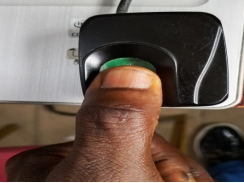
Figure 24. Futronic fingerprint-capture device.
Figure 25. Fingerprint captured dataset.
Figure 26. Contextual data interface.
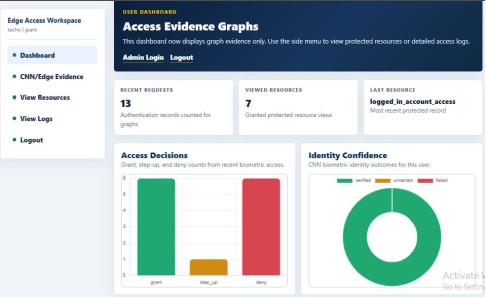
Figure 27. User dashboard page design layout.
Figure 28. Contextual versus biometric access decisions.
References
[1] Hameed, S., et al. Securing distributed systems: A survey on access control techniques for cloud, blockchain, IoT and SDN. Cyber Security and Applications. 2023, 1, 100015.
[2] Shakarami, A., et al. Contemporary advances in multi-access edge computing: A survey of fundamentals, architecture, technologies, deployment cases, security, challenges, and directions. Journal of Network and Computer Applications. 2023, 219, 103726.
[3] Kaur, N. A systematic review on security aspects of fog computing environment: Challenges, solutions and future directions. Computer Science Review. 2024, 54, 100688.
[4] Chandramouli, R., Butcher, Z. A Zero Trust Architecture Model for Access Control in Cloud-Native Applications in Multi-Cloud Environments. NIST Special Publication 800-207. National Institute of Standards and Technology. 2023.
[5] Alam, T., et al. Differential privacy in edge computing-based smart city applications: Security issues, solutions and future directions. Array. 2023, 19, 100293.
[6] Xu, G., Ren, J., Zhang, Y., Lin, C. A multimodal biometric authentication scheme for mobile edge computing. Information Sciences. 2021, 553, 1-15.
[7] Yao, H., Zhang, J., Liu, X., Wang, Y. Multimodal biometric authentication by federated learning. Biomedical Signal Processing and Control. 2023, 85, 104932.
[8] Hu, V. C., Ferraiolo, D. F., Kuhn, R., Schnitzer, A., Sandlin, K., Miller, R., Scarfone, K. Guide to Attribute Based Access Control (ABAC) Definition and Considerations. NIST SP 800-162. National Institute of Standards and Technology. 2015.
[9] Muhammad, B. A., Garba, M., Gabi, D., Suru, H. U., Argungu, M. S. Dynamic access control at the network edge using an adaptive risk-based access control system (ad-RACs). 2024, 1(2), 12-19.
[10] Goudarzi, H., Liao, X., Zhang, Q. A review on edge computing architecture and its applications in IoT and AI. Future Generation Computer Systems. 2023, 142, 312-328.
[11] Shi, W., Cao, J., Zhang, Q., Li, Y., Xu, L. Edge Computing: Vision and Challenges. IEEE Internet of Things Journal. 2016, 3(5), 637-646.
[12] Satyanarayanan, M. The Emergence of Edge Computing. Computer. 2017, 50(1), 30-39.
[13] XenonStack. Edge Computing Solutions and Capabilities. Available from:
[14] Jain, A. K., Ross, A., Prabhakar, S. An Introduction to Biometric Recognition. IEEE Transactions on Circuits and Systems for Video Technology. 2004, 14(1), 4-20.
[15] Ratha, N. K., Connell, J. H., Bolle, R. M. Enhancing security and privacy in biometrics-based authentication systems. IBM Systems Journal. 2001, 40(3), 614-634.
[16] Jain, A. K., Ross, A. Introduction to Biometrics. In Handbook of Biometrics. Springer. 2008, pp. 1-22.
[17] Maltoni, D., Maio, D., Jain, A. K., Prabhakar, S. Handbook of Fingerprint Recognition. 2nd ed. Springer. 2009.
[18] Li, S. Z., Jain, A. K., editors. Handbook of Face Recognition. 2nd ed. Springer. 2011.
[19] Sandler, M., Howard, A., Zhu, M., Zhmoginov, A., Chen, L. C. MobileNetV2: Inverted Residuals and Linear Bottlenecks. Proceedings of the IEEE/CVF Conference on Computer Vision and Pattern Recognition. 2018, pp. 4510-4520.
[20] Tan, M., Le, Q. V. EfficientNet: Rethinking Model Scaling for Convolutional Neural Networks. Proceedings of the 36th International Conference on Machine Learning. 2019, 97, 6105-6114.
[21] Nobi, M. Machine learning in access control systems: A survey. ACM Computing Surveys. 2022, 55(3), 1-36.
[22] Rahman, M. S., Li, X., Chen, J. Risk-adaptive access control using reinforcement learning. IEEE Transactions on Information Forensics and Security. 2023, 18, 408-421.
[23] LeCun, Y., Bengio, Y., Hinton, G. Deep learning. Nature. 2015, 521, 436-444.
[24] Abbas, N., Zhang, Y., Taherkordi, A., Skeie, T. Mobile edge computing: A survey. IEEE Internet of Things Journal. 2018, 5(1), 450-465.
[25] Jahan, N., Reno, S., Ahmed, M. Securing E-Passport Management Using Private-Permissioned Blockchain and IPFS. In 3rd International Conference on Electrical, Computer and Communication Engineering. 2023.
[26] Cao, Q., Shen, L., Xie, W., Parkhi, O. M., Zisserman, A. VGGFace2: A dataset for recognising faces across pose and age. 13th IEEE International Conference on Automatic Face and Gesture Recognition. 2018, pp. 67-74.
[27] Ruiz Garcia, S. SOCOFing Dataset. Kaggle. Available from:
[28] Brewer, D. F. C., Nash, M. J. The Chinese Wall Security Policy. Proceedings of the IEEE Symposium on Security and Privacy. 1989, pp. 206-214.
Cite This Article
  • APA Style

    Ohia, P. N., Onuodu, F. E., Okengwu, U. A. (2026). Enhanced Access Control Management System in an Edge Computing Environment Using Bimodal Biometrics Technique. American Journal of Computer Science and Technology, 9(4), 138-153. https://doi.org/10.11648/j.ajcst.20260904.11

    Copy | Download

    ACS Style

    Ohia, P. N.; Onuodu, F. E.; Okengwu, U. A. Enhanced Access Control Management System in an Edge Computing Environment Using Bimodal Biometrics Technique. Am. J. Comput. Sci. Technol. 2026, 9(4), 138-153. doi: 10.11648/j.ajcst.20260904.11

    Copy | Download

    AMA Style

    Ohia PN, Onuodu FE, Okengwu UA. Enhanced Access Control Management System in an Edge Computing Environment Using Bimodal Biometrics Technique. Am J Comput Sci Technol. 2026;9(4):138-153. doi: 10.11648/j.ajcst.20260904.11

    Copy | Download

  • @article{10.11648/j.ajcst.20260904.11,
      author = {Paul Ndudiri Ohia and Friday Eleonu Onuodu and Ugochi Adaku Okengwu},
      title = {Enhanced Access Control Management System in an Edge Computing Environment Using Bimodal Biometrics Technique},
      journal = {American Journal of Computer Science and Technology},
      volume = {9},
      number = {4},
      pages = {138-153},
      doi = {10.11648/j.ajcst.20260904.11},
      url = {https://doi.org/10.11648/j.ajcst.20260904.11},
      eprint = {https://article.sciencepublishinggroup.com/pdf/10.11648.j.ajcst.20260904.11},
      abstract = {This study presents an enhanced access control management system for edge computing environments using bimodal biometrics, contextual risk analysis, and Chinese Wall policy enforcement. The work addresses a limitation in context-only access control frameworks, namely their inability to confirm that the person requesting access is the genuine enrolled user. To close this identity-verification gap, the proposed system integrates face recognition, fingerprint recognition, and contextual decision support into a unified edge-aware authentication workflow. The implementation was developed in Python using Flask, with MySQL for transactional data storage and IPFS for content-addressed storage of biometric-related artifacts. A hybrid dataset strategy was adopted. Public datasets such as VGGFace2 and SOCOFing supported preliminary experimentation, while locally captured biometric samples were emphasized for operational training and evaluation in order to reduce domain mismatch. A one-dimensional convolutional neural network was used for contextual access analysis, while transfer-learning-based convolutional neural networks were used for face and fingerprint recognition. The datasets were split into 70% training and 30% testing. Experimental results showed strong performance for the biometric and contextual modules. The face model achieved about 0.96 accuracy, the fingerprint model achieved about 93.36% classification accuracy with 95.83% precision, recall, and F1-score for the enrolled-user fingerprint class, and the contextual Conv1D model achieved 84.08% test accuracy. System-level testing further showed that integrating biometric evidence with contextual intelligence and policy enforcement improved access-decision reliability over the earlier context-only model. The study concludes that combining bimodal biometrics with edge-based contextual reasoning can provide stronger identity assurance, better real-time responsiveness, and more dependable access control for distributed computing environments.},
     year = {2026}
    }
    

    Copy | Download

  • TY  - JOUR
    T1  - Enhanced Access Control Management System in an Edge Computing Environment Using Bimodal Biometrics Technique
    AU  - Paul Ndudiri Ohia
    AU  - Friday Eleonu Onuodu
    AU  - Ugochi Adaku Okengwu
    Y1  - 2026/10/14
    PY  - 2026
    N1  - https://doi.org/10.11648/j.ajcst.20260904.11
    DO  - 10.11648/j.ajcst.20260904.11
    T2  - American Journal of Computer Science and Technology
    JF  - American Journal of Computer Science and Technology
    JO  - American Journal of Computer Science and Technology
    SP  - 138
    EP  - 153
    PB  - Science Publishing Group
    SN  - 2640-012X
    UR  - https://doi.org/10.11648/j.ajcst.20260904.11
    AB  - This study presents an enhanced access control management system for edge computing environments using bimodal biometrics, contextual risk analysis, and Chinese Wall policy enforcement. The work addresses a limitation in context-only access control frameworks, namely their inability to confirm that the person requesting access is the genuine enrolled user. To close this identity-verification gap, the proposed system integrates face recognition, fingerprint recognition, and contextual decision support into a unified edge-aware authentication workflow. The implementation was developed in Python using Flask, with MySQL for transactional data storage and IPFS for content-addressed storage of biometric-related artifacts. A hybrid dataset strategy was adopted. Public datasets such as VGGFace2 and SOCOFing supported preliminary experimentation, while locally captured biometric samples were emphasized for operational training and evaluation in order to reduce domain mismatch. A one-dimensional convolutional neural network was used for contextual access analysis, while transfer-learning-based convolutional neural networks were used for face and fingerprint recognition. The datasets were split into 70% training and 30% testing. Experimental results showed strong performance for the biometric and contextual modules. The face model achieved about 0.96 accuracy, the fingerprint model achieved about 93.36% classification accuracy with 95.83% precision, recall, and F1-score for the enrolled-user fingerprint class, and the contextual Conv1D model achieved 84.08% test accuracy. System-level testing further showed that integrating biometric evidence with contextual intelligence and policy enforcement improved access-decision reliability over the earlier context-only model. The study concludes that combining bimodal biometrics with edge-based contextual reasoning can provide stronger identity assurance, better real-time responsiveness, and more dependable access control for distributed computing environments.
    VL  - 9
    IS  - 4
    ER  - 

    Copy | Download

Author Information
  • Department of Information Technology, University of Port Harcourt, Port Harcourt, Nigeria

    Biography: Paul Ndudiri Ohia holds B.Sc., M.Sc., and Ph.D. degrees in Computer Science. He has over 12 years of experience in software and web application development.

  • Department of Information Technology, University of Port Harcourt, Port Harcourt, Nigeria
  • Department of Computer Science, University of Port Harcourt, Port Harcourt, Nigeria

  • Abstract
  • Keywords
  • Document Sections

    1. 1. Introduction
    2. 2. Related Works
    3. 3. Materials and Methods
    4. 4. Results
    5. 5. Discussion
    6. 6. Conclusions and Future Work
    Show Full Outline
  • Abbreviations
  • Acknowledgments
  • Author Contributions
  • Funding
  • Data Availability Statement
  • Conflicts of Interest
  • Appendix
  • References
  • Cite This Article
  • Author Information