Abstract
Solanum aethiopicum, commonly called "African eggplant", is a Solanaceae very popular for its fruits but also for its leaves with invaluable virtues. The production of this plant is experiencing many problems including attacks from various pests that affect its performance. The dangerousness of these pests being poorly understood by some market gardeners, the means of control, sometimes very harmful to the environment and human health, often remain ineffective. With the aim of developing appropriate and respectful control methods in human habitats, this study contributed to the knowledge of insect pests associated with Solanum aethiopicum. It allowed for the cataloging of the insect fauna associated with Solanum aethiopicum and the comparison of damage caused by Leucinodes orbonalis over the study seasons. To this end, we conducted direct field observations, sampling, and inventories of the various arthropods and their activities. Some insect groups were found to be more abundant than others. Indeed, the orders Coleoptera (71.77% of the total insect fauna) and Diptera (8.15% of the total insect fauna) were the most abundant. The families Chrysomelidae (57.87%) and Coccinellidae (10.93%) were also widely represented. The assessment of the attack rate on incubated fruit showed that the damage was due to Leucinodes orbonalis (with an average attack rate of 47.68±22.86% over the two seasons). The study also revealed that the attack rate was higher during the long rainy season (67.49% attack rate). The average number of Leucinodes orbonalis individuals per incubated fruit varied according to the mass, length and average circumference of the attacked fruits of S. aethiopicum. These parameters varied according to the seasons. Thus, the fruits increased in size during the long rainy season and offered a more favorable habitat for L. orbonalis larvae; these larvae were found there in large numbers (12.63 ± 0.15 individuals per incubated fruit during the long rainy season compared to 2.52 ± 0.10 individuals per incubated fruit during the short dry season). We found a positive and significant correlation between the number of Leucinodes orbonalis individuals and the mass (r=0.27; p<0.05), the length (r=0.25; p<0.05) and then the circumference (r=0.27; p<0.05) of the attacked fruits.
|
Published in
|
American Journal of Entomology (Volume 10, Issue 2)
|
|
DOI
|
10.11648/j.aje.20261002.11
|
|
Page(s)
|
26-37 |
|
Creative Commons
|

This is an Open Access article, distributed under the terms of the Creative Commons Attribution 4.0 International License (http://creativecommons.org/licenses/by/4.0/), which permits unrestricted use, distribution and reproduction in any medium or format, provided the original work is properly cited.
|
|
Copyright
|
Copyright © The Author(s), 2026. Published by Science Publishing Group
|
Keywords
Solanum aethiopicum, Diversity, Damage, Leucinodes orbonalis, Correlation
1. Introduction
In Cameroon, as in many African countries, agriculture is and remains the predominant sector of the national economy, both in terms of its contribution to GDP and the knock-on effects on other sectors of activity. It employs about 60 percent of the active population and contributes between 19% and 21% to the GDP. According to the National Institute of Statistics (NIS), most of the wealth is created by agriculture. The agricultural sector represents 55% of the country's export earnings, ahead of hydrocarbons (30%). The sector is mainly constituted by subsistence agriculture characterized by small family farms
| [7] | FAO. Évaluation du Programme de la FAO au Cameroun, 2017, pp 2013-2017. |
[7]
. The population of Cameroon is constantly growing. According to
| [7] | FAO. Évaluation du Programme de la FAO au Cameroun, 2017, pp 2013-2017. |
[7]
, it went from 17.3 million inhabitants in 2006 to 20 million inhabitants in 2010. It is a relatively young population with 42% under 14 and 72% under 30 years. Nevertheless, young people are highly concentrated in urban areas. Following the strong population growth, populations are threatened with food insecurity. To improve their living conditions, people engage in income-generating activities such as market gardening in peri-urban areas or in swamps
| [16] | Nguegang, P., Parrot, L., Lejoly, J., Joris, V. Mise en valeur des bas-fonds à Yaoundé: système de production, savoir-faire traditionnel et potentialités d’une agriculture urbaine et périurbaine en développement. Rapport de l’atelier CIRAD, Yaoundé, 2005, 11p. |
[16]
. This is how eggplant production is booming.
Solanum aethiopicum, the African eggplant, is a highly prized Solanaceae around the world. It is the most important fruit vegetable in Asia with 90% of world production
| [16] | Nguegang, P., Parrot, L., Lejoly, J., Joris, V. Mise en valeur des bas-fonds à Yaoundé: système de production, savoir-faire traditionnel et potentialités d’une agriculture urbaine et périurbaine en développement. Rapport de l’atelier CIRAD, Yaoundé, 2005, 11p. |
[16]
. Eggplant is an important export product for Cameroon which recorded 99.4 tons sent to Equatorial Guinea in 2007
| [1] | Anonyme. Annuaire statistique du Cameroun, 2010, 189 p. |
[1]
. With considerable nutritional value, the leaves and fruits of African eggplant are widely consumed, both raw and cooked
. This plant has medicinal properties that are exploited in many African countries, several conditions are thus treated such as hernia, malaria, tetanus, to name a few
| [3] | Dansi. Biodiversité des légumes feuilles traditionnels consommés au Bénin; 2008. IRDCAMM-IFS.
https://www.researchgate.net/publication/299289600 |
| [13] | Lester, R., N. and Seck, A. Solanum aethiopicum L. In: Grubben, G. J. H. & Denton, O. A. Ressources végétales de l'Afrique tropicale 2. Légumes. Fondation PROTA / CTA: Wageningen / Pays-Bas, 2004, 737p. |
[3, 13]
. Despite this economic and food potential of the African eggplant, this culture encounters many problems and undergoes many constraints linked to the plant itself on the one hand and linked to policies: the emergence and diversification of predators due to intensification of eggplant production systems, soil depletion, high cost of agricultural inputs and their misuse, almost non-existent marketing policies
| [12] | Kumar, R. La lutte contre les insectes ravageurs: La situation de l’agriculture africaine (régions tropicales). Karthala/CTA, 1991, 310p. |
[12]
. Certain practices, such as the excessive and uncontrolled use of pesticides, insecticides and fertilizers, prove to be very dangerous for the environment, which is degraded by it, for farmers and consumers, whose health is threatened, but they can also lead to pest resistance problems. These means of controlling fruit pests using insecticides remain ineffective. The implementation of integrated control strategies is necessary in the protection of
Solanum aethiopicum against these many pests in order to increase its yield. However, market gardeners do not have a good knowledge of certain pests which turn out to be the most dangerous. This study is a contribution to the knowledge of the major pests associated with
Solanum aethiopicum with a view to researching integrated pest management strategies against them. To carry out this work, we propose: (i) to study the diversity of the entomofauna associated with
Solanum aethiopicum; (ii) to evaluate the attack rate due to
Leucinodes orbonalis according to the seasons; (iii) to study the influence of the morphometric parameters of the fruits on the average number of individuals of
Leucinodes orbonalis per incubated fruit.
2. Material and Methods
2.1. Study Site
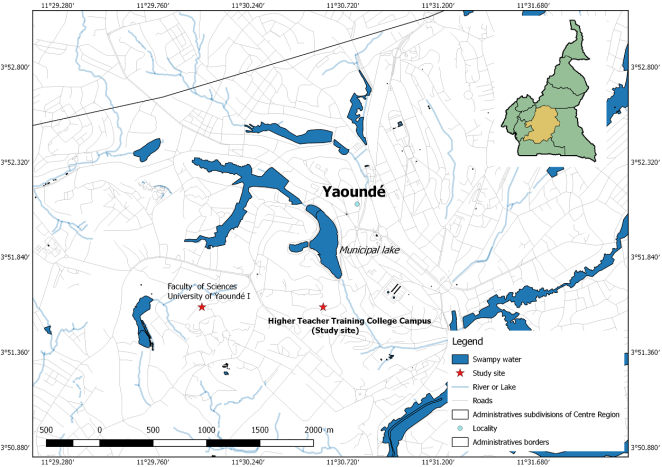
The study was conducted in the forest region of southern Cameroon, specifically in the urban area of Yaoundé, corresponding to the following geographical coordinates: longitude 3°57’35.5’’N and latitude 11°30’37.1’’E (
Figure 1). Our study period was limited to March 23 to September 11, 2019, and the fruit harvest period extended from the short dry season to the beginning of the long rainy season.
2.2. Geology, Soil and Vegetation
According to
, the soil of Yaoundé is a classic lateritic and forest soil, with a red horizon that is more or less superficially leached and can reach a depth of 4 to 10 m under favorable conditions, followed by a gravelly horizon, a mottled horizon, and a horizon of weathered parent rock. In addition to its marshland, this soil is poor in nutrients but can support rich crops in semi-rural areas if enriched or as long as significant forest cover protects it from erosion. Of an intertropical type with a predominance of southern forest, the vegetation of Yaoundé consists of dense semi-deciduous and evergreen forests. The practice of shifting cultivation with slash-and-burn followed by fallow periods to restore soil productivity is traditional. It has been severely degraded following intense urbanization. There has been a further impoverishment of the region's flora linked to a rapid expansion of settlement types in the metropolis. The need for materials for house construction, the use of firewood or charcoal, carpentry, and the search for space for urban agriculture, to name just a few, are the causes of the degradation of the forest vegetation of Yaoundé.
2.3. Meteorological Data
According to
| [18] | Suchel, F., G. Les climats du Cameroun. Thèse de Doctorat d’état. Université de Bordeaux III, France, 1987, 1188p. |
[18]
, Yaoundé is dominated by a Guinean-type equatorial climate with four seasons and bimodal rainfall: a short dry season, a long dry season, a short rainy season, and a long rainy season. To determine the dry months,
| [9] | Gaussen, H., Bagnouls, F. L’indice xérothermiquue. Bulletin de l’Association de Géographes Français, 1952, 29 (222), pp. 10-16. |
[9]
proposed ombrothermic diagrams, which are widely used for this purpose. A dry month is one in which the precipitation P (expressed in millimeters) is less than or equal to twice the average temperature T (expressed in degrees Celsius) of that same month, such that P is less than or equal to 2T. A climate is considered dry when the temperature curve rises above the rainfall curve. It is considered humid when the temperature curve falls below the rainfall curve. For our study, the climate data used was provided by Wetherbase.com. From this data, we observed that the city of Yaoundé received 1540 mm of annual rainfall. January was the driest month with 20 mm of rainfall, while October received the most rain with 290 mm. The average annual temperature was 23°C, with data ranging from 18°C to 28°C. The average annual relative humidity was 83%.
2.4. Biological Material
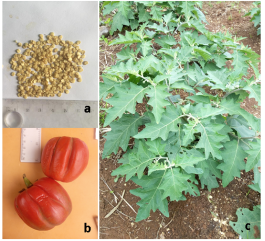
Figure 2. Biological material.
The plant material used in our study consisted of eggplant plants of the species Solanum aethiopicum, of the "zong" variety, whose seeds were extracted from fruits purchased at the Mfoundi market in Yaoundé (
Figure 2).
2.5. Experimental Design
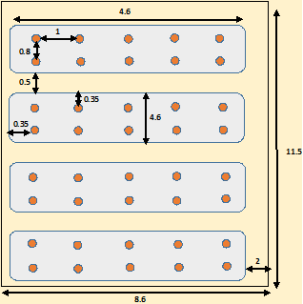
The eggplant seeds were placed in a nursery on March 23, 2019, on the ENS campus, in a rectangular container (dimensions: 20cm*30cm) filled with black soil that we purchased from a botanical garden at the crossroads of the National School of Administration and Magistracy (ENAM), not far from the study site. The seeds were sown in horizontally spaced rows, 1 cm deep, and then covered. We then watered regularly (every 2 days). Germination occurred 8 days after sowing. Left fallow for 2 years, the experimental plot, measuring 11.5 m long and 8.6 m wide, was cleared, cleaned, and plowed. We then established 4 ridges, each 4.6 m long and 1.5 m wide, spaced 0.5 m apart. The transplanting of the young plants (with 4 to 5 leaves) was carried out on the evening of May 14, 2019, to avoid water stress caused by high temperatures at the experimental site. Each bed contained 10 young eggplant plants, with 5 plants per row (
Figure 3).
Figure 3. Experimental garden. (NB: the unit is the meter (m)).
3. Data Collection
3.1. Ordinal Richness
3.1.1. Observation and Capture of Insects in the Field
Insect observations and captures were conducted from July 31, 2019, to September 11, 2019, at a regular weekly rate between 7:00 and 11:00 AM. Numbered
Solanum aethiopicum plants were examined in their entirety for insect activity. Captures were made using a locally manufactured mouth-operated aspirator, which was the only capture method employed
| [5] | Elono Azang, P. S., Heumou, C. R., Aléné, D. C., Ngassam, P. and Djiéto-Lordon, C. Diversity, abundance and incidence of fruit pest insects on three Solanum varieties (Solanaceae) in two agroecological zones of Southern Cameroon, 2016, African Journal of Agricultural Research. 11(39): pp: 3788-3798. |
[5]
. The captured insects were placed in a container filled with 70% alcohol for better preservation and labeled with the following information: the sampling date, the current season, the plant number, and the plant's phenological stage.
3.1.2. Insect Identification in the Laboratory
Identifications were carried out using the field guides
| [2] | Bordat, D. and Arvanitakis L. Arthropodes des cultures légumières d’Afrique de l’Ouest, Centrale, Mayotte et Réunion, 2004, Cirad, 300 p. |
[2]
. In conjunction with these guides, a Leica b2S6E 1044/6321-1.6×/WD55mm micrometer magnifier allowed for easy identification of the insect orders. To further assist in the identification process, the reference collection of the Zoology Laboratory at the University of Yaoundé I was also consulted. The individuals captured in the field and identified in the laboratory allowed us to highlight the biological diversity of insects, thus enabling us to assess the abundance of each insect order according to the seasons.
3.2. Ordinal Diversity
The Shannon-Wiener (H') and Simpson (S) diversity indices allowed us to calculate ordinal diversity. Diversity is a function of the probability Pi of the presence of each species i relative to the total number of individuals. It is calculated using the following formula:
H’ = -∑ ni/N log2ni/N (0≤ H ≤ log2S)
D = ∑ ni (ni-1) / N (N-1)
Where: H’ = Shannon index;
D = Simpson index;
N = Sum of the numbers in all orders;
ni = Population size of order i.
3.3. Sampling Effort
Sampling effort was assessed using rarefaction curves and non-parametric estimators of ordinal richness, namely: ACE, ICE, Chao 1, Chao 2, Jack-Knife 1, Jack-Knife 2, Bootstrap, MMSMean and Mean.
3.4. Index Damage Due to Leucinodes orbonalis
The attack rate (AR) due to Leucinodes orbonalis was calculated by dividing the number of fruits attacked (ni) by the pest by the total number of fruits harvested (N) per plant, multiplied by 100. The formula is as follows:
Where: AR (%) = Attack rate
ni = Number of fruits attacked
N = Total number of fruits
Thus, the total number of fruits per plant, the number of fruits harvested per plant, the number of fruits attacked per plant, and the attack rate due to L. orbonalis were evaluated according to harvests and seasons.
3.5. Relationship Between Leucinodes orbonalis Abundance and Fruits Parameters
3.5.1. Incubation of Fruits and Leucinodes orbonalis Abundance
The fruit was harvested and incubated once a week, from July 30, 2019, to October 10, 2019. Placed in bags labeled with the same number as the plant from which it was harvested, the fruit was transported to the laboratory, counted, and weighed using a scale. Infested fruits were identified by the holes corresponding to the entry or exit points of the larvae. Healthy fruits were those without these features and were dissected with a knife to check for the presence or absence of larvae. The infested fruits were incubated in cylindrical plastic boxes 12 cm high and 9.5 cm in diameter containing 5 cm of moist sand, necessary for the pupation of the pupae (for Diptera) and chrysalides (for Lepidoptera)
| [4] | Elono Azang P. S. Arthropodofaune associée à quelques Solanaceae maraîchères dans la région forestière du Sud-Cameroun: écologie et impact agronomique des principaux carpophage; 2017. Thèse de Doctorat/Ph.D. Université de Yaoundé 1, Cameroun. 230 p. |
[4]
. Using a fine-mesh white fabric, the boxes were covered to prevent the escape of emerging adults. The average number of
Leucinodes orbonalis individuals per incubated fruit was also evaluated, taking into account harvests and seasons.
3.5.2. Measurement of Fruit Biometric Parameters and Correlation
Before each incubation period, the mass, length, and circumference of the infested fruits were measured using a balance (for mass) and a measuring tape (for length and circumference). To assess their influence on Leucinodes orbonalis populations, these parameters were correlated with the abundance of emerging adults.
3.6. Data Analysis
To encode and calculate the means and proportions of the different sampled taxa, the data were processed using Excel. After a logarithmic transformation of the insect population sizes, we compared the means using the Analysis of Variance (ANOVA) test included in the GLM procedure of Statistica software version 8.0 (2007). To determine the biological diversity of the captured insects and the sampling effort, we used Estimate S software version 8.2.0 (2009). All results were assessed at a significance level of 5%.
4. Results
4.1. Ordinal Richness
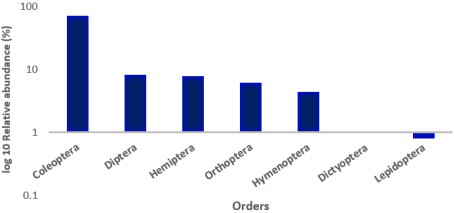
At the end of the insect capture phase on our plot, we counted 503 individuals belonging to 7 orders. The order Coleoptera was the most represented with 361 individuals, or 71.77% of the total insect fauna recorded, followed by the order Diptera with 41 individuals, or 8.15%, the order Hemiptera with 39 individuals, or 7.75%, the order Orthoptera with 31 individuals, or 6.16%, and the order Hymenoptera with 22 individuals, or 4.37%. The orders Dictyoptera (0.99%) and Lepidoptera (0.79%) were the least abundant (
Figure 4).
Figure 4. Relative abundance (%) of insect’s orders on S. aethiopicum.
4.2. Sampling Effort
The non-parametric estimators of ordinal richness for evaluating sampling success gave satisfactory values which are presented in
Table 1.
Table 1. Non-parametric estimators of ordinal richness on insects associated with S. aethiopicum.
Non-parametric estimators of ordinal richness | Values | Sampling effort |
ACE | 7 | 100% |
ICE | 7 | 100% |
Chao 1 | 7 | 100% |
Chao 2 | 7 | 100% |
Jack Knife 1 | 7 | 100% |
Jack Knife 2 | 7 | 100% |
Bootstrap | 7,06 | 99,15% |
Means | 7,31 | 95,75% |
MMSMeans | 7,4 | 94,59% |
Orders observed | 7 | |
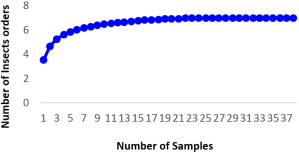
Cumulative number of samples | 38 |
Number of individuals | 503 |
The accumulation or rarefaction curve of ordinal richness used to determine sampling effort reveals a gradual evolution of the orders obtained as a function of the cumulative number of samples (
Figure 5).
Figure 5. Rarefaction curve on sampling effort as a function of the cumulative number of samples on Solanum aethiopicum.
4.3. Ordinal Diversity
Table 2. Ordinal diversity of entomofauna associated with S. aethiopicum.
Diversity index | Values |
Shannon index (H’) | 1,03 |
Simpson index (D) | 1,88 |
Abundance (N) | 503 |
Order number (O) | 7 |
The ordinal diversity of the insect fauna associated with
Solanum aethiopicum at our study site showed that this site is diverse. The evidence in favor of this diversity is the Shannon (H’=1.03; N=503; O=7) and Simpson (D=1.88; N=503; O=7) indices, the values of which are recorded in
Table 2.
4.4. Index Damage Due to Leucinodes orbonalis on Fruits
4.4.1. Index Damage per Harvest
The average total number of fruits per plant differed significantly between harvests (df=4; F=39.79; P=0.000). The highest average total number of fruits per plant was obtained at the third harvest, at 31.40 ± 1.26 fruits/plant (Min=28.88; Max=33.93; N=64) (
Table 3).
The average number of fruits harvested per plant varied significantly across harvests (df=4; F=17.53; P=0.0000). The average number of fruits harvested was highest at the fifth harvest, at 11.65 ± 0.34 fruits/plant (Min=10.97; Max=12.32; N=270). The average number of fruits harvested was lowest at the second harvest, at 5.55 ± 0.46 fruits/plant (Min=4.62; Max=6.42; N=60) (
Table 3).
Table 3. Ordinal diversity of entomofauna associated with S. aethiopicum.
Variable | Harvest (Means ± Std. Err.) | Probability values | Means ± Std. Err. |
1 (N=49) | 2 (N=60) | 3 (N=64) | 4 (N=9) | 5 (N=270) | ddl | F | P |
TNF/ plant | 31.10±2.50a (26.06-36.1) | 24.71±1.51b (21.69-27.7) | 31.40±1.26a (28.88-33.9) | 17.00±00b (00-00) | 17.26±0.48c (16.31-18.31) | 4 | 39.79 | 0.00 | 24.29±6.66 |
TNHaF/ plant | 11.38±1.13a (9.11-13.65) | 5.55±0.46b (4.61-6.48) | 9.31±0.6b (8.11-10.51) | 5.66±0.52b (4.45-6.88) | 11.65±0.34a (10.97-12.32) | 4 | 17.53 | 0.00 | 8.71±2.80 |
TNHF/ plant | 0.26±0.06a (0.13-0.39) | 0.81±0.09b (0.62-1.00) | 0.12±0.06a (0.003-0.24) | 0.44±0.29a (-0.23-1.1) | 0.00±0.00c (0.0-0.0) | 4 | 59.81 | 0.00 | 0.33±0.29 |
TNIF/ plant | 11.12±1.14a (8.82-13.41) | 4.71±0.40b (3.91-5.52) | 8.93±0.62a (7.70-10.17) | 4.55±0.17b (4.15-4.96) | 11.65±0.34a (10.97-12.32) | 4 | 22.86 | 0.00 | 8.19± 3.21 |
IR (%) | 35,75% | 19,06% | 28,43% | 26,76% | 67,49% | 4 | 38.22 | 0.00 | 35,49±17,76% |
4.4.2. Index Damage per Season
The average total number of fruits per plant varied significantly according to the seasons (df=1; F=123.89; P=0.00). During the short dry season, the average total number of fruits was 28.40 ± 0.98 fruits/plant (Min=26.45; Max=30.35; N=182); During the long rainy season, the average total number of fruits was 17.26 ± 0.48 fruits/plant (Min=16.31; Max=18.21; N=270) (
Table 4).
The average number of fruits harvested per plant differed significantly between seasons (df=1; F=33.87; P=0.00000).
The average number of fruits harvested per plant during the long rainy season (11.65±0.34 fruits/plant) was higher than the average number of fruits harvested per plant during the short dry season (8.45±0.43 fruits/plant) (
Table 4).
The average number of healthy fruits per plant was significant depending on the season (df=1; F=101.21; P<0.0004).
During the short dry season, the average number of healthy fruits was 0.41 ± 0.05 fruits/plant (Min=0.31; Max=0.5; N=182). During the long rainy season, no healthy fruits were observed at harvest (
Table 4).
The average number of fruits infested per plant by L. orbonalis differed significantly between seasons (df=1; F=45.53; P<0.0004).
During the short dry season, the average number of infested fruits was lower than during the long rainy season, with 7.92 ± 0.44 infested fruits/plant (Min=7.04; Max=8.79; N=182) and 11.65 ± 0.34 infested fruits/plant (Min=10.97; Max=12.32; N=270), respectively (
Table 4).
The average attack rate of fruit due to L. orbonalis showed a significant difference depending on the season (df=1; F=70.50; P<0.0004). Our study revealed that the attack rate was highest during the main rainy season (67.49% attack).
Table 4. Variation in average abundance of harvested and infestation eggplant fruits per season.
Variables | Seasons (Means ± Std. Err.) | Probability values | Means ± Std. Err. |
SDS (N=182) | LRS (N=270) | ddl | F | P |
TNF/ plant | 28.40±0.98 a (23.45-30.35) | 17.26±0.48 b (16.31-18.21) | 1 | 123.9 | 0.0000 | 22.83±6.23 fruits |
TNHaF/ plant | 8.45±0.43 a (7.58-9.31) | 11.65±0.34 b (10.97-12.32) | 1 | 33.87 | 0.000 | 10.05±1.84 fruits |
TNHF/ plant | 0.41±0.05 a (0.30-0.45) | 0.00±0.00 b (0.00-0.00) | 1 | 101.2 | 0.0000 | 0.20±0.23 fruits |
TNIF/ plant | 7.92±0.44 a (7.04-8.79) | 11.65±0.34 b (10.97-12.32) | 1 | 45.53 | 0.000 | 10.78±1.004 fruits |
IR (%) | 27,88% | 67,49% | 1 | 70.51 | 0.000 | 47,68±22,86% |
4.5. Index Damage Due to Leucinodes orbonalis on Fruits
4.5.1. Mass (g), Length (mm) and Circumference (mm) of Attacked Fruits and Average Number of L. orbonalis Individuals per Fruit
(i). Depending on the Harvests
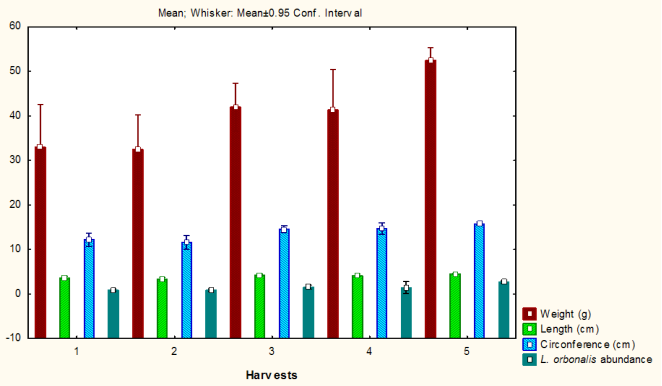
Our study showed an increasing trend in these three parameters over time and across harvests:
The average mass of infested and incubated fruit varied significantly across harvests (df=4; F=12.37; P<0.0004). We noted that the average mass of infested and incubated fruit was highest at the fifth harvest (corresponding to the long rainy season), at 52.51 ± 1.44 grams/fruit (Min=49.66; Max=55.35; N=270).
The average length of attacked and incubated fruit showed a significant difference between harvests (df=4; F=19.88; P<0.0004). Specifically, the average length of attacked and incubated fruit was greatest at the fifth harvest (corresponding to the long rainy season), at 4.55 ± 0.05 cm/fruit (Min=4.45; Max=4.66; N=270).
The average circumference of attacked and incubated fruit also showed a significant difference between harvests (df=4; F=20.81; P<0.0004). We observed that the average circumference of attacked and incubated fruit was greater at the fifth harvest (corresponding to the long rainy season, at 15.76 ± 0.18 cm/fruit (Min=15.41; Max=16.12; N=270) (
Figure 6).
The mean number of
L. orbonalis individuals per incubated fruit differed significantly between harvests (df=4; F=15.13; P<0.0004). This mean number was highest at the fifth harvest (between 2.5 and 3 individuals per incubated fruit), while we observed fewer than one individual per incubated fruit at the first harvest. From the first to the fifth harvest, a gradual increase in the mean number of
L. orbonalis individuals per incubated fruit was observed (
Figure 6).
Figure 6. Cumulative graph showing the evolution of the mass, length, circumference of attacked fruits and the average number of L. orbonalis individuals as a function of harvests.
(ii). Depending on the Seasons
The average mass (26.84±11.06g), length (4.15±0.45 cm), and circumference (14.35±1.62 cm) of the attacked and incubated fruits showed significant differences according to the season: (df=1; F=43.48; P<0.0004) for mass, (df=1; F=52.40; P<0.0004) for length, and (df=1; F=57.49; p<0.000) for circumference. During the long rainy season, an increase in these three parameters was observed (52.50±1.44 g; 4.55±0.05 cm and 15.76±0.18 cm respectively), compared to the short dry season (
Table 5).
The mean number of L. orbonalis individuals per incubated fruit varied significantly with the seasons (df=1; F=56.30; P<0.0004). An increase in the mean number of L. orbonalis individuals was observed from the short dry season to the long rainy season.
During the short dry season, the mean was 1.14 ± 0.10 individuals per incubated fruit (Min=0.93; Max=1.35; N=182). During the long rainy season, the mean was 2.66 ± 0.14 individuals per incubated fruit (Min=2.37; Max=2.96; N=270) (
Table 5).
Table 5. Evolution of the mass, length, average circumference of attacked fruits and the number of L. orbonalis individuals as a function of the seasons.
Parameters of fruits | Seasons (Means ± Err. Std) | Probabilities values | Means ± Std. Err. |
SDS (N=182) | LRS (N=270) | ddl | F | P |
Mass (g) | 36.42±2.05 a (23.45-30.35) | 52.50±1.44 b (49.66-55.35) | 1 | 43.48 | 0.000 | 26.84±11.06 (g) |
Length (cm) | 3.76±0.10 a (3.55-3.97) | 4.55±0.05 b (4.45-4.66) | 1 | 52.40 | 0.000 | 4.15±0.45 (cm) |
Circumference (cm) | 12.95±0.36 a (12.23-13.67) | 15.76±0.18 b (15.41-16.12) | 1 | 57.49 | 0.000 | 14.35±1.62 (cm) |
L. orbonalis abundance per fruit | 1.14±0.10 a (0.93-1.35) | 2.66±0.14 b (2.37-2.96) | 1 | 56.30 | 0.000 | 1.91±0.87 individuals |
4.5.2. Correlation
During the short dry season, the study showed positive and significant correlations between the mean number of
L. orbonalis and the mass (r = 0.29; p < 0.05), length (r = 0.28; p < 0.05), and circumference (r = 0.31; p < 0.05) of the incubated fruits (
Table 6). In contrast, during the long rainy season, the study showed positive and significant correlations between the mean number of
L. orbonalis and the mass (r = 0.12; p < 0.05) and length (r = 0.13; p < 0.05), but no significant correlation with the circumference (r = 0.11; p ≥ 0.05) of the incubated fruits (
Table 6).
Table 6. Correlation of the mass, length, circumference of attacked fruits with the number of L. orbonalis individuals as a function of the seasons.
Pairs of Variables | Seasons |
SDS (N=182) | LRS (N=270) |
Mass (g) & L. orbonalis | r = 0.29* | p < 0.05 | r = 0.12* | p < 0.05 |
Length (cm) & L. orbonalis | r = 0.28* | p < 0.05 | r = 0.13* | p < 0.05 |
Circumference (cm) & L. orbonalis | r = 0.31* | p < 0.05 | r = 0.11 | p ≥ 0.05 |
The average mass of infested fruit showed a positive and significant correlation with the average number of Leucinodes orbonalis individuals per incubated fruit (r=0.27; p<0.05). This indicated that if the incubated fruit has a high mass, Leucinodes orbonalis individuals are abundant.
The average length of infested fruits showed a positive and significant correlation with the average number of Leucinodes orbonalis individuals per incubated fruit (r = 0.25; p < 0.05). Thus, if the incubated fruit is long, Leucinodes orbonalis individuals are abundant.
The average circumference of the infested fruits showed a positive and significant correlation with the average number of
Leucinodes orbonalis individuals per incubated fruit (r = 0.27; p < 0.05). Therefore, if the incubated fruit has a large circumference,
Leucinodes orbonalis individuals are abundant (
Table 7).
Table 7. Spearman’s R correlation between biometric parameters of attacked fruits and the number of L. orbonalis individuals per fruit.
Pairs of Variables | Valid N | Spearman R | T (N-2) | p-level |
Mass (g) & L. orbonalis abundance | 452 | 0.269 | 5.941 | 0.000 |
Length (cm) & L. orbonalis abundance | 452 | 0.254 | 5.579 | 0.000 |
Circumference (cm) & L. orbonalis abundance | 452 | 0.260 | 5.733 | 0.000 |
5. Discussion
5.1. Ordinal Richness and Diversity
In our experimental field, the insect fauna observed and inventoried on
Solanum aethiopicum comprises 34 families distributed across 7 orders: Coleoptera, Diptera, Hemiptera, Orthoptera, Hymenoptera, Dictyoptera, and Lepidoptera. These results are comparable to those of
| [15] | Mahanac Njiti, L., C. Etude de l’arthropodofaune associée à Solanum aethiopicum L. (Solanaceae) au campus de l’Ecole Normale Supérieure de l’Université de Yaoundé I. Mémoire de fin d’étude. ENS, Université de Yaoundé I, Cameroun, 2019, 70p. |
[15]
, who studied the arthropod fauna associated with
Solanum aethiopicum (Solanaceae) on the campus of the Higher Teacher Training College at Yaoundé, and identified 10 orders of arthropods distributed across 39 families. These results are consistent with those of
| [4] | Elono Azang P. S. Arthropodofaune associée à quelques Solanaceae maraîchères dans la région forestière du Sud-Cameroun: écologie et impact agronomique des principaux carpophage; 2017. Thèse de Doctorat/Ph.D. Université de Yaoundé 1, Cameroun. 230 p. |
[4]
in his study of the arthropod fauna associated with some vegetable Solanaceae in the Okola area (peri-urban zone of Yaoundé), whose findings revealed the presence of 12 orders and 62 families in the different study plots.
| [2] | Bordat, D. and Arvanitakis L. Arthropodes des cultures légumières d’Afrique de l’Ouest, Centrale, Mayotte et Réunion, 2004, Cirad, 300 p. |
[2]
obtained similar results in their study of arthropods in vegetable crops in West and Central Africa, Mayotte and Reunion. Therefore, we can conclude that the insect fauna associated with
Solanum aethiopicum was diverse in our study.
5.2. Infestation Rate Due to Leucinodes orbonalis on Fruits
The results obtained during our study show that the infestation rate of
Solanum aethiopicum fruit by
Leucinodes orbonalis is significantly high, despite fluctuation between harvests. This infestation rate is higher during the long rainy season, taking into account the average number of individuals in an infested and incubating fruit. These results are similar to those of
| [4] | Elono Azang P. S. Arthropodofaune associée à quelques Solanaceae maraîchères dans la région forestière du Sud-Cameroun: écologie et impact agronomique des principaux carpophage; 2017. Thèse de Doctorat/Ph.D. Université de Yaoundé 1, Cameroun. 230 p. |
[4]
, who noted that damage to fruit caused by
L. orbonalis is greater during wet periods and less severe during dry periods. His work revealed that nearly 80% of fruit losses in the study sites were due to
Leucinodes orbonalis. These results are consistent with those of
| [11] | Halder, J., Khushwaha, D, Singh, A., Tiwari, S., K., Rai, A., B., and Singh, B. Whether Leucinodes orbonalis Guenee is becoming a serious problem to brinjal seedlings in nursery? ICAR-Indian Institute of Vegetable Research, Varanasi, Uttar Pradesh - 221305, India. Published in Pest Management in Horticultural Ecosystems, 2015, Vol. 21, No. 2 pp 231-232. |
[11]
, who studied the impact of
Leucinodes orbonalis on fruit in the field. This pyralid moth is considered the most important pest of
Solanum aethiopicum, attacking mainly the stems and fruits. It can cause 100% damage if no control measures are implemented
| [14] | Latif, M., A., Rahman, M., M., Alam, M., Z. Efficacy of nine insecticides against shoot and fruit borer, Leucinodes orbonalis Guenee (Lepidoptera: Pyralidae) in eggplant. Journal of Pest Science, 2010, 83 (4), pp: 391-397. |
[14]
. In South Asia,
L. orbonalis causes significant damage to Solanum sp., especially during the fruiting stage and at harvest time
| [6] | FAO. Eggplant integrated pest management an ecological guide. FAO inter-country programme for integrated pest management in vegetables in South and Southeast Asia, 2003, Bangkok, Thailand. 177p. |
[6]
.
Leucinodes orbonalis can infest other plants in the same family as eggplant (Solanaceae); indeed,
| [10] | Heumou, C. R., Djiéto-Lordon, C., Aléné, D. C. and Elono Azang, P. S. Diversity and agronomic status of tomato and pepper fruit pests in two agro-ecological zones of Southern Cameroon: Western Highland and Southern Plateau of Cameroon. African Journal of Agricultural Research, 2015, 10 (11): pp: 1224-1232. |
[10]
found this species in the attacked fruits of
Capsicum annuum at Okola, Cameroon, and their results showed an attack rate of 1.06% with a relative abundance of 9%.
5.3. Relationship Between L. orbonalis Abundance and Fruits Parameters
Our investigations revealed that the mass, length, and average circumference of the infested fruits influence the average number of
Leucinodes orbonalis individuals per incubated fruit. Indeed, the average number of
Leucinodes orbonalis individuals was found to be high when the fruit was large (high mass, length, and circumference). These parameters are even higher with rainfall patterns. The fruits increase in size during the rainy season and lose water during the dry season. These results corroborate those of
| [4] | Elono Azang P. S. Arthropodofaune associée à quelques Solanaceae maraîchères dans la région forestière du Sud-Cameroun: écologie et impact agronomique des principaux carpophage; 2017. Thèse de Doctorat/Ph.D. Université de Yaoundé 1, Cameroun. 230 p. |
[4]
. Humid and rich in essential biochemical, the fruits could offer a considerable (in terms of volume) and favorable environment for the development of
L. orbonalis larvae
| [17] | Srinivasan, R. Insect and mite pests on eggplant. AVRDC Publication, 2009, 09-729. |
[17]
.
6. Conclusion
At the end of our work, we identified seven orders, with Coleoptera being the most abundant, the Chrysomelidae family having the highest relative abundance. These are leaf pests whose damage to leaves was significant. We observed that Lepidoptera were less abundant compared to the other orders; however, they caused more damage, particularly to fruit. We observed that the infestation rate of Leucinodes orbonalis (Pyralidae) on incubated S. aethiopicum fruit varies depending on the harvest and the season. This pest proved particularly dangerous during the wet season, when we harvested no healthy fruit, unlike during the dry season, when the damage is even more significant. Over the course of the harvests, the attack rate has shown significant growth, which can be explained by the plant's growth, resulting in a high fruit yield, and by the climate, with the transition from the short dry season to the long rainy season, which is favorable to our crop. The data obtained after measuring the mass, length, and circumference of the infested and incubated fruits allowed us to conclude that the abundance of Leucinodes orbonalis individuals varies according to these three parameters. The fruits become waterlogged during the rainy season, and their volume increases, providing considerable space for the development of Leucinodes orbonalis larvae during the rainy period.
Abbreviations
SDS | Short Dry Season |
LRS | Long Rainy Season |
TNF | Total Number of Fruits |
TNHaF | Total Number of Harvested Fruits |
TNHF | Total Number of Healthy Fruits |
TNIF | Total Number of Infested Fruits |
IR | Infestation Rate |
M | Mass |
L | Length |
C | Circumference |
Acknowledgments
Authors acknowledge the support of Director of Higher Teacher’s Training College, University of Yaoundé I, for their material support and cooperation.
Author Contributions
Elono Azang Pierre Stephan: Conceptualization, Formal Analysis, Methodology, Project administration, Resources, Writing – review & editing, Software, Writing – original draft
Heumou Cyril Romeo: Conceptualization, Project administration, Resources, Writing – review & editing, Methodology
Alene Desiree Chantal: Conceptualization, Methodology, Project administration, Writing – review & editing
Owoundi Alphonse Vincent: Conceptualization, Data curation, Methodology, Project administration, Writing – review & editing
Ngassam Pierre: Conceptualization, Methodology, Project administration, Writing – review & editing
Djieto-Lordon Champlain: Formal Analysis, Validation, Writing–review & editing
Data Availability Statement
The data is available from the corresponding author upon reasonable request.
Conflicts of Interest
The authors declare no conflicts of interest.
References
| [1] |
Anonyme. Annuaire statistique du Cameroun, 2010, 189 p.
|
| [2] |
Bordat, D. and Arvanitakis L. Arthropodes des cultures légumières d’Afrique de l’Ouest, Centrale, Mayotte et Réunion, 2004, Cirad, 300 p.
|
| [3] |
Dansi. Biodiversité des légumes feuilles traditionnels consommés au Bénin; 2008. IRDCAMM-IFS.
https://www.researchgate.net/publication/299289600
|
| [4] |
Elono Azang P. S. Arthropodofaune associée à quelques Solanaceae maraîchères dans la région forestière du Sud-Cameroun: écologie et impact agronomique des principaux carpophage; 2017. Thèse de Doctorat/Ph.D. Université de Yaoundé 1, Cameroun. 230 p.
|
| [5] |
Elono Azang, P. S., Heumou, C. R., Aléné, D. C., Ngassam, P. and Djiéto-Lordon, C. Diversity, abundance and incidence of fruit pest insects on three Solanum varieties (Solanaceae) in two agroecological zones of Southern Cameroon, 2016, African Journal of Agricultural Research. 11(39): pp: 3788-3798.
|
| [6] |
FAO. Eggplant integrated pest management an ecological guide. FAO inter-country programme for integrated pest management in vegetables in South and Southeast Asia, 2003, Bangkok, Thailand. 177p.
|
| [7] |
FAO. Évaluation du Programme de la FAO au Cameroun, 2017, pp 2013-2017.
|
| [8] |
Georges B. Etude pédologique des sols de Yaoundé: Contribution à l’étude de la pédogenèse des sols ferralitiques. Agronomie tropicale, 1959, 14 (3), 279-305.
http://www.documentation.ird.fr/hor/fdi:18029
|
| [9] |
Gaussen, H., Bagnouls, F. L’indice xérothermiquue. Bulletin de l’Association de Géographes Français, 1952, 29 (222), pp. 10-16.
|
| [10] |
Heumou, C. R., Djiéto-Lordon, C., Aléné, D. C. and Elono Azang, P. S. Diversity and agronomic status of tomato and pepper fruit pests in two agro-ecological zones of Southern Cameroon: Western Highland and Southern Plateau of Cameroon. African Journal of Agricultural Research, 2015, 10 (11): pp: 1224-1232.
|
| [11] |
Halder, J., Khushwaha, D, Singh, A., Tiwari, S., K., Rai, A., B., and Singh, B. Whether Leucinodes orbonalis Guenee is becoming a serious problem to brinjal seedlings in nursery? ICAR-Indian Institute of Vegetable Research, Varanasi, Uttar Pradesh - 221305, India. Published in Pest Management in Horticultural Ecosystems, 2015, Vol. 21, No. 2 pp 231-232.
|
| [12] |
Kumar, R. La lutte contre les insectes ravageurs: La situation de l’agriculture africaine (régions tropicales). Karthala/CTA, 1991, 310p.
|
| [13] |
Lester, R., N. and Seck, A. Solanum aethiopicum L. In: Grubben, G. J. H. & Denton, O. A. Ressources végétales de l'Afrique tropicale 2. Légumes. Fondation PROTA / CTA: Wageningen / Pays-Bas, 2004, 737p.
|
| [14] |
Latif, M., A., Rahman, M., M., Alam, M., Z. Efficacy of nine insecticides against shoot and fruit borer, Leucinodes orbonalis Guenee (Lepidoptera: Pyralidae) in eggplant. Journal of Pest Science, 2010, 83 (4), pp: 391-397.
|
| [15] |
Mahanac Njiti, L., C. Etude de l’arthropodofaune associée à Solanum aethiopicum L. (Solanaceae) au campus de l’Ecole Normale Supérieure de l’Université de Yaoundé I. Mémoire de fin d’étude. ENS, Université de Yaoundé I, Cameroun, 2019, 70p.
|
| [16] |
Nguegang, P., Parrot, L., Lejoly, J., Joris, V. Mise en valeur des bas-fonds à Yaoundé: système de production, savoir-faire traditionnel et potentialités d’une agriculture urbaine et périurbaine en développement. Rapport de l’atelier CIRAD, Yaoundé, 2005, 11p.
|
| [17] |
Srinivasan, R. Insect and mite pests on eggplant. AVRDC Publication, 2009, 09-729.
|
| [18] |
Suchel, F., G. Les climats du Cameroun. Thèse de Doctorat d’état. Université de Bordeaux III, France, 1987, 1188p.
|
Cite This Article
-
APA Style
Stephan, E. A. P., Romeo, H. C., Chantal, A. D., Vincent, O. A., Pierre, N., et al. (2026). Ordinal Diversity of Insects and Seasonal Variation of Damage Due to Leucinodes orbonalis Genn. (Pyralidae) on Solanum aethiopicum L., 1756 (Solanaceae). American Journal of Entomology, 10(2), 26-37. https://doi.org/10.11648/j.aje.20261002.11
 Copy
|
Copy
|
 Download
ACS Style
Stephan, E. A. P.; Romeo, H. C.; Chantal, A. D.; Vincent, O. A.; Pierre, N., et al. Ordinal Diversity of Insects and Seasonal Variation of Damage Due to Leucinodes orbonalis Genn. (Pyralidae) on Solanum aethiopicum L., 1756 (Solanaceae). Am. J. Entomol. 2026, 10(2), 26-37. doi: 10.11648/j.aje.20261002.11
Copy
|
Download
AMA Style
Stephan EAP, Romeo HC, Chantal AD, Vincent OA, Pierre N, et al. Ordinal Diversity of Insects and Seasonal Variation of Damage Due to Leucinodes orbonalis Genn. (Pyralidae) on Solanum aethiopicum L., 1756 (Solanaceae). Am J Entomol. 2026;10(2):26-37. doi: 10.11648/j.aje.20261002.11
Copy
|
Download
-
@article{10.11648/j.aje.20261002.11,
  author = {Elono Azang Pierre Stephan and Heumou Cyril Romeo and Alene Desiree Chantal and Owoundi Alphonse Vincent and Ngassam Pierre and Djieto-Lordon Champlain},
  title = {Ordinal Diversity of Insects and Seasonal Variation of Damage Due to Leucinodes orbonalis Genn. (Pyralidae) on Solanum aethiopicum L., 1756 (Solanaceae)},
  journal = {American Journal of Entomology},
  volume = {10},
  number = {2},
  pages = {26-37},
  doi = {10.11648/j.aje.20261002.11},
  url = {https://doi.org/10.11648/j.aje.20261002.11},
  eprint = {https://article.sciencepublishinggroup.com/pdf/10.11648.j.aje.20261002.11},
  abstract = {Solanum aethiopicum, commonly called "African eggplant", is a Solanaceae very popular for its fruits but also for its leaves with invaluable virtues. The production of this plant is experiencing many problems including attacks from various pests that affect its performance. The dangerousness of these pests being poorly understood by some market gardeners, the means of control, sometimes very harmful to the environment and human health, often remain ineffective. With the aim of developing appropriate and respectful control methods in human habitats, this study contributed to the knowledge of insect pests associated with Solanum aethiopicum. It allowed for the cataloging of the insect fauna associated with Solanum aethiopicum and the comparison of damage caused by Leucinodes orbonalis over the study seasons. To this end, we conducted direct field observations, sampling, and inventories of the various arthropods and their activities. Some insect groups were found to be more abundant than others. Indeed, the orders Coleoptera (71.77% of the total insect fauna) and Diptera (8.15% of the total insect fauna) were the most abundant. The families Chrysomelidae (57.87%) and Coccinellidae (10.93%) were also widely represented. The assessment of the attack rate on incubated fruit showed that the damage was due to Leucinodes orbonalis (with an average attack rate of 47.68±22.86% over the two seasons). The study also revealed that the attack rate was higher during the long rainy season (67.49% attack rate). The average number of Leucinodes orbonalis individuals per incubated fruit varied according to the mass, length and average circumference of the attacked fruits of S. aethiopicum. These parameters varied according to the seasons. Thus, the fruits increased in size during the long rainy season and offered a more favorable habitat for L. orbonalis larvae; these larvae were found there in large numbers (12.63 ± 0.15 individuals per incubated fruit during the long rainy season compared to 2.52 ± 0.10 individuals per incubated fruit during the short dry season). We found a positive and significant correlation between the number of Leucinodes orbonalis individuals and the mass (r=0.27; p<0.05), the length (r=0.25; p<0.05) and then the circumference (r=0.27; p<0.05) of the attacked fruits.},
 year = {2026}
}
Copy
|
Download
-
TY  - JOUR
T1  - Ordinal Diversity of Insects and Seasonal Variation of Damage Due to Leucinodes orbonalis Genn. (Pyralidae) on Solanum aethiopicum L., 1756 (Solanaceae)
AU  - Elono Azang Pierre Stephan
AU  - Heumou Cyril Romeo
AU  - Alene Desiree Chantal
AU  - Owoundi Alphonse Vincent
AU  - Ngassam Pierre
AU  - Djieto-Lordon Champlain
Y1  - 2026/06/26
PY  - 2026
N1  - https://doi.org/10.11648/j.aje.20261002.11
DO  - 10.11648/j.aje.20261002.11
T2  - American Journal of Entomology
JF  - American Journal of Entomology
JO  - American Journal of Entomology
SP  - 26
EP  - 37
PB  - Science Publishing Group
SN  - 2640-0537
UR  - https://doi.org/10.11648/j.aje.20261002.11
AB  - Solanum aethiopicum, commonly called "African eggplant", is a Solanaceae very popular for its fruits but also for its leaves with invaluable virtues. The production of this plant is experiencing many problems including attacks from various pests that affect its performance. The dangerousness of these pests being poorly understood by some market gardeners, the means of control, sometimes very harmful to the environment and human health, often remain ineffective. With the aim of developing appropriate and respectful control methods in human habitats, this study contributed to the knowledge of insect pests associated with Solanum aethiopicum. It allowed for the cataloging of the insect fauna associated with Solanum aethiopicum and the comparison of damage caused by Leucinodes orbonalis over the study seasons. To this end, we conducted direct field observations, sampling, and inventories of the various arthropods and their activities. Some insect groups were found to be more abundant than others. Indeed, the orders Coleoptera (71.77% of the total insect fauna) and Diptera (8.15% of the total insect fauna) were the most abundant. The families Chrysomelidae (57.87%) and Coccinellidae (10.93%) were also widely represented. The assessment of the attack rate on incubated fruit showed that the damage was due to Leucinodes orbonalis (with an average attack rate of 47.68±22.86% over the two seasons). The study also revealed that the attack rate was higher during the long rainy season (67.49% attack rate). The average number of Leucinodes orbonalis individuals per incubated fruit varied according to the mass, length and average circumference of the attacked fruits of S. aethiopicum. These parameters varied according to the seasons. Thus, the fruits increased in size during the long rainy season and offered a more favorable habitat for L. orbonalis larvae; these larvae were found there in large numbers (12.63 ± 0.15 individuals per incubated fruit during the long rainy season compared to 2.52 ± 0.10 individuals per incubated fruit during the short dry season). We found a positive and significant correlation between the number of Leucinodes orbonalis individuals and the mass (r=0.27; p<0.05), the length (r=0.25; p<0.05) and then the circumference (r=0.27; p<0.05) of the attacked fruits.
VL  - 10
IS  - 2
ER  -
Copy
|
Download





 Share This Article
 Twitter
 Linked In
 Facebook