1. Introduction
Masts and towers are facilities installed by telecommunication companies to carry out their business operations. Olori Limited located its Mast and Tower in Mgbede Community in Ogba/Egbema/Ndoni Local Government Area of Rivers State, Nigeria. This location has common boundary with other residential houses in the community. The neighboring residents to this base station complained of untold hardship since the operation of the company began there in 2010.
In Nigeria, since the advent of telecommunication industry in 1999 the industry has boomed the economy providing among other things jobs and revenue source to the government. However, these benefits are not without setbacks. As a result of its setbacks, the Nigerian Communication commission (NCC) was formed by the Federal Government to watch and monitor the activities of the operators. In so doing, NCC set forth the operational guidelines for operators which are expected to be adhered to strictly.
Similarly, the Federal Ministry of Environment set up guidelines for the operators in the Telecommunication industry to protect the health of the public and the Nigerian environment. This regulation is known as National Environmental Standards and Regulations Enforcement Agency (Establishment) Act, 2007.
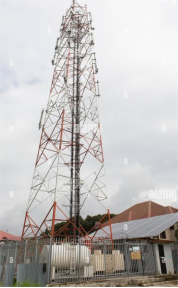
Mast and Tower facilities include the antenna, RF Cables, Equipment shelter, Security post, Tower, two diesel generating plants and diesel storage tank. The operational activity of a typical station emits noise (Vibration) pollution, Radio Frequency Electromagnetic radiation and toxic fumes from exhaust pipe of the generating plants. This is shown in
Figure 1:
Figure 1. A base Station for the Telecommunication industry.
According to European Environment Agency (EEA)
combustion plants remain s significant source of acidifying pollutants which include SO
2, NOx and other pollutants such as PM, CO, and non metal volatile organic compounds (NMVOC) that potentially impact human health and the environment. Kakareka and Salivonchyk noted that emissions from Diesel engines are more dense and deleterious than those of fuel engines
| [3] | Kakareka,. S. and Salivonchyk, S. (2020) “An assessment of the impacts ofdiesel power plants on air quality in Antartica” Advances in Polar Science Vol. 31 (1) page 74-87. |
[3]
. They include Sox, Nox, and PM
10. It is estimated that, diesel engines globally produce an astounding 1.3 billion tons of particulate matter each year.
Jakhrani, Rigit, Othman, Samo and Kamboh
| [4] | Jakhrani, A. Q., Othman,. a., Rigit, A. R. H., Samo, S. R. and Kamboh, S. A. (2012) “Estimation of Carbon Footprints from Diesel Generators Emissions” Paper Presented at the International Conference in Green and Ubiquitous Technology. |
[4]
stated that diesel engines release many hazardous air contaminants and greenhouse gases (GHG) including particulate matter (diesel soot and aerosols), carbon monoxide, carbon dioxide and oxides of nitrogen. Particulate matters are largely elemental and organic carbon soot, coated by gaseous organic substances such as formaldehyde and polycyclic aromatic hydrocarbons (PAHs) which are highly toxic.
Okoro and Umeuduji
| [5] | Okoro, G. Umeuduji, J. E. (2022) Monitoring & Adaptation to Air Pollution: The Case of Oil Producing Communities in the Niger Delta Region. American Journal of Bioscience and Bioengineering. Vol. 10, No. 4, 2022, pp. 89-104. https://doi.org/10.11648/j.bio.20221004.13 |
[5]
reveal the health implications of atmospheric pollutants on human beings and environment in Egbema. Diesel emissions like every other hydrocarbon emissions pose a significant threat to both the environment and public health. It is relevant to address the issue of particulate matter, including black carbon and greenhouse gas emissions, from on-site diesel generators. By prioritizing emissions reduction or switch to greener energy, we can pave the way towards a cleaner, healthier, and more sustainable future.
The overall study aim is to promote the activities of Telecommunication companies in the study area in a sustainable manner without endangering lives, property and environment. To achieve this, the following objectives are clearly stated as follows:
1. To examine the activity of the company in accordance with the regulatory standards upon which their license was granted in order to protect public health from the harmful practices resulting from their operation.
2. To determine the noise level in the area.
3. To reveal the impact of the exhaust emissions, noise, and vibration resulting from the companies activity on the adjacent residents of the base station.
4. To recommend measures for a peaceful and healthy co-existence between the company and the neighborhood residents.
In view of the above, it is expected that this study will bring a lasting peace and happiness in the area and a sustainable future for the environment that would benefit both the company, present and future generations.
2. Literature Review
The anxiety generated by locating Telecommunication mast and towers near residential homes is a global trend. Results were shown from the Northern Ireland statistics and Research Agency that in its Dunganon Local Government District, residents that are 1-5km from the mast have several number of cancer cases including cancer of lungs, prostate, breast cancer, lung cancer, leukemia, lymphoma and haemotopoletic cancerRuediger,
| [6] | Ruediger, H. W (2009), “Genotic effect of radio frequency electromagnetic fields. |
[6]
.
In Osogbo, Nigeria, Akindele and Adeniji
| [7] | Akindele, O. A and Adeniji, M. (2014) “Location Adequacy of Telecommunication masts and residents livability in Osogbo, Nigeria” International Journal of Research in Applied, Natural and Social Sciences Vol. (2)(11) page 7-16. |
[7]
noted that most telecommunication masts were built less than 10 meters to residential areas. This exposes the buildings to noise, vibrations, fumes from the generating sets and pollution. Health challenges suffered by the people include headaches, sleep disorder, respiratory disease as well as property value decline and low patronage by the landlords of those nearby houses.
In the USA, the Weston FL Code of Ordinances set standards for Telecommunication Towers
Section 133.10(A)(12) of the Code states that: All Telecommunication Towers shall be located no closer than 100% of the height of the Tower from Residential Areas or districts, as measured on a straight line from the two closest points between the nearest residential zoning district line and the nearest point of the proposed tower structure.
While in the UK, Local Planning Authorities is charged with the responsibility of regulating the activities of this sector (Mobile Operators Association (MOA)
. However, in response to public agitations and paucity of data on the effects of the radiation on human health, a ten point commitment towards best locating practice of the telecommunication base stations and masts as precautionary approach have been proposed as follows:
Ten Commitments to Best Siting Practice (Mobile Operators Association (MOA) [op.cit]
1. Improved Consultations With Communities: Develop, with other stakeholders, clear standards and procedures to deliver significantly improved consultation with local communities.
2. Detailed Consultation With Planners: Participate in obligatory pre-rollout and pre-application consultation with local planning authorities.
3. Site Sharing: Publish clear, transparent and accountable criteria and cross-industry agreement on site sharing, against which progress will be published regularly.
4. Workshops for Councils: Establish professional development workshops on technological developments within telecommunications for local authority officers and elected members.
5. Database of Base Station Sites: Deliver, with the Government, a database of information available to the public on radio base stations.
6. Compliance With ICNIRP Public Exposure Levels Guidance: Assess all radio base stations for international (ICNIRP) compliance for public exposure, and produce a programme for ICNIRP compliance for all radio base stations as recommended by the Independent Expert Group on Mobile Phones (IEGMP).
7. ICNIRP certification: Provide, as part of planning applications for radio base stations, a certification of compliance with ICNIRP public exposure guidelines.
8. Prompt Responses To Enquiries: Provide specific staff resources to respond to complaints and enquiries about radio base stations, within ten working days.
9. Support Research Into Health And Mobile Phones: Begin financially supporting the Government's independent scientific research programme on mobile communications health issues.
10. Standard Documentation for Planning Submissions: Develop standard supporting documentation for all planning submissions whether for full planning or prior approval.
2.1. Regulatory Frame Work for the Telecommunication Industries in Nigeria
The Nigerian Communications Commission (NCC) and National Environmental Standards and Regulatory Agency (NESERA) are two government agencies regulating the activities of the telecommunication industries in Nigeria. Both regulations have a single objective which revolves around protecting the business interest of the operators without compromising the health and well beings of Nigerians and the environment.
2.2. The Nigerian Communications Act, 2003. NCA, | [10] | Nigerian Communications Commission (2023) “Guidelines on Technical Specifications for the Deployment of Infrastructure in the Telecommunication Sector in Nigeria, July, 2023. |
[10]
This provision helps to checkmate the activities of the operators before and during installation of their masts and towers to ensure that inconveniences caused during same is reduced to the barest minimum.
a) To reduce the visual impact of towers and antenna’s structure, stealth and/or camouflage design of towers and antennas are encouraged.
b) All towers and masts sited in cities shall conform to this Guidelines and Standards of the Commission concerning all matters on radio frequency. In March 2020, ICNIRP produced updated guidelines that ensure the protection of people against all established health hazards when they are exposed to radiofrequency electromagnetic fields (RF-EMF) in the range 100 kHz to 300 GHz.
| [11] | International Commission on Non-Ionizing Radiation Protection (ICNIRP) (2020) ICNIRP Guidelines for limiting Exposure to Electromagnetic Fields (100kHz to 300 GHz) Health Physics 118 (5) page 483-524. |
[11]
. See
Table 1 below:
Table 1.
Reference levels averaged over the whole body and 30 mins (ICNIRP, | [11] | International Commission on Non-Ionizing Radiation Protection (ICNIRP) (2020) ICNIRP Guidelines for limiting Exposure to Electromagnetic Fields (100kHz to 300 GHz) Health Physics 118 (5) page 483-524. |
Exposure Scenario | Frequency range | Incident E-Field strengthEinc (V/m) | Incident H-field strengthHinc (A/m) | Incident power densitySinc (W/m2) |
Occupational | >400-2000 MHz | 3fM0.5 | 0.008fM0.5 | fM/40 |
>2-300GHz | NA | NA | 50 |
General Public | >400-2000 MHz | 1.375fM0.5 | 0.0037 fM0.5 | Fm/200 |
>2-300GHz | NA | NA | 10 |
c) All towers sited within residential areas must conform to the setback stipulated under Paragraph 31 of the Guidelines to mitigate the effect of heat, smoke and noise pollution arising from generating sets.
d) Communications towers above 25 Meters in height would not be permitted within districts delineated as residential.
e) Notwithstanding, where towers in excess of 25 meters in height are permitted, they should be placed at a minimum setback of 10 meters distance to the nearest demised property, excluding the fence. Prior permission must be obtained from the Commission.
f) Notwithstanding, in residential areas where setback of 10 meters is not feasible, a licensee shall apply to the Commission for an exemption within a minimum of 7.5 meters setback.
g) Prior written approval of the Commission shall be obtained when installing communication infrastructure on electric lamp post, traffic signal posts, traffic lights, road direction signage, advertisement signage, camera poles, flag poles and other alternative structures.
h) Licensees shall ensure they follow the best International Standards and safety in the installation of communication infrastructure on such structures.
i) Towers and masts sited in contravention of this Guidelines shall be removed and the owner of the tower shall bear the cost of such removal.
j) Permissible Generator setback, sound level, smoke and vibration.
k) All generators within a base station must be sited 6meters from the wall (fence) of perimeter of residential premises but 8m where there is no fence.
l) All generating sets must be sound proof.
m) All generating sets must be installed on good shock absorbers so as tominimize vibrations to the barest minimum.
n) The exhaust of all generators must not be directed towards any demisedproperty.
o) Before commencing any activities contractors shall ensure that the project activities do not negatively impact the environment. This implies that necessary Environmental Impact Assessment (EIA) is conducted and the result is found to be satisfactory. All noise pollution in the work shall be kept to a minimum.
2.3. Setbacks
All towers as well as guys and guyed anchors shall be located within the build-able area of the property and not within the front, rear, or side building setbacks.
All towers in excess of 150 meters in height shall be set back by a minimum of 50meters from the right of way of all controlled access, federal and state roadways designated as freeways, in order to provide unobstructed flight paths for helicopters.
In all other cases, the distance for setbacks shall be as follows: 10 meters from any demised property excluding the fence.
(iii) Guyed wire anchors and accessory structures shall not encroach into the mandatory setbacks listed above.
2.4. National Environmental Standards and Regulations Enforcement Agency (Establishment) Act, 2007.| [12] | National Environmental Standards and Regulations Enforcement Agency (NESREA) (Establishment) Act, 2007. |
[12]
This Regulation shall apply to all environment impacting activities in the context of the operation and service of the telecommunications and broadcast industry within Nigeria. It is stated below:
1. All new telecommunications/broadcasting base stations and masts/ towers shall be erected and operated in compliance with the provisions of the Environmental Impact Assessment (EIA) Act Cap. E12 Laws of the Federation of Nigeria, 2004, in addition to the submission of site-specific Environmental impact Assessment (EIA) to the Agency; and
2. All existing telecommunications/broadcasting base stations and masts/towers that have been erected without an EIA shall be subjected to an Environmental Audit (EA) in accordance with the National Environmental standards and Regulations Enforcement Agency (NESREA) Guidelines on EA
3. All existing telecommunication/broadcasting facilities shall be subjected to environmental audit once in every three (3) years.
Without prejudice to the Guidelines on Technical Specifications for the installation of Telecommunication Masts and Towers issued by theNigerian communications commission (NCC) and any relevant Guidelines or code issued by the National Broadcasting Commission (NBC), locating sand installing base stations and masts/towers shall:
1. Not be detrimental to environmental protection. Public health, safety or general welfare;
2. Not have any negative effect on the host and immediate transit neighborhood;
3. Be in conformity with the plan of the particular area and the general plan of the host and immediate transit community;
4. Have an Environmental Compliance Signage (ECS) issued by the Agency;
5. Comply with all extant natural resources conservation laws, regulations and guidelines with regard to sitting of facilities near any protected and ecologically sensitive areas such as National Parks, Forests and Games Reserves, Wildlife Sanctuaries and Corridors. Biosphere Reserves as well as sensitive Wetlands and Watersheds:
6. Adopt stealth and camouflage design of masts and towers to reduce their visual impacts in designated areas and other places as may be determined by NESREA, from time to time: and
7. Not violate compliance with any other applicable laws, regulations or guidelines issued by relevant authorities in Nigerian.
All new facilities shall;
a)

Primarily be located in industrial commercial and business areas:
b) Have a minimum setback of ten (10) meters from the perimeter wall (fence) of residential/business premises, schools and hospitals to the base of the mast/tower; and
c) Where there is no perimeter wall (fence) have a minimum of twelve (12) meters from the wall of residential/business premises, schools and hospitals to the base of the mast/tower.
d) All new facilities shall not be intrusive by way of excessive height or cluttered structure, design and arrangement.
e) Any telecommunication/broadcasting base station and mast/tower that has not been in operation for a period of three years shall be considered abandoned.
f) Abandoned telecommunication/broadcasting base stations and masts/towers shall not be allowed to pose threats to the environment human health and safety.
g) Without prejudice to the provision of the Guidelines on Technical Specifications for the Installation of telecommunications Mast and towers issued by the Nigerian Communication Commission (NCC) and relevant guidelines by the National Broadcasting Commission (NBC), an abandoned mast or tower shall be removed in conformity with the Environmental Impact assessment (EIA) Act, cap E12, Laws of the Federation. 2004 and the National Environmental Standards and Regulations Enforcement Agency (Establishment) Act, (2007) (NESREA Act, 2007) and the extant Regulations made pursuant thereto.
h) The site of an abandoned telecommunications and broadcasting base station and mast/tower shall be restored to its natural state within six (6) months of termination of operation or abandonment.
i) The agency shall carry out routine inspection and monitoring of all telecommunication/broadcasting facilities to determine compliance with this Regulation.
2.5. The Negative Impact of Diesel Emissions
Diesel emission is produced when an engine burns diesel fuel. It is a complex mixture of thousands of gases and fine particles (commonly known as soot) that contains more than 40 toxic air contaminants, American Lung Association of California,
| [13] | American Lung Association of California (2023) “Health Effects of Diesel Exhaust’ Available Online www.californialung.org 30th January, 2025. |
[13]
These include many known or suspected cancer-causing substances, such as benzene, arsenic and formaldehyde. It also contains other harmful pollutants, including nitrogen oxides (a component of urban smog).
Jakhrani, Othman, Rigit, Samo and Kamboh, [ibid]posit that diesel particulate matter (PM) consists of black carbon, or soot, along with various organic compounds. Diesel exhaust also releases gaseous pollutants, including volatile organic compounds (VOCs) and nitric oxides (NOx). The emission of NOx from diesel engines is significant because it can undergo chemical reactions in the atmosphere, leading to the formation of particulate matter and ozone. Additionally, diesel exhaust contains carbon dioxide (CO
2). These pollutants exert a remarkable effect on air pollution, increase the greenhouse effect and enhance climate change (Ahmed, Abed, Salam, Reza, Mahdiy and Chaichan
| [14] | Ahmed, W. K., Abed, T. A., Salam, A. Q, Reza,. K. S., Mahdiy, M. T., Chaichan, M. T.(2020) “Environmental Impact of Using Generators in the University of Technology in Baghdad, Iraq” Journal of Thermal Engineering Vol. (6)(6) page 272-281. |
[14]
. Exposure to diesel exhaust can have immediate health effects. Diesel exhaust can irritate the eyes, nose, throat and lungs, and it can cause coughs, headaches, light-headedness and nausea. In studies with human volunteers, diesel exhaust particles made people with allergies more susceptible to the materials to which they are allergic, such as dust and pollen. Exposure to diesel exhaust also causes inflammation in the lungs, which may aggravate chronic respiratory symptoms and increase the frequency or intensity of asthma attacks. Black carbon, a component of diesel PM, is a recognized carcinogen and is associated with the occurrence of strokes, heart attacks, and chronic respiratory diseases.
The California Air Resources Board (CARB) estimates that diesel PM contributes to approximately 1,400 premature deaths from cardiovascular disease annually in California alone. Furthermore, a study conducted in 2022 even found a correlation between low-level exposure to PM and behavioral issues, as well as lower IQ scores in children aged 2 to 4 years.
3. Methodology
The methodology adopted in this study is Convenience sampling techniques and comparative analysis. This techniqueoffers flexibility and more cost effective following the goal of the study. The study aims to reveal the impact of the activities of the Telecommunication company on a given target group (Adjacent residents). Since the target population is known, it is not generalized, therefore it is a waste of resources (time, energy and money) embarking on a rigorous random sampling techniques.
Inherent weaknesses of convenience sampling techniques cannot be over emphasized. Non probability sampling has several limitations due to the subjective nature in choosing the sample and thus it is not good representative of the population (Ilker, Sulaiman, and Rukayya
| [15] | Ilker, E., Sulaiman, A. M., Rukayya, S. A. (2016) “Comparison of Convenience Sampling and Purposive Sampling” American Journal of Theoretical and Applied Statistics. Vol. 5, No. 1, 2016, pp. 1-4. https://doi.org/10.11648/j.ajtas.20160501.11 |
[15]
However, it is useful especially when randomization is irrelevant due to the goal of a study. When the research does not aim to generate results that will be used to create generalizations pertaining to the entire population such as in this study, it is invaluable. In this study, some factors such as distance to source, wind direction and speed, health status of individuals, exposure times and others varies spatially and individually among the populace.
Convenience sampling techniques combined with researchers experience were used to determine locations for noise sampling as well as residents that were able to respond to the interviews. To show objectivity of the researcher, the respondent permitted video coverage of their responses.
On the other hand, Bolbakov, Sinitsyn and Tsvetkov [ibid], describe comparative analysis as a set of analytical techniques which allows making comparisons of different objects and their sets. It gives rise to comparative intellectual analysis which is performed by means of natural intelligence using logical reasoning. Michael and William
| [16] | Michael, A. and William,. A. (2017) Comparative ResearchRural Development Institute, Brandon University. |
[16]
emphasized that Comparative research can be traced to a long history but has gained attention recently due to globalization and technological advances. Comparative analysis conventionally explains differences and similarities between two or more scenarios.
Comparative methodology could be quantitative and qualitative. Qualitative methods are done using nominal or ordinal scales of measurement while quantitative analysis makes use of interval and relative scale of measurement. This (Comparative analysis) method is widely used in environmental science. Silvia, Yeray, Rueben and Paulo
| [17] | Silvia, R., Yeray, H, Ruben, U and Paulo, B. (2021) “A comparative analysis to depict underlying attributes that might determine successful implementation of local adaptation plans” Environmental Science and Policy (Vol. (17) page 25-33. |
[17]
noted that comparative analysis is a useful tool in environmental studies to confront different scenarios, situations and actions. It involves a systematic comparison of two or more environmental factors systems or approaches to identify similarities, differences or patterns. In this study, it is used to evaluate differences of the noise emission levels from the generating sets and the permissible limit set by the regulatory agency.
Data were gotten from direct field measurements using noise sound leveler, Garmin hand held GPS and structured video interview of people residing in the adjacent compound. The Mast and Tower belonging to a multinational company was located in Mgbede community since 2010. The base station hosts the following materials: The antenna (receiver), two diesel generating power plants and Diesel storage tank. The following observations were made in the field during the study.
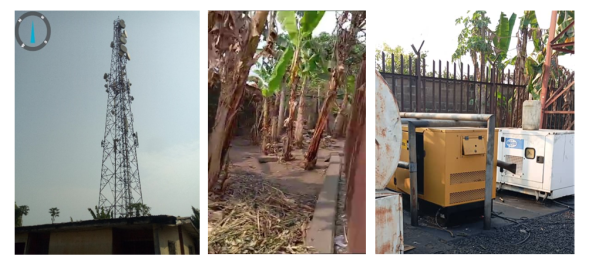
The buffer distance from the Base station, the mast and the perimeter fence of a residential building of the respondents building is less than five meters. Usually, if their tools fell while working on height, it is picked up within our respondents’ premises. See
Figure 2.
Figure 2. Close proximity of the Mast and generators to the residential building.
Rising noise pollution and vibration during the operation of the generating sets, cracks the fence and buildings of the respondents. See
Table 2 and
Figure 3.
Table 2. Field measurement of the noise levels in the Area.
S/N | Location | Distance from Mast (m) | Northings | Eastings | Max. Noise leveldBA | Max. Acceptable limit (dBA) (NESREA, 2007) | Time Taken |
NIGHT TIME READINGS WHEN GENERATOR WAS ON |
1 | A | 7.12 | 0247608 | 0605704 | 55 | 35 | 10:15-10:30pm |
2 | B | 8.6 | 0247630 | 0605717 | 48 | | 10:30-10:45pm |
3 | C | 9.5 | 0247610 | 0605707 | 40 | | 10:45-11:00pm |
DAY TIME READINGS WHEN GENERATOR WAS ON |
4 | A | 7.12 | 0247608 | 0605704 | 60 | 50 | 9:00-9:15am |
5 | B | 8.6 | 0247630 | 0605717 | 55 | | 9:15-9:30am |
8 | C | 9.5 | 0247610 | 0605707 | 58 | | 9:30-9:45am |
Instrument used: Sound level meter, Max. Sound level Japan, 0-120 dB uncertainty level of 0.23dB. Baseline Night time measurement in the compound = 30 dBA.
Figure 3. Cracks on different buildings in the respondent’s compound and the perimeter fence.
Structured interview with the victims reveals that there was no EIA properly carried out during the installation of the base station and Towers which could have recommended mitigation measures to protect the environment and public health in the neighborhood neither has there been any Environmental Audit carried out as regularly required.
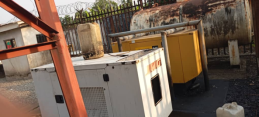
There are two diesel generating sets powering the base station 24/7 hrs every day. Mounting of the generators were on concrete floor. This has no sufficient materials to absorb the vibrations/shock of the equipment. See the
Figure 4.
Figure 4. The two generating sets operating 24/7 hrs in the base station.
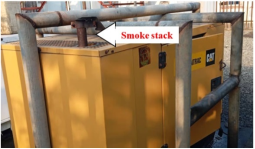
The heights of the smoke stacks (exhausts pipes) of the diesel generating sets are low causing the smoke to circulate and diffuse within the ambient environment. See the
figure 5.
Figure 5. The location of the generators smokes stack.
The generating sets emit poisonous gaseous substances such as Sox, Nox, PM and VOCs that negatively impairs human health.
Around the diesel storage tank and the generating sets, there was no bund wall that could contain any spilled oil or diesel from the rusting tank, thereby exposing the soil and groundwater to pollution. See the
Figure 6.
Figure 6. Diesel Storage Tank without Bundwall.
Our respondents’ have disturbed sleep every night the generating sets are operating. They suffer significant health challenges such as headaches, body pains, fever and insomnia since the installation and operation of the mask. See
Figures 7 and 8.
Figure 7. Drugs frequently taken by the victims.
Figure 8. Victims of various health challenges.
4. Discussions of Findings
A critical review and analysis of the activities and operations of the company in the area reveals alarming deviations from the standards proposed by the regulatory agencies. The Nigerian Communication Commission (NCC) and the Nigerian Environmental Standards and Regulatory Agency (NESREA) set up standards for Telecommunication operators as examined in Section 2.1 and Section 2.2 respectively of this piece of work. The regulations are jointly aimed at promoting the activities of the operators in view of its significant role to the economy of the nation without endangering the health of the people the sustainability of the environment.
Unfortunately, field observation in course of this work revealed several activities of the company on the site that are inconsistent with various provisions of the two regulations, despite over a decade old of the company’s operation in the area. Whereas, their operational licenses were based on absolute compliance to the provisional framework of the regulations. Continuous operation in this aberration for more than a decade is a clear failure of the regulatory institutions in the country. This is because in advanced countries such as United Kingdom, there is no individual or a corporate entity that can operate favourably while ignoring its regulatory framework for years.
On the other hand, it requires an absolute corporate responsibility and integrity for an organization to be compliant with its enabling laws and regulation without external policing. Failures on both ends usually put the public health and the environment on a precarious situation leading to anger, protests, agitations, environmental degradation, in severe cases, such as this, detestation, rising morbidity and impoverishment.
From
Figure 1, there is very close proximity in the location of the mast base and generating plants powering the device to respondent’s compound. The consensus distance between the two regulations is a minimum distance of 7.5 meters from the fence, whereas, during the field study, the nearest distance from fence was about (Four) 4 meters. The effect of this non compliance is the rising noise levels and vibrations on the neighborhood with its attendant structural failure, health and environmental consequences. Raheem and Aladekoyi
| [18] | Raheem, W. M and Aladekoyi, O. C (2015) Effects of Telecommunication Masts' Locations on Health and Urban Livability in Osogbo, Nigeria International Journal of Advanced Scientific and Technical Research Issue 5 volume 7, Nov. –Dec. 2015 Page 476-492. |
[18]
established that there is health and environmental effects in the siting of base stations (Telecommunication mast) in residential areas, schools and health centres
inter alia.
Again, cursory look at
Figure 2 and
Figure 4 shows that the generating sets were not mounted on structures fortified with efficient shock absorbers capable of absorbing the shocks and vibrations arising from the operations of the generating sets as stated in the regulation. In reaction, the walls of the block fence and buildings cracked, ceilings fell posing further danger to children that might be playing around the area.
The health consequences of noise pollution have been studied by several scholars. There is sufficient scientific evidence that noise exposure can induce hearing impairment, hypertension and ischemic heart disease, annoyance, sleep disturbance, and decreased school performance. For other effects such as changes in the immune system and birth defects, the evidence is limited (Passchier-Vermeer and Passchier
. Health of children and the aged are more vulnerable to noise pollution.
Field studies and structured interview in this work as shown in
Figure 6, revealed that both the aged, children and youths living in the compound have had significant health challenges following prolong exposure to noise pollution from the facility. This high morbidity and mortality recorded by the victims within one year demands urgent attention.
Similarly, the position of the generators smoke stack was poorly designed as seen in
Figure 5. According to American Lung Association of California
ibid, the elderly and people with emphysema, asthma, and chronic heart and lung disease are especially sensitive to fine-particle pollution. Numerous studies have linked elevated particle levels in the air to increased hospital admissions, emergency room visits, asthma attacks and premature deaths among those suffering from respiratory problems. Because children’s lungs and respiratory systems are still developing, they are also more susceptible than healthy adults to fine particles.
Figure 7 shows that the health of the victims has deteriorated over the years of the company’s operation in the area. Field interviews revealed high morbidity and mortality rate among residents in the compound. Two elders died in the compound within one year following various medical visitations and protracted illnesses. While in the month of October, 2024, the victims suffered various degrees of skin rashes and infections with regular hospital visits and medications.
Lastly, the mounting of the diesel storage tank within the premises of the company was not in conformity with the NUPRC regulation. In NUPRC regulation, EGASPIN,
| [20] | EGASPIN (2003) Environmental Guidelines and Standards for the Petroleum Industry in Nigeria. Lagos |
[20]
a lined bundwall should be constructed around a hydrocarbon storage tank to contain any spill that could escape from the tanks due to corrosion, accident or human error. However, Figure6 shows the diesel storage tank for the generating plants. Absence of the bundwall exposes the soil and groundwater to hydrocarbon pollution in the event of any spill.








 Share This Article
 Twitter
 Linked In
 Facebook

 Copy
 Download