Abstract
Background: Diabetes Mellitus (DM) patients undergoing hemodialysis often experience diminished quality of life (QoL) due to physical, psychological, and social challenges associated with chronic kidney disease. Social support and spirituality have been identified as key psychosocial factors that may influence patients’ well-being and treatment outcomes. Objective: This systematic review aims to evaluate the impact of social support and spirituality on the quality of life of DM patients undergoing hemodialysis, synthesizing evidence from recent studies conducted across diverse cultural and clinical settings. Methods: A comprehensive literature search was performed across PubMed, Scopus, ScienceDirect, and Google Scholar for studies published between 2015 and 2025. Inclusion criteria focused on studies reporting social support, family support, spiritual well-being, and QoL outcomes in hemodialysis patients, specifically those with DM or chronic kidney disease complications. Ten studies meeting eligibility criteria were analyzed, encompassing cross-sectional, descriptive-analytic, and quasi-experimental designs. Results: Across the studies, higher levels of social support, particularly from family and peers, were consistently associated with improved QoL. Spirituality, including religious engagement and personal spiritual well-being, further contributed to resilience, psychological stability, and enhanced coping with chronic treatment regimens. Combined interventions addressing both social support and spirituality demonstrated synergistic effects, leading to measurable improvements in physical, emotional, and social domains of QoL. Evidence from diverse regions, including Indonesia, Saudi Arabia, Iran, and Iraq, indicates the universal relevance of these factors. Conclusion: Social support and spirituality are pivotal determinants of QoL among DM patients undergoing hemodialysis. Integrating structured psychosocial and spiritual interventions into routine hemodialysis care may enhance patient outcomes and promote holistic management. Future research should investigate longitudinal effects and interventional strategies to optimize QoL in this population.
|
Published in
|
American Journal of Health Research (Volume 14, Issue 3)
|
|
DOI
|
10.11648/j.ajhr.20261403.15
|
|
Page(s)
|
172-178 |
|
Creative Commons
|

This is an Open Access article, distributed under the terms of the Creative Commons Attribution 4.0 International License (http://creativecommons.org/licenses/by/4.0/), which permits unrestricted use, distribution and reproduction in any medium or format, provided the original work is properly cited.
|
|
Copyright
|
Copyright © The Author(s), 2026. Published by Science Publishing Group
|
Keywords
Social Support, Spirituality, Quality of Life, Diabetes Mellitus, Hemodialysis, Chronic Kidney Disease, Patient Well-being, Nursing Care
1. Introduction
Diabetes mellitus (DM) is a chronic metabolic disease with a rapidly increasing global prevalence. According to the International Diabetes Federation, approximately 537 million adults were living with diabetes worldwide in 2021, and this number is projected to reach 783 million by 2045
. One of the serious complications of DM is chronic kidney disease (CKD), which, in its advanced stages, may require hemodialysis therapy
| [2] | R. Jha, S. Lopez-Trevino, H. R. Kankanamalage, and J. C. Jha, “Diabetes and Renal Complications: An Overview on Pathophysiology, Biomarkers and Therapeutic Interventions,” Biomedicines, vol. 12, no. 5, pp. 1–23, 2024,
https://doi.org/10.3390/biomedicines12051098 |
[2]
. Hemodialysis not only addresses the physiological consequences of renal failure but also significantly affects patients’ quality of life (QoL), encompassing physical, psychological, and social dimensions
| [3] | R. Shaw, S. K. Sadhukhan, J. Pal, P. Mukherjee, and A. Biswas, “Factors Influencing Quality of Life in Hemodialysis Patients With Chronic Kidney Disease at a Tertiary Care Hospital in Eastern India,” Cureus, vol. 17, no. 7, 2025,
https://doi.org/10.7759/cureus.88740 |
[3]
.
Patients with DM undergoing hemodialysis often experience a reduced QoL due to limitations in daily activities, dependency on ongoing medical treatment, and substantial psychosocial stress
| [4] | L. Sułkowski, A. Matyja, and M. Matyja, “Social Support and Quality of Life in Hemodialysis Patients: A Comparative Study with Healthy Controls,” Med., vol. 60, no. 11, pp. 1–14, 2024, https://doi.org/10.3390/medicina60111732 |
[4]
. Poor QoL may negatively impact treatment adherence, exacerbate stress, and increase the risk of further complications. Consequently, identifying and addressing factors that support patients’ well-being is of critical importance.
Social support from family, friends, and the wider community has been shown to enhance mental resilience, motivate adherence to treatment, and improve QoL among patients receiving hemodialysis
| [5] | D. Agrivina, B. R. Nasution, T. A. Nasution, R. Amalia, and C. Saragih, “The Relationship of Social Support and Spirituality to Resilience in Chronic Kidney Disease Patients Undergoing Regular Hemodialysis at Adam Malik Hospital Medan in 2025,” Indonesian Journal of Kidney and Hypertension. vol. 3, no. 1, pp. 162–168, 2026,
https://doi.org/10.32867/inakidney.v3i1.236 |
| [6] | Y. Wang, Y. Qiu, L. Ren, H. Jiang, M. Chen, and C. Dong, “Social support, family resilience and psychological resilience among maintenance hemodialysis patients: a longitudinal study,” BMC Psychiatry, vol. 24, no. 1, pp. 1–13, 2024,
https://doi.org/10.1186/s12888-024-05526-4 |
[5, 6]
. Additionally, spirituality and religiosity help patients cope with chronic illness by providing meaning, inner peace, and better psychological adaptation
| [7] | J. M. Pérez-Jiménez, P. Bonilla Sierra, and R. de-Diego-Cordero, “The Influence of Spirituality in the Care of Patients with Advanced Chronic Illnesses and at the End of Life: An Integrative Review,” J. Relig. Health, vol. 65, no. 1, pp. 451–479, 2026, https://doi.org/10.1007/s10943-025-02543-9 |
| [8] | A. M. Bakhsh and W. H. Mahallawi, “Psychological Effects of Hemodialysis on Patients with Renal Failure: A Cross-Sectional Study,” J. Clin. Med., vol. 14, no. 20, pp. 1–8, 2025,
https://doi.org/10.3390/jcm14207136 |
[7, 8]
. Interventions that integrate social support and spiritual care may therefore play a significant role in optimizing QoL for these patients.
Although prior studies have highlighted the importance of psychosocial factors in CKD, research specifically examining the influence of social support and spirituality on the QoL of patients with DM undergoing hemodialysis remains limited
| [4] | L. Sułkowski, A. Matyja, and M. Matyja, “Social Support and Quality of Life in Hemodialysis Patients: A Comparative Study with Healthy Controls,” Med., vol. 60, no. 11, pp. 1–14, 2024, https://doi.org/10.3390/medicina60111732 |
| [9] | D. T. Bulathwatta, J. Borchet, A. Rudnik, and M. Bidzan, “Psychosocial well-being among individuals with chronic kidney disease undergoing hemodialysis treatment and their caregivers: a protocol of a mixed method study in Sri Lanka and Poland,” Front. Psychol., vol. 14, no. December, pp. 1–13, 2023,
https://doi.org/10.3389/fpsyg.2023.1194991 |
[4, 9]
. This systematic review aims to summarize current evidence, identify research gaps, and emphasize the potential role of social support and spirituality in improving QoL among DM patients on hemodialysis, thereby providing insights for future clinical interventions and practice.
2. Materials and Methods
2.1. Sources and Search Strategy
A comprehensive literature search was conducted to identify relevant articles on social support, spirituality, and quality of life among patients with Diabetes Mellitus (DM) undergoing hemodialysis. The search was performed using several electronic databases, including PubMed, Scopus, ScienceDirect, and Google Scholar. Both electronic searches and manual screening of reference lists were conducted to identify additional relevant studies. Duplicate records were removed using EndNote software.
The search was limited to articles published between January 2015 and March 2025 and written in English or Indonesian. The search terms included both keywords and, where applicable, Medical Subject Headings (MeSH) terms. The Boolean search strategy was as follows:
(“diabetes mellitus” OR “DM”) AND (“hemodialysis” OR “haemodialysis”) AND (“quality of life” OR “QoL” OR “health-related quality of life”) AND (“social support” OR “family support”) AND (“spirituality” OR “religiosity” OR “spiritual well-being”).
This strategy ensured a comprehensive and reproducible search across multiple databases.
2.2. Article Selection and Evaluation
The articles obtained from the literature search were selected through a stepwise process. In the first step, duplicate articles were removed. Next, the remaining articles were screened based on their titles and abstracts to assess relevance to the research topic. Articles deemed relevant were then read in full to determine final eligibility. The inclusion criteria for this review were:
1) Articles discussing patients with Diabetes Mellitus undergoing hemodialysis.
2) Articles addressing social support, family support, spirituality, religiosity, or spiritual well-being.
3) Articles assessing quality of life as one of the main variables.
4) Articles published between 2015 and 2025.
5) Articles available in full-text format.
6) Articles written in English or Indonesian.
The exclusion criteria were:
1) Articles not discussing DM patients undergoing hemodialysis.
2) Articles not assessing quality of life.
3) Articles not addressing social support, family support, or spirituality.
4) Articles in the form of editorials, opinions, letters to the editor, or conference abstracts without full text.
5) Duplicate articles from different databases.
2.3. Selected Publications
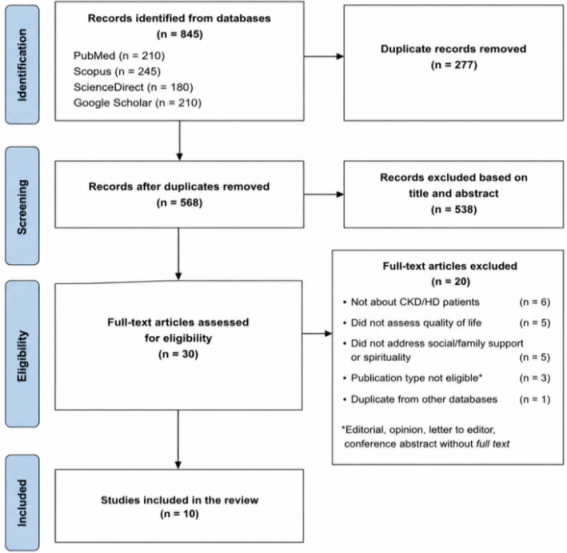
The article selection process is summarized in a PRISMA flow diagram (
Figure 1). The initial search across multiple databases yielded a total of 845 articles. After removing duplicates, 568 articles remained for title and abstract screening. Following this screening, 30 articles were deemed eligible for full-text review; 20 were subsequently excluded due to reasons such as irrelevance to DM/hemodialysis patients, not assessing quality of life, not addressing social support or spirituality, or publication type not meeting the inclusion criteria. Ultimately, 10 articles were finally included and analyzed in this review. This process demonstrates a systematic and transparent approach to article selection in accordance with PRISMA 2020 guidelines.
The Figure illustrates the PRISMA 2020 flow diagram in English, depicting the article selection process for this systematic review. A total of 845 articles were identified through database searches, of which 277 duplicates were removed. Of the remaining 568 articles, 538 were excluded after title and abstract screening. Thirty full-text articles were then assessed for eligibility, and 20 were excluded due to irrelevance to DM/hemodialysis patients, not assessing quality of life, not addressing social support or spirituality, or not meeting publication type requirements. Ultimately, 10 articles met the inclusion criteria and were included in the review, demonstrating a systematic and transparent selection process in accordance with PRISMA 2020 guidelines.
3. Results
This section presents the findings of the systematic review, summarizing the characteristics and outcomes of the included studies. The results are reported accurately and concisely, reflecting the data extracted from each study without any manipulation or fabrication. The main findings are organized to highlight patterns and key insights regarding social support, spirituality, and quality of life among patients with Diabetes Mellitus undergoing hemodialysis.
Table 1 provides a summary of the included studies following the PRISMA flow diagram, detailing study design, sample characteristics, interventions or exposures, and measured outcomes.
Table 1. Main Findings based on Literature.
No. | Authors & Year | Study Design | Sample | Key Results |
1. | Wulandari, E. M., Yunita, R., & Hartono, D. (2023) | Cross-sectional correlational | 38 chronic kidney disease patients undergoing hemodialysis, RSUD dr. R. Soedarsono, Pasuruan, Indonesia | Social support levels were measured and correlated with quality of life (QoL). Most patients had high social support (42.1%) and moderate QoL (52.6%). Spearman’s rank correlation showed a significant positive relationship between social support and quality of life (p < 0.05), indicating that higher social support is associated with better QoL. Majority of participants were female (55.3%) and aged 36–45 years. |
2. | Wardani, A. D., Ratnawati, D., & Siregar, T. (2026) | Descriptive-analytic, cross-sectional | 61 elderly Diabetes Mellitus patients, Kelurahan Limo, Indonesia | Social support and spirituality were significantly associated with quality of life in elderly DM patients. Chi-square test showed social support (p = 0.048) and spirituality (p = 0.026) positively correlated with higher QoL. Elderly with higher social and spiritual support had better quality of life compared to those with lower support. |
3. | Irwan, M., Ginting, C. N., & Chiuman, L. (2025) | Cross-sectional quantitative | 100 Diabetes Mellitus patients undergoing hemodialysis, RSUD Arifin Achmad, Riau Province, Indonesia | Family support and spirituality were significantly associated with quality of life. Family support had a dominant influence (path coefficient 0.320, p < 0.05), especially emotional, instrumental, and informational support. Spirituality also contributed significantly (path coefficient 0.187, p < 0.05). Together, these factors explained 33% of the variance in patients' quality of life. |
4. | Agrivina, D., Nasution, B. R., Nasution, T. A., et al. (2026) | Cross-sectional analytical | 50 CKD patients undergoing regular hemodialysis, Adam Malik Hospital, Medan, Indonesia | Social support and spirituality were significantly positively associated with resilience. Majority of patients had high resilience (66%). High social support and spirituality enhanced patients’ coping and adaptation to hemodialysis therapy. Sociodemographic factors were not significant. |
5. | Rosyadi, A., Hapsari, I., & Utami, P. I. (2021) | Cross-sectional | 48 Diabetes Mellitus patients with CKD complications, Siaga Medika Purbalingga Hospital, Indonesia | Lifestyle, spirituality, and family support were significantly associated with quality of life (QoL). 62.5% of patients had good QoL. Patients with higher lifestyle and spirituality scores had 11 times higher chance of better QoL. Better family support also positively influenced QoL (OR 0.13). The study emphasizes counseling and psychosocial support to improve QoL in DM patients with CKD complications. |
6. | Hassani, F., Zarea, K., Gholamzadeh Jofreh, M., Dashtebozorgi, Z., & Chan, S. W. C. (2022) | Descriptive cross-sectional | 260 hemodialysis patients, three educational hospitals, Ahvaz, Iran | Perceived social support, spiritual well-being, resilience, and health literacy were significant predictors of quality of life (QOL). Structural Equation Modeling (SEM) showed that higher social support and spiritual well-being were associated with improved QOL. Resilience mediated the relationship between social support/spirituality and QOL. Demographics were not significant. |
7. | Al-Khaqani, M. A., & AL-Fayyadh, S. (2024) | Cross-sectional | 234 hemodialysis patients, University of Baghdad, Iraq | Social support and spiritual well-being significantly influenced quality of life (QOL). Regression analysis: social support t=1.434, p=0.038; spiritual well-being t=1.906, p=0.015; F (2,231)=3.14, p=0.034; R²=0.45. Higher social support and spirituality were associated with better QOL, although overall QOL remained moderate. |
8. | Wahyuni, M. M. D., Roga, A. U., Faida, E. W., Alkatiri, F. M., & Palandima, R. K. T. I. (2026) | Cross-sectional | 176 Indonesian Christian patients with End-Stage Renal Disease (ESRD) undergoing hemodialysis, Prof. Dr. W. Z. Johannes Hospital, Kupang, Indonesia | Spirituality and social support were positively associated with quality of life (QoL). Higher perceived social support (MSPSS) and higher spiritual experience (DSES) correlated with improved QoL (measured by WHOQOL). The study emphasizes culturally tailored interventions to enhance social and spiritual support to improve patient QoL. |
9. | Susanti, B. D. N., Setiawan, A. H., Ikwan, M., Umamah, F., Zahroh, C., et al. (2025) | Quasi-experimental, pre- and post-test control group | 92 CKD patients undergoing hemodialysis, Rumah Sakit Islam Surabaya, Indonesia | Spiritual social support significantly reduced depressive symptoms and improved quality of life (QoL) in CKD patients. The intervention group showed measurable improvements in QoL scores post-intervention compared to controls. This highlights the importance of spiritual and social support interventions to enhance psychological well-being and QoL in hemodialysis patients. |
10. | Asiri, W. A., Asiri, A. A. H., Almutlaq, A. H., Almutairi, K. H., Alotaibi, A. E., Alshahrani, M. S., & Hassan, E. E. A. (2023) | Cross-sectional | 162 haemodialysis patients, Aseer Region, Saudi Arabia | High perceived social support (79.6%) and high religiosity/spirituality were positively associated with quality of life (QOL). Longer duration of haemodialysis did not significantly affect QOL. The study emphasizes that enhancing social and spiritual support can improve psychological well-being and QOL in HD patients. |
The analysis of the ten selected studies reveals consistent evidence that social support and spirituality are significant determinants of quality of life (QoL) among patients undergoing hemodialysis, including those with Diabetes Mellitus. Across various cross-sectional and quasi-experimental designs, social support whether from family, peers, or healthcare providers was repeatedly shown to positively influence patients’ psychological well-being, coping abilities, and overall QoL. Studies conducted in diverse populations, including elderly DM patients in Indonesia, ESRD patients in Saudi Arabia, and CKD patients in Iran, indicate that higher levels of perceived social support correlate with improved physical, emotional, and social functioning. Spirituality, encompassing both religiosity and personal spiritual well-being, also consistently demonstrated a positive association with QoL, providing patients with resilience, a sense of purpose, and emotional stability while facing the challenges of long-term hemodialysis therapy.
Furthermore, several studies highlighted the combined effect of social support and spirituality on enhancing QoL. For instance, family support often emerged as a dominant predictor, particularly when paired with strong spiritual engagement, explaining a substantial proportion of variance in QoL outcomes. Interventions or structured support programs that strengthened either social networks or spiritual practices were linked to measurable improvements in patient-reported QoL, even when sociodemographic or clinical variables were controlled. Collectively, these findings underscore the importance of integrating psychosocial and spiritual considerations into patient care plans, emphasizing that addressing both social and spiritual needs is crucial for optimizing health outcomes in DM and CKD populations undergoing hemodialysis.
4. Discussion
The ten selected studies collectively highlight that social support and spirituality are critical determinants of quality of life (QoL) among patients undergoing hemodialysis, including those with Diabetes Mellitus
| [10] | E. M. Wulandari, R. Yunita, and D. Hartono, “The Relationship between Social Support and Quality of Life of Renal Failure Patients Undergoing Hemodialysis at Dr. R. Soedarsono Regional Hospital, Pasuruan,” Mandira Cendikia Journal of Health Sciences, vol. 2, no. 10, pp. 440–448, 2023.
https://journal.mandiracendikia.com/index.php/JIK-MC/article/view/634 |
| [11] | A. D. Wardani et al., “Social Support and Spirituality in Relation to Quality of Life among Elderly Patients with Diabetes Mellitus Undergoing Hemodialysis,” Widya Gantari Indonesia Journal of Nursing, vol. 10, no. 1, 2026,
https://doi.org/10.52020/jkwgi.v10i1.13545 |
| [12] | M. Irwan, C. N. Ginting, and L. Chiuman, “The Relationship between Family Support and Spirituality with Quality of Life of Diabetes Mellitus Patients Undergoing Hemodialysis at Arifin Achmad Regional Hospital, Riau Province,” Malahayati Health Student Journal., vol. 5, no. 8, pp. 3854–3870, 2025. https://doi.org/10.33024/mahesa.v5i8.19127 |
[10-12]
. Social support, particularly from family, peers, and healthcare providers, was consistently associated with higher emotional stability, reduced stress, and better coping strategies. Spirituality, including religious practices and personal spiritual well-being, further enhanced resilience, promoted meaning-making, and positively influenced psychological and physical health domains (Wahyuni et al., 2026; Al-Khaqani & AL-Fayyadh, 2024). These findings align with broader literature on chronic disease management, emphasizing the psychosocial and spiritual components as essential for improving patient outcomes (Susanti et al., 2025).
Several studies emphasized the interconnectedness of social support and spirituality, showing a synergistic effect on QoL. Patients with strong family support and active spiritual engagement reported significantly higher QoL scores compared to those lacking one or both factors
| [12] | M. Irwan, C. N. Ginting, and L. Chiuman, “The Relationship between Family Support and Spirituality with Quality of Life of Diabetes Mellitus Patients Undergoing Hemodialysis at Arifin Achmad Regional Hospital, Riau Province,” Malahayati Health Student Journal., vol. 5, no. 8, pp. 3854–3870, 2025. https://doi.org/10.33024/mahesa.v5i8.19127 |
| [13] | M. M. D. Wahyuni, A. U. Roga, E. W. Faida, M. A. Fahira, and R. K. T. I. Palandima, “Spirituality, Social Support, and Quality of Life: A Study of Indonesian Christian Patients With End-Stage Renal Undergoing Haemodialysis Treatment,” Journal of Health Information, vol. 24, no. 1, pp. 115-125., 2026,
https://doi.org/10.31965/infokes.Vol24.Iss1.2399 |
[12, 13]
. This synergy appears to operate by enhancing coping resources, reducing depressive symptoms, and fostering adherence to hemodialysis protocols. Social support also provides instrumental aid, such as assistance with treatment logistics and lifestyle management, while spirituality promotes hope, self-efficacy, and a sense of life purpose, which together contribute to improved QoL
| [14] | A. Rosyadi, I. Hapsari, and P. I. Utami, “The Effect of Lifestyle, Spiritual, and Family Support on Diabetic Mellitus Patient with Chronic Kidney Disease Complication,” Pharm. J. Indones., vol. 18, no. 2, pp. 422–431, 2021.
https://doi.org/10.30595/pharmacy.v18i2.13255 |
[14]
.
Cross-cultural applicability is another notable aspect. The positive association between social support, spirituality, and QoL was observed in diverse populations, including elderly DM patients in Indonesia, ESRD patients in Saudi Arabia, CKD patients in Iran, and hemodialysis patients in Iraq
| [13] | M. M. D. Wahyuni, A. U. Roga, E. W. Faida, M. A. Fahira, and R. K. T. I. Palandima, “Spirituality, Social Support, and Quality of Life: A Study of Indonesian Christian Patients With End-Stage Renal Undergoing Haemodialysis Treatment,” Journal of Health Information, vol. 24, no. 1, pp. 115-125., 2026,
https://doi.org/10.31965/infokes.Vol24.Iss1.2399 |
| [14] | A. Rosyadi, I. Hapsari, and P. I. Utami, “The Effect of Lifestyle, Spiritual, and Family Support on Diabetic Mellitus Patient with Chronic Kidney Disease Complication,” Pharm. J. Indones., vol. 18, no. 2, pp. 422–431, 2021.
https://doi.org/10.30595/pharmacy.v18i2.13255 |
| [15] | Al-Khaqani, M. A. Yaseen, and S. AL-Fayyadh, “Effect of Social Support and Spiritual Well-being on the Quality of Life of Patients Undergoing Hemodialysis,” South East. Eur. J. Public Heal., vol. 24, no. 4, pp. 760–777, 2024,
https://doi.org/10.70135/seejph.vi.1332 |
| [16] | W. A. Asiri et al., “Social support, religiosity, and quality of life among haemodialysis patients in Aseer region, Saudi Arabia,” Middle East Curr. Psychiatry, vol. 30, no. 1, 2023,
https://doi.org/10.1186/s43045-023-00306-4 |
[13-16]
. Despite differences in healthcare systems, cultural norms, and religious backgrounds, the consistent influence of psychosocial and spiritual factors underscores their universal importance in managing chronic kidney disease and DM patients undergoing hemodialysis. These findings suggest that interventions promoting social and spiritual well-being could be applied broadly, though culturally tailored approaches may optimize their effectiveness.
While cross-sectional designs dominated the included studies, a few quasi-experimental studies provided evidence for causal effects, showing that structured spiritual or social support interventions improved QoL and reduced depressive symptoms
| [17] | Susanti et al., “The Beneficial Effect of Spiritual Social Support on Depression and Quality of Life in Chronic Renal Failure Patients Undergoing Haemodialysis,” Scr. Medica (Banja Luka), vol. 56, no. 2, pp. 299–305, 2025,
https://doi.org/10.5937/scriptamed56-53832 |
[17]
. These studies highlight the potential for practical interventions, including family counseling, peer support programs, and spiritual care integration, to be incorporated into routine hemodialysis care. Mechanistically, social support and spirituality appear to mediate stress, enhance resilience, and reinforce adherence to treatment, thereby improving both physical and psychosocial outcomes.
Despite these consistent findings, gaps remain. Most studies did not focus exclusively on Diabetes Mellitus patients, and the interplay between DM-specific complications and psychosocial/spiritual factors requires further exploration. Longitudinal studies and randomized controlled trials are necessary to clarify causal pathways, quantify intervention effects, and identify optimal strategies for integrating social and spiritual support in clinical practice. Additionally, investigating patient subgroups, such as elderly, newly diagnosed, or long-term dialysis patients, may reveal differences in needs and response to interventions.
In conclusion, the reviewed literature strongly supports the inclusion of social support and spirituality as integral components of patient-centered care in hemodialysis settings. Interventions that enhance family involvement, foster spiritual well-being, and provide structured psychosocial support have the potential to significantly improve quality of life for patients with CKD and DM. Future research should aim to test and refine these interventions across diverse populations and clinical contexts, ultimately informing evidence-based guidelines for holistic care in chronic kidney disease management.
5. Conclusions
The systematic review of ten studies demonstrates that social support and spirituality are pivotal factors influencing the quality of life (QoL) in patients undergoing hemodialysis, including those with Diabetes Mellitus. Across diverse cultural and clinical contexts, higher levels of perceived social support particularly from family and close social networks and greater engagement in spiritual practices were consistently associated with improved psychological well-being, resilience, and overall QoL. The evidence underscores that integrating psychosocial and spiritual care into routine hemodialysis management can meaningfully enhance patient outcomes and promote holistic care.
These findings have significant clinical implications, suggesting that healthcare providers should consider structured interventions aimed at strengthening family involvement, social networks, and spiritual well-being to optimize QoL in chronic kidney disease patients. Future research should focus on longitudinal studies and interventional trials to confirm causal relationships and develop evidence-based strategies for integrating social and spiritual support in diverse hemodialysis populations. Overall, the review highlights the essential role of psychosocial and spiritual determinants in comprehensive patient-centered care for individuals undergoing hemodialysis.
Abbreviations
CKD | Chronic Kidney Disease |
DM | Diabetes Mellitus |
ESRD | End-stage Renal Disease |
HD | Hemodialysis |
QoL | Quality of Life |
PSS | Perceived Social Support |
MSPSS | Multidimensional Scale of Perceived Social Suport |
DSES | Daily Spiritual Experiences Scale |
WHOQOL | World Health Organization Quality of Life Questionnaire |
PLS | Partial Least Squares |
SEM | Structural Equation Modeling |
Acknowledgments
The authors would like to express their sincere gratitude to all the patients and staff at the participating hemodialysis centers for their cooperation and support during the data collection. Special thanks are extended to the research assistants for their technical assistance in questionnaire administration and data management. The authors also acknowledge the support of their respective institutions for facilitating this research.
Author Contributions
Muhammad Irwan: Conceptualization, Data curation, Formal Analysis, Investigation, Methodology, Project administration, Resources, Supervision, Validation, Visualization, Writing – original draft, Writing – review & editing
Data Availability Statement
The data supporting the outcome of this research work has been reported in this manuscript.
Conflicts of Interest
The author declares no conflicts of interest.
References
| [1] |
(International Diabetes Federation) IDF, “Diabetes Facts & Figures.” Available:
https://idf.org/about-diabetes/diabetes-facts-Figures/
|
| [2] |
R. Jha, S. Lopez-Trevino, H. R. Kankanamalage, and J. C. Jha, “Diabetes and Renal Complications: An Overview on Pathophysiology, Biomarkers and Therapeutic Interventions,” Biomedicines, vol. 12, no. 5, pp. 1–23, 2024,
https://doi.org/10.3390/biomedicines12051098
|
| [3] |
R. Shaw, S. K. Sadhukhan, J. Pal, P. Mukherjee, and A. Biswas, “Factors Influencing Quality of Life in Hemodialysis Patients With Chronic Kidney Disease at a Tertiary Care Hospital in Eastern India,” Cureus, vol. 17, no. 7, 2025,
https://doi.org/10.7759/cureus.88740
|
| [4] |
L. Sułkowski, A. Matyja, and M. Matyja, “Social Support and Quality of Life in Hemodialysis Patients: A Comparative Study with Healthy Controls,” Med., vol. 60, no. 11, pp. 1–14, 2024,
https://doi.org/10.3390/medicina60111732
|
| [5] |
D. Agrivina, B. R. Nasution, T. A. Nasution, R. Amalia, and C. Saragih, “The Relationship of Social Support and Spirituality to Resilience in Chronic Kidney Disease Patients Undergoing Regular Hemodialysis at Adam Malik Hospital Medan in 2025,” Indonesian Journal of Kidney and Hypertension. vol. 3, no. 1, pp. 162–168, 2026,
https://doi.org/10.32867/inakidney.v3i1.236
|
| [6] |
Y. Wang, Y. Qiu, L. Ren, H. Jiang, M. Chen, and C. Dong, “Social support, family resilience and psychological resilience among maintenance hemodialysis patients: a longitudinal study,” BMC Psychiatry, vol. 24, no. 1, pp. 1–13, 2024,
https://doi.org/10.1186/s12888-024-05526-4
|
| [7] |
J. M. Pérez-Jiménez, P. Bonilla Sierra, and R. de-Diego-Cordero, “The Influence of Spirituality in the Care of Patients with Advanced Chronic Illnesses and at the End of Life: An Integrative Review,” J. Relig. Health, vol. 65, no. 1, pp. 451–479, 2026,
https://doi.org/10.1007/s10943-025-02543-9
|
| [8] |
A. M. Bakhsh and W. H. Mahallawi, “Psychological Effects of Hemodialysis on Patients with Renal Failure: A Cross-Sectional Study,” J. Clin. Med., vol. 14, no. 20, pp. 1–8, 2025,
https://doi.org/10.3390/jcm14207136
|
| [9] |
D. T. Bulathwatta, J. Borchet, A. Rudnik, and M. Bidzan, “Psychosocial well-being among individuals with chronic kidney disease undergoing hemodialysis treatment and their caregivers: a protocol of a mixed method study in Sri Lanka and Poland,” Front. Psychol., vol. 14, no. December, pp. 1–13, 2023,
https://doi.org/10.3389/fpsyg.2023.1194991
|
| [10] |
E. M. Wulandari, R. Yunita, and D. Hartono, “The Relationship between Social Support and Quality of Life of Renal Failure Patients Undergoing Hemodialysis at Dr. R. Soedarsono Regional Hospital, Pasuruan,” Mandira Cendikia Journal of Health Sciences, vol. 2, no. 10, pp. 440–448, 2023.
https://journal.mandiracendikia.com/index.php/JIK-MC/article/view/634
|
| [11] |
A. D. Wardani et al., “Social Support and Spirituality in Relation to Quality of Life among Elderly Patients with Diabetes Mellitus Undergoing Hemodialysis,” Widya Gantari Indonesia Journal of Nursing, vol. 10, no. 1, 2026,
https://doi.org/10.52020/jkwgi.v10i1.13545
|
| [12] |
M. Irwan, C. N. Ginting, and L. Chiuman, “The Relationship between Family Support and Spirituality with Quality of Life of Diabetes Mellitus Patients Undergoing Hemodialysis at Arifin Achmad Regional Hospital, Riau Province,” Malahayati Health Student Journal., vol. 5, no. 8, pp. 3854–3870, 2025.
https://doi.org/10.33024/mahesa.v5i8.19127
|
| [13] |
M. M. D. Wahyuni, A. U. Roga, E. W. Faida, M. A. Fahira, and R. K. T. I. Palandima, “Spirituality, Social Support, and Quality of Life: A Study of Indonesian Christian Patients With End-Stage Renal Undergoing Haemodialysis Treatment,” Journal of Health Information, vol. 24, no. 1, pp. 115-125., 2026,
https://doi.org/10.31965/infokes.Vol24.Iss1.2399
|
| [14] |
A. Rosyadi, I. Hapsari, and P. I. Utami, “The Effect of Lifestyle, Spiritual, and Family Support on Diabetic Mellitus Patient with Chronic Kidney Disease Complication,” Pharm. J. Indones., vol. 18, no. 2, pp. 422–431, 2021.
https://doi.org/10.30595/pharmacy.v18i2.13255
|
| [15] |
Al-Khaqani, M. A. Yaseen, and S. AL-Fayyadh, “Effect of Social Support and Spiritual Well-being on the Quality of Life of Patients Undergoing Hemodialysis,” South East. Eur. J. Public Heal., vol. 24, no. 4, pp. 760–777, 2024,
https://doi.org/10.70135/seejph.vi.1332
|
| [16] |
W. A. Asiri et al., “Social support, religiosity, and quality of life among haemodialysis patients in Aseer region, Saudi Arabia,” Middle East Curr. Psychiatry, vol. 30, no. 1, 2023,
https://doi.org/10.1186/s43045-023-00306-4
|
| [17] |
Susanti et al., “The Beneficial Effect of Spiritual Social Support on Depression and Quality of Life in Chronic Renal Failure Patients Undergoing Haemodialysis,” Scr. Medica (Banja Luka), vol. 56, no. 2, pp. 299–305, 2025,
https://doi.org/10.5937/scriptamed56-53832
|
Cite This Article
-
APA Style
Irwan, M. (2026). Social Support and Spirituality as Determinants of Quality of Life in Diabetes Mellitus Patients on Hemodialysis:
A Systematic Review. American Journal of Health Research, 14(3), 172-178. https://doi.org/10.11648/j.ajhr.20261403.15
Copy
|
Download
ACS Style
Irwan, M. Social Support and Spirituality as Determinants of Quality of Life in Diabetes Mellitus Patients on Hemodialysis:
A Systematic Review. Am. J. Health Res. 2026, 14(3), 172-178. doi: 10.11648/j.ajhr.20261403.15
Copy
|
Download
AMA Style
Irwan M. Social Support and Spirituality as Determinants of Quality of Life in Diabetes Mellitus Patients on Hemodialysis:
A Systematic Review. Am J Health Res. 2026;14(3):172-178. doi: 10.11648/j.ajhr.20261403.15
Copy
|
Download
-
@article{10.11648/j.ajhr.20261403.15,
author = {Muhammad Irwan},
title = {Social Support and Spirituality as Determinants of Quality of Life in Diabetes Mellitus Patients on Hemodialysis:
A Systematic Review},
journal = {American Journal of Health Research},
volume = {14},
number = {3},
pages = {172-178},
doi = {10.11648/j.ajhr.20261403.15},
url = {https://doi.org/10.11648/j.ajhr.20261403.15},
eprint = {https://article.sciencepublishinggroup.com/pdf/10.11648.j.ajhr.20261403.15},
abstract = {Background: Diabetes Mellitus (DM) patients undergoing hemodialysis often experience diminished quality of life (QoL) due to physical, psychological, and social challenges associated with chronic kidney disease. Social support and spirituality have been identified as key psychosocial factors that may influence patients’ well-being and treatment outcomes. Objective: This systematic review aims to evaluate the impact of social support and spirituality on the quality of life of DM patients undergoing hemodialysis, synthesizing evidence from recent studies conducted across diverse cultural and clinical settings. Methods: A comprehensive literature search was performed across PubMed, Scopus, ScienceDirect, and Google Scholar for studies published between 2015 and 2025. Inclusion criteria focused on studies reporting social support, family support, spiritual well-being, and QoL outcomes in hemodialysis patients, specifically those with DM or chronic kidney disease complications. Ten studies meeting eligibility criteria were analyzed, encompassing cross-sectional, descriptive-analytic, and quasi-experimental designs. Results: Across the studies, higher levels of social support, particularly from family and peers, were consistently associated with improved QoL. Spirituality, including religious engagement and personal spiritual well-being, further contributed to resilience, psychological stability, and enhanced coping with chronic treatment regimens. Combined interventions addressing both social support and spirituality demonstrated synergistic effects, leading to measurable improvements in physical, emotional, and social domains of QoL. Evidence from diverse regions, including Indonesia, Saudi Arabia, Iran, and Iraq, indicates the universal relevance of these factors. Conclusion: Social support and spirituality are pivotal determinants of QoL among DM patients undergoing hemodialysis. Integrating structured psychosocial and spiritual interventions into routine hemodialysis care may enhance patient outcomes and promote holistic management. Future research should investigate longitudinal effects and interventional strategies to optimize QoL in this population.},
year = {2026}
}
Copy
|
Download
-
TY - JOUR
T1 - Social Support and Spirituality as Determinants of Quality of Life in Diabetes Mellitus Patients on Hemodialysis:
A Systematic Review
AU - Muhammad Irwan
Y1 - 2026/06/29
PY - 2026
N1 - https://doi.org/10.11648/j.ajhr.20261403.15
DO - 10.11648/j.ajhr.20261403.15
T2 - American Journal of Health Research
JF - American Journal of Health Research
JO - American Journal of Health Research
SP - 172
EP - 178
PB - Science Publishing Group
SN - 2330-8796
UR - https://doi.org/10.11648/j.ajhr.20261403.15
AB - Background: Diabetes Mellitus (DM) patients undergoing hemodialysis often experience diminished quality of life (QoL) due to physical, psychological, and social challenges associated with chronic kidney disease. Social support and spirituality have been identified as key psychosocial factors that may influence patients’ well-being and treatment outcomes. Objective: This systematic review aims to evaluate the impact of social support and spirituality on the quality of life of DM patients undergoing hemodialysis, synthesizing evidence from recent studies conducted across diverse cultural and clinical settings. Methods: A comprehensive literature search was performed across PubMed, Scopus, ScienceDirect, and Google Scholar for studies published between 2015 and 2025. Inclusion criteria focused on studies reporting social support, family support, spiritual well-being, and QoL outcomes in hemodialysis patients, specifically those with DM or chronic kidney disease complications. Ten studies meeting eligibility criteria were analyzed, encompassing cross-sectional, descriptive-analytic, and quasi-experimental designs. Results: Across the studies, higher levels of social support, particularly from family and peers, were consistently associated with improved QoL. Spirituality, including religious engagement and personal spiritual well-being, further contributed to resilience, psychological stability, and enhanced coping with chronic treatment regimens. Combined interventions addressing both social support and spirituality demonstrated synergistic effects, leading to measurable improvements in physical, emotional, and social domains of QoL. Evidence from diverse regions, including Indonesia, Saudi Arabia, Iran, and Iraq, indicates the universal relevance of these factors. Conclusion: Social support and spirituality are pivotal determinants of QoL among DM patients undergoing hemodialysis. Integrating structured psychosocial and spiritual interventions into routine hemodialysis care may enhance patient outcomes and promote holistic management. Future research should investigate longitudinal effects and interventional strategies to optimize QoL in this population.
VL - 14
IS - 3
ER -
Copy
|
Download