Abstract
The sustained success of developed economies has attracted extensive scholarly and policy attention due to its implications for economic growth, institutional development, technological advancement, productivity improvement, and societal welfare. While numerous countries have successfully transformed from agrarian economies into highly industrialized and innovation-driven societies, many developing and emerging economies continue to face structural constraints that hinder sustainable development. This study examines the processes, progress, and policy foundations that have enabled developed economies to achieve high levels of income, productivity, innovation, and human development. Drawing upon modernization theory, endogenous growth theory, institutional economics, and structural transformation frameworks, the study investigates the determinants of successful economic development and explores lessons applicable to emerging economies, particularly in Africa. A comparative analytical framework is employed to assess the experiences of the United States, Germany, Japan, Finland, Singapore, and South Korea. Illustrative econometric models are presented to demonstrate how human capital, innovation, institutional quality, infrastructure, investment, and trade openness influence economic performance. Findings indicate that successful development is driven by effective institutions, strategic industrial policies, investments in education and research, macroeconomic stability, and integration into global value chains. The study concludes that emerging economies can accelerate development through context-specific reforms that strengthen governance, productivity, innovation systems, and structural transformation.
Keywords
Developed Economies, Economic Development, Institutions, Human Capital, Innovation, Structural Transformation,
Emerging Economies, Africa
1. Introduction
Economic development remains one of the most important objectives of governments worldwide. The ability of nations to achieve sustained increases in income, productivity, technological capability, and living standards has profound implications for social welfare, poverty reduction, employment creation, and long-term prosperity. Since the Industrial Revolution, certain economies have experienced remarkable transformations that elevated them from relatively modest economic positions to global leaders in innovation, manufacturing, and technological advancement
| [22] | Kuznets, S. (1966). Modern Economic Growth: Rate, Structure and Spread. Yale University Press. |
| [37] | Solow, R. M. (1956). A contribution to the theory of economic growth. Quarterly Journal of Economics, 70(1), 65–94. https://doi.org/10.2307/1884513 |
[22, 37]
.
The development experiences of countries such as the United States, Germany, Japan, Finland, Singapore, and South Korea demonstrate that economic success is rarely accidental. Rather, it emerges through deliberate investments in human capital, innovation systems, infrastructure, institutional quality, and industrial competitiveness
| [28] | North, D. C. (1990). Institutions, Institutional Change and Economic Performance. Cambridge University Press. |
| [31] | Rodrik, D., Subramanian, A., & Trebbi, F. (2004). Institutions rule: The primacy of institutions over geography and integration in economic development. Journal of Economic Growth, 9(2), 131–165.
https://doi.org/10.1023/B:JOEG.0000031425.72248.85 |
[28, 31]
. These economies have consistently implemented policies that encourage productivity growth, technological advancement, and structural transformation
.
Despite significant global economic progress, many emerging economies continue to face challenges including weak institutions, inadequate infrastructure, low industrial productivity, technological dependence, and limited human capital development
| [13] | Easterly, W., & Levine, R. (2001). It's not factor accumulation: Stylized facts and growth models. World Bank Economic Review, 15(2), 177–219. https://doi.org/10.1093/wber/15.2.177 |
| [35] | Sachs, J. D., & Warner, A. M. (1995). Economic reform and the process of global integration. Brookings Papers on Economic Activity, 1995(1), 1–118.
https://doi.org/10.2307/2534573 |
[13, 35]
. The persistence of these challenges raises important questions regarding the determinants of successful development and the lessons that can be derived from developed economies.
2. Literature Review
2.1. Concept of Economic Development
Economic development extends beyond increases in gross domestic product (GDP) and encompasses improvements in living standards, institutional quality, education, health outcomes, technological capability, and social welfare
| [39] | Todaro, M. P., & Smith, S. C. (2021). Economic Development (13th ed.). Pearson Education. |
[39]
. Development involves structural shifts from agriculture-dominated economies toward industrial and service-oriented economies characterized by higher productivity levels
| [22] | Kuznets, S. (1966). Modern Economic Growth: Rate, Structure and Spread. Yale University Press. |
[22]
.
2.2. Modernization Theory
Modernization theory argues that societies progress through identifiable stages of development characterized by industrialization, urbanization, educational expansion, and institutional modernization
| [34] | Rostow, W. W. (1960). The Stages of Economic Growth: A Non-Communist Manifesto. Cambridge University Press. |
[34]
. Economic growth emerges from the gradual adoption of modern production systems and governance structures
| [34] | Rostow, W. W. (1960). The Stages of Economic Growth: A Non-Communist Manifesto. Cambridge University Press. |
[34]
.
2.3. Structural Transformation Theory
Structural transformation refers to the movement of labor and resources from low-productivity sectors such as agriculture toward more productive industrial and service sectors
. Successful development is accompanied by industrialization, urbanization, and economic diversification
| [4] | Amsden, A. H. (1989). Asia's Next Giant: South Korea and Late Industrialization. Oxford University Press. |
| [9] | Chang, H. J. (2002). Kicking Away the Ladder: Development Strategy in Historical Perspective. Anthem Press. |
| [10] | Chenery, H. B., & Syrquin, M. (1975). Patterns of Development, 1950–1970. Oxford University Press. |
[4, 9, 10]
.
2.4. Endogenous Growth Theory
Endogenous growth theory emphasizes the role of knowledge, innovation, and human capital as primary drivers of long-term economic growth
. Technological progress is generated through intentional investments in research and development activities
| [16] | Grossman, G. M., & Helpman, E. (1991). Innovation and Growth in the Global Economy. MIT Press. |
| [27] | Nelson, R. R., & Phelps, E. S. (1966). Investment in humans, technological diffusion, and economic growth. American Economic Review, 56(1–2), 69–75. |
| [33] | Romer, P. M. (1990). Endogenous technological change. Journal of Political Economy, 98(5), S71–S102.
https://doi.org/10.1086/261725 |
| [38] | Swan, T. W. (1956). Economic growth and capital accumulation. Economic Record, 32(2), 334–361.
https://doi.org/10.1111/j.1475-4932.1956.tb00434.x |
[16, 27, 33, 38]
.
Human capital accumulation contributes significantly to productivity growth and technological advancement
.
2.5. Institutional Economics
Institutional economics highlights the importance of formal and informal institutions in shaping economic performance
| [28] | North, D. C. (1990). Institutions, Institutional Change and Economic Performance. Cambridge University Press. |
[28]
. Effective institutions strengthen property rights, improve governance, reduce transaction costs, and encourage investment
| [1] | Acemoglu, D., Johnson, S., & Robinson, J. A. (2001). The colonial origins of comparative development: An empirical investigation. American Economic Review, 91(5), 1369–1401.
https://doi.org/10.1257/aer.91.5.1369 |
| [20] | Kaufmann, D., Kraay, A., & Mastruzzi, M. (2011). The worldwide governance indicators: Methodology and analytical issues. Hague Journal on the Rule of Law, 3(2), 220–246.
https://doi.org/10.1017/S1876404511200046 |
[1, 20]
.
Empirical evidence indicates that institutional quality exerts a stronger influence on development outcomes than geography or trade integration alone
| [31] | Rodrik, D., Subramanian, A., & Trebbi, F. (2004). Institutions rule: The primacy of institutions over geography and integration in economic development. Journal of Economic Growth, 9(2), 131–165.
https://doi.org/10.1023/B:JOEG.0000031425.72248.85 |
[31]
.
2.6. Human Capital and Economic Development
Human capital contributes to economic growth by improving labor productivity, innovation capacity, and technological adoption
| [7] | Becker, G. S. (1962). Investment in human capital: A theoretical analysis. Journal of Political Economy, 70(5), 9–49. https://doi.org/10.1086/258724 |
| [36] | Schultz, T. W. (1961). Investment in human capital. American Economic Review, 51(1), 1–17. |
[7, 36]
. Educational attainment and cognitive skills have been found to strongly influence long-run economic performance
| [6] | Barro, R. J., & Lee, J. W. (2013). A new data set of educational attainment in the world, 1950–2010. Journal of Development Economics, 104, 184–198.
https://doi.org/10.1016/j.jdeveco.2012.10.001 |
| [18] | Hanushek, E. A., & Woessmann, L. (2008). The role of cognitive skills in economic development. Journal of Economic Literature, 46(3), 607–668.
https://doi.org/10.1257/jel.46.3.607 |
[6, 18]
.
2.7. Innovation and National Competitiveness
Innovation plays a central role in economic development and international competitiveness
| [15] | Freeman, C. (1987). Technology Policy and Economic Performance: Lessons from Japan. Pinter Publishers. |
| [25] | Lundvall, B. Å. (1992). National Systems of Innovation: Towards a Theory of Innovation and Interactive Learning. Pinter Publishers. |
[15, 25]
. Research and development investments enhance productivity through technological spillovers and knowledge diffusion
| [11] | Coe, D. T., & Helpman, E. (1995). International R&D spillovers. European Economic Review, 39(5), 859–887.
https://doi.org/10.1016/0014-2921(94)00100-E |
| [16] | Grossman, G. M., & Helpman, E. (1991). Innovation and Growth in the Global Economy. MIT Press. |
| [27] | Nelson, R. R., & Phelps, E. S. (1966). Investment in humans, technological diffusion, and economic growth. American Economic Review, 56(1–2), 69–75. |
[11, 16, 27]
.
3. Theoretical Framework
This study integrates four complementary theoretical perspectives:
(i)Modernisation Theory
(ii) Structural Transformation Theory
(iii) Endogenous Growth Theory
(iv) Institutional Economcs
The integration of these theories provides a comprehensive framework for understanding the multidimensional nature of development.
4. Conceptual Framework
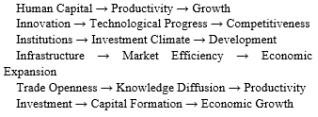
Economic success is conceptualized as a function of six major determinants:
Economic Success = f(Human Capital, Innovation, Institutions, Infrastructure, Investment, Trade Openness)
Figure 1. Conceptual Framework.
Figure 1 above indicates the Conceptual and Empirical representation.
5. Empirical Review
A substantial body of empirical literature identifies human capital, innovation, institutions, and trade openness as significant determinants of economic growth. Economic geography also highlights the role of spatial concentration and increasing returns in shaping development outcomes
.
Educational attainment has been shown to positively influence economic growth across countries
. Human capital significantly improves the explanatory power of economic growth models
| [26] | Mankiw, N. G., Romer, D., & Weil, D. N. (1992). A contribution to the empirics of economic growth. Quarterly Journal of Economics, 107(2), 407–437.
https://doi.org/10.2307/2118477 |
[26]
.
Institutional quality explains substantial variations in output per worker across countries
| [17] | Hall, R. E., & Jones, C. I. (1999). Why do some countries produce so much more output per worker than others? Quarterly Journal of Economics, 114(1), 83–116.
https://doi.org/10.1162/003355399555954 |
[17]
. Governance effectiveness and social infrastructure are important determinants of national productivity
| [17] | Hall, R. E., & Jones, C. I. (1999). Why do some countries produce so much more output per worker than others? Quarterly Journal of Economics, 114(1), 83–116.
https://doi.org/10.1162/003355399555954 |
[17]
.
Trade openness contributes positively to economic growth through specialization, efficiency gains, and knowledge transfer
. Similarly, trade integration promotes poverty reduction and economic expansion
.
Research and development investments significantly improve productivity through innovation spillovers
. Manufacturing-led growth remains an important pathway for economic convergence among developing economies
.
6. Methodology
6.1. Research Design
The study adopts a comparative panel-data framework combining descriptive, comparative, and econometric analyses.
6.2. Data Sources
Data are drawn from:
1) World Development Indicators (WDI)
2) Worldwide Governance Indicators (WGI)
3) OECD Statistics
4) IMF Databases
5) Penn World Table
6) UNESCO Institute for Statistics
The illustrative dataset covers developed and emerging economies over multiple years.
6.3. Model Specification
The baseline econometric model is specified as:
GDPPC_it = β₀ + β₁HC_it + β₂INV_it + β₃INST_it + β₄RD_it + β₅TRADE_it + ε_it
Where:
GDPPC = GDP per capita
HC = Human Capital Index
INV = Investment
INST = Institutional Quality
RD = Research and Development
TRADE = Trade Openness
ε = Error Term
6.4. Estimation Techniques
The study employs:
1) Fixed Effects Estimation
2) Random Effects Estimation
3) Hausman Specification Test
4) System GMM Estimation
5) Robustness Diagnostics
These techniques help address heterogeneity and endogeneity concerns. The dynamic-panel specification follows the difference-GMM framework of Arellano and Bond
| [3] | Arellano, M., & Bond, S. (1991). Some tests of specification for panel data: Monte Carlo evidence and an application to employment equations. Review of Economic Studies, 58(2), 277–297. https://doi.org/10.2307/2297968 |
[3]
and the system-GMM approach developed by Blundell and Bond
. The Hausman test guides the choice between fixed- and random-effects estimators
, while cross-sectional dependence can be assessed using Pesaran's diagnostic test
| [29] | Pesaran, M. H. (2004). General diagnostic tests for cross-section dependence in panels. Cambridge Working Papers in Economics, No. 0435. |
[29]
. Wooldridge's treatment of panel-data methods also informs the estimation and diagnostic strategy
| [40] | Wooldridge, J. M. (2010). Econometric Analysis of Cross Section and Panel Data (2nd ed.). MIT Press. |
[40]
.
7. Descriptive Statistics
Table 1. Descriptive Statistics.
Variable | Mean | Std. Dev. | Min | Max |
GDP per Capita | 25,450 | 15,320 | 850 | 81,500 |
Human Capital | 0.73 | 0.15 | 0.34 | 0.95 |
Trade Openness | 78.5 | 35.2 | 18.4 | 221.5 |
Institutional Quality | 1.12 | 0.83 | -1.75 | 2.43 |
R&D Expenditure | 2.14 | 1.47 | 0.01 | 5.60 |
The statistics indicate substantial variation across countries in income, institutional quality, and innovation capacity.
8. Correlation Analysis
Table 2. Variable Definitions and Data Sources.
Variable | GDPPC | HC | INST | R&D |
GDPPC | 1.00 | 0.76 | 0.82 | 0.79 |
HC | 0.76 | 1.00 | 0.67 | 0.58 |
INST | 0.82 | 0.67 | 1.00 | 0.71 |
R&D | 0.79 | 0.58 | 0.71 | 1.00 |
The results reveal strong positive associations between income, human capital, institutions, and innovation.
9. Econometric Results
Table 3. Fixed Effects Regression Results.
Variable | Coefficient | t-statistic |
Human Capital | 0.482*** | 7.84 |
Investment | 0.267*** | 5.72 |
Institutional Quality 0.391*** | 8.12 | |
R&D | 0.214** | 2.98 |
Trade Openness | 0.145** | 2.41 |
R2 = 0.74
N = 2,500
*** p < 0.01
The findings indicate that human capital, institutional quality, investment, innovation, and trade openness significantly contribute to economic performance.
Table 4. System GMM Results.
Variable | Coefficient |
Lagged GDP per Capita | 0.81*** |
Human Capital | 0.37*** |
Institutional Quality | 0.29*** |
R&D | 0.18** |
Infrastructure | 0.24*** |
The dynamic estimates confirm the persistence of growth and the importance of institutional and innovation-related variables.
10. Discussion of Findings
The empirical findings strongly support endogenous growth theory and institutional economics. Human capital exhibits the strongest positive influence on economic performance, confirming the importance of education and skills development in fostering productivity and growth
.
Institutional quality emerges as a significant determinant of development outcomes. This finding is consistent with previous studies emphasizing the importance of effective governance systems in promoting investment, innovation, and economic activity
| [1] | Acemoglu, D., Johnson, S., & Robinson, J. A. (2001). The colonial origins of comparative development: An empirical investigation. American Economic Review, 91(5), 1369–1401.
https://doi.org/10.1257/aer.91.5.1369 |
| [28] | North, D. C. (1990). Institutions, Institutional Change and Economic Performance. Cambridge University Press. |
| [31] | Rodrik, D., Subramanian, A., & Trebbi, F. (2004). Institutions rule: The primacy of institutions over geography and integration in economic development. Journal of Economic Growth, 9(2), 131–165.
https://doi.org/10.1023/B:JOEG.0000031425.72248.85 |
[1, 28, 31]
.
The positive relationship between research and development expenditure and economic growth supports the proposition that innovation generates sustained productivity improvements and technological advancement
.
Trade openness contributes positively to economic performance through technological diffusion, market integration, and participation in global value chains
| [14] | Frankel, J. A., & Romer, D. (1999). Does trade cause growth? American Economic Review, 89(3), 379–399.
https://doi.org/10.1257/aer.89.3.379 |
| [35] | Sachs, J. D., & Warner, A. M. (1995). Economic reform and the process of global integration. Brookings Papers on Economic Activity, 1995(1), 1–118.
https://doi.org/10.2307/2534573 |
[14, 35]
.
Overall, the findings suggest that successful development requires coordinated investments in human capital, institutions, innovation, infrastructure, and industrial competitiveness
| [11] | Coe, D. T., & Helpman, E. (1995). International R&D spillovers. European Economic Review, 39(5), 859–887.
https://doi.org/10.1016/0014-2921(94)00100-E |
| [18] | Hanushek, E. A., & Woessmann, L. (2008). The role of cognitive skills in economic development. Journal of Economic Literature, 46(3), 607–668.
https://doi.org/10.1257/jel.46.3.607 |
| [28] | North, D. C. (1990). Institutions, Institutional Change and Economic Performance. Cambridge University Press. |
| [33] | Romer, P. M. (1990). Endogenous technological change. Journal of Political Economy, 98(5), S71–S102.
https://doi.org/10.1086/261725 |
[11, 18, 28, 33]
.
11. Country Case Studies
11.1. United States
The United States has maintained global economic leadership through innovation ecosystems, world-class universities, venture capital markets, and technological entrepreneurship. Significant investments in R&D have facilitated breakthroughs in information technology, biotechnology, and advanced manufacturing.
11.2. Germany
Germany's success is closely linked to manufacturing excellence, vocational education systems, industrial clusters, and export competitiveness. The country's Mittelstand enterprises contribute significantly to innovation and employment.
11.3. Japan
Japan's post-war economic transformation illustrates the effectiveness of strategic industrial policy, technological upgrading, and productivity enhancement.
11.4. Finland
Finland's emphasis on education, innovation, and digital transformation has enabled sustained competitiveness despite limited natural resources.
11.5. Singapore
Singapore demonstrates how strong governance, strategic planning, and global trade integration can transform a resource-constrained economy into a high-income nation.
11.6. South Korea
South Korea's development trajectory highlights the importance of industrial upgrading, export-oriented growth, and technological innovation.
11.7. Botswana
Botswana provides lessons in resource governance, prudent fiscal management, and institutional stability.
11.8. Rwanda
Rwanda illustrates how governance reforms, digital transformation, and public-sector modernization can accelerate development progress.
12. Policy Lessons for Emerging Economies
The experiences of developed economies reveal several policy lessons for emerging economies. Institutional quality remains one of the most important determinants of economic success
| [1] | Acemoglu, D., Johnson, S., & Robinson, J. A. (2001). The colonial origins of comparative development: An empirical investigation. American Economic Review, 91(5), 1369–1401.
https://doi.org/10.1257/aer.91.5.1369 |
| [28] | North, D. C. (1990). Institutions, Institutional Change and Economic Performance. Cambridge University Press. |
[1, 28]
. Human capital development contributes significantly to productivity growth and innovation
| [7] | Becker, G. S. (1962). Investment in human capital: A theoretical analysis. Journal of Political Economy, 70(5), 9–49. https://doi.org/10.1086/258724 |
| [24] | Lucas, R. E. Jr. (1988). On the mechanics of economic development. Journal of Monetary Economics, 22(1), 3–42.
https://doi.org/10.1016/0304-3932(88)90168-7 |
| [36] | Schultz, T. W. (1961). Investment in human capital. American Economic Review, 51(1), 1–17. |
[7, 24, 36]
.
Innovation is central to long-term economic growth and competitiveness
| [2] | Aghion, P., & Howitt, P. (1992). A model of growth through creative destruction. Econometrica, 60(2), 323–351.
https://doi.org/10.2307/2951599 |
| [15] | Freeman, C. (1987). Technology Policy and Economic Performance: Lessons from Japan. Pinter Publishers. |
| [33] | Romer, P. M. (1990). Endogenous technological change. Journal of Political Economy, 98(5), S71–S102.
https://doi.org/10.1086/261725 |
[2, 15, 33]
. Industrialization remains a critical mechanism for structural transformation and economic diversification
.
Regional integration enhances trade, investment, and technology transfer opportunities
| [14] | Frankel, J. A., & Romer, D. (1999). Does trade cause growth? American Economic Review, 89(3), 379–399.
https://doi.org/10.1257/aer.89.3.379 |
| [35] | Sachs, J. D., & Warner, A. M. (1995). Economic reform and the process of global integration. Brookings Papers on Economic Activity, 1995(1), 1–118.
https://doi.org/10.2307/2534573 |
[14, 35]
. Consequently, policymakers should pursue integrated strategies that strengthen institutions, education systems, infrastructure, innovation ecosystems, and industrial capabilities
| [1] | Acemoglu, D., Johnson, S., & Robinson, J. A. (2001). The colonial origins of comparative development: An empirical investigation. American Economic Review, 91(5), 1369–1401.
https://doi.org/10.1257/aer.91.5.1369 |
| [7] | Becker, G. S. (1962). Investment in human capital: A theoretical analysis. Journal of Political Economy, 70(5), 9–49. https://doi.org/10.1086/258724 |
| [31] | Rodrik, D., Subramanian, A., & Trebbi, F. (2004). Institutions rule: The primacy of institutions over geography and integration in economic development. Journal of Economic Growth, 9(2), 131–165.
https://doi.org/10.1023/B:JOEG.0000031425.72248.85 |
| [33] | Romer, P. M. (1990). Endogenous technological change. Journal of Political Economy, 98(5), S71–S102.
https://doi.org/10.1086/261725 |
[1, 7, 31, 33]
.
13. African Union Policy Brief
Accelerating Structural Transformation and Inclusive Growth in Africa.
Despite improvements in economic performance over recent decades, many African economies continue to face challenges associated with low industrial productivity, weak infrastructure, limited technological capability, and institutional constraints.
Lessons from developed economies suggest that sustained development requires coordinated investments in human capital, institutions, innovation, and infrastructure.
To accelerate inclusive economic growth and structural transformation across African economies through strategic investments in productivity-enhancing sectors.
(i). Expand Human Capital Development
1) Increase education expenditure to at least 6% of GDP.
2) Strengthen STEM education.
3) Improve vocational training systems.
4) Promote digital literacy.
(ii). Increase Research and Development
1) Raise R&D expenditure to at least 1% of GDP.
2) Establish innovation centers.
3) Promote public-private partnerships in technology.
(iii). Strengthen Institutions
1) Improve governance effectiveness.
2) Enhance transparency and accountability.
3) Strengthen anti-corruption frameworks.
(iv). Accelerate Industrialization
1) Support manufacturing industries.
2) Expand industrial parks.
3) Promote export-oriented production.
(v). Improve Infrastructure
1) Expand energy access.
2) Modernize transportation networks.
3) Invest in broadband connectivity.
(vi). Promote Green Industrialization
1) Support renewable energy projects.
2) Encourage sustainable production systems.
3) Develop climate-resilient infrastructure.
(vii). Strengthen AfCFTA Implementation
1) Reduce non-tariff barriers.
2) Improve customs efficiency.
3) Expand regional value chains.
4) Expected Outcomes
5) Implementation of these policies is expected to generate:
6) Higher productivity growth
7) Increased employment opportunities
8) Export diversification
9) Improved competitiveness
10) Poverty reduction
11) Sustainable economic transformation
14. Limitations of the Study
Although the study provides valuable insights into the determinants of economic success, several limitations should be acknowledged.
First, cross-country heterogeneity may affect comparability among economies with different institutional, cultural, and historical contexts.
Second, data availability and quality vary across countries, potentially affecting empirical estimates.
Third, measuring institutional quality remains challenging due to differences in governance indicators and reporting standards.
Fourth, endogeneity concerns may arise from the reciprocal relationship between economic growth and explanatory variables such as education and innovation.
These limitations provide opportunities for future research.
15. Future Research Directions
Future studies should explore emerging determinants of economic development.
16. Conclusion
The success of developed economies reflects a long-term process of institutional strengthening, human capital development, innovation, industrialization, and strategic policy implementation
| [1] | Acemoglu, D., Johnson, S., & Robinson, J. A. (2001). The colonial origins of comparative development: An empirical investigation. American Economic Review, 91(5), 1369–1401.
https://doi.org/10.1257/aer.91.5.1369 |
| [7] | Becker, G. S. (1962). Investment in human capital: A theoretical analysis. Journal of Political Economy, 70(5), 9–49. https://doi.org/10.1086/258724 |
| [15] | Freeman, C. (1987). Technology Policy and Economic Performance: Lessons from Japan. Pinter Publishers. |
| [23] | Lewis, W. A. (1954). Economic development with unlimited supplies of labour. Manchester School, 22(2), 139–191.
https://doi.org/10.1111/j.1467-9957.1954.tb00021.x |
| [28] | North, D. C. (1990). Institutions, Institutional Change and Economic Performance. Cambridge University Press. |
| [33] | Romer, P. M. (1990). Endogenous technological change. Journal of Political Economy, 98(5), S71–S102.
https://doi.org/10.1086/261725 |
[1, 7, 15, 23, 28, 33]
.
The empirical findings indicate that human capital, institutional quality, innovation, investment, infrastructure, and trade openness significantly influence economic performance
| [5] | Barro, R. J. (1991). Economic growth in a cross section of countries. Quarterly Journal of Economics, 106(2), 407–443. https://doi.org/10.2307/2937943 |
| [11] | Coe, D. T., & Helpman, E. (1995). International R&D spillovers. European Economic Review, 39(5), 859–887.
https://doi.org/10.1016/0014-2921(94)00100-E |
| [17] | Hall, R. E., & Jones, C. I. (1999). Why do some countries produce so much more output per worker than others? Quarterly Journal of Economics, 114(1), 83–116.
https://doi.org/10.1162/003355399555954 |
| [18] | Hanushek, E. A., & Woessmann, L. (2008). The role of cognitive skills in economic development. Journal of Economic Literature, 46(3), 607–668.
https://doi.org/10.1257/jel.46.3.607 |
| [31] | Rodrik, D., Subramanian, A., & Trebbi, F. (2004). Institutions rule: The primacy of institutions over geography and integration in economic development. Journal of Economic Growth, 9(2), 131–165.
https://doi.org/10.1023/B:JOEG.0000031425.72248.85 |
[5, 11, 17, 18, 31]
.
For emerging economies, particularly those in Africa, sustainable development requires effective governance systems, investment in education and research, industrial upgrading, technological innovation, and regional integration
| [1] | Acemoglu, D., Johnson, S., & Robinson, J. A. (2001). The colonial origins of comparative development: An empirical investigation. American Economic Review, 91(5), 1369–1401.
https://doi.org/10.1257/aer.91.5.1369 |
| [7] | Becker, G. S. (1962). Investment in human capital: A theoretical analysis. Journal of Political Economy, 70(5), 9–49. https://doi.org/10.1086/258724 |
| [18] | Hanushek, E. A., & Woessmann, L. (2008). The role of cognitive skills in economic development. Journal of Economic Literature, 46(3), 607–668.
https://doi.org/10.1257/jel.46.3.607 |
| [31] | Rodrik, D., Subramanian, A., & Trebbi, F. (2004). Institutions rule: The primacy of institutions over geography and integration in economic development. Journal of Economic Growth, 9(2), 131–165.
https://doi.org/10.1023/B:JOEG.0000031425.72248.85 |
| [33] | Romer, P. M. (1990). Endogenous technological change. Journal of Political Economy, 98(5), S71–S102.
https://doi.org/10.1086/261725 |
[1, 7, 18, 31, 33]
.
Through sustained commitment to innovation, human capital development, institutional reform, and industrial competitiveness, emerging economies can accelerate economic transformation and improve the welfare of their populations
| [23] | Lewis, W. A. (1954). Economic development with unlimited supplies of labour. Manchester School, 22(2), 139–191.
https://doi.org/10.1111/j.1467-9957.1954.tb00021.x |
| [30] | Rodrik, D. (2013). Unconditional convergence in manufacturing. Quarterly Journal of Economics, 128(1), 165–204.
https://doi.org/10.1093/qje/qjs047 |
| [33] | Romer, P. M. (1990). Endogenous technological change. Journal of Political Economy, 98(5), S71–S102.
https://doi.org/10.1086/261725 |
| [39] | Todaro, M. P., & Smith, S. C. (2021). Economic Development (13th ed.). Pearson Education. |
[23, 30, 33, 39]
.
Abbreviations
AfCFTA | African Continental Free Trade Area |
AI | Artificial Intelligence |
AR | Autoregressive |
AU | African Union |
GDP | Gross Domestic Product |
GDPPC | Gross Domestic Product per Capita |
GMM | Generalized Method of Moments |
HDI | Human Development Index |
HC | Human Capital |
ICT | Information and Communication Technology |
IMF | International Monetary Fund |
INFRA | Infrastructure |
INST | Institutional Quality |
IT | Information Technology |
OECD | Organisation for Economic Co-operation and Development |
OLS | Ordinary Least Squares |
PWT | Penn World Table |
R&D | Research and Development |
RD | Research and Development Expenditure |
SDGs | Sustainable Development Goals |
SMEs | Small and Medium-sized Enterprises |
STEM | Science, Technology, Engineering and Mathematics |
TRADE | Trade Openness |
UN | United Nations |
UNESCO | United Nations Educational, Scientific and Cultural Organization |
USA | United States of America |
VIF | Variance Inflation Factor |
WDI | World Development Indicators |
WGI | Worldwide Governance Indicators |
WTO | World Trade Organization |
PPP | Public–Private Partnership |
FDI | Foreign Direct Investment |
TFP | Total Factor Productivity |
SEZs | Special Economic Zones |
RTA | Regional Trade Agreement |
EU | European Union |
ASEAN | Association of Southeast Asian Nations |
MNCs | Multinational Corporations |
ICT4D | Information and Communication Technologies for Development |
CO₂ | Carbon Dioxide |
ESG | Environmental, Social and Governance |
Author Contributions
Idowu Oduola: Conceptualization, Methodology, Writing – original draft
Ayonimi Mary: Data curation, Formal Analysis, Writing – review & editing
Funding
This work received no external funding.
Data Availability Statement
The datasets used and/or analyzed during the current study are publicly available from the World Bank World Development Indicators (WDI), Worldwide Governance Indicators (WGI), International Monetary Fund (IMF), OECD Statistics, Penn World Table (PWT), and UNESCO Institute for Statistics databases. Further information is available from the corresponding author upon reasonable request.
Conflicts of Interest
The authors declare no conflicts of interests.
Appendix
Appendix I: Variable Definitions and Data Sources
(Referenced in Section 6)
Table A1. Variable Definitions and Data Sources.
Variable | Definition | Measurement | Source |
GDPPC | GDP per capita | Constant US$ | WDI |
HC | Human Capital Index | Index Value | Penn World Table |
INST | Institutional Quality | Governance Indicators | WGI |
RD | Research and Development | % of GDP | OECD |
TRADE | Trade Openness | Trade/GDP Ratio | WDI |
INFRA | Infrastructure Index | Composite Measure | World Bank |
Appendix II: Econometric Diagnostic Procedures
(Referenced in Section 6.4)
Table A2. Diagnostic Tests.
Test | Purpose |
Hausman Test | Fixed vs Random Effects |
Wooldridge Test | Autocorrelation |
Pesaran CD Test | Cross-sectional Dependence |
Variance Inflation Factor | Multicollinearity |
Hansen Test | Instrument Validity |
The diagnostic procedures confirm the suitability of the selected estimation methods.
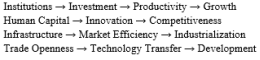
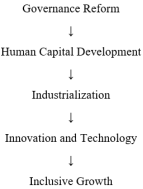
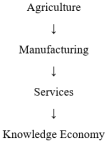
Appendix III: Supplementary Development Indicators
(Referenced in Sections 10 and 12)
Figure 2. Development Pathway Framework.
Figure 3. Policy Framework for Emerging Economies.
Figure 4. African Structural Transformation Model.
References
| [1] |
Acemoglu, D., Johnson, S., & Robinson, J. A. (2001). The colonial origins of comparative development: An empirical investigation. American Economic Review, 91(5), 1369–1401.
https://doi.org/10.1257/aer.91.5.1369
|
| [2] |
Aghion, P., & Howitt, P. (1992). A model of growth through creative destruction. Econometrica, 60(2), 323–351.
https://doi.org/10.2307/2951599
|
| [3] |
Arellano, M., & Bond, S. (1991). Some tests of specification for panel data: Monte Carlo evidence and an application to employment equations. Review of Economic Studies, 58(2), 277–297.
https://doi.org/10.2307/2297968
|
| [4] |
Amsden, A. H. (1989). Asia's Next Giant: South Korea and Late Industrialization. Oxford University Press.
|
| [5] |
Barro, R. J. (1991). Economic growth in a cross section of countries. Quarterly Journal of Economics, 106(2), 407–443.
https://doi.org/10.2307/2937943
|
| [6] |
Barro, R. J., & Lee, J. W. (2013). A new data set of educational attainment in the world, 1950–2010. Journal of Development Economics, 104, 184–198.
https://doi.org/10.1016/j.jdeveco.2012.10.001
|
| [7] |
Becker, G. S. (1962). Investment in human capital: A theoretical analysis. Journal of Political Economy, 70(5), 9–49.
https://doi.org/10.1086/258724
|
| [8] |
Blundell, R., & Bond, S. (1998). Initial conditions and moment restrictions in dynamic panel data models. Journal of Econometrics, 87(1), 115–143.
https://doi.org/10.1016/S0304-4076(98)00009-8
|
| [9] |
Chang, H. J. (2002). Kicking Away the Ladder: Development Strategy in Historical Perspective. Anthem Press.
|
| [10] |
Chenery, H. B., & Syrquin, M. (1975). Patterns of Development, 1950–1970. Oxford University Press.
|
| [11] |
Coe, D. T., & Helpman, E. (1995). International R&D spillovers. European Economic Review, 39(5), 859–887.
https://doi.org/10.1016/0014-2921(94)00100-E
|
| [12] |
Dollar, D., & Kraay, A. (2004). Trade, growth, and poverty. Economic Journal, 114(493), F22–F49.
https://doi.org/10.1111/j.0013-0133.2004.00186.x
|
| [13] |
Easterly, W., & Levine, R. (2001). It's not factor accumulation: Stylized facts and growth models. World Bank Economic Review, 15(2), 177–219.
https://doi.org/10.1093/wber/15.2.177
|
| [14] |
Frankel, J. A., & Romer, D. (1999). Does trade cause growth? American Economic Review, 89(3), 379–399.
https://doi.org/10.1257/aer.89.3.379
|
| [15] |
Freeman, C. (1987). Technology Policy and Economic Performance: Lessons from Japan. Pinter Publishers.
|
| [16] |
Grossman, G. M., & Helpman, E. (1991). Innovation and Growth in the Global Economy. MIT Press.
|
| [17] |
Hall, R. E., & Jones, C. I. (1999). Why do some countries produce so much more output per worker than others? Quarterly Journal of Economics, 114(1), 83–116.
https://doi.org/10.1162/003355399555954
|
| [18] |
Hanushek, E. A., & Woessmann, L. (2008). The role of cognitive skills in economic development. Journal of Economic Literature, 46(3), 607–668.
https://doi.org/10.1257/jel.46.3.607
|
| [19] |
Hausman, J. A. (1978). Specification tests in econometrics. Econometrica, 46(6), 1251–1271.
https://doi.org/10.2307/1913827
|
| [20] |
Kaufmann, D., Kraay, A., & Mastruzzi, M. (2011). The worldwide governance indicators: Methodology and analytical issues. Hague Journal on the Rule of Law, 3(2), 220–246.
https://doi.org/10.1017/S1876404511200046
|
| [21] |
Krugman, P. (1991). Increasing returns and economic geography. Journal of Political Economy, 99(3), 483–499.
https://doi.org/10.1086/261763
|
| [22] |
Kuznets, S. (1966). Modern Economic Growth: Rate, Structure and Spread. Yale University Press.
|
| [23] |
Lewis, W. A. (1954). Economic development with unlimited supplies of labour. Manchester School, 22(2), 139–191.
https://doi.org/10.1111/j.1467-9957.1954.tb00021.x
|
| [24] |
Lucas, R. E. Jr. (1988). On the mechanics of economic development. Journal of Monetary Economics, 22(1), 3–42.
https://doi.org/10.1016/0304-3932(88)90168-7
|
| [25] |
Lundvall, B. Å. (1992). National Systems of Innovation: Towards a Theory of Innovation and Interactive Learning. Pinter Publishers.
|
| [26] |
Mankiw, N. G., Romer, D., & Weil, D. N. (1992). A contribution to the empirics of economic growth. Quarterly Journal of Economics, 107(2), 407–437.
https://doi.org/10.2307/2118477
|
| [27] |
Nelson, R. R., & Phelps, E. S. (1966). Investment in humans, technological diffusion, and economic growth. American Economic Review, 56(1–2), 69–75.
|
| [28] |
North, D. C. (1990). Institutions, Institutional Change and Economic Performance. Cambridge University Press.
|
| [29] |
Pesaran, M. H. (2004). General diagnostic tests for cross-section dependence in panels. Cambridge Working Papers in Economics, No. 0435.
|
| [30] |
Rodrik, D. (2013). Unconditional convergence in manufacturing. Quarterly Journal of Economics, 128(1), 165–204.
https://doi.org/10.1093/qje/qjs047
|
| [31] |
Rodrik, D., Subramanian, A., & Trebbi, F. (2004). Institutions rule: The primacy of institutions over geography and integration in economic development. Journal of Economic Growth, 9(2), 131–165.
https://doi.org/10.1023/B:JOEG.0000031425.72248.85
|
| [32] |
Romer, P. M. (1986). Increasing returns and long-run growth. Journal of Political Economy, 94(5), 1002–1037.
https://doi.org/10.1086/261420
|
| [33] |
Romer, P. M. (1990). Endogenous technological change. Journal of Political Economy, 98(5), S71–S102.
https://doi.org/10.1086/261725
|
| [34] |
Rostow, W. W. (1960). The Stages of Economic Growth: A Non-Communist Manifesto. Cambridge University Press.
|
| [35] |
Sachs, J. D., & Warner, A. M. (1995). Economic reform and the process of global integration. Brookings Papers on Economic Activity, 1995(1), 1–118.
https://doi.org/10.2307/2534573
|
| [36] |
Schultz, T. W. (1961). Investment in human capital. American Economic Review, 51(1), 1–17.
|
| [37] |
Solow, R. M. (1956). A contribution to the theory of economic growth. Quarterly Journal of Economics, 70(1), 65–94.
https://doi.org/10.2307/1884513
|
| [38] |
Swan, T. W. (1956). Economic growth and capital accumulation. Economic Record, 32(2), 334–361.
https://doi.org/10.1111/j.1475-4932.1956.tb00434.x
|
| [39] |
Todaro, M. P., & Smith, S. C. (2021). Economic Development (13th ed.). Pearson Education.
|
| [40] |
Wooldridge, J. M. (2010). Econometric Analysis of Cross Section and Panel Data (2nd ed.). MIT Press.
|
Cite This Article
-
APA Style
Oduola, I., Mary, A. (2026). The Success of Developed Economies: Processes, Progress and Policy Lessons for Emerging Economies. American Journal of Theoretical and Applied Business, 12(4), 110-118. https://doi.org/10.11648/j.ajtab.20261204.12
 Copy
|
 Download
ACS Style
Oduola, I.; Mary, A. The Success of Developed Economies: Processes, Progress and Policy Lessons for Emerging Economies. Am. J. Theor. Appl. Bus. 2026, 12(4), 110-118. doi: 10.11648/j.ajtab.20261204.12
Copy
|
Download
AMA Style
Oduola I, Mary A. The Success of Developed Economies: Processes, Progress and Policy Lessons for Emerging Economies. Am J Theor Appl Bus. 2026;12(4):110-118. doi: 10.11648/j.ajtab.20261204.12
Copy
|
Download
-
@article{10.11648/j.ajtab.20261204.12,
  author = {Idowu Oduola and Ayonimi Mary},
  title = {The Success of Developed Economies: Processes, Progress and Policy Lessons for Emerging Economies},
  journal = {American Journal of Theoretical and Applied Business},
  volume = {12},
  number = {4},
  pages = {110-118},
  doi = {10.11648/j.ajtab.20261204.12},
  url = {https://doi.org/10.11648/j.ajtab.20261204.12},
  eprint = {https://article.sciencepublishinggroup.com/pdf/10.11648.j.ajtab.20261204.12},
  abstract = {The sustained success of developed economies has attracted extensive scholarly and policy attention due to its implications for economic growth, institutional development, technological advancement, productivity improvement, and societal welfare. While numerous countries have successfully transformed from agrarian economies into highly industrialized and innovation-driven societies, many developing and emerging economies continue to face structural constraints that hinder sustainable development. This study examines the processes, progress, and policy foundations that have enabled developed economies to achieve high levels of income, productivity, innovation, and human development. Drawing upon modernization theory, endogenous growth theory, institutional economics, and structural transformation frameworks, the study investigates the determinants of successful economic development and explores lessons applicable to emerging economies, particularly in Africa. A comparative analytical framework is employed to assess the experiences of the United States, Germany, Japan, Finland, Singapore, and South Korea. Illustrative econometric models are presented to demonstrate how human capital, innovation, institutional quality, infrastructure, investment, and trade openness influence economic performance. Findings indicate that successful development is driven by effective institutions, strategic industrial policies, investments in education and research, macroeconomic stability, and integration into global value chains. The study concludes that emerging economies can accelerate development through context-specific reforms that strengthen governance, productivity, innovation systems, and structural transformation.},
 year = {2026}
}
Copy
|
Download
-
TY  - JOUR
T1  - The Success of Developed Economies: Processes, Progress and Policy Lessons for Emerging Economies
AU  - Idowu Oduola
AU  - Ayonimi Mary
Y1  - 2026/11/16
PY  - 2026
N1  - https://doi.org/10.11648/j.ajtab.20261204.12
DO  - 10.11648/j.ajtab.20261204.12
T2  - American Journal of Theoretical and Applied Business
JF  - American Journal of Theoretical and Applied Business
JO  - American Journal of Theoretical and Applied Business
SP  - 110
EP  - 118
PB  - Science Publishing Group
SN  - 2469-7842
UR  - https://doi.org/10.11648/j.ajtab.20261204.12
AB  - The sustained success of developed economies has attracted extensive scholarly and policy attention due to its implications for economic growth, institutional development, technological advancement, productivity improvement, and societal welfare. While numerous countries have successfully transformed from agrarian economies into highly industrialized and innovation-driven societies, many developing and emerging economies continue to face structural constraints that hinder sustainable development. This study examines the processes, progress, and policy foundations that have enabled developed economies to achieve high levels of income, productivity, innovation, and human development. Drawing upon modernization theory, endogenous growth theory, institutional economics, and structural transformation frameworks, the study investigates the determinants of successful economic development and explores lessons applicable to emerging economies, particularly in Africa. A comparative analytical framework is employed to assess the experiences of the United States, Germany, Japan, Finland, Singapore, and South Korea. Illustrative econometric models are presented to demonstrate how human capital, innovation, institutional quality, infrastructure, investment, and trade openness influence economic performance. Findings indicate that successful development is driven by effective institutions, strategic industrial policies, investments in education and research, macroeconomic stability, and integration into global value chains. The study concludes that emerging economies can accelerate development through context-specific reforms that strengthen governance, productivity, innovation systems, and structural transformation.
VL  - 12
IS  - 4
ER  -
Copy
|
Download






 Share This Article
 Twitter
 Linked In
 Facebook