1. Introduction
1.1. Context: Groundwater as a Strategic yet Vulnerable Resource
In much of sub-Saharan Africa, groundwater provides a decisive share of the drinking-water supply of rapidly expanding cities
| [1] | S. Adelana, A. Tamiru, and C. Tindimugaya, Urban groundwater management and protection in sub-Saharan Africa. CRC Press, 2008. https://doi.org/10.1201/9780203889497.pt3 |
| [2] | D. J. Lapworth, J. Okotto-Okotto, S. Pedley, M. E. Stuart, M. N. Tijani, and J. A. Wright, “Urban groundwater quality in sub-Saharan Africa: Current status and implications for water security and public health,” Hydrogeol. J., vol. 25, no. 4, pp. 1093–1116, 2017, https://doi.org/10.1007/s10040-016-1516-6 |
[1, 2]
. It offers relatively continuous availability throughout the seasons, a lighter infrastructure footprint than surface-water networks, and often greater resilience to climate variability (Foster et al., 2020). This strategic importance is matched by an equally marked vulnerability: in cities where urbanisation precedes sanitation and wastewater collection networks, shallow unconfined aquifers that are directly connected to the surface are exposed to a dual chemical and microbiological pressure
| [2] | D. J. Lapworth, J. Okotto-Okotto, S. Pedley, M. E. Stuart, M. N. Tijani, and J. A. Wright, “Urban groundwater quality in sub-Saharan Africa: Current status and implications for water security and public health,” Hydrogeol. J., vol. 25, no. 4, pp. 1093–1116, 2017, https://doi.org/10.1007/s10040-016-1516-6 |
| [3] | F. R. B. Twinomucunguzi, P. Nyenje, R. Kulabako, S. Semiyaga, J. Foppen, and F. Kansiime, “Reducing groundwater contamination from on-site sanitation in peri-urban sub-Saharan Africa: Reviewing transition management attributes towards implementation of water safety plans,” Sustainability, vol. 12, no. 10, p. 4210, 2020, https://doi.org/10.3390/su12104210 |
[2, 3]
.
Chad is no exception to this trend. Population growth, rapid urbanisation and rising demand for drinking water are placing increasing pressure on groundwater resources
| [1] | S. Adelana, A. Tamiru, and C. Tindimugaya, Urban groundwater management and protection in sub-Saharan Africa. CRC Press, 2008. https://doi.org/10.1201/9780203889497.pt3 |
| [2] | D. J. Lapworth, J. Okotto-Okotto, S. Pedley, M. E. Stuart, M. N. Tijani, and J. A. Wright, “Urban groundwater quality in sub-Saharan Africa: Current status and implications for water security and public health,” Hydrogeol. J., vol. 25, no. 4, pp. 1093–1116, 2017, https://doi.org/10.1007/s10040-016-1516-6 |
[1, 2]
. In Moundou, the capital of Logone Occidental Province and the country’s second-largest city, private wells and boreholes are an essential component of the water supply system, in a hydrogeological setting dominated by sandy, sandy-clayey and clayey sedimentary formations associated with the Continental Terminal and Quaternary deposits
| [4] | P. Doumtoudjinodji, E. Manou Bernadin, J. C. Doumnang Mbaigane, N. Djoueingu’e, U. Agnichola, and A. Socohou Amadou, “Hydrochemical characterisation and assessment of the level of contamination of groundwater collected by private waterworks in the town of Moundou in the south of Chad,” Journal of Geoscience and Environment Protection, vol. 12, no. 1, pp. 13–32, 2024. |
| [5] | P. Doumtoudjinodji, M. B. Elegbede, M. J. C. Doumnang, A. A. Socohou, and N. Djoueingue, “Spatio-Temporal Assessment of Groundwater Quality in the Town of Moundou in South-Western Chad,” Nature Environment and Pollution Technology, vol. 25, no. 1, Mar. 2026,
https://doi.org/10.46488/NEPT.2026.v25i01.D1800 |
[4, 5]
. The city is also connected to the Logone hydrographic network and to nearby water bodies (Lakes Wey and Taba), which promotes exchanges between surface water and groundwater, particularly during high-water periods
| [4] | P. Doumtoudjinodji, E. Manou Bernadin, J. C. Doumnang Mbaigane, N. Djoueingu’e, U. Agnichola, and A. Socohou Amadou, “Hydrochemical characterisation and assessment of the level of contamination of groundwater collected by private waterworks in the town of Moundou in the south of Chad,” Journal of Geoscience and Environment Protection, vol. 12, no. 1, pp. 13–32, 2024. |
| [6] | D. Morgongarti, L. Andossa, M. Hassan, and T. Lauric, “HYDROCHEMICAL CHARACTERIZATION OF GROUNDWATER IN THE CONTINENTAL TERMINAL AQUIFER OF MOUNDOU AND ITS SURROUNDINGS (SOUTHWEST CHAD),” Int. J. Adv. Res. (Indore)., vol. 13, no. 07, pp. 796–825, Jul. 2025, https://doi.org/10.21474/IJAR01/21389 |
[4, 6]
.
The Lake Chad basin, in which Moundou lies, is moreover recognised as one of the most fragile hydrological systems of the Sahel, owing to poverty, instability and the population’s heavy reliance on groundwater to compensate for erratic rainfall. At the basin scale, recharge of the Quaternary aquifers remains globally resilient to climate change, but this quantitative resilience says nothing about the quality of the water abstracted, which depends mainly on local sanitation conditions and on the protection of abstraction structures
| [7] | A. M. Nour et al., “Shallow Quaternary groundwater in the Lake Chad basin is resilient to climate change but requires sustainable management strategy: Results of isotopic investigation,” Sci. Total Environ., vol. 851, p. 158152, 2022,
https://doi.org/10.1016/j.scitotenv.2022.158152 |
[7]
.
1.2. Problem Statement
Groundwater can be weakly mineralised, with a reassuring bicarbonate facies, and yet be microbiologically hazardous. Conversely, a high electrical conductivity or a high nitrate or chloride content may reflect anthropogenic influence without, on its own, demonstrating faecal contamination. The two dimensions are therefore complementary and not interchangeable: hydrochemistry informs on mineralisation processes and diffuse anthropogenic inputs, whereas bacteriology provides direct evidence of exposure to enteric pathogens. A review focused solely on hydrochemistry risks underestimating the actual health risk borne by users of private wells and boreholes, which account for most of the domestic water supply in Moundou.
This issue is all the more critical because studies conducted specifically in Moundou since 2019 have revealed very high rates of bacteriological non-compliance, marked seasonal variability and, more recently, the appearance of Escherichia coli and Salmonella spp. strains resistant to certain antibiotics in well water. This antimicrobial resistance dimension introduces a public health issue that goes beyond conventional faecal contamination and remains largely absent from earlier reviews focused on hydrochemistry.
1.3. Objectives and Synthesis Axes
The objective of this narrative review is to bring together, interpret and critically contextualise the available knowledge on groundwater quality in Moundou, by linking hydrogeological processes, hydrochemistry and microbiological contamination, and by situating these results within the broader context of Sahelian urban aquifers. Rather than answering research questions formulated according to a pre-registered systematic protocol, the review is organised around five synthesis themes that structure the critical reading of the literature:
Theme 1. What are the main hydrochemical processes controlling mineralisation and the chemical composition of groundwater in Moundou, and how do they compare with the water quality indices (WQI, SAR, RSC) used elsewhere in the region?
Theme 2. What is the level of bacteriological contamination of groundwater in Moundou, and how does it vary between seasons?
Theme 3. What are the main natural and anthropogenic pathways responsible for groundwater contamination in Moundou?
Theme 4. What are the potential public health implications of hydrochemical and bacteriological contamination in Moundou?
Theme 5. To what extent is the situation in Moundou comparable to, or on the contrary specific relative to, other urban aquifers in arid and semi-arid Africa?
2. Manuscript Formatting
2.1. Rationale for a Narrative Review
A systematic review, in the sense of the PRISMA 2020 statement, presupposes a body of literature large and homogeneous enough to justify a pre-registered search protocol, an exhaustive quantitative account of the selection process (identification, deduplication, screening, inclusion) and, where possible, a statistical synthesis of the results. However, the literature published specifically on groundwater quality in Moundou remains, to date, limited to a small number of works (a handful of master’s dissertations, doctoral theses and articles, produced mostly by small research teams since 2016). Applying the methodological apparatus of a systematic review to this narrow corpus would have given an impression of quantitative rigour that the data cannot genuinely support, with the risk of masking, rather than acknowledging, the real limits of the available knowledge base.
This review therefore adopts a narrative approach: it aims to gather, contextualise and critically interpret all available work on Moundou, however scarce, by explicitly linking it to a broader literature on urban aquifers of the Lake Chad basin and West Africa, in order to place the Moundou case in a regional perspective and to draw lessons despite the narrowness of the local corpus. A narrative review also allows a more interpretative reading of the results, an explicit dialogue between disciplines (hydrogeology, hydrochemistry, microbiology, public health) and a freer formulation of research gaps, all of which a rigid systematic protocol would have constrained to a greater extent.
2.2. Information Sources and Search Strategy
The literature used includes peer-reviewed scientific articles, doctoral theses, master’s dissertations, institutional reports and international drinking-water quality guidelines. Sources were identified from the following databases and platforms: Scopus, Web of Science, PubMed, ScienceDirect, SpringerLink, Google Scholar, African Journals Online and DICAMES, as well as World Health Organization guidance documents. The search combined terms centred on Moundou and the Chari-Logone basin (“Moundou”, “Logone Occidental”, “Lake Chad basin”, “Chad”) with thematic terms relating to groundwater, hydrochemistry, water quality indices (WQI, SAR, RSC) and bacteriology (“groundwater”, “aquifer”, “water quality”, “Escherichia coli”, “Salmonella”, “coliforms”, “faecal contamination”, “antibiotic resistance”).
Unlike a systematic review, this search was not conducted using a single Boolean equation applied identically and exhaustively to each database, nor was it followed by a numerical count of references at each selection stage. It proceeded iteratively and cumulatively: the references cited in works centred on Moundou were used as entry points to extend the search to the comparative literature on other Sahelian and West African urban aquifers (N’Djamena, Cotonou, Ibadan, Dakar), an approach typical of narrative reviews but one that would not have met the reproducibility requirements of a PRISMA protocol.
2.3. Thematic and Temporal Scope
Works were retained if they dealt with groundwater, wells, boreholes or aquifers of Moundou and of the Chari-Logone/Lake Chad basin and provided hydrochemical, bacteriological, hydrogeological or health information; studies on other African urban aquifers were also included where they offered relevant comparative insight, notably in arid or semi-arid zones. Priority was given to the most recent publications (2015-2026); older references were retained when they provided fundamental information on geology, regional hydrogeology or the classical interpretation of groundwater geochemistry (foundational works on the Lake Chad basin; the reference methods of Richards, 1954
| [8] | L. A. Richards, Diagnosis and improvement of saline and alkali soils. in USDA Agriculture Handbook No. 60. United States Department of Agriculture, 1954. |
[8]
, and Wilcox, 1955
| [9] | L. V Wilcox, Classification and use of irrigation waters. in USDA Circular No. 969. United States Department of Agriculture, 1955. |
[9]
, for irrigation indices). No quantitative inclusion threshold was set a priori: given the small number of works available on Moundou, all relevant studies identified were taken into account rather than selected according to strict exclusion criteria.
2.4. Synthesis Approach
For each study on Moundou, the following information was extracted where available: geographical location, sampling period, number and type of water points, groundwater depth, physicochemical parameters, major ions, bacteriological indicators, analytical methods, main results, contamination sources identified and health implications. This information was organised around five main themes: the hydrogeological context; hydrochemical characteristics and quality indices; bacteriological quality and contamination pathways; combined risk factors and population vulnerability; and implications for management and public health. The synthesis remains narrative and interpretative throughout: given the heterogeneity of sampling strategies and analytical units among studies, no statistical aggregation was attempted; numerical comparisons between studies, or with other cities, are presented with the necessary caution.
2.5. Methodological Limitations of the Review
This narrative review has limitations that should be explicitly acknowledged. First, and this is the very reason for choosing this format, the literature specifically focused on Moundou remains sparse and originates from a small number of research teams, which limits the possibility of triangulating results and exposes the synthesis to a selection bias inherent to the available works, rather than to the whole of the unpublished grey literature. Second, the absence of a pre-registered systematic protocol means that the exhaustiveness of the literature search can be neither guaranteed nor replicated identically by another author, which is an accepted limitation of the narrative approach. Third, the comparison with other African urban aquifers rests on climatic, geological and socio-economic contexts that are not strictly identical, which requires a cautious reading of the parallels drawn in the Discussion section. These limitations do not invalidate the synthesis but delimit its scope: it is a critical, reasoned appraisal intended to guide future research, rather than an exhaustive and reproducible inventory of the literature.
3. Results
3.1. General State of the Available Literature on Moundou
Before entering into the thematic detail, it is useful to outline, in narrative form and without claiming bibliometric exhaustiveness, the general profile of the literature devoted to Moundou. This qualitative overview clarifies both the scope and the limits of the synthesis that follows. No study specifically devoted to groundwater quality in Moundou was identified before 2016. The first structuring work is the master’s thesis of Bandé (2016), devoted to the hydrodynamic and hydrochemical characterisation of groundwater in an urban setting in Moundou. Output has since been concentrated almost entirely in the period 2020-2026, with the series of works by Dionkas and colleagues (2021, 2022, 2023)
| [10] | J. Dionkas, “Impact de la pression anthropique sur la qualité faunique et bactériologique des eaux souterraines de la ville de Moundou (Tchad) et risques sanitaires,” University of Yaoundé I, 2022. |
[10]
on physicochemical and bacteriological quality, anthropogenic pressure and antibiotic resistance, followed by the studies of Doumtoudjinodji et al. (2024)
| [4] | P. Doumtoudjinodji, E. Manou Bernadin, J. C. Doumnang Mbaigane, N. Djoueingu’e, U. Agnichola, and A. Socohou Amadou, “Hydrochemical characterisation and assessment of the level of contamination of groundwater collected by private waterworks in the town of Moundou in the south of Chad,” Journal of Geoscience and Environment Protection, vol. 12, no. 1, pp. 13–32, 2024. |
[4]
on private waterworks and of Djimrabaye et al. (2025)
| [6] | D. Morgongarti, L. Andossa, M. Hassan, and T. Lauric, “HYDROCHEMICAL CHARACTERIZATION OF GROUNDWATER IN THE CONTINENTAL TERMINAL AQUIFER OF MOUNDOU AND ITS SURROUNDINGS (SOUTHWEST CHAD),” Int. J. Adv. Res. (Indore)., vol. 13, no. 07, pp. 796–825, Jul. 2025, https://doi.org/10.21474/IJAR01/21389 |
[6]
on the Continental Terminal aquifer. This recent and concentrated output reflects growing scientific interest, but it rests on a limited number of teams and field campaigns, which calls for caution in any generalisation. In this review, the core of work directly centred on Moundou is complemented by a broader regional literature used for contextualisation: studies on other cities of the Lake Chad basin (N’Djamena) and on other West African urban aquifers (Ibadan, Cotonou, Dakar), together with continental syntheses on urban groundwater quality in sub-Saharan Africa. This deliberate choice to look beyond the local corpus is the main methodological response to the narrowness of the Moundou-specific literature.
The works most directly centred on Moundou have been published in African or open-access journals, as well as in the form of university theses and dissertations, and mainly combine conventional physicochemical assays and bacteriological analyses by membrane filtration or the most probable number (MPN) technique, supplemented by antibiotic susceptibility tests in the most recent works. More advanced tools, namely standardised water quality indices (WQI, SAR, RSC), have been used to assess the potability and irrigation suitability of Moundou’s waters. However, isotopic tracers and geographic information systems, which have been used in regional studies of the Lake Chad basin (for example for N’Djamena), have not yet been applied specifically to Moundou, a gap identified later in this review.
3.2. Hydrogeological Setting
Moundou is located in the Western Logone basin, within the wider Chari-Logone hydrological system, close to the Logone River and to water bodies such as Lakes Wey and Taba. The hydrogeological context is dominated by sedimentary formations made up of sandy, sandy-clayey and clayey deposits, associated with the Continental Terminal and Quaternary formations, which are identified as the most important hydrogeological units of the region. These formations contain shallow unconfined aquifers, whose sandy nature favours infiltration and groundwater circulation, while clayey horizons locally influence flow and the chemical evolution of the water.
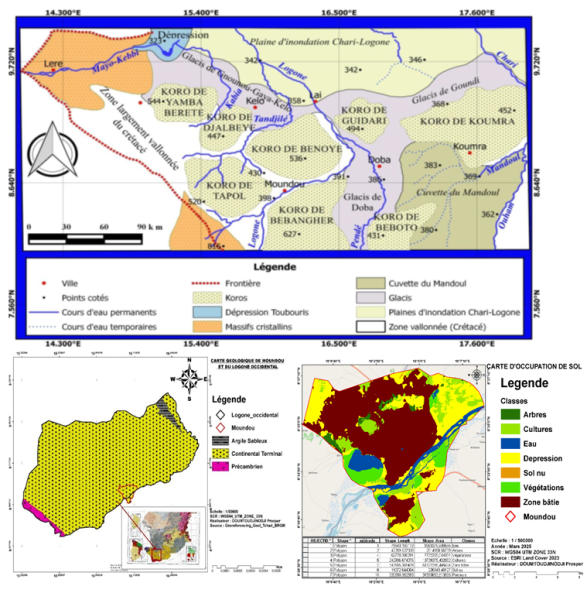
Aquifer recharge is mainly associated with direct infiltration of precipitation, supplemented by exchanges with surface water during high-water periods, a mechanism documented at the scale of the Chari basin. This same hydraulic connectivity that favours recharge also increases the vulnerability of the resource: where wells are shallow and poorly protected, rainwater and runoff can carry microorganisms and dissolved pollutants from latrines, on-site sanitation systems, wastewater and waste dumps to the aquifer (
Figure 1).
3.3. Hydrochemical Groundwater Quality
3.3.1. General Composition and Hydrochemical Facies
The available studies indicate that groundwater in Moundou is generally low to moderately mineralised, with substantial local variability. The main ions studied include calcium, magnesium, sodium, potassium, bicarbonate, chloride and sulphate. The hydrochemical facies reported are mainly of the calcium-magnesium-bicarbonate and sodium-potassium-bicarbonate types, consistent with weak to moderate water-rock interaction. Doumtoudjinodji et al. (2024)
| [4] | P. Doumtoudjinodji, E. Manou Bernadin, J. C. Doumnang Mbaigane, N. Djoueingu’e, U. Agnichola, and A. Socohou Amadou, “Hydrochemical characterisation and assessment of the level of contamination of groundwater collected by private waterworks in the town of Moundou in the south of Chad,” Journal of Geoscience and Environment Protection, vol. 12, no. 1, pp. 13–32, 2024. |
[4]
, working on private waterworks, revealed considerable hydrochemical variability and identified silicate hydrolysis, ion exchange and anthropogenic influences among the main processes controlling the chemical composition. Djimrabaye et al. (2025)
| [6] | D. Morgongarti, L. Andossa, M. Hassan, and T. Lauric, “HYDROCHEMICAL CHARACTERIZATION OF GROUNDWATER IN THE CONTINENTAL TERMINAL AQUIFER OF MOUNDOU AND ITS SURROUNDINGS (SOUTHWEST CHAD),” Int. J. Adv. Res. (Indore)., vol. 13, no. 07, pp. 796–825, Jul. 2025, https://doi.org/10.21474/IJAR01/21389 |
[6]
, on sixty samples collected during two campaigns in December 2023 and March 2024 in the Continental Terminal aquife, for their part reported acidic groundwater resulting from both natural and anthropogenic influences a notable study because, for some of the water points, it combines hydrochemical and bacteriological analyses within a single sampling design.water-rock interactions. Doumtoudjinodji et al. (2024)
| [4] | P. Doumtoudjinodji, E. Manou Bernadin, J. C. Doumnang Mbaigane, N. Djoueingu’e, U. Agnichola, and A. Socohou Amadou, “Hydrochemical characterisation and assessment of the level of contamination of groundwater collected by private waterworks in the town of Moundou in the south of Chad,” Journal of Geoscience and Environment Protection, vol. 12, no. 1, pp. 13–32, 2024. |
[4]
identified silicate hydrolysis, ion exchange, and anthropogenic inputs as key drivers of chemical composition. Djimrabaye et al. (2025)
| [6] | D. Morgongarti, L. Andossa, M. Hassan, and T. Lauric, “HYDROCHEMICAL CHARACTERIZATION OF GROUNDWATER IN THE CONTINENTAL TERMINAL AQUIFER OF MOUNDOU AND ITS SURROUNDINGS (SOUTHWEST CHAD),” Int. J. Adv. Res. (Indore)., vol. 13, no. 07, pp. 796–825, Jul. 2025, https://doi.org/10.21474/IJAR01/21389 |
[6]
sampled 60 water points across the Continental Terminal aquifer, reporting acidic groundwater influenced by both natural weathering and urban pollution.
Figure 1. Geological map and land-use map of the city of Moundou.
3.3.2. Dominant Hydrochemical Processes
Weathering of silicate minerals, present in the sedimentary matrix of the aquifer, contributes sodium, potassium and dissolved silica. This process is particularly relevant in the sedimentary environments of the Continental Terminal and Quaternary formations. Carbonate dissolution contributes to calcium and bicarbonate concentrations, according to the classical reaction: CaCO3 + CO2 + H2O → Ca2+ + 2 HCO3−. Although carbonate minerals are not necessarily the dominant lithological component everywhere in Moundou, this reaction, coupled with soil CO2, contributes to the observed chemical composition. Ion exchange involving clay minerals modifies the relative proportions of calcium, magnesium, sodium and potassium, and may explain some of the differences between calcium-bicarbonate and sodium-bicarbonate waters observed from one water point to another.
Evaporite dissolution and salinisation: Doumtoudjinodji et al. (2025)
| [11] | P. Doumtoudjinodji, “Caractérisation hydrochimique et bactériologique des eaux souterraines captées par les ouvrages d’eau privés de la ville de Moundou au Sud-Ouest du TCHAD,” Université d’Abomey-Calavi, Bénin, 2025. |
[11]
demonstrated an evaporitic component in the Moundou area. Indeed, the dissolution of gypsum (CaSO
4·2H
2O) and CaCl
2 salts, alongside silicate weathering, carbonate dissolution and organic matter decomposition, is among the main processes controlling groundwater quality in Moundou. This dissolution remains moderate and has not, to date, resulted in a generalised degradation of water quality. Comparison with more northerly, more arid and more evaporated aquifers confirms that salinisation is not, at this stage of knowledge, a dominant process in Moundou, which distinguishes the city from arid zones in the strict sense, without ruling out future vulnerability should exploitation of the resource intensify.
3.3.3. Water Quality Indices: WQI, SAR, and RSC
Standardised water quality indices are synthesis tools widely used in arid and semi-arid regions to translate a set of physicochemical parameters into a single quality class that can easily be communicated to managers. The Water Quality Index (WQI), intended for drinking water, generally aggregates pH, electrical conductivity, total dissolved solids and major ions, weighted according to their health significance. The Sodium Adsorption Ratio (SAR) and the Residual Sodium Carbonate (RSC), intended for assessing irrigation suitability, measure respectively the risk of soil sodification, SAR = Na+ / √[(Ca2+ + Mg2+) / 2], with concentrations expressed in milliequivalents per litre, and the excess of carbonates and bicarbonates relative to the available calcium and magnesium, following the reference methods of Richards (1954) and Wilcox (1955).
The WQI and SAR calculated at the scale of the city of Moundou on 62 samples distributed across the city’s 27 neighbourhoods, in the rainy season (August 2022) and the dry season (May 2023), classify these waters as acceptable for consumption from a physicochemical standpoint and suitable for irrigation (Doumtoudjinodji et al., 2026). This situation contrasts with that observed in N’Djamena, where Mfonka et al. (2024) calculated a WQI ranging from 188 to 867 on sixty-six samples collected from twenty-two boreholes, corresponding to “poor” (9%), “very poor” (18%) and “unsuitable” (72%) classes for consumption. A favourable physicochemical WQI, such as that reported for Moundou, provides no guarantee of the bacteriological safety of the water: hydrochemical and microbiological assessments remain complementary and not interchangeable.
3.4. Bacteriological Quality of Groundwater
3.4.1. Indicators of Faecal Contamination
Microbiological quality is a fundamental element of drinking-water safety. Unlike several hydrochemical parameters, the presence of faecal indicator organisms total coliforms, faecal coliforms, Escherichia coli, intestinal enterococci provides direct information on contamination by faecal matter and on potential exposure to enteric pathogens. The World Health Organization recommends a risk-management approach, from the catchment to the consumer, emphasising hazard identification, risk management and continuous surveillance rather than one-off checks.
3.4.2. Available Results for Moundou
Analysis of the microbiological quality of groundwater in Moundou reveals marked sanitary degradation and strong seasonal dynamics. In a reference study conducted by Dionkas et al. (2021)
| [12] | J. Dionkas, A. Ban-bo Bebanto, B. N. R. Ngandolo, M.-O. Kossou, S. Abba, and S. H. Z. Togouet, “Seasonal variation in the physicochemical and bacteriological qualities of well water in two sub-divisions of Moundou city (Southern Chad, Central Africa),” World Journal of Advanced Research and Reviews, vol. 12, no. 2, pp. 332–345, 2021. |
[12]
between May 2019 and July 2020 in two subdivisions of the city, the assessment of total coliforms, faecal coliforms,
Escherichia coli and
Salmonella spp. revealed high contamination rates. In the rainy season, non-compliance rates reached 93% for total and faecal coliforms, while
E. coli and
Salmonella spp. showed non-compliance of 14% and 29%, respectively. In the dry season, degradation increased markedly: non-compliance reached 100% for total coliforms, faecal coliforms and
Salmonella spp., and rose to 71.5% for
E. coli.
These seasonal variations were also supported by the recent work of Doumtoudjinodji et al. (2025)
| [11] | P. Doumtoudjinodji, “Caractérisation hydrochimique et bactériologique des eaux souterraines captées par les ouvrages d’eau privés de la ville de Moundou au Sud-Ouest du TCHAD,” Université d’Abomey-Calavi, Bénin, 2025. |
[11]
, which highlights contrasting behaviours depending on the indicator organism.
Escherichia coli and faecal enterococci recorded higher mean concentrations in the dry season (187 CFU versus 100 CFU in the rainy season for
E. coli, and 2.73 CFU versus 0 CFU for enterococci, respectively). Conversely, total coliforms and total aerobic flora showed a clearly higher bacterial load during the rainy season (reaching 2,366 CFU and 15,023 CFU, respectively, in the rainy season, versus 1,029 CFU and 6,818 CFU in the dry season).
The study by Dionkas et al. (2021)
| [12] | J. Dionkas, A. Ban-bo Bebanto, B. N. R. Ngandolo, M.-O. Kossou, S. Abba, and S. H. Z. Togouet, “Seasonal variation in the physicochemical and bacteriological qualities of well water in two sub-divisions of Moundou city (Southern Chad, Central Africa),” World Journal of Advanced Research and Reviews, vol. 12, no. 2, pp. 332–345, 2021. |
[12]
shows greater contamination in the dry season for several bacteriological indicators, which may be explained by reduced dilution, higher temperature, concentration effects and the persistence of contamination sources around water points. Precipitation may, however, under certain hydrogeological conditions, also increase contamination by promoting runoff and the rapid infiltration of surface pollutants. The relationship between precipitation and microbiological contamination is therefore not linear: it depends on well construction, water-table depth, soil permeability, surrounding sanitation conditions and the recharge timing specific to each site.
3.4.3. Salmonella and Antibiotic Resistance: An Emerging Dimension
The detection of
Salmonella spp. in well water in Moundou is an additional concern. Dionkas et al. (2023)
| [13] | J. Dionkas, B. N. R. Ngandolo, and S. H. Z’ebaz’e Togouet, “Seasonal variation of antibiotic resistance of Salmonella spp. and Escherichia coli strains isolated from well water of Moundou city, Chad (Central Africa),” World Journal of Advanced Research and Reviews, vol. 20, no. 3, pp. 1694–1704, 2023. |
[13]
, using samples collected between May 2019 and July 2020, examined the antibiotic resistance of
Salmonella spp. and
Escherichia coli isolated from well water, and reported substantial resistance to several antibiotics, notably ceftriaxone and ampicillin, with resistance profiles varying according to organism and season. This observation is part of a broader issue of antimicrobial resistance (AMR) in environmental waters in Africa, widely documented in other countries of the continent, where high rates of resistance to ampicillin and other first-line antibiotics are commonly reported in untreated drinking water in low- and middle-income countries. Contaminated groundwater may thus not only act as a vector for enteric microorganisms but also contribute to the environmental dissemination of resistance genes, although current data do not allow the specific contribution of this pathway to the resistance observed in clinical settings in Moundou to be estimated.
3.5. Sources and Pathways of Contamination
The available data suggest that groundwater contamination in Moundou results from several sources that may interact with one another:
1) Poorly designed or poorly maintained latrines and on-site sanitation systems, which allow the infiltration of faecal microorganisms and dissolved nitrogen compounds, with an increased risk when these facilities are close to shallow wells;
2) Untreated domestic wastewater, discharged onto the ground surface and infiltrating permeable soils, in the absence of adequate drainage and treatment networks;
3) Solid waste accumulated around water points, a local source of microorganisms and, through rainfall and decomposition, of dissolved pollutants;
4) Surface runoff during rainy periods, which may enter poorly protected wells directly or infiltrate through permeable soils;
5) Deficient construction and maintenance of wells, open or poorly protected structures being particularly vulnerable to surface inputs.
This configuration echoes the findings established for urban sub-Saharan Africa by Lapworth et al. (2017)
| [2] | D. J. Lapworth, J. Okotto-Okotto, S. Pedley, M. E. Stuart, M. N. Tijani, and J. A. Wright, “Urban groundwater quality in sub-Saharan Africa: Current status and implications for water security and public health,” Hydrogeol. J., vol. 25, no. 4, pp. 1093–1116, 2017, https://doi.org/10.1007/s10040-016-1516-6 |
[2]
, who associate the vulnerability of shallow aquifers with the proximity of pit latrines, inadequate waste management and poor wellhead protection, with nitrate and chloride as the most widely used indicators of anthropogenic pollution in studies of the region.
3.6. Combined Risk Factors and Population Vulnerability
The combination of a shallow water table, permeable sandy formations and inadequate on-site sanitation places a significant proportion of private wells in Moundou in a situation of structural vulnerability. This vulnerability translates into a direct health risk for users, particularly children under five, who are more exposed to waterborne diarrhoeal diseases, and low-income households, which often depend on private wells for lack of a safe and affordable alternative. The absence of alternative supply sources forces many households to continue using water whose bacteriological non-compliance is nonetheless documented, illustrating the tension between resource availability and health safety that is typical of situations described for other rapidly growing West African cities.
Integrated assessment of hydrochemical and bacteriological quality is, in this respect, a major contribution of the recent literature: hydrochemistry identifies mineralisation processes and possible diffuse anthropogenic inputs; microbiology provides direct evidence of faecal contamination and potential exposure to pathogens; sanitary inspection identifies local contamination sources; and hydrogeology, finally, explains the pathways by which contaminants are transferred to the aquifer. An integrated monitoring programme should therefore jointly include pH, electrical conductivity, total dissolved solids, major ions, nitrates, ammonium and iron, on the one hand, and total coliforms, faecal coliforms, Escherichia coli and, where relevant, intestinal enterococci and certain pathogenic microorganisms, on the other.
3.7. Temporal Trends
1990-2000. No study specifically devoted to groundwater quality in Moundou was identified for this period in the corpus assembled. Knowledge available for Chad at that time consists essentially of geological and hydrogeological mapping work at the national scale, which sets the regional geological framework without specifically addressing water quality in Moundou.
2000-2010. This decade is also poorly documented for Moundou in the literature reviewed. At the scale of the Lake Chad basin, doctoral work on the neighbouring Chari-Baguirmi aquifer system (N’Djamena area) laid the methodological foundations (hydrochemical characterisation, recharge estimation by chemical and isotopic methods) that would later be used for regional comparisons, but without data specific to Moundou.
2010-2020. This period marks the starting point of work specifically devoted to Moundou, with the hydrodynamic and hydrochemical characterisation by Bandé (2016)
| [14] | F. Bandé, “Caractérisation hydrodynamique et hydrochimique des eaux souterraines en contexte urbain : cas de la ville de Moundou (Sud-ouest du Tchad),” University of Ngaoundéré, 2016. |
[14]
, which establishes the basis of the local hydrogeological context. In parallel, at the basin scale, studies on the recharge and hydrological functioning of the Chari-Logone system
| [15] | A. M. Nour, C. Vallet‐Coulomb, J. Gonçalves, F. Sylvestre, and P. Deschamps, “Rainfall-discharge relationship and water balance over the past 60 years within the Chari-Logone sub-basins, Lake Chad basin,” J. Hydrol. Reg. Stud., vol. 35, p. 100824, 2021. |
[15]
, based on earlier field data) confirm the importance of surface water-groundwater interactions for the recharge of the region’s shallow aquifers. The very end of this decade also saw the launch, in May 2019, of the most comprehensive bacteriological sampling campaign available to date for Moundou
| [12] | J. Dionkas, A. Ban-bo Bebanto, B. N. R. Ngandolo, M.-O. Kossou, S. Abba, and S. H. Z. Togouet, “Seasonal variation in the physicochemical and bacteriological qualities of well water in two sub-divisions of Moundou city (Southern Chad, Central Africa),” World Journal of Advanced Research and Reviews, vol. 12, no. 2, pp. 332–345, 2021. |
[12]
.
2020-2026. This period accounts for most of the recent scientific output on Moundou: the results of the 2019-2020 campaign were published and elaborated by Dionkas et al. (2021, 2022, 2023)
| [10] | J. Dionkas, “Impact de la pression anthropique sur la qualité faunique et bactériologique des eaux souterraines de la ville de Moundou (Tchad) et risques sanitaires,” University of Yaoundé I, 2022. |
| [12] | J. Dionkas, A. Ban-bo Bebanto, B. N. R. Ngandolo, M.-O. Kossou, S. Abba, and S. H. Z. Togouet, “Seasonal variation in the physicochemical and bacteriological qualities of well water in two sub-divisions of Moundou city (Southern Chad, Central Africa),” World Journal of Advanced Research and Reviews, vol. 12, no. 2, pp. 332–345, 2021. |
| [13] | J. Dionkas, B. N. R. Ngandolo, and S. H. Z’ebaz’e Togouet, “Seasonal variation of antibiotic resistance of Salmonella spp. and Escherichia coli strains isolated from well water of Moundou city, Chad (Central Africa),” World Journal of Advanced Research and Reviews, vol. 20, no. 3, pp. 1694–1704, 2023. |
[10, 12, 13]
, who successively document seasonal bacteriological contamination, the relationship between anthropogenic pressure and water quality, and then the antibiotic resistance of the isolated strains. Doumtoudjinodji et al. (2024)
| [4] | P. Doumtoudjinodji, E. Manou Bernadin, J. C. Doumnang Mbaigane, N. Djoueingu’e, U. Agnichola, and A. Socohou Amadou, “Hydrochemical characterisation and assessment of the level of contamination of groundwater collected by private waterworks in the town of Moundou in the south of Chad,” Journal of Geoscience and Environment Protection, vol. 12, no. 1, pp. 13–32, 2024. |
[4]
provide a detailed hydrochemical characterisation of private waterworks, and Djimrabaye et al. (2025)
| [6] | D. Morgongarti, L. Andossa, M. Hassan, and T. Lauric, “HYDROCHEMICAL CHARACTERIZATION OF GROUNDWATER IN THE CONTINENTAL TERMINAL AQUIFER OF MOUNDOU AND ITS SURROUNDINGS (SOUTHWEST CHAD),” Int. J. Adv. Res. (Indore)., vol. 13, no. 07, pp. 796–825, Jul. 2025, https://doi.org/10.21474/IJAR01/21389 |
[6]
publish the first study combining, at least partially, hydrochemistry and bacteriology on the Continental Terminal aquifer. Doumtoudjinodji et al. (2026)
| [11] | P. Doumtoudjinodji, “Caractérisation hydrochimique et bactériologique des eaux souterraines captées par les ouvrages d’eau privés de la ville de Moundou au Sud-Ouest du TCHAD,” Université d’Abomey-Calavi, Bénin, 2025. |
[11]
complete this picture by producing the first spatio-temporal assessment of the WQI and SAR at the scale of the entire city, on 62 samples distributed across the 27 neighbourhoods of Moundou and two contrasting seasons (August 2022 and May 2023), identifying the dissolution of gypsum and CaCl
2 salts, alongside silicates, carbonates and organic matter, among the processes dominating water chemistry. This period also saw the publication of a comparable study for N’Djamena
| [16] | Z. Mfonka et al., “Groundwater quality assessment for drinking and agricultural purposes under arid climate in N’Djamena, Chad (Central Africa),” International Journal of Energy and Water Resources, vol. 9, pp. 447–470, 2024. |
[16]
, which introduced the WQI in the region for the first time from an integrated management perspective.
Degradation, stabilisation or improvement? In the absence of a continuous series of measurements on the same network of water points, it is not possible to state with certainty whether groundwater quality in Moundou has deteriorated, stabilised or improved over recent decades. The apparent increase in the number of documented contaminations since 2019 largely reflects an intensification of monitoring effort and the introduction of parameters not previously measured (Salmonella, antibiotic resistance), rather than a demonstrated and measured degradation of the resource. What the data do allow us to conclude, however, is the persistence of a high and recurrent bacteriological risk from one season to the next since the beginning of monitoring, accompanied by a new and growing concern related to antimicrobial resistance since 2023. This lack of historical perspective is in itself one of the major gaps identified by this review (section 4.3).
3.8. Comparative Synthesis of Previous Studies on Moundou
This comparison shows that hydrochemical and bacteriological studies are complementary rather than contradictory: the former emphasise natural mineralisation processes, whereas the latter reveal the vulnerability created by urban sanitation conditions and the shallow depth of the aquifers. The apparent difference between results is therefore explained mainly by different objectives and sampling strategies, rather than by a fundamental contradiction.
Table 1. Main studies on groundwater quality in Moundou.
Study | Period / design | Main parameters | Main results | Contribution |
Bandé (2016) | Moundou; hydrogeological and hydrochemical study | Hydrogeology, hydrochemistry | Characteristics of shallow groundwater and its hydrochemistry | Basis of the hydrogeological context |
Dionkas et al. (2021) | 2019-2020; wells, two subdivisions | Physicochemistry + total coliforms, faecal coliforms, E. coli, Salmonella | High microbiological contamination and marked seasonal variability | Demonstration of bacteriological vulnerability |
Dionkas (2022) | Four seasonal campaigns; 50 wells | Anthropogenic pressure, bacteriology, health risks | Strong relationship between urban pressure and groundwater quality | Integrated risk assessment |
Dionkas et al. (2023) | 2019-2020, same samples | E. coli, Salmonella, antibiotic susceptibility | Detection of resistant strains in well water | Antimicrobial resistance dimension |
Doumtoudjinodji et al. (2024) | Moundou; private waterworks | Major ions, pH, conductivity, etc. | Hydrochemical heterogeneity; natural and anthropogenic influences | Perspective on private waterworks |
Djimrabaye et al. (2025) | Dec. 2023 and Mar. 2024; 60 samples | Physicochemistry + bacteriology | Acidic groundwater; natural and anthropogenic influences | First recent integrated approach |
Doumtoudjinodji et al. (2025) | Aug. 2022 (rainy season) and May 2023 (dry season); 62 samples, 27 neighbourhoods | Physicochemistry, microbiology, multivariate analysis, WQI, SAR, suitability as concrete-mixing water, aggressiveness | 89% of sites acceptable (WQI); dissolution of gypsum and CaCl2 among the dominant processes; pH, iron and ammonium non-compliant with WHO guidelines; water better suited to irrigation, aggressive | First complete physicochemical and microbiological characterisation at the scale of the entire city |
4. Discussion
4.1. Moundou Compared with Other Urban Aquifers in Arid and Semi-arid Zones
The situation in Moundou is part of a more general trend observed in rapidly urbanising African cities. The synthesis work of Lapworth et al. (2017)
| [2] | D. J. Lapworth, J. Okotto-Okotto, S. Pedley, M. E. Stuart, M. N. Tijani, and J. A. Wright, “Urban groundwater quality in sub-Saharan Africa: Current status and implications for water security and public health,” Hydrogeol. J., vol. 25, no. 4, pp. 1093–1116, 2017, https://doi.org/10.1007/s10040-016-1516-6 |
[2]
shows that shallow urban groundwater in sub-Saharan Africa is frequently affected by microbiological and chemical contamination, particularly where waste management and the protection of water points remain inadequate, with nitrate as the most widely used indicator of anthropogenic pollution in the studies reviewed at continental scale. The most direct comparison is with N’Djamena, the capital of Chad, also located in the Lake Chad basin but under a more arid Sahelo-Saharan climate. Mfonka et al. (2024)
| [16] | Z. Mfonka et al., “Groundwater quality assessment for drinking and agricultural purposes under arid climate in N’Djamena, Chad (Central Africa),” International Journal of Energy and Water Resources, vol. 9, pp. 447–470, 2024. |
[16]
report there a hydrochemical facies almost identical to that of Moundou calcium-magnesium-bicarbonate type, associated with the Quaternary aquifer and likewise low to moderate mineralisation (conductivity of 92 to 590 microsiemens per centimetre). The major difference lies in bacteriological quality: in N’Djamena, poor water quality, measured by a WQI reaching the “unsuitable” class for 72% of samples, is directly attributed to the presence of bacterial species rather than to an excess of major ions a finding that echoes, almost term for term, the bacteriological situation documented in Moundou.
The comparison with West African coastal and sedimentary aquifers, in Cotonou (Benin) and Ibadan (Nigeria), reveals structural similarities: in both cases, shallow unconfined aquifers are degraded by the proximity of septic tanks and latrines, with markedly higher electrical conductivity in shallow wells located in the immediate vicinity of sanitation facilities than in deeper boreholes. In Cotonou, Houéménou et al. (2020)
| [17] | H. Houéménou et al., “Degradation of groundwater quality in expanding cities in West Africa. A case study of the unregulated shallow aquifer in Cotonou,” J. Hydrol. (Amst)., vol. 582, p. 124438, 2020. |
[17]
further show that the vulnerability of the shallow aquifer results from the combination of salinisation, related to proximity to the coast and to brackish water bodies, and contamination by wastewater and septic tanks, with a risk that varies with the seasons and with the position of neighbourhoods in the recharge or discharge zone of the aquifer. This dual saline and sanitary pressure has no documented equivalent in Moundou, where contamination remains, in the current state of knowledge, almost exclusively of sanitary rather than saline origin.
Finally, comparison with strictly arid aquifers (Ksour Mountains in Algeria, the Ewaso Ng’iro-Lagh Dera basin in Kenya, the Aksum basin in Ethiopia) confirms that Moundou occupies an intermediate position: its more humid climate and its position within the Chari-Logone system protect it, for the time being, from the salinisation and saline intrusion processes that dominate in more arid or coastal aquifers. A moderate contribution from the dissolution of gypsum and CaCl
2 salts has nevertheless been demonstrated locally by Doumtoudjinodji et al. (2025)
| [11] | P. Doumtoudjinodji, “Caractérisation hydrochimique et bactériologique des eaux souterraines captées par les ouvrages d’eau privés de la ville de Moundou au Sud-Ouest du TCHAD,” Université d’Abomey-Calavi, Bénin, 2025. |
[11]
, although it has not resulted to date in a generalised degradation of water quality. At the same time, rapid urban growth and still largely on-site sanitation bring Moundou closer to the bacteriological vulnerability described for secondary cities throughout sub-Saharan Africa. This specificity indicates that management strategies developed for more arid aquifers, focused on salinity and irrigation, cannot be transposed as such to Moundou, where the management priority remains resolutely sanitary and microbiological.
4.2. Methodological Limitations of the Studies Reviewed
The data available on Moundou are heterogeneous: some studies focus mainly on hydrochemistry, others on bacteriological contamination or health risks, rarely on both simultaneously. Sampling campaigns also differ in duration, number of water points covered, analytical methods used and parameters measured, which limits the possibility of strict statistical comparison between studies. Field protocols (exact depth of structures, distance to pollution sources, sample preservation conditions before bacteriological analysis) are not always documented at the same level of detail, which complicates the interpretation of differences observed between studies. Finally, most campaigns rely on a limited number of water points and on one or a few one-off campaigns, rather than on a permanent monitoring network, which restricts the spatial and temporal representativeness of the available results.
4.3. Identified Research Gaps
Insufficient integrated data: Most studies address either hydrochemistry or bacteriology. Few works simultaneously measure major ions, nutrients, metals, bacteriological indicators, piezometric levels and sanitary conditions at the same sampling points. Djimrabaye et al. (2025)
| [6] | D. Morgongarti, L. Andossa, M. Hassan, and T. Lauric, “HYDROCHEMICAL CHARACTERIZATION OF GROUNDWATER IN THE CONTINENTAL TERMINAL AQUIFER OF MOUNDOU AND ITS SURROUNDINGS (SOUTHWEST CHAD),” Int. J. Adv. Res. (Indore)., vol. 13, no. 07, pp. 796–825, Jul. 2025, https://doi.org/10.21474/IJAR01/21389 |
[6]
and Doumtoudjinodji et al. (2025)
| [11] | P. Doumtoudjinodji, “Caractérisation hydrochimique et bactériologique des eaux souterraines captées par les ouvrages d’eau privés de la ville de Moundou au Sud-Ouest du TCHAD,” Université d’Abomey-Calavi, Bénin, 2025. |
[11]
are, to date, the most accomplished examples of this integration in Moundou, but with a limited number of bacteriological samples (twenty of the 62 samples, respectively).
Limited long-term monitoring: The available studies generally cover one or a few one-off campaigns rather than continuous monitoring over several years. It is consequently difficult to distinguish normal seasonal variations from longer-term underlying trends, and hence to answer with certainty the question of a possible degradation of the resource (see section 3.7).
Incomplete attribution of contamination sources: The relative contributions of latrines, septic tanks, wastewater, agricultural activities, livestock and solid waste have not yet been established quantitatively in Moundou, for lack of tracing studies (isotopic, microbiological or based on distance to sources) comparable to those conducted in Cotonou or in other sub-Saharan African cities.
Limited spatial assessment of vulnerability: An assessment based on geographic information systems, integrating water-table depth, soil permeability, land use, sanitation infrastructure and well location, would make it possible to better identify the most vulnerable areas and to improve the planning of groundwater protection an approach already implemented in N’Djamena but not yet in Moundou.
Lack of quantitative health risk assessment: The available studies demonstrate the existence of microbiological contamination but do not yet provide a quantitative estimate of the probability of infection or of the disease burden specifically attributable to groundwater consumption, a gap that a quantitative microbial risk assessment (QMRA) approach would make it possible to address.
Emerging concern related to antimicrobial resistance: The detection of antibiotic-resistant Escherichia coli and Salmonella in well water in Moundou calls for further investigation, in particular to determine whether the resistant microorganisms are spatially associated with wastewater, livestock activities, health facilities or other specific anthropogenic sources.
4.4. Implications for Water Resource Management and Public Health
The available data indicate that groundwater management in Moundou should shift from an approach mainly centred on resource exploitation to an integrated approach to water safety management, in line with the risk-based management framework promoted by the World Health Organization, from the catchment to the consumer. This shift is consistent with the recommendations made for all rapidly growing African cities dependent on shallow groundwater, and is in keeping with the Sustainable Development Goal targets on access to safely managed drinking water.
5. Conclusion and Perspectives
5.1. Synthesis
Groundwater is a strategic resource for Moundou, whose quality is controlled by the combination of natural hydrogeological processes and growing anthropogenic pressures. The available data indicate that this water is generally low to moderately mineralised and has bicarbonate-rich hydrochemical facies, shaped by silicate weathering, water-rock interactions and ion exchange, with no evidence to date of significant evaporite dissolution or saline intrusion which distinguishes Moundou from the more arid or coastal aquifers of the region. At the same time, shallow groundwater remains vulnerable to contamination, as permeable formations and seasonal recharge facilitate the transfer of pollutants from the surface. Bacteriological data constitute the main public health concern. Studies conducted in Moundou have consistently detected total and faecal coliforms, Escherichia coli and Salmonella spp., with substantial seasonal variability, while recent work has revealed bacterial strains resistant to certain antibiotics. Comparison with other Sahelian and West African urban aquifers confirms that this microbiological vulnerability is not specific to Moundou but is part of a broader regional pattern associated with inadequate on-site sanitation and the shallow depth of the aquifers exploited, while underscoring Moundou’s climatic specificity, which for now limits the salinisation risks observed elsewhere in the Lake Chad basin.
Groundwater quality in Moundou can be properly understood only through a joint reading of hydrochemistry, bacteriology and hydrogeology. The city’s groundwater, chemically reassuring on the whole, carries a very real and poorly quantified health risk, driven by on-site sanitation and the shallow depth of the aquifers exploited. Filling the gaps identified in this review systematic coupling of data, standardised quality indices, long-term monitoring, mapping of contamination sources, quantitative risk assessment is a necessary condition for turning a currently vulnerable resource into a reliable and sustainable pillar of the city’s drinking-water supply.
5.2. Recommendations for Future Research
1) Consider, once the local corpus is sufficiently developed, a full systematic review in accordance with the PRISMA 2020 statement, with formalised search equations, a quantitative account of the selection process and, if the data allow, a statistical synthesis of the results; the present narrative review may serve as its starting point;
2) Implement campaigns that simultaneously integrate hydrochemistry, bacteriology, piezometric levels and sanitary inspection at the same water points, in order to move beyond the current juxtaposition of thematically separate studies;
3) Calculate and map standardised quality indices (WQI for drinking water, SAR and RSC for irrigation) specifically for Moundou, to facilitate comparison with other cities of the Lake Chad basin and West Africa;
4) Develop permanent seasonal monitoring on a fixed network of water points, the only way to distinguish seasonal variations from medium- and long-term underlying trends;
5) Deepen the study of antimicrobial resistance in groundwater and its potential sources (wastewater, livestock, health facilities), drawing on spatial tracing methods;
6) Use isotopic techniques and hydrogeological modelling to clarify transit times and the pathways by which contaminants are transferred to the aquifer;
7) Conduct a quantitative microbial risk assessment (QMRA) in order to translate contamination data into disease-burden indicators directly useful for public health.





 Share This Article
 Twitter
 Linked In
 Facebook

 Copy
 Download