
The influence of precursor solution volume on the characteristics of containing iron-doped titanium dioxide (Fe:TiO2) thin films was examined in this work. The coatings were prepared on transparent substrates by the spin-coating method using precursor volumes between 0.5 and 2.5 mL. Following deposition, the coatings were heat treated at 450°C and analyzed using X-ray diffraction (XRD), Fourier transform infrared (FTIR) spectroscopy, and ultraviolet-visible (UV-Vis) spectroscopy. XRD analysis revealed the presence of both rutile and anatase crystalline phases, evidenced by reflections near 27.4° and 49° corresponding to the (110) and (200) planes, respectively. Variations in precursor volume affected the crystallographic properties of the films, with the sample prepared using 1.0 mL exhibiting the largest crystallite size and sharper diffraction peaks, suggesting improved crystal growth. Increasing the precursor volume beyond this value resulted in peak broadening, which may be associated with greater lattice imperfections and strain within the films. The FTIR results identified characteristic vibrational bands assigned to Ti-O-Ti and Ti-O-Fe linkages, confirming the incorporation of iron species into the TiO2 network. Optical characterization showed that increasing precursor volume shifted the absorption threshold toward longer wavelengths and reduced the optical band gap. This behavior can be ascribed to the creation of defect-induced energy states and oxygen-vacancy states within the material. Overall, the findings demonstrate that precursor solution volume significantly affects both the crystallographic and photonic performance of Fe:TiO2 coatings, with the 1.0 mL sample providing the most favorable combination of crystallinity and film quality.
| Published in | Advances in Materials (Volume 15, Issue 3) |
| DOI | 10.11648/j.am.20261503.12 |
| Page(s) | 91-98 |
| Creative Commons |
This is an Open Access article, distributed under the terms of the Creative Commons Attribution 4.0 International License (http://creativecommons.org/licenses/by/4.0/), which permits unrestricted use, distribution and reproduction in any medium or format, provided the original work is properly cited. |
| Copyright |
Copyright © The Author(s), 2026. Published by Science Publishing Group |
Fe:TiO2 Thin Films, Spin Coating, Precursor Solution Volume, Anatase-rutile Phases, Thin Film Deposition
Sample (mL) | Plane (hkl) | 2θ (°) | FWHM (°) | Crystallite size (nm) | dhkl (Å) | Lattice parameter a (Å) |
|---|---|---|---|---|---|---|
0.5 | 110 | 27.79 | 2.101 | 3.893 | 3.208 | 4.537 |
1.0 | 110 | 27.73 | 1.992 | 4.107 | 3.214 | 4.545 |
200 | 49.60 | 2.078 | 4.211 | 1.836 | 3.672 | |
1.5 | 110 | 27.71 | 1.997 | 4.097 | 3.216 | 4.548 |
2.0 | 110 | 27.70 | 2.031 | 4.028 | 3.218 | 4.550 |
2.5 | 110 | 27.55 | 2.091 | 3.911 | 3.235 | 4.575 |
DEA | Diethanolamine |
Fe | Iron |
TiO2 | Titanium Dioxide |
UV | Ultra Violet |
Fe:TiO2 | Iron Doped Titanium Dioxide |
FTIR | Fourier Transform Infrared Spectroscopy |
UV-Vis | Ultraviolet-Visible Spectroscopy |
XRD | X-ray Diffraction |
FWHM | Full Width at Half Maximum |
JCPDS | Joint Committee on Powder Diffraction Standards |
| [1] | K. S. Swathi and K. Gopalakrishna Naik, “Structural, morphological, and optical studies of sol-gel spin coated TiO2 thin films,” Materials Today: Proceedings, vol. 92, pp. 1149-1153, Jan. 2023, |
| [2] | A. M. Youssef and S. M. Yakout, “Mono, dual and tri-doped TiO2: Sunlight photocatalytic, room temperature ferromagnetic and dielectric constant properties,” Materials Chemistry and Physics, vol. 282, p. 125978, Apr. 2022, |
| [3] | A. Seifi, D. Salari, A. Khataee, B. Çoşut, L. Ç. Arslan, and A. Niaei, “Enhanced photocatalytic activity of highly transparent superhydrophilic doped TiO2 thin films for improving the self-cleaning property of solar panel covers,” Ceramics International, vol. 49, no. 2, pp. 1678-1689, Jan. 2023, |
| [4] | S. Ghosh, S. Saha, A. A. Moyeen, A. A. Mahmood, and M. B. Islam, “Tailoring the structural and optical properties of TiO2 thin films: A study of undoped, N-doped, and Fe-doped variants via sol-gel spin coating,” Next Materials, vol. 8, p. 100757, Jul. 2025, |
| [5] | E. Radha, D. Komaraiah, R. Sayanna, and J. Sivakumar, “Photoluminescence and photocatalytic activity of rare earth ions doped anatase TiO2 thin films,” Journal of Luminescence, vol. 244, p. 118727, Apr. 2022, |
| [6] | T. C. Paul, M. H. Babu, J. Podder, B. C. Dev, S. K. Sen, and S. Islam, “Influence of Fe3+ ions doping on TiO2 thin films: Defect generation, d-d transition and band gap tuning for optoelectronic device applications,” Physica B: Condensed Matter, vol. 604, p. 412618, Mar. 2021, |
| [7] | J. Chen, L. Liu, L. Zheng, M. Liu, Y. Gao, and K. Zhao, “Structural and optical properties of Fe@C doped TiO2 thin films prepared by sol-gel method,” Inorganic Chemistry Communications, vol. 153, p. 110776, Jul. 2023, |
| [8] | J. Aljuaid, A. Timoumi, and S. N. Alamri, “Investigation of the impact of iron amounts on optical and physical properties of coated TiO2 thin films used for PV solar cells,” Optical Materials: X, vol. 16, p. 100178, Oct. 2022, |
| [9] | H.-J. Lin, T.-S. Yang, C.-S. Hsi, M.-C. Wang, and K.-C. Lee, “Optical and photocatalytic properties of Fe3+-doped TiO2 thin films prepared by a sol-gel spin coating,” Ceramics International, vol. 40, no. 7, Part B, pp. 10633-10640, Aug. 2014, |
| [10] | N. Sharma and R. Kumar, “Effect of spin speed on the properties of TiO2 thin films,” Materials Today: Proceedings, vol. 62, pp. 6615-6618, Jan. 2022, |
| [11] | N. E. Djehiche et al., “Sol-gel synthesis and spin-coating Nb-doped TiO2 anatase thin films,” J Sol-Gel Sci Technol, vol. 117, no. 3, p. 79, Mar. 2026, |
| [12] | E. Radha, D. Komaraiah, R. Sayanna, and J. Sivakumar, “Influence of dysprosium ions on structural, optical, luminescence properties and photocatalytic ability of spin coated dysprosium ions doped TiO2 thin films,” Thin Solid Films, vol. 761, p. 139519, Nov. 2022, |
| [13] | X. Dong, M. Mamat, Y. Baikeli, G. Liu, and F. Xiaerding, “Effect of Fe doping on crystalline phase, structure and photocatalytic properties of TiO2 thin films,” Optical Materials, vol. 150, p. 115196, Apr. 2024, |
| [14] | T. Chandra Paul, J. Podder, and L. Paik, “Effect of Fe doping on the microstructure, optical and dispersion energy characteristics 10 of TiO2 thin films prepared via spray pyrolysis technique,” Results in Optics, vol. 8, p. 100235, Aug. 2022, |
| [15] | A. M. Oviedo, H. Truong Thi, Q. C. Van, and H. H. Nguyen, “Physicochemical properties of Fe-doped TiO2 and the application in Dye-sensitized solar cells,” Optical Materials, vol. 137, p. 113587, Mar. 2023, |
| [16] | M. Wang, S. Yuan, B. Lv, and H. Yang, “Electrochemical Synthesis of Mg-doped ZnO Nanotapers as Photocatalyst for Degradation of Bisphenol under Solar Light Irradiation,” International Journal of Electrochemical Science, vol. 16, no. 2, p. 210248, Feb. 2021, |
| [17] | K. Albaidani, A. Timoumi, W. Belhadj, S. N. Alamri, and S. A. Ahmed, “Structural, electronic and optical characteristics of TiO2 and Cu-TiO2 thin films produced by sol-gel spin coating,” Ceramics International, vol. 49, no. 22, Part B, pp. 36265-36275, Nov. 2023, |
| [18] | S. Ruzgar and S. A. Pehlivanoglu, “The effect of Fe dopant on structural, optical properties of TiO2 thin films and electrical performance of TiO2 based photodiode,” Superlattices and Microstructures, vol. 145, p. 106636, Sep. 2020, |
| [19] | T. G. de Oliveira et al., “A comprehensive study of structural, optical, and magnetic Properties of Co and Fe-doped TiO2 prepared by different sol-gel routes,” J Sol-Gel Sci Technol, vol. 116, no. 3, pp. 2670-2691, Dec. 2025, |
| [20] | N. H. S. Nasralla, M. Yeganeh, Y. Astuti, S. Piticharoenphun, and L. Šiller, “Systematic study of electronic properties of Fe-doped TiO2 nanoparticles by X-ray photoemission spectroscopy,” J Mater Sci: Mater Electron, vol. 29, no. 20, pp. 17956-17966, Oct. 2018, |
| [21] | R. Varasada, D. Jadav, M. Trasadiya, P. Patel, A. Vora, and S. Vyas, “Investigation of structural, optical and dielectric properties of the zinc oxide thin films,” Next Nanotechnology, vol. 9, p. 100523, Jun. 2026, |
| [22] | P. Phyu Cho, P. Phyu Mon, M. Kumar, S. Dobhal, and S. Challapalli, “Improving photocatalytic efficiency through Cu substitution in TiO2 /g-C 3 N 4 heterojunction nanocomposites for wastewater remediation,” Environmental Science: Advances, vol. 4, no. 9, pp. 1488-1500, 2025, |
| [23] | X. Shi, X. Yu, C. Nie, F. Li, and S. Zhang, “Controlled growth of nanocrystalline aluminum nitride films for full color range,” Ceramics International, vol. 47, no. 15, pp. 21546-21553, Aug. 2021, |
| [24] | Z.-Y. Deng, P.-C. Chiang, K.-L. Chen, J.-H. Chen, and C.-H. Wu, “Highly sensitive and rapid responding humidity sensors based on silver catalyzed Ag2S–TiO2 quantum dots prepared by SILAR,” RSC Adv., vol. 11, no. 17, pp. 10285–10290, Mar. 2021, |
| [25] | P. Londhe, N. B. Chaure, and A. Athawale, “TiO2 thin films derived by facile sol-gel method: Influence of spin rate and Al-doping on the optical and electronic properties,” Materials Today Communications, vol. 29, p. 102924, Dec. 2021, |
APA Style
Sharon, C., Njagi, J., Ungula, J., Kiprotich, S. (2026). Effect of Precursor Solution Volume on Structural and Optical Properties of Iron Doped Titanium Dioxide Thin Films Prepared by Spin Coating. Advances in Materials, 15(3), 91-98. https://doi.org/10.11648/j.am.20261503.12
ACS Style
Sharon, C.; Njagi, J.; Ungula, J.; Kiprotich, S. Effect of Precursor Solution Volume on Structural and Optical Properties of Iron Doped Titanium Dioxide Thin Films Prepared by Spin Coating. Adv. Mater. 2026, 15(3), 91-98. doi: 10.11648/j.am.20261503.12
@article{10.11648/j.am.20261503.12,
  author = {Chemutai Sharon and John Njagi and Jatani Ungula and Sharon Kiprotich},
  title = {Effect of Precursor Solution Volume on Structural and Optical Properties of Iron Doped Titanium Dioxide Thin Films Prepared by Spin Coating},
  journal = {Advances in Materials},
  volume = {15},
  number = {3},
  pages = {91-98},
  doi = {10.11648/j.am.20261503.12},
  url = {https://doi.org/10.11648/j.am.20261503.12},
  eprint = {https://article.sciencepublishinggroup.com/pdf/10.11648.j.am.20261503.12},
  abstract = {The influence of precursor solution volume on the characteristics of containing iron-doped titanium dioxide (Fe:TiO2) thin films was examined in this work. The coatings were prepared on transparent substrates by the spin-coating method using precursor volumes between 0.5 and 2.5 mL. Following deposition, the coatings were heat treated at 450°C and analyzed using X-ray diffraction (XRD), Fourier transform infrared (FTIR) spectroscopy, and ultraviolet-visible (UV-Vis) spectroscopy. XRD analysis revealed the presence of both rutile and anatase crystalline phases, evidenced by reflections near 27.4° and 49° corresponding to the (110) and (200) planes, respectively. Variations in precursor volume affected the crystallographic properties of the films, with the sample prepared using 1.0 mL exhibiting the largest crystallite size and sharper diffraction peaks, suggesting improved crystal growth. Increasing the precursor volume beyond this value resulted in peak broadening, which may be associated with greater lattice imperfections and strain within the films. The FTIR results identified characteristic vibrational bands assigned to Ti-O-Ti and Ti-O-Fe linkages, confirming the incorporation of iron species into the TiO2 network. Optical characterization showed that increasing precursor volume shifted the absorption threshold toward longer wavelengths and reduced the optical band gap. This behavior can be ascribed to the creation of defect-induced energy states and oxygen-vacancy states within the material. Overall, the findings demonstrate that precursor solution volume significantly affects both the crystallographic and photonic performance of Fe:TiO2 coatings, with the 1.0 mL sample providing the most favorable combination of crystallinity and film quality.},
 year = {2026}
}
TY  - JOUR
T1  - Effect of Precursor Solution Volume on Structural and Optical Properties of Iron Doped Titanium Dioxide Thin Films Prepared by Spin Coating
AU  - Chemutai Sharon
AU  - John Njagi
AU  - Jatani Ungula
AU  - Sharon Kiprotich
Y1  - 2026/07/22
PY  - 2026
N1  - https://doi.org/10.11648/j.am.20261503.12
DO  - 10.11648/j.am.20261503.12
T2  - Advances in Materials
JF  - Advances in Materials
JO  - Advances in Materials
SP  - 91
EP  - 98
PB  - Science Publishing Group
SN  - 2327-252X
UR  - https://doi.org/10.11648/j.am.20261503.12
AB  - The influence of precursor solution volume on the characteristics of containing iron-doped titanium dioxide (Fe:TiO2) thin films was examined in this work. The coatings were prepared on transparent substrates by the spin-coating method using precursor volumes between 0.5 and 2.5 mL. Following deposition, the coatings were heat treated at 450°C and analyzed using X-ray diffraction (XRD), Fourier transform infrared (FTIR) spectroscopy, and ultraviolet-visible (UV-Vis) spectroscopy. XRD analysis revealed the presence of both rutile and anatase crystalline phases, evidenced by reflections near 27.4° and 49° corresponding to the (110) and (200) planes, respectively. Variations in precursor volume affected the crystallographic properties of the films, with the sample prepared using 1.0 mL exhibiting the largest crystallite size and sharper diffraction peaks, suggesting improved crystal growth. Increasing the precursor volume beyond this value resulted in peak broadening, which may be associated with greater lattice imperfections and strain within the films. The FTIR results identified characteristic vibrational bands assigned to Ti-O-Ti and Ti-O-Fe linkages, confirming the incorporation of iron species into the TiO2 network. Optical characterization showed that increasing precursor volume shifted the absorption threshold toward longer wavelengths and reduced the optical band gap. This behavior can be ascribed to the creation of defect-induced energy states and oxygen-vacancy states within the material. Overall, the findings demonstrate that precursor solution volume significantly affects both the crystallographic and photonic performance of Fe:TiO2 coatings, with the 1.0 mL sample providing the most favorable combination of crystallinity and film quality.
VL  - 15
IS  - 3
ER  -
Department of Physical and Biological science, Murang’a University of Technology, Murang’a, Kenya
Department of Physical and Biological science, Murang’a University of Technology, Murang’a, Kenya
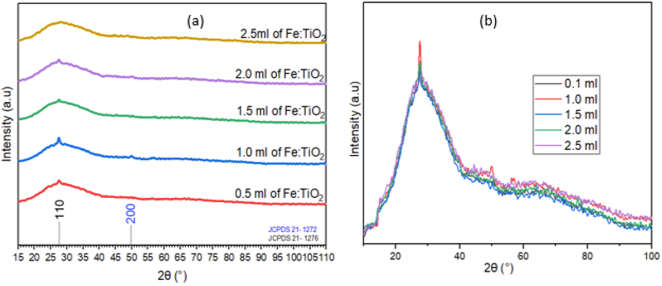
Figure 1. XRD spectra of Fe:TiO2 thin films of varying precursor volumes.
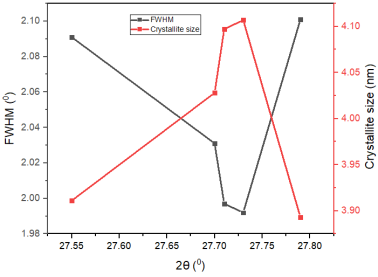
Figure 2. Variation of FWHM and Crystallite Size of deposited Fe:TiO2 thin films using varying volumes of the precursor.
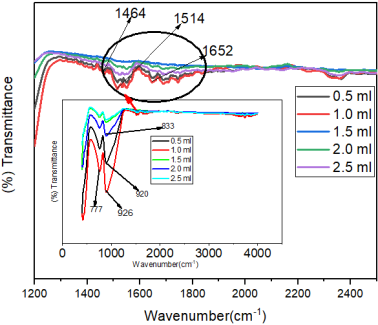
Figure 3. FT-IR spectra of Fe:TiO2 thin films deposited using different precursor volumes.
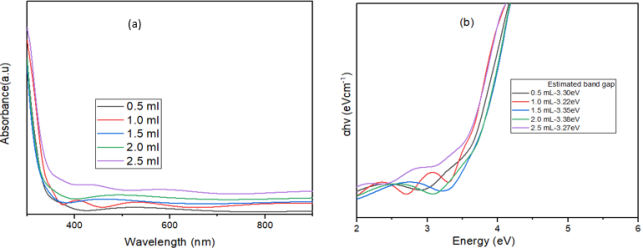
Figure 4. (a) Absorbance spectra as a function of wavelength and (b) Tauc plots of versus photon energy for Fe-doped TiO2 thin films deposited using precursor solution volumes ranging from 0.5 mL to 2.5 mL.

Information



 Share This Article
 Twitter
 Linked In
 Facebook
 Copy
Copy Download