
 ,
Daniel Fatori,
Fernanda Goncalves de Mateo Tamura,
Gabriel de Jesus da Fonseca Loureiro,
Milena Frota Macatrao-Costa,
Claudia Yanet San Martin de Bernoche,
Fabio Antonio Gaiotto,
Liliane Kopel,
Silvia Gelas Lage*
,
Daniel Fatori,
Fernanda Goncalves de Mateo Tamura,
Gabriel de Jesus da Fonseca Loureiro,
Milena Frota Macatrao-Costa,
Claudia Yanet San Martin de Bernoche,
Fabio Antonio Gaiotto,
Liliane Kopel,
Silvia Gelas Lage*
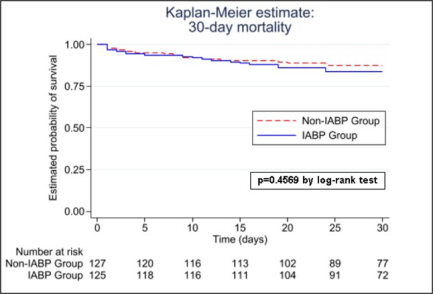
The use of the intra-aortic balloon pump (IABP) in advanced heart failure (HF) and cardiogenic shock (CS) is still under debate. In this study we sought to assess the clinical and hemodynamic outcomes in IABP-treated heart transplantation (HTx) patients as well as its impact on mortality. We retrospectively analyzed patients with advanced HF and CS, admitted in the cardiac intensive care unit (ICU) of our institution, between 2009 and 2020, who underwent HTx. We compared patients treated with IABP pre-HTx with a control (CR) group submitted to HTx without mechanical circulatory support. Propensity Score Matching was used to pair the groups according to relevant clinical covariates. 326 patients were included (IABP= 199; CR= 127). Overall survival was similar in IABP and CR groups at 30 days post-HTx (p=0.459). Clinical conditions improved 96 hours after IABP therapy. Central venous oxygen saturation (ScvO2) increased from 49.9% to 66.85% (p<0.001), and diuresis from 1690.12 mL/24 h to 2193.12 mL/24h (p<0.001). Lactate decreased from 21.91 mg/dl to 12.6 mg/dl (p<0.001) and creatinine from 2.04 mg/dL to 1.72 mg/dL (p=0.301). The use of nitroprusside increased from 58.08 to 63.59% (p=0.154), and norepinephrine decreased from 17.7% to 6.63% (p<0.001). The differences were maintained until HTx. IABP related complications were few. Overall outcomes of IABP in advanced HF and CS as a bridge therapy to HTx are encouraging. The survival rate was similar between the groups and IABP can be considered a safe and effective device with few and manageable complications.
| Published in | Cardiology and Cardiovascular Research (Volume 10, Issue 3) |
| DOI | 10.11648/j.ccr.20261003.19 |
| Page(s) | 96-105 |
| Creative Commons |
This is an Open Access article, distributed under the terms of the Creative Commons Attribution 4.0 International License (http://creativecommons.org/licenses/by/4.0/), which permits unrestricted use, distribution and reproduction in any medium or format, provided the original work is properly cited. |
| Copyright |
Copyright © The Author(s), 2026. Published by Science Publishing Group |
Intra-aortic Balloon Pump, Advanced Heart Failure, Cardiogenic Shock, Heart Transplantation
Variables | Group | |||
|---|---|---|---|---|
Control (N = 127) | IABP (N = 199) | Total (N = 326) | p | |
Age (years), median ± DP | 46.9 ± 14.4 | 46.5 ± 12 | 46.6 ± 13 | 0.791** |
Gender (male), n (%) | 80 (63) | 122 (61.3) | 202 (62) | 0.76 |
LVEF (%), median ± DP | 25.9 ± 9.5 | 23.5 ± 5.9 | 24.5 ± 7.6 | 0.010** |
Etiology, n (%) | 0.006 | |||
Ischemic cardiomyopathy | 23 (18.1) | 24 (12.1) | 47 (14.4) | |
Chagasic cardiomyopathy | 38 (29.9) | 94 (47.2) | 132 (40.5) | |
Idiopathic cardiomyopathy | 39 (30.7) | 58 (29.1) | 97 (29.8) | |
Others | 27 (21.3) | 23 (11.6) | 50 (15.3) | |
Right ventricular dysfunction, n (%) | 0.987 | |||
Normal | 28 (22) | 43 (21.6) | 71 (21.8) | |
Minor | 33 (26) | 49 (24.6) | 82 (25.2) | |
Moderate | 47 (37) | 75 (37.7) | 122 (37.4) | |
Severe | 19 (15) | 32 (16.1) | 51 (15.6) | |
Arterial Hypertension, n (%) | 9 (7.1) | 21 (10.6) | 30 (9.2) | 0.291 |
Diabetes Mellitus, n (%) | 13 (10.2) | 27 (13.6) | 40 (12.3) | 0.371 |
Chronic Kidney Disease, n (%) | 20 (15.7) | 44 (22.1) | 64 (19.6) | 0.158 |
Atrial Fibrillation, n (%) | 33 (26) | 56 (28.1) | 89 (27.3) | 0.67 |
Stroke, n (%) | 18 (14.3) | 29 (14.6) | 47 (14.5) | 0.943 |
Previous Acute Myocardial Infarction, n (%) | 21 (16.5) | 32 (16.1) | 53 (16.3) | 0.914 |
ICD, n (%) | 33 (26) | 41 (20.6) | 74 (22.7) | 0.258 |
SAPS 3 (%), mean ± DP | 36.8 ± 17.8 | 32.6 ± 18.6 | 34.2 ± 18.4 | 0.042** |
SAPS 3 (Total), mean ± DP | 60.2 ± 10 | 57.4 ± 10.6 | 58.5 ± 10.4 | 0.018** |
Post operative ICU stay (days), median (p25; p75) | 9 (6; 15) | 11 (7; 19) | 10 (6; 17.3) | 0.063£ |
Time from transplant to discharge (days), median (p25; p75) | 35 (22; 48) | 35 (24; 58) | 35 (23; 52) | 0.175£ |
IABP time (days), median (p25; p75) | 20 (10; 33) | 20 (10; 33) | & | |
ICU Discharge, n (%) | 105 (82.7) | 153 (76.9) | 258 (79.1) | 0.209 |
Discharge status, n (%) | 0.138 | |||
Hospital Discharge | 104 (81.9) | 149 (74.9) | 253 (77.6) | |
Death | 23 (18.1) | 50 (25.1) | 73 (22.4) | |
104 (52.3) | 104 (52.3) | & | ||
Complications, n (%) | 62 (31.1) | 62 (31.1) | & | |
Bleeding, n (%) | 13 (6.5) | 13 (6.5) | & | |
Thrombocytopenia, n (%) | 25 (12.6) | 25 (12.6) | & | |
Infection, n (%) | 19 (9.5) | 19 (9.5) | & | |
Limb ischemia, n (%) | 5 (2.5) | 5 (2.5) | & | |
| T1 | T2 | T3 | T4 | T2xT3 | T1xT4 |
|---|---|---|---|---|---|---|
| ICU admission | Pre-IABP | Post-IABP | Pre-HTx | p | p |
Creatinine (mg/dL) | 1.75 | 2.04 | 1.72 | 1.33 | 0.301 | <0.001 |
Urea (mg/dL) | 76.42 | 67.33 | 57.26 | 52.98 | <0.001 | <0.001 |
ScVO2 (%) | 65.6 | 49.99 | 66.85 | 63.22 | <0.001 | 0.691 |
Diuresis (ml/24h) | 1740.35 | 1690.12 | 2193.7 | 2266.34 | <0.001 | <0.001 |
Lactate (mg/dL) | 16.61 | 21.91 | 12.6 | 11.95 | <0.001 | <0.001 |
Complications | IABP Time (days) | N | p | |
|---|---|---|---|---|
mean ± SD | median (p25; p75) | |||
Without complications | 23 ± 19.1 | 19 (9; 29) | 137 |
|
Bleeding | 36.1 ± 33.9 | 20 (11; 69) | 13 | 0.328 |
Thrombocytopenia | 23.1 ± 22.4 | 19 (8; 32) | 25 | 0.733 |
Infection | 52.1 ± 22.1 | 52 (41; 60) | 19 | <0.001 |
Ischemia | 27.2 ± 35.2 | 7 (4.5; 60) | 5 | 0.651 |
Any complications | 33.6 ± 27 | 28 (11; 52.5) | 62 | 0.025 |
Vasoactive Drugs | T1 | T2 | p |
|---|---|---|---|
Pre-IABP | Post-IABP | ||
Dobutamine | 193 (97.47%) | 193 (97.47%) | 0.323 |
Milrinone | 38 (19.29%) | 44 (22.45%) | 0.234 |
Norepinephrine | 34 (17.17%) | 13 (6.63%) | <0.001 |
Sodium Nitroprusside | 115 (58.08%) | 124 (63.59%) | 0.154 |
CS | Cardiogenic Shock |
HF | Heart Failure |
ICU | Intensive Care Unit |
HTx | Heart Transplantation |
IABP | Intra |
AMI | Acute Myocardial Infarction |
CR | Control |
SCAI | Society for Cardiovascular Angiography and Interventions |
ICD | Implantable Cardioverter |
ScVO2 | Central Venous Saturation |
PSM | Propensity Score Matching |
SAPS 3 | Simplified Acute Physiology Score 3 |
LVEF | Left Ventricular Ejection Fraction |
TTE | Transthoracic Echocardiogram |
RV | Right Ventricular |
LV | Left Ventricular |
| [1] | Marcondes-Braga, F. G., Moura, L. A. Z., Issa, V. S., et al. Emerging Topics Update of the Brazilian Heart Failure Guideline - 2021. Arq Bras Cardiol. 2021 Jun 8; 116(6): 1174–1212. |
| [2] | Kantrowitz, A., Tjonneland, S., Freed, P. S., et al. Initial clinical experience with intraaortic balloon pumping in cardiogenic shock. JAMA. 1968; 203(2), 113-118. |
| [3] | Prondzinsky, R., Unverzagt, S., Russ, M., et al. Hemodynamic effects of intra-aortic balloon counter pulsation in patients with acute myocardial infarction complicated by cardiogenic shock: the prospective, randomized IABP shock trial. Shock. 2012, 37(4), 378-384. |
| [4] | Thiele, H., Zeymer, U., Neumann, F. J., et al. Intra-aortic balloon counterpulsation in acute myocardial infarction complicated by cardiogenic shock (IABP- SHOCK II): final 12-month results of a randomized open-label trial. The Lancet. 2013, 382(9905), 1638-1645. |
| [5] | Hillis, L. D., Smith, P. K., Anderson, J. L., et al. 2011 ACCF/AHA Guideline for Coronary Artery Bypass Graft Surgery: Executive Summary: A Report of the American College of Cardiology Foundation/American Heart Association Task Force on Practice Guidelines. Circulation. 2011, 124(23), 2610-2642. |
| [6] | Wijns, W., Kolh, P., Danchin, N., et al. Guidelines on myocardial revascularization: The Task Force on Myocardial Revascularization of the European Society of Cardiology (ESC) and the European Association for Cardio-Thoracic Surgery (EACTS). European Heart Journal. 2010, 31(20), 2501-2555. |
| [7] | O'Gara, P. T., Kushner, F. G., Ascheim, D. D., et al. 2013 ACCF/AHA guideline for the management of ST-elevation myocardial infarction: executive summary: a report of the American College of Cardiology Foundation/American Heart Association Task Force on Practice Guidelines: developed in collaboration with the American College of Emergency Physicians and Society for Cardiovascular Angiography and Interventions. Catheterization & Cardiovascular Interventions. 2013, 82(1), E1-E27. |
| [8] | Task Force on the management of ST-segment elevation acute myocardial infarction of the European Society of Cardiology (ESC), Steg, P. G., James, S. K., Atar, D., et al. ESC Guidelines for the management of acute myocardial infarction in patients presenting with ST-segment elevation. European Heart Journal. 2012, 33(20), 2569-2619. |
| [9] | Feldman, D., Pamboukian, S. V., Teuteberg, J. J., et al. The 2013 International Society for Heart and Lung Transplantation guidelines for mechanical circulatory support: executive summary. The Journal of Heart and Lung Transplantation. 2013, 32(2), 157-187. |
| [10] | Van Diepen, S., Katz, J. N., Albert, N. M., et al. Contemporary Management of Cardiogenic Shock: A Scientific Statement from the American Heart Association. Circulation. 2017, 136(16), e232-e268. |
| [11] | Thiele, H., Zeymer, U., Neumann, F. J., et al. Intraaortic balloon support for myocardial infarction with cardiogenic shock. The New England Journal of Medicine. 2012, 367(14), 1287-1296. |
| [12] | Bertolino, N. D., Villafanha, D. F., Cardinalli-Neto, A., et al. Prognostic impact of Chagas' disease in patients awaiting heart transplantation. The Journal of Heart and Lung Transplantation. 2010; 29(4): 449-453. |
| [13] | Huckaby, L. V., Seese, L. M., Mathier, M. A., et al. Intra-aortic balloon pump bridging to heart transplantation. Circulation Heart Failure. 2020, 13(8), e006971. |
| [14] | Gjesdal, O., Gude, E., Arora, S., et al. Intra-aortic balloon counterpulsation as a bridge to heart transplantation does not impair long-term survival. European Journal of Heart Failure. 2009; 11(7), 709-714. |
| [15] | Bezerra, C. G., Adam, E. L., Baptista, M. L., et al. Terapia de Contrapulsação Aórtica em Pacientes com Insuficiência Cardíaca Avançada: Análise do Registro THE BRIDGE. Arquivos Brasileiros de Cardiologia. 2016, 106(1), 26-32. |
| [16] | Baldetti, L., Pagnesi, M., Gramegna, M., et al. Intra-Aortic Balloon Pumping in Acute Decompensated Heart Failure with Hypoperfusion: From Pathophysiology to Clinical Practice. Circulation Heart Failure. 2021, 14(11), e008527. |
| [17] | Den Uil, C. A., Van Mieghem, N. M., Bastos, M. B., et al. Primary intra-aortic balloon support versus inotropes for decompensated heart failure and low output: a randomized trial. EuroIntervention. 2019, 15(7), 586-593. |
| [18] | Norkiene, I., Ringaitiene, D., Rucinskas, K., et al. Intra-aortic balloon counterpulsation in decompensated cardiomyopathy patients: bridge to transplantation or assist device. Interactive Cardiovascular Thoracic Surgery. 2007, 6(1), 66-70. |
| [19] | Ferguson, J. J. 3rd., Cohen, M., Freedman, R. J. Jr., et al. The current practice of intra-aortic balloon counterpulsation: results from the Benchmark Registry. Journal of the American College of Cardiology. 2001, 38(5), 1456-1462. |
| [20] | Koudoumas, D., Malliaras, K., Theodoropoulos, S., et al. Long-term intra-aortic balloon pump support as a bridge to left ventricular assist device implantation. Journal of Cardiac Surgery. 2016, 31(7), 467-471. |
| [21] |
D'Agostino, R. B. Jr. Propensity score methods for bias reduction in the comparison of a treatment to a non-randomized control group. Statistics in Medicine. 1998, 17(19), 2265-2281.
http://doi.org/10.1002/(sici)1097-0258(19981015)17:19<2265::aid-sim918>3.0.co;2-b |
APA Style
Bellini, V. S. C., Fatori, D., Tamura, F. G. D. M., Loureiro, G. D. J. D. F., Macatrao-Costa, M. F., et al. (2026). Impact of Intra-aortic Balloon Pump in Advanced Heart Failure and Cardiogenic Shock Pre and Post Heart Transplant. Cardiology and Cardiovascular Research, 10(3), 96-105. https://doi.org/10.11648/j.ccr.20261003.19
ACS Style
Bellini, V. S. C.; Fatori, D.; Tamura, F. G. D. M.; Loureiro, G. D. J. D. F.; Macatrao-Costa, M. F., et al. Impact of Intra-aortic Balloon Pump in Advanced Heart Failure and Cardiogenic Shock Pre and Post Heart Transplant. Cardiol. Cardiovasc. Res. 2026, 10(3), 96-105. doi: 10.11648/j.ccr.20261003.19
AMA Style
Bellini VSC, Fatori D, Tamura FGDM, Loureiro GDJDF, Macatrao-Costa MF, et al. Impact of Intra-aortic Balloon Pump in Advanced Heart Failure and Cardiogenic Shock Pre and Post Heart Transplant. Cardiol Cardiovasc Res. 2026;10(3):96-105. doi: 10.11648/j.ccr.20261003.19
@article{10.11648/j.ccr.20261003.19,
  author = {Vanessa Sanches Corcioli Bellini and Daniel Fatori and Fernanda Goncalves de Mateo Tamura and Gabriel de Jesus da Fonseca Loureiro and Milena Frota Macatrao-Costa and Claudia Yanet San Martin de Bernoche and Fabio Antonio Gaiotto and Liliane Kopel and Silvia Gelas Lage},
  title = {Impact of Intra-aortic Balloon Pump in Advanced Heart Failure and Cardiogenic Shock Pre and Post Heart Transplant},
  journal = {Cardiology and Cardiovascular Research},
  volume = {10},
  number = {3},
  pages = {96-105},
  doi = {10.11648/j.ccr.20261003.19},
  url = {https://doi.org/10.11648/j.ccr.20261003.19},
  eprint = {https://article.sciencepublishinggroup.com/pdf/10.11648.j.ccr.20261003.19},
  abstract = {The use of the intra-aortic balloon pump (IABP) in advanced heart failure (HF) and cardiogenic shock (CS) is still under debate. In this study we sought to assess the clinical and hemodynamic outcomes in IABP-treated heart transplantation (HTx) patients as well as its impact on mortality. We retrospectively analyzed patients with advanced HF and CS, admitted in the cardiac intensive care unit (ICU) of our institution, between 2009 and 2020, who underwent HTx. We compared patients treated with IABP pre-HTx with a control (CR) group submitted to HTx without mechanical circulatory support. Propensity Score Matching was used to pair the groups according to relevant clinical covariates. 326 patients were included (IABP= 199; CR= 127). Overall survival was similar in IABP and CR groups at 30 days post-HTx (p=0.459). Clinical conditions improved 96 hours after IABP therapy. Central venous oxygen saturation (ScvO2) increased from 49.9% to 66.85% (p<0.001), and diuresis from 1690.12 mL/24 h to 2193.12 mL/24h (p<0.001). Lactate decreased from 21.91 mg/dl to 12.6 mg/dl (p<0.001) and creatinine from 2.04 mg/dL to 1.72 mg/dL (p=0.301). The use of nitroprusside increased from 58.08 to 63.59% (p=0.154), and norepinephrine decreased from 17.7% to 6.63% (p<0.001). The differences were maintained until HTx. IABP related complications were few. Overall outcomes of IABP in advanced HF and CS as a bridge therapy to HTx are encouraging. The survival rate was similar between the groups and IABP can be considered a safe and effective device with few and manageable complications.},
 year = {2026}
}
TY  - JOUR
T1  - Impact of Intra-aortic Balloon Pump in Advanced Heart Failure and Cardiogenic Shock Pre and Post Heart Transplant
AU  - Vanessa Sanches Corcioli Bellini
AU  - Daniel Fatori
AU  - Fernanda Goncalves de Mateo Tamura
AU  - Gabriel de Jesus da Fonseca Loureiro
AU  - Milena Frota Macatrao-Costa
AU  - Claudia Yanet San Martin de Bernoche
AU  - Fabio Antonio Gaiotto
AU  - Liliane Kopel
AU  - Silvia Gelas Lage
Y1  - 2026/09/24
PY  - 2026
N1  - https://doi.org/10.11648/j.ccr.20261003.19
DO  - 10.11648/j.ccr.20261003.19
T2  - Cardiology and Cardiovascular Research
JF  - Cardiology and Cardiovascular Research
JO  - Cardiology and Cardiovascular Research
SP  - 96
EP  - 105
PB  - Science Publishing Group
SN  - 2578-8914
UR  - https://doi.org/10.11648/j.ccr.20261003.19
AB  - The use of the intra-aortic balloon pump (IABP) in advanced heart failure (HF) and cardiogenic shock (CS) is still under debate. In this study we sought to assess the clinical and hemodynamic outcomes in IABP-treated heart transplantation (HTx) patients as well as its impact on mortality. We retrospectively analyzed patients with advanced HF and CS, admitted in the cardiac intensive care unit (ICU) of our institution, between 2009 and 2020, who underwent HTx. We compared patients treated with IABP pre-HTx with a control (CR) group submitted to HTx without mechanical circulatory support. Propensity Score Matching was used to pair the groups according to relevant clinical covariates. 326 patients were included (IABP= 199; CR= 127). Overall survival was similar in IABP and CR groups at 30 days post-HTx (p=0.459). Clinical conditions improved 96 hours after IABP therapy. Central venous oxygen saturation (ScvO2) increased from 49.9% to 66.85% (p<0.001), and diuresis from 1690.12 mL/24 h to 2193.12 mL/24h (p<0.001). Lactate decreased from 21.91 mg/dl to 12.6 mg/dl (p<0.001) and creatinine from 2.04 mg/dL to 1.72 mg/dL (p=0.301). The use of nitroprusside increased from 58.08 to 63.59% (p=0.154), and norepinephrine decreased from 17.7% to 6.63% (p<0.001). The differences were maintained until HTx. IABP related complications were few. Overall outcomes of IABP in advanced HF and CS as a bridge therapy to HTx are encouraging. The survival rate was similar between the groups and IABP can be considered a safe and effective device with few and manageable complications.
VL  - 10
IS  - 3
ER  -
Department of Cardiovascular Intensive Care Unit, Heart Institute of Sao Paulo, Sao Paulo, Brazil
Biography: Vanessa Sanches Corcioli Bellini is a physician specialized in Clinical Medicine at Santa Casa de São Paulo, a cardiologist at InCor-HCFMUSP (Heart Institute-Hospital das Clínicas of the University of São Paulo Medical School), and an Intensive Care Cardiologist at InCor-HCFMUSP. PhD in Health Sciences from the University of São Paulo School of Medicine. Attending Physician in the Cardiovascular Intensive Care Unit at InCor-HCFMUSP.
Research Fields: Cardiogenic shock, advanced heart failure, and mechanical circulatory support

Department of Psychiatry, Clinical Hospital of the University of Sao Paulo, Sao Paulo, Brazil
Biography: Daniel Fatori is a researcher, graduated in Psychology and holding a Master’s degree in human development from Mackenzie Presbyterian University, and a PhD in Psychiatry at the University of São Paulo School of Medicine. Specialist in Cognitive Therapies from the Institute of Psychiatry in Hospital das Clínicas of the University of São Paulo Medical School (HCFMUSP). Currently a Researcher at the Laboratory of Psychopathology and Psychiatric Therapeutics (LIM-23) of HCFMUSP. Winner of the 2018 abril-DASA Award for Medical Innovation in Social Medicine.
Research Fields: Epidemiology, Psychiatry, Randomized clinical trial

Department of Cardiovascular Intensive Care Unit, Heart Institute of Sao Paulo, Sao Paulo, Brazil
Biography: Fernanda Goncalves de Mateo Tamura is a physician specialized in Clinical Medicine at Santa Casa de São Paulo, Cardiologist at InCor-HCFMUSP (Heart Institute-Hospital das Clínicas of the University of São Paulo Medical School), and Echocardiographer at Hospital Alemão Oswaldo Cruz. Attending Physician in the Cardiovascular Intensive Care Unit at InCor-HCFMUSP.
Research Fields: Cardiogenic shock, advanced heart failure, and mechanical circulatory support
Department of Cardiovascular Intensive Care Unit, Heart Institute of Sao Paulo, Sao Paulo, Brazil
Biography: Gabriel de Jesus da Fonseca Loureiro is a physician specialized in Clinical Medicine at Ophir Loyola Hospital and Cardiology at InCor-HCFMUSP (Heart Institute-Hospital das Clínicas of the University of São Paulo Medical School). Attending Physician in the Cardiovascular Intensive Care Unit at InCor-HCFMUSP.
Research Fields: Cardiogenic shock, advanced heart failure, and mechanical circulatory support
Department of Cardiovascular Intensive Care Unit, Heart Institute of Sao Paulo, Sao Paulo, Brazil
Biography: Milena Frota Macatrao-Costa is a physician specialized in Clinical Medicine at Santa Marcelina Hospital in São Paulo, Cardiology at InCor-HCFMUSP (Heart Institute-Hospital das Clínicas of the University of São Paulo Medical School) and clinical arrhythmia at InCor-HCFMUSP. PhD in Health Sciences from the University of São Paulo. Attending Physician in the Cardiovascular Intensive Care Unit at InCor-HCFMUSP.
Research Fields: Cardiogenic shock and advanced heart failure, hypertrophic cardiomyopathy

Department of Cardiovascular Intensive Care Unit, Heart Institute of Sao Paulo, Sao Paulo, Brazil
Biography: Claudia Yanet San Martin de Bernoche is a physician specialized in Clinical Medicine at Clinical Hospital of University of São Paulo (HCFMUSP) and Cardiology at InCor-HCFMUSP. PhD in Medicine from the FMUSP. Attending Physician in Quality and Patient Safety at InCor-HCFMUSP (Heart Institute-Hospital das Clínicas of the University of São Paulo Medical School). Medical Coordinator of the General and Specialty Emergency Department at Hospital Nove de Julho - Rede Américas, and Head of the Cardiovascular Emergency Department at the same institution since 2014. She worked in the Post-Anesthesia Care Unit at InCor-HCFMUSP from 1997 to 2001, in the Clinical Emergency Unit from 2001 to 2009, and in the Clinical Intensive Care Unit from 2009 to 2024.
Research Fields: Cardiogenic shock, advanced heart failure, and mechanical circulatory support
Department of Cardiac Surgery and Heart Transplant, Heart Institute of Sao Paulo, Sao Paulo, Brazil
Biography: Fabio Antonio Gaiotto is a physician graduated from the University of São Paulo School of Medicine (FMUSP) in 1994. He completed his medical residency in General Surgery at FMUSP and his medical residency in Cardiovascular Surgery at InCor-HCFMUSP (Heart Institute-Hospital das Clínicas of the University of São Paulo Medical School). PhD in Medical Sciences from the FMUSP and completed a postdoctoral fellowship in the Department of Cardiopneumology at the FMUSP. He is an Attending Physician in the Division of Cardiovascular Surgery at InCor-HCFMUSP and has been the cardiovascular surgeon responsible for adult heart transplantation at Hospital Israelita Albert Einstein since 2020. He has been a Full Member of the Brazilian Society of Cardiovascular Surgery since 2024.
Research Fields: Advanced heart failure, heart transplantation, and mechanical circulatory support

Department of Cardiovascular Intensive Care Unit, Heart Institute of Sao Paulo, Sao Paulo, Brazil
Biography: Liliane Kopel is a physician specialized in Clinical Medicine at Clinical Hospital of University of São Paulo (HCFMUSP), Cardiology at InCor-HCFMUSP (Heart Institute-Hospital das Clínicas of the University of São Paulo Medical School) and an Intensive Care Cardiologist at InCor-HCFMUSP. PhD in Medicine from the University of São Paulo School of Medicine (FMUSP). Specialist in Cardiology, Intensive Care Medicine, and Nutrology. Attending Physician in the Cardiovascular Intensive Care Unit at InCor-HCFMUSP.
Research Fields: Cardiogenic shock, advanced heart failure, and mechanical circulatory support
Department of Cardiovascular Intensive Care Unit, Heart Institute of Sao Paulo, Sao Paulo, Brazil
Biography: Silvia Gelas Lage is Associate Professor at Medical School- University of São Paulo (USP) and Director of Critical Care Unit at Heart Institute - Medical School- USP. She completed her doctor/ Cardiology degree at USP in 1986 and her postdoctoral degree at Harvard Medical School in 1990. As Associate Professor since 1994 is envolved in multiple assistance, research and educational activities.
Research Fields: Cardiogenic shock, advanced heart failure, and mechanical circulatory support

Information


 Share This Article
 Twitter
 Linked In
 Facebook
 Copy
Copy Download