
The rise in Electric Vehicle (EV) usage has significantly increased the need for high-power fast charging systems that must meet rigorous performance standards. This paper examines the performance of 50 kW grid-connected EV charger. The design of the charger utilizes a dual stage Vienna rectifier at the front end, combined with a bi-directional DC-DC stage, to achieve a high-power factor, minimize total harmonic distortion (THD), and maintain stable operation of the DC bus. Vienna rectifiers are commonly utilized in high-power electric vehicle chargers because of their excellent efficiency greater than 94% and nearly unity power factor. An analysis of 50 kW charger that employs a Vienna rectifier focuses on its output ripple, input signal distortion, and power input factor. Under standard operating conditions, the performance remains equable. However, once the battery charge status surpasses 80%, the notable decline in performance occurs. In this scenario, both ripple and THD increase, and the power factor strays from unity, potentially harming the battery State of Health (SOH) during constant-voltage charging. Based on research results, this paper quantified the implication of current ripple on conversion efficiency in Electric vehicle charger through experimental verification and the results communicate that the current ripples have important influence on EV chargers.
| Published in | Science Journal of Circuits, Systems and Signal Processing (Volume 13, Issue 1) |
| DOI | 10.11648/j.cssp.20261301.11 |
| Page(s) | 1-13 |
| Creative Commons |
This is an Open Access article, distributed under the terms of the Creative Commons Attribution 4.0 International License (http://creativecommons.org/licenses/by/4.0/), which permits unrestricted use, distribution and reproduction in any medium or format, provided the original work is properly cited. |
| Copyright |
Copyright © The Author(s), 2026. Published by Science Publishing Group |
Electric Vehicle, Vienna Rectifier, DC-DC Stage, Harmonic Distortion, Output Ripple, State of Health (SOH)
Parameter | Value |
|---|---|
Input Voltage | 41510% VAC |
Output Voltage | 200-1000 VDC |
Max. Output Current DC | 250 Amp |
Max. Output Power | 60 kW |
Frequency | 50 Hz |
Battery Capacity (BC) = 5 kWh | ||||
|---|---|---|---|---|
Time (Minutes) | DC Output Voltage (V) | DC Output Current (A) | Output Power (kW) | Efficiency (%) |
0 | 495.1 | 38.08 | 18.85 | 70.55 |
0.82 | 494.81 | 100.02 | 49.49 | 94.23 |
1.43 | 494.81 | 99.99 | 49.47 | 94.2 |
2 | 494.81 | 99.96 | 49.46 | 94.2 |
2.65 | 494.81 | 99.93 | 49.44 | 94.18 |
3.23 | 494.80 | 99.92 | 49.44 | 94.14 |
3.88 | 494.81 | 99.89 | 49.43 | 94.12 |
4.48 | 494.81 | 99.86 | 49.41 | 94.09 |
5.02 | 494.81 | 99.86 | 49.41 | 94.09 |
5.58 | 494.99 | 36.56 | 18.09 | 96.68 |
7.05 | 495.08 | 12.14 | 6.01 | 86.08 |
12.07 | 495.11 | 3.11 | 1.54 | 74.80 |
23.1 | 495.11 | 2.02 | 1 | 64.52 |
Battery Capacity (BC) = 10 kWh | ||||
|---|---|---|---|---|
Time (Minutes) | DC Output Voltage (V) | DC Output Current (A) | Output Power (kW) | Efficiency (%) |
0 | 494.99 | 50.39 | 24.94 | 93.47 |
1.32 | 494.84 | 100.14 | 49.55 | 94.20 |
2.5 | 494.84 | 100.08 | 49.52 | 94.16 |
3.72 | 494.83 | 100.01 | 49.48 | 94.14 |
4.92 | 494.83 | 99.97 | 49.46 | 94.12 |
6.17 | 494.83 | 99.92 | 49.44 | 94.07 |
7.37 | 494.83 | 99.89 | 49.42 | 94.03 |
8.6 | 494.82 | 99.86 | 49.41 | 93.99 |
9.67 | 494.82 | 99.84 | 49.40 | 93.96 |
10.83 | 495.01 | 35.97 | 17.80 | 93.98 |
13.75 | 495.10 | 11.97 | 5.92 | 84.02 |
23.8 | 495.11 | 3.12 | 1.54 | 75.15 |
46.17 | 495.11 | 2.03 | 1 | 64.68 |
Battery Capacity (BC) = 25 kWh | ||||
|---|---|---|---|---|
Time (Minutes) | DC Output Voltage (V) | DC Output Current (A) | Output Power (kW) | Efficiency (%) |
0 | 494.97 | 49.2 | 24.35 | 92.2 |
3.45 | 494.81 | 99.86 | 49.41 | 94.03 |
6.53 | 494.82 | 99.80 | 49.38 | 93.88 |
9.55 | 494.81 | 99.72 | 49.34 | 93.78 |
12.65 | 494.80 | 99.70 | 49.33 | 93.74 |
15.62 | 494.81 | 99.66 | 49.31 | 93.74 |
18.67 | 494.80 | 99.64 | 49.30 | 93.69 |
21.7 | 494.81 | 99.61 | 49.28 | 93.69 |
24.48 | 494.80 | 99.58 | 49.27 | 93.66 |
27.35 | 495 | 36.83 | 18.23 | 93.53 |
34.73 | 495.08 | 12.20 | 6.04 | 86.84 |
60.33 | 495.11 | 2.99 | 1.48 | 71.82 |
115.43 | 495.10 | 2.02 | 0.99 | 64.38 |
Battery Capacity (BC) = 50 kWh | ||||
|---|---|---|---|---|
Time (Minutes) | DC Output Voltage (V) | DC Output Current (A) | Output Power (kW) | Efficiency (%) |
0 | 495.01 | 49.86 | 24.68 | 93.33 |
6.68 | 494.85 | 99.92 | 49.44 | 94.07 |
12.75 | 494.84 | 99.80 | 49.38 | 93.86 |
19.02 | 494.84 | 99.71 | 49.34 | 93.75 |
24.93 | 494.83 | 99.66 | 49.32 | 93.70 |
31.05 | 494.83 | 99.60 | 49.28 | 93.67 |
37.17 | 494.82 | 99.57 | 49.27 | 93.67 |
43.23 | 494.82 | 99.56 | 49.26 | 93.64 |
48.77 | 494.83 | 99.54 | 49.25 | 93.64 |
54.48 | 495.02 | 36.95 | 18.29 | 93.42 |
69.65 | 495.09 | 12.07 | 5.97 | 83.79 |
120.42 | 495.11 | 3.01 | 1.49 | 71.82 |
234.53 | 495.12 | 2.02 | 1 | 64.36 |
5 kWh BC | |||||||||||||
|---|---|---|---|---|---|---|---|---|---|---|---|---|---|
SOC (%) | 0 | 10 | 20 | 30 | 40 | 50 | 60 | 70 | 79 | 85 | 90 | 95 | 99 |
34.89 | 0.85 | 0.87 | 0.84 | 0.93 | 0.86 | 0.79 | 0.88 | 0.84 | 3.47 | 3.79 | 7.40 | 8.91 | |
Efficiency (%) | 70.55 | 94.23 | 94.20 | 94.20 | 94.18 | 94.14 | 94.12 | 94.09 | 94.09 | 96.68 | 86.08 | 74.80 | 64.52 |
10 kWh BC | |||||||||||||
|---|---|---|---|---|---|---|---|---|---|---|---|---|---|
SOC (%) | 0 | 10 | 20 | 30 | 40 | 50 | 60 | 70 | 79 | 85 | 90 | 95 | 99 |
(%) | 1.27 | 0.93 | 0.89 | 0.93 | 0.91 | 0.85 | 0.81 | 0.75 | 0.73 | 2.46 | 5.14 | 6.57 | 8.87 |
Efficiency (%) | 93.47 | 94.20 | 94.16 | 94.14 | 94.12 | 94.07 | 94.03 | 93.99 | 93.96 | 93.98 | 84.02 | 75.15 | 64.68 |
25 kWh BC | |||||||||||||
|---|---|---|---|---|---|---|---|---|---|---|---|---|---|
SOC (%) | 0 | 10 | 20 | 30 | 40 | 50 | 60 | 70 | 79 | 85 | 90 | 95 | 99 |
(%) | 1.82 | 0.89 | 0.83 | 0.79 | 0.82 | 0.82 | 0.77 | 0.82 | 0.72 | 1.56 | 2.83 | 8.03 | 8.66 |
Efficiency (%) | 92.2 | 94.03 | 93.88 | 93.78 | 93.74 | 93.74 | 93.69 | 93.69 | 93.66 | 93.53 | 86.84 | 71.82 | 64.38 |
50 kWh BC | |||||||||||||
|---|---|---|---|---|---|---|---|---|---|---|---|---|---|
SOC (%) | 0 | 10 | 20 | 30 | 40 | 50 | 60 | 70 | 79 | 85 | 90 | 95 | 99 |
(%) | 1.85 | 0.92 | 0.77 | 0.81 | 0.84 | 0.82 | 0.84 | 0.84 | 0.85 | 2.42 | 3.36 | 8.97 | 9.16 |
Efficiency (%) | 93.33 | 94.07 | 93.86 | 93.75 | 93.70 | 93.67 | 93.67 | 93.64 | 93.64 | 93.42 | 83.79 | 71.82 | 64.36 |
AC | Alternating Current |
BC | Battery Charger/Battery Capacity |
CC-CV | Constant Votlage-Constant Current |
CDS | Charging Discover System |
DC | Direct Current |
EV | Electric Vehicle |
EVSE | Electric Vehicle Supply Equipment |
PFC | Power Factor Correction |
SOC | State of Charge |
SOH | State of Health |
THD | Total Harmonic Distortion |
| [1] | Nishant, Kumar & Rani, K. & Murthy, K. (2022). Comparative Analysis of Different Topologies of Vienna Rectifier. |
| [2] | T. -H. Kim et al., "Analytical study on low-frequency ripple effect of battery charging," 2012 IEEE Vehicle Power and Propulsion Conference, Seoul, 2012, pp. 809-811, |
| [3] | Zhang, Hechuan. (2016). Impact of Current Ripple on Electric Vehicle Charging Equipment. |
| [4] | Kotub Uddin, Andrew D. Moore, Anup Barai, James Marco, The effects of high frequency current ripple on electric vehicle battery performance, Applied Energy, Volume 178, 2016, Pages 142-154, |
| [5] | Y. Zhang, J. Fang, F. Gao, T. Song, S. Gao and D. J. Rogers, "Second-Harmonic Ripple Voltage Suppression of Integrated Single-Phase Pulsewidth Modulation Rectifier Charging System for EVs," in IEEE Transactions on Power Electronics, vol. 35, no. 4, pp. 3616-3626, April 2020, |
| [6] | S. Gong and V. G. Agelidis, "Ripple manipulator towards REG-integrated EV charging infrastructure system," IECON 2020 The 46th Annual Conference of the IEEE Industrial Electronics Society, Singapore, 2020, pp. 5203-5209, |
| [7] | M. Bayati, M. Abedi, G. B. Gharehpetian and M. Farahmandrad, "Sinusoidal-Ripple Current Control in Battery Charger of Electric Vehicles," in IEEE Transactions on Vehicular Technology, vol. 69, no. 7, pp. 7201-7210, July 2020, |
| [8] | Akhtar, M. F., Raihan, S. R. S. & Rahim, N. A. Battery Charger Based on High Step-Down DC–DC. |
| [9] | Converter for Light Electric Vehicle Charging Applications. Arab J Sci Eng (2025). |
| [10] | Ramos, L. A.; Van Kan, R. F.; Mezaroba, M.; Batschauer, A. L. A Control Strategy to Smooth Power Ripple of a Single-Stage Bidirectional and Isolated AC-DC Converter for Electric Vehicles Chargers. Electronics 2022, 11, 650. |
| [11] | Wrona, G.; Zdanowski, M.; Trochimiuk, P.; Rąbkowski, J.; Sobieski, R. Experimental Validation of 40 kW EV Charger Based on Vienna Rectifier and Series-Resonant Dual Active Bridge. Energies 2023, 16, 5797. |
| [12] | Goldammer, E.; Gentejohann, M.; Schlüter, M.; Weber, D.; Wondrak, W.; Dieckerhoff, S.; Gühmann, C.; Kowal, J. The Impact of an Overlaid Ripple Current on Battery Aging: The Development of the SiCWell Dataset. Batteries 2022, 8, 11. |
APA Style
Manju, D., R, H., Kumar, K. J. (2026). Performance Evaluation of 50 kW AC-DC Converter Using Vienna Rectifier for EV Charging Applications. Science Journal of Circuits, Systems and Signal Processing, 13(1), 1-13. https://doi.org/10.11648/j.cssp.20261301.11
ACS Style
Manju, D.; R, H.; Kumar, K. J. Performance Evaluation of 50 kW AC-DC Converter Using Vienna Rectifier for EV Charging Applications. Sci. J. Circuits Syst. Signal Process. 2026, 13(1), 1-13. doi: 10.11648/j.cssp.20261301.11
@article{10.11648/j.cssp.20261301.11,
  author = {Divyajyothi Manju and Hemavathi R and K Jeykishan Kumar},
  title = {Performance Evaluation of 50 kW AC-DC Converter Using Vienna Rectifier for EV Charging Applications},
  journal = {Science Journal of Circuits, Systems and Signal Processing},
  volume = {13},
  number = {1},
  pages = {1-13},
  doi = {10.11648/j.cssp.20261301.11},
  url = {https://doi.org/10.11648/j.cssp.20261301.11},
  eprint = {https://article.sciencepublishinggroup.com/pdf/10.11648.j.cssp.20261301.11},
  abstract = {The rise in Electric Vehicle (EV) usage has significantly increased the need for high-power fast charging systems that must meet rigorous performance standards. This paper examines the performance of 50 kW grid-connected EV charger. The design of the charger utilizes a dual stage Vienna rectifier at the front end, combined with a bi-directional DC-DC stage, to achieve a high-power factor, minimize total harmonic distortion (THD), and maintain stable operation of the DC bus. Vienna rectifiers are commonly utilized in high-power electric vehicle chargers because of their excellent efficiency greater than 94% and nearly unity power factor. An analysis of 50 kW charger that employs a Vienna rectifier focuses on its output ripple, input signal distortion, and power input factor. Under standard operating conditions, the performance remains equable. However, once the battery charge status surpasses 80%, the notable decline in performance occurs. In this scenario, both ripple and THD increase, and the power factor strays from unity, potentially harming the battery State of Health (SOH) during constant-voltage charging. Based on research results, this paper quantified the implication of current ripple on conversion efficiency in Electric vehicle charger through experimental verification and the results communicate that the current ripples have important influence on EV chargers.},
 year = {2026}
}
TY  - JOUR
T1  - Performance Evaluation of 50 kW AC-DC Converter Using Vienna Rectifier for EV Charging Applications
AU  - Divyajyothi Manju
AU  - Hemavathi R
AU  - K Jeykishan Kumar
Y1  - 2026/01/19
PY  - 2026
N1  - https://doi.org/10.11648/j.cssp.20261301.11
DO  - 10.11648/j.cssp.20261301.11
T2  - Science Journal of Circuits, Systems and Signal Processing
JF  - Science Journal of Circuits, Systems and Signal Processing
JO  - Science Journal of Circuits, Systems and Signal Processing
SP  - 1
EP  - 13
PB  - Science Publishing Group
SN  - 2326-9073
UR  - https://doi.org/10.11648/j.cssp.20261301.11
AB  - The rise in Electric Vehicle (EV) usage has significantly increased the need for high-power fast charging systems that must meet rigorous performance standards. This paper examines the performance of 50 kW grid-connected EV charger. The design of the charger utilizes a dual stage Vienna rectifier at the front end, combined with a bi-directional DC-DC stage, to achieve a high-power factor, minimize total harmonic distortion (THD), and maintain stable operation of the DC bus. Vienna rectifiers are commonly utilized in high-power electric vehicle chargers because of their excellent efficiency greater than 94% and nearly unity power factor. An analysis of 50 kW charger that employs a Vienna rectifier focuses on its output ripple, input signal distortion, and power input factor. Under standard operating conditions, the performance remains equable. However, once the battery charge status surpasses 80%, the notable decline in performance occurs. In this scenario, both ripple and THD increase, and the power factor strays from unity, potentially harming the battery State of Health (SOH) during constant-voltage charging. Based on research results, this paper quantified the implication of current ripple on conversion efficiency in Electric vehicle charger through experimental verification and the results communicate that the current ripples have important influence on EV chargers.
VL  - 13
IS  - 1
ER  -
Department of Electrical Engineering, University of Visvesvaraya College of Engineering, Bengaluru, India
Department of Electrical Engineering, University of Visvesvaraya College of Engineering, Bengaluru, India
Energy Efficiency and Renewable Energy Division, Central Power Research Institute, Bengaluru, India
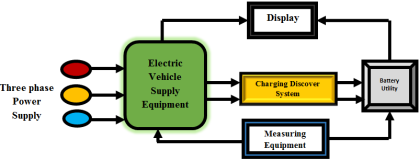
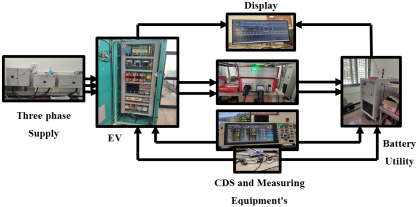
Figure 2. Experimental Set-up in laboratory for EVSE testing.
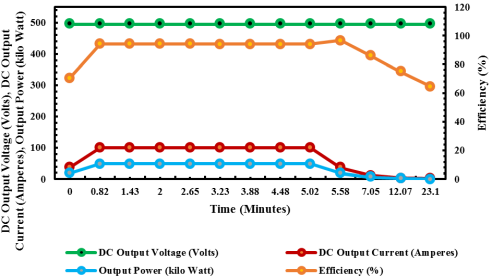
Figure 3. Output Parameters plot of 5 kWh BC.
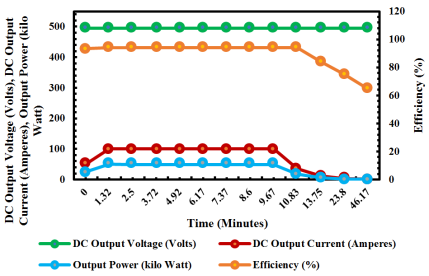
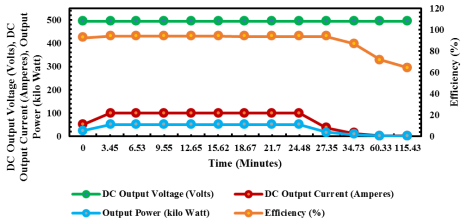
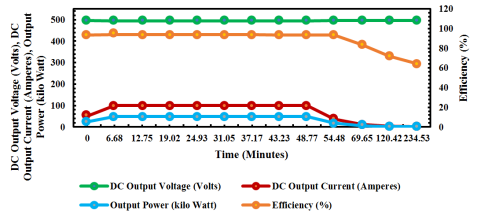
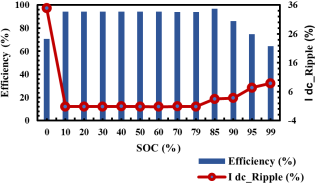
Figure 8. Output DC current ripple vs Efficiency plot for 5 kWh BC.
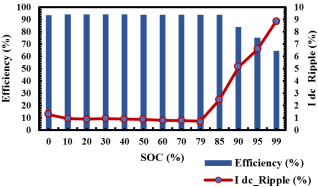
Figure 9. Output DC current ripple vs Efficiency plot for 10 kWh BC.
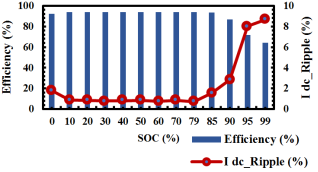
Figure . 10
. Output DC current ripple vs Efficiency plot for 25 kWh BC.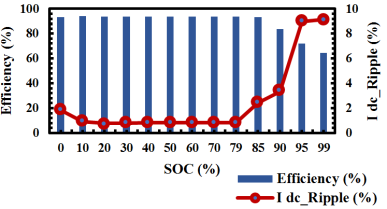
Figure 11. Output DC current ripple vs Efficiency plot for 50 kWh BC.
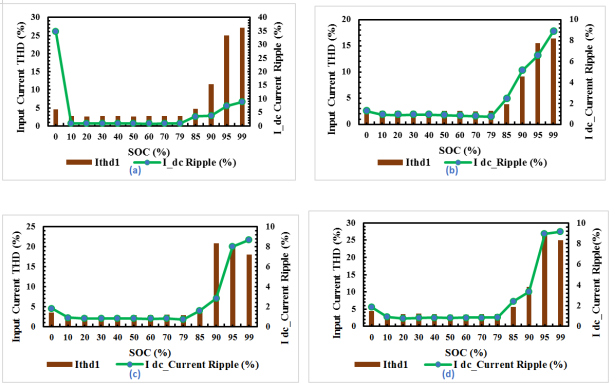
Figure 13. Variations of Input current THD for (a) 5 kWh, (b) 10 kWh, (c) 25 kWh, (d) 50 kWh Battery Capacit.
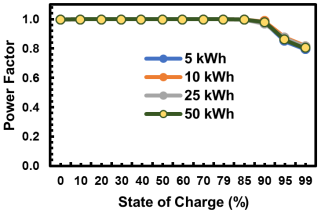
Figure 14. Effects of Ripple on Power factor for different Battery Capacities.
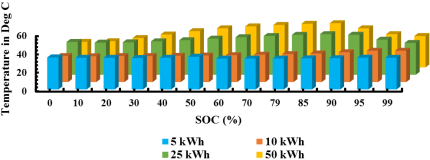
Figure 15. Temperature vs State of Charge for different Battery Capacities.

Information



 Share This Article
 Twitter
 Linked In
 Facebook
 Copy
Copy Download