
 ,
Ernesto Cabral Houehanou*,
Judicael Koffi Agbellele,
Ramdane Tchao,
Mohamed Gibigaye
This study assesses the suitability of aggregates from South Benin for self-compacting concrete (SCC) through a five-step approach: a georeferenced inventory of 75 sand and 39 gravel quarries; dimensional classification according to NF EN 12620; physical and mechanical characterization (density, water absorption, cleanliness, Los Angeles and Micro-Deval resistance); evaluation of aggregate behavior in concrete mixes; and a transparent multicriteria ranking. The results show strong heterogeneity. Lagoon sands, although abundant, have a low fineness modulus (2.10) and an insufficient sand equivalent (SE = 62%), and are unsuitable for SCC without treatment. Marine and Oumé alluvial sands (average SE of 72% and 68%) remain below the SE ≥ 80% recommended by EFNARC for SCC and require washing or blending. The chloride content of raw marine sand (0.09% of dry sand mass, i.e. 0.197% of cement mass in a 400 kg/m3 mix) complies with class Cl 0.40 but leaves almost no margin to class Cl 0.20, so washing is mandatory for prestressed or severely exposed concrete. Crushed basalt and granite show excellent mechanical performance (LA ≤ 22%, MDE ≤ 14%), whereas laterite is unsuitable for structural use. A weighted-sum multicriteria analysis (six criteria, weights of 15–20%) ranks crushed aggregates first (7.62/10), marginally ahead of marine sands (7.51/10), followed by alluvial sands (7.33/10) and lagoon sands (6.89/10); a full sensitivity analysis shows that lagoon sands rank last in all tested scenarios, whereas the order of the first two depends on the weights. A C30/37 SCC can be obtained by combining washed marine or alluvial sand with crushed gravel 5.6/16 or 10/20, a carboxylate superplasticizer, and a mineral addition (fc28 = 33–45 MPa). The originality of this work lies in cross-referencing a georeferenced deposit inventory with SCC-specific normative requirements and in proposing a transparent, reproducible multicriteria ranking tool for SCC mix design.
| Published in | Engineering and Applied Sciences (Volume 11, Issue 6) |
| DOI | 10.11648/j.eas.20261106.11 |
| Page(s) | 214-242 |
| Creative Commons |
This is an Open Access article, distributed under the terms of the Creative Commons Attribution 4.0 International License (http://creativecommons.org/licenses/by/4.0/), which permits unrestricted use, distribution and reproduction in any medium or format, provided the original work is properly cited. |
| Copyright |
Copyright © The Author(s), 2026. Published by Science Publishing Group |
Self-compacting Concrete (SCC), Tropical Aggregates, Mix Design Optimization, South Benin, Multicriteria Analysis, Chloride Content
Reference | Region / materials | Aggregate parameter studied | Main findings |
|---|---|---|---|
Khayat (1999) [6] | SCC, general | Particle shape and surface texture | Shape and texture affect plastic viscosity and segregation resistance. |
Domone (2006) [7] | 68 SCC mix designs from case studies | Aggregate mineralogy and Dmax | Regular calcareous aggregates favor workability; Dmax > 20 mm increases blocking risk. |
De Schutter et al. (2008) [8] | SCC, state of the art | Fragmentation resistance, absorption, volumetric stability | Strength and durability of SCC depend on the intrinsic quality of aggregates. |
Westerholm et al. (2008) [30] | Mortars, Sweden | Fine aggregate shape and fines | Particle shape and fines content influence mortar rheology. |
Benabed et al. (2012) [29] | Self-compacting mortars | Various sand types | Sand type affects the fresh and hardened properties of self-compacting mortars. |
Nanthagopalan and Santhanam (2011) [28] | SCC, India | Manufactured vs natural sand | Fresh and hardened behavior of SCC made with manufactured sand compared with natural sand. |
Bouziani (2013) [31] ; Bouziani et al. (2014) [23] | SCC, Algeria | River, crushed and dune sand blends | Crushed and dune sands raise sand packing density and J-ring flowability; T500 passing ability decreases with the proportion of crushed sand. |
Laoufi et al. (2020) [25] | Self-compacting mortars, Mascara (Algeria) | Three natural and three crushed sands | Crushed sands give a more compact skeleton and higher mechanical performance. |
Sooriyaarachchi and Lasintha (2016) [26] | SCC, Sri Lanka | River sand, quarry dust, offshore sand | Minimum fine-aggregate share of 50, 55 and 60% (offshore, river, quarry dust); offshore sand had the lowest water demand, quarry dust the highest 28-day strength. |
Sahraoui and Bouziani (2021) [24] | ANN on Algerian literature data | Sand and gravel types and contents | Higher gravel content lowers passing ability but raises viscosity, stability and strength. |
Khaoya et al. (2024) [27] | SCC, Kenya | Volcanic tuff replacing river sand (0–10%) | Flowability, passing ability and strength decrease as tuff content increases. |
Oluwasola et al. (2020) [18] | Review | Rounded vs crushed aggregates | Crushed aggregates raise compressive strength by 8–15% at equal cement content (as reported). |
Houehanou et al. (2026) [20] | SCC, southern Benin | 3 sands × 2 gravels (18 mixes) | Natural aggregates improve flowability; crushed aggregates improve strength; crushed sand + crushed gravel reduces passing ability. |
This study | South Benin; 75 sand and 39 gravel quarries inventoried | All aggregate families; NF EN 12620 classification; physical, mechanical and chloride tests | Georeferenced inventory, compliance with SCC requirements, transparent multicriteria ranking, and corrective treatments. |
Zone | Department | Sand type | Extraction method | Quality (SE%) | Construction uses |
|---|---|---|---|---|---|
Seme-Kpodji | Oueme | Alluvial / lagoon | Artisanal / dredging | 58-74 | Masonry, reinforced concrete |
Porto-Novo | Oueme | Fine lagoon | Artisanal | 55-68 | Masonry, mortar |
Cotonou (Nokoue) | Littoral | Medium lagoon | Floating dredge | 60-75 | Concrete, renders |
Ouidah | Atlantique | Coastal marine | Dredging / mechanical | 65-80 | Concrete, marine works |
Grand-Popo | Mono | Marine / fluvial | Artisanal | 68-83 | Ordinary concrete, backfill |
Come | Mono | Alluvial | Semi-mechanized | 62-76 | Concrete, mortar, pavements |
Lokossa | Mono | Alluvial (Mono) | Artisanal / mechanical | 65-78 | Structural concrete |
Abomey-Calavi | Atlantique | Lagoon / CT | Artisanal | 52-67 | Masonry, backfill |
Sô-Ava | Atlantique | Very fine lagoon | Artisanal | 48-60 | Mortar, backfill |
Dangbo | Oueme | Oueme alluvial | Semi-mechanized | 68-80 | Reinforced concrete, pavements |
Deposit type | Location | Estimated volume (Mm3) | Dominant particle size | SE average (%) | Exploitation status |
|---|---|---|---|---|---|
Alluvial (Oueme) | Dangbo, Adjohoun, Seme | 50-100 | 0.125-4 mm | 68-80 | Semi-industrial / artisanal |
Alluvial (Mono) | Lokossa, Come, Grand-Popo | 15-30 | 0.25-2 mm | 65-78 | Predominantly artisanal |
Lagoon (Nokoue) | Cotonou, Abomey-Calavi | 20-50 | 0.063-1 mm | 55-68 | Artisanal (dredging) |
Lagoon (Porto-Novo) | Porto-Novo, Seme-Kpodji | 10-20 | 0.063-0.5 mm | 52-65 | Artisanal |
Coastal marine | Grand-Popo, Ouidah, Cotonou | 5-15 | 0.125-0.5 mm | 68-83 | Semi-mechanized (dredging) |
Continental Terminal | Allada, Toffo, Kpomasse | 2-8 | 0.063-0.5 mm | 45-75 | Occasional artisanal |
Crushed aggregates (imported) | Crushing units, Cotonou area | N/A | 0-31.5 mm | - | Industrial (imported) |
Logistical constraint | Materials concerned | Consequence for SCC | Mitigation adopted or recommended |
|---|---|---|---|
No hard-rock outcrop in the coastal sedimentary basin | Crushed gravel 5.6/16 and 10/20 (basalt, granite, gneiss; imports from Togo) | Long road supply chains, higher delivered cost and transport-related CO₂ emissions; dependence on a few industrial quarries | Qualify at least two sources; keep stockpile buffers; use the 5.6/16 fraction, available through import channels or crushing units near Cotonou |
Artisanal or semi-mechanized extraction; seasonal hydrology | Alluvial and lagoon sands (Mf 1.80–3.00; SE 52–78%) | Batch-to-batch variability of grading and cleanliness, hence fluctuating water demand and superplasticizer dosage | Grading and SE control at each delivery; dry- and rainy-season sampling; blending of lagoon sand with a coarser sand |
Fine and clayey fractions | Lagoon sands (SE 62%, VBs up to 1.2 g/100 g) and manufactured sand 0/4 (fines 12%) | Higher water and superplasticizer demand, loss of flowability, risk of blocking | Washing, dedusting or screening; particle-size blending to reach SE ≥ 80% |
Salt contamination of coastal deposits | Marine and coastal sands (0.09% Cl⁻ of dry sand mass) | Reinforcement corrosion risk; margin to class Cl 0.20 almost nil | Fresh-water washing with settling and drainage areas; chloride test (NF EN 1744-1) on every batch |
Variable moisture and limited traceability of stockpiles | All natural sands | Moisture changes alter the effective water content and the rheology of SCC | Saturated surface-dry preparation and moisture correction before batching; sample coding [Type]-[Site]-[Season or Batch]-[Number] |
Category | d/D notation | D (mm) | Main use | Local examples |
|---|---|---|---|---|
Filler aggregate | 0/0.063 | 0.063 | Compacity additive | Crushing fines, lagoon sediments |
Very fine sand (fine aggregate) | 0/1 | 1 | Mortar, render | Nokoue lagoon sands |
Fine sand | 0/2 | 2 | Ordinary concrete, mortar | Fine lagoon and marine sands |
Medium-to-coarse sand | 0/4 | 4 | Reinforced concrete, pavements | Alluvial sands (Oueme, Mono) |
Fine gravel (coarse aggregate) | 4/8 or 4/10 | 8–10 | SCC, high-performance concrete | Imported crushed gravel |
Medium gravel | 8/16 or 5.6/16 | 16 | Ordinary reinforced concrete | Crushed gravel (central and northern Benin quarries) |
Coarse gravel | 16/31.5 or 20/40 | 31.5–40 | Mass concrete, foundations | Imported crushed gravel |
All-in aggregate 0/20 | 0/20 | 20 | Road sub-base, unbound granular material | Crushed graded aggregate (northern Benin quarries) |
All-in aggregate 0/31.5 | 0/31.5 | 31.5 | Road base course | Imported crushed graded aggregate |
Material / Sieve (mm) | 0.063 | 0.125 | 0.250 | 0.500 | 1.000 | 2.000 | 4.000 | 8.000 |
|---|---|---|---|---|---|---|---|---|
Lagoon sand | 2% | 5% | 18% | 55% | 82% | 96% | 99% | 100% |
Marine sand | 1% | 3% | 12% | 38% | 68% | 90% | 98% | 100% |
Alluvial sand | 3% | 7% | 22% | 60% | 85% | 95% | 99% | 100% |
Manufactured sand | 8% | 15% | 35% | 58% | 76% | 88% | 96% | 100% |
Gravel 5.6/16 | 0% | 0% | 1% | 2% | 5% | 12% | 40% | 82% |
Gravel 10/20 | 0% | 0% | 0% | 1% | 2% | 5% | 18% | 55% |
Upper NF envelope | 10% | 20% | 55% | 90% | 100% | 100% | 100% | 100% |
Lower NF envelope | 0% | 0% | 5% | 25% | 55% | 80% | 95% | 100% |
Sand type | Mf min | Average Mf | Mf max | Range | Compliance (2.2-2.8) | Recommendation |
|---|---|---|---|---|---|---|
Lagoon sand (Nokoue) | 1.80 | 2.10 | 2.50 | 0.70 | Partial | Blending with coarser sand required |
Marine sand (Cotonou) | 2.00 | 2.40 | 2.80 | 0.80 | Compliant | Anti-chloride washing mandatory |
Alluvial sand (Oueme) | 2.20 | 2.60 | 3.00 | 0.80 | Compliant | Direct use possible |
Alluvial sand (Mono) | 2.10 | 2.50 | 2.90 | 0.80 | Compliant | Direct use possible |
Manufactured sand 0/4 | 2.40 | 2.80 | 3.20 | 0.80 | Compliant/marginal | Check fines content (< 12%) |
Dune sand (coastal) | 1.50 | 1.80 | 2.20 | 0.70 | Non-compliant | Not recommended for reinforced concrete |
Property / Aggregate | Lagoon sand | Marine sand | Alluvial sand | Manufactured sand | Rounded gravel 5.6/16 | Crushed gravel 10/20 |
|---|---|---|---|---|---|---|
ρs particle density (t/m3) | 2.59 | 2.62 | 2.61 | 2.65 | 2.67 | 2.68 |
ρap (t/m3) | 1.42 | 1.48 | 1.45 | 1.52 | 1.58 | 1.62 |
WA (%) | 1.8 | 1.2 | 1.5 | 2.2 | 0.9 | 0.7 |
Porosity (%) | 3.5 | 2.8 | 3.0 | 4.2 | 2.1 | 1.8 |
VBs (g/100g) | 0.8 | 0.5 | 0.7 | 1.2 | 0.4 | 0.3 |
Fines < 0.063 mm (%) | 8 | 4 | 6 | 12 | 2 | 1 |
Conf. WA | OK | OK | OK | Out of threshold | OK | OK |
Conf. VBs | OK | OK | OK | Out of threshold | OK | OK |
Property / Aggregate | Lagoon sand | Marine sand | Alluvial sand | Manufactured sand | Beach sand |
|---|---|---|---|---|---|
ES min (%) | 52 | 60 | 58 | 45 | 65 |
ES moy (%) | 62 | 72 | 68 | 56 | 78 |
ES max (%) | 74 | 83 | 78 | 68 | 88 |
Standard deviation | 5.5 | 5.75 | 5.0 | 5.75 | 5.75 |
RC threshold (70%) | 70 | 70 | 70 | 70 | 70 |
NRC threshold (60%) | 60 | 60 | 60 | 60 | 60 |
RC compliance | Washing required | Compliant (avg.) | Washing required | Non-compliant | Compliant |
Property / Aggregate | Rounded gravel 4/10 | Rounded gravel 10/20 | Crushed gravel 4/10 | Crushed gravel 10/20 | Crushed gravel 16/22.4 | Crushed graded aggregate 0/20 |
|---|---|---|---|---|---|---|
Origin | Rounded | Rounded | Crushed | Crushed | Crushed | Crushed |
IA min (%) | 7 | 9 | 16 | 18 | 20 | 15 |
IA moy (%) | 10 | 12 | 22 | 25 | 28 | 20 |
IA max (%) | 14 | 16 | 28 | 32 | 35 | 28 |
CB moy (%) | 12 | 15 | 18 | 22 | 24 | 18 |
FI threshold (35%) | 35 | 35 | 35 | 35 | 35 | 35 |
FI compliance | Pavement OK | Pavement OK | Pavement OK | Pavement OK | Concrete only | Pavement OK |
Optimal use | Ordinary concrete, SCC | Reinforced concrete, SCC | Reinforced concrete, high-performance concrete | Ordinary reinforced concrete | Ordinary concrete | Base course, unbound granular material |
Rock type / aggregate | LA (%) | MDE (%) | Mohs hardness (approx.) | NF EN 12620 class | Suitability for structural concrete |
|---|---|---|---|---|---|
Basalt (Atacora) | 15-22 | 10-14 | 6-7 | LA25 / MDE15 | Excellent: all uses |
Granite compact (Zou) | 18-26 | 14-18 | 6-7 | LA25 / MDE20 | Very good: reinforced concrete |
Gneiss (periphery) | 20-28 | 16-22 | 5-7 | LA25 / MDE25 | Good: ordinary concrete |
Limestone (imported) | 25-32 | 18-26 | 3-4 | LA35 / MDE25 | Acceptable: unreinforced concrete |
Siliceous sandstone | 28-38 | 22-30 | 5-6 | LA40 / MDE30 | Marginal: avoid in structural use |
Compact laterite | 35-45 | 28-38 | 4-5 | Unclassified | Insufficient: backfill only |
Crushed aggregates (imported from Togo) | 18-24 | 12-18 | 6-7 | LA25 / MDE20 | Very good: reinforced concrete |
Concrete mix | W/C | Cement (kg/m3) | Effective water (L/m3) | Additions (kg/m3) | Superplasticizer (% of cement mass) |
|---|---|---|---|---|---|
Lagoon sand | 0.60 | 320 | 192 | — | 0.4 |
Washed marine sand | 0.58 | 340 | 197 | — | 0.5 |
Alluvial sand | 0.55 | 360 | 198 | — | 0.6 |
Crushed aggregates | 0.50 | 380 | 190 | — | 0.8 |
High-performance concrete (crushed + additions) | 0.35* | 450 | 175 | Silica fume: 50 | 1.8 |
SCC, marine sand + crushed gravel | 0.42 | 400 | 168 | Limestone filler: 150 | 1.1 |
Mix / Age (days) | 7 | 14 | 28 | 56 | 90 | NF EN 206 class |
|---|---|---|---|---|---|---|
Lagoon sand (W/C=0.60) | 12 | 18 | 23 | 26 | 27 | C20/25 |
Washed marine sand (W/C=0.58) | 15 | 21 | 27 | 30 | 31 | C25/30 |
Alluvial sand (W/C=0.55) | 16 | 23 | 29 | 32 | 33 | C25/30 |
Crushed aggregates (W/C=0.50) | 20 | 28 | 35 | 39 | 41 | C30/37 |
High-performance concrete, crushed + additions (W/C=0.35) | 25 | 35 | 45 | 52 | 55 | C45/55 |
SCC, marine + crushed (W/C=0.42) | 18 | 24 | 33 | 38 | 40 | C30/37 |
Aggregate (sand/gravel) | W/C | fc28 (MPa) | E (GPa) | WA concrete (%) | Durability class (NF EN 206) |
|---|---|---|---|---|---|
Lagoon sand + crushed gravel | 0.60 | 21-26 | 28-32 | 6.5-9.0 | XC2 (carbonation) |
Washed marine sand + crushed gravel | 0.58 | 26-31 | 30-34 | 5.0-7.0 | XC3/XD1 (chlorides) |
Alluvial sand + crushed gravel | 0.55 | 29-34 | 32-36 | 4.5-6.5 | XC3/XS1 |
Manufactured sand + crushed gravel | 0.50 | 34-41 | 34-40 | 3.5-5.0 | XC4/XS2 |
High-performance concrete: crushed gravel + SF + SP | 0.35 | 45 | 40-48 | 2.0-3.5 | XC4/XS3 — very durable |
SCC: marine sand + crushed gravel | 0.42 | 33-45 | 35-42 | 3.0-4.5 | XC3/XD2 |
Durability indicator | Method / standard | Value | Benchmark | Assessment and origin |
|---|---|---|---|---|
Water-soluble chloride content of raw marine sand | NF EN 1744-1 | 0.09% of dry sand mass (mean) | — | Measured in this study |
Chloride brought by the sand in the SCC mix (875 kg/m3 sand, 400 kg/m3 cement) | Eq. (1) | 0.7875 kg/m3, i.e. 0.197% of cement mass | Cl 0.40: 0.40%; Cl 0.20: 0.20% | Complies with Cl 0.40 (49% of limit); marginal for Cl 0.20 (98% of limit) — calculated from measured value |
Maximum sand chloride content compatible with the class (sand as sole source) | Calculation | 0.183% (Cl 0.40); 0.091% (Cl 0.20) of dry sand mass | — | Measured value (0.09%) is at the Cl 0.20 limit |
Chloride diffusion coefficient | NT Build 492 | 8–25 × 10-12 m2/s (unwashed lagoon sand); 3–10 × 10-12 m2/s (crushed aggregates) | Lower = better | Literature [15] , not measured here |
Water absorption of concrete | 2.0–9.0% | Lower = better | Increases from high-performance to lagoon-sand concrete (Table 14) | |
Aggregate water absorption and porosity | NF EN 1097-6 | WA 0.7–2.2%; porosity 1.8–4.2% | WA ≤ 2% | Manufactured sand out of threshold (2.2%); measured (Table 8) |
Aggregate cleanliness (SE; VBs) | NF EN 933-8, 933-9 | SE 56–78%; VBs 0.3–1.2 g/100 g | SE ≥ 80% (SCC); VBs ≤ 1.0 g/100 g | Washing or blending required; measured (Tables 8 and 9) |
Fragmentation and wear resistance | NF EN 1097-2, 1097-1 | LA 15–45%; MDE 10–38% | LA ≤ 30%; MDE ≤ 20% | Basalt, granite comply; laterite does not; measured (Table 11) |
Exposure classes of the reference concretes | NF EN 206 | XC2 to XS3 | — | See Table 14 |
Alkali–aggregate reactivity; carbonation depth | — | Not assessed | — | Research perspective (Section 5) |
Criterion j | Indicator and standard | Preferred direction | Weight wj (%) | Normative benchmark | Rationale |
|---|---|---|---|---|---|
1. Cleanliness (SE/VBs) | Sand equivalent SE,% (NF EN 933-8); VBs (NF EN 933-9) used as compliance check | Higher | 15 | SE ≥ 70% (reinforced concrete); SE ≥ 80% (SCC); VBs ≤ 1.0 g/100 g | Active fines increase water and superplasticizer demand |
2. Mechanical strength (LA) | Los Angeles coefficient LA,% (NF EN 1097-2) | Lower | 20 | LA ≤ 30 (SCC, EFNARC); categories LA20 to LA40 (NF EN 12620) | Governs strength and durability of hardened concrete |
3. Optimal grading (Mf) | Fineness modulus Mf (NF EN 933-1) | Within 2.2–2.8 | 15 | 2.2 ≤ Mf ≤ 2.8 | Governs water demand, packing, and stability |
4. Shape (FI) | Flakiness index FI,% (NF EN 933-3) | Lower | 15 | FI ≤ 20 (SCC, EFNARC); FI25, FI35 | Governs viscosity and blocking risk |
5. Low absorption (WA) | Water absorption WA24,% (NF EN 1097-6) | Lower | 20 | WA ≤ 2% | Governs effective water, W/C ratio, and durability |
6. Particle density (ρs) | Particle density ρs, t/m3 (NF EN 1097-6) | Higher | 15 | ρs ≥ 2.60 t/m3 | Governs absolute volumes, paste demand, and soundness |
Quality criterion | Weight (%) | Lagoon sand | Marine sand | Alluvial sand | Crushed aggregates |
|---|---|---|---|---|---|
Cleanliness (SE/VBs) | 15 | 6.2 | 7.2 | 6.8 | 5.6 |
Mechanical strength (LA) | 20 | 6.0 | 6.5 | 6.8 | 8.5 |
Optimal grading (Mf) | 15 | 5.8 | 6.5 | 7.0 | 7.5 |
Shape (FI index) | 15 | 8.5 | 8.8 | 8.0 | 6.0 |
Low absorption (WA) | 20 | 7.2 | 8.0 | 7.5 | 8.5 |
Particle density (ρs) | 15 | 7.8 | 8.2 | 8.0 | 9.0 |
Weighted score /10 | 100 | 6.89 | 7.51 | 7.33 | 7.62 |
Ranking | - | 4th | 2nd | 3rd | 1st |
Indicator | Scoring rule | Lagoon sand: x → s (computed) | Marine sand: x → s (computed) | Alluvial sand: x → s (computed) | Crushed aggregates: x → s (computed) |
|---|---|---|---|---|---|
SE (%) | s = SE/10 | 62 → 6.2 | 72 → 7.2 | 68 → 6.8 | 56ᵃ → 5.6 |
LA (%) | Coarse aggregates only | proxyᵇ → 6.0 | proxyᵇ → 6.5 | proxyᵇ → 6.8 | 18–22 → 8.5 |
Mf | s = 2.43·Mf + 0.69 | 2.10 → 5.8 (5.79) | 2.40 → 6.5 (6.52) | 2.60 → 7.0 (7.01) | 2.80ᵃ → 7.5 (7.49) |
FI (%) | Coarse aggregates only | proxyᵇ → 8.5 | 10–12ᵇ → 8.8 | proxyᵇ → 8.0 | 22–25 → 6.0 |
WA (%) | s = 9.38 − 1.21·WA | 1.8 → 7.2 (7.20) | 1.2 → 8.0 (7.93) | 1.5 → 7.5 (7.57) | 0.7ᶜ → 8.5 (8.53) |
ρs (t/m3) | s = 14.43·ρs − 29.60 | 2.59 → 7.8 (7.77) | 2.62 → 8.2 (8.21) | 2.61 → 8.0 (8.06) | 2.68ᶜ → 9.0 (9.07) |
Criterion | Weight w_j | Lagoon sand | Marine sand | Alluvial sand | Crushed aggregates |
|---|---|---|---|---|---|
Cleanliness (SE/VBs) | 0.15 | 0.930 | 1.080 | 1.020 | 0.840 |
Mechanical strength (LA) | 0.20 | 1.200 | 1.300 | 1.360 | 1.700 |
Optimal grading (Mf) | 0.15 | 0.870 | 0.975 | 1.050 | 1.125 |
Shape (FI) | 0.15 | 1.275 | 1.320 | 1.200 | 0.900 |
Low absorption (WA) | 0.20 | 1.440 | 1.600 | 1.500 | 1.700 |
Particle density (ρs) | 0.15 | 1.170 | 1.230 | 1.200 | 1.350 |
Sum S_i = Σ w_j·s_ij | 1.00 | 6.885 | 7.505 | 7.330 | 7.615 |
Overall score /10 (rounded) | — | 6.89 | 7.51 | 7.33 | 7.62 |
Rank | — | 4th | 2nd | 3rd | 1st |
Weighting scenario | Lagoon sand | Marine sand | Alluvial sand | Crushed aggregates | Ranking (1st > 4th) |
|---|---|---|---|---|---|
Baseline (Table 16) | 6.89 | 7.51 | 7.33 | 7.62 | Crushed > Marine > Alluvial > Lagoon |
Equal weights (16.7% each) | 6.92 | 7.53 | 7.35 | 7.52 | Marine > Crushed > Alluvial > Lagoon |
Cleanliness (SE) weight = 10% | 6.93 | 7.52 | 7.36 | 7.73 | Crushed > Marine > Alluvial > Lagoon |
Cleanliness (SE) weight = 30% | 6.76 | 7.45 | 7.24 | 7.26 | Marine > Crushed > Alluvial > Lagoon |
Strength (LA) weight = 10% | 7.00 | 7.63 | 7.40 | 7.50 | Marine > Crushed > Alluvial > Lagoon |
Strength (LA) weight = 30% | 6.77 | 7.38 | 7.26 | 7.73 | Crushed > Marine > Alluvial > Lagoon |
Grading (Mf) weight = 10% | 6.95 | 7.56 | 7.35 | 7.62 | Crushed > Marine > Alluvial > Lagoon |
Grading (Mf) weight = 30% | 6.69 | 7.33 | 7.27 | 7.59 | Crushed > Marine > Alluvial > Lagoon |
Shape (FI) weight = 10% | 6.79 | 7.43 | 7.29 | 7.71 | Crushed > Marine > Alluvial > Lagoon |
Shape (FI) weight = 30% | 7.17 | 7.73 | 7.45 | 7.33 | Marine > Alluvial > Crushed > Lagoon |
Absorption (WA) weight = 10% | 6.85 | 7.44 | 7.31 | 7.50 | Crushed > Marine > Alluvial > Lagoon |
Absorption (WA) weight = 30% | 6.92 | 7.57 | 7.35 | 7.73 | Crushed > Marine > Alluvial > Lagoon |
Density (ρs) weight = 10% | 6.83 | 7.46 | 7.29 | 7.53 | Crushed > Marine > Alluvial > Lagoon |
Density (ρs) weight = 30% | 7.05 | 7.63 | 7.45 | 7.86 | Crushed > Marine > Alluvial > Lagoon |
Random weights (10,000 draws): mean ± SD | 6.92 ± 0.38 | 7.54 ± 0.33 | 7.35 ± 0.20 | 7.52 ± 0.49 | 1st: crushed 51%, marine 48%; last: lagoon 83%, crushed 17% |
AHP | Analytic Hierarchy Process |
ANOVA | Analysis of Variance |
Dmax | Maximum Aggregate Size |
EFNARC | European Federation of Producers and Applicators of Specialist Products for Structures |
EI | Elongation Index |
FI | Flakiness Index |
GIS | Geographic Information System |
ITZ | Interfacial Transition Zone |
LA | Los Angeles Coefficient |
MDE | Micro-Deval Coefficient |
Mf | Fineness Modulus |
SCC | Self-compacting Concrete |
SE | Sand Equivalent |
SSD | Saturated Surface-dry |
TOPSIS | Technique for Order of Preference by Similarity to Ideal Solution |
VBs | Methylene Blue Value |
WA | Water Absorption |
W/C | Water-to-cement Ratio |
| [1] | Okamura, H., Ouchi, M., Ozawa, K. Beton autoplaçant. Beton structural. 2000, 1(1), 3-15. |
| [2] | EFNARC. The European Guidelines for Self-Compacting Concrete: Specification, Production and Use. Farnham (UK): European Federation of Producers and Applicators of Specialist Products for Structures; 2005. |
| [3] |
Okamura, H. Beton autoplaçant haute performance. Concrete International. 1997, 19(7), 50-54.
https://www.concrete.org/publications/internationalconcreteabstractsportal/m/details/id/52 |
| [4] |
Okamura, H., Ouchi, M. Self-compacting concrete. Development, present use and future. In Proceedings of the 1st International RILEM Symposium on Self-Compacting Concrete, Stockholm, Sweden, 1999; RILEM Publications; pp. 3-14.
https://www.scirp.org/reference/referencespapers?referenceid=834143 |
| [5] |
EFNARC. Specification and Guidelines for Self-Compacting Concrete. Farnham (UK): European Federation of Producers and Applicators of Specialist Products for Structures; 2002.
https://www.scirp.org/reference/referencespapers?referenceid=4272899 |
| [6] | Khayat, K. H. Workability, testing, and performance of self-consolidating concrete. ACI Materials Journal. 1999, 96(3), 346-353. |
| [7] | Domone, P. L. Self-compacting concrete: An analysis of 11 years of case studies. Cement and Concrete Composites. 2006, 28(2), 197-208. |
| [8] | De Schutter, G., Bartos, P., Domone, P., Gibbs, J. Self-compacting concrete. Caithness (UK): Whittles Publishing; 2008. |
| [9] |
Mehta, P. K., Monteiro, P. J. M. Concrete: Microstructure, Properties, and Materials. 3rd ed. McGraw-Hill; 2006.
https://www.scirp.org/reference/referencespapers?referenceid=2281427 |
| [10] |
Mehta, P. K., Monteiro, P. J. M. Concrete: Microstructure, Properties, and Materials. 4th ed. New York: McGraw-Hill Education; 2014.
https://www.scirp.org/reference/referencespapers?referenceid=4139326 |
| [11] | Rapport EIES: Projet d'exploitation de carriere de concassage de granite à Iwoye, arrondissement d'Idigny, commune de Ketou. Available from: |
| [12] | Ahouannou, C. Dispositif de tests de contrôle de qualite des caracteristiques mecaniques de tuiles en micro-beton; 2017. |
| [13] |
Hessouh. Caracterisations physique et mecanique, et durabilite des betons de sol: materiaux de laboratoire et materiaux de chantiers. HAL; 2021.
https://theses.hal.science/tel-03635416v1/file/93320_HESSOUH_2021_archivage.pdf |
| [14] | Kossi, B. A. Caracterisation Geotechnique Du Sable Silteux Utilise En Couche De Chaussee Au Sud Du Togo Et Du Benin. ResearchGate; 2016. |
| [15] | BCG. Infrastructures et BTP au Benin: comment BCG accompagne les projets de construction nationaux avec des granulats aux normes ISO. Available from: |
| [16] | Tanesi, J., Benz, D. P., Scott Z., Mengesha, B. Influence of Aggregate Properties on Concrete Mechanical Performance. ResearchGate; 2017. |
| [17] |
Neville, A. M. Properties of Concrete. 5th ed. Harlow (UK): Pearson Education; 2011.
https://www.scirp.org/reference/referencespapers?referenceid=2593644 |
| [18] | Oluwasola, E. A., Oginni, A. O., Ipindola, O. Effect of Aggregate Shapes on the Properties of Concrete. ResearchGate; 2020. |
| [19] | Aïtcin, P.-C. Science and Technology of Concrete Admixtures. Woodhead Publishing / Elsevier; 2016. |
| [20] | Houehanou, E. C. et al. Influence du type et de la morphologie des granulats locaux sur les proprietes rheologiques et mecaniques du beton autoplaçant en conditions tropicales. Modern Mechanical Engineering. 2026, 16, 1-18. |
| [21] |
Aitcin, P.-C. Binders for Durable and Sustainable Concrete. Modern Concrete Technology Series No. 16. Boca Raton: CRC Press; 2007.
https://www.scirp.org/reference/referencespapers?referenceid=1334613 |
| [22] | Saaty, T. L. The Analytic Hierarchy Process: Planning, Priority Setting, Resource Allocation. New York: McGraw-Hill; 1980. |
| [23] | Bouziani, T., Bédérina, M., Makhloufi, Z., Hadjoudja, M. Mixture design approach to evaluate fresh properties of SCC made with various sands. Journal of Building Materials and Structures. 2014, 1(1), 1-9. |
| [24] | Sahraoui, M., Bouziani, T. ANN modelling approach for predicting SCC properties - Research considering Algerian experience. Part II. Effects of aggregates types and contents. Journal of Building Materials and Structures. 2021, 8(1). |
| [25] | Laoufi, L., Senhadji, Y., Laoufi, I., Benazzouk, A. Effect of the sands close to the Mascara region in the manufacture of self-compacting mortars. Journal of Fundamental and Applied Sciences. 2020, 12(2). |
| [26] | Sooriyaarachchi, H. P., Lasintha, E. D. L. Influence of fine aggregate types on the performance of self-compacting concrete. Engineer: Journal of the Institution of Engineers, Sri Lanka. 2016, 49(1), 9-20. |
| [27] | Khaoya, L. M., Abuodha, S., Mwero, J. N. Effects of volcanic tuff use on the rheological and mechanical properties of self-compacting concrete. Diyala Journal of Engineering Sciences. September 2024. |
| [28] | Nanthagopalan, P., Santhanam, M. Fresh and hardened properties of self-compacting concrete produced with manufactured sand. Cement and Concrete Composites. 2011, 33(3), 353-358. |
| [29] | Benabed, B., Kadri, E.-H., Azzouz, L., Kenai, S. Properties of self-compacting mortar made with various types of sand. Cement and Concrete Composites. 2012, 34(10), 1167-1173. |
| [30] | Westerholm, M., Lagerblad, B., Silfwerbrand, J., Forssberg, E. Influence of fine aggregate characteristics on the rheological properties of mortars. Cement and Concrete Composites. 2008, 30(4), 274-282. |
| [31] | Bouziani, T. Assessment of fresh properties and compressive strength of self-compacting concrete made with different sand types by mixture design modelling approach. Construction and Building Materials. 2013, 49, 308-314. |
| [32] | EN 206:2013+A2:2021. Concrete - Specification, performance, production and conformity. Brussels: European Committee for Standardization (CEN); 2021. |
| [33] | EN 1744-1:2009+A1:2012. Tests for chemical properties of aggregates - Part 1: Chemical analysis. Brussels: CEN; 2012. |
| [34] | NF EN 12620+A1:2008. Aggregates for concrete. Saint-Denis La Plaine: AFNOR; 2008. |
| [35] | Narayana Rao, U. V., Naga Satish Kumar, Ch. Mechanical properties of high strength self compacting concrete based on rheological mix proportioning. Civil and Environmental Engineering. 2023, 19(1), 260-270. |
APA Style
Ayena, V. S., Houehanou, E. C., Agbellele, J. K., Tchao, R., Gibigaye, M. (2026). Assessment of the Suitability of Aggregates from Southern Benin for Self-Compacting Concrete Production: Characterization, Normative Classification and Multicriteria Comparison. Engineering and Applied Sciences, 11(6), 214-242. https://doi.org/10.11648/j.eas.20261106.11
ACS Style
Ayena, V. S.; Houehanou, E. C.; Agbellele, J. K.; Tchao, R.; Gibigaye, M. Assessment of the Suitability of Aggregates from Southern Benin for Self-Compacting Concrete Production: Characterization, Normative Classification and Multicriteria Comparison. Eng. Appl. Sci. 2026, 11(6), 214-242. doi: 10.11648/j.eas.20261106.11
AMA Style
Ayena VS, Houehanou EC, Agbellele JK, Tchao R, Gibigaye M. Assessment of the Suitability of Aggregates from Southern Benin for Self-Compacting Concrete Production: Characterization, Normative Classification and Multicriteria Comparison. Eng Appl Sci. 2026;11(6):214-242. doi: 10.11648/j.eas.20261106.11
@article{10.11648/j.eas.20261106.11,
  author = {Valerico Sewade Ayena and Ernesto Cabral Houehanou and Judicael Koffi Agbellele and Ramdane Tchao and Mohamed Gibigaye},
  title = {Assessment of the Suitability of Aggregates from Southern Benin for Self-Compacting Concrete Production: Characterization, Normative Classification and Multicriteria Comparison},
  journal = {Engineering and Applied Sciences},
  volume = {11},
  number = {6},
  pages = {214-242},
  doi = {10.11648/j.eas.20261106.11},
  url = {https://doi.org/10.11648/j.eas.20261106.11},
  eprint = {https://article.sciencepublishinggroup.com/pdf/10.11648.j.eas.20261106.11},
  abstract = {This study assesses the suitability of aggregates from South Benin for self-compacting concrete (SCC) through a five-step approach: a georeferenced inventory of 75 sand and 39 gravel quarries; dimensional classification according to NF EN 12620; physical and mechanical characterization (density, water absorption, cleanliness, Los Angeles and Micro-Deval resistance); evaluation of aggregate behavior in concrete mixes; and a transparent multicriteria ranking. The results show strong heterogeneity. Lagoon sands, although abundant, have a low fineness modulus (2.10) and an insufficient sand equivalent (SE = 62%), and are unsuitable for SCC without treatment. Marine and Oumé alluvial sands (average SE of 72% and 68%) remain below the SE ≥ 80% recommended by EFNARC for SCC and require washing or blending. The chloride content of raw marine sand (0.09% of dry sand mass, i.e. 0.197% of cement mass in a 400 kg/m3 mix) complies with class Cl 0.40 but leaves almost no margin to class Cl 0.20, so washing is mandatory for prestressed or severely exposed concrete. Crushed basalt and granite show excellent mechanical performance (LA ≤ 22%, MDE ≤ 14%), whereas laterite is unsuitable for structural use. A weighted-sum multicriteria analysis (six criteria, weights of 15–20%) ranks crushed aggregates first (7.62/10), marginally ahead of marine sands (7.51/10), followed by alluvial sands (7.33/10) and lagoon sands (6.89/10); a full sensitivity analysis shows that lagoon sands rank last in all tested scenarios, whereas the order of the first two depends on the weights. A C30/37 SCC can be obtained by combining washed marine or alluvial sand with crushed gravel 5.6/16 or 10/20, a carboxylate superplasticizer, and a mineral addition (fc28 = 33–45 MPa). The originality of this work lies in cross-referencing a georeferenced deposit inventory with SCC-specific normative requirements and in proposing a transparent, reproducible multicriteria ranking tool for SCC mix design.},
 year = {2026}
}
TY  - JOUR
T1  - Assessment of the Suitability of Aggregates from Southern Benin for Self-Compacting Concrete Production: Characterization, Normative Classification and Multicriteria Comparison
AU  - Valerico Sewade Ayena
AU  - Ernesto Cabral Houehanou
AU  - Judicael Koffi Agbellele
AU  - Ramdane Tchao
AU  - Mohamed Gibigaye
Y1  - 2026/11/24
PY  - 2026
N1  - https://doi.org/10.11648/j.eas.20261106.11
DO  - 10.11648/j.eas.20261106.11
T2  - Engineering and Applied Sciences
JF  - Engineering and Applied Sciences
JO  - Engineering and Applied Sciences
SP  - 214
EP  - 242
PB  - Science Publishing Group
SN  - 2575-1468
UR  - https://doi.org/10.11648/j.eas.20261106.11
AB  - This study assesses the suitability of aggregates from South Benin for self-compacting concrete (SCC) through a five-step approach: a georeferenced inventory of 75 sand and 39 gravel quarries; dimensional classification according to NF EN 12620; physical and mechanical characterization (density, water absorption, cleanliness, Los Angeles and Micro-Deval resistance); evaluation of aggregate behavior in concrete mixes; and a transparent multicriteria ranking. The results show strong heterogeneity. Lagoon sands, although abundant, have a low fineness modulus (2.10) and an insufficient sand equivalent (SE = 62%), and are unsuitable for SCC without treatment. Marine and Oumé alluvial sands (average SE of 72% and 68%) remain below the SE ≥ 80% recommended by EFNARC for SCC and require washing or blending. The chloride content of raw marine sand (0.09% of dry sand mass, i.e. 0.197% of cement mass in a 400 kg/m3 mix) complies with class Cl 0.40 but leaves almost no margin to class Cl 0.20, so washing is mandatory for prestressed or severely exposed concrete. Crushed basalt and granite show excellent mechanical performance (LA ≤ 22%, MDE ≤ 14%), whereas laterite is unsuitable for structural use. A weighted-sum multicriteria analysis (six criteria, weights of 15–20%) ranks crushed aggregates first (7.62/10), marginally ahead of marine sands (7.51/10), followed by alluvial sands (7.33/10) and lagoon sands (6.89/10); a full sensitivity analysis shows that lagoon sands rank last in all tested scenarios, whereas the order of the first two depends on the weights. A C30/37 SCC can be obtained by combining washed marine or alluvial sand with crushed gravel 5.6/16 or 10/20, a carboxylate superplasticizer, and a mineral addition (fc28 = 33–45 MPa). The originality of this work lies in cross-referencing a georeferenced deposit inventory with SCC-specific normative requirements and in proposing a transparent, reproducible multicriteria ranking tool for SCC mix design.
VL  - 11
IS  - 6
ER  -
Doctoral School of Science Technology Engineering and Mathematics, National University of Sciences Technologies Engineering and Mathematics, Abomey, Benin
Biography: Valerico Sewade Ayena is a Beninese civil engineer and final-year PhD student at the Doctoral School of Science, Technology, Engineering and Mathematics (ED-STIM) of the National University of Sciences, Technologies, Engineering and Mathematics (UNSTIM), Benin. He holds an engineering Master's degree in Civil Engineering and Infrastructure from the International Institute for Water and Environmental Engineering (2iE), Burkina Faso, and a research Master's degree in Materials and Structures from the Doctoral School of Engineering Sciences of the University of Abomey-Calavi. He has been Civil Engineer and Head of Mission for design and supervision studies at the engineering and control firm ATLAS INTER since 2018. His doctoral research focuses on the suitability of Beninese aggregates for self-compacting concrete.
Research Fields: Civil engineering, Construction materials, Aggregates for concrete, Self-compacting concrete, Quarry inventory and characterization, Multicriteria analysis, Local materials valorization, Infrastructure design and supervision
National Higher Institute of Industrial Technology, National University of Sciences Technologies Engineering and Mathematics, Lokossa, Benin
Biography: Ernesto Cabral Houehanou is Associate Professor (Maître de Conférences) of Civil Engineering at the National Higher Institute of Industrial Technology (INSTI), National University of Sciences, Technologies, Engineering and Mathematics (UNSTIM), Lokossa, Benin, where he has taught and conducted research since 2012. He holds a Ph.D. and a Master's degree in Applied Sciences (Civil Engineering) from the Université de Sherbrooke, Canada, and a University Diploma of Technology (DUT) in Civil Engineering from the University of Abomey-Calavi, Benin. His current major work focuses on the valorization of local and recycled materials for sustainable construction: compressed earth blocks stabilized with recycled lime and palm kernel cake fibers, Borassus aethiopum reinforcement for concrete, self-compacting concrete made with tropical aggregates, and the stability of foundation soils. He has authored numerous peer-reviewed articles in materials and structural engineering.
Research Fields: Sustainable construction materials from local resources, Stabilized compressed earth blocks, Plant fiber reinforced concrete, Self-compacting concrete with tropical aggregates, Durability of concrete structures, Geotechnics of lateritic and clayey soils, Slope stability and deep foundations, Building information modeling
Higher Normal School for Technical Education, National University of Sciences Technologies Engineering and Mathematics, Lokossa, Benin
Biography: Judicael Koffi Agbellele is a Beninese teacher-researcher and Senior Lecturer (Maître-Assistant, CAMES) in Civil Engineering. He holds a PhD in Engineering Sciences, specializing in civil engineering and geotechnics, following a university career focused on soil mechanics and construction materials. He is currently a teacher-researcher at the Higher Normal School for Technical Education (ENSET) of Lokossa, part of the National University of Sciences, Technologies, Engineering and Mathematics (UNSTIM), Benin. He delivers lectures, supervises laboratory practical work and coordinates applied research projects. Recognized for his expertise, he also provides pedagogical supervision and guidance to final-year engineering students in the writing of their academic dissertations.
Research Fields: Civil engineering, Geotechnical engineering, Soil mechanics, Construction materials, Self-compacting concrete, Aggregates for concrete, Local materials valorization, Applied materials research
National Higher Institute of Industrial Technology, National University of Sciences Technologies Engineering and Mathematics, Lokossa, Benin
Biography: Ramdane Tchao holds a Bachelor's degree in Civil Engineering and a Master's degree in Building, Public Works and Sustainable Construction from the National Higher Institute of Industrial Technology (INSTI), National University of Sciences, Technologies, Engineering and Mathematics (UNSTIM), Lokossa, Benin. His research focuses on sustainable construction materials and on optimizing concrete performance using locally available resources. His current major work concerns the characterization of local aggregates through image analysis and physicomechanical testing, in order to improve the fresh and hardened properties of self-compacting concrete. He is committed to promoting the sustainable use of local construction materials and to developing innovative solutions adapted to the needs of the construction industry in Benin.
Research Fields: Sustainable construction materials from local resources, Self-compacting concrete with tropical aggregates, Characterization of local aggregates by image analysis, Physicomechanical testing of construction materials, Optimization of concrete mix performance, Fresh and hardened properties of concrete
Abomey-Calavi Polytechnic School, University of Abomey-Calavi, Abomey-Calavi, Benin
Biography: Mohamed Gibigaye is a distinguished Beninese academic and Full Professor (Professeur Titulaire, CAMES) in Technological and Engineering Sciences (Civil Engineering). He holds an engineering degree in civil and industrial design and a PhD in Mechanics of Deformable Solids, both obtained at the Zaporozhye Machine-Building Institute in Ukraine. He is currently Director of the Doctoral School of Engineering Sciences at the University of Abomey-Calavi, while remaining a permanent teacher-researcher at the Abomey-Calavi Polytechnic School. Specializing in the valorization of local materials and reinforced concrete, he also serves as an international quality expert for CAMES, as well as for courts and banks.
Research Fields: Civil engineering, Mechanics of deformable solids, Reinforced concrete, Local materials valorization, Construction materials, Self-compacting concrete, Structural durability, Construction quality expertise
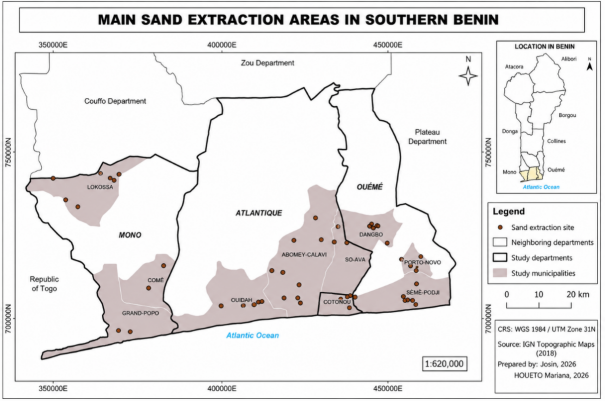
Figure 1. Graphical representation of sand quarries and deposits in South Benin.
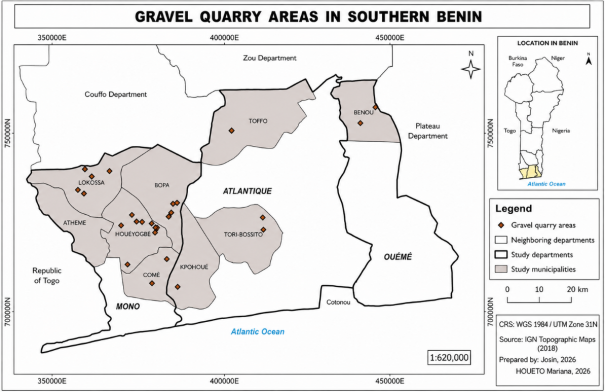
Figure 2. Graphical representation of gravel quarries and deposits in South Benin.
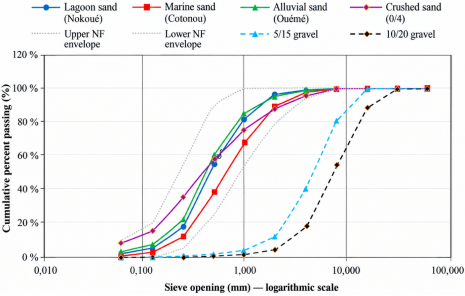
Figure 3. Comparative particle size distribution curves of South Benin aggregates.
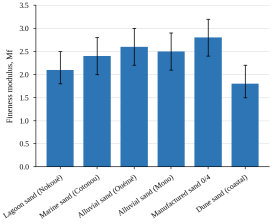
Figure 4. Fineness moduli of South Benin sands (min-average-max values, n > 30 samples per type; error bars represent the observed min-max range, not a standard deviation).
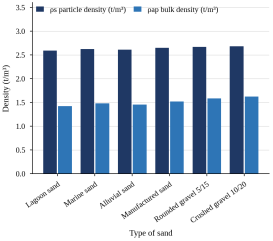
Figure 5. Particle and bulk density.
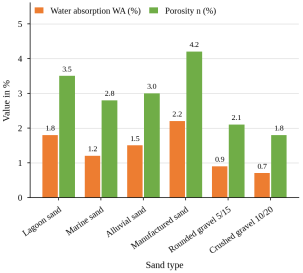
Figure 6. Absorption and porosity of aggregates.
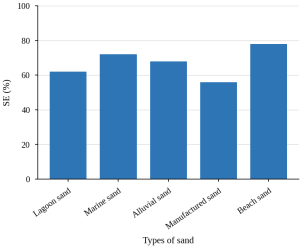
Figure 7. Sand equivalent values of South Benin aggregates.
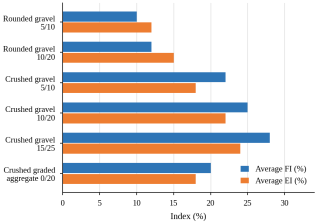
Figure 8. Flakiness (FI) and elongation (EI) indices.
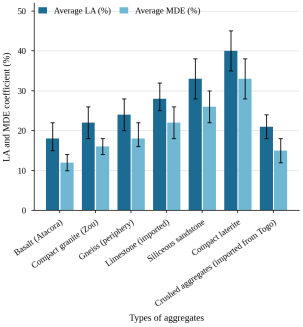
Figure 9. Los Angeles and Micro-Deval test results for Beninese aggregates (error bars: observed min-max range of measured values per rock type, n ≥ 10 samples).
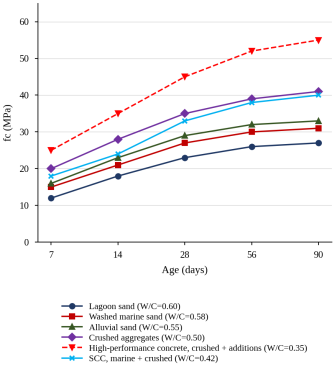
Figure 10. Evolution of compressive strength fc (MPa).
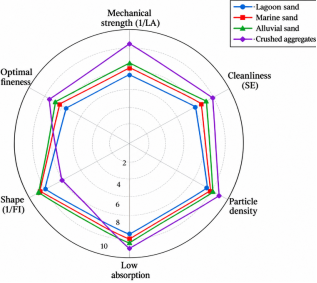
Figure 11. Radar chart of comparative aggregate quality in South Benin (normalized score /10 across 6 criteria, author compilation 2024).

Information


 Share This Article
 Twitter
 Linked In
 Facebook

 Copy
 Download