
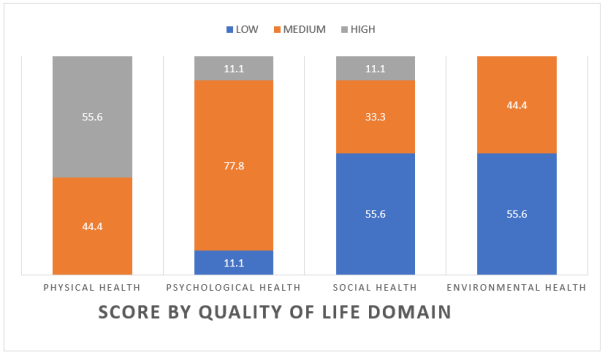
The aim of this study was to assess the health-related quality of life (QOL) of patients with traumatic vision loss, with a view making recommendations for comprehensive patient management. It was a retrospective and prospective study with descriptive and analytical aims carried out in the ophthalmology department of the Cocody University Hospital Center (CHU) in Abidjan, Côte d'Ivoire, over a period of 13 months, from September 1, 2024, to September 30, 2025. The study included nine patient records of individuals followed for traumatic vision loss. Data were collected using a semi-structured questionnaire and the abbreviated version of the World Health Organization's Quality of Life Assessment Scale (WHO-QOL-BREF). The mean age of the patients was 32 ± 13.7 years, with a range of 19 to 50 years. The majority of patients were between 19 and 39 years old (66.7%). Males predominated (7/9 eyes), representing 77.8% of the population, with a sex ratio of 3.5. Patients' mean overall quality of life score was 51.78 ± 10.73. Patients had significantly lower QoL scores than the general population, especially for the psychological, social, and environmental health domains. The interest lies in the need to systematically include a psychological assessment to ensure comprehensive management.
| Published in | European Journal of Preventive Medicine (Volume 14, Issue 1) |
| DOI | 10.11648/j.ejpm.20261401.12 |
| Page(s) | 8-15 |
| Creative Commons |
This is an Open Access article, distributed under the terms of the Creative Commons Attribution 4.0 International License (http://creativecommons.org/licenses/by/4.0/), which permits unrestricted use, distribution and reproduction in any medium or format, provided the original work is properly cited. |
| Copyright |
Copyright © The Author(s), 2026. Published by Science Publishing Group |
Impact, Quality of Life, Traumatic Vision Loss, Ivory Coast, Sub-Saharan Africa
Variables | Number (n) | Percentage (%) |
|---|---|---|
Age range | ||
[19 and 30 years old] | 5 | 55.6 |
[31 and 50 years old] | 4 | 44.4 |
sex | ||
male | 8 | 88.9 |
female | 1 | 11.1 |
Marital status | ||
Single | 6 | 66.7 |
Bride | 2 | 22.2 |
divorcee | 1 | 11.1 |
Place of residence | ||
Abidjan | 5 | 55.6 |
out Abidjan | 4 | 44.4 |
Level of education | ||
illiterate | 1 | 11.1 |
primary | 2 | 22.2 |
secondary | 4 | 44.4 |
superior | 2 | 22.2 |
Patient activities | Staff | Percentage |
student | 1 | 11.1 |
Merchants | 2 | 22.2 |
craftsmen | 4 | 44.4 |
carrier | 1 | 11.1 |
entrepreneur | 1 | 11.1 |
Unemployment after blindness | Staff | Percentage |
Yes | 2 | 22.2 |
No | 7 | 77.8 |
laterality | ||
right eye | 2 | 22.2 |
left eye | 7 | 77.8 |
Circumstances of occurrence | ||
domestic accident | 3 | 33.3 |
workplace accident | 2 | 22.2 |
assault | 2 | 22.2 |
eye infection | 2 | 22.2 |
Type of trauma | ||
evisceration | 4 | 44.4 |
wound of the globe | 5 | 55.6 |
Visual acuity | ||
pl - | 4 | 44.4 |
pl + | 5 | 55.6 |
Diagnosis at presentation | ||
endophthalmitis | 2 | 22.2 |
wound to the eyeball | 5 | 55.6 |
corneal staphyloma | 2 | 22.2 |
Time since vision loss | ||
<6 months | 1 | 11.1 |
> 6 months | 8 | 88.9 |
prosthetic fitting | ||
Yes | 2 | 22.2 |
No | 7 | 77.8 |
Domain | Average score | WHO standards | p -value |
|---|---|---|---|
Physical health | 67.4556 (±8.26) | 72 (±10) | 0.173 |
Psychological health | 52.3122 (±15.8) | 65 (±12) | 0.014 |
Health of social relationships | 42.5789 (±15.8) | 70 (±18) | 0.003 |
Environmental health | 44.7889 (±14.3) | 75 (±15) | 0.004 |
Physical health | Psychological health | Health and Social Services | Environmental health | QOL SCORE | Test value | p -Value | ||
|---|---|---|---|---|---|---|---|---|
Sex | Male | 69.38 | 57.74 | 47.61 | 44.64 | 54.84 | 4 | 0.5 |
Female | 60.71 | 33.33 | 24.98 | 45.31 | 41.08 | |||
Marital status | Bachelor | 71.42 | 56.25 | 49.99 | 42.71 | 55.09 | ||
Bride | 64.28 | 58.33 | 37.50 | 59.37 | 54.87 | 2.48 | 0.28 | |
Divorcee | 50.00 | 16.66 | 8.30 | 28.12 | 25.77 | |||
Level of education | Illiterate | 67.85 | 45.83 | 66.60 | 31.25 | 52.88 | ||
Primary | 71.43 | 58.33 | 45.83 | 35.94 | 52.88 | 3.36 | 0.33 | |
Secondary | 64.28 | 45.83 | 33.32 | 46.09 | 47.38 | |||
Superior | 69.64 | 62.50 | 45.83 | 57.81 | 58.94 | |||
Age range | Between 18 and 39 years old | 71.42 | 56.25 | 49.99 | 42.71 | 55.09 | 5 | 0.38 |
Between 40 and 50 years old | 59.52 | 44.44 | 27.76 | 48.95 | 45.17 | |||
Type of trauma | Evisceration | 68.576 68.57 | 57.50 | 48.32 | 48.12 | 55.62 | 7 | 0.55 |
Blinding wound of the globe | 66.0 66.07 | 45.83 | 35.41 | 40.62 | 46.98 | |||
Wearing an ocular prosthesis | Yes | 69.64 | 58.33 | 41.67 | 57.81 | 56.86 | 5 | 0.66 |
No | 66.83 | 50.59 | 42.84 | 41.07 | 50.33 | |||
Time since vision loss | <6 months | 64.28 | 54.16 | 33.33 | 59.37 | 52.78 | 6 | 0.66 |
> 6 months | 67.85 | 52.08 | 43.74 | 42.97 | 51.66 | |||
Unemployment after blindness | Yes | 57.14 | 35.41 | 20.82 | 43.75 | 39.28 | 13 | 0.11 |
No | 70.40 | 57.14 | 48.80 | 45.09 | 55.35 |
QOL | Quality of Life |
CHU | University Hospital Center |
WHO-QOL-BREF | World Health Organization's Quality of Life Assessment Scale |
| [1] | NAPO A, KÉITA F, GUIROU N, et al. EVALUATION OF QUALITY OF LIFE IN PATIENTS WITH PRIMARY OPEN-ANGLE GLAUCOMA IN AN URBAN ENVIRONMENT. Mali Médical, 2019, vol. 34, no 3. |
| [2] | SAVAS Ç, ARAS N, YEŞILBALKAN T, CAN IO. Post-traumatic visual sequelae from a forensic medicine perspective: A retrospective analysis of 10 years of data. Ulus Travma Acil Cerrahi Derg 2025; 31: 682-690. |
| [3] | KOKI G, HELLES G, BILONG Y, ET AL. Characteristics of post-traumatic blindness at the Yaoundé military teaching, application and referral hospital. French Journal of Ophthalmology 2018; 41: 540-545. |
| [4] | LI M, WANG Y, CHEN H, ET AL. Research on the Anxiety and Depression of Patients with Mechanical Ocular Injuries: A Cross-Sectional Study. PRBM 2025; Volume 18: 81-90. |
| [5] | KOFFI KF-H, OUATTARA Y, KOFFI KAP, et al. Irreversible Blindness in Bouake: Epidemiology and Etiologies. HEALTH SCIENCES AND DISEASE, 2025, vol. 26, no. 1. |
| [6] | JOSE CARLO M. ARTIAGA MD, RUBEN LIM BON SIONG MD. Quality of Life After Ocular Trauma: A Prospective, Longitudinal, Questionnaire-Based Study in a Tertiary Hospital in the Philippines. Philippine Journal of Ophthalmology 2019; 44: 59-67. |
| [7] | SHAH M, SHAH S, CHANDANA P. Impact of ocular trauma on vision-related quality of life. J Clin Ophthalmol Res 2023; 11: 87. |
| [8] | YÜKSEL H, TÜRKCÜ MF, ŞAHIN M, ÇINAR Y, CINGÜ K, ÖZKURT A, Z.,... & ÇAÇA İ. (2014). Vision-related quality of life in patients after penetrating eye surgery. Brazilian Archives of Ophthalmology, 77(2), 95-98. |
| [9] | IFEOMA E, EBERECHUKWU A, ONYINYE O, OMOLABAKE E, U NKWOGU F. Impact of Visual Impairment and Blindness on Quality of Life of Patients in Owerri, Imo State, Nigeria. Middle East African Journal of Ophthalmology 26(3): p 127-132, Jul-Sep 2019. |
| [10] | VU HTV, KEEFFE JE, MCCARTY CA, ET AL. Impact of unilateral and bilateral vision loss on quality of life. Br J Ophthalmol 2005; 89: 360-363. |
| [11] | OFEIBEA AA, ADADE S, YAA KN, ET AL. INFLUENCE OF VISUAL IMPAIRMENT ON THE QUALITY OF LIFE: A SURVEY OF PATIENTS REPORTING AT THE LOW VISION CENTER OF THE EASTERN REGIONAL HOSPITAL OF GHANA. JOS 2016; 1: 1-13. |
| [12] | CHOTPRASERT N, SHRESTHA B, THANASAPBURACHOT P, ET AL. Psychosocial distress and psychological adjustment in patients with ocular loss: a framework analysis. BMC Oral Health 2022; 22: 533. |
| [13] | GOIATO MC, DE CAXIAS FP, DOS SANTOS DM. Quality of life living with ocular prosthesis. Expert Review of Ophthalmology 2018; 13: 187-189. |
APA Style
Romarie, K. K. C., Simeon, K. A. N., Prisca, A. R., Pascaline, K. M. S. M., Massese, S., et al. (2026). Impact of Traumatic Visual Loss: A Pilot Study on the Quality of Life of Evisceral Patients. European Journal of Preventive Medicine, 14(1), 8-15. https://doi.org/10.11648/j.ejpm.20261401.12
ACS Style
Romarie, K. K. C.; Simeon, K. A. N.; Prisca, A. R.; Pascaline, K. M. S. M.; Massese, S., et al. Impact of Traumatic Visual Loss: A Pilot Study on the Quality of Life of Evisceral Patients. Eur. J. Prev. Med. 2026, 14(1), 8-15. doi: 10.11648/j.ejpm.20261401.12
AMA Style
Romarie KKC, Simeon KAN, Prisca AR, Pascaline KMSM, Massese S, et al. Impact of Traumatic Visual Loss: A Pilot Study on the Quality of Life of Evisceral Patients. Eur J Prev Med. 2026;14(1):8-15. doi: 10.11648/j.ejpm.20261401.12
@article{10.11648/j.ejpm.20261401.12,
  author = {Kouadio Kouao Cedric Romarie and Kra Alla N’goran Simeon and Agbohoun Reine Prisca and Konan Manmi Sienou Marguerite Pascaline and Soumahoro Massese and Koman Chiatse Ellalie and Kouassi-Rebours Aya Colette and N'da Hermine Cynthia and Gogoua Mattekei Roxane and Kouassi Francois Xavier},
  title = {Impact of Traumatic Visual Loss: A Pilot Study on the Quality of Life of Evisceral Patients},
  journal = {European Journal of Preventive Medicine},
  volume = {14},
  number = {1},
  pages = {8-15},
  doi = {10.11648/j.ejpm.20261401.12},
  url = {https://doi.org/10.11648/j.ejpm.20261401.12},
  eprint = {https://article.sciencepublishinggroup.com/pdf/10.11648.j.ejpm.20261401.12},
  abstract = {The aim of this study was to assess the health-related quality of life (QOL) of patients with traumatic vision loss, with a view making recommendations for comprehensive patient management. It was a retrospective and prospective study with descriptive and analytical aims carried out in the ophthalmology department of the Cocody University Hospital Center (CHU) in Abidjan, Côte d'Ivoire, over a period of 13 months, from September 1, 2024, to September 30, 2025. The study included nine patient records of individuals followed for traumatic vision loss. Data were collected using a semi-structured questionnaire and the abbreviated version of the World Health Organization's Quality of Life Assessment Scale (WHO-QOL-BREF). The mean age of the patients was 32 ± 13.7 years, with a range of 19 to 50 years. The majority of patients were between 19 and 39 years old (66.7%). Males predominated (7/9 eyes), representing 77.8% of the population, with a sex ratio of 3.5. Patients' mean overall quality of life score was 51.78 ± 10.73. Patients had significantly lower QoL scores than the general population, especially for the psychological, social, and environmental health domains. The interest lies in the need to systematically include a psychological assessment to ensure comprehensive management.},
 year = {2026}
}
TY  - JOUR
T1  - Impact of Traumatic Visual Loss: A Pilot Study on the Quality of Life of Evisceral Patients
AU  - Kouadio Kouao Cedric Romarie
AU  - Kra Alla N’goran Simeon
AU  - Agbohoun Reine Prisca
AU  - Konan Manmi Sienou Marguerite Pascaline
AU  - Soumahoro Massese
AU  - Koman Chiatse Ellalie
AU  - Kouassi-Rebours Aya Colette
AU  - N'da Hermine Cynthia
AU  - Gogoua Mattekei Roxane
AU  - Kouassi Francois Xavier
Y1  - 2026/01/30
PY  - 2026
N1  - https://doi.org/10.11648/j.ejpm.20261401.12
DO  - 10.11648/j.ejpm.20261401.12
T2  - European Journal of Preventive Medicine
JF  - European Journal of Preventive Medicine
JO  - European Journal of Preventive Medicine
SP  - 8
EP  - 15
PB  - Science Publishing Group
SN  - 2330-8230
UR  - https://doi.org/10.11648/j.ejpm.20261401.12
AB  - The aim of this study was to assess the health-related quality of life (QOL) of patients with traumatic vision loss, with a view making recommendations for comprehensive patient management. It was a retrospective and prospective study with descriptive and analytical aims carried out in the ophthalmology department of the Cocody University Hospital Center (CHU) in Abidjan, Côte d'Ivoire, over a period of 13 months, from September 1, 2024, to September 30, 2025. The study included nine patient records of individuals followed for traumatic vision loss. Data were collected using a semi-structured questionnaire and the abbreviated version of the World Health Organization's Quality of Life Assessment Scale (WHO-QOL-BREF). The mean age of the patients was 32 ± 13.7 years, with a range of 19 to 50 years. The majority of patients were between 19 and 39 years old (66.7%). Males predominated (7/9 eyes), representing 77.8% of the population, with a sex ratio of 3.5. Patients' mean overall quality of life score was 51.78 ± 10.73. Patients had significantly lower QoL scores than the general population, especially for the psychological, social, and environmental health domains. The interest lies in the need to systematically include a psychological assessment to ensure comprehensive management.
VL  - 14
IS  - 1
ER  -
Faculty of Medical Sciences, Felix Houphouet Boigny University, Abidjan, Ivory Coast

Information


 Share This Article
 Twitter
 Linked In
 Facebook
 Copy
Copy Download