1. Introduction
Long before, writing was not given emphasis. Moreover, the focus of teaching writing was not on helping students communicate using the skill but rather on making students accurate in grammar and vocabulary. Also, teachers argued that this skill was not as important as the other main skills, such as vocabulary and grammar. As Cholifah et al.’s study indicated, writing skill is not conducted properly as part of curriculum design
| [7] | Cholifah, A. N., Pustika, R., & Winanta, A. (2022). Teacher’s perceives on the implementation of genre-based approach in teaching writing. ELS Journal on Interdisciplinary Studies in Humanities, 5(3), 532-538. Classroom,7(9),45-49. |
[7]
. This way of teaching has affected students’ writing skills performance for years. Due to different factors, approaches to teaching English as a foreign language were changed in the 1960s
| [16] | Richards, J. C. (2001). Curriculum development in language teaching. Cambridge university press. |
[16]
. In this era, language experts brought the theory of cognitive psychology in relation to the process writing approach. Experts stated that manipulating the mind or letting our cognitive practice in the language processor is a decisive factor in language teaching. Thus, to manipulate the mind, the writing approach changed from the product to the process approach. In relation to this, the process-genre approach is increasingly supported. Although the process writing approach gives writers a chance to follow different stages of writing, it does not strictly advocate why students write
| [7] | Cholifah, A. N., Pustika, R., & Winanta, A. (2022). Teacher’s perceives on the implementation of genre-based approach in teaching writing. ELS Journal on Interdisciplinary Studies in Humanities, 5(3), 532-538. Classroom,7(9),45-49. |
[7]
. To fill the gap that the process writing approach has, a mixed approach (process-genre) was put into practice. It is because a genre approach necessitates that students learn plainly the languages used to make meanings in a context. As
| [4] | Amogne, D. (2013). Enhancing students’ writing skills through the genre approach. International Journal of English and Literature, 4(5), 242-248. |
[4]
stated the genre-based writing approach is extremely indispensable to convey social purposes of the written text quite well. Further, it is supportive in contextualizing writing for audiences and purpose
. Like the preceding approaches, the genre writing approach has its own gaps. To mention, the genre writing approach grants little attention to learners’ skill of producing texts
| [7] | Cholifah, A. N., Pustika, R., & Winanta, A. (2022). Teacher’s perceives on the implementation of genre-based approach in teaching writing. ELS Journal on Interdisciplinary Studies in Humanities, 5(3), 532-538. Classroom,7(9),45-49. |
[7]
. This shows it decreases students’ enthusiasm to produce quality written text. The above three approaches have their own weaknesses and strengths. To fill those gaps, teachers should use a mixed writing approach when they conduct writing lessons, since one can supplement the limitation of the other. As such, students comprehend the significance of the kind of text that the writers produce and why these are produced. The process-genre amalgamated approach is fundamentally the combination of both process and genre methods that makes the text entirely effective although boosting students’ self-belief in their abilities and promoting the use of effective writing strategies may help enhance writing outcomes, relying solely on writing strategies might not be enough
| [9] | Dinsa, M. T. (2024). EFL students’ writing strategies, self-efficacy, and performance in Ethiopia: Exploring interrelationships. GIST – Education and Learning Research Journal, 18, 52–64. (ERIC PDF). ERIC+1. |
[9]
.
2. Statement of the Problem
Most university students were very poor in writing. They could not write an effective paragraph. Their writing had content, organization, cohesion, vocabulary, grammar, punctuation, and spelling problems. Besides, their paragraph had no unity and coherence; it was not well structured. Moreover, students did not follow steps of writing when they wrote different texts in the classroom. Concerning this, recent studies
| [2] | Albore, A. K. (2024). Effects of process-genre approach on students’ writing strategy use in paragraphs. International Journal of English Language Studies. Advance online publication.
https://doi.org/10.1155/2024/5527768 |
| [8] | Desta, M. A., & Wondim, B. M. (2024). Investigating the Impact of Process-Genre Methodology on Students' Essay Writing Ability. Available at SSRN 5109000. |
| [18] | Taye, T. (2024). Identifying and analyzing common English writing problems of Ethiopian university students: A descriptive study. Journal of Academic Writing Studies, 5(2), 45–68. ScienceDirect. |
[2, 8, 18]
stated that writing skill is an entanglement task for students at different levels. Writing different texts is a tempting skill for English foreign language learners. This could be because of a lack of time, knowledgeable and experienced teachers, or even the method the teachers use while teaching writing skills
| [7] | Cholifah, A. N., Pustika, R., & Winanta, A. (2022). Teacher’s perceives on the implementation of genre-based approach in teaching writing. ELS Journal on Interdisciplinary Studies in Humanities, 5(3), 532-538. Classroom,7(9),45-49. |
[7]
. Similarly, the teachers did not make students practice the writing tasks following the stages of writing. This indicates that there was a problem in the implementation of writing skills
| [8] | Desta, M. A., & Wondim, B. M. (2024). Investigating the Impact of Process-Genre Methodology on Students' Essay Writing Ability. Available at SSRN 5109000. |
[8]
. From the researcher’s experiences and close observation, the researcher of this study has known that writing in general and process-genre writing in particular were given less or no attention in Bonga University English as a foreign language teacher. From the informal discussion and classroom observation, it was made clear that students at Bonga University might not have been given the opportunity to practice the process genre writing approach by following the important stages like preparation, modeling, joint construction, independent construction, and evaluation. Instructors did not give emphasis to this approach; they used the usual product and process approach
| [1] | Ajmal, A., Aziz, S., & Anwar, F. (2023). Strategies to reduce writing anxiety by using the Process-Genre teaching writing approach (PGA) among intermediate students in Pakistan. Pakistan Social Sciences Review, 7(4), 472-478. |
[1]
.
The following things initiated the researcher to conduct the study. First, since the researcher was eager for teaching writing courses, he was inspired to study this problem. He had intrinsic motivation for it. Second, from the researcher’s experience and his formal and informal discussions at Bonga University, students’ writing problem was serious when compared with others’ English language skills. Since students had been trained by the product and process approaches, their writing skill performances were getting worse from time to time on this campus. This excited or interested the researcher so as to reach a goal and try another method, which is applying the process genre approach. The third reason that initiated the researcher to conduct the study was that writing is integrated skills. As
| [21] | Wilson, G. (2003). Learning through Interaction. Cambridge: Cambridge University Press. |
[21]
stated through writing students can learn vocabulary, spelling and sentence structure.
In relation to writing skills, different foreign and local researches have been conducted. For example, recent local studies by
| [8] | Desta, M. A., & Wondim, B. M. (2024). Investigating the Impact of Process-Genre Methodology on Students' Essay Writing Ability. Available at SSRN 5109000. |
[8]
studied Investigating the Impact of Process-Genre Methodology on Students' Essay Writing Ability at Debre Tabor University in Ethiopia. Its result shows that process-genre instruction has a significant effect on students' essay writing abilities. What makes this research different from the current study is that the former focused on essay writing, but the latter relied on paragraph writing specifically.
| [13] | Nigus, A. (2021). EFL Writing Teachers’ and Students’ Perceptions, Preferences and Practices of Written Corrective Feedback Techniques in Improving Grammatical Accuracy. Abyssinia Journal of Business and Social Sciences, 6(1), 24-35. |
[13]
EFL Writing Teachers’ and Students’ Perceptions, Preferences and Practices of Written Corrective Feedback Techniques in Improving Grammatical Accuracy. This study is unlike from the current study in terms of research design, data gathering tools and study variables although its focus is on writing courses. Also,
| [4] | Amogne, D. (2013). Enhancing students’ writing skills through the genre approach. International Journal of English and Literature, 4(5), 242-248. |
[4]
conducted research on Improving Pupils’ Argumentative Writing Skills Using the Genre Approach at Bahir Dar University, Ethiopia. The focus of Dawit’s work is students’ argumentative writing skills(only one type) and applying genre approach, but the latter study emphasized to see the effect of process-genre instruction on students’ paragraph writing performance(all types of paragraph).
Moreover, different foreign studies were studied; for example
| [14] | Peungcharoenkun, T., & Waluyo, B. (2023). Implementing process-genre approach, feedback, and technology in L2 writing in higher education. Asian-Pacific Journal of Second and Foreign Language Education, 8(1), 34. |
[14]
conducted research on implementing the process-genre approach, feedback, and technology in L2 writing in higher education at a Thai university in Thailand. Thailand employed three interrelate variable also its focus was writing in general. But the current study aimed to see the effect of mixed (process and meaning focused) instruction on students’ paragraph writing performance. It did not incorporate feedback and technology. Furthermore, the former study used tests and interviews as data-gathering tools, whereas the second work applied a paragraph-writing test for gathering data. Moreover, the first was conducted at a Thai university in Thailand, but the current one was directed at Bonga University in Ethiopia. Other researchers,
| [1] | Ajmal, A., Aziz, S., & Anwar, F. (2023). Strategies to reduce writing anxiety by using the Process-Genre teaching writing approach (PGA) among intermediate students in Pakistan. Pakistan Social Sciences Review, 7(4), 472-478. |
[1]
studied strategies to reduce writing anxiety by using the process-genre teaching writing approach among intermediate students in Pakistan. This study aimed to minimize students’ anxiety by applying mixed process-genre instruction to medium-level learners in Pakistan. It is unlike from my study in terms of design, concept, and setting.
Patricia
| [20] | Visser, P., & Sukavatee, P. (2020). Effects of the genre-based writing instructional module in a blended learning environment. Journal of Education and Innovation, 22(2), 1-18. |
[20]
conducted on the effects of the genre-based writing instructional module in a blended learning environment in Thailand. The concept of this study revolved around a genre-based writing instructional module in a blended learning environment, and its setting was Thailand; however, my study relied on the impacts of process and meaning-focused instruction on students’ paragraph writing performance in a face-to-face environment at one of the Ethiopian universities. Blended learning was not the variable for this study. Thus, it is different from the former in study variables and settings.
6. Review of Related Literatures
6.1. Product Approach
The product approach was considered as the primary approach to teaching writing skills. And this approach focused on the grammatical structure of language rather than the meaning and usage of the language in real life. Moreover it does not give freedom for learners
| [17] | Richards, J. C., & Rodgers, T. S. (2014). Approaches and methods in language teaching. Cambridge university press. |
[17]
. From this we can infer that the product writing approach is rule-based instruction that lets students produce structural-based patterns of a text. It is characterized by copying model written texts. Also, the product writing approach does not encourage students to follow different stages of writing. Moreover, this old writing approach relies on sentence and paragraph level; it does not advocate different discourse beyond paragraph and sentence levels.
This grammar-based writing instruction focus of attention has been on the form of finished texts. In this approach much effort has been exerted in writing courses of second language reading materials. Thus, it appears to be prescriptive
| [17] | Richards, J. C., & Rodgers, T. S. (2014). Approaches and methods in language teaching. Cambridge university press. |
[17]
.
6.2. Genre-Based Approach
The genre approach is a type of writing mechanism that focuses on the concept of letting learners be active participants in composition. This is to mean that the aim of this approach is emphasizing the significance of investigating the social and cultural context to write a piece of writing. According to
| [22] | Zhai, X., & Razali, A. B. (2023). Triple method approach to development of a genre-based approach to teaching ESL/EFL writing: A systematic literature review by bibliometric, content, and scientometric analyses. SAGE Open, 13(1),
https://doi.org/21582440221147255 |
[22]
noticed the extent of readerships and the linguistic conventions that a piece of writing needs to pass through to be attainably received by its readers. In this type of writing,
| [22] | Zhai, X., & Razali, A. B. (2023). Triple method approach to development of a genre-based approach to teaching ESL/EFL writing: A systematic literature review by bibliometric, content, and scientometric analyses. SAGE Open, 13(1),
https://doi.org/21582440221147255 |
[22]
stated pupils are invited to participate into account the overall social dedications while comprising a text. When students learn both to follow the process of writing and to consider social and cultural aspects of writing, they can enhance their writing performance.
Here what we should deduce is that genre writing shows learners the way how to develop writing skills by exposing them to the social context of the writing topics. This in turn enables them to develop their own means of developing writing. This is because learners have opportunities for practicing and then creating their own context to develop a piece of writing. As Badger and White stated, genre is the integrative writing approach that combines both theories of process and theories of genre approach
| [5] | Badger, R., & White, G. (2000). A process genre approach to teaching writing. ELT journal, 54(2), 153-160. |
[5]
. Since it makes the instruction more contextualized, it is successful in teaching learners about writing skills.
6.3. Process-Genre (Mixed Process and Meaning Focused) Approach
The process- and meaning-focused or mixed writing approach is the integration of process and genre instruction
| [11] | Maluleke, M. (2024). Blending process and genre approaches in teaching academic writing to first-year English as a second language students. JEES (Journal of English Educators Society), 9(2), 173-182. |
[11]
. As he stated, following different stages of writing like preparation, joint construction, independent construction, and publishing are the process features, whereas the following text organization and language of text type is the genre aspect in the lessons.
Teaching writing skills must be integrated with form and content so that learners will be able to interact to improve their abilities. Thus, this could be meaningful when the teaching method of writing skill involves the combination of the process and genre approaches. This is because one can fill the limitation of the other. In line with this,
| [10] | Jasrial, D. (2019). Process-genre approach for teaching writing of English text. Edu-Ling: Journal of English Education and Linguistics, 2(2), 82-95. |
[10]
and
| [15] | Raimes, A. (1983). Techniques in Teaching Writing. Oxford: OUP. |
[15]
asserted that the emphasis of writing must be on structure and content, issues and organization, syntax and meaning. Practicing the material, brainstorming ideas, and outlining ideas, all of which should be comprised under pre-writing activities including planning and drafting, revising, editing, finalizing, publishing, and socially contextualizing, and above all, moving among the stages, are basic elements that need great attention and provide opportunity to learners so as to think, practice, write, and revise their piece of writing.
Process genre concerns with students on occasions that a text is inquired about. Students differentiate why, to whom, what, and how they will produce a text. Pupils are led through stage processes such as process planning and drafting that motivates students’ independence and pass through the set of procedures of any skilled writers. It advocates input from mates because it is indispensable to share schemata
| [19] | Tudor, E. (2017). The process genre writing approach; an alternative option for the modern classroom. Online Submission. |
[19]
.
7. Conceptual Framework
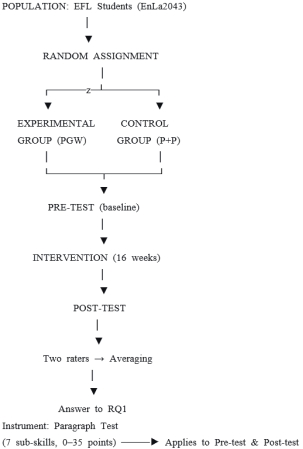
The conceptual framework describes a vivid image of the study. It is the framework that shows the implementation of the study through each stage logically. This road map leads the researcher to relate concepts to one another.
During the manipulation of the independent variables, the researcher should consider different extraneous variables. The experimental group was treated through the mixed approach, while the comparison group was treated by the usual process writing approaches. Here the researcher tried to minimize extraneous variables as much as he could. Both the experimental and comparison groups had a writing lesson for three credit hours weekly. The teaching material for both groups was Intermediate Writing Skills (EnLa2043). It was one of the courses developed in September 2013 for the Nationally Harmonized Modular Curriculum for Undergraduate Programs for Bachelor of Arts Degrees in English Language and Literature students in Ethiopia. The comparison group was being taught most dominantly by product and process approaches using this teaching material as it was. Unlike this, the experimental group was being imparted based on the process genre writing approach. The teacher had various roles while teaching through process genre writing instruction. These two different approaches were taken into account when the experiment was conducted.
The researcher used paragraph writing tests as data gathering instrument. The test was designed in a way that it represents the learners’ writing skills performance. The test included writing sub skills (content, organization, vocabulary, cohesion, language use, punctuation and spelling). A test rubric was prepared based on the writing sub-skills and it was scored out of 35. Each writing sub skill was given 5 marks. Data was collected from the pretest and posttest. The test was administered and marked by the researcher and other EFL instructor.
The results of the two raters were added together and divided by two to get the average for comparing with the pretest and posttest. This helped the researcher to avoid bias since evaluating pieces of writing is subjective. Therefore, the pre and posttests were designed to answer research question number one.
The following conceptual framework clearly summarized the relation between the dependent and independent variables.
Figure 1. Conceptual diagram of the study.
8. Research Design and Methodology
8.1. Design of the Study
The study used quasi – experimental research design since the nature of the study forced the researcher to use quasi-experimental design. It enabled him to evaluate the relationship between the two variables. Similarly, it is a key to accept or reject the hypothesis of the study
| [6] | Best, J. W & Khan, J. V. (1993). Research in Education. Needham Heights, MA: Allyn and Bacon. |
[6]
.
The experimental group received a Mixed (Process and Meaning Focused) writing approach language teaching, whereas students in the comparison group received process approaches of teaching. Therefore, in this study both comparison and experimental groups were participated so as to compare their English paragraph writing performance mean scores before and after the intervention.
8.2. Sample and Sampling Techniques
The study was conducted at Bonga University. This University was selected for the following grounds. Firstly, it is new. Among Ethiopian fourth generation (newly established) Universities, Bonga University is one, and research about writing has not been conducted yet. Second, since the researcher has been working there, it is convenient for the researcher to give intervention based on the students’ natural setting (in their classroom). In connection to this, suggests that when the research sight is convenient for the researcher, it has its own effect in determining the quality of the final findings.
The target population of the study was second year Bachelor of Arts Degree in English Language and Literature students at Bonga University. Second year English major students in this campus were two classes. Section one students who were normally assigned by Ministry of education at Bonga University, and section two students who were assigned at Woldia University, but due to the internal instability of the eastern parts of the country, these students were transferred in to Bonga University. Thus, section one 49 students and section two 50 students were the sample of the study. The two sample sections were selected comprehensively. From these two sections, one section was comparison group and the other section was experimental group. To decide the experimental and comparison group, the researcher used lottery method.
8.3. Research Tools
8.3.1. Pretest
The writing pretest was constructed and administered by the researcher and other EFL teacher. It was conducted before the intervention to make sure those students have the same writing performance. The researcher asked the participants to write paragraph on the topic “Write a Paragraph on How Ethiopian Ladies Make Coffee at Home. Try to show each steps using sequencing words and expressions.” In this part, the researcher employed criteria to score the students’ writing which were stated by
| [3] | Alderson, J. C., Clapham, C., & Wall, D. (1995). Language test construction and evaluation. Cambridge University Press. |
[3]
. These criteria were participants’ error in content, organization, cohesion, vocabulary, grammar, spelling and punctuation.
8.3.2. Posttest
The researcher had proposed to give the posttest after the end of the intervention. After the experiment, the participant groups were given a post writing test to confirm the effectiveness of the experiment based on the writing evaluation criteria used in the pretest. The topic was “Write a Paragraph on How We Bake Bread at Home. Try to show each steps using sequencing words and expressions. Students’ in the two groups were given similar topics. Also, the time given for both groups and tests were the same. This was because the researcher wanted to minimize extraneous variables. Thus, posttest was designed to see the change which the intervention brought.
8.4. Pilot Study
The writing test was pilot tested on two students who did not intentionally included in the study. After this study, same modifications were made like correcting the instruction of the test and the allotted time to write paragraph was not enough, so the given time for writing paragraph was added.
8.5. Methods of Data Analysis
The researcher used t-test data analysis method to analyze the collected data. Tests result before and after the intervention in one group (Experimental or comparison) was calculated by paired sample t-test, whereas independent t-test was used to compare the two groups in similar variable (pretest only or posttest only). Generally, the data was analyzed using the statistical package for social sciences (SPSS Version 16.0).
8.6. Data Analysis and Discussion
Tables 1 and 2 presented all data which the researcher gathered from the two groups at the beginning of the study.
Table 1. Pre Test Results in Both Groups.
| Set | Number of the set | Average | SD | Sig (2-tailed) |
Average Score | Comparison | 49 | 2.10 | .293 | 0.25 |
Experimental | 50 | 2.04 | .198 |
As
Table 1 show the average score of both groups is almost the same (2.10 and 2.04) respectively. Also, the significant value or p- value 0.25 is greater than 0.05 and therefore it is possible to say that there was no significant difference between the comparison and experimental groups before the intervention.
Table 2. Descriptive and Inferential Group Statistics in Each Component (Pre Test).
Rubrics | Group | N | Mean | Std. Deviation | Sig(2-tailed) | Means difference |
Content score pre intervention | Comparison | 49 | 2.03 | .644 | 0.17 | -0.16 |
Experimental | 50 | 2.19 | .553 |
Organization score pre intervention | Comparison | 49 | 2.28 | .751 | 0.21 | 0.17 |
Experimental | 50 | 2.11 | .595 |
Cohesion score pre intervention | Comparison | 49 | 2.33 | .602 | 0.54 | 0.08 |
Experimental | 50 | 2.25 | .728 |
Vocabulary score pre intervention | Comparison | 49 | 2.12 | .588 | 0.31 | 0.12 |
Experimental | 50 | 2.00 | .660 |
Grammar score pre intervention | Comparison | 49 | 2.03 | .644 | 0.66 | 0.05 |
Experimental | 50 | 1.98 | .514 |
Punctuation score pre intervention | Comparison | 49 | 2.08 | .634 | 0.89 | 0.01 |
Experimental | 50 | 2.06 | .632 |
Spelling score pre intervention | Comparison | 49 | 1.82 | .586 | 0.29 | 0.12 |
Table 2 shows that, the two groups are more or less similar at each component (element of paragraph writing). The average score of the groups in content was 2.03 and 2.19 respectively. Moreover, the standard deviation (.644=comparison group and .553=experimental group) also referred the approximation of participants result to the mean score in the two groups. It implied that the two groups achieved very similar score. To find out whether this observed difference between the scores was statistically significant or not, we need to look at an inferential statistics.
The difference between the average score of the comparison group in content was not statistically significant (where the P value is 0.17) with the mean difference -0.16. When we see the significant value of cohesion, it was 0.54 and the mean difference 0.08. The p- value of vocabulary is 0.31 and also its mean is 0.12. Similarly, the significant value of grammar is 0.66 and the mean difference is 0.05. Furthermore, the p- value of both punctuation (0.89) and spelling (0.29) was greater than the significant level (sig=0.05). Thus as we observed in
Table 2 above, all rubric p-values were greater than the significant level (sig= 0.05). From this, we can conclude that paragraph writing performance of both groups was the same.
Table 3. Results of Comparison and Experimental Groups in the Post-test.
| Set | Number of the set | average | SD | Sig (2-tailed) |
Average score | Comparison | 49 | 2.01 | .268 | 0.00 |
Experimental | 50 | 3.62 | .191 |
As
Table 3 shows the mean score of the comparison and experimental groups was found 2.01and 3.64 respectively. Besides, the standard deviation of these participants was found .268 for comparison group and .214 for experimental group. Even though standard deviation score implied that the score of each individual participant groups was approximate, their mean score demonstrated that the experimental group had better performance than the comparison group in paragraph writing. So the mean score of the two groups was found being different.
Although it was not possible to decide whether the difference was statistically significant or not, the researcher ran t- test and compared the performance of the groups in doing the posttest writing result. Since, the significance value 0.00< 0.05, there is greater different between the two groups. Also, the result confirmed that the significance level is high. Similarly, as the above
Table 3 shows, the average score of the experimental group in the post intervention is 3.62 out of 5% for each rubrics. Before the intervention the experimental students’ was low. It was 2.04 out of 5%. Thus; the result confirmed that the significance level is high.
Table 4. Descriptive and Inferential group Statistics in Each Component (Post Test).
Rubrics | Group | N | Mean | Std. Deviation | Sig(2-tailed) | Means difference |
Content score post intervention | Comparison | 49 | 1.91 | .704 | 0.00* | -1.94 |
Experimental | 50 | 3.85 | .643 |
Organization score post intervention | Comparison | 49 | 2.06 | .636 | 0.00* | -1.58 |
Experimental | 50 | 3.64 | .476 |
Cohesion score post intervention | Comparison | 49 | 1.72 | .518 | 0.00* | -1.46 |
Experimental | 50 | 3.19 | .464 |
Vocabulary score post intervention | Comparison | 49 | 2.12 | .673 | 0.00* | -1.85 |
Experimental | 50 | 3.98 | .631 |
Grammar score post intervention | Comparison | 49 | 1.97 | .670 | 0.00* | -1.63 |
Experimental | 50 | 3.61 | .551 |
Punctuation score post intervention | Comparison | 49 | 2.24 | .726 | 0.00* | -1.39 |
Experimental | 50 | 3.64 | .490 |
Spelling score post intervention | Comparison | 49 | 2.04 | .604 | 0.00* | -1.52 |
Experimental | 50 | 3.56 | .545 |
As
Table 4 above depicts that descriptive and inferential group Statistics (in each component) shows significance difference between comparison and experimental group.
So as to make decision whether the difference is significant or not, the researcher employed the output from the inferential statistics. As indicated in
Table 4, the difference between the study and the control groups in content was statistically significant where the p- value was 0.00 with the mean difference -1.94. Similarly, the organization and the cohesion p-values of the comparison and experimental groups were the same (0.00 and 0.00) and their mean difference was-158 and -1.46 respectively. Like the above rubrics the significant value of vocabulary, grammar, punctuation and spelling in comparison and experimental groups was 0.00, whereas their mean difference were -1.85, -1.63, -1.39 and -1.52 respectively. Thus, data 0.00<0.05 depicts that there is observable difference. This result confirmed that the significance level is high. The confidence interval or range shows that it is 0.01. It is near to 0.00. This is because process genre writing approach encourages experimental groups to integrate all rubrics and to develop their skills by passing through preparation, modeling, joint construction, independent constriction and evaluation. Consequently, this result safely enabled us teaching writing through mixed approach (process and meaning focused) writing approach is effective to improve students’ paragraph writing performance.
8.7. Discussion of the Results
To test this objective, the researcher formulated hypotheses. The null hypothesis states that mixed approach (process and meaning focused) will not have impacts on students’ paragraph writing performance. The alternative hypothesis claimed that mixed (process and meaning based) instruction will have impacts on students’ paragraph writing performance. To accept or reject one of these hypotheses, the researcher tested both comparison and experimental students result in T-test. According to the data calculated from the T-test (
Table 4) above, the students’ paragraph writing performance on writing after the intervention was better than the comparison group. The mean score of the comparison and experimental groups was found 2.01 and 3.64 respectively. Besides, the standard deviation of these participants was found .268 for comparison group and .214 for experimental group. Even though the standard deviation score implied that the score of the two groups was approximate, their mean score demonstrated that the study group performed well than the comparison group in paragraph writing; because P- value (0.00) was less than the standard limit of significant (sig 0.05). Moreover, the result confirmed that the significance level is high. And this safely assured the comparison and study group students’ paragraph writing performance was statistically significant. This could be participants in the experimental group help, comment edit and learn each other. Also, mixed (process and meaning focused) writing approach encourages experimental group to integrate all rubrics (components of paragraph) and to develop their skills by passing through preparation, modeling, joint construction, independent constriction and evaluation. This implied that, the result safely enable us teaching writing through mixed (process and meaning focused) writing approach is effective to improve students’ paragraph writing performance. Therefore, the null hypothesis was rejected and its alternative hypothesis was accepted.
9. Conclusions and Recommendations
9.1. Conclusions
Considering the outcome of the study, the researcher forwarded the following conclusions.
Mixed approach instruction is effective to improve students’ paragraph writing performance. Moreover, this writing approach is relevant for the students to write paragraph by integrating form and meaning. Furthermore, this approach makes learners to identify their audiences and aware them how to write their text so that they can attain their intended aim through utilizing explicit language structure.
9.2. Recommendations
Considering the outcome of the study, the researcher forwarded the following recommendations.
First, instructors have various roles while teaching through process genre writing instruction. The teachers are an audience, assistant, evaluator and examiner, so they should be flexible and wise when they teach writing for their students. Second, teaching writing skills must be integrated with form, content and meaning so that learners will be able to interact and improve their writing abilities. Third, Ethiopian English Language and Literature curriculum designers should revise and shaped writing courses such as Intermediate Writing Skills, Basic writing skills and advanced writing skills in to mixed(process-meaning focused instructions) to enhance students’ writing performance effectively.





 Share This Article
 Twitter
 Linked In
 Facebook
 Copy
Copy Download