
Rapid infrastructure development in Wolaita Sodo City, Ethiopia, relies extensively on locally available tropical red clay, whose high plasticity and compressibility result in complex mechanical behavior. However, the sensitivity of this residual soil to shearing rate under rapid and transient loading conditions remains poorly understood. This study investigates the effects of shearing rate on the stress-strain response, peak deviator stress, and shear strength of Wolaita Sodo red clay. Disturbed and undisturbed samples were collected from eight test pits distributed across four sub-cities at depths of 2.5-3.0 m. The experimental program included index-property characterization, Modified Proctor compaction, and Unconsolidated Undrained (UU) and Consolidated Undrained (CU) triaxial compression tests conducted at axial displacement rates of 0.01, 0.1, and 1.0 mm/min. The results demonstrate pronounced rate-dependent behavior. Increasing the displacement rate from 0.01 to 1.0 mm/min increased the peak deviator stress and undrained shear strength, while reducing the axial strain at failure, indicating a transition from more ductile to more brittle deformation. The CU tests also showed increases in the derived effective strength parameters, (c') and ϕ', with increasing shearing rate, although the magnitude of this response varied among test pits and confining pressures. Higher confining pressures generally increased the overall shear resistance. These findings provide site-specific experimental parameters for evaluating foundations, slopes, and other geotechnical structures constructed on tropical red clay deposits.
| Published in | Engineering Science (Volume 11, Issue 3) |
| DOI | 10.11648/j.es.20261103.11 |
| Page(s) | 59-68 |
| Creative Commons |
This is an Open Access article, distributed under the terms of the Creative Commons Attribution 4.0 International License (http://creativecommons.org/licenses/by/4.0/), which permits unrestricted use, distribution and reproduction in any medium or format, provided the original work is properly cited. |
| Copyright |
Copyright © The Author(s), 2026. Published by Science Publishing Group |
Shearing-rate Sensitivity, Tropical Residual Clay, Triaxial Compression, Undrained Shear Strength, Peak Deviator Stress, Stress-strain Behavior
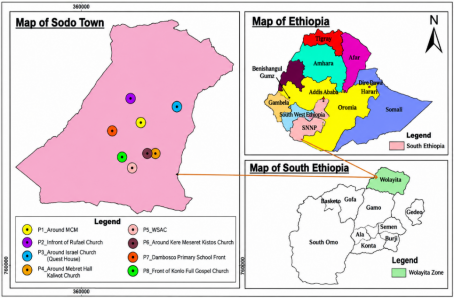
Test pits | Sample depth, m | Location description | Latitude (DMS) | Longitude (DMS) | Elevation (m) | Sub-city |
|---|---|---|---|---|---|---|
TP1 | 3 | Around city municipality | 6°51'57.954” N | 37°45'45.990” E | 2072 | Arada |
TP2 | 2.5 | Rufael church | 6°52'48.52” N | 37°45'26.423” E | 2110 | Arada |
TP3 | 3 | Around Isreal church | 6°52'32.33” N | 37°46'54.066” E | 2165 | Markato |
TP4 | 2.5 | Mebrat Hail kalhiwot church | 6°50'55.326” N | 37°46'12.041” E | 2033 | Markato |
TP5 | 2.5 | Sodo Agricultural college | 6°50'25.896” N | 37°45'29.754” E | 1930 | Fana |
TP6 | 2.5 | Kera Meseret kirstos church | 6°50'56.423” N | 37°45'58.608” E | 1970 | Fana |
TP7 | 3 | Dombosco primary school | 6°51'40.745” N | 37°44'52.607” E | 1951 | Mehal |
TP8 | 2.5 | Konto full Gospel church | 6°50'46.199” N | 37°45'12.005” E | 1952 | Mehal |
No. | Test or Parameter | Governing standard | Main output |
|---|---|---|---|
1 | Natural moisture content | ASTM D2216 | In-situ moisture state via oven drying method |
2 | Specific gravity | ASTM D854 | Particle density using a calibrated water pycnometer |
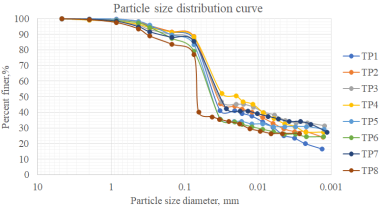
3 | Particle size distribution | ASTM D422 | Wet sieve and hydrometer analysis |
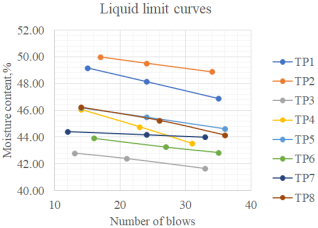
4 | Atterberg limits | ASTM D4318 | Liquid limit, plastic limit and plasticity index |
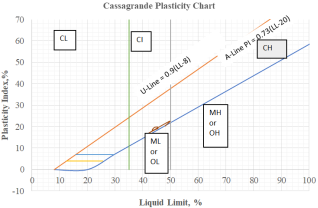
5 | Soil classification | ASTM D2487/AASHTO M145 | USCS (plasticity chart) and AASHTO (Group index |
6 | Modified Compaction | ASTM D1557 | Maximum dry density and Optimum moisture content |
7 | Unconsolidated undrained (UU) triaxial test | ASTM D2850 | Total stress undrained shear strength at varying strain rates |
8 | Unconsolidated Drained (CU) triaxial test | ASTM D4767 | Effective shear strength parameters (c' and ϕ') |
Test pit | Fines passing #200 (%) | Liquid limit (%) | Plastic limit (%) | Plasticity index (%) | AASHTO code | USCS code | Specific gravity | Natural moisture content (%) | Soil color |
|---|---|---|---|---|---|---|---|---|---|
TP1 | 88.97 | 48.05 | 27.72 | 20.33 | A-7-6 (21) | CI | 2.60 | 38.89 | Red |
TP2 | 88.75 | 49.47 | 27.02 | 22.45 | A-7-6 (22) | CI | 2.59 | 39.08 | Red |
TP3 | 85.73 | 42.16 | 25.09 | 17.07 | A-7-6 (16) | CI | 2.65 | 32.46 | Red |
TP4 | 88.44 | 44.47 | 25.79 | 18.68 | A-7-6 (18) | CI | 2.62 | 33.03 | Red |
TP5 | 83.59 | 45.43 | 26.31 | 19.12 | A-7-6 (17) | CI | 2.62 | 37.34 | Red |
TP6 | 79.49 | 43.38 | 25.05 | 18.33 | A-7-6 (15) | CI | 2.65 | 36.17 | Red |
TP7 | 85.65 | 44.16 | 24.49 | 19.67 | A-7-6 (18) | CI | 2.75 | 37.64 | Red |
TP8 | 77.20 | 45.35 | 25.51 | 19.84 | A-7-6 (16) | CI | 2.70 | 37.08 | Red |
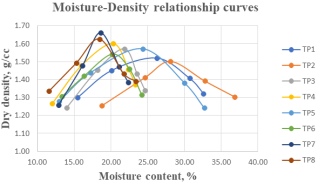
Test pits | OMC (%) | MDD (g/cm3) |
|---|---|---|
TP1 | 26.25 | 1.53 |
TP2 | 28.12 | 1.52 |
TP3 | 21.81 | 1.57 |
TP4 | 20.5 | 1.6 |
TP5 | 24.30 | 1.54 |
TP6 | 20.14 | 1.58 |
TP7 | 18.48 | 1.66 |
TP8 | 18.53 | 1.63 |
Sample pit | Axial displacement rates (mm/min) | Confining pressure (kPa) | Peak deviator stress (kPa) | Undrained shear strength (kPa) | Axial strain at failure (%) |
|---|---|---|---|---|---|
TP1 | 0.01 | 50 | 123 | 61.5 | 16.02 |
0.1 | 50 | 174.8 | 87.4 | 12.5 | |
1.0 | 50 | 226.6 | 113.3 | 9.5 | |
0.01 | 150 | 118.2 | 59.1 | 26 | |
0.1 | 150 | 170.2 | 85 | 24.84 | |
1.0 | 150 | 221.8 | 110.9 | 18 | |
0.01 | 200 | 97.4 | 48.7 | 29 | |
0.1 | 200 | 170 | 74.6 | 26.5 | |
1.0 | 200 | 201 | 100.5 | 24.94 | |
TP2 | 0.01 | 80 | 281 | 140 | 13.12 |
0.1 | 80 | 323.2 | 161.6 | 11.5 | |
1.0 | 80 | 365.3 | 182.6 | 10 | |
0.01 | 160 | 198.1 | 99.1 | 26.5 | |
0.1 | 160 | 233 | 116 | 24.71 | |
1.0 | 160 | 267.95 | 133.98 | 23 | |
0.01 | 200 | 352.1 | 176 | 25.5 | |
0.1 | 200 | 427.6 | 251 | 23.5 | |
1.0 | 200 | 503 | 251 | 21.23 | |
TP3 | 0.01 | 40 | 249 | 125 | 25.5 |
0.1 | 40 | 286.4 | 143.2 | 21.5 | |
1.0 | 40 | 311.3 | 155.6 | 18.5 | |
0.01 | 80 | 211.7 | 105.8 | 27.5 | |
0.1 | 80 | 249 | 125 | 25.05 | |
1.0 | 80 | 298.8 | 149.4 | 20.5 | |
0.01 | 120 | 368.2 | 184.1 | 29 | |
0.1 | 120 | 415.4 | 207.7 | 27 | |
1.0 | 120 | 472 | 236 | 25.02 | |
TP4 | 0.01 | 45 | 332 | 166 | 25.13 |
0.1 | 45 | 382.8 | 190.9 | 23.6 | |
1.0 | 45 | 431.6 | 215.8 | 22.1 | |
0.01 | 100 | 352 | 176 | 25.1 | |
0.1 | 100 | 391 | 200.9 | 22.43 | |
1.0 | 100 | 441.6 | 225.8 | 21.13 | |
0.01 | 150 | 400 | 200 | 21.5 | |
0.1 | 150 | 465 | 232.5 | 19.5 | |
1.0 | 150 | 548 | 274 | 17.92 |
Sample pit | Strain rate (mm/min) | Effective Confining pressure (kPa) | Major effective principal stress (kPa) | Peak deviator stress (kPa) | Effective cohesion, c' (kPa) | Effective friction angle, ϕ’ (º) |
|---|---|---|---|---|---|---|
TP1 | 0.01 | 78.6 | 318.9 | 240.3 | 42.9 | 24 |
0.1 | 78.6 | 342.9 | 264.3 | 44 | 26 | |
1.0 | 78.6 | 367 | 288.4 | 44.8 | 28 | |
0.01 | 158.1 | 555 | 396.9 | 44.59 | 25 | |
0.1 | 158.1 | 575.5 | 417.4 | 44.65 | 26 | |
1.0 | 158.1 | 596 | 437.9 | 45.61 | 28 | |
0.01 | 196.3 | 520.3 | 324 | 50.1 | 23.03 | |
0.1 | 196.3 | 539.8 | 343.5 | 63.27 | 24.38 | |
1.0 | 196.3 | 559.3 | 363 | 64.62 | 25.67 | |
TP2 | 0.01 | 85.6 | 348.5 | 262.9 | 35.2 | 23.6 |
0.1 | 85.6 | 367.7 | 282.1 | 41.4 | 25.4 | |
1.0 | 85.6 | 387.7 | 302.1 | 48.2 | 27.2 | |
0.01 | 170 | 522.4 | 340 | 35.51 | 23.1 | |
0.1 | 170 | 542.4 | 360 | 42.76 | 24.3 | |
1.0 | 170 | 562.4 | 380 | 49.81 | 25 | |
0.01 | 255 | 670 | 415 | 40.1 | 23.03 | |
0.1 | 255 | 685 | 430 | 53.27 | 24.38 | |
1.0 | 255 | 715 | 460 | 56.62 | 25.67 | |
TP3 | 0.01 | 45.9 | 301.5 | 255.6 | 55 | 20 |
0.1 | 45.9 | 342.9 | 268.3 | 60 | 24 | |
1.0 | 45.9 | 367 | 288.4 | 70 | 27 | |
0.01 | 89.1 | 264.6 | 178.5 | 55 | 20 | |
0.1 | 89.1 | 265.3 | 191 | 60 | 24 | |
1.0 | 89.1 | 292.7 | 203.6 | 70 | 27 | |
0.01 | 118.4 | 336.2 | 217.8 | 51.15 | 25.5 | |
0.1 | 118.4 | 352.4 | 234 | 59.25 | 26 | |
1.0 | 118.4 | 363.9 | 250.3 | 67.4 | 28 | |
TP4 | 0.01 | 76.7 | 447.6 | 370.9 | 41.9 | 22.3 |
0.1 | 76.7 | 468.2 | 392 | 44.5 | 24.2 | |
1.0 | 76.7 | 491.7 | 415 | 45 | 25 | |
0.01 | 154 | 678.5 | 524.5 | 43.9 | 25 | |
0.1 | 154 | 689 | 535 | 44.6 | 26 | |
1.0 | 154 | 706 | 552 | 45.8 | 28.6 | |
0.01 | 230 | 872 | 534 | 42.1 | 21.3 | |
0.1 | 230 | 1000.4 | 560 | 46.8 | 23.2 | |
1.0 | 230 | 1129 | 575 | 50.3 | 24.2 |
UU | Unconsolidated Undrained Triaxial Test |
CU | Consolidated Undrained Triaxial Test |
c' | Effective Cohesion |
ϕ' | Effective Friction Angle |
σ'3 | Minor Effective Principal Stress |
qmax | Peak Deviator Stress |
MDD | Maximum Dry Density |
OMC | Optimum Moisture Content |
kPa | Kilo Pascal |
CI | Intermediate Plasticity |
DMS | Degree Minute Second |
GPS | Global Positioning System |
| [1] | H. Xu, Y. Zhao, W. Ding, and P. Cheng, "Experimental study on the influence of clay content on the shear strength of silty soil and mechanism analysis," Applied Sciences, vol. 14, no. 8, art. no. 3178, pp. 1-16, 2024, |
| [2] | S. Mohammed, A. Kassahun, and A. Ahmed, "An inclusive study on the effect of strain rate on the stress-strain behavior and the undrained shear strength of clay soils in Kombolcha, Ethiopia," Engineering, Technology & Applied Science Research, vol. 12, no. 1, pp. 8107-8113, 2022, |
| [3] | E. A. Ozsoy and H. B. Özmen, "Investigation of the shear strength behavior of clay soil reinforced with basalt fiber using ring shear tests," Buildings, vol. 16, no. 1, pp. 1-16, 2026, |
| [4] | A. Tirualem, "Effect of strain rate on stress-strain relationship and shear strength of Addis Ababa red clay," M. Sc. thesis, Department of Civil Engineering, Addis Ababa University, Addis Ababa, Ethiopia, 2011. |
| [5] | F. Cheng, X. Zhang, and Q. Li, "Interfacial shear properties of red clay and polyurethane with different densities," Polymers, vol. 17, no. 3, pp. 1-15, 2025, |
| [6] | P. Iqbal, R. F. Susanti, and A. Mulyana, "Geotechnical characteristics of volcanic red clay soil related to geoengineering problem in Sekincau, Sumatra, Indonesia," International Journal of Advanced Science and Technology, vol. 29, no. 7, pp. 3166-3173, 2020. |
| [7] | Y. Chen, B. Li, Y. Xu, Y. Zhao, and J. Xu, "Field study on the soil water characteristics of shallow layers on red clay slopes and its application in stability analysis," Arabian Journal for Science and Engineering, vol. 44, no. 5, pp. 5107-5116, 2019, |
| [8] | W. Chinkhuntha, A. Owayo, and N. Ambassah, "Performance evaluation of red clay soils stabilized with bluegum sawdust ash and sisal fiber as low-volume road sub-base materials," Engineering, Technology & Applied Science Research, vol. 14, no. 6, pp. 18105-18113, 2024, |
| [9] | A. Tadese, E. Getahun, M. Jothimani, and T. Demisie, "Engineering geological characterization of soils and rocks for urban planning: A case study from Wolaita Sodo Town, Southern Ethiopia," Urban Science, vol. 9, no. 1, art. no. 124, pp. 1-39, 2025, |
| [10] | M. S. Senthil and E. S. M. Suresh, "Study on geotechnical, engineering and chemical analysis of amended red soil as landfill liner material," Sambodhi Journal, vol. 44, no. 2, pp. 212-220, 2021. |
| [11] | T. B. Esubalew and W. Wondemagne, "Stabilization of expansive soil by using A-1-b soil in subgrade materials: A study in Boditi Town, Wolaita Zone, Southern Ethiopia," Journal of University of Shanghai for Science and Technology, vol. 24, no. 1, pp. 346-357, 2022, |
| [12] | G. A. Gizachew, "Improving the geotechnical property of expansive soil through marble dust and lime for road construction projects," International Research Journal of Engineering and Technology, vol. 6, no. 10, pp. 1497-1504, 2019. |
| [13] | J. A. Gobena and S. Suppiah, "Strength characteristics of expansive soil mixed with quarry residue and cement," International Journal of Innovative Technology and Exploring Engineering, vol. 8, no. 8, pp. 1668-1673, 2019. |
| [14] | T. Hanna, "Study of index properties and shear strength parameters of laterite soils in southern part of Ethiopia: The case of Wolayita-Sodo," M. Sc. thesis, School of Graduate Studies, Addis Ababa University, Addis Ababa, Ethiopia, 2008. |
| [15] | A. C. Yan, "Stabilization of clayey soil using lime and lime with Prosopis juliflora fibers in Jimma Town, Ethiopia," M. Sc. thesis, Faculty of Civil and Environmental Engineering, Jimma Institute of Technology, Jimma University, Jimma, Ethiopia, 2021. |
| [16] | S. Zheng, D. Qi, X. Guo, X. Xi, and L. Zhang, "Characterization of the undrained shear strength of expansive soils of high water content," MATEC Web of Conferences, vol. 206, art. no. 01002, pp. 1-5, 2018, |
| [17] | A. Olowofoyeku, O. Ofuyatan, J. Oluwafemi, and P. Iroaganachi, "Geotechnical properties of lateritic soil stabilized with sugarcane straw ash," Journal of Physics: Conference Series, vol. 1734, no. 1, art. no. 012011, pp. 1-5, 2021, |
| [18] | E. A. Gaenamo, D. D. Dirate, D. K. Dasho, and V. R. Pampana, "Experimental investigation and mapping of index and shear behavior of soils: A case in Gimbichu Town, Ethiopia," Indian Journal of Science and Technology, vol. 15, no. 4, pp. 166-174, 2022, |
| [19] | S. A. Sule, S. I. Maude, U. Adamu, and M. A. Mailafiya, "Investigation of index properties of soils along Jos-Makurdi Road in North Central Nigeria," Saudi Journal of Civil Engineering, vol. 5, no. 4, pp. 87-90, 2021, |
| [20] | D. Gudissa, S. Thanappan, and E. Mekonnen, "The stabilization of lateritic soils: Trends in Africa/Ethiopia," Journal of Xidian University, vol. 14, no. 11, pp. 328-335, 2020, |
| [21] | Q. Dai, X. Shen, C. Wei, and Z. Zhou, "Shear failure mechanism and shear zone morphology of red-bed soft rock at different strain rates," Applied Sciences, vol. 16, no. 2, pp. 1-17, 2026, |
| [22] | Geotechnical Engineering Office, "The determination of shear strength in residual soils," Civil Engineering Department, The Government of the Hong Kong Special Administrative Region, GEO Report No. 110, pp. 1-18, 2001. |
| [23] | F. Jamil, C. Zeng, Y. Ma, S. H. Tun, and S. Ali, "Shear stress-strain relationships and anisotropy in silty soil: The role of principal stress rotation," Acta Geodynamica et Geomaterialia, vol. 21, no. 4, pp. 309-328, 2024, |
APA Style
Beyene, W. B., Koyra, E. S., Gobena, J. A. (2026). Effects of Shearing Rate on the Stress-strain Response and Shear Strength of Red Clay: A Case Study of Wolaita Sodo City, Ethiopia. Engineering Science, 11(3), 59-68. https://doi.org/10.11648/j.es.20261103.11
ACS Style
Beyene, W. B.; Koyra, E. S.; Gobena, J. A. Effects of Shearing Rate on the Stress-strain Response and Shear Strength of Red Clay: A Case Study of Wolaita Sodo City, Ethiopia. Eng. Sci. 2026, 11(3), 59-68. doi: 10.11648/j.es.20261103.11
@article{10.11648/j.es.20261103.11,
  author = {Wopnesh Bassa Beyene and Eyob Shanka Koyra and Jemal Aliy Gobena},
  title = {Effects of Shearing Rate on the Stress-strain Response and Shear Strength of Red Clay: A Case Study of Wolaita Sodo City, Ethiopia},
  journal = {Engineering Science},
  volume = {11},
  number = {3},
  pages = {59-68},
  doi = {10.11648/j.es.20261103.11},
  url = {https://doi.org/10.11648/j.es.20261103.11},
  eprint = {https://article.sciencepublishinggroup.com/pdf/10.11648.j.es.20261103.11},
  abstract = {Rapid infrastructure development in Wolaita Sodo City, Ethiopia, relies extensively on locally available tropical red clay, whose high plasticity and compressibility result in complex mechanical behavior. However, the sensitivity of this residual soil to shearing rate under rapid and transient loading conditions remains poorly understood. This study investigates the effects of shearing rate on the stress-strain response, peak deviator stress, and shear strength of Wolaita Sodo red clay. Disturbed and undisturbed samples were collected from eight test pits distributed across four sub-cities at depths of 2.5-3.0 m. The experimental program included index-property characterization, Modified Proctor compaction, and Unconsolidated Undrained (UU) and Consolidated Undrained (CU) triaxial compression tests conducted at axial displacement rates of 0.01, 0.1, and 1.0 mm/min. The results demonstrate pronounced rate-dependent behavior. Increasing the displacement rate from 0.01 to 1.0 mm/min increased the peak deviator stress and undrained shear strength, while reducing the axial strain at failure, indicating a transition from more ductile to more brittle deformation. The CU tests also showed increases in the derived effective strength parameters, (c') and ϕ', with increasing shearing rate, although the magnitude of this response varied among test pits and confining pressures. Higher confining pressures generally increased the overall shear resistance. These findings provide site-specific experimental parameters for evaluating foundations, slopes, and other geotechnical structures constructed on tropical red clay deposits.},
 year = {2026}
}
TY  - JOUR
T1  - Effects of Shearing Rate on the Stress-strain Response and Shear Strength of Red Clay: A Case Study of Wolaita Sodo City, Ethiopia
AU  - Wopnesh Bassa Beyene
AU  - Eyob Shanka Koyra
AU  - Jemal Aliy Gobena
Y1  - 2026/11/09
PY  - 2026
N1  - https://doi.org/10.11648/j.es.20261103.11
DO  - 10.11648/j.es.20261103.11
T2  - Engineering Science
JF  - Engineering Science
JO  - Engineering Science
SP  - 59
EP  - 68
PB  - Science Publishing Group
SN  - 2578-9279
UR  - https://doi.org/10.11648/j.es.20261103.11
AB  - Rapid infrastructure development in Wolaita Sodo City, Ethiopia, relies extensively on locally available tropical red clay, whose high plasticity and compressibility result in complex mechanical behavior. However, the sensitivity of this residual soil to shearing rate under rapid and transient loading conditions remains poorly understood. This study investigates the effects of shearing rate on the stress-strain response, peak deviator stress, and shear strength of Wolaita Sodo red clay. Disturbed and undisturbed samples were collected from eight test pits distributed across four sub-cities at depths of 2.5-3.0 m. The experimental program included index-property characterization, Modified Proctor compaction, and Unconsolidated Undrained (UU) and Consolidated Undrained (CU) triaxial compression tests conducted at axial displacement rates of 0.01, 0.1, and 1.0 mm/min. The results demonstrate pronounced rate-dependent behavior. Increasing the displacement rate from 0.01 to 1.0 mm/min increased the peak deviator stress and undrained shear strength, while reducing the axial strain at failure, indicating a transition from more ductile to more brittle deformation. The CU tests also showed increases in the derived effective strength parameters, (c') and ϕ', with increasing shearing rate, although the magnitude of this response varied among test pits and confining pressures. Higher confining pressures generally increased the overall shear resistance. These findings provide site-specific experimental parameters for evaluating foundations, slopes, and other geotechnical structures constructed on tropical red clay deposits.
VL  - 11
IS  - 3
ER  -
Department of Civil Engineering, Wolaita Sodo University, Wolaita Sodo, Ethiopia
Department of Civil Engineering, Wolaita Sodo University, Wolaita Sodo, Ethiopia
Department of Civil Engineering, Wolaita Sodo University, Wolaita Sodo, Ethiopia

Information



 Share This Article
 Twitter
 Linked In
 Facebook

 Copy
 Download