
“Numerical Simulation Technology on Manufacturing Processes” is a graduate-level course designed for students majoring in mechanical engineering, especially in manufacturing technology. With the advancement of manufacturing and information technologies, the course has become significantly more applicable and practical for students across various manufacturing fields. To enable students not only to master numerical simulation techniques but also to extract and analyze engineering problems from a scientific perspective, this paper presents the course design, core contents, and representative outcomes as a reference. The main contents include: (1) the course background, target audience, and key instructional procedures, with an emphasis on the rationale behind student presentation sessions; (2) two typical manufacturing process case studies that illustrate how the course systematically enhances students’ research capabilities through the pre-simulation stages of problem extraction and model simplification; (3) a discussion on the application prospects of cutting-edge artificial intelligence (AI) technologies such as physics-informed neural networks (PINN) and graph neural networks (GNN) in simulation curricula, identifying them as key future directions for numerical simulation technology. Through a comprehensive introduction to this course, we aim to contribute to the cultivation of outstanding research-oriented talents for China’s manufacturing engineering sector, which already holds a competitive edge and having the inevitable requirement for a scientific transformation.
| Published in | Higher Education Research (Volume 11, Issue 2) |
| DOI | 10.11648/j.her.20261102.12 |
| Page(s) | 34-42 |
| Creative Commons |
This is an Open Access article, distributed under the terms of the Creative Commons Attribution 4.0 International License (http://creativecommons.org/licenses/by/4.0/), which permits unrestricted use, distribution and reproduction in any medium or format, provided the original work is properly cited. |
| Copyright |
Copyright © The Author(s), 2026. Published by Science Publishing Group |
Intelligent Manufacturing, Precision Machining, Physical Fields Simulation, Practical Project, Numerical Calculation, Experimental Demonstration, AI for Engineering
UIT | Ultrasonic Impact Treatment |
AI | Artificial-intellegence |
PINN | Physics-Informed Neural Networks |
GNN | Graph Neural Networks |
| [1] | Hu X P, Yu B H, Li X Y, et al. Research on Cutting Force Model of Triangular Blade for Ultrasonic Assisted Cutting Honeycomb Composites. Procedia CIRP, 2017, 66, 159-163. |
| [2] | Liu S, Zhang Y, Liu P. New analytical model for heat transfer efficiency of metallic honeycomb structures. International Journal of Heat and Mass Transfer. 2008, 51(25-26), 6254-6258. |
| [3] | Jaafar M, Atlati S, Makich H, et al. A 3D FE Modeling of Machining Process of Nomex® Honeycomb Core, Influence of the Cell Structure Behaviour and Specific Tool Geometry. Procedia CIRP, 2017, 58, 505-510. |
| [4] | Wang Y, Kang R, Dong Z, et al. A Novel Method of Blade-Inclined Ultrasonic Cutting Nomex Honeycomb Core With Straight Blade. Journal of Manufacturing Science and Engineering, 2021, 143(4), 041012. |
| [5] | Jaafar M, Nouari M, Makich H, et al. 3D numerical modeling and experimental validation of machining Nomex® honeycomb materials. The International Journal of Advanced Manufacturing Technology, 2021, 115(9-10), 2853-2872. |
| [6] | Sun J, Wang Y, Zhou P, et al. Equivalent mechanical model of resin-coated aramid paper of Nomex honeycomb. International Journal of Mechanical Sciences, 2023, 240, 107935. |
| [7] | Xu J, Wang C, Feng P, et al. Meso-scale cracks initiation of Nomex honeycomb composites in orthogonal cutting with a straight blade cutter. Composites Science and Technology, 2023, 233, 109914. |
| [8] | Hu S, Guo C, Wang D, et al. Finite element analysis of residual stress evolution with multiple impacts on one point in ultrasonic impact treatment process. Proceedings of the Institution of Mechanical Engineers, Part B: Journal of Engineering Manufacture, 2018, 232(7), 1201-1211. |
| [9] | Guo C, Wang Z, Wang D, et al. Numerical analysis of the residual stress in ultrasonic impact treatment process with single-impact and two-impact models. Applied Surface Science, 2015, 347, 596-601. |
| [10] | Wang F, Men X, Liu Y, et al. Experiment and simulation study on influence of ultrasonic rolling parameters on residual stress of Ti-6Al-4V alloy. Simulation Modelling Practice and Theory, 2020, 104, 102121. |
| [11] | Teimouri R, Amini S. Analytical modeling of ultrasonic surface burnishing process: evaluation of through depth localized strain. International Journal of Mechanical Sciences, 2019, 151, 118-132. |
| [12] | Liang Y, Feng P, Song Z, et al. Wear mechanisms of straight blade tool by dual-periodic impact platform. International Journal of Mechanical Sciences, 2025, 288, 110031. |
| [13] | Feng S, Feng P, Feng F, et al. Rotary ultrasonic rolling chamfer: impact on surface integrity and fatigue performance of load-bearing holes. International Journal of Fatigue, 2025, 109269. |
| [14] | Feng S, Huang K, Tang M, et al. Comparative Evaluation of Rolling and Ultrasonic Rolling Chamfer for 7050 Aluminum Alloy Load-Bearing Holes. International Journal of Lightweight Materials and Manufacture, 2026. |
| [15] | Nan J, Feng P, Xu J, et al. Efficient modeling of liquid splashing via graph neural networks with adaptive filter and aggregator fusion. International Journal of Numerical Methods for Heat & Fluid Flow. 2024, 34(6), 2513-2538. |
APA Style
Yue, Q., Liang, Y., Feng, S., Xu, J., Feng, F. (2026). Research-Ability-Orientated Course Design and Cultivation Examples of Numerical Simulation Technology on Manufacturing Processes for Graduate Students. Higher Education Research, 11(2), 34-42. https://doi.org/10.11648/j.her.20261102.12
ACS Style
Yue, Q.; Liang, Y.; Feng, S.; Xu, J.; Feng, F. Research-Ability-Orientated Course Design and Cultivation Examples of Numerical Simulation Technology on Manufacturing Processes for Graduate Students. High. Educ. Res. 2026, 11(2), 34-42. doi: 10.11648/j.her.20261102.12
@article{10.11648/j.her.20261102.12,
  author = {Qizhong Yue and Yiying Liang and Shulong Feng and Jie Xu and Feng Feng},
  title = {Research-Ability-Orientated Course Design and Cultivation Examples of Numerical Simulation Technology on Manufacturing Processes for Graduate Students},
  journal = {Higher Education Research},
  volume = {11},
  number = {2},
  pages = {34-42},
  doi = {10.11648/j.her.20261102.12},
  url = {https://doi.org/10.11648/j.her.20261102.12},
  eprint = {https://article.sciencepublishinggroup.com/pdf/10.11648.j.her.20261102.12},
  abstract = {“Numerical Simulation Technology on Manufacturing Processes” is a graduate-level course designed for students majoring in mechanical engineering, especially in manufacturing technology. With the advancement of manufacturing and information technologies, the course has become significantly more applicable and practical for students across various manufacturing fields. To enable students not only to master numerical simulation techniques but also to extract and analyze engineering problems from a scientific perspective, this paper presents the course design, core contents, and representative outcomes as a reference. The main contents include: (1) the course background, target audience, and key instructional procedures, with an emphasis on the rationale behind student presentation sessions; (2) two typical manufacturing process case studies that illustrate how the course systematically enhances students’ research capabilities through the pre-simulation stages of problem extraction and model simplification; (3) a discussion on the application prospects of cutting-edge artificial intelligence (AI) technologies such as physics-informed neural networks (PINN) and graph neural networks (GNN) in simulation curricula, identifying them as key future directions for numerical simulation technology. Through a comprehensive introduction to this course, we aim to contribute to the cultivation of outstanding research-oriented talents for China’s manufacturing engineering sector, which already holds a competitive edge and having the inevitable requirement for a scientific transformation.},
 year = {2026}
}
TY  - JOUR
T1  - Research-Ability-Orientated Course Design and Cultivation Examples of Numerical Simulation Technology on Manufacturing Processes for Graduate Students
AU  - Qizhong Yue
AU  - Yiying Liang
AU  - Shulong Feng
AU  - Jie Xu
AU  - Feng Feng
Y1  - 2026/04/30
PY  - 2026
N1  - https://doi.org/10.11648/j.her.20261102.12
DO  - 10.11648/j.her.20261102.12
T2  - Higher Education Research
JF  - Higher Education Research
JO  - Higher Education Research
SP  - 34
EP  - 42
PB  - Science Publishing Group
SN  - 2578-935X
UR  - https://doi.org/10.11648/j.her.20261102.12
AB  - “Numerical Simulation Technology on Manufacturing Processes” is a graduate-level course designed for students majoring in mechanical engineering, especially in manufacturing technology. With the advancement of manufacturing and information technologies, the course has become significantly more applicable and practical for students across various manufacturing fields. To enable students not only to master numerical simulation techniques but also to extract and analyze engineering problems from a scientific perspective, this paper presents the course design, core contents, and representative outcomes as a reference. The main contents include: (1) the course background, target audience, and key instructional procedures, with an emphasis on the rationale behind student presentation sessions; (2) two typical manufacturing process case studies that illustrate how the course systematically enhances students’ research capabilities through the pre-simulation stages of problem extraction and model simplification; (3) a discussion on the application prospects of cutting-edge artificial intelligence (AI) technologies such as physics-informed neural networks (PINN) and graph neural networks (GNN) in simulation curricula, identifying them as key future directions for numerical simulation technology. Through a comprehensive introduction to this course, we aim to contribute to the cultivation of outstanding research-oriented talents for China’s manufacturing engineering sector, which already holds a competitive edge and having the inevitable requirement for a scientific transformation.
VL  - 11
IS  - 2
ER  -
Division of Intelligent Instrument and Equipment, Tsinghua University, Shenzhen, China
Division of Intelligent Instrument and Equipment, Tsinghua University, Shenzhen, China
Division of Intelligent Instrument and Equipment, Tsinghua University, Shenzhen, China
Division of Intelligent Instrument and Equipment, Tsinghua University, Shenzhen, China
Division of Intelligent Instrument and Equipment, Tsinghua University, Shenzhen, China
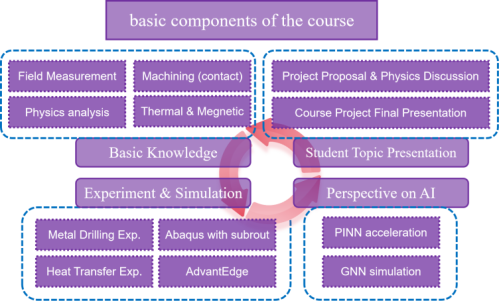
Figure 1. The main modules and components of the course.
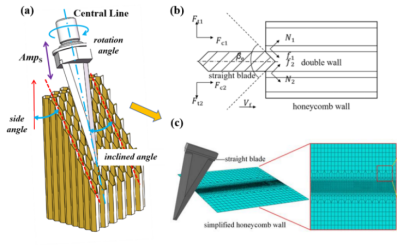
Figure 2. Simulation Outlines of Example 1: (a) working background of aramid paper honeycomb cutting; (b) calculation of feed rate and angle-related parameters; (c) simplified finite element model of analysis.
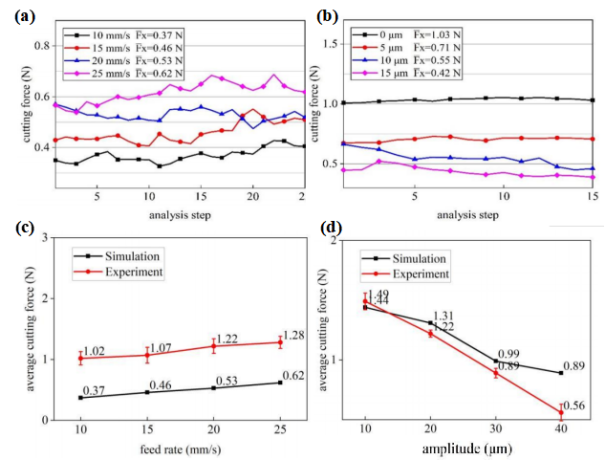
Figure 3. Related findings in exampled project 1: (a) and (b) gives the time-sequenced cutting load under different feed rate and vibration amplitude; (c) and (d) are the comparison of average force of feed direction between experiments and simulation.
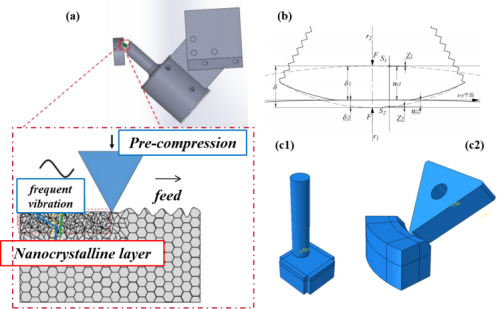
Figure 4. Simulation Outlines of Example 2: (a) working background of steel impact strengthening process; (b) analytical principle of Hertz contact theory; (c) simplified planar FE model (c1) and process-scale model (c2).
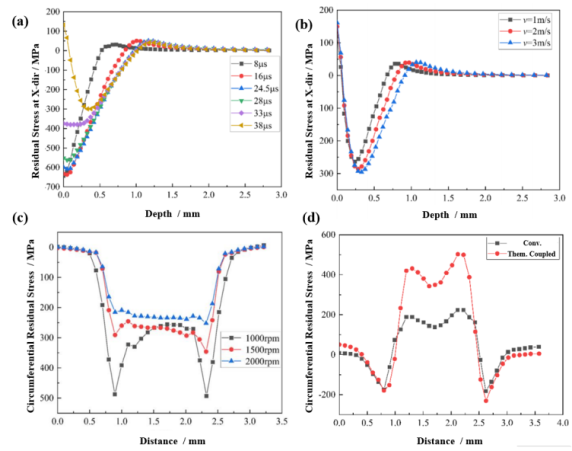
Figure 5. Related findings in exampled project 2: (a) shows the stress distribution in the depth direction during a impact and (b) shows the stress distribution under different impactor speed; (c) and (d) were representative results of process-scale stress distribution under different speed and with/without considering temperature effect in process.
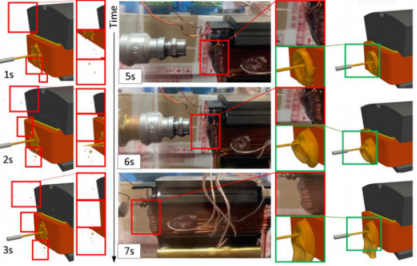
Figure 6. Cutting-edge GNN-based simulation used in classroom which is applied to simulate the convective cooling process in manufacturing engineering cases.

Information



 Share This Article
 Twitter
 Linked In
 Facebook
 Copy
Copy Download